Followers

Showing posts with label manuscript. Show all posts

Thursday, April 4, 2024

News: Stephen C. Carlson Discovers an Irrelevant (?) Unregistered Manuscript in Paris

Stephen C. Carlson, Associate Professor at

Australian Catholic University (ACU), recently visited Paris (the one in France, not Texas) and discovered at the National Library of France an unregistered folio containing text from the Gospel of Mark!  Specifically, it has text from Mark 10.  The text is difficult to read and it is even more difficult on the opposite side.  There is enough to deduce that it is Byzantine.

And that means, to quote Kurt Aland, whose influence upon the Nestle/Aland compilation was immense, that it must be ignored, along with the vast majority of Greek manuscripts.  Aland's statement can be found on page 142 of The Text of the New Testament which he co-authored with Barbara Aland:  "All of these minuscules exhibit a purely or predominantly Byzantine text.  And this is not a peculiarity of the minuscules, but a characteristic they share with a considerable number of uncials.  They are all irrelevant for textual criticism, at least for establishing the original form of the text and its development in the early centuries."

Not everyone subscribes to the Alands' estimate of the value of Byzantine manuscripts - I certainly do not.  To our colleague Dr. Carlson I say, congratulations!  May such serendipitous events continue to occur. 


Thursday, December 12, 2019

Christmas Combat: Luke 2:1-18 in Codex Bezae


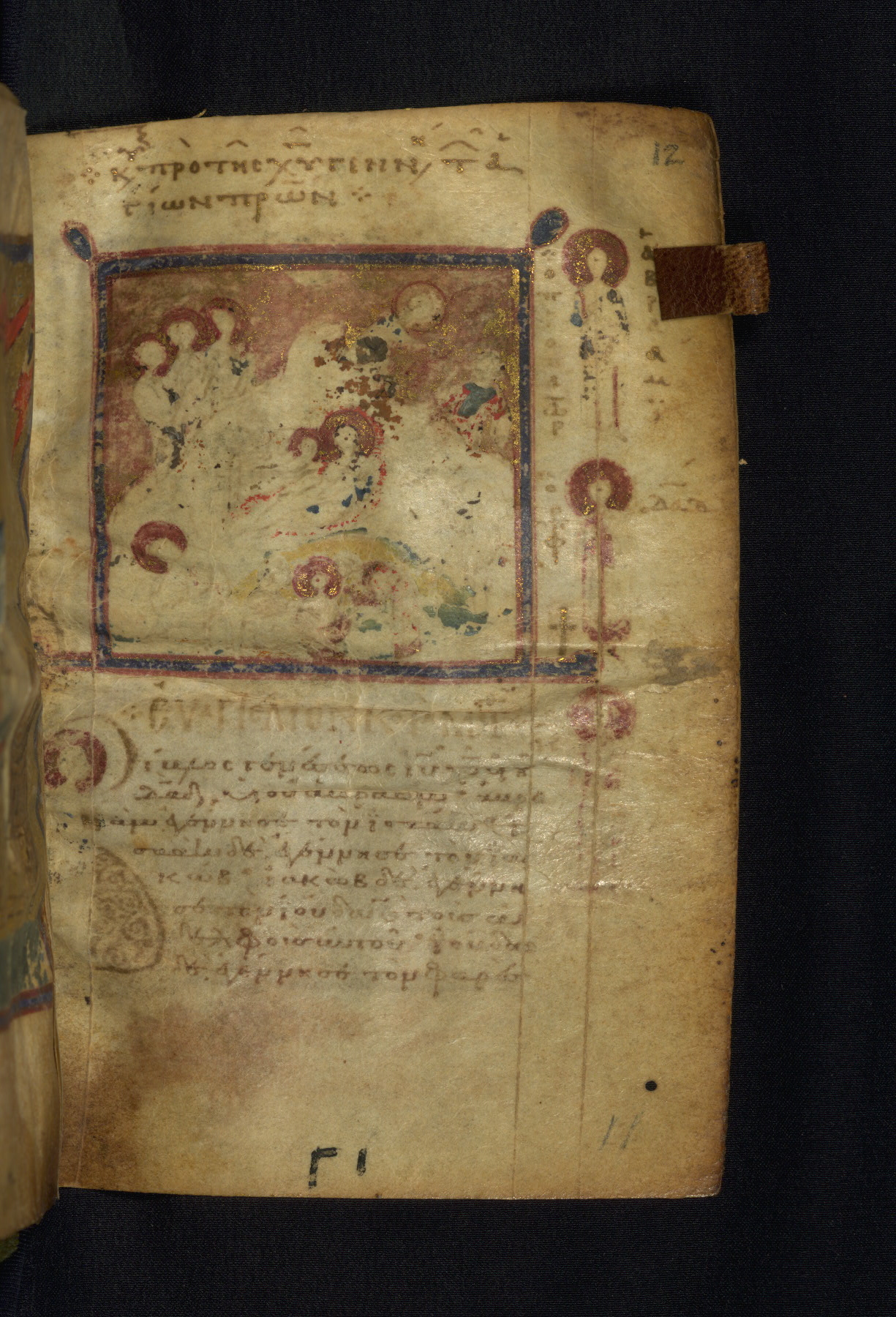
            It’s time for another round of hand-to-hand combat!  Since it’s almost Christmastime, our combatants will square off in Luke 2:1-18, a passage which contains the accounts of the birth of Christ and the angels’ visit to the shepherds who were keeping watch over their flocks.  The competitors in today’s contest are the famous Codex Bezae (D, 05) – which nowadays is usually assigned to the early 400s – and GA 2370, a remarkably small minuscule Gospels-manuscript from the late 1000s, one of several Greek New Testament manuscripts at the Walters Art Museum (the manuscript is also known as Walters 522). 
            Before proceeding, let’s consider a few details about 2370:
            ● 2370 is a nearly complete copy of the four Gospels; the last verse on its last (damaged) page is John 21:3.
            ● The story of the adulteress is included (7:53 begins on page-view 521, numbered as fol. 253 at the top and as 248 at the bottom).  However, the pages from 247a (numbered as 242 at the bottom) (beginning in John 6:32) to 261 are secondary; the main copyist’s work resumes on 262a (page-view 539) in Jn. 10:14.  A few of the secondary pages were inserted upside-down.
            ● Each Gospel is accompanied by a picture of the Evangelist, and an icon-like headpiece.  For Mark, the headpiece is a portrait of Christ (with hardly any pigment surviving); for Luke, the headpiece is an icon representing the birth of John the Baptist; Zachariah stands in the margin, and Luke is represented in the initial.  For John, the full-page portrait shows John dictating to Prochorus, and the headpiece is a portrait (fairly intact) of Christ.
            ● A detailed description of 2370 can be found in Georgi R. Parpulov’s Catalogue of Greek Manuscripts at the Walters Art Museum, which the author dedicated to the memory of his beloved grandfather, Konstantin Tzitzelkov.

            This contest may provide a convenient test of the idea that the oldest a manuscript is, the better its text tends to be.  If the assigned production-dates for these two manuscripts are correct, then the copyists in the transmission-line of GA 2370 had more than twice as much time as the copyists of in the transmission-line of Codex D to make additions, omissions, and other mistakes in the text.  Let’s compare their contents and see which text is more accurate, using as our standard of comparison the Tyndale House Greek New Testament.
            As in earlier rounds of Hand-to-Hand Combat, a few ground rules are in play.  A point is assigned to each manuscript for each non-original letter in its text, and a point is also assigned to each manuscript for each original letter that is absent from its text.  Transpositions are mentioned, but do not result in any points unless there is an actual loss of a letter or letters.  Nomina sacra (i.e., sacred-name contractions) and other contractions in and of themselves are not considered variants, unless the contraction is of a word that is not in the original text. Movable-nu differences are not noted in this comparison.

Luke 2:1-18 in GA 2370

1 – no variants
2 – has η after αυτη (+1)
3 – has ιδιαν instead of εαυτου (+5, -6)
4 – no variants
5 – has μεμνηστευμένη instead of εμνηστευμενη (+1)
5 – has αυτου instead of αυτω (+2, -1)
5 – has γυναικι before ουση (+7)
5 – has εγκύω instead of ενκύω (+1, -1)
6 – no variants
7 – has τη before φατνη (+2)
8 – no variants
9 – has ιδου before αγγελος (+4)
10 – no variants
11 – no variants
12 – does not have και before κείμενον (-3)
13 – no variants
14 – has ευδοκια instead of ευδοκιας (-1)
15 – has και οι ανθρωποι after αγγελοι (+13)
15 – has ειπον instead of ελάλουν (+5, -7)
16 – has ηλθον instead of ηλθαν (+1, -1)
17 – has διεγνώρισαν instead of εγνώρισαν (+2)
18 – no variants

            Thus, when we look over 2370’s text and compare it to the Tyndale House edition of the Greek New Testament, as if the Tyndale House edition is the original text, 2370’s text of Luke 2:1-18 contains 45 non-original letters, and is missing 20 original letters, for a total of 65 letters’ worth of scribal corruption.  
            Now let’s look at the same passage in Codex Bezae, which is estimated to be at least 500 years older than GA 2370.  In a couple of places, there is a correction in the manuscript; to keep things simple I removed these variants from consideration after making mention of them.

Luke 2:1-18 in Codex Bezae (D, 05)

1 – no variants
2 – transposes to εγενετο απογραφη πρωτη
3 – has πατριδα instead of πολιν (+6, -4)
4 – has Ναζαρεθ instead of Ναζαρετ (+1, -1)
4 – has Ιουδα instead of Ιουδαίαν (-3)
4 – has καλειτε instead of καλειται (+1, -2)
4 – transposes the last phrase of v. 4 and the first phrase of v. 5
5 – has απογράψεσθαι instead of απογράψασθαι (+1, -1)
6 – has ως instead of εγενετο before δε (+2, -7)
6 – has παρεγείνοντο instead of εν τω ειναι αυτους εκει after δε (+12, -19)
6 – has ετελέσθησαν instead of επλήσθησαν (+4, -3)
7 – no variants
8 – has δε after ποιμενες instead of και before ποιμενες (+2, -3)
8 – has χαρα ταυτη instead of χωρα τη αυτη (+1, -2) [correction in MS]
8 – has τας before φυλακας (+3)
9 – has ϊδου before αγγελος (+4)
9 – does not have κυρίου (ΚΥ) after δοξα (-6, or -2 if counted as contracted sacred name)
10 – has υμειν instead of υμιν (+1)
10 – has και before εσται (+3)
11 – has υμειν instead of υμιν (+1)
12 – has υμειν instead of υμιν (+1)
12 – has εστω after σημειον (+4)
12 – does not have και κείμενον (-11)
13 – has στρατειας instead of στρατιας (+1)  
13 – has αιτουντων instead of αινουντων (+1, -1) [correction in MS]
15 – no variants
15 – moves οι αγγελοι to follow απηλθον
15 – has και οι ανθρωποι before οι ποιμενες (+13)
15 – has ειπον instead of ελάλουν (+5, -7)
15 – has γεγονως instead of γεγονος (+1, -1) [correction in MS]
15 – has ημειν instead of ημιν (+1)
16 – has ηλθον instead of ηλθαν (+1, -1)
16 – has σπευδοντες instead of σπευσαντες (+2, -2)
16 – has ευρον instead of ανευρον (-2)
16 – does not have τε before Μαριαμ (-2)
16 – has Μαριαν instead of Μαριαμ (+1, -1)
17 – does not have τουτου (-6)
18 – has ακουοντες instead of ακουσαντες (+1, -2)
18 – has εθαυμαζον instead of εθαυμασαν (+2, -2)

            Thus, when we look over Codex D’s text of Luke 2:1-18, and compare it to the Tyndale House edition of the Greek New Testament, as if the Tyndale House edition is the original text, D’s text of this passage contains 76 non-original letters, and is missing 86 original letters, for a total of 162 letters’ worth of scribal corruption.  
            Can we make the score – only 65 letters’ worth of corruption in 2370’s transmission-line over 900 years, but 162 letters’ worth of corruption in Codex D’s transmission-line over 350 years! – a little closer by removing trivial spelling-related variants from consideration?  If we overlook the variant-units that involve  the spelling of Ναζαρετ in verse 4, καλειται in verse 4, εγκύω in verse 5, απογράψασθαι in verse 5, the corrected reading in verse 8, υμιν in verses 10, 11, and 12, στρατιας in verse 13, the corrected readings in verses 13 and 15, ημιν in verse 15, ηλθαν in verse 16, Μαριαμ in verse 16, and εθαυμασαν in verse 18, Codex D’s text of Luke 2:1-18 still contains 62 non-original letters, and is still missing 74 original letters, yielding a total of 136 letters’ worth of scribal corruptions.
            Thus we see that 2370, a medieval minuscule that is not mentioned in the textual apparatuses of the Nestle-Aland, UBS, or Tyndale House compilations (or any other textual apparatus that I know of), contains a text of Luke 2:1-18 that is, at minimum, twice as accurate as the text of Luke 2:1-18 in Codex Bezae.

            In addition, in at least four places in this passage, I suspect that the Tyndale House edition of the Greek New Testament contains a corruption. 
            ● First, the spelling of ενκύω (εγκύω in NA, in Tregelles, in Scholz, in Baljon, in Souter, in Holmes’ SBLGNT, and in Byz) in 2:5:  what justifies the adoption of this anomaly?
            ● Second, there is the contest involving the final word of Luke 2:14.  Regarding this I have offered an analysis previously, vindicating the reading ευδοκια which is the basis for the phrase (and carol-lyric) “Peace on earth, good will to men.” 
            ● Third, in verse 9, ἰδού is broadly attested by A D Κ Θ Byz 157 1424 OL Vulgate Pesh, and should be retained.  Contrary to Metzger’s proposal that it is difficult to imagine why copyists would have omitted “behold,” it is not hard at all to reckon that they felt over-beholden, in light of the recurrence of the same term in v. 10 (and in 1:20, 1:31, 1:36, 1:38, 1:44, 1:48, and in 2:25).  The word ἰδού is omitted in 2:25 by D and N; it is also omitted by D in 6:23, 7:12, and 8:41, 9:39 (where ℵ also omits), 10:25, 23:15, and 24:13.  The same phenomenon is on display at Lk. 17:21 and 19:19 in 157, and at 22:21 in f13, and at 23:29 in P75, D, and f13, and in 24:49 in P75 and D.  (Readers may also compare how the word “Behold” has disappeared from some English versions, even though ἰδού remains in their base-text.)        
            ● Fourth, in verse 15, it is easy to notice that the words καὶ οἱ ἄνθρωποι are vulnerable to accidental parableptic loss, situated between οἱ ἄγγελοι and οἱ ποιμένες, especially when ἄνθρωποι is written in contracted form (και οι ανθοι οι).  Tregelles included these words in his Greek New Testament, albeit in brackets.  Burgon’s brief comments on this passage (in Causes of Corruption, page 36) remain forceful. 

           Finally, especially in light of the approach of the Christmas season, a feature in 2370 draws our attention:  the headpiece for the Gospel of Matthew is a Nativity icon – or what is left of one.   Mary and the baby Jesus are depicted in the center of the picture; when the icon was pristine, the red paint around Mary represented her red bed-mattress. Joseph and other characters are also in the picture.  Above the picture is the heading for the lection assigned to the Sunday before Christmas (for the Holy Fathers).  In the outer margin next to the main picture are representations of Abraham and David.  This small manuscript was apparently used by some very devout readers, whose kisses gradually took away most of the pigment.      


Readers are invited to double-check the data in this post.  


Monday, November 4, 2019

A Surprise in Athens


            In 2015-2016, a team of researchers from the Center for the Study of New Testament Manuscripts visited the National Library of Greece and brought to light 21 manuscripts in the collection there in Athens.  One of them – Lectionary 2012 – has not gotten very much attention,  That is unfortunate, considering that of all the manuscripts that CSNTM’s research has brought to the attention of the Institute for New Testament Research, this is one of the oldest.
            This sheet of parchment, glued to the cover of another, later lectionary, is from an uncial Gospels-lectionary that was probably produced in the 900s.  The reverse side cannot presently be viewed, since it is glued down.  On the side that is viewable, portions of two pages (on a single parchment sheet) with text can be seen.  
            If we look at the manuscript and begin to read the third column (to the right of where the sheet was once vertically folded), we encounter text from Matthew 27:6, beginning with εξεστιν at the end of the first tattered line, followed by βαλειν αυτὰ on the next line.  The text of this column continues to the beginning of Matthew 27:9, where διὰ Ιερεμίου is the last line of the column. 
            Shifting our focus to the first column of the manuscript (first, that is, in its present glued-down state), we see text from Matthew 27:53, beginning with –λθον at the end of the tattered upper edge of the parchment.  The text continues to the end of Matthew 27:54, and then – in the same line on which Mt. 27:54 ends – the text switches immediately to the beginning of John 19:31 with οι ουν Ιουδαιοι, continuing to the words τω σαβββάτῳ which constitute the last line of the column.  At the top of the second column, the first extant line is Πιλάτον ινα.  The middle of John 19:31 occupied the non-extant portion of the column (the descender of the ρ in ηρώτησαν has survived).  The text continues to the first part of John 19:34; the last line is αλλ’ εις των στρα–.    
            Thus, in this single-sheet manuscript fragment, we have (1) Matthew’s account of the purchase of the Field of Blood, (2) Matthew’s account of the centurion’s confession, “Truly this was the Son of God,” and (3) John’s report that when the soldiers came to Jesus to break His legs, they found Him already dead.  
            Here is a complete transcript, column by column, along with a more or less line-by-line English translation.  Bracketed letters in the transcription are not visible in the photographs.  Red letters are variations from the text of the passage as found in the Robinson-Pierpont Byzantine Textform.  Red crosses are features of the manuscript.

Lectionary 2012, in English.
Matthew 27:6-9a:
            [ε]ξεστ[ιν]
  βαλ[ε]ιν αυτα ·
  εις τον κορβαν[αν]
  επει τιμη αί
  ματος εστιν +
συμβούλιον δ[ε]
  λαβόντες η[γό]
  ρασαν εξ αυτ[ων]
  τον αγρον του
  κεραμέως · εις τα
  φην τοις ξένοι[ς]
  διο εκλήθη · ο α
  γρος εκεινος · α
  γρος αιματος ·
  εως της σήμερ[ον]
  τοτε επληρώ
  θη τω ρηθεν
  δια Ϊερεμίου

Matthew 27:53b-54 + John 19:31a:

                    –ηλθον
  εις τὴν αγίαν πό
  λην καὶ ενεφα
  νησθησαν πολλοις +
Ο δε εκατόνταρ
  χος και οι μετ’ αυ
  του · τηρουντες
  τον Ιν · ϊδοντες 
  τον σεισμον και
  τα γενόμενα ·
  εφοβήθησαν σφό
  δρα + λέγοντες ·  
  αληθως Θυ Υς ην
  ουτος + οι ουν Ϊου
  δαιοι · ϊνα μὴ μεί
  νη επι του στρου ·
  τα σώματα εν
  τω σαββάτω ·

John 19:31c-34a:

  Πιλάτον ίνα
  κατεαγωσιν αυ
  των τὰ σκέλει
  και αρθωσιν +
  ηλθον ουν οι στρα
  τιωται + και του
  μεν πρώτου
  κατέαξαν τὰ
  σκέλει καὶ του
  αλλου του συσταυ
  ρωθέν τος αυ
  τω + επι δε τὸν
  Ιν ελθόντες ως
  ειδον αυτον η
  δη τεθνηκότα
  ου κατέαξαν αυ
  του τὰ σκέλη +
  αλλ’ εις των στρα

         
            The extant text of this fragment differs from the Robinson-Pierpont Byzantine Textform only in matters of spelling; for all practical purposes, the two are identical.  This leads me to suspect that the writers who are responsible for spreading the claim that “No two New Testament manuscripts have the same text” have not examined very many fragmentary lectionaries.
            It would be interesting to examine this fragment with Multi-Spectral Imaging at the National Library of Greece (where it is kept as Collection-item 2460 ) to see the text on the other side.  It is interesting to see how this lection combined text from Matthew and John; perhaps a closer analysis of this kind of Good Friday lectionary-cycle could explain why the Alexandrian Text (in some of what are often called the “oldest and best” manuscripts) has a reading that resembles John 19:34 after  Matthew 27:49. 


Readers are invited to double-check the data in this post.


Sunday, August 18, 2019

093: A Byzantine Fragment of Acts from the 500s in Egypt


            Today, let’s take a close look at part of 093 – a small fragment that contains text from Acts 24:22-26, and text from First Peter 2:22-3:7.  (I will focus here especially on the text from Acts.  093 is a palimpsest with an interesting history:  it was among the approximately 193,000 fragments that had been stored in the Genizah of the Ben Ezra Synagogue in Cairo over the course of centuries.  (The story of how researchers Charles Taylor and Solomon Schechter discovered this immense collection of materials and, in 1896-1897, arranged for its transportation to Cambridge University for continued study, can be found online.) 
            Charles Taylor published a transcription of the text from Acts in 093 in 1900, along with a short summary of the text from First Peter, and some other texts.  He also noted that the upper writing on the palimpsest consisted of Hebrew extracts from the Bereshith Rabbah (ch. 45, 47,and 98). The lower writing contains most of Acts 24:22-26 on one page in two columns of 24 lines each.  The text on the verso is mostly illegible but Taylor made out words from the tops of the two columns:  from Acts 24:26, οτι χρηματα / δοθησεται, and from Acts 24:27, ελαβεν διαδο / χον ο Φηλιξ  / Πορκιον Φη / στον.  (This manuscript is identified in the catalog of Joseph van Haelst as item 487; in the Taylor-Schechter Collection it is in Collection 12, 189 and 208.  For a while, 093 was identified with the siglum ﬥ.)
Green lines:  093 disagrees with Alex.
Red lines:  093 disagrees with Byz.
            The smattering of text on the verso does not allow much insight regarding the type of text of Acts that 093 contains, inasmuch as the Alexandrian Text and the Byzantine Text are in exact agreement in those parts of Acts 24:26 and 24:27.  When we turn to the much more extensive text on the recto, however, there can be no doubt:  093’s text of Acts is Byzantine:  except for its inclusion of the contracted sacred name Ιν after Χν in verse 24, and the reading λαβων instead of μεταλαβὼν in verse 25, the text from Acts in 093 agrees perfectly with the Robinson-Pierpont Byzantine Textform.  (The Textus Receptus differs from RP2005 in this passage in two places; the TR includes αυτου after γυναικι in 24:24, and reads δε between αμα and και in 24:26.)
            Meanwhile, 093 disagrees with the Nestle-Aland compilation at the following seven places:
● 1.  In verse 22, there is a word-order variant:  ανεβαλετο αυτους follows Φηλιξ, instead of the Alexandrian reading in which ανεβαλετο δε αυτους precedes ὁ Φηλιξ.
● 2.  In verse 22, after οδου, 093 reads ειπων, not ειπας.
● 3.  In verse 23, before τω, 093 reads τε. 
● 4.  In verse 23, after τηρεισθαι, 093 reads τον Παυλον instead of αυτον.
● 5.  In verse 23, before αυτω, 093 reads η προσέρχεσθαι.
● 6.  In verse 24, before γυναικι, 093 does not read ιδία. 
● 7.  In verse 25, after μέλλοντος, 093 reads εσεσθαι.

            Two points are illustrated by this evidence. 
            First, contrary to the much-repeated claim that the Textus Receptus is a late medieval compilation (as opposed to an essentially early form of the text with a relatively small stratum of late medieval readings), 093 confirms that the Byzantine Text of Acts – at least, Acts 24:22-26 – existed in the 500s, around a thousand years before Erasmus, Stephanus, and Beza made their compilations.
            Second, there is some reason to suspect that apparatuses in some widely used Greek New Testaments cannot be trusted to present evidence in an even-handed way in cases where Byzantine readings receive early support:  
                 Of the seven reading in Acts 24:22-26 that are supported by 093 and the majority of Greek manuscripts, the Nestle-Aland apparatus (in NA27) fails to record four of them (#2, 3, 4, and 6). 
                 In the United Bible Societies’ Greek New Testament (4th ed.) only one variant-unit is covered in the verses that are extant in 093:  the contest between Ιν Χν and just Χν in 24:24.  In this case the theoretical mechanics of the “expansion of piety” have been rejected in favor of strong early support (including support from 093) for the longer reading. 
                 ● In the apparatus of the Tyndale House edition of the Greek New Testament, only one textual contest in the passage that is extant in 093 is mentioned:  the contest in Acts 24:24 between the inclusion or non-inclusion of ιδια before γυναικι, and the inclusion or non-inclusion of αυτου after γυναικι.  The reading found in 093 is mentioned as a reading supported by C* L P 1424, but 093’s support is not mentioned.  The compilers of the Tyndale House edition of the Greek New Testament apparently never looked at 093.  (A list of consulted witnesses in an appendix of THEGNT does not mention 093, although over a dozen manuscripts younger than 093 are listed.)   
            Third – provisionally accepting the classification of the fragmentary text from First Peter 2:22-3:7 as Alexandrian – it was possible for a Byzantine text of Acts to appear in the same manuscript as an Alexandrian text of First Peter in Cairo, Egypt.  While it cannot be demonstrated that 093 was produced in Egypt, the presence of an Alexandrian text of First Peter in the manuscript favors this possibility, and the presence of 093 among the genizah’s fragments also indicates that the Byzantine Text of Acts in the 500s was used in a broad range of territory. 

            093 is not the only manuscript with texts from the New Testament that was discovered in the Cairo Genizah.   A few palimpsests were discovered to have material from the New Testament in their lower writing, in Palestinian Aramaic; these texts were studied, and published, by the scholarly sisters Agnes Smith Lewis and Margaret Dunlop Gibson, with assistance from J. R. Harris – including a palimpsest-fragment with Palestian Aramaic text from John 14:25-15:16.  The Syriac specialist G. H. Gwilliam published the contents of five palimpsest-fragments (assigned to the 700s) in 1893, containing text from chapters 4 and 5 of Numbers, and from Colossians 4:12-18, First Thessalonians 1:1-3 and 4:3-15, Second Timothy 1:10-2:7, and Titus 1:11-2:8.  Michael Sokoloff and Joseph Yahalom brought such investigations up to date in 1979, and expanded upon them, in a detailed essay in Revue d’Histoire des Textes, “Christian palimpsests from the Cairo Geniza.”  (Fragments of manuscripts of the Hexapla from the Cairo Genizah, by the way, can be viewed at the Greek Bible in Byzantine Judaism website.)

            A few other palimpsest-fragments in the Cairo Genizah contain some New Testament passages.  (One fragment contains Syriac text from Second Corinthians 3:2-15; another fragment contains Syriac text from chapters 3 and 4 of First Thessalonians.)  The lower writing on yet another fragment consists of the remains of an early (600s or 700s?) Greek uncial lectionary, now catalogued as lectionary 1276, a.k.a. Taylor-Schechter 16.93, containing excerpts from Matthew 10:2-15 and John 20:11-15.  We may take a closer look at lectionary 1276 in a future post.


Readers are invited to double-check the data in this post.


Friday, August 2, 2019

News: The Durham Gospels is Online!


            Nice try, Viking marauders, but we still have most of it!
            The Durham Gospels, an important Latin manuscript, has recently been digitized and made available online.  It is just one of the many manuscripts that can be viewed at the Durham Priory Library Recreated website, listed there as Durham Cathedral Library MS. A.II.17.
            The presentation-format at the website is better than practically any other manuscript-presentation on the internet; not only can the digital full-color page-views be magnified, so that viewers can zoom in on fine details, but by accessing a menu in the left upper corner of the page-views, viewers can rotate the page, adjust brightness, adjust contrast, adjust saturation, and more – even invert colors.  There is also an easy-to-navigate Rolodex-style bar of page-views below the main image, allowing viewers to sift through the entire manuscript.  It may be wished that this will become a new standard in online manuscript-presentation.  
            The Durham Gospels had already been produced (probably by monks at Lindisfarne monastery) well before the Vikings attacked there in 793.  It might have undergone some damage at the hands of the Vikings:  almost all of the Gospel of Matthew is missing.  The last two chapters of John are missing.  Several chapters of the Gospel of Luke are missing, too, and have been replaced with pages from another (very different) manuscript.  Presently, when one reads the Durham Gospels, the text of John appears first, which is highly unusual.  This was not how the manuscript was made; some unknown person re-ordered the pages.  Most of the text is neatly written in a semi-uncial insular script, very similar to the handwriting in the Echternach Gospels. 

Here is a basic index for the Durham Gospels:

2r – The Gospel of John begins, with a huge and elaborately embellished initial.
16r-16v contain the passage about the adulteress.
38v – The text of John ends in 19:32.
38r* – The text on this page is all somewhat damaged; its text begins in Matthew 25:35.
38v* – The text on this page begins in Matthew 25:45.
38r2 – The text on this page (as a note above the text near the upper left corner indicates) begins in Matthew 26:13 and continues through Matthew 26:23; the handwriting is different in the final line.
38v2 – The text on this page begins in Matthew 26:24.
38r3 – Centered on the page is the text of Matthew 28:17-20, within a frame enhanced by knotwork.  Although this is the last page of the Gospel of Matthew, it must have existed adjacent to 38v2 for some time, because the imprint of some of the lettering on 38v2 is visible on the page; the intervening pages from chapters 26, 27, and 28 were absent. 
38v3 has a full-page picture of Christ crucified, flanked by two angels.  A heading identifies Him as Jesus the King; the Greek letters alpha and omega appear to the left and right of His head, respectively.  A soldier is offering Him a sponge on the end of a reed (cf. Mark 15:36).  There are words on the outside of all four sides of the frame.  This may be the earliest English depiction of the crucifixion.
38r4 – Introduction to the Gospel of Mark.  The introduction begins with an elaborately decorated title.
394 – More introductory glosses, including a list of some non-Latin words (beginning with Abba)
40r – The text of Mark begins in 1:12.
(Many of the pages in the Gospel of Mark have been cut at the bottom of the page, almost as if someone was in very desperate need of blank parchment.)
66r features a pair of ornate embellished initials in the text of Mark 14:27.
69r features a particularly beautiful intial E, with knotwork, at the beginning of Mark 16:2.
69v has the text from Mark 16:3-14a (the last words are illis XI apparuit), but the final page of Mark is not extant.
70 apparently has been the victim of a thief; someone cut away the upper half of the page, probably to obtain a particularly beautiful sample of the copyist’s artistic penmanship.
70r begins the text of Luke 1:9.
71v, a well-executed M (with eagle-heads) begins the Magnificat, in Luke 1:46.
72v features some nice colorful artistry in the opening letters of Luke 2:1.
On fol, 75, half of the page has been cut out.
102v ends on the last line in Luke 22:2.
103r begins the supplemental manuscript, written in an entirely different script (uncial) and different ink, containing text from Luke 21:33ff., cola-and-commata style, in two narrow columns per page.
105r features, I think, an Anglo-Saxon note scrawled in the upper margin.  The name “Aldred” is in this note, and is repeated on the same page.  This may have been added by the individual known as Aldred the Scribe, who in the mid-900s inserted an Old English translation in between the Latin lines of the Lindisfarne Gospels.  This suggests, in turn, that the Durham Gospels were once housed in Chester-le-Street, the town where Aldred resided.
106v includes the text of Luke 22:43-44.
111v ends the last line of its text in Luke 23:44.

An ornamental initial
in the Durham Gospels.
            Many initials, especially those with colored interiors (yellow, green, purple) are surrounded by small red dots of lead, a feature shared by many initials and decorations in the Book of Kells.
            The Durham Gospels – at least, the main portion – was probably made at Lindisfarne, while either Eadberht or Eadfrith was bishop there (i.e., sometime in 688-721), and, probably, after undergoing severe damage when Vikings attacked Lindisfarne in 793, it was taken inland, and was (at least partly) repaired at Chester-le-Street by someone using part of a two-column Gospels-manuscript that had some affinity with copies made at Wearmouth-Jarrow
             Those seeking more detailed information about the Durham Gospels may wish to seek out The Durham Gospels:  Together with Fragments of a Gospel Book in Uncial (1980) by the team of Christopher Verey, Julian Brown, and Elisabeth Coatsworth, along with Roger Powell. 
             The individuals responsible for the digitalization of the manuscripts at the Durham Priory Library Recreated website are to be thanked and congratulated for bringing online such an excellent collection of resources.  Funding for the project has come from, among other places, The Foyle Foundation, the J. Paul Getty Jnr. Charitable Trust, the Zeno Karl Schindler Foundation, and various generous individuals.  Those responsible for producing the digital materials and formatting them for online use include Andrew Tremlett, David Cowling, Liz Waller, Stephen Taylor, Judy Burg, Richard Higgins, Richard Gameson, Geoff Watson, Liz Branigan, Olli Lyytinen, Frank Addison, Robin Brownlee-Sayers, Caroline Craggs, and Gizella Dewath.   There is a blog which explores various aspects of the digitalization project.


Tuesday, June 25, 2019

Hand-to-Hand Combat: Sinaiticus vs. Textus Receptus in Rev. 22


            It is often claimed that the text in older manuscripts is more accurate than the text in younger manuscripts.  At first glance, this makes sense:  fewer years implies fewer opportunities for copyists to corrupt the text.  But upon more careful consideration, it does not make sense, except as a general consideration:  what matters is not whether scribes had those opportunities for corruption, but whether they used them. 
            Confirmation that the text of an early manuscript can be more corrupt than the text in a later manuscript has already been provided here in the Hand-to-Hand Combat series of posts.  In each of those twelve posts, the text of an older manuscript was compared to the text of a younger manuscript, using the NA27 compilation as the standard of comparision. 

In Matthew 24:23-30, minuscule 2474’s text is more accurate than the text in Codex Sinaiticus.  Sinaiticus has 59 letters’ worth of corruption; 25 letters’ worth when itacisms and trivial variants are removed from consideration.  2474 has 14 letters’ worth of corruption; 5 letters’ worth when itacisms and trivial variants are removed from consideration.           

In Luke 2:1-12, Vaticanus’ text is more accurate than the text in minuscule 1295, but the text in 1295 is more accurate than the text in Sinaiticus.  When itacisms and trivial variants are set aside, B has 18 letters’ worth of corruption, 1295 has 28 letters’ worth of corruption, and À has 44 letters’ worth of corruption.  

In Colossians 3:1-11, the text of minuscule 6 is more accurate than the texts in Vaticanus and Sinaiticus.    The text of minuscule 2401 is more accurate than the text in B.  When itacisms and trivial variants are set aside, B has 25 letters’ worth of corruption; 2401 has 24; Sinaiticus has 31, and minuscule 6 has 15.

In First Corinthians 15:1-11, the text of minuscule 384 is more accurate than the text of Papyrus 46.  When itacisms and trivial variants are set aside, 384 has 9 letters’ worth of difference from the NA text, the text in P46 has 14 or 15 letters’ worth of corruption.   

In Luke 8:19-25, the text of Codex Alexandrinus is more accurate than the text of Papyrus 75.  When itacisms and trivial variants are set aside, P75’s text has 29 letters’ worth of corruption; Codex A’s text has 18 letters’ worth of corruption.

In Luke 8:19-25, the text of minuscule 1324 is far more accurate than the text of Codex Bezae.  When itacisms and trivial variants are set aside, Codex Bezae has 83 letters’ worth of corruption, while the text of 1324 has 39.   

In Jude, the text of minuscule 6 is more accurate than the text of Papyrus 72.  Minuscule 6 has 157 letters’ worth of corruption, but the text of Papyrus 72 has 399 letters’ worth of corruption.

In Acts 18:27-19:6, the text of minuscule 2401 is more accurate than the text of Papyrus 38.  2401 has 29 letters’ worth of corruption; Papyrus 38 has 152 letters’ worth of corruption.

In Mark 4:1-9, the text of minuscule 545 is more accurate than the text of Codex W.    The text in minuscule 545 has 88 letters’ worth of corruption, but Codex W’s text has 258 letters’ worth of corruption.

In John 15:1-9, the text of minuscule 2222 is more accurate than the text of Codex A.    Both of these manuscripts are very accurate in this passage, but when minor variants are taken into consideration 2222 has 11 letters’ worth of corruption, and Codex A has 30 letters’ worth of corruption.

In John 6:65-7:16, the text of minuscule 4 is more accurate than the text of Codex Sinaiticus.  Minuscule 4’s text has 106 letters’ worth of corruption, but the text in Sinaiticus has 122 letters’ worth of corruption.   

In First Peter 5, the text of minuscule 496 is more accurate than the text of Codex Vaticanus.  Minuscule 496 has 75 letters’ worth of corruption, but the text in Vaticanus has 110 letters’ worth of corruption.   

            Today, let’s add one more comparison to those twelve, by comparing the text of Revelation 22:10-21 in the oldest manuscript of this passage – Codex Sinaiticus – to the text of Revelation 22:10-21 in the Textus Receptus.   This particular part of the Textus Receptus is somewhat notorious, because when Erasmus produced the Textus Receptus, he had only one Greek manuscript of Revelation on hand, and it was missing the final six verses of the book.  With nothing to go on except his memory, a revised Vulgate text, and the notes of Lorenzo Valla, Erasmus resorted to retro-translating the text from Latin into Greek, so as to finish the compilation. 
            It ought to be a foregone conclusion, then, that Sinaiticus has a better text of Revelation 22:10-21 than the Textus Receptus has.  But just to make sure, here’s a comparison of both texts to the contents of Revelation 22:10-21 as printed in the Tyndale House edition of the Greek New Testament:

Codex Sinaiticus’ text of Revelation 22:10-21 differs from the text in THEGNT at the following points:

10 - ℵ reads τουτους after λογους (+7)
11 – no variation
12 - ℵ reads αποδοθηναι instead of αποδουναι (+2, -1)
13 – no variation
14 – ℵ reads ως δε η εξουσια before επι το ζυλον (+12)
15 – ℵ transposes so as to read, in the final phrase, ποιων και φιλων ψευδος.
16 – no variation
17 – ℵ reads π before the sacred-name contraction for πνευμα (+1)
17 - ℵ does not read η before νυμφη (-1)
18 – ℵ reads η at the beginning of the verse (+1)
18 – ℵ does not include επιθησει επ’ αυτον (-15)
19 – ℵ reads αν instead of εαν (-1)
19 – ℵ reads τουτων after λόγων (+6)
19 – ℵ reads προφητιας instead of προφητειας (-1)
19 – ℵ reads αφελι instead of αφελει after ταυτης (-1)
20 – ℵ reads λεγι instead of λεγει at the beginning of the verse (-1)
20 – ℵ reads ειναι after ταυτα (+5)
20 – ℵ does not have αμήν after ταχυ (-4)
21 – no variation

            This yields a total of 33 non-original letters present, and 25 original letters absent, for a total of 58 letters’ worth of corruption.
            When itacisms and similar inconsequential corruptions are set aside, the amount of non-trivial corruption in Sinaiticus in Rev. 22:10-21 consists of 32 non-original letters present, and 21 original letters absent, for a total of 53 letters’ worth of corruption.

Now let’s see how the Textus Receptus does (using Scrivener’s edition):

10 – TR reads οτι after τουτου (+3)
10 – TR does not have γαρ after καιρος (-3)
11 – TR reads ρυπων instead of ρυπαρος (+2, -4)
11 – TR reads δικαιωθητω instead of δικαιοσύνην ποιησάτω (+5, -14)
12 – TR reads και at the beginning of the verse (+3)
12 – TR does not have εστιν after εργον (-5)
12 – TR has εσται after αυτου (+5)
13 – TR has ειμι after εγω (+4)
13 – TR has the letter α rather than the word αλφα
13 – TR does not have η before αρχη (-1)
13 – TR transposes the final two phrases
14 – TR reads ποιουντες τας εντολας αυτου instead of πλυνοντες τας στολας αυτων (+9, -8)
15 – TR has δε after εξω (+2)
15 – TR has ο before φιλων (+1)
16 – TR has του after γενος (+3)
16 – TR has Δαβιδ instead of Δαυιδ (+1, -1)
16 – TR has και after λαμπρος (+3)
16 – TR has ορθρινος instead of πρωϊνος (+4, -3)
17 – TR has ελθε instead of ερχου after λεγουσιν (+3, -4)
17 – TR has ελθε instead of ερχου after ειπατω (+3, -4)
17 – TR has ελθε instead of ερχέσθω (+3, -6)
17 – TR has και before ο θελων (+3)
17 – TR has λαμβανετω instead of λαβέτω (+3)
17 = TR has το before υδωρ (+2)
18 – TR has συμμαρτυρουμαι γαρ instead of μαρτυρω εγω (+11, -4)
18 – TR does not have τω after παντι (-2)
18 – TR has επιτιθη instead of επιθη (+2)
18 – TR has προς ταυτα instead of επ’ αυτα (+5, -2)
18 – TR transposes so as to read ο θεος επ αυτον
18 – TR does not have τω before βιβλιω (-2)
19 – TR does not include τις (-3)
19 – TR reads αφαιρη instead of αφέλη (+3, -2)
19 – TR does not include του (-3) before βιβλίου (-3)
19 – TR reads βιβλου instead of βιβλίου (-1)
19 – TR reads αφαιρησει instead of αφελει (+5, -2)
19 – TR reads βιβλου instead of του ξυλου (+4, -6)
19 – TR reads και after αγιας (+3)
19 – TR does not have τω before βιβλιω (-2)
20 – TR reads ναι after αμην (+3)
21 – TR reads ημων after κυριου (+4)
21 – TR reads χριστου after ιησου (+7)
21 – TR reads παντων υμων instead of των αγίων (+10, -8)

            This yields a total of 110 non-original letters present, and 83 original letters absent, for a total of 193 letters’ worth of corruption in the Textus Receptus in Revelation 22:10-21.  Finally, Codex Sinaiticus wins a round of hand-to-hand combat, by the overwhelming score of 58 to 193!
            But Sinaiticus was not really going up against another manuscript in verses 16-21; its opponent was Erasmus’ Greek reconstruction.  What happens when we look at Rev. 22:10-21 in an intact medieval minuscule?  Perhaps we might do exactly that in a future round of hand-to-hand combat.


Readers are invited to double-check the data in the post.
The stewards of the Codex Sinaiticus website are also invited to fix their website.


Monday, February 18, 2019

Erasmus' Manuscript of Revelation


            Erasmus’ first edition of the printed Greek New Testament – it was released by the printer Johann Froben in 1516 – has several famous features.  One of them involves the way Erasmus treated the last six verses of Revelation.  Erasmus had only one Greek manuscript of Revelation when he compiled the text for his Novum Instrumentum (the official name of the first edition):  GA 2814, which had been loaned to Erasmus by Johann Reuchlin.  (For a long time, this manuscript was simply referred to as manuscript 1r.)
            Page-views of the entire manuscript can be now accessed at the website of the library of the University of Augsburg.  (You may need to reload the page once or twice to get to the page-views.)  
A page (31v) of the manuscript
of Revelation used by Erasmus,
now at the University of Augsburg.
            (Shown:  part of Andreas of Caesarea’s commentary, followed by Rev. 8:13, followed by some commentary and a heading (in red), followed by Rev. 9:1-5a.  (The text is accompanied in the margin by red > marks.)  Notice the textual variant in 8:13:  this manuscript reads αγγελου (“angel”) although the Byzantine text (and the Nestle-Aland compilation) reads αετου (“eagle”).  Oikoumenios (keep reading for more information about him) also used the reading “eagle” in his commentary on Revelation, stating, “The eagle in midheaven, looking sadly at the misfortunes of those on earth, you will understand is a kind of divine angel sympathizing with the plight of human beings.” (Cf. John N. Suggit’s translation.)   
            If you consult the final pages of the manuscript, you can see that at the foot of fol. 92v, most of the text of Rev. 22:16 appears, interrupted by, and followed by, Andreas’ commentary – and on the next extant page (93r), we find ourselves in the summary of the contents of Revelation with which Andreas ended his commentary.  On 93v, Andreas’ review of the contents of Revelation continues, and then on 94r, in entirely different handwriting (as if someone had noticed that the manuscript had been damaged, and made this replacement-page, although the entire loss was not detected), we find the last words of Andreas’ commentary.   There are a few more pages, but they are blank.  (It looks like 95v may have been prepared to hold a framed illustration which was never added.)    
           
            This fits the description that was supplied by Erasmus regarding the manuscript that he used as the main basis for his compilation of the text of Revelation.  Erasmus mentioned that he used a Greek manuscript which was deficient at the end:  in the course of correspondence with Edward Lee, Erasmus wrote: 
            In calce Apocalypsis in exemplari, quod tum nobis erat unicum, nam is liber apud Graecos rarus est inventu, deerat unus atque alter versus.  Eos nos addidimus secuti Latinos codices.  Et erant ejusmodi, ut ex his quae praecesserant possent reponi. 
            That is, in English:  “At the end of my exemplar of Revelation – of which I had only one, because Greek copies of this book are rare – a few lines were missing.  I added them, using Latin copies as the basis.  These lines were of the sort that could be reconstructed [in Greek] by consulting the preceding text.” 
            This accounts for the very unusual Greek text of Revelation 22:16b-21 in Erasmus’ compilation.  For these verses, Erasmus took in hand a copy of the Vulgate, and translated its Latin text of Revelation 22:16b-21 into Greek (beginning with ὁ ἀστήρ). 
            Erasmus’ reconstruction of this passage, however, does not match up with any Greek manuscripts at several points (at least, not with any Greek manuscripts made prior to his compilation).  Although the Textus Receptus went through several revisions in the 1500s, Erasmus’ retro-translation of Revelation 22:16b-21 survived the process; as a result, the Textus Receptus continues to perpetuate some Greek readings in this passage that originated with Erasmus.  Bruce Metzger (in a footnote on page 100 of The Text of the New Testament, third edition) wrote about some of them: 
            “For example ἀκαθάρτητος (Rev. xvii. 4; there is, however, no such word in the Greek language as ἀκαθάρτης, meaning ‘uncleanness’); ὀρθρινός (xxii. 16); ἐλθέ twice, ἐλθέτω (xxii. 17); συμμαρτυροῦμαι γάρ . . . ἐπιτιθῇ πρὸς ταῦτα (xxii. 18); ἀφαιρῇ βίβλου . . . ἀφαιρήσει (future for ἀφελεῖ!!), βίβλου (second occurrence) (xxii. 19); ὑμῶν (xxii. 21).”
            How significant are these variations?  Almost all of them are trivial.  If one takes in hand the KJV and the NASB, and compares the two, it appears that the most of the new readings invented by Erasmus made no difference in translation: 
            v. 18:  KJV:  “For” / NASB does not have “For.”
            v. 19:  KJV:  “the book of life” / NASB:  “the tree of life”
            v. 19:  KJV:  “and from the things which are written” / NASB:  “which are written.”  (That is, in the KJV, three things are referred to:  the book of life, the holy city, and the things written in this book.  Whereas in the NASB, two things are referred to:  the book of life and the holy city, which are written about in this book.)
            v. 20:  KJV:  Even so, come” / NASB:  does not have “Even so.”      
            v. 21:  KJV:  our Lord Jesus Christ” / NASB:  “the Lord Jesus.” 
            v. 21:  KJV:  you all” / NASB:  “all.”

            Only the difference between “tree of life” and “book of life” yields a significant change to the meaning of the text.  Metzger, in his Textual Commentary on the Greek New Testament (albeit not in all editions), proposed a theory to account for this:  “The corruption of “tree” into “book” had occurred earlier in the transmission of the Latin text when a scribe accidentally miscopied the correct word ligno (“tree”) as libro (“book”).” 
           If Metzger’s theory is true, the confusion between ligno and libro may have occurred much earlier – early enough to affect some early Latin texts and the Bohairic version.  All Greek manuscripts of Revelation, however – at least, all Greek manuscripts prior to Erasmus’ printed text – support the reading “tree of life.”
           
            Some more information about Erasmus’ manuscript of Revelation may be helpful.  For many years after Erasmus used it, its location was not publicly known, and there was some concern that it had been lost.  In 1861, however, it turned up, and the scholar who discovered it – Franz Delitsch – wrote a detailed essay (in German) describing its readings, and showing how tightly its contents match up with Erasmus’ compilation, leaving no doubt that it was indeed Codex Reuchlins, the manuscript used by Erasmus.  It was later given a new identification-number (GA 2814).  

           Accompanying the text of Revelation in 2814 is a commentary which was composed by archbishop Andreas of Caesarea in 611.  Contrary to a recent claim made by James White, this commentary is not written in Latin; it is Greek.  Prior to Andreas of Caesarea (this Caesarea is the same place as Kayseri in Turkey, not the Caesarea on the coast of Israel), a writer named Oikoumenios had also written a commentary on Revelation, in the late 500s.  The work of Oikoumenios was known to Andreas; he refers to it repeatedly.  There is not a lot of data about the setting in which Oikoumenios wrote, but one of his statements indicates the time when he wrote:  he stated specifically that more than 500 years had passed since John wrote the book of Revelation.  The time between the composition of Oikoumenios’ commentary, and the commentary by Andreas, cannot have been great. 
            Andreas’ commentary became something of a standard work. (Meanwhile the Latin commentary on Revelation by the fourth-century writer Tyconius similarly was widely used, despite Tyconius’ Donatist views.)  It was often copied with the text of Revelation itself, in a specialized format, which Metzger described in The Text of the New Testament:  “He divided the book into twenty-four λόγοι, or discourses, because of the twenty-four elders sitting on thrones about the throne of God (Rev. iv. 4).  He further reflected that the nature of each of the twenty-four elders was tripartite (σῶμα, ψυχή, and πνεῦμα), and therefore divided each λόγος into three κεφάλαια, making a total of seventy-two chapters for the entire book.”
            An English translation of Andreas’ commentary on Revelation, with an insightful introduction, was recently completed by Eugenia Constantinou.  It can be downloaded for free – although you might have to spend a few minutes tracking it down from a large collection of academic papers.  It is also available to purchase as a paper book.   The Greek text of Andreas’ commentary, extracted from Volume 106 of Migne’s Patrologia Graece series, is also online.                   


Post-script

            Some writers who tend to defend the Textus Receptus, such as Thomas Holland and Chris Thomas, have insisted that Erasmus did not reconstruct Revelation 22:16-21 from Latin, or at least that there is little evidence for such a reconstruction.  Jan Krans has issued a detailed and remarkably effective reply, and his general conclusions are confirmed beyond all doubt by the examination of the online page-views of 2814.