Followers

Showing posts with label Codex Bezae. Show all posts

Thursday, December 22, 2022

Glitches in Christ's Genealogy

          The genealogy of Jesus Christ, which appears in Matthew 1:1-17 and the genealogy of Jesus Christ which appears in Luke 3:23-38, may both be skipped by casual Bible-readers, but they are both interesting passages to both the textual critic and the Christian apologist.  Today, let’s look at some of the ways in which copyists treated – and mistreated – parts of these two portions of Scripture.

          Perhaps the most famous variations within the genealogy in Matthew appear at the end of verse 7 and in verse 10.  These were the first two variant-units to be commented upon by the late Bruce Metzger in his Textual Commentary on the Greek New Testament.  The Alexandrian text reads Ἀσάφ instead of the Byzantine Ἀσὰ in verse 7, and it reads Ἀμώς instead of Ἀμών in verse 10.    Neither Asaph the psalmist nor Amos the prophet was ever a king of Judah, so the presence of their names in the genealogy is surprising.  If the canon prefer the more difficult reading is applied, in both cases the Alexandrian reading will be adopted.  This was the course taken by Elijah Hixson in 2019, and it has been for over a century the usual decision.   (Hixson briefly described the main external evidence, so in the interest of brevity I will not review that here.)

          I argued in 2012, and again in 2016, however, in favor of Ἀσὰ and Ἀμών, proposing that lectio difficilior potior has been applied here too mechanically. As I showed in 2016, there was quite a bit of orthographic variety in the spelling of names by early Alexandrian copyists.  And I still propose that these erroneous readings originated as an attempt by an early copyist (one with “Western” proclivities) to “pad the resume” of Jesus, by including prophets in his genealogy. 

          Less famous, but no less interesting, is the treatment of Jesus’ genealogy in Luke in Codex Bezae (D, 05).  (Matthew 1 is not extant in D.)  The text in D omits Luke 3:24-31, and has instead the names of the ancestors listed in Matthew 1:6-16, in reverse order (Zadok’s name is not included), and there are other aberrations, including the names Ασαφ and Αμως) before resuming Luke’s list of Jesus’ ancestors in verse 31b.

          In Codex W (032), the genealogy in Luke is missing.  After Joseph’s name in Luke 3:23, the text of 032 simply jumps to chapter 4.  Perhaps this reflects a scribe’s awareness that the genealogies were absent in Tatian’s Diatessaron, or it could conceivably be a deletion by a recklessly bold scribe who did not want to transcribe anything that could be construed as a contradiction of the genealogy in Matthew 1.
         

          A small cluster of manuscripts (including M U Θ 1 1582 33, and over 150 minuscules) reflects a reading that was known to Epiphanius (in the late 300s):  somebody inserted, between Josiah and Jeconiah, a reference to Jehoiakim (Ἰωακείμ).  This is a harmonization to First Chronicles 3:15.  Some copyists, it appears, were not averse to attempting to correct their exemplars, even if it meant disrupting the total in one of Matthew’s groups of fourteen generations.  (Matthew probably intended foe this 14x structure to bring to his readers’ minds the memory of the numerical value of David’s name).

          Other glitch-readings occur in other manuscripts.  A notable error by the scribe of GA 109 was mentioned by Metzger (Text of the New Testament, p. 195):  the copyist mechanically copied the text of his exemplar, in which the individuals in the genealogy in Luke were formatted in two columns, as if they were one continuous piece, thus making a garbled mess of things.  A detailed analysis of how this occurred can be found near the entry of an entry at CSNTM’s “From the Library” blog from 2018.  
The beginning of the genealogy in Luke in GA 1273.

           The copyist of GA 1273 (the George Grey Gospels) also was discombobulated when formatting the genealogy in Luke.  Putting the names of Jesus’ ancestors in three columns, he mixed up the whole series of names, concluding with “of Adam, of Serug, of God.”  A little detective work (which Daniel Buck has done) can reveal the format of the genealogy in Luke in the exemplar used by the scribe of GA 1273.  It might be interesting to compare the format in 1273’s reconstructed exemplar with the three-names-per-line format in GA 2. 

The end of the genealogy in Luke in 1273.
          
Other treatments of Luke’s genealogy have been identified by Daniel Buck; he has noticed that glitchy treatments in Luke’s genealogy seem to arise especially in verse 33, and that GA 1305, 1424, 2563, 2658, 2661, 2756, and 2882 all have glitches of one kind or another.  GA 28 also has some unusual readings, such as the insertion of τοῦ Ἀρὰμ in verse 33.

          Quite a few scribes, when listing the names in Luke’s genealogy, gave each name a single line.  These include the copyist of Sinaiticus (À) and Codex Vaticanus (B, 03) – mostly.  In B, near the end of the last column on a page, the copyist wrote Ιωσηφ του Ηλει (“Joseph, of Heli”) on one line, as long as his normal lines, with a space between “Ιωσηφ” and “του Ηλει”, but on the next line (the last line on the page), του Ματθατ gets a line all its own, and on the next page, each ancestor’s name, preceded by του, gets its own line.

          One glitch that has received special attention is the omission of τοῦ Καϊναν (or τοῦ Καϊναμ) at the beginning of Luke 3:36 in P75vid and Codex Bezae (D, 05).  Kainan’s name is not in Genesis 10:24 in the Masoretic Text, or in the Samaritan Pentateuch.  It may be that due to its absence in Genesis in these witnesses, a scribe deliberately removed it from the Western text as it appears in D.  A question arises:  the texts of P75 (early Alexandrian) and D (Western) are so different from each other, how could they share this reading if it is not original?

          But do they?  In 2019, Henry B Smith Jr. and Kris J. Udd published a 46-page essay in the Detroit Baptist Seminary Journal, On the Authenticity of Kainan, Son of Arpachshad, in which this variant-unit was minutely examined.  A reconstruction of the relevant part of P75 (the MS is extremely fragmentary in this portion) was made by Smith and Udd in which “The inclusion of -Α TOΥ KAINAN at the beginning of line 5 would only increase its line length to 26 letters, fitting the context well.”  This reconstruction helps clear up some inaccurate records of P75’s text in Luke 3:36.  It also demonstrates that P75 never lacked Καϊναμ, though the question is open as to whether P75 read Καϊναμ or Καϊναν. 

          Thus the only manuscript that omits Kainan’s name in Luke 3:36 is Codex D.  Finding Kainan’s name absent in the early Alexandrian text and in a relatively early Western manuscript such as Codex D would have been remarkable.  But finding Kainan’s name omitted only in in the Western text of Luke attested by D is like finding a hamburger at McDonald’s; it is not remarkable at all, considering the other liberties that have been taken in Luke’s genealogy in D.

          While some readers might be taken aback by how some scribes messed up the genealogy of Jesus Christ, one should remember that the bulk of manuscripts in different transmission-streams maintain the original text of the genealogies very well.  A blizzard of scribal errors does not make the sun stop shining.


(Thanks to Kris Udd and Daniel Buck for their help obtaining some of the data in this post.)


Thursday, December 16, 2021

A New Book About the Text of Codex Bezae

Peter Lorenz

           You might think that there would be little more to say about the text of Codex Bezae after D. C. Parker’s 1992 Codex Bezae - An Early Christian Manuscript and Its Text.  But Peter Lorenz has a lot more to say in his new book, A History of Codex Bezae’s Text in the Gospel of MarkReaders of Dr. Lorenz’s blog will be aware that he has been studying Codex Bezae for some time.  His new book is based on the dissertation that he successfully defended in July of 2020.

          Lorenz calls into question the idea that Codex Bezae’s distinctive Greek text of the Gospels and Acts represents an ancient native Greek tradition that begat the Old Latin version(s).  Lorenz argues that the Greek text found in Codex Bezae should be assigned to the late 300s, immediately prior to the production of the manuscript, and represents the conformation of a Greek text to a Latin model (different from the Latin text preserved in the manuscript itself). 


Here are ten intriguing implications of Lorenz’s analysis, in his own words:

● (1) there are very few parallels between Bezae’s distinctive text and Justin Martyr or Marcion, certainly not enough to justify the view that they knew a text like Bezae’s,

● (2) Bezae’s parallels with Irenaeus appear to be secondary relative to this author’s text, 

● (3) Bezae’s nomina sacra reflect Latin practice in the choice and representation of sacred names,

● (4) Bezae’s Greek and Latin columns are independent of each other, i.e. in general, the Greek text has not been corrected to the Latin column and the Latin column is not a translation of the Greek text,

● (5) Bezae’s text does not seem to represent the source of the Latin version or, at least, this version does not require a text like Bezae’s to account for its distinctive readings,

● (6) much of Bezae’s text is quite close to the Greek “mainstream”, much more than is generally observed, it is certainly not a “paraphrase,”

● (7) Bezae’s text appears to contain erroneously copied corrections suggesting that its text derives from heavily corrected exemplar,

● (8) Bezae’s distinctive parallels with the Latin version apparently reflect instances of borrowing from the Latin version, i.e. like Jerome’s revision of the Old Latin version to Greek copies, only in reverse,

● (9) Bezae’s distinctive variations are not evenly distributed throughout its text but tend to concentrate in certain places,

● (10) Bezae’s producers seem not to have been native speakers of either Greek or Latin. 

          Incidentally, Lorenz’s research (already released in the Tyndale Bulletin and described at his blog in October 2021) does not bode well at all for the 2011 NIV’s adoption of οργισθεις in its base-text of Mark 1:41.  Bill Mounce, take note! 

           A History of Codex Bezae’s Text in the Gospel of Mark is available as a hardcover at Amazon for $150 – just in time for Christmas!


Saturday, March 28, 2020

Hand to Hand Combat: D versus 505 in Mark 5


            Today, let’s compare the accuracy of Codex Bezae (D, 05) to medieval minuscule 505 (Harley MS 5538 at the British Library, from the 1100s).  Bart Ehrman has heralded Codex Bezae as “one of our oldest manuscripts” and D. C. Parker has given it a production date around the year 400 (although previous researched gave it a production-date somewhat later).  If a production-date around 400 or 500 is accepted, it ought to have the more accurate text, compared to a manuscript made 500 years later, right?  Nope.  The Gospels-text in Codex Bezae is one of the most inaccurate transcriptions that can be found in any Greek manuscript. 
           The main reason for this is that Codex Bezae’s text is “Western.”  The Western text is a paraphrastic text that developed in the second century.  The individuals who made it were more concerned with conveying the meaning of the text than with preserving its original form – possibly because they were transmitting not only the Greek text of the Gospels, but also the Latin text of the Gospels.   It should be understood that “Western” does not mean that this form of the text originated in the West.  The use of the term “Western” is only meant to convey that it became more popular in the West (especially in the Old Latin Gospels) than elsewhere.
            Codex Bezae is a Greek-Latin manuscript – each page with Greek text is followed by approximately the same passage in Latin on the following page – and occasionally, the Western text has been paraphrased.  (Paraphrasing could be done not only by the scribe of this particular manuscript, but by scribes much earlier in the transmission of its text.)  For example, in Mark 7:19b, the Latin text in Codex Bezae says (after the spelling is tidied up), “Sed in uentrem, et in secessum exit, purgans omnes escas.”  This is not unusual; the Vulgate text edited by Wordsworth and White says the same thing.  But on the accompanying page of Codex Bezae with Greek text, where most manuscripts (including B A L Π K M) read ἀφεδρῶνα ἐκπορεύεται, Codex D’s text reads instead ὀχετὸν ἐξέρχεται (and 7:19 begins Mark 7:19 with οὐ γὰρ εἰσέρχεται).  That is, excrement doesn’t just go into a latrine; it goes into the sewer (an ὀχετὸν is a sewer-drain).
            One might speculate that the Western paraphraser lived in a city with sewers, rather than in the countryside with latrines (or that he made the paraphrase for people who did so); the thing to see is that the Western Text has been paraphrased.
            Now let’s see who made the more accurate text:  the early Western paraphraser, whose work is echoed in Codex Bezae, or Byzantine copyists who transmitted the text found in GA 505.  (And along the way, we might ask ourselves, “Does it look like the Byzantine Text had the Western text as a source?)  The arena for today’s comparison is Mark 5:25-34 – the account of Jesus healing the woman (known traditionally as Saint Veronica) who had been afflicted with a bloody hemorrhage for 12 years.
            The usual rules for hand-to-hand combat apply:  nomina sacra contractions are not counted as variants; transpositions are merely noted; additions, deletions, and substitutions are counted letter-by-letter, and the standard of comparison is the 27th edition of the Nestle-Aland Novum Testamentum Graece.  However, I will make an adjustment due to one especially questionable reading in the N-A compilation (near the end of the analysis).

Mark 5:25-34 in Codex Bezae

25 – D has τις after γυνη (+3)
25 – D transposes to ετη ιβ
26 – D had η instead of και at the beginning (+1, -3)
26 – D does not have παρ before εαυτης (-3)
26 – D reads ωφελιθεισα instead of ωφεληθεισα (+1, -1)
26 – D reads επι instead of εις (+2, -2)
26 – D does not have ελθουσα (-7)
27 – D reads πε instead of περι.  The missing letters have been supplied by a corrector.  (-2)
27 – D, in the course of a transposition, reads οπισθεν instead of οπιθεν (+1)
27 – D, in the course of a transposition, has και before ηψατο (+3).  A corrector has overdotted the word.  
27 – D transposes εν τω οχλω to the end of the verse
28 – D begins the verse with λεγουσα εν εαυτη instead of ελεγεν γὰρ (+14, -9)
28 – D transposes after οτι to καν του ιματίων εαυτου αψωμαι (see next two variants)
28 – D reads του instead of των (+2, -2)
28 – D reads εαυτου instead of αυτου (+1)
28 – D reads ειαται instead of ιαται (+1)
29 – D reads ευθέως instead of ευθυς (+2, -1)
30 – D transposes and adds και between επιγνους and ὁ Ιης (+3)
30 – D does not have εν εαυτω (-7)
30 – D does not have εξ αυτου (-7)
30 – D reads απ αυτου και before επιστραφεὶς (+10) 
30 – D reads ειπεν instead of ελεγεν (+4, -5)
30 – D transposes at the end of the verse to ηψατο των ιματίων μου
31 – D, in the course of a transposition, reads δε instead of και (+2, -3)
31 – D, in the course of a transposition, reads λεγουσιν instead of ελεγον (+8, -6)
31 – D reads συνθλειβοντά instead of συνθλιβοντά (+1)
32 – D reads ειδειν instead of ιδειν (+1)
33 – D reads φοβηθισα instead of φοβηθεισα (-1)
33 – D reads διο πεποιήκει λάθρα after τρέμουσα (+17)
34 – D reads Ιης after ὁ δε (+3) 
34 – D reads σθι instead of ισθι (or κα instead of και) (-1)

TOTAL:  In Codex Bezae’s text of Mark 5:25-34, there are 80 non-original letters present, and 60 original letters are missing, for a total of 140 letters’ worth of corruption.

Now let’s look at GA 505.


Mark 5:25-34 in GA 505

25 – 505 has τις after γυνη (+3)
25 – 505 transposes to ετη δώδεκα
26 – no variations
27 – no variations
28 – 505 has ελεγε instead of ελεγεν (-1)
28 – 505 does not include εαν after οτι (-3)
28 – 505 transposes after οτι to καν των ιματίων αυτου αψωμαι  
29 – 505 has ευθέως instead of ευθυς (+2, -1)
30 – 505 has ευθέως instead of ευθυς (+2, -1)
[30 – part of the page is obscured, but 505 probably does not have ὁ before Ις] (-1)
30 – 505 has ελεγε instead of ελεγεν (-1)
31 – no variations
32 – no variations
33 – 505 has επ before αυτη (+2)
34 – 505 has θύγατερ instead of θύγατηρ (+1, -1)
34 – 505 has σέσωκ- but the ending seems abnormally contracted.  I’m going to treat this as a fluke reading.  (-2)

TOTAL:  In Mark 5:25-34, GA 505 has 9 non-original letters, and is missing 11 original letters, for a total of 20 letters’ worth of corruption.

Using this passage as a sample of the accuracy of the Greek text in D, and the accuracy of the text in 505, there are 140 letters’ worth of corruption in D for every 20 letters’ worth of corruption in 505.  To put it another way:  using the Nestle-Aland compilation as our basis of comparison, Codex D’s text of Mark 5:25-34 contains seven times as much corruption as the text in GA 505.  If the Robinson-Pierpont Byzantine Textform were used as our basis of comparison, 505’s text would be essential congruent to it:  the only differences between the two texts in this passage involve movable ν, the obscured portion of the page in verse 30, and that word-ending in v. 34. 

Now let’s consider how the word “daughter” should be spelled in verse 34.  Codex D and Codex W agree with Codex B, reading θύγατηρ.  So does GA 474 (Scrivener’s “e,” Lambeth MS 1179).  However, most other manuscripts read θύγατερ, including ℵ A K L N Θ Π Δ 33 700 1424 1582.  This was the reading adopted in the past by Bengel, by Griesbach, by Scholz, and by Tischendorf (in 1872), and even after θύγατηρ was adopted in the Westcott-Hort 1881 compilation, θύγατερ was preferred by Baljon and Souter. 
            One might try to defend the reading θύγατηρ by proposing that a change to θύγατερ was introduced to bring Mark 5:34 into closer harmony with the parallel-account in Matthew 9:22.  However, when we look at Matthew 9:22, we see that two of the three uncial witnesses for θύγατηρ in Mark 5:34 (D and W) also have θύγατηρ in Matthew 9:22.  Furthermore, L N and Θ read θύγατερ in Mark 5:34 and read θύγατηρ in Matthew 9:22.  Another consideration is that it seems unlikely that a harmonizer would fine-tune spelling but not add Θάρσει from the Matthean parallel.  The lonely testimony of B for θύγατερ in Matthew and θύγατηρ in Mark, where θύγατηρ appears in the following verse, is not as strong, on a point of orthography, as the extremely broad support that θύγατερ enjoys in both passages.  The reading θύγατερ should be adopted in Mark 5:34 – as it already has been in the Tyndale House Greek New Testament.
            With this adjustment in the picture, the accuracy of the text of Mark 5:35-34 in 505 (assigned to the 1100s) is more than seven times better than the text in Codex Bezae (assigned to the 400s).
            Before we leave Mark’s account of the healing of Saint Veronica, there is a variant in Mark 5:27 worth examining.  In the Byzantine Text and in the Nestle-Aland compilation this verse is exactly the same, but after the word ηψατο, in a smattering of witnesses – M f1 33 579 1071 and the Ethiopic version – the words του κρασπέδου (the hem of) are included here.  In Matthew 9:20, after ηψατο, we encounter this full phrase, του κρασπέδου του ἱματίου αυτου (“the hem of His garment”).  In the next verse in f13, κρασπέδου has usurped ἱματίου.  Turning to the parallel-passage in Luke 8:44, we find the same phrase after ηψατο:  του κρασπέδου του ἱματίου αυτου. 
            The puzzle that this data presents is this:  if Matthew and Luke both depended on Mark, how is it that they both have του κρασπέδου and Mark does not?  If we reject the reading of f1 and its allies in Mark 5:27, then we have here a “Minor Agreement” – a passage where Matthew and Luke share a reading with each other but not with Mark. 
            Making things a bit more interesting, Codex D has του κρασπέδου in Matthew 9:20 but not in Luke 8:44 (in which case, the Minor Agreement goes poof in the Western Text.)  Furthermore, Codex D is allied in this respect with a few Old Latin copies:  Old Latin codices a (Codex Vercellensis, probably from the 370s, a.k.a. VL 3), ff2 (Codex Corbeiensis secundus, a.k.a. VL 8) and r1 (Codex  Usserianus primus, a.k.a. VL 14) also do not have these words in Luke 8:44.      
            Without exploring this puzzle further today, I note that this particular array of readings may pose some problems for researchers who want to preserve the Two-Source Hypothesis as a solution to the Synoptic Problem while maintaining the Alexandrian readings in all three Synoptic Gospels.


Readers are invited to double-check the data in this post.


Thursday, December 12, 2019

Christmas Combat: Luke 2:1-18 in Codex Bezae


            It’s time for another round of hand-to-hand combat!  Since it’s almost Christmastime, our combatants will square off in Luke 2:1-18, a passage which contains the accounts of the birth of Christ and the angels’ visit to the shepherds who were keeping watch over their flocks.  The competitors in today’s contest are the famous Codex Bezae (D, 05) – which nowadays is usually assigned to the early 400s – and GA 2370, a remarkably small minuscule Gospels-manuscript from the late 1000s, one of several Greek New Testament manuscripts at the Walters Art Museum (the manuscript is also known as Walters 522). 
            Before proceeding, let’s consider a few details about 2370:
            ● 2370 is a nearly complete copy of the four Gospels; the last verse on its last (damaged) page is John 21:3.
            ● The story of the adulteress is included (7:53 begins on page-view 521, numbered as fol. 253 at the top and as 248 at the bottom).  However, the pages from 247a (numbered as 242 at the bottom) (beginning in John 6:32) to 261 are secondary; the main copyist’s work resumes on 262a (page-view 539) in Jn. 10:14.  A few of the secondary pages were inserted upside-down.
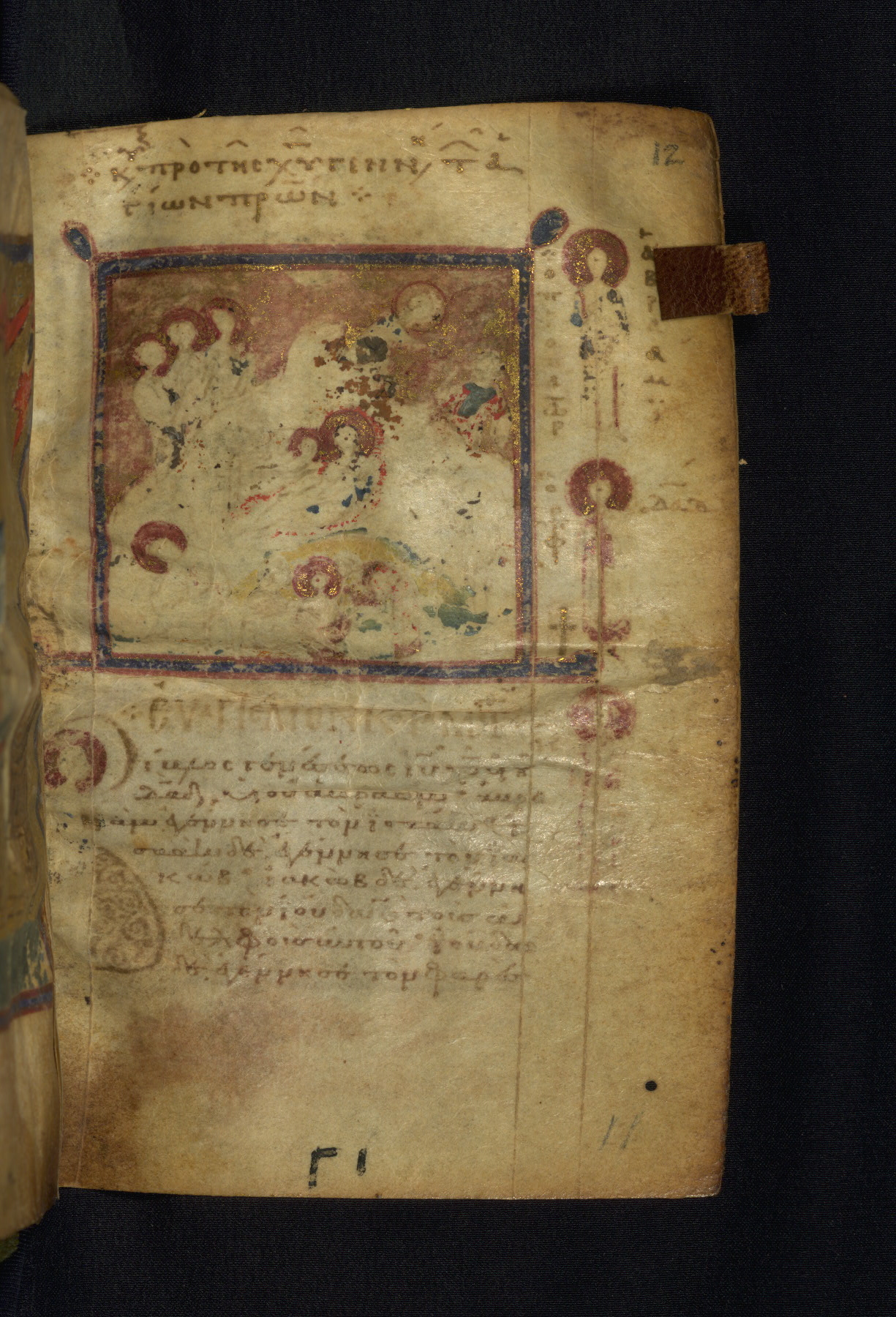
            ● Each Gospel is accompanied by a picture of the Evangelist, and an icon-like headpiece.  For Mark, the headpiece is a portrait of Christ (with hardly any pigment surviving); for Luke, the headpiece is an icon representing the birth of John the Baptist; Zachariah stands in the margin, and Luke is represented in the initial.  For John, the full-page portrait shows John dictating to Prochorus, and the headpiece is a portrait (fairly intact) of Christ.
            ● A detailed description of 2370 can be found in Georgi R. Parpulov’s Catalogue of Greek Manuscripts at the Walters Art Museum, which the author dedicated to the memory of his beloved grandfather, Konstantin Tzitzelkov.

            This contest may provide a convenient test of the idea that the oldest a manuscript is, the better its text tends to be.  If the assigned production-dates for these two manuscripts are correct, then the copyists in the transmission-line of GA 2370 had more than twice as much time as the copyists of in the transmission-line of Codex D to make additions, omissions, and other mistakes in the text.  Let’s compare their contents and see which text is more accurate, using as our standard of comparison the Tyndale House Greek New Testament.
            As in earlier rounds of Hand-to-Hand Combat, a few ground rules are in play.  A point is assigned to each manuscript for each non-original letter in its text, and a point is also assigned to each manuscript for each original letter that is absent from its text.  Transpositions are mentioned, but do not result in any points unless there is an actual loss of a letter or letters.  Nomina sacra (i.e., sacred-name contractions) and other contractions in and of themselves are not considered variants, unless the contraction is of a word that is not in the original text. Movable-nu differences are not noted in this comparison.

Luke 2:1-18 in GA 2370

1 – no variants
2 – has η after αυτη (+1)
3 – has ιδιαν instead of εαυτου (+5, -6)
4 – no variants
5 – has μεμνηστευμένη instead of εμνηστευμενη (+1)
5 – has αυτου instead of αυτω (+2, -1)
5 – has γυναικι before ουση (+7)
5 – has εγκύω instead of ενκύω (+1, -1)
6 – no variants
7 – has τη before φατνη (+2)
8 – no variants
9 – has ιδου before αγγελος (+4)
10 – no variants
11 – no variants
12 – does not have και before κείμενον (-3)
13 – no variants
14 – has ευδοκια instead of ευδοκιας (-1)
15 – has και οι ανθρωποι after αγγελοι (+13)
15 – has ειπον instead of ελάλουν (+5, -7)
16 – has ηλθον instead of ηλθαν (+1, -1)
17 – has διεγνώρισαν instead of εγνώρισαν (+2)
18 – no variants

            Thus, when we look over 2370’s text and compare it to the Tyndale House edition of the Greek New Testament, as if the Tyndale House edition is the original text, 2370’s text of Luke 2:1-18 contains 45 non-original letters, and is missing 20 original letters, for a total of 65 letters’ worth of scribal corruption.  
            Now let’s look at the same passage in Codex Bezae, which is estimated to be at least 500 years older than GA 2370.  In a couple of places, there is a correction in the manuscript; to keep things simple I removed these variants from consideration after making mention of them.

Luke 2:1-18 in Codex Bezae (D, 05)

1 – no variants
2 – transposes to εγενετο απογραφη πρωτη
3 – has πατριδα instead of πολιν (+6, -4)
4 – has Ναζαρεθ instead of Ναζαρετ (+1, -1)
4 – has Ιουδα instead of Ιουδαίαν (-3)
4 – has καλειτε instead of καλειται (+1, -2)
4 – transposes the last phrase of v. 4 and the first phrase of v. 5
5 – has απογράψεσθαι instead of απογράψασθαι (+1, -1)
6 – has ως instead of εγενετο before δε (+2, -7)
6 – has παρεγείνοντο instead of εν τω ειναι αυτους εκει after δε (+12, -19)
6 – has ετελέσθησαν instead of επλήσθησαν (+4, -3)
7 – no variants
8 – has δε after ποιμενες instead of και before ποιμενες (+2, -3)
8 – has χαρα ταυτη instead of χωρα τη αυτη (+1, -2) [correction in MS]
8 – has τας before φυλακας (+3)
9 – has ϊδου before αγγελος (+4)
9 – does not have κυρίου (ΚΥ) after δοξα (-6, or -2 if counted as contracted sacred name)
10 – has υμειν instead of υμιν (+1)
10 – has και before εσται (+3)
11 – has υμειν instead of υμιν (+1)
12 – has υμειν instead of υμιν (+1)
12 – has εστω after σημειον (+4)
12 – does not have και κείμενον (-11)
13 – has στρατειας instead of στρατιας (+1)  
13 – has αιτουντων instead of αινουντων (+1, -1) [correction in MS]
15 – no variants
15 – moves οι αγγελοι to follow απηλθον
15 – has και οι ανθρωποι before οι ποιμενες (+13)
15 – has ειπον instead of ελάλουν (+5, -7)
15 – has γεγονως instead of γεγονος (+1, -1) [correction in MS]
15 – has ημειν instead of ημιν (+1)
16 – has ηλθον instead of ηλθαν (+1, -1)
16 – has σπευδοντες instead of σπευσαντες (+2, -2)
16 – has ευρον instead of ανευρον (-2)
16 – does not have τε before Μαριαμ (-2)
16 – has Μαριαν instead of Μαριαμ (+1, -1)
17 – does not have τουτου (-6)
18 – has ακουοντες instead of ακουσαντες (+1, -2)
18 – has εθαυμαζον instead of εθαυμασαν (+2, -2)

            Thus, when we look over Codex D’s text of Luke 2:1-18, and compare it to the Tyndale House edition of the Greek New Testament, as if the Tyndale House edition is the original text, D’s text of this passage contains 76 non-original letters, and is missing 86 original letters, for a total of 162 letters’ worth of scribal corruption.  
            Can we make the score – only 65 letters’ worth of corruption in 2370’s transmission-line over 900 years, but 162 letters’ worth of corruption in Codex D’s transmission-line over 350 years! – a little closer by removing trivial spelling-related variants from consideration?  If we overlook the variant-units that involve  the spelling of Ναζαρετ in verse 4, καλειται in verse 4, εγκύω in verse 5, απογράψασθαι in verse 5, the corrected reading in verse 8, υμιν in verses 10, 11, and 12, στρατιας in verse 13, the corrected readings in verses 13 and 15, ημιν in verse 15, ηλθαν in verse 16, Μαριαμ in verse 16, and εθαυμασαν in verse 18, Codex D’s text of Luke 2:1-18 still contains 62 non-original letters, and is still missing 74 original letters, yielding a total of 136 letters’ worth of scribal corruptions.
            Thus we see that 2370, a medieval minuscule that is not mentioned in the textual apparatuses of the Nestle-Aland, UBS, or Tyndale House compilations (or any other textual apparatus that I know of), contains a text of Luke 2:1-18 that is, at minimum, twice as accurate as the text of Luke 2:1-18 in Codex Bezae.

            In addition, in at least four places in this passage, I suspect that the Tyndale House edition of the Greek New Testament contains a corruption. 
            ● First, the spelling of ενκύω (εγκύω in NA, in Tregelles, in Scholz, in Baljon, in Souter, in Holmes’ SBLGNT, and in Byz) in 2:5:  what justifies the adoption of this anomaly?
            ● Second, there is the contest involving the final word of Luke 2:14.  Regarding this I have offered an analysis previously, vindicating the reading ευδοκια which is the basis for the phrase (and carol-lyric) “Peace on earth, good will to men.” 
            ● Third, in verse 9, ἰδού is broadly attested by A D Κ Θ Byz 157 1424 OL Vulgate Pesh, and should be retained.  Contrary to Metzger’s proposal that it is difficult to imagine why copyists would have omitted “behold,” it is not hard at all to reckon that they felt over-beholden, in light of the recurrence of the same term in v. 10 (and in 1:20, 1:31, 1:36, 1:38, 1:44, 1:48, and in 2:25).  The word ἰδού is omitted in 2:25 by D and N; it is also omitted by D in 6:23, 7:12, and 8:41, 9:39 (where ℵ also omits), 10:25, 23:15, and 24:13.  The same phenomenon is on display at Lk. 17:21 and 19:19 in 157, and at 22:21 in f13, and at 23:29 in P75, D, and f13, and in 24:49 in P75 and D.  (Readers may also compare how the word “Behold” has disappeared from some English versions, even though ἰδού remains in their base-text.)        
            ● Fourth, in verse 15, it is easy to notice that the words καὶ οἱ ἄνθρωποι are vulnerable to accidental parableptic loss, situated between οἱ ἄγγελοι and οἱ ποιμένες, especially when ἄνθρωποι is written in contracted form (και οι ανθοι οι).  Tregelles included these words in his Greek New Testament, albeit in brackets.  Burgon’s brief comments on this passage (in Causes of Corruption, page 36) remain forceful. 

           Finally, especially in light of the approach of the Christmas season, a feature in 2370 draws our attention:  the headpiece for the Gospel of Matthew is a Nativity icon – or what is left of one.   Mary and the baby Jesus are depicted in the center of the picture; when the icon was pristine, the red paint around Mary represented her red bed-mattress. Joseph and other characters are also in the picture.  Above the picture is the heading for the lection assigned to the Sunday before Christmas (for the Holy Fathers).  In the outer margin next to the main picture are representations of Abraham and David.  This small manuscript was apparently used by some very devout readers, whose kisses gradually took away most of the pigment.      


Readers are invited to double-check the data in this post.  


Thursday, October 10, 2019

Book Review: To Cast the First Stone


            Last year, Princeton University Press released To Cast the First Stone, a book by Tommy Wasserman and Jennifer Knust about the story of the adulteress (John 7:53-8:11).  Tommy Wasserman (academic dean at Örebro Theological Seminary in Sweden, about 120 miles west of Stockholm) is perhaps best known to American scholars as the author of The Epistle of Jude:  Its Text and Transmission (2006), and as the General Editor of the online TC-Journal.  He is also involved in the International Greek New Testament Project.  Jennifer Knust is a professor of Religious Studies at Duke University, and is the author of Unprotected Texts.
            Back in 2014, Wasserman and Knust were among the participants in a symposium on the pericope adulterae (“section about the adulteress”) at Southeast Baptist Theological Seminary in Wake Forest, North Carolina – a symposium which concluded with an affirmation by all of the participants that the pericope adulterae should be proclaimed in churches.  Instead of a Perspectives-style volume in which all symposium-participants present their views, we have, five years later, To Cast the First Stone:  The Transmission of a Gospel Story.
            This is not the text-critically focused volume that some readers might expect.  Nowhere in its 344 pages (440 if the bibliography and indices are counted) is there a straightforward list of Greek manuscripts in which John 7:53-8:11 follows John 7:52, and of Greek manuscripts which have nothing at all between John 7:52 and John 8:11, and of Greek manuscripts which move all twelve verses to another location (after John 21, or after Luke 21:38, for example), and of Greek manuscripts which have only part of the passage (either John 7:53-8:2, or John 8:3-11).  Readers must reach the table on pages 280-281 to find a presentation of how the passage is treated in uncial manuscripts.  In a book which Bart Ehrman has predicted to be “definitive,” this is a major shortcoming, especially when one notices how much of the book dwells upon minutiae.  The description of patristic evidence presented by Wasserman and Knust is likewise insufficient. (Prosper of Aquitaine?  Faustus?  These names do not appear.)
            Readers are sure to learn much, however, about a wide variety of peripheral subjects.  For example, Marcion (an infamous heretic of the second century) is thoroughly rehabilitated; Wasserman and Knust declare that he was actually “a modest rather than a radical redactor” (p. 113).  Several pages (pp. 185-191) address the question of the provenance of Codex Vaticanus and Codex Sinaiticus – inconclusively.  Mark 16:9-20 comes up again and again, although Wasserman and Knust avoid going into much detail about the voluminous support this passage receives.  They affirm that the passage should be viewed as “unquestionably canonical” (p. 19). 
            Other subjects covered in the first half of the book include Julius Africanus’ rejection of the book of Susanna, singular omissions in early Greek manuscripts of John, the significance of asterisks and obeloi in Origen’s Hexapla, the story of Judith, the prayer of Sarah in the book of Tobit, an episode in the “Martyrdom of Peter,” the Roman story of the rape of Lucretia, the debauchery of Claudius’ wife Messalina, and even Cleopatra.  Readers may find the first half of the book rather padded.
            Things get better after the first 200 pages.  Chapter 6 begins with an account of fourth-century references to the pericope adulterae in Latin patristic writings.  Unfortunately, little care has been taken to differentiate between quotations and allusions and possible quotations and possible allusions.  A statement by Hilary of Poitiers is called an allusion although it may be a case of coincidental uses of the same common terms.  The authors describe the statement of the monk Gnositheos, including the phrase, “if anyone is without sin,” as “a brief allusion to the adulteress” (p. 203) although the similarity to John 8:7 may be entirely coincidental. 
            Wasserman and Knust go into detail about two pieces of evidence which will doubtlessly be of interest to many readers, for these important details have not been covered in popular materials such as Metzger’s Textual Commentary:  (1)  the Greek base-text of Ambrose’s quotations of the pericope adulterae, and (2) the support given to the pericope adulterae as part of the text of the Gospel of John following 7:52 and preceding 8:12, in the Old Latin capitula, or chapter-summaries.   
            Ambrose, the authors observe, “appears either to have translated directly from the Greek or to have consulted diverse Latin witnesses or, as is more likely, both options” (p. 220).   They point out that Ambrose’s term amodo, in his quotation of John 8:11, has no support in Latin manuscripts, and should be considered “a calque, that is, a new Latin word designed to match the Greek phrase ἀπὸ τοῦ νῦν (or ἀπ’ ἄρτι)”  (p. 222).
            The Latin capitulaa subject I have visited previously – were collected, compared, and published by Donatien De Bruyne in 1914.  Wasserman and Knust present De Bruyne’s data showing that the Latin capitula exist in multiple forms that in one way or another mention the account of the adulteress.  Two of these forms of the capitula are especially interesting:  “Form Cy” (“Cy” stands for Cyprian) was assigned by De Bruyne to the time of Cyprian or shortly thereafter, that is, to the mid-200s.  It has the phrase ub adulteram dimisit at the beginning of a chapter-summary, stating that after Jesus dismissed the adulteress, He testified that He is the light of the world, speaking at the treasury in the temple, etc.  Wasserman and Knust also point out that another form, “Form I,” uses the Greek loanword moechatione; this may confirm that the Old Latin text(s) of the pericope adulterae was translated from Greek.           
            Somewhat surprisingly – considering that Wasserman and Knust repeatedly affirm their belief that the pericope adulterae is not original – the authors grant that if De Bruyne is correct in his dating of the Old Latin capitula forms, and also correct in his view that ub adulteram dimisit is not an interpolation (and Wasserman and Knust present nothing to support any other view), then “the pericope adulterae was present in John in a Latin context by the third century” (p. 263).  This admission – basically conceding that the Old Latin capitula constitute plausible evidence that the story of the adulteress was in the Greek text of John from which Latin translations were made in the 100s (“by the third century”) – renders the earliest evidence for the inclusion of the passage practically contemporary with the earliest manuscript-evidence for its non-inclusion.  (I see no way to reconcile this with the authors’ statement on page 268 that “It seems likely that the Johannine pericope adulterae was interpolated in the early third century.”)
            Other evidence is also covered:  the treatment of John 7:53-8:11 in Codex Bezae and its marginalia, Jerome’s reference to the inclusion of the story of the adulteress in many manuscripts, both Greek and Latin, the assignment of a chapter-heading to the passage in some medieval manuscripts, the support for the pericope adulterae in most Old Latin manuscripts, and corrections of some misinformation that has been spread about the passage.   Regarding this last subject, some readers may be shocked by the mercifully brief critique the authors supply as they test the accuracy of a paragraph from Metzger’s Textual Commentary on page 251.  For those who have trusted D. A. Carson’s claim that “All the early church fathers omit this narrative,” or Steven Cole’s claim that no early versions include the story of the adulteress, the data provided by Wasserman and Knust should be illuminating, the way being struck with a cattle prod is illuminating.     
           
            Some readers may be exasperated by the amount of information in this book that does not pertain directly to the text of the story about the adulteress; it pertains instead to what may be called “ancient Christian book culture.”  The tour of ecclesiastical treatment of the New Testament text is far too scenic.  Yet this may be advantageous to readers who might appreciate being told things such as the following:
            Codex Bezae might have been copied from a third-century bilingual exemplar (p. 236).
            ● Eighteen papyri manuscripts from the 100s and 200s with text from the Gospel of John have been found, but only two of them (P66 and P75) contain John 7:52 and 8:12. (p. 67)
            ● “In the case of the Gospel of John, a circle of friends added a series of postresurrection appearances to the end of the Gospel.” (p. 91, footnote, referring to John 21.)
            This last data-nugget may serve as a sort of model for the authors’ solution to the question, “What should be done with the story about the adulteress, and why?”.   It would have seemed heavy-handed if they had said, “The passage is not original, but it should be retained because the Council of Trent said so,” or, “The passage is not original, but it should be retained because it has been declared “inspired, authentic, canonical Scripture” by the Orthodox Church.”  Instead, Wasserman and Knust affirm that the pericope adulterae is not original, but offer a more nuanced basis for an argument for its inclusion:  on balance, ancient Christian book culture affirmed the passage and proclaimed its message.  Can a convincing case be made that John did not write the pericope adulterae as part of the Gospel of John?  Yes, say Wasserman and Knust – but similarly they are convinced that John, anticipating his death, did not write the twenty-first chapter of the Gospel of John; the embrace of the supplemented text in ancient Christian book culture may be considered a better guide, when it comes to defining the canonical text, than strict matters of authorship.

            Some readers (myself included) may be disappointed that Wasserman and Knust did not spend more time engaging Maurice Robinson’s theory (presented at the 2014 symposium) that the pericope adulterae is an original segment of the Gospel of John which fell out of the text in an early influential transmission-stream.   Robinson proposed that in an early lection-cycle, the annual reading for Pentecost was John 7:37-52 with 8:12 attached (as it is in the Byzantine lectionary).  An early copyist, either deliberately adjusting the text to make the lector’s job easier, or accidentally misinterpreting marginalia that told the lector to skip ahead to 8:12, omitted 7:53-8:11.  Thus, the theory goes, the pericope adulterae was dropped from the text – not due to anyone’s desire to suppress it, but as a conformation of the form of the text used in a rudimentary lection-cycle. 
            Wasserman and Knust attempt to refute Robinson’s theory by citing the Typikon of the Great Church – a ninth-century liturgical book in which, among other things, Gospels-segments are arranged for each day of the year.  The authors grant that in this source, the Gospels-segment for Pentecost was indeed John 7:37-52 with 8:12 attached.  They also observe that in this Pentecost-lection, there are no instructions to skip from the main segment (John 7:37-52) to the closing segment (8:12), although such skip-from-here-to-there instructions appear for other lections which consist of more than one segment of text.  “This evidence,” Wasserman and Knust state on page 298, “suggests to us that the Johannine pericope adulterae was simply missing from copies available in Constantinople when the Pentecost lection was assigned,” and (p. 299) “It seems fairly certain that the pericope adulterae did not enter Byzantine copies of John until the close of the fourth century, or even later.” 
            Explanations for the Typikon’s non-use of skip-from-here-to-there instructions for the Pentecost lection can easily be imagined, but the thing to see is that the authors’ proposal that the pericope adulterae was not in the text at Constantinople when the Pentecost lection was assigned does not really touch Robinson’s model, in which the basic Byzantine lection-cycle echoes an earlier lection-cycle in which the loss of the pericope adulterae had already occurred.    
            Wasserman and Knust do not adequate address Robinson’s point that it is difficult to picture a Byzantine scribe deciding to insert the pericope adulterae within the lection for Pentecost, when simpler options existed, such as putting it at John 7:36 (so as to immediately precede the Pentecost lection).  They simply acknowledge, “This aspect of Robinson’s argument is convincing.”  So how do they explain the presence of the pericope adulterae within the Pentecost lection in over 1,400 manuscripts of John?  Similarly they offer no explanation for the first sentence of the pericope adulterae:   as Robinson asked in 2014, what kind of freestanding story begins with “Then everyone went home.”???
            A more satisfying explanation is given for the migration of the pericope adulterae to a place after Luke 21:38 in family-13 manuscripts (et al).  As Chris Keith has already shown, the insertion of the pericope adulterae to follow Luke 21:38 is an effect of treating the passage like a lection; the movement to this location made the lector’s job easier; the lector could thus find the lection for Oct. 8 (the Feast of Pelagia) near the lection for Oct. 7 (the Feast of Sergius and Bacchus).  Everything you have read or heard to the effect that the pericope adulterae is shown to be a “floating anecdote” by its appearance after Luke 21:38 in family-13 manuscripts can be safely ignored.

            A few shortcomings of To Cast the First Stone may be covered briefly:
            ● There is no variant-by-variant treatment of the text of the pericope adulterae.  An opportunity has thus been missed to show readers the differences in the forms in which the pericope adulterae appears in various sets of witnesses.  The interesting distinctive readings in the passage in the family-1 manuscripts are never given a spotlight.  In a book that gives two full pages to the Lothair Crystal, this was neglectful. 
            ● Asterisks were discussed briefly but the authors seem to have given up any attempt to analyze their use by scribes producing Gospel-manuscripts:  “The precise meaning of asteriskoi in Byzantine Gospel manuscripts remains opaque,” they acknowledge on page 128.  But what would have been a better occasion to shine a strong light upon copyists’ use of asterisks and other marks than when investigating the pericope adulterae?
            ● Only slight attention is given to the pericope adulterae in the Armenian version; no attention is given to the Georgian version.  No explanation is offered for the treatment of the pericope adulterae in a small group of Georgian copies in which the passage appears after John 7:44.  This is unfortunate, inasmuch as the Christian Standard Bible has a footnote which mentions this dislocation; CSB-readers are bound to think (incorrectly) that the footnote describes Greek manuscripts.             
            ● Wasserman and Knust treat Jerome’s affirmation (in Against the Pelagians 2:17) that the story of the adulteress is found in many copies, both Greek and Latin, with unwarranted skepticism:   “The existence of many copies of John “in both Greek and Latin” with the pericope adulterae,” they write on p. 236, “though presupposed by Jerome, cannot easily be confirmed.”  This is certainly true once one no longer considers a statement (not a presupposition but an assertion) from the supreme scholar of his age to be confirmation.  It seems bold – not in a good way – to look back 1,600 years, squint, and say that Jerome’s claim “may have been an exaggeration.” 
            ● Too little attention is given to Codex Macedonianus; unless readers consults a detail in the footnote on pages 280-281, below the two-page table, they could get a false impression from the table.  Codex Ebnerianus should have been featured, and more attention should have been given to the Palestinian Syriac lectionary’s dislocation of John 8:3-11 to the end of the Gospel.  Also, readers could have benefited from some acknowledgement that dozens of the manuscripts in which the pericope adulterae does not appear are copies of the same medieval commentary, and thus boil down to a single relatively late source.
            ● Codex Fuldensis is erroneously assigned to 569 on page 230; the correct date (546) is stated in a footnote on page 4.  Also, it is difficult to explain the description of Codex Fuldensis as “a fifth-century Latin Gospel harmony” on page 260.
            ● No detailed analysis of the lacuna in Codex Alexandrinus was provided; this would have been helpful.
            ● Annotations found in 039 and in minuscules 34, 135, 1187, 1282, and 1424 should have been included in the discussion of critical notes on pages 279ff.
            ● The description of GA 1333’s secondary inclusion of John 8:3-11 between Luke and John is insufficient.
            ● Didymus the Blind stated in his commentary on Ecclesiastes that there had been found, “in certain Gospels” – ἔν τισιν εὐαγγελίοις – an account in which Jesus says, “Whoever has not sinned, let him take up a stone and cast it” regarding a woman the Jews had accused of sin.  The authors’ case for their view that Didymus was referring to some extra-canonical composition as “Gospels,” rather than to copies containing Matthew, Mark, Luke, and John, is not solid at all. 
            ● No foundation is given for the recurring claim that Eusebius “omitted the passage” (see p. 11, p. 23, 176ff. 181, 284) when preparing his Canon-tables.  However reasonable it may be to assume that Eusebius preferred a form of John that did not have the passage, Section 86 looks the same in the Eusebian Canons with or without the pericope adulterae.  
            ● The index is somewhat spotty.

            In closing:  Wasserman and Knust have provided a fascinating and valuable portrait of the ancient Christian book culture in which John 7:53-8:11 was accepted as a canonical part of the Gospel of John.  Their proposal that a non-original reading – one which, they argue, was not part of the text of the Gospel of John until a century after John’s death – should be considered canonical because of that ecclesiastical acceptance invites some problems.  For instance, if widespread ecclesiastical acceptance can veto text-critical analysis, why not simplify the text-critical enterprise by accepting all readings upon which the Vulgate, the Peshitta, and the Byzantine Text agree?  Or, even more simply, if ecclesiastical acceptance is decisive, why not accept, as a matter of course, all readings in the Byzantine Text which are supported by over 85% of the extant manuscripts?  
             To Cast the First Stone contains a lot of helpful data; nevertheless, important aspects of the evidence have been overlooked.  This is far from what a definitive book about the story of the adulteress ought to be. 


To Cast the First Stone:  The Transmission of a Gospel Story is Copyright © 2019 by Princeton University Press. 


P.S. I have written a book, A Fresh Analysis of John 7:53-8:11, maintaining that the pericope adulterae was originally part of the Gospel of John.  It is available as an e-book on Amazon.