Followers

Showing posts with label Parpulov. Show all posts

Tuesday, January 14, 2020

The British Library 2020: Manuscript Index


            The British Library houses Codex Sinaiticus (most of it, at least) and Codex Alexandrinus.  As reported at the British Library’s website, 905 Greek manuscripts in the British Library’s large collection of Greek manuscripts have been digitized.  This includes not only Codices À (Sinaiticus) and A (Alexandrinus), and assorted works by secular authors, and by patristic writers, but also the following New Testament manuscripts – 115 continuous-text manuscripts, and 62 lectionaries.
            Each link should take you to a page where each manuscript is briefly described, and where access to page-views of each manuscript is provided.

GA 011 (Codex Seidelianus I, Gospels, 800s, damaged)
GA 027 (Codex Nitriensis, 500s, palimpsest)
GA 0121a (900s)
GA 0133, 0269, 0271, 0272, 0273, 0297, Lect 334 (Codex Blenheimius, 700s lower writing, palimpsest)

GA 44 (Gospels, 1100s)
GA 65 (Gospels, 1100s)
GA 72 (Gospels, 1100s, interesting marginalia)
GA 81 (Acts, 1044)

GA 104 (New Testament, 1087)
GA 109 (Gospels, 1300s/1400s)
GA 110 (New Testament, 1100s)
GA 113 (Gospels, 1100s, illustrated)
GA 114 (Gospels, 1000s or later.  quatrefoil Ad Carpianus)
GA 115 (Gospels, 1000s, heavily damaged)
GA 116 (Gospels, 1100s/1200s)
GA 117 and Lect 1357 (Gospels and Acts, early 1500s)

GA 201 (New Testament, 1357)
GA 202 (Gospels, 1100s)
GA 203 (New Testament except for Gospels, 1108)
GA 272 (Gospels, 1000s/1100s)

GA 308 (Acts and Epistles, 1300s)
GA 312 (Vol. 1) (Acts and Epistles, 1000s-1100s)
GA 312 (Vol. 2) (Epistles, 1000s-1100s)
GA 321 (Acts and Epistles, 1100s or later)
GA 322 (Acts and Epistles, 1500s)
GA 384 (Acts and Epistles, 1200s)
GA 385 (Acts, Epistles, Revelation, 1407)

            Golden Canon Tables (500s or 600s – in situ with 438)

GA 445 (Gospels, 1506)
GA 446 (Gospels, 1400s)
GA 447 (Gospels, 1500s)
GA 448 (Gospels, 1478)

GA 476 (Gospels, 1000s)
GA 478 (Gospels, 900s-1000s)
GA 480 (Gospels and part of Hebrews, 1366)
GA 481 (Gospels, 900s-1100s, Evangelists portraits) (Burney Gospels 19)
GA 482 (Gospels, 1285, Evangelists’ portraits)
GA 484 (Gospels, 1291, quatrefoil headpiece)
GA 485 (Gospels, 1100s, semi-quatrefoil Ad Carpianus)
GA 490 (Gospels, 1000s, quatrefoil Ad Carpianus and quatrefoil headpiece)
GA 491 (New Testament except Revelation, 1000s)
GA 492 (Gospels, 1325)
GA 493 (Gospels, 1400s)
GA 494 (Gospels, 1300s)
GA 495 (Gospels, 1100s, Evangelists’ portraits)
GA 496 (New Testament except Revelation, 1200s)
GA 497 (Gospels, 1000s)
GA 498 (New Testament, missing some pages, 1300s)
GA 499 (Gospels, 1100s)

GA 500 (Gospels, 1200s)
GA 501 (Gospels, 1200s, some later supplements)
GA 502 (Gospels, 1200s)
GA 503 (John, 1200s)
GA 504 (Gospels, 1033)
GA 505 (Gospels, 1100s, quatrefoil headpiece)
GA 547 (New Testament except Revelation, 1000s)
GA 548 (Gospels, 1100s)
GA 549 (Gospels, 1000s, commentary)
GA 550 (Gospels, 1100s)
GA 551 (Gospels, 1100s-1400s)
GA 552 (Gospels, 1100s)
GA 553 (Gospels, 1200s)

GA 640 (James, fragment, 1000s-1100s, commentary)
GA 641 (Acts and Epistles, 1000s, commentary)
GA 643 (Vol. 1) (Pauline Epistles, 1300s, Chrysostom commentary)
GA 643 (Vol. 2) (Pauline Epistles w/Chrysostom comm., and General Epistles, 1300s)
GA 644 (Pauline Epistles, incomplete, 1300s)
GA 645 (Gospels, 1304)
GA 686 (Gospels, 1337)
GA 687 (fragments of Matthew, 1000s)
GA 688 (Gospels, 1179)
GA 689 (Gospels, 1200s)
GA 690 (Gospels, 1200s-1300s)
GA 691 (Gospels, 1200s-1300s)
GA 692 (Gospels, 1200s-1300s, quatrefoil headpiece)
GA 693 (Gospels, 1200s-1300s)
GA 694 (Gospels, 1400s)
GA 695 (Gospels, 1200s)
GA 696 (Gospels, 1300s)
GA 697 (Gospels, 1200s) (decorated, fox & snake initial)
GA 698 (Matthew, Mark, Luke, 1300s)
GA 699 / GA 699 (Guest-Coutts NT) (Gospels, Acts, Epistles, 900s)

GA 700 (Gospels, 1000s) (Hoskier’s Codex)
GA 714 (Gospels, 1100s-1200s)
GA 715 (Gospels, 1200s, quatrefoil headpiece)
GA 716 (Gospels, 1300s, quatrefoil headpiece)
GA 892 (Gospels, 800s with later supplements)

GA 910 (Acts and Epistles, 1009)
GA 911 (Acts and Epistles, 1000s)
GA 911(2040) (Revelation, 1000s)
GA 912 (Acts and Epistles, 1200s)
GA 913 (Acts and Epistles, 1300s)

GA 1268 (Gospels, 1200s, commentary)
GA 1274 (Vol. 1) (Palimpsest – parts of Matthew and Mark, 1100s/1400s)
GA 1274 (Vol. 2) – Luke, Matthew, Mark) and GA 2823  and GA 2822 (Palimpsest – part of James and Jude, 1100s/1400s)
GA 1279 (Gospels, 1100s-1200s)
GA 1280 (Gospels, 1100s-1400s)

GA 1765 (Acts and Epistles, 1300s)

GA 1911 (Romans-Jude, 1500s.  This is Harley MS 5552, likely a transcript of Erasmus’ first edition)
GA 1956 (Pauline Epistles, 1200s, catena)

GA 2041 (Revelation, 1300s)
GA 2099 (Gospels, 1200s)

GA 2277 (Gospels, 1000s-1300s)
GA 2278 (Gospels, 1314)
GA 2279 (Acts and Epistles, 1300s)
GA 2280 (Gospels, 1100s)
GA 2290 (Gospels, 900s with supplements from 1600s)
GA 2291 (Vol. 1) (Matthew and Mark, 1200s)
GA 2291 (Vol. 2) (Luke and John, 1200s)

GA 2484 (Acts and Epistles, 1312)

LECTIONARIES

Lect 25a and 25b (partly palimpsest)

Lect 150 (995, uncial)
Lect 151 (1100s, quatrefoil headpiece)
Lect 152 (800s-900s, uncial)
Lect 169 (1200s, Acts and Epistles)
Lect 183 (nice uncial lectionary)
Lect 184 (late 900s)
Lect 187 (1100s-1200s)
Lect 189 (1100s)
Lect 190 (1000s, fragment)
Lect 191 (1100s)
Lect 192 (1200s)
Lect 193 (1334)

Lect 233 (1100s, cruciform text)
Lect 237 & Lect 2310 (1100s and 1600s)
Lect 238 (1000s-1100s)
Lect 257 (1306, Acts and Epistles)

Lect 318 (1000s)
Lect 319 (1100s-1200s, quatrefoil headpiece)
Lect 320 (1300s, damaged)
Lect 321 (1100s-1200s)
Lect 322 (1000s)
Lect 323 (1100s-1200s)
Lect 324 (1200s)
Lect 325 (1200s)
Lect 326 (1100s)
Lect 327 (1300s)
Lect 328 (1300s)
Lect 329 (900s-1000s)

Lect 330 & 331 (1272)   
Lect 332 (1300s)
Lect 333 1200s)
Lect 335 (1100s)
Lect 336 (1100s-1300s)
Lect 337 (1200s)
Lect 338 (900s lower writing, palimpsest)
Lect 339 (1100s)
Lect 340 (1200s) 
Lect 344 (1100s-1300s)
Lect 346 (1100s-1300s)

Lect 927 (1200s-1300s)
Lect 930 (1200s)
Lect 932 (1200s)
Lect 939 (1100s)
Lect 940 (1200s)
Lect 941 (1100s)

Lect 1053 (1000s-1100s, fragment)
Lect 1234 (1300s)
Lect 1317 (800s and 1400s, palimpsest)

Lect 1490 (1100s)
Lect 1491 (1008)
Lect 1492 (late 1000s)
Lect 1493 (1000s)
Lect 1494 (1100s-1200s)
Lect 1495 (1200s)
Lect 1496 (1413)

Lect 1742 (late 1300s)
Lect 1743 (1256)

Lect 2376 (1000s, quatrefoil headpiece)

Also of interest:
Collation of GA 71 (Codex Ephesinus), made in 1679
Add. MS 34186 – Wax Tablets  (Probably similar to what Zachariah used in Luke 1:63)

In addition, the British Library’s website offers several essays on subjects relevant in one way or another to the field of New Testament textual criticism, including the following:

Scribes and Scholars in Byzantium (Georgi Parpulov)
Manuscripts of the Christian Bible (Scot McKendrick)
Ancient Books (Cillian O’Hogan)
Ancient Libraries (Matthew Nicholls)
Book Illumination in Antiquity (Cillian O’Hogan) (featuring Codex N)
Biblical Illumination (Kathleen Doyle)
Byzantine Bookbindings (Ann Tomalak)
Byzantine Book Epigrams (Julie Boeten and Sien De Groot)
Illuminated Gospel-books (Kathleen Maxwell)
The Earliest Greek Bibles (David C. Parker) (featuring Papyrus 5)


Readers are invited to double-check the data in this post.


Thursday, December 12, 2019

Christmas Combat: Luke 2:1-18 in Codex Bezae


            It’s time for another round of hand-to-hand combat!  Since it’s almost Christmastime, our combatants will square off in Luke 2:1-18, a passage which contains the accounts of the birth of Christ and the angels’ visit to the shepherds who were keeping watch over their flocks.  The competitors in today’s contest are the famous Codex Bezae (D, 05) – which nowadays is usually assigned to the early 400s – and GA 2370, a remarkably small minuscule Gospels-manuscript from the late 1000s, one of several Greek New Testament manuscripts at the Walters Art Museum (the manuscript is also known as Walters 522). 
            Before proceeding, let’s consider a few details about 2370:
            ● 2370 is a nearly complete copy of the four Gospels; the last verse on its last (damaged) page is John 21:3.
            ● The story of the adulteress is included (7:53 begins on page-view 521, numbered as fol. 253 at the top and as 248 at the bottom).  However, the pages from 247a (numbered as 242 at the bottom) (beginning in John 6:32) to 261 are secondary; the main copyist’s work resumes on 262a (page-view 539) in Jn. 10:14.  A few of the secondary pages were inserted upside-down.
            ● Each Gospel is accompanied by a picture of the Evangelist, and an icon-like headpiece.  For Mark, the headpiece is a portrait of Christ (with hardly any pigment surviving); for Luke, the headpiece is an icon representing the birth of John the Baptist; Zachariah stands in the margin, and Luke is represented in the initial.  For John, the full-page portrait shows John dictating to Prochorus, and the headpiece is a portrait (fairly intact) of Christ.
            ● A detailed description of 2370 can be found in Georgi R. Parpulov’s Catalogue of Greek Manuscripts at the Walters Art Museum, which the author dedicated to the memory of his beloved grandfather, Konstantin Tzitzelkov.

            This contest may provide a convenient test of the idea that the oldest a manuscript is, the better its text tends to be.  If the assigned production-dates for these two manuscripts are correct, then the copyists in the transmission-line of GA 2370 had more than twice as much time as the copyists of in the transmission-line of Codex D to make additions, omissions, and other mistakes in the text.  Let’s compare their contents and see which text is more accurate, using as our standard of comparison the Tyndale House Greek New Testament.
            As in earlier rounds of Hand-to-Hand Combat, a few ground rules are in play.  A point is assigned to each manuscript for each non-original letter in its text, and a point is also assigned to each manuscript for each original letter that is absent from its text.  Transpositions are mentioned, but do not result in any points unless there is an actual loss of a letter or letters.  Nomina sacra (i.e., sacred-name contractions) and other contractions in and of themselves are not considered variants, unless the contraction is of a word that is not in the original text. Movable-nu differences are not noted in this comparison.

Luke 2:1-18 in GA 2370

1 – no variants
2 – has η after αυτη (+1)
3 – has ιδιαν instead of εαυτου (+5, -6)
4 – no variants
5 – has μεμνηστευμένη instead of εμνηστευμενη (+1)
5 – has αυτου instead of αυτω (+2, -1)
5 – has γυναικι before ουση (+7)
5 – has εγκύω instead of ενκύω (+1, -1)
6 – no variants
7 – has τη before φατνη (+2)
8 – no variants
9 – has ιδου before αγγελος (+4)
10 – no variants
11 – no variants
12 – does not have και before κείμενον (-3)
13 – no variants
14 – has ευδοκια instead of ευδοκιας (-1)
15 – has και οι ανθρωποι after αγγελοι (+13)
15 – has ειπον instead of ελάλουν (+5, -7)
16 – has ηλθον instead of ηλθαν (+1, -1)
17 – has διεγνώρισαν instead of εγνώρισαν (+2)
18 – no variants

            Thus, when we look over 2370’s text and compare it to the Tyndale House edition of the Greek New Testament, as if the Tyndale House edition is the original text, 2370’s text of Luke 2:1-18 contains 45 non-original letters, and is missing 20 original letters, for a total of 65 letters’ worth of scribal corruption.  
            Now let’s look at the same passage in Codex Bezae, which is estimated to be at least 500 years older than GA 2370.  In a couple of places, there is a correction in the manuscript; to keep things simple I removed these variants from consideration after making mention of them.

Luke 2:1-18 in Codex Bezae (D, 05)

1 – no variants
2 – transposes to εγενετο απογραφη πρωτη
3 – has πατριδα instead of πολιν (+6, -4)
4 – has Ναζαρεθ instead of Ναζαρετ (+1, -1)
4 – has Ιουδα instead of Ιουδαίαν (-3)
4 – has καλειτε instead of καλειται (+1, -2)
4 – transposes the last phrase of v. 4 and the first phrase of v. 5
5 – has απογράψεσθαι instead of απογράψασθαι (+1, -1)
6 – has ως instead of εγενετο before δε (+2, -7)
6 – has παρεγείνοντο instead of εν τω ειναι αυτους εκει after δε (+12, -19)
6 – has ετελέσθησαν instead of επλήσθησαν (+4, -3)
7 – no variants
8 – has δε after ποιμενες instead of και before ποιμενες (+2, -3)
8 – has χαρα ταυτη instead of χωρα τη αυτη (+1, -2) [correction in MS]
8 – has τας before φυλακας (+3)
9 – has ϊδου before αγγελος (+4)
9 – does not have κυρίου (ΚΥ) after δοξα (-6, or -2 if counted as contracted sacred name)
10 – has υμειν instead of υμιν (+1)
10 – has και before εσται (+3)
11 – has υμειν instead of υμιν (+1)
12 – has υμειν instead of υμιν (+1)
12 – has εστω after σημειον (+4)
12 – does not have και κείμενον (-11)
13 – has στρατειας instead of στρατιας (+1)  
13 – has αιτουντων instead of αινουντων (+1, -1) [correction in MS]
15 – no variants
15 – moves οι αγγελοι to follow απηλθον
15 – has και οι ανθρωποι before οι ποιμενες (+13)
15 – has ειπον instead of ελάλουν (+5, -7)
15 – has γεγονως instead of γεγονος (+1, -1) [correction in MS]
15 – has ημειν instead of ημιν (+1)
16 – has ηλθον instead of ηλθαν (+1, -1)
16 – has σπευδοντες instead of σπευσαντες (+2, -2)
16 – has ευρον instead of ανευρον (-2)
16 – does not have τε before Μαριαμ (-2)
16 – has Μαριαν instead of Μαριαμ (+1, -1)
17 – does not have τουτου (-6)
18 – has ακουοντες instead of ακουσαντες (+1, -2)
18 – has εθαυμαζον instead of εθαυμασαν (+2, -2)

            Thus, when we look over Codex D’s text of Luke 2:1-18, and compare it to the Tyndale House edition of the Greek New Testament, as if the Tyndale House edition is the original text, D’s text of this passage contains 76 non-original letters, and is missing 86 original letters, for a total of 162 letters’ worth of scribal corruption.  
            Can we make the score – only 65 letters’ worth of corruption in 2370’s transmission-line over 900 years, but 162 letters’ worth of corruption in Codex D’s transmission-line over 350 years! – a little closer by removing trivial spelling-related variants from consideration?  If we overlook the variant-units that involve  the spelling of Ναζαρετ in verse 4, καλειται in verse 4, εγκύω in verse 5, απογράψασθαι in verse 5, the corrected reading in verse 8, υμιν in verses 10, 11, and 12, στρατιας in verse 13, the corrected readings in verses 13 and 15, ημιν in verse 15, ηλθαν in verse 16, Μαριαμ in verse 16, and εθαυμασαν in verse 18, Codex D’s text of Luke 2:1-18 still contains 62 non-original letters, and is still missing 74 original letters, yielding a total of 136 letters’ worth of scribal corruptions.
            Thus we see that 2370, a medieval minuscule that is not mentioned in the textual apparatuses of the Nestle-Aland, UBS, or Tyndale House compilations (or any other textual apparatus that I know of), contains a text of Luke 2:1-18 that is, at minimum, twice as accurate as the text of Luke 2:1-18 in Codex Bezae.

            In addition, in at least four places in this passage, I suspect that the Tyndale House edition of the Greek New Testament contains a corruption. 
            ● First, the spelling of ενκύω (εγκύω in NA, in Tregelles, in Scholz, in Baljon, in Souter, in Holmes’ SBLGNT, and in Byz) in 2:5:  what justifies the adoption of this anomaly?
            ● Second, there is the contest involving the final word of Luke 2:14.  Regarding this I have offered an analysis previously, vindicating the reading ευδοκια which is the basis for the phrase (and carol-lyric) “Peace on earth, good will to men.” 
            ● Third, in verse 9, ἰδού is broadly attested by A D Κ Θ Byz 157 1424 OL Vulgate Pesh, and should be retained.  Contrary to Metzger’s proposal that it is difficult to imagine why copyists would have omitted “behold,” it is not hard at all to reckon that they felt over-beholden, in light of the recurrence of the same term in v. 10 (and in 1:20, 1:31, 1:36, 1:38, 1:44, 1:48, and in 2:25).  The word ἰδού is omitted in 2:25 by D and N; it is also omitted by D in 6:23, 7:12, and 8:41, 9:39 (where ℵ also omits), 10:25, 23:15, and 24:13.  The same phenomenon is on display at Lk. 17:21 and 19:19 in 157, and at 22:21 in f13, and at 23:29 in P75, D, and f13, and in 24:49 in P75 and D.  (Readers may also compare how the word “Behold” has disappeared from some English versions, even though ἰδού remains in their base-text.)        
            ● Fourth, in verse 15, it is easy to notice that the words καὶ οἱ ἄνθρωποι are vulnerable to accidental parableptic loss, situated between οἱ ἄγγελοι and οἱ ποιμένες, especially when ἄνθρωποι is written in contracted form (και οι ανθοι οι).  Tregelles included these words in his Greek New Testament, albeit in brackets.  Burgon’s brief comments on this passage (in Causes of Corruption, page 36) remain forceful. 

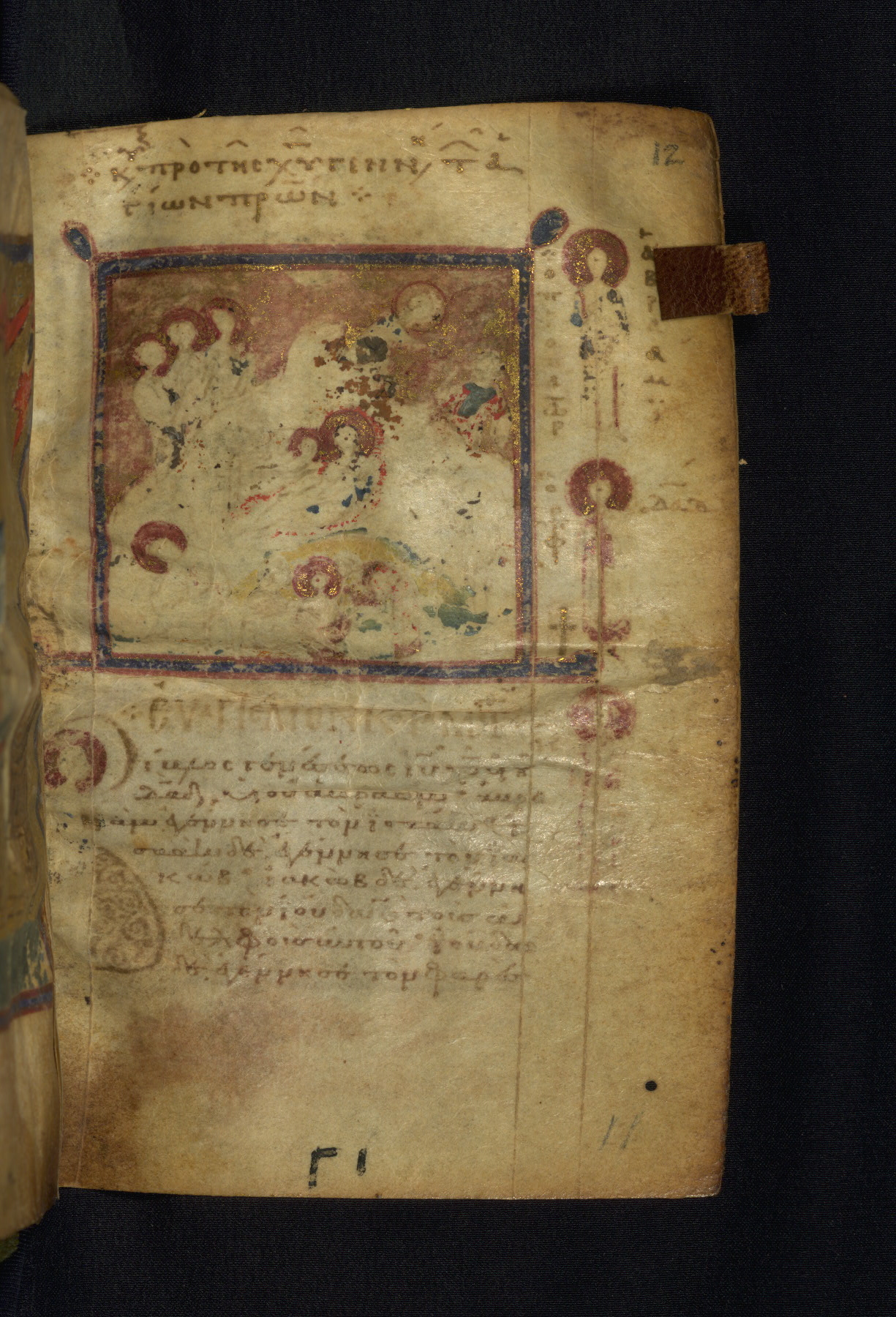
           Finally, especially in light of the approach of the Christmas season, a feature in 2370 draws our attention:  the headpiece for the Gospel of Matthew is a Nativity icon – or what is left of one.   Mary and the baby Jesus are depicted in the center of the picture; when the icon was pristine, the red paint around Mary represented her red bed-mattress. Joseph and other characters are also in the picture.  Above the picture is the heading for the lection assigned to the Sunday before Christmas (for the Holy Fathers).  In the outer margin next to the main picture are representations of Abraham and David.  This small manuscript was apparently used by some very devout readers, whose kisses gradually took away most of the pigment.      


Readers are invited to double-check the data in this post.  


Tuesday, July 5, 2016

Free Manuscript Downloads from the Walters Art Museum

          The Walters Art Museum, in Baltimore, Maryland, is famous for its world-class art exhibits, but its manuscript collections are also of considerable significance.   In 2004, a catalogue of the Walters Art Museum’s Greek manuscripts was prepared by Georgi R. Parpulov.  Among the 19 Greek manuscripts in the collection are six copies of the four Gospels, two copies of Acts and the Epistles, and two Gospels-lectionaries, along with some fragments.    
          Most of these manuscripts can be viewed page-by-page at the Walters Art Museum’s website.  If that had been the only contribution that the Walters Art Museum had made to the field of New Testament textual criticism, it would be sufficient to deserve high praise.  But there is more:  each of the following manuscripts can be downloaded for free as a PDF:  
W. 520, a lectionary
written in Greek uncial script.
        
Walters 520 (GA Lect 1629):  Gospels lectionary, 900’s.  PDF of W. 520.
Walters 522 (GA 2370):  Gospels, 1000’s/1100’s.  PDF of W. 522.             
Walters 523 (GA 2369):  Gospels, 900’s (with replacement-pages).  PDF of W. 523.
Walters 524 (GA 2373):  Gospels, 900’s.  PDF of W. 524.           
Walters 525 (GA 2374):  Gospels, Acts, and Epistles, c. 1300.  PDF of W. 525.            
Walters 528 (GA 2372):  Gospels, early 1200’s.  PDF of W. 528.            
Walters 531 (GA 2375):  Gospels, c. 1150.  The Trebizond Gospels.  PDF of W. 531
Walters 533 (GA 1022):  Acts and Epistles, early 1100’s.  PDF of W. 533.          
Walters 535 (GA Lect 1029):  late (1594) lectionary copied by Luke the Cypriot, with many illustrations.  PDF of W. 535.
            
          Details about the contents and special features of these manuscripts can be found in the catalogue prepared by Georgi R. Parpulov.  Many more manuscripts – including the Reichenau Gospels, the Freising Gospels, and the Claricia Psalter – are at the Walters Art Museum’s website; I have not mentioned many other exquisite manuscripts, so as to encourage readers to visit the website directly and enjoy exploring it for themselves.  
W. 47 features a large illustration
of the assassination
of Thomas Becket
.
          Some other Greek manuscripts are too fragile to digitize at present; these include Walters 532 (GA 1346, a Gospels manuscript from c. 1100) and Walters 529 (GA 647 and 2371), the latter of which is formatted similarly to GA 1175.  Among the fragments which consist of only one or two images, are Walters 530A (a miniature of Mark), Walters 530C (GA 2191) (with text from John 21).  Walters 526 (GA 1531, from the late 1200’s) and Walters 527 (GA 2368) are more substantial, but full digital views of these Gospels-copies are not yet available:             
          An abundance of versional manuscripts resides in the Walters Art Museum’s collection, including Walters 537, the oldest substantial Armenian Gospels-manuscript in North America.  (PDF of Walters 537.)  Other interesting non-Greek manuscripts include the following:

Walters 836, an Ethiopic Gospels from the 1300’s.  PDF of Walters 836.   
Walters 751, the Corvey Gospel Fragment (Latin, 950-975). 
Walters 592, an illustrated Arabic Gospels made in 1684.  PDF of W. 592.   
Walters 739, a Coptic fragment of Exodus (with text from chapters 21 & 23).
Walters 47, the Psalter-Hours of Brother Guimier (Latin, late 1200’s).

          Congratulations and thanks are extended to the staff of, and donors to, the Walters Art Museum for making these tremendous resources available!