Followers

Showing posts with label headpiece. Show all posts

Thursday, May 7, 2020

Video Lecture: Kinds of Greek NT Manuscripts

Lecture 02 -
Kinds of Greek NT Manuscripts
            The second video lecture in the series Introduction to New Testament Textual Criticism is online.  This lecture, a little more than 20 minutes long, reviews different kinds of continuous-text Greek manuscripts of books of the New Testament – papyri, uncials (majuscules), and minuscules – and some of their distinctive features. 
            Sub-titles provide a running outline of the lecture.

On YouTube at
https://www.youtube.com/watch?v=RACT7JaKOXo

Here is an excerpt:

            In our first lecture, I mentioned that there are five kinds of witnesses to the New Testament text:  (1) manuscripts, (2) versions, (3) patristic writings, (4) lectionaries, and (5) talismans and inscriptions.  Today we are taking a closer look into the distinct characteristics of each kind of continuous-text Greek manuscript.

Let me tell you an old story [Jadecarver and Student] . . . 

             Before we do anything else - before we learn the guidelines of how to make text-critical decisions, before we learn about the impact they can have upon the text, and before we investigate controversies in the field - we get to know the materials.

             A New Testament Greek manuscript is a witness that contains the Greek text of one or more New Testament books, initially formatted as one or more New Testament books.  For everything else I’m going to describe, it is probably safe to add the words:   “There are some exceptions.”  Today, we’re not exploring exceptional cases.  They’re out there, but we can look into them later.             

             With some exceptions, every substantial New Testament manuscript in existence was a codex when it was produced.  A codex is a handmade book, as opposed to a scroll.  Some witnesses used to be codices but only a single fragment of a single page has survived. 

            If a fragment has writing on both sides, from the same composition, that’s a giveaway that it was part of a codex. 

            If an early fragment has writing on just one side, and it’s not the end of the composition, that indicates that it was part of a scroll. 

            If an early fragment, such as Papyrus 13, has writing on both sides, but the writing on one side is from a different composition compared to the text on the other side, that indicates that it was part of a scroll, which first had writing on one side, and then someone decided to recycle it, and wrote on the other side.

           Our earliest witnesses were written on papyrus, pages made from the processed fibers of papyrus plants that grew along the Nile River.         

            In the 300s, after Christianity was legalized, books continued to be made out of papyrus, but parchment began to be the preferred material for New Testament manuscript-makers.   Parchment is made out of animal-skin.  At the end of the lecture, I will mention some resources that should give you a good idea of what goes into making papyrus, and what goes into the process of turning the skin of an animal into the pages of a book.

            In the Middle Ages, manuscripts began to be made out of a different material, called paper.  Some manuscripts have portions that are parchment, and portions that are paper, especially in cases where a parchment manuscript was damaged, and paper was used to replace the damaged pages.

          Now let’s consider the different kinds of continuous-text Greek manuscripts.

            First, there are the papyri.                     

            Papyrus-material, by the way, is still produced today; here’s a piece. 

            Papyrus manuscripts of New Testament books have their own catalog-numbers or names in the libraries where they reside, but for general purposes they are known by the letter “P” and a number, which represents the order in which they were found.  So, Papyrus 52 was approximately the 52nd New Testament papyrus to be found, identified, and catalogued.  

            Papyrus manuscripts are typically the first witnesses mentioned when comparing the support for rival readings.  The earliest papyri echo a period that is earlier than all other manuscripts.  So it is natural to give them a high level of importance.  But there are seven things that should be kept in mind about the papyri.

             ● First, it is not unusual for papyri to be cited for readings that do not appear in the surviving part of the manuscript.  When it comes to papyrus fragments, there is often more to see than just what you can see.  Depending on how much text survives in a fragment, on how many pages, it is sometimes possible to create what is called a codicological reconstruction of part of the non-extant part of the manuscript.  For example, if you have fragments of two pages of a manuscript, you might be able to tell approximately how much text was on each page of the manuscript, and approximately how many pages it had.  The further the reconstruction gets from the extant text, the less useful it is for text-critical purposes.   But if a variant is large, and relatively close to the extant text, codicological reconstruction can serve as the basis on which to form a strong suspicion about whether the variant was present or absent in the manuscript, on the basis of space-considerations.     

            ● Second:  there is nothing magical about papyrus.  Copyists did not suddenly become more accurate just by writing the text on papyrus.  Papyrus 72 was probably made in the 300s, and it is one of the earliest manuscripts of the books that it contains.  But if you compare its text of the Epistle of Jude to the text of Jude in an ordinary late medieval manuscript, the text in the medieval manuscript will be far closer to the original text.    

            ● Third:  while the papyri are very old, many of them are not remarkably old.  Right now, we have about 140 papyrus manuscripts.   Forty of them were produced after the fall of the Roman Empire, in the 500s or later.    

            ● Fourth:  almost all of the papyri are fragmentary, and most of the papyri are very fragmentary.  Less than 30 early papyri – and by “early” I mean, “earlier than Jerome” – before the late 300s – consist of more than two pages. 

            ● Fifth:  the primary value and use of the papyri, by far, has been to confirm readings that were already known from other witnesses.  The number of readings found exclusively in papyri that have been securely adopted in any major edition of the Greek New Testament is zero.  In the late 1800s, textual critics had practically no papyri to work with; now we have 140, and in terms of the contents of the text, they have made very little difference.

            ● Sixth:  almost all of the papyri were found in Egypt.  That is because papyrus tends to gradually decay in climates that are not very dry, and the climate in parts of Egypt is very dry.  So if a textual critic were to say, “Let’s reconstruct the text based on the earliest manuscript,” he would produce a text based on evidence from Egypt, at least in the passages for which there is an early papyri – because that’s where papyrus lasted longer than in other places.  That kind of approach might give us a good look at the texts that were used in Egypt.  But it doesn’t really help us see what the text looked like in other locations, where there was more rain – such as the location of every church mentioned in the New Testament.  Saying, “Let’s depend primarily on the oldest evidence” is like saying, “Let’s depend primarily on the evidence that experienced the best weather.”

            ● Seventh, the production-date assigned to a papyrus manuscript is usually an estimate, with a range of 100 years.  The analysis of ancient writing, called paleography, is used to arrive at these production-dates.  In rare cases, the circumstances in which a New Testament manuscript has been found sets some parameters for its production-date; for example, if a manuscript is found in the ruins of a city that was destroyed in a particular year, we can deduce that it was not produced after that year.  But usually, paleographers assign production-dates according to the Greek script that the copyist used.

             If you look at printed English fonts from 300 years ago, and compare them to fonts in use today, you will see some differences.  The same sort of thing is true of ancient Greek handwriting; different styles of script were dominant at different times.  Paleographers study the script in detail.  But they can’t look at a script and tell you how old a copyist was when he wrote it. 

            If you reckon that a copyist in the ancient world engaged in a peaceful profession that involved copying books, he could copy a book at age 20, or at age 70 – and use the same handwriting he had learned when he had first learned to write.  There’s no way to tell if he was young, and would go on using that handwriting for another 50 years, or if he was old, and had been using that handwriting for 50 years.  So this range of about 50 years in both directions is built-into most paleographically assigned production-dates. 

           Now let’s consider the uncial manuscripts, also called majuscules.  When you read the textual apparatus in a Nestle-Aland or United Bible Societies or Tyndale House Greek New Testament, you can tell when a witness is a papyrus, because it is identified by a number after the letter P.   Similarly, you can tell when a witness is an uncial, because all uncials are numbered with numbers that begin with the numeral 0.  Codex Sinaiticus is 01, Codex Alexandrinus is 02, Codex Vaticanus is 03, and so forth.  Whether an uncial is a massive codex like Codex Sinaiticus, or a Gospels-book like Codex Cyprius, or a small fragment like 0315, every one gets its own number.  These numbers are called the Gregory-Aland numbers, because this kind of identification-system was developed by the scholar C. R. Gregory and expanded by Kurt Aland.  Different identification-systems were used before this became the standard identification-method; a comparison-chart of the obsolete methods and the standard method can be found online at the Encyclopedia of New Testament Textual Criticism.

            That is the first standard way in which uncials are identified.  But there is another method:  some uncials are also represented by letters of the English alphabet, and some uncials are represented by letters of the Greek alphabet.  Codex Alexandrinus is Codex A, Codex Vaticanus is Codex B, and so forth.  Codex Sinaiticus is represented as À, the first letter of the Hebrew alphabet.  Generally, the more important an uncial is, the more likely it is to be better-known by its letter than by its number.

            There are only 26 English letters and 24 Greek letters, and we have a lot more than 50 uncial manuscripts.  Sometimes the same letter is used for different manuscripts in different parts of the New Testament.  For example, “D” is Codex Bezae in the Gospels and Acts, but in the Epistles, “D” represents Codex Claromontanus.  “E” is Codex Basiliensis in the Gospels, but in Acts, “E” is Codex Laudianus. 

            The numerical system is less likely to cause confusion, because each number represents exactly one manuscript.  But the letter-based system is easy to remember and it is used in the printed textual apparatus of the major editions of the Greek New Testament.  The only safe course of action is to learn both identification systems.

             It is not unusual for an uncial manuscript of the four Gospels to contain more than just the text of the four Gospels.  A Gospels-codex may begin with the Eusebian canons before the text of the Gospels begins, introduced by Eusebius’ letter to Carpian explaining how to use the Canons as a cross-reference tool.  Each Gospel may also be preceded by a list of its chapters; these chapter-lists are called Kephalaia.  The chapter-titles may be repeated at the top or bottom of the page of text where they begin; at these locations, they are called the titloi.  And at the end of each Gospel, one usually finds the closing-title.             

            Next come the minuscules – that’s minUscules.  Whereas uncial manuscripts are written in large letters that are usually separated from one another, minuscules are written in small letters that tend to be connected to one another in words.  Minuscule copies of New Testament books go back as early as the early 800s.  Uncial manuscripts continued to be made after that, but by the 1000s, minuscule script became dominant.  It took less time and required less materials to make a minuscule manuscript. 

            Here are a few things to know about minuscules:

            ● Minuscules should not be belittled simply because they are minuscules.  Kirsopp Lake said, “It is neither the date nor the script of a MS which determines its value for the critic, but the textual history of its ancestors.”

             ● Some minuscules are not technically continuous-text manuscripts:  they are commentaries, in which a portion of the New Testament text is written, followed by a portion of commentary, followed by the next portion of New Testament text, followed by a portion of commentary, and so forth.   This is not much different from a truly continuous-text manuscript that has the same commentary-material in the outer margins.  When several copies of the same commentary also share the same form of the New Testament text, divided into the same portions, it is clear that they share the same ancestry, and their weight should be boiled down.

            ● Some minuscules contain a high amount of abbreviation.

            ● Some uncials are partly minuscule.  It is not rare to see uncial letters and minuscule letters on the same page – occasionally, comments are written in minuscule script and the text is written in uncial script, to help prevent readers from getting them confused.

            ● Some minuscules are illustrated.  Minuscule copies of the Gospels may include full-page miniature portraits of each Evangelist before his Gospel begins.  In this context, the term “miniature” does not describe the size of the portrait; a “miniature” is a picture framed in pigment that contains red lead – a pigment called minium

             Often each evangelist in these pictures is accompanied by a symbolic representation:  usually for Matthew, it is a man or angel.  For Mark, it is a lion.  For Luke, it is an ox.  And for John, it is an eagle.  The symbolism is based on the visions of the seraphim around God’s throne in the books of Ezekiel and Revelation.

            Also, the initial letter of a book, or in some cases, many of the initial letters at the beginnings of sections of a book, may be artistically stylized.  When an initial is made to resemble an animal, this is called a zoomorphic initial.  In many manuscripts, at the beginning of a book, there is a large ornamental design, called a headpiece, accompanied by the title of the book.

            ● In some minuscules of the Gospels, in addition to the Eusebian Canons and chapter-lists, there are book-introductions, or summaries.  Sometimes there are lists of rare words.  In some copies of Acts, there is an itinerary of the journeys of Paul.  And sometimes, at the end of the book, there is a scribal note, or colophon, which might include information about when and where it was copied. 

           Regarding all other witnesses to the Greek New Testament:  we will hopefully look into them in future lectures.  Representatives of the Greek text of the New Testament tend to take center stage, because everything else does not contain the text that is being reconstructed.  But other witnesses are extremely important when it comes to tracking specific readings and building a history of separate forms of the text.              For example, when you see a rare reading in a Coptic manuscript from Egypt, and it also shows up in a Latin manuscript that was made in Ireland, it raises a question about how the text in these two geographically separated places is connected.  And if you see that the same reading in the same passage was quoted and interpreted by two early writers in two different locations, you can thus observe that the reading was widely distributed – and sometimes this evidence is earlier than any extant evidence from continuous-text Greek manuscripts.

             To learn more about early papyrus manuscripts and parchment manuscripts and how they were made, download Sitterly’s 1898 book Praxis in Manuscripts of the Greek Testament, and read chapters 1, 2, and 3.

            Also, watch the video, 8 minutes and 44 seconds long, that you can find at YouTube by searching there for “Beloved Essences How To Make Papyrus” –

            And another video, 3 minutes and 42 seconds long, that you can find at YouTube by searching there for “Texas Film Studio How To Make Papyrus.”

            And, watch the video about how to make parchment at Mike Rowe’s Dirty Jobs series, Season 4, Episode 26, which is also accessible at YouTube, beginning in the 20th minute of the video.

            And, watch the video about how paper was made in the late Middle Ages at YouTube; search there for a video 15 minutes and 18 seconds long, called “Papermaking by Hand at Hayle Mill.”

           Also, if you can acquire Larry Stone’s book The Story of the Bible, do so, and read chapters 1 and 3, and be sure to look inside the pouches. 


Thursday, December 12, 2019

Christmas Combat: Luke 2:1-18 in Codex Bezae


            It’s time for another round of hand-to-hand combat!  Since it’s almost Christmastime, our combatants will square off in Luke 2:1-18, a passage which contains the accounts of the birth of Christ and the angels’ visit to the shepherds who were keeping watch over their flocks.  The competitors in today’s contest are the famous Codex Bezae (D, 05) – which nowadays is usually assigned to the early 400s – and GA 2370, a remarkably small minuscule Gospels-manuscript from the late 1000s, one of several Greek New Testament manuscripts at the Walters Art Museum (the manuscript is also known as Walters 522). 
            Before proceeding, let’s consider a few details about 2370:
            ● 2370 is a nearly complete copy of the four Gospels; the last verse on its last (damaged) page is John 21:3.
            ● The story of the adulteress is included (7:53 begins on page-view 521, numbered as fol. 253 at the top and as 248 at the bottom).  However, the pages from 247a (numbered as 242 at the bottom) (beginning in John 6:32) to 261 are secondary; the main copyist’s work resumes on 262a (page-view 539) in Jn. 10:14.  A few of the secondary pages were inserted upside-down.
            ● Each Gospel is accompanied by a picture of the Evangelist, and an icon-like headpiece.  For Mark, the headpiece is a portrait of Christ (with hardly any pigment surviving); for Luke, the headpiece is an icon representing the birth of John the Baptist; Zachariah stands in the margin, and Luke is represented in the initial.  For John, the full-page portrait shows John dictating to Prochorus, and the headpiece is a portrait (fairly intact) of Christ.
            ● A detailed description of 2370 can be found in Georgi R. Parpulov’s Catalogue of Greek Manuscripts at the Walters Art Museum, which the author dedicated to the memory of his beloved grandfather, Konstantin Tzitzelkov.

            This contest may provide a convenient test of the idea that the oldest a manuscript is, the better its text tends to be.  If the assigned production-dates for these two manuscripts are correct, then the copyists in the transmission-line of GA 2370 had more than twice as much time as the copyists of in the transmission-line of Codex D to make additions, omissions, and other mistakes in the text.  Let’s compare their contents and see which text is more accurate, using as our standard of comparison the Tyndale House Greek New Testament.
            As in earlier rounds of Hand-to-Hand Combat, a few ground rules are in play.  A point is assigned to each manuscript for each non-original letter in its text, and a point is also assigned to each manuscript for each original letter that is absent from its text.  Transpositions are mentioned, but do not result in any points unless there is an actual loss of a letter or letters.  Nomina sacra (i.e., sacred-name contractions) and other contractions in and of themselves are not considered variants, unless the contraction is of a word that is not in the original text. Movable-nu differences are not noted in this comparison.

Luke 2:1-18 in GA 2370

1 – no variants
2 – has η after αυτη (+1)
3 – has ιδιαν instead of εαυτου (+5, -6)
4 – no variants
5 – has μεμνηστευμένη instead of εμνηστευμενη (+1)
5 – has αυτου instead of αυτω (+2, -1)
5 – has γυναικι before ουση (+7)
5 – has εγκύω instead of ενκύω (+1, -1)
6 – no variants
7 – has τη before φατνη (+2)
8 – no variants
9 – has ιδου before αγγελος (+4)
10 – no variants
11 – no variants
12 – does not have και before κείμενον (-3)
13 – no variants
14 – has ευδοκια instead of ευδοκιας (-1)
15 – has και οι ανθρωποι after αγγελοι (+13)
15 – has ειπον instead of ελάλουν (+5, -7)
16 – has ηλθον instead of ηλθαν (+1, -1)
17 – has διεγνώρισαν instead of εγνώρισαν (+2)
18 – no variants

            Thus, when we look over 2370’s text and compare it to the Tyndale House edition of the Greek New Testament, as if the Tyndale House edition is the original text, 2370’s text of Luke 2:1-18 contains 45 non-original letters, and is missing 20 original letters, for a total of 65 letters’ worth of scribal corruption.  
            Now let’s look at the same passage in Codex Bezae, which is estimated to be at least 500 years older than GA 2370.  In a couple of places, there is a correction in the manuscript; to keep things simple I removed these variants from consideration after making mention of them.

Luke 2:1-18 in Codex Bezae (D, 05)

1 – no variants
2 – transposes to εγενετο απογραφη πρωτη
3 – has πατριδα instead of πολιν (+6, -4)
4 – has Ναζαρεθ instead of Ναζαρετ (+1, -1)
4 – has Ιουδα instead of Ιουδαίαν (-3)
4 – has καλειτε instead of καλειται (+1, -2)
4 – transposes the last phrase of v. 4 and the first phrase of v. 5
5 – has απογράψεσθαι instead of απογράψασθαι (+1, -1)
6 – has ως instead of εγενετο before δε (+2, -7)
6 – has παρεγείνοντο instead of εν τω ειναι αυτους εκει after δε (+12, -19)
6 – has ετελέσθησαν instead of επλήσθησαν (+4, -3)
7 – no variants
8 – has δε after ποιμενες instead of και before ποιμενες (+2, -3)
8 – has χαρα ταυτη instead of χωρα τη αυτη (+1, -2) [correction in MS]
8 – has τας before φυλακας (+3)
9 – has ϊδου before αγγελος (+4)
9 – does not have κυρίου (ΚΥ) after δοξα (-6, or -2 if counted as contracted sacred name)
10 – has υμειν instead of υμιν (+1)
10 – has και before εσται (+3)
11 – has υμειν instead of υμιν (+1)
12 – has υμειν instead of υμιν (+1)
12 – has εστω after σημειον (+4)
12 – does not have και κείμενον (-11)
13 – has στρατειας instead of στρατιας (+1)  
13 – has αιτουντων instead of αινουντων (+1, -1) [correction in MS]
15 – no variants
15 – moves οι αγγελοι to follow απηλθον
15 – has και οι ανθρωποι before οι ποιμενες (+13)
15 – has ειπον instead of ελάλουν (+5, -7)
15 – has γεγονως instead of γεγονος (+1, -1) [correction in MS]
15 – has ημειν instead of ημιν (+1)
16 – has ηλθον instead of ηλθαν (+1, -1)
16 – has σπευδοντες instead of σπευσαντες (+2, -2)
16 – has ευρον instead of ανευρον (-2)
16 – does not have τε before Μαριαμ (-2)
16 – has Μαριαν instead of Μαριαμ (+1, -1)
17 – does not have τουτου (-6)
18 – has ακουοντες instead of ακουσαντες (+1, -2)
18 – has εθαυμαζον instead of εθαυμασαν (+2, -2)

            Thus, when we look over Codex D’s text of Luke 2:1-18, and compare it to the Tyndale House edition of the Greek New Testament, as if the Tyndale House edition is the original text, D’s text of this passage contains 76 non-original letters, and is missing 86 original letters, for a total of 162 letters’ worth of scribal corruption.  
            Can we make the score – only 65 letters’ worth of corruption in 2370’s transmission-line over 900 years, but 162 letters’ worth of corruption in Codex D’s transmission-line over 350 years! – a little closer by removing trivial spelling-related variants from consideration?  If we overlook the variant-units that involve  the spelling of Ναζαρετ in verse 4, καλειται in verse 4, εγκύω in verse 5, απογράψασθαι in verse 5, the corrected reading in verse 8, υμιν in verses 10, 11, and 12, στρατιας in verse 13, the corrected readings in verses 13 and 15, ημιν in verse 15, ηλθαν in verse 16, Μαριαμ in verse 16, and εθαυμασαν in verse 18, Codex D’s text of Luke 2:1-18 still contains 62 non-original letters, and is still missing 74 original letters, yielding a total of 136 letters’ worth of scribal corruptions.
            Thus we see that 2370, a medieval minuscule that is not mentioned in the textual apparatuses of the Nestle-Aland, UBS, or Tyndale House compilations (or any other textual apparatus that I know of), contains a text of Luke 2:1-18 that is, at minimum, twice as accurate as the text of Luke 2:1-18 in Codex Bezae.

            In addition, in at least four places in this passage, I suspect that the Tyndale House edition of the Greek New Testament contains a corruption. 
            ● First, the spelling of ενκύω (εγκύω in NA, in Tregelles, in Scholz, in Baljon, in Souter, in Holmes’ SBLGNT, and in Byz) in 2:5:  what justifies the adoption of this anomaly?
            ● Second, there is the contest involving the final word of Luke 2:14.  Regarding this I have offered an analysis previously, vindicating the reading ευδοκια which is the basis for the phrase (and carol-lyric) “Peace on earth, good will to men.” 
            ● Third, in verse 9, ἰδού is broadly attested by A D Κ Θ Byz 157 1424 OL Vulgate Pesh, and should be retained.  Contrary to Metzger’s proposal that it is difficult to imagine why copyists would have omitted “behold,” it is not hard at all to reckon that they felt over-beholden, in light of the recurrence of the same term in v. 10 (and in 1:20, 1:31, 1:36, 1:38, 1:44, 1:48, and in 2:25).  The word ἰδού is omitted in 2:25 by D and N; it is also omitted by D in 6:23, 7:12, and 8:41, 9:39 (where ℵ also omits), 10:25, 23:15, and 24:13.  The same phenomenon is on display at Lk. 17:21 and 19:19 in 157, and at 22:21 in f13, and at 23:29 in P75, D, and f13, and in 24:49 in P75 and D.  (Readers may also compare how the word “Behold” has disappeared from some English versions, even though ἰδού remains in their base-text.)        
            ● Fourth, in verse 15, it is easy to notice that the words καὶ οἱ ἄνθρωποι are vulnerable to accidental parableptic loss, situated between οἱ ἄγγελοι and οἱ ποιμένες, especially when ἄνθρωποι is written in contracted form (και οι ανθοι οι).  Tregelles included these words in his Greek New Testament, albeit in brackets.  Burgon’s brief comments on this passage (in Causes of Corruption, page 36) remain forceful. 

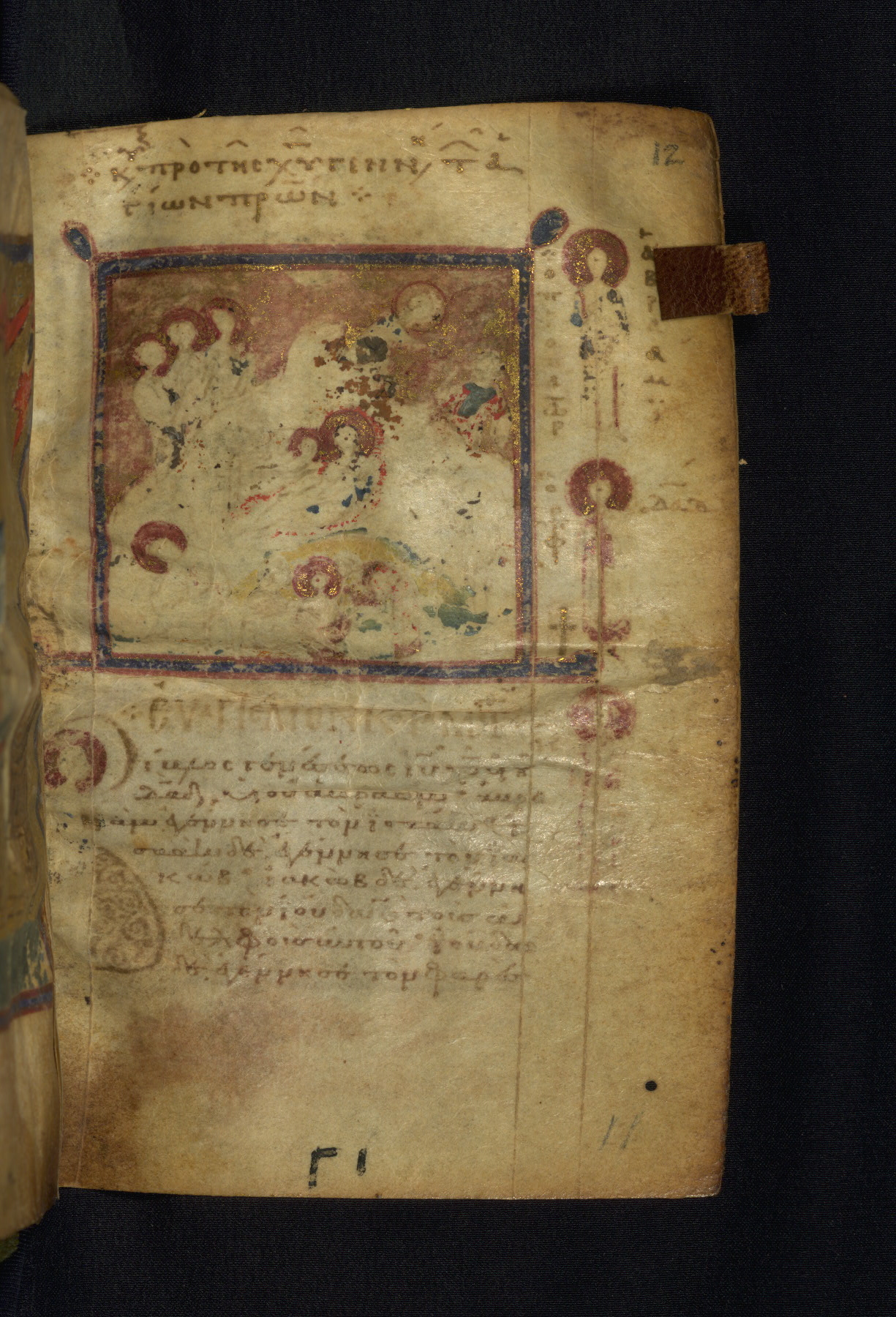
           Finally, especially in light of the approach of the Christmas season, a feature in 2370 draws our attention:  the headpiece for the Gospel of Matthew is a Nativity icon – or what is left of one.   Mary and the baby Jesus are depicted in the center of the picture; when the icon was pristine, the red paint around Mary represented her red bed-mattress. Joseph and other characters are also in the picture.  Above the picture is the heading for the lection assigned to the Sunday before Christmas (for the Holy Fathers).  In the outer margin next to the main picture are representations of Abraham and David.  This small manuscript was apparently used by some very devout readers, whose kisses gradually took away most of the pigment.      


Readers are invited to double-check the data in this post.  


Friday, September 1, 2017

Seventy-seven Manuscripts from Jerusalem

The Mar Saba Monastery
            In the year 483, a monk named Sabbas founded a monastery about eight miles east of Bethlehem in the rugged Kidron ValleyThis monastery – the Holy Lavra of Saint Sabbas the Sanctified – gradually grew into a highly influential theological center.  John of Damascus worked there, and his tomb is there.  Although the premises were temporarily abandoned in the 1400’s due to constant raids by nearby nomadic tribes, it was reactivated, and in 1625 formally joined the Greek Orthodox Patriarchate of Jerusalem.
            Much of the manuscript collection of the Saint Sabbas Monastery is presently housed in Jerusalem.  In 1949-1950, an expedition led by Kenneth W. Clark visited the collections overseen by the Jerusalem Patriarchate, and photographed almost all of their manuscripts.  The Library of Congress recently released the photographs of these images online, making them freely available.  Many of these manuscripts consist of copies of the Psalms, saints’ biographies, history books, patristic compositions, liturgical texts, and even an occasional work by an ancient Greek author, such as Aristotle.  The collections also include some New Testament manuscripts.
            The New Testament manuscripts from the Saint Sabbas Collection are listed here, with embedded links to images of each manuscript.  

The headpiece of Matthew
in GA 1335 (Sabas 248)
GA 1335:  Hagios Sabas 248 - Four Gospels (The Gospel of Matthew in this manuscript has one of the strangest headpieces I have ever seen.)
GA 2926:  Hagios Sabas 676 - Revelation and Praxapostolos (This was catalogued as a Praxapostolos manuscript, but it begins with the continuous text of Revelation; Acts begins after that.)

            In addition to those 23 continuous-text manuscripts, the collection from the Saint Sabbas Monastery includes the following lectionaries: 
The first and last page
of Revelation in GA 2926


Hagios Sabas 360 - Evangelion (Weird script in the preface – stylized Georgian?)

            Another collection held at the Jerusalem Patriarchate is categorized as the Panagios Taphu collection, and it, too, includes some New Testament manuscripts, listed here with embedded links:

GA 1318:  Panagios Taphu 46 - Four Gospels (Neatly written.  Merits closer study.)
GA 1321:  Panagios Taphu 49 - Four Gospels (Some pages from a lectionary at the beginning)
GA 1325:  Panagios Taphu 62 Four Gospels (Made in 1724 – Greek and Modern Turkish Greek)

            Besides the 15 continuous-text manuscripts listed above, the Panagios Taphu collection also includes the following nine lectionaries: 

Panagios Taphu 33 - Evangelion (900’s/1000’s) (Elaborately executed)
Panagios Taphu 43 - Praxapostolos (Damaged; text begins in Acts 12)
Panagios Taphu 530 - Evangelion (made in 1744 – Greek and modern Turkish Greek)

[A couple of manuscripts were in the Checklist of manuscripts in the Jerusalem Patriarchate’s holdings, but I could not find photographs of them:  Hagios Sabas 413 (GA 1344, a manuscript of the Gospels) and Hagios Sabas 154 (an Evangelion).]


Thanks to the Library of Congress for making these images available.  Thanks, too, to Peter Montero and Peter Gurry for sharing the news about their release. 

Tuesday, October 4, 2016

Codex S (028) - The Other Codex Vaticanus

In this replica of the last page of Matthew
in Codex S, several features are seen:
the text of Matthew 28:17b-20, a sticho-
metric note, a note about when and where
Matthew wrote his account, a decorative
line with a simple bird-flourish,
and a brief prayer by the copyist.
Codex S (028) is an exceptional manuscript in several respects:

 It is the only uncial Greek manuscript of the Gospels that contains a colophon which mentions precisely when it was made.   
 In the decorations that accompany the Eusebian Canon-tables in Codex S, there are not only birds, but also rabbits, lions, elephants and what appears to be an abstractly drawn dragon.
 The chapter-titles for Matthew in Codex S are given in a slightly longer-than-usual form.
 For chapter-titles and section-numbers in the page-margins, the copyist used not only red ink (as expected) but also, frequently, blue ink.

          Textually, Codex S is a representative of the Byzantine text.  Although Codex S was used for public reading in church-services (lection-titles and date-assignments appear in the margins throughout the manuscript), deviations from the normal Byzantine text that have an impact on translation are fairly rare.  

          Two significant omissions occur in Matthew 9:17 (where Codex S does not have the words, “but they put new wine into new wineskins, and both are preserved”) and in Matthew 19:9 (where Codex S does not have the words, “and whoever marries her who is divorced commits adultery”).  Both of these omissions are the result of parablepsis; that is, the copyist’s line of sight drifted from a series of letters in one line to the same series of letters further along in the text.  In this case, the copyist’s line of sight jumped from –ουνται to –ουνται in 9:17, and from μοιχαται to μοιχαται in 19:9.
          A reading in Matthew 28:2 suggests that even though Codex S was produced before most minuscules, its text contains a few embellishments which are not found in the majority of manuscripts.  In this verse, the phrase “of the tomb” has been added after the phrase “of the door.”  (In the Alexandrian text, reflected in the ESV and NIV, the phrase “of the door” is absent, which would imply, if this short variant is original, that the reading in Codex S is the equivalent of a barnacle on a barnacle.)     
          Codex S also contains a few – but not many – small benign expansions, such as the insertion of the name “Jesus” in Matthew 21:18.  The 2011 edition of the NIV, unlike the 1984 edition of the NIV, gives the appearance of having been translated from a Greek base-text that resembled Codex S in this verse, since it has the name “Jesus” in Matthew 21:18 – even though its preface states that it was translated from the Nestle-Aland compilation, which does not have Jesus’ name in Matthew 21:18.

Here is a guide to some of the most interesting pages of this manuscript.  The embedded links will take you to page-views at the website of the Vatican Library, digitized as part of the Polonsky Foundation Digitization Project:  

1r-5r – Ad Carpianus , a guide to the Eusebian Canons, written in hollow red uncials.  (The opening words are missing; probably they were on an illustrated page that has been lost or removed.) 
17r – Matthew 1:1, with a circular headpiece and a zoomorphic initial. 
74r – A marginal note alongside Mt. 27, extracted from Origen’s commentary on Matthew, about the name of Barabbas. 
79r – Mark 1:1
114v – Mark 16:9 begins section #234 on this page.
115v A scribal note about when the Gospel of Mark was written, and a prayer, with a pavilion-framework.
117v – Luke 1:1
172r – Each line of Luke 22:42-44 is accompanied by an asterisk in the left side-margin, except the last line, where the Eusebian canon-number and section-number occupy the margin. 
180r – John 1:1
197r – Each line of the pericope adulterae (John 7:53-8:11) is accompanied by an obelus (÷) in the left side-margin of each column.  Yet, a rubric for the passage clearly identifies it in the upper margin; the title “Πε[ρι] της Μοιχαλιδος” appears, accompanied by an asterisk, which is meant to show that the pericope begins at the beginning of 8:3, where another large asterisk appears in the left margin.  Instructional notes tell the lector how to treat the passage on Pentecost, by jumping from the end of 7:52 to resume at the beginning of 8:12.
225r  After the end of the Gospel of John, Codex S features a series of lections for four annual holy days:  
           For Holy Thursday:  Mt. 26:1b-20 + Jn. 16:3-17 + Mt. 26:21-39 
          + Lk. 22:43-45a + Mt. 26:45-27:2
           For Good Friday (Vespers):  Mt. 27:1-38 + Lk. 23:39-43 + Mt. 27:39-54 
          + Jn. 19:30-37 + Mt. 27:55-61
           For the Dormition of the God-bearer:  Lk. 10:38-42 + 11:27-28
           For the Exaltation of the Cross:  selections from Jn. 19:6-35
234v - The lections are followed by a colophon which gives the name of the copyist (Michael, the monk and sinner) and the date and year that the manuscript was produced March 5, in the year six-thousand and 400 and 57.  This is an “Anno Mundi” year, calculated from the creation of the world, which Byzantine monks believed to have taken place in 5509 B.C. (a belief based on consultation of the Septuagint; deductions based on the Hebrew text yield a different date).  Adjusted to the modern Gregorian calendar, the production-date of Codex S is 949.   

          Codex S, while not as important as Codex B, is among the most significant New Testament manuscripts housed at the Vatican Library.  It is an important witness to the Byzantine Text of the Gospels.