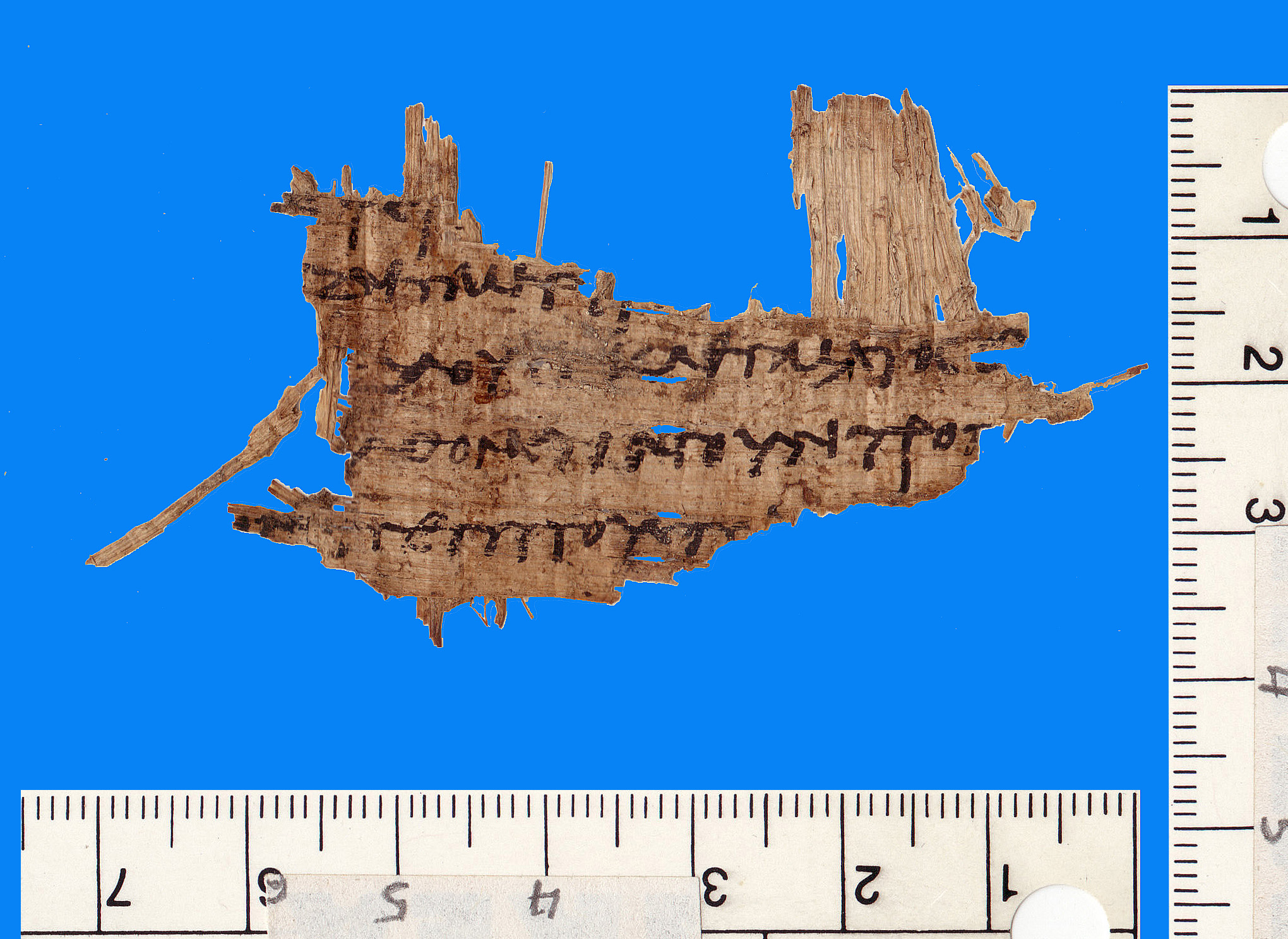
Parpulov assigns it to the 1100s. Its text is thoroughly Byzantine, agreeing with the Robinson-Pierpont Byzantine Textform in thirteen out of thirteen legible (to me) variation-units. It has one unusual omission, in 9:33, where the words ἐπὶ κραββάτῳ are absent.
Followers
Showing posts with label fragment. Show all posts
Friday, August 21, 2026
An Uncatalogued Fragment of Acts in Bulgaria
Labels:
Acts 10,
Acts 9,
Bachkovo Monastery,
fragment,
Parpulov
Sunday, August 18, 2019
093: A Byzantine Fragment of Acts from the 500s in Egypt
Today,
let’s take a close look at part of 093 – a small fragment that contains text
from Acts 24:22-26, and text from First Peter 2:22-3:7. (I will focus here especially on the text
from Acts. 093 is a palimpsest
with an interesting history: it was
among the approximately 193,000 fragments that had been stored in the Genizah
of the Ben Ezra Synagogue in Cairo over the course of centuries. (The story of how researchers Charles Taylor and
Solomon Schechter discovered this immense collection of materials and, in
1896-1897, arranged for its transportation to Cambridge
University for continued study, can be found online.)
Charles Taylor published a transcription of the text from Acts in 093 in 1900, along
with a short summary of the text from First Peter, and some other texts. He also noted that the upper writing on the
palimpsest consisted of Hebrew extracts from the Bereshith
Rabbah (ch. 45, 47,and 98). The lower writing
contains most of Acts 24:22-26 on one page in two columns of 24 lines
each. The text on the verso is mostly
illegible but Taylor
made out words from the tops of the two columns: from Acts 24:26, οτι χρηματα / δοθησεται, and
from Acts 24:27, ελαβεν διαδο / χον ο Φηλιξ
/ Πορκιον Φη / στον. (This
manuscript is identified in the catalog of Joseph van Haelst as item 487; in
the Taylor-Schechter Collection it is in Collection 12, 189 and 208. For a while, 093 was identified with the
siglum ﬥ.)
![]() |
| Green lines: 093 disagrees with Alex. Red lines: 093 disagrees with Byz. |
The
smattering of text on the verso does not allow much insight regarding the type
of text of Acts that 093 contains, inasmuch as the Alexandrian Text and the
Byzantine Text are in exact agreement in those parts of Acts 24:26 and
24:27. When we turn to the much more
extensive text on the recto, however, there can be no doubt: 093’s text of Acts is Byzantine: except for its inclusion of the contracted
sacred name Ιν after Χν in verse 24, and the reading λαβων
instead of μεταλαβὼν in verse 25, the text from Acts in 093 agrees perfectly
with the Robinson-Pierpont
Byzantine Textform. (The Textus Receptus differs from RP2005 in
this passage in two places; the TR includes αυτου after γυναικι in 24:24, and
reads δε between αμα and και in 24:26.)
Meanwhile,
093 disagrees with the Nestle-Aland compilation at the following seven places:
● 1. In verse 22, there is a word-order variant: ανεβαλετο αυτους follows Φηλιξ, instead of the Alexandrian reading in which ανεβαλετο δε αυτους precedes ὁ Φηλιξ.
● 2. In verse 22, after οδου, 093 reads ειπων, not
ειπας.
● 3. In verse 23, before τω, 093 reads τε.
● 4. In verse 23, after τηρεισθαι, 093 reads τον
Παυλον instead of αυτον.
● 5. In verse 23, before αυτω, 093 reads η
προσέρχεσθαι.
● 6. In verse 24, before γυναικι, 093 does not
read ιδία.
● 7. In verse 25, after μέλλοντος, 093 reads
εσεσθαι.
Two points
are illustrated by this evidence.
First,
contrary to the much-repeated claim that the Textus Receptus is a late medieval compilation (as opposed to an
essentially early form of the text with a relatively small stratum of late medieval
readings), 093 confirms that the Byzantine Text of Acts – at least, Acts
24:22-26 – existed in the 500s, around a thousand years before Erasmus,
Stephanus, and Beza made their compilations.
Second,
there is some reason to suspect that apparatuses in some widely used Greek New
Testaments cannot be trusted to present evidence in an even-handed way in cases
where Byzantine readings receive early support:
● Of the seven reading in Acts 24:22-26 that are
supported by 093 and the majority of Greek manuscripts, the Nestle-Aland
apparatus (in NA27) fails to record four of them (#2, 3, 4, and 6).
● In the United Bible Societies’ Greek New Testament (4th ed.) only one variant-unit
is covered in the verses that are extant in 093: the contest between Ιν Χν and
just Χν in 24:24. In this case
the theoretical mechanics of the “expansion
of piety” have been rejected in favor of strong early support (including
support from 093) for the longer reading.
● In the apparatus of the Tyndale House edition of
the Greek New Testament, only one textual contest in the passage that is extant
in 093 is mentioned: the contest in Acts
24:24 between the inclusion or non-inclusion of ιδια before γυναικι, and the inclusion or non-inclusion of αυτου
after γυναικι.
The reading found in 093 is mentioned as a reading supported by C* L P
1424, but 093’s support is not mentioned.
The compilers of the Tyndale House edition of the Greek New
Testament apparently never looked at 093. (A list of consulted witnesses in an appendix
of THEGNT does not mention 093, although over a dozen manuscripts younger than
093 are listed.)
Third –
provisionally accepting the classification of the fragmentary text from First Peter 2:22-3:7 as Alexandrian – it was possible for a Byzantine text
of Acts to appear in the same manuscript as an Alexandrian text of First Peter
in Cairo , Egypt . While it cannot be demonstrated that 093 was
produced in Egypt, the presence of an Alexandrian text of First Peter in the
manuscript favors this possibility, and the presence of 093 among the genizah’s
fragments also indicates that the Byzantine Text of Acts in the 500s was used
in a broad range of territory.
093 is not
the only manuscript with texts from the New Testament that was discovered in
the Cairo Genizah. A few palimpsests
were discovered to have material from the New Testament in their lower writing,
in Palestinian Aramaic; these texts were studied, and published, by the
scholarly sisters Agnes Smith Lewis and Margaret Dunlop Gibson, with assistance from J. R. Harris –
including a
palimpsest-fragment with Palestian Aramaic text from John 14:25-15:16. The Syriac specialist G.
H. Gwilliam published the contents of five palimpsest-fragments (assigned
to the 700s) in 1893, containing text from chapters 4 and 5 of Numbers, and
from Colossians 4:12-18, First Thessalonians 1:1-3 and 4:3-15, Second Timothy
1:10-2:7, and Titus 1:11-2:8. Michael
Sokoloff and Joseph Yahalom brought such investigations up to date in 1979, and
expanded upon them, in a detailed essay in Revue
d’Histoire des Textes, “Christian
palimpsests from the Cairo Geniza.” (Fragments of manuscripts of the Hexapla from
the Cairo Genizah, by the way, can be viewed at the Greek Bible in
Byzantine Judaism website.)
A few other
palimpsest-fragments in the Cairo Genizah contain some New Testament passages. (One fragment
contains Syriac text from Second Corinthians 3:2-15; another fragment
contains Syriac text from chapters 3 and 4 of First Thessalonians.) The lower writing on yet another fragment
consists of the remains of an early (600s or 700s?) Greek uncial lectionary,
now catalogued as lectionary
1276, a.k.a. Taylor-Schechter 16.93, containing excerpts from Matthew 10:2-15
and John 20:11-15. We may take a closer
look at lectionary 1276 in a future post.
Readers are invited to double-check the data in this post.
Labels:
093,
Acts 24,
Alexandrian,
Byzantine Text,
Cairo Genizah,
Egypt,
fragment,
Gibson,
GNT,
Lewis,
manuscript,
palimpsest,
Sokoloff,
Tyndale House
Wednesday, May 23, 2018
"First-Century Mark" - Finally! But . . .
First-century Mark is finally published! Elijah Hixson has already reported at the Evangelical Textual Criticism blog that in the latest issue of the journal Oxyrhynchus Papyri – Graeco-Roman Memoirs,#LXXXIII, Dirk Obbink – the specialist who, according to Scott Carroll, had been
seen with “First-century Mark” in his possession – has, with fellow specialist
Daniela Colomo, published Oxyrhynchus Papyrus 5345 – and that it
contains text from Mark 1:7-9 and 1:16-18.
This fits exactly the contours of “First-century Mark” which could be
deduced from earlier reports about the fragment, and Daniel Wallace has
confirmed that this is the manuscript that he had in mind when he mentioned the
existence of a fragment of the Gospel of Mark dated to the first century back
in 2012.
As some researchers expected, the fragment is no longer considered to
have been produced in the first century, but it is still very early – almost as
old as Papyrus 45, which is the oldest known manuscript with text from the
Gospel of Mark. The newly published
fragment has an almost-distinctive reading in Mark 1:17: the words ὁ Ἰησοῦς (“Jesus”) are not present. These genuineness of these two words is very well-attested in
other manuscripts, and their absence in Oxyrhynchus Papyrus 5345 is probably
due to a simple mistake by the copyist:
his line of sight could have drifted easily from the letters ΟΙΣ at the
end of the preceding word (αὐτοις) to the same three letters that followed it,
ΟΙΣ, without noticing. This would
imply that in the scribe’s exemplar, the nomen
sacrum for Jesus’ name was already in place (that is, Jesus’ name was
contracted out of a special reverence, it seems, for the divine, like the
sacred names for “God,” “Lord,” and “Jesus,” and some other words). (Or, perhaps, all three letters were overlined and the copyist construed this to signify a correction, meaning that the letters below the line were not to be copied.)
Without actually seeing images of the fragment, there is not
much that can be said about it. No doubt there will be plenty of reports
about it in the next few days and weeks.
The fragment is definitely from a codex, not a scroll.
It should be emphasized that even if the fragment had been
from the late first century, it would not have had much impact. The Gospel of Mark is generally considered to
have been written in the 60s of the first century, and this would still be the
most plausible composition-date whether this fragment had been from the late
100s or (as now seems much more likely) the 200s.
Rather than bring some shocking new text to light, the fragment essentially
confirms the text we already had. But of
course I will need to read the publication before this can be shown in detail.
The issue of Oxyrhynchus Papyri – Graeco-Roman Memoirs in which this fragment was published also contains information on early fragments with text from the Gospel of Luke and the Epistle of Paul to Philemon, which certainly should not be overlooked!
About the picture here: this is merely a hypothetical model. The real pictures of Formerly-First-Century-Mark are not yet online (as of May 23, 2018). The real fragment is reported to have just five lines of text on each side, unlike this reconstruction. This is meant to acquaint readers with what such a fragment might look like: the front and back sides of a small fragment with text from Mark 1:7-9 and 1:16-18 is shown (above) with a presentation of its text in modern script (below). The actual age of the pictured fragment is about an hour.
[UPDATE: The Egypt Exploration Society has released, as a free gift, a small file which includes a picture of the newly published papyrus. A link to the file is in the brief article at the Egypt Exploration Society website.]
[UPDATE: The Egypt Exploration Society has released, as a free gift, a small file which includes a picture of the newly published papyrus. A link to the file is in the brief article at the Egypt Exploration Society website.]
Labels:
5346,
Colomo,
Dan Wallace,
early,
Egypt,
Exploration,
first-century Mark,
fragment,
Luke,
manuscript,
Obbink,
Oxyrhynchus,
Papyrus,
Philemon,
publication,
published,
Society
Saturday, April 1, 2017
News: Early Text of the Pericope Adulterae Found in Book-binding
![]() |
The
cover of a fragmentary
copy of Selenographia (1647) |
Although manuscripts of the New Testament continue to be discovered in remote monasteries, the axiom,“The best place to discover a New
Testament manuscript is a European library” has been proven to be correct once
again: an early fragment containing the pericope
adulterae has been found in
Denmark, after being recycled centuries ago to be used as material in the
binding of a printed book.
At the same time Walkeek was undertaking the
library’s inventory-check, professor Dr. Kris Jodi was at the library, and had
just completed multi-spectral
imaging of dozens of
old book-bindings, searching for signs of recycled manuscripts.
Multi-spectral imaging technology, similar to x-rays, has already yielded the discovery of
numerous manuscripts (see,
for example, here and here and here).
Dr. Jodi’s experimental work is taking the technology a step further:
using Photomagnetic Hyperspectral Ultraviolet Light Scans, several
images of a binding are made; each one is “tuned” to detect specific
ingredients in ancient ink. From these images, an aggregate image is formed,
thus allowing the ink on hidden pages to be revealed without the pages
themselves being visible.
![]() |
A
mutilated Latin fragment embedded in the binding:
John 7:50-8:5a on recto; John 8:5b-12 on verso. (Superimposed over the book-cover.) |
Paleographical analysis of the script indicates that the
codex from which the fragment was taken was produced in the 700’s, possibly in Northumbria . It
resembles the Vulgate but has some affinities with a form of the earlier Old Latin text, which is notable for its inclusion
of the pericope adulterae. A full
analysis is scheduled for publication later this year in a special Danish edition of the German journal Zeitschrift des Lachens.
Labels:
April,
binding,
Coperhagen,
fragment,
Gospel,
multispectral imaging,
news,
pericope adulterae,
Selenographia
Tuesday, October 20, 2015
The Other Recently Discovered Fragment of the Gospel of Mark
Lately there has been much ado about a small Greek fragment of the Gospel of Mark (the existence of which was reported in February of 2012 but which is still unpublished), which, according to various reports,
was extracted from the papyrus lining of an ancient Egyptian mummy-mask, and
which might have been produced in the first century. Hardly anyone, however, seems to have noticed the discovery of another fragment from the Gospel of Mark which is relatively
early, and which, unlike the elusive first-century fragment, has been published
with photographs.
![]() |
| Visit CSNTM to see 0313 in color and in ultraviolet. |
The fragment to which
I refer is 0313, a small piece of a codex produced in the 300’s or 400’s. As Peter Head reported in 2008 in the Journal
of Theological Studies, 0313 was one of several fragments which had come
into the possession of Dr. Christopher de Hamel. (An additional report, describing the
photographing of these fragments, was entered at the CSNTM site.) The contents of 0313 were identified by Dr.
Dirk Jongkind. Head initially described
it as “late fifth century” but a production-date in the 300’s cannot be ruled
out. This little scrap is thus one of
the ten oldest Greek manuscripts that contain text from the Gospel of
Mark.
The text of 0313 from Mark 4:9 is (first line) Ο ΕΧΩΝ ΩΤΑ
ΑΚΟΥΕΙ[Ν] [Α-] (second line) ΚΟΥΕΤΩ.
This is a notable feature, because 0313 thus confirms the early
existence of a Byzantine reading that is not supported by the best
representatives of the Alexandrian Text (À and B). This reading is not supported by Codex D, either. À*, B, and D support ΟΣ ΕΧΕΙ in Mark 4:9 instead of Ο
ΕΧΩΝ. (In addition, D, along with some
Old Latin copies, has an entire extra phrase in Mark 4:9.)
When this passage is compared to the
parallel-passages in Matthew 13:9 and Luke 8:8 (where the text reads Ο ΕΧΩΝ),
it becomes clear that the adoption of the Alexandrian-Western reading of Mark
4:9 yields a Minor Agreement.In other words, if one builds on the premise that
Matthew and Luke both used Mark, then one would need to posit that Matthew and
Luke both read Ο ΕΧΩΝ and then each one replaced this with ΟΣ ΕΧΕΙ. The simpler scenario is that they each wrote
ΟΣ ΕΧΕΙ because they both read ΟΣ ΕΧΕΙ.
Unfortunately, this intrinsic evidence in favor of the Byzantine reading
in Mark 4:9 is not mentioned in the apparatus of the UBS
Greek New Testament, and it is not
noted in the apparatus of the 27th edition of the Nestle-Aland Novum Testamentum Graece, either.
On the other side of the fragment, text from Mark 9:15 is found:
ΤΗΝ ΟΔΟΝ. ΟΠΟΥ ΣΠΙΡΕ
Ο ΛΟΓΟΣ· ΚΑΙ ΟΤΑΝ ΑΚΟΥ.
0313 has the usual text of Mark 4:15, which allows us to
perceive that we are indeed looking at a manuscript of Mark, rather than
Matthew or Luke. It also means that 0313
is a more accurate witness to the text of Mark 9:15 than Codex Vaticanus, which
has an anomalous reading in this passage.
If ΟΣ ΕΧΕΙ is the original text of Mark 4:9 (implying that À and B contain (part of) a Western reading at this point), then 0313 is
among the earliest extant manuscripts of the original text of the verse. Even little fragments can contribute to our
knowledge of the text. He who has ears
to hear, let him hear!
(In related news, I hope that you all have seen Christopher
de Hamel’s clearly written and opulently illustrated book, The Book. A History of the Bible.)
UPDATE (2019) - 0313 is now part of the manuscript-collection of the Museum of the Bible in Washington, D.C.
Labels:
0313,
Christopher de Hamel,
CSNTM,
Dirk Jongkind,
ears,
fragment,
Gospel,
hear,
manuscript,
Mark,
Minor Agreement,
Museum of the Bible,
Nestle-Aland,
NTG,
Peter Head,
uncial,
Vaticanus
Saturday, February 14, 2015
A Surprise from Oxyrhynchus: 069, a Fragment of Mark
Although the Byzantine Text of the Gospels is normally supported by about 85% (or more) of the extant Greek manuscripts at any given point, lists of the early Greek manuscript support for the
Byzantine Text of the Gospels typically are very short, consisting mainly of Codex A (02, Alexandrinus) and (in Matthew, and in Luke 8:13-24:53 )
Codex W (032, Washingtoniensis), with some support from Codex C (04, Ephraimi Rescriptus). Their testimony
is often reinforced by the Gothic version and the Peshitta. Later, in the early 500’s, comes the
testimony of the Purple Uncials (N, O, Σ, Φ).
This testimony for the Byzantine Text is augmented by some patristic
evidence from Cyril of Jerusalem, Gregory of Nyssa, John Chrysostom, and others. But are there any more manuscripts from this period that support the Byzantine Text –
anything at all?
Yes, there are. One of them is 069, a small fragment from the
Gospel of Mark. 069 was the third item listed by Grenfell & Hunt when they
began publishing the results of the excavations conducted at Oxyrhynchus ,
Egypt . The text of 069 agrees perfectly with the text printed in 2005 by Robinson and Pierpont in The New Testament in the Original Greek - Byzantine Textform. It was printed in Oxyrhynchus Papyri - Volume One, on
pages 7-8. Grenfell and Hunt described
this fragment more or less like this:
St. Mark’s Gospel –
10:50-51, 11:11 -12
4.5 x 8.3 cm
Fragment of an early vellum
codex containing part of St. Mark 10:50-51, 11:11 -12, in a calligraphic uncial hand, probably of the
fifth or sixth century. The manuscript
to which the fragment belonged was of the same class as Codex Alexandrinus, and
the part preserved agrees with the Textus Receptus.
Recto:
ιμ]ατιο‾
[αυτου α]ναστας ηλ
θεν προς τον ιν·
και αποκριθεις λε
γει αυτω ο ις τι θ[ε
λεις ποιησω σο[ι
ο δε τυφλος ε[ιπε‾
Verso:
κ[αι εις το ειρον
και [περιβλεψαμε
νος πα[ντα οψι
ας ηδη ουσης τη[ς
ωρας εξηλθεν
εις βηθανιαν με
[τ]α των δωδεκα·
[κ]αι τη επαυριον
When Codex
W was discovered, it demonstrated that the Byzantine Text of the Gospel of
Matthew and Luke was known in Egypt in late 300’s/early 400’s. The testimony of 069 has been overshadowed by
W’s more famous and more substantial testimony, but 069 still should be noticed as a
witness from the late 400’s or early 500’s to the existence of the Byzantine
Text of Mark in Egypt .
069 was
given to the University of Chicago
in the early 1900’s – one of the perks of the investment the university had
made in Grenfell & Hunt’s excavation-work.
It is currently housed at the Oriental
Institute Museum ,
as collection #2057. Images of the manuscript are online at the website of the Goodspeed Manuscript Collection – one
of the very first world-class collections of New Testament manuscripts that
became accessible online.
As I mentioned before, the text of 069 agrees perfectly with the Byzantine Text. Here is a list of its disagreements with the chief Greek representatives of other text-types.
Recto, line 2 (10:50 ): 069 supports αναστας but ÀBDLΔΨΘ
read αναπηδήσας.
Recto, line 3 (10:50 ): 069 supports τον ιν but D Θ and 565
read αυτον.
Recto, line 4 (10:51 ): 069 supports και but Θ and 565 read ο δε.
Recto, lines 4-5 (10:51 ): 069 supports λεγει αυτω ο ις but ÀBLΔΨ
read αυτω ο ις ειπεν.
Θ and 565
read λεγει αυτω. K Π Υ 700 read ο ις
λεγει αυτω.
Recto, line 5 (10:51 ): 069 supports τι θελεις ποιησω σοι but ÀBLΔΨ
read σοι θελεις ποιησω.
Verso, line 1 (11:11 ):
069 supports και before εις το ειρον. ÀBCLWΔΘ do not have και.
Verso, line 2 (11:11 ): 069 supports και
after εις το ειρον. D* does not have και.
Verso, lines 3-4 (11:11 ): 069 and B support οψιας. ÀCL read οψε.
Verso, lines 4-5 (11:11 ): 069 supports της ωρας. B does not have της ωρας.
Verso, line 8 (11:12 ): 069 supports επαυριον. W reads αυριον.
Sunday, February 1, 2015
First-century Mark: A Timeline
Are you braced for the impact of the Green Scholars
Initiative’s work on newly discovered New Testament papyri? The most famous (or infamous) of these papyri
is a fragment from the Gospel of Mark which has been assigned a production-date
in the first century – but there are several important papyri among the
documents which are scheduled to be published – hopefully – within a year. Maybe two.
Or three. In the meantime, here’s
a timeline of events leading up to this eventual important event.
● Late 1970’s-1990’s – Jaakko Frösén (Philology professor at
the University of Helsinki )
develops methods to extract literary papyri from cartonnage. A video of his conservation-technique is
accessible at http://www.helsinki.fi/hum/kla/papupetra/papyrus/cartonnage.html
. (You may need an up-to-date version of RealPlayer to watch the video.)
● August 9, 2007
– Robert A. Kraft (currently the Berg Professor of Religious Studies, Emeritus,
at the University of Pennsylvania )
expands his report on the appearance on eBay of papyrus fragments extracted
from mummy cartonnage, at http://ccat.sas.upenn.edu/rak/papyri/ebay/report-2007/report-frame.html
and
http://ccat.sas.upenn.edu/rak/publics/papyri/pKraft/studies/cartonnage.html
.
Kraft’s report, Studies in the (Mis)uses of Papyrus Cartonnage, and
Recovery/Conservation of Its Layers, shows that readable papyri are being extracted
from cartonnage, as shown by the example at http://ccat.sas.upenn.edu/rak/publics/papyri/pKraft/images/cartonnage/078-2w-scan.jpg
.
![]() |
| A papyrus fragment, from Dr. Kraft's report |
● March 30, 2010
– Hobby Lobby founder and CEO David Green discusses the Green Collection and the plans for a Museum of the Bible. (At the time of the interview, Dallas
was the planned location of the Museum of the Bible, but that has changed; it
is being constructed in Washington , D.C. ) Codex Climaci Rescriptus, previously housed at Westminster College, Cambridge, is among the items in the collection.
![]() |
| Scott Carroll |
![]() |
| Codex Climaci Rescriptus (0250) |
●
Summer 2011 – Baylor Magazine describes “an unconventional research project” in which exterior mummy-coverings were
“dissolved” and in which “More than 150 papyri texts” were extracted. The report mentions that the Green Collection
“provided the items for the study.” The
report names Scott Carroll as the “principal investigator” of the research;
specialists involved in the research include David Kyle Jeffrey and Jeffrey
Fish.
●
Fall 2011 – In a newsletter of Baylor University, Scott Carroll’s work on manuscript-extraction from mummy cartonnage is described. Jeff Fish was interviewed for the
report: “One day I received a call on
the phone from Dr. Scott Carroll, who told me about a vast new collection of
unedited papyri. . . . I have since found that Byron Johnson, director of
Baylor’s Institute for the Study of Religion, was instrumental in getting
Baylor involved with the Green Scholars Initiative.”
● November 27,
2011 – Scott Carroll, known to be acquiring artifacts and
manuscripts for the rapidly growing Green Collection, states on Twitter: “Finished
exhibit and lectures in West Africa
with over 21,000 registered. Now in Istanbul looking at a collection of unpublished
papyri.” Later the same day: “My eyes feasted on classical texts, royal
decrees, and Biblical and Gnostic texts; nearly 1,000 papyri hidden in this
private treasure-trove.”
● December
1, 2011 – Scott
Carroll states on Twitter: “For over 100
years the earliest known text of the New Testament has been the so-call John
Rylands Papyrus. Not any more.” [The John Rylands Papyrus to which he refers is P52.] On
Facebook, Carroll states: “For over 100
years the earliest-known text of the NT has been the so-called John Rylands
papyrus. That is about to change with a
sensational discover[y] I made yesterday. Stay tuned for the update.”
● February 1,
2012 – Daniel Wallace mentions the existence of “a fragment from
Mark’s Gospel that is from the first century” during a debate with Bart Ehrman
about the reliability of the New Testament text. The debate is online at https://www.youtube.com/watch?v=kg-dJA3SnTA&feature=youtu.be
(uploaded to YouTube on February 13, 2012).
One hour and 13 minutes into the debate, Dr. Wallace mentions the
existence of the first-century fragment of Mark:
“In the last few months several very early fragments of the
New Testament have been discovered.
These will be published by an international scholarly publishing house
in a book one year from now. . . . Among
the finds was also a fragment of Luke that is from the early second century. .
. . The oldest manuscript of the New
Testament is now a fragment from Mark’s Gospel that is from the first century.
. . . How accurate is the dating? Well,
my source is a papyrologist who worked on this manuscript – a man whose
reputation is unimpeachable. Many
consider him to be the best papyrologist on the planet. His reputation is on the line with this dating, and he knows
it, but he is certain that this manuscript was from the first century.”
● February 15, 2012 – Ben Witherington III
(New Testament professor at Asbury), after a lecture by Scott Carroll at
Gordon-Conwell Theological Seminary – Charlotte, writes at his blog (at http://www.patheos.com/blogs/bibleandculture/2012/02/15/the-ripening-of-the-green-collection/
), “ The brief lecture by Scott Carroll at
GCTS Charlotte last Friday night highlighted some of the most exciting aspects
of the Green Collection. It is possible that a very early copy of the Gospel of
Mark in Greek, possibly the very earliest is a part of this collection. An
epigrapher from Oxford has already prepared to say that it is a first century
copy!” (Witherington also notes, “Sadly it does not include Mark 16.”)
[It so happens that Dirk Obbink is a papyrologist who works at Oxford. He has been working
with Jerry Pattengale (who is currently the Green Scholars Initiative’s Executive Director of
Education) as General Editor for the Brill Papyrus Series, in which,
it is hoped, the first-century papyrus fragment will be published, along with
the other early manuscripts Scott Carroll has described.]
●
February 24,
2012 – Hugh Hewitt’s interview of Daniel Wallace is published at http://www.hughhewitt.com/new-testment-scholar-daniel-wallace-on-the-gospel-of-mark-discovery-and-other-biblical-papyri-with-it/
. Near the beginning of the interview,
Wallace states: “First of all, there is a fragment of Mark, and
it’s a very small fragment, not too many verses, but it’s definitely from
Mark. And the most amazing thing about
this is that it’s from the first century.
We don’t have any other New Testament manuscripts that are written
within the same century that the Gospels and the rest of the New Testament were
written in. This is the first. And it’s
dated by one of the world’s leading paleographers, whose name I’m not allowed to reveal yet.”
![]() |
| Daniel Wallace |
Asked for an “absolute last date” when
the newly discovered fragments will be published, Wallace states, “I have been told that a book should be out, a multi-author book,
should be out early next year. Now
publishers sometimes take longer. Scholars
sometimes take longer. So I’m not going
to bet anything on that. But I’m pretty darned confident 2013 is going to be
the year all of this is going to be published.”
● March 22, 2012
– Daniel Wallace posts the following at his blog: “At my debate with Bart Ehrman (1 Feb 2012, held at UNC Chapel Hill) over
whether we can recover the wording of the New Testament autographs, I made the announcement
that a probable first-century fragment of Mark’s Gospel had been recently
discovered. I noted that a world-class paleographer had dated this manuscript
and that he was pretty darn sure that it belonged to the first century. All the
details will be coming out in a multi-author book published by E. J. Brill
sometime in 2013.” And, “When the
fragment is published along with six other early New Testament papyri (all from
around the second century), the scholarly vetting will do its due diligence.”
● April 6, 2012 –
Bart Ehrman, at his blog, expresses some frustration about the secrecy surrounding the first-century
papyrus fragment of first-century
papyrus of Mark: “I don’t
understand why there is so much secrecy about this “manuscript.” Why NOT tell
us where it was found, who found it, how extensive it is, who has examined it,
what his grounds for dating it were, whether his views have been independently
corroborated?”
● August 13, 2013
– Updates are made to the Bibliographical
Test Update (which is accessible at
![]() |
| Recto: Mt. 6:33 Verso: Mt. 7:4 |
Beginning on page 23 of the Bibliographical Test Update,
there is a report of the contents of non-Biblical papyri from the second
century B.C., extracted from a mummy-mask that is not the same mask that was
featured in McDowell’s video.
![]() |
| Text: First John 2:21 (from the Bibl. Test Update) |
Min. 28: Carroll announces his discovery of the earliest known text of Romans, lost works of Sappho, and “tons of Homer.”
Min. 29: Carroll
describes the multi-spectral imaging technology that is being used to read the
underwriting of Codex Cimaci Rescriptus.
Other subjects are also covered, such as the use of lasers to recover
text by measuring the microscopic imprint of the stylus where no ink has
survived on the page.
Min. 33: Carroll
mentions that a text of Euripides has been recovered.
Min. 36: Carroll mentions
that he has (there in the room) the earliest text of Exodus 24.
Min. 37: Carroll states
that texts from “many of the Old Testament books,” have been discovered, “with
New Testament books,” – “including a first-century text of the Gospel of
Mark. That will be the earliest text of
the New Testament.”
Min. 38: Carroll
states, “We’re looking now at a text of Mark that dates between 70 and
110. And there’s even something more
important than that, that I’ve not even told David Hamilton. And I’m not going to.”
Min. 39: Carroll
displays a Powerpoint-graphic with a list of manuscripts, including:
22. Gospel of Mt c. 140
23. Mt 6 mid-2c
24. Gospel of Mark late 1c-early 2c
25. Gospel of Luke mid-2c
26. Gospel of Luke mid-to-late 2c
27. John 8 early-3c
29. Early 4c fragment of John 3 in Coptic
30. Acts 19 in Coptic
31. Romans early-3c.
The next slide includes:
32. Romans 14 early 4c papyrus in Coptic
33. I Corinthians 9 mid-2c
35. Codex quire of 2 Corinthians and Galatians 4c
in Coptic
36. Ephesians 4 Coptic
37. Hebrews 9 early-3c
38. Hebrews 11 mid-2c (the earliest text of
Hebrews)
39. 2 Timothy 3 papyrus (only surviving evidence
for the epistle)
In the course of describing these items and others, Carroll
mentions the existence of an ancient fragment that is a portion of Matthew
27-28 and “The earliest text in the world of Luke 16,” “the earliest text of
Timothy,” a manuscript containing Second Corinthians chapter 6 through
Galatians 3 (which would necessarily be several pages long), “The earliest text in the world of Genesis 17,” and “The earliest text
of Second Kings 9.” Referring to a text
of First Samuel, Carroll states, “This text came from a mummy mask,” and says
that it was found along with a fragment of the Iliad.
Min. 51: Carroll refers
to a fragment of Matthew 12 which will be the second-earliest New Testament
manuscript when it is published, to a fragment of Matthew and Luke “dating to
around 150,” to the earliest surviving manuscript of Luke 2, “dating to around
140,” and to a fragment of Luke 12, “dating to before 200.”
Other items mentioned in Carroll’s description of the newly
discovered manuscripts: “The earliest
text of Acts 19,” the “earliest text of Romans, found in a mummy mask,” “earliest
of Romans 14,” and the “earliest copy of any of Paul’s writings – First
Corinthians 9.” He seems to say that
last-mentioned item (a manuscript of First Corinthians 9) was produced in 140
to 160, and was found in a box. [Therefore we ought to keep in mind that some of the new finds are not from mummy cartonnage!]
● March 24, 2014 – Josh McDowell, in a lecture (online at http://vimeo.com/62646535 ) given at Gracespring Bible Church, describes an experience at the Discover the Evidence seminar (which took place Dec. 5-6, 2013) at which a mummy-mask was deconstructed to obtain literary papyri that were among its component-parts.
Beginning in the 26th minute of the video, the deconstruction of the mummy-mask is clearly shown: it is submerged in a sink at specific temperature-levels, a gentle detergent (Palmolive) is applied, the material is massaged, and then the layers of papyri are gently separated. This results in the destruction of the artwork on the surface of the mask. In the 28th minute of the video, McDowell mentions that “three classical scholars” were involved in the identification of texts derived via this method of papyrus-extraction. (Footage of the mask-deconstruction and papyrus-extraction is at https://www.youtube.com/watch?v=j_gwgGcpD1M .)
![]() |
| Josh McDowell |
The Discover the Evidence seminar is described at http://www.josh.org/discover/ . The webpage includes detailed bios of Scott Carroll (Ph.D., Miami University , Ohio ) and Josh McDowell (M.Div., Talbot Theological Seminary).
● April 23, 2014
– [Unverified Data] Josh McDowell, in a lecture at Wheaton
Bible Church ,
refers to some new manuscript-discoveries.
At about one hour and 12 minutes into the video (formerly at http://vimeo.com/92964208 but no longer
available), according to a comment at a blog, McDowell stated that the text of the fragment is from the first
chapter of the Gospel of Mark. (This was
reported by comment-contributor Jeff at the blog of Brice C. Jones on May 5, 2014 , at http://www.bricecjones.com/blog/the-first-century-gospel-of-mark-josh-mcdowell-and-mummy-masks-what-they-all-have-in-common
.)
● May 5, 2014
– Tommy Wasserman, at the Evangelical Textual Criticism blog, using information
from Brice C. Jones, posts photos of some of the manuscripts featured in Josh
McDowell’s video. One of the photos is
of a fragment containing First Corinthians 10:1-6. Peter Head (who currently is a scholar involved in the Green Scholars Initiative, according to the list at http://www.greenscholarsinitiative.org/scholars-staff ) refers to McDowell’s “outlandish claims”
and describes the process of papyri-extraction as “slapdash” and “deplorable.” Wasserman (who is also currently a scholar involved in the Green Scholars initiative) concurs, briefly stating, “Slapdash
is the word.”
● May 7, 2014
– Paul Barford offers a collection of online articles and videos related to the papyrus
manuscripts that have been obtained via extraction from mummy-cartonnage. The heading:
“US Christian Apologist Fanatics Destroy Ancient Artefacts.”
● May 15, 2014 – Jerry Pattengale, in a video at https://www.youtube.com/watch?v=DLCNIZ3z_vk
, describes the work of the Green Scholars Initiative, as well as plans for the
opening of the Museum of the Bible in Washington, D.C. in 2017.
● September 13,
2014 – Dorothy King compares Josh McDowell to the Taliban in a
blog-post at
http://phdiva.blogspot.com/2014/09/i-come-to-bury-green-not-to-praise-him.html
, stating, “If islamic fundamentalists destroy
cultural property to propagate religious propaganda – whether it’s the
Taliban or ISIS – we’re metaphorically up in arms. Why do we treat Christian fundamentalists
differently? Why do we make allowances for the Green Collection scholars
destroying ancient Egyptian mummies? If
this ain’t religious discrimination, I don't know what is.”
● December 5, 2014
- Scott Carroll appears in a chapel-service at Dallas Theological Seminary
(where Dan Wallace is a professor), online at https://www.youtube.com/watch?v=htXrOgDahAQ
, beginning at about 23 minutes into the video.
His title, in a caption in the video, is “Director, Manuscript Research
Group, Grand Haven, MI.”
● December 7, 2014
– Roberta Mazza, who has repeatedly expressed candid dismay about the operation of the Green Scholars Initiative’s research and manuscript-acquisitions on her blog, requests a presentation of “acquisition documents” for the
mummy-mask that was the source of papyri depicted by Josh McDowell, in a blog-post at https://facesandvoices.wordpress.com/2014/12/07/josh-mcdowell-scott-carroll-and-the-green-collection/ .
● January 9, 2015
– Dirk Obbink releases information on newly discovered texts of Sappho,
including a statement that these particular fragments were not obtained from
mummy cartonnage. In his report (which includes photos), Obbink refers to the material as “industrial papyri,” and offers a guess that
it existed as a book-binding. [However,
I note that his basis for this is that “none of the fragments showed any trace
of gesso or paint prior to dissolving or after.” It seems to me that this does not preclude an
origin in mummy cartonnage; it only implies that the fragments were not from its outer
layer or layers.] He mentions that his
fellow-researchers included Simon Burris and Jeffrey Fish. [These may be the “three classical scholars”
alluded to by Josh McDowell in his 2013 lecture.]
Scheduled for 2017: the opening of the Museum of the Bible. The museum has a website at http://www.museumofthebible.org . Passages, a traveling exhibit featuring items from the Green Collection, continues to draw public attention to the collection. The current director of the museum’s collections is David Trobisch. Dr. Trobisch is currently listed online as a Fellow of the Center for Inquiry at http://www.centerforinquiry.net/jesusproject/fellows/trobisch_david ; interestingly, the stated mission of the CFI, as stated at http://www.centerforinquiry.netabout , is “to foster a secular society based on science, reason, freedom of inquiry, and humanistic values.” [This seems very different from the candid Christian commitment that has been expressed by Dr. Carroll. It also seems diametrically opposed to the priorities of the Green family.]
[UPDATE: July 14, 2017: footage comes to light of a discussion between Josh McDowell and Scott Carroll, from November of 2015, in which Carroll confirms that Dirk Obbink is the papyrologist studying the manuscript, that he (Carroll) has seen the manuscript twice, that the Green Collection does not own the manuscript, and that Obbink has assigned a tentative production-date for it between A.D. 70 and 120.]
[UPDATE: July 14, 2017: footage comes to light of a discussion between Josh McDowell and Scott Carroll, from November of 2015, in which Carroll confirms that Dirk Obbink is the papyrologist studying the manuscript, that he (Carroll) has seen the manuscript twice, that the Green Collection does not own the manuscript, and that Obbink has assigned a tentative production-date for it between A.D. 70 and 120.]
____________________
That about covers it. We are still awaiting the publication of the first-century papyrus of the Gospel of Mark; I expect that it will be published by Dirk Obbink (perhaps along with Jeffrey Fish) in late 2015 or 2016, and that it will turn out to be a small fragment with text from Mark chapter one. It is very possible that some of the other fragments to be published in the same series, which is expected to be prohibitively expensive, will turn out to make a much more significant text-critical contribution than the Mark fragment. (Note to the GSI and Brill: affordable digital copies would be a nice compensation for making everyone wait so long!)
Labels:
Carroll,
First century,
First-century,
fragment,
Gospel,
Green,
Mark,
Obbink,
Papyrus,
Wallace
Subscribe to:
Posts (Atom)