Followers
Monday, October 7, 2024
Meet GA 200 - A Definitive Byzantine Gospels Manuscript
GA 200 never gets cited individually in the
Nestle-Aland apparatus, or any other modern textual apparatus as far as I
know. Housed at the Laurentian
Library in
Let’s take a
closer look at 200’s text of Matthew.
Mt. 5:38 – σου σιαγόνα
Mt. 5:45 – includes τοις
Mt. 9:4 – reads ιδον before ο ις
Mt. 9:5 – σου after αφέωνται
Mt. 9:27 – υιε
Mt. 10:28 – has την before ψυχην
Mt. 10:28 – has και before το σωμα
Mt. 11:16 – reads αγοραις
Mt. 11:16 – reads ετεροις
Mt. 11:21 – reads βεθσαιδα
Mt. 11:23 – reads υψωθεισα
Mt. 13:3 – reads σπειρειν
Mt. 13:15 – reads ιασομαι
Mt. 13:28 – reads συλλεξοεν
Mt. 13:33 – reads εκρυψεν
Mt. 15:39 – reads ανεβη
Mt. 17:2 – reads εγενετο
Mt. 17:27 – αναβαινοντα
Mt. 19:5 – does not have αυτου after ρπα
Mt. 19:5 – reads προσκολληθήσεται
Mt. 19:26 – does not have εστιν after δυνατα
Mt. 21:1 – reads βηθφαγη
Mt. 21:22 – reads εαν
Mt. 21:30 – reads ετέρω
Mt. 21:33 – reads τις after ανος
Mt. 22:9 – reads αν
Mt. 22:13 – reads χειρα και ποδας
Mt. 22:23 – does not read οι after σαδδουκαιοι
Mt. 22:32 – reads αυτῃ
Mt. 23:36 – reads ταυτα (no παντα)
Mt. 24:2 – reads ταυτα παντα
Mt. 24:33 – reads ταυτα παντα
Mt. 26:9 – has τοις before πτωχοις
Mt. 26:11 – begins τουσ πτωχους γαρ παντοτε
Mt. 26:15 – reads και
εγω
Mt. 26:17 – reads ετοιμάσομεν
Mt. 26:33 – reads δε
ουδέποτε
Mt. 26:35 – reads απαρνήσομαι
Mt. 28:11 – reads και εκει
In
John, the pericope adulterae appears at the usual place after 7:52 and begins
και απηλθεν εκαστος εις τον οικον αυτου.
Jn
8:2 – βαθεως
Jn
8:3 – includes προς αυτον
Jn
8:4 – αυτοφώρω
Jn
8:5 – μωσης
Jn
8:5 – does not read περι αυτης after λεγεις
Jn 8:9 – after γυναι: ουδεις σε
κατέκρινεν
The
entire manuscript is very well executed and is in excellent condition. GA 200 is fully
indexed at the Center for the Study of New Testament Manuscripts.
Tuesday, October 1, 2024
Another Misleading Footnote - First Nations Version
This is not a review of
the First Nations Version of the New Testament, the work of
translators such as Terry Wildman and Gordon Campbell, Alvin Deer, Antonia
Belindo, Bryan Jon Maciewski and others which was released in 2021. Today
I want to simply point out that despite being recommended by scholars such as Matthew Schlimm (
The footnote says, "Most ancient manuscripts end at this verse. Some others include verses 9-20 as we have in this translation."
The problem is that only two ancient Greek manuscripts end the text of Mark at the end of 16:8. And the "some" is over 1,650 Greek manuscripts. In addition, earlier witnesses such as Tatian's Diatessaron and Irenaeus (in about 180) support the inclusion of verses 9-20; Irenaeus explicitly cited Mark 16:19 in his third book of Against Heresies.
I don't know why it seems so hard for some people to write an accurate footnote. The possibility occurs to me that if they were accurate and let readers know how lopsided the external evidence is in favor of including Mark 16:9-20, readers would stop trusting the scholars who want to erase the passage from the Gospel of Mark. I suspect that some people are rejecting Mark 16:9-20 not because of the evidence but because they don't like what this Scripture says - they don't like the idea that baptism normally is a step into salvation instead of a consequence of salvation; they want Jesus to say "He who believes and is saved shall be baptized" instead of "He who believes and is baptized shall be saved." Or perhaps they don't like reading an endorsement of glossolalia from the lips of Jesus because they believe that sort of thing isn't for modern-day Christians. Whatever the reason, the headings and footnotes in a lot of modern versions at Mark 16:9 are pitiful. A half-truth is a whole lie. FIX YOUR FOOTNOTES, Bible publishers. Crossway and Holman and Zondervan, I'm talking to you. You can do it if you want to.
Thursday, September 26, 2024
Matthew 17:21 - What's the Early Evidence Say?
In the Evangelical Heritage Version, Matthew 17:21 says, "But
this kind does
not go out except by prayer and fasting.”
The KJV, NKJV, EOB-NT, MEV, WEB, and 1995 NASB read similarly. In the RV 1881, ASV, ESV, NIV, NLT, and NRSV,
however, there is no such verse; the versification jumps from 20 to 22. What has happened?
Bruce Metzger did not spend many words
explaining: “Since there is no good
reason why the passage, if originally present in Mathew, should have been
omitted, and since copyists frequently inserted material derived from another
Gospel, it appears that most manuscripts have been assimilated to the parallel
in Mk. 9.29.” (Textual Commentary on the GNT, p. 43) His concise treatment is unsatisfactory for
at least three reasons, first of which is the consideration that Matthew
himself when using Mark’s Gospel (or something closely resembling it) had no
discernible reason to skip over this statement of Jesus. Bruce Manning Metzger
Second, the external evidence merits a closer look. Neither the apparatus in the UBS GNT nor the Nestle-Aland NTG is sufficient. We begin with their data, supplemented by Swanson: verse 21 is absent in À* B Q 579 788 892* l253 ite ff1 the Sinaitic Syriac, the Curetonian Syriac, Palestinian Aramaic, the Sahidic version, some Bohairic witnesses, an Ethiopic witness, and an early strata of the Old Georgian version. Everything else favors the inclusion of τοῦτο δὲ τό γένος ούκ ἐκπορεύεται εἰ μὴ ἐν προσευχῇ καὶ νηστείᾳ (Àc reads ἐκβάλλεται instead of ἐκπορεύεται, 118 reads ἐξέρχεται, and 205 1505 l1074 read εξέρχεται) – including C D F G H K L Y O W Y Δ Σ Φ 0281 f1 f13 28 157 180 565 597 678 700 892c 1006 1010 1071 1241 1243 1292 1342 1424 Byz Lect ita itaur itb itc itd itf itff2 itg1 it1 itn itq Vulgate Peshitta Harklean Syriac Armenian some Georgian, and the patristic evidence is lopsided in favor of inclusion: Origen Asterius Basil-of-Caesarea Chrysostom Hilary Ambrose Jerome Augustine. Hort noted that daemonii is sometimes added in Old Latin witnesses. The writer of an article at NeverThirsty stated, “The verse is not included in the newer Bibles because the older and better manuscripts of Matthew do not include it” and “Apparently in the process of copying the manuscripts, someone at a much later date copied the verse from the Gospel of Mark and added it to the Matthew account. “
Now let’s zoom in on some patristic witnesses.
In 2010 Jonathan C. Borland presented a paper titled “THE AUTHENTICITY AND INTERPRETATION OF MATTHEW 17:21”
at a gathering of the Evangelical
Theological Society in
● The author known as Pseudo-Clement,
in Letters on Virginity (1:12) did
not specify which Gospel he was quoting but the wording looks more like Matthew
17:21 than Mark 9:29 when he wrote
against individuals who “do not act with
true faith, according to the teaching of our Lord, who hath said: ‘This kind
goeth not out but by fasting and prayer,' offered unceasingly and with earnest
mind.’”
● Clement of Alexandria, c. 200, in Extracts from the Prophets, wrote, “The Savior plainly declared to the believing apostles that prayer was stronger than faith in the case of a certain demoniac, whom they could not cleanse, when he said, ‘Such things are accomplished successfully through prayer.’”
● Tertullian, in de Jejun 8:2-3, without specifying
whether he was citing Matthew or Mark, wrote the following: “After that, he prescribed that fasting
should be carried out without sadness. For
why should what is beneficial be sad? He taught also to fight against the more
fierce demons by means of fasting. For is it surprising that the Holy Spirit is
lead in through the same means by which the sinful spirit is lead out?”
● Origen, in his Commentary on Matthew (13:6-7) wrote, “That
those, then, who suffer from what is called lunacy sometimes fall into the
water is evident, and that they also fall into the fire, less frequently
indeed, yet it does happen; and it is evident that this disorder is very
difficult to cure, so that those who have the power to cure demoniacs sometimes
fail in respect of this, and sometimes with
fastings and supplications and more toils, succeed.” And, “But let us also attend to this, ‘This kind goeth not out save by prayer and
fasting,’ in order that if at any time it is necessary that we should be
engaged in the healing of one suffering from such a disorder, we may not
adjure, nor put questions, nor speak to the impure spirit as if it heard, but
devoting ourselves to prayer and fasting,
may be successful as we pray for the sufferer, and by our own fasting may
thrust out the unclean spirit from him.”
● The Latin writer Juvencus wrote in Book 3
of Libri evangeliorum quattuor, “For by means of limitless prayers it is faith and much fasting
of determined soul that drive off this kind of illness.”
Although
defenders
of modern versions have claimed that “The verse is not included in the newer Bibles
because the older and better manuscripts of Matthew do not include it,” antiquity
in this case favors inclusion: the oldest
witness for inclusion is older than the oldest witness for non-inclusion.
The scope of attestation also favors inclusion at least as
much as it favors non-inclusion: Western
witnesses for inclusion far outnumber the Western witnesses for non-inclusion,
and they are geographically widespread.
We are left with the appeal to the “best” manuscripts as
the basis for rejecting the verse. But
this is circular reasoning; the real question is “What are the best witnesses at this specific point?”, and
generalizations simply do not answer that question. It is like deciding which football team wins the ballgame when the score is tied by asking which kicker has made the most field goals, instead of by actually scoring more points than the other team.
Third, this supposed harmonization doesn’t yield a tight harmony. Let’s compare the text of Matthew 17:21 to Mark 9:29. Mark wrote, τοῦτο τό γένος ἐν οὐδενὶ δύναται ἐξελθειν εἰ μὴ ἐν προσευχῇ καὶ νηστείᾳ. (Regarding the Alexandrian text’s non-inclusion of καὶ νηστείᾳ, see my earlier analysis.) Metzger’s plea that Mark 9:29 was transplanted into Matthew 17 is complicated by the distinct lack of verbal similarity:
Matthew: τοῦτο δὲ τό γένος ούκ
ἐκπορεύεται εἰ μὴ ἐν προσευχῇ καὶ νηστείᾳ.
Mark: τοῦτο τό γένος ἐν οὐδενὶ δύναται ἐξελθειν εἰ μὴ ἐν προσευχῇ καὶ νηστείᾳ.
This
is not a verbatim harmonization – out
of 12 words (in Matthew 17:21), nine are identical – and Metzger’s comment that
“copyists frequently inserted material derived from another Gospel” fails to explain
why a scribe with Mark 9:29 in front of him would change 25% of its wording
when inserting it into the text of the Gospel of Matthew. It should also be noted that the kind of
harmonization Metzger referred to usually involved harmonization to
the text of Matthew in Mark and Luke, not the other way around (the harmonization
of Matthew 9:13 and Mark 2:17 to Luke 5:32
being a notable exception).
I
propose that an early Western scribe intentionally omitted the material we know
as Matthew 17:21 out of concern that readers might think that the ability of
the Son of God was limited depending on whether he fasted or not. (The same concern motivated the omission of καὶ νηστείᾳ in Mark 9:29.) This exclusion was
subsequently adopted by scribes in the Alexandrian transmission-line, which led
to the reading (or non-reading) in À B Q et
al.
Matthew 17:21 should be regarded as an authentic part of the Gospel of Matthew. The oldest evidence, the most geographically diverse evidence, and the vast majority of evidence all point in favor of its inclusion. The NIV, ESV, etc. should be corrected accordingly.
Thanks to Jonathan Borland for sharing his insightful research.
Sunday, September 8, 2024
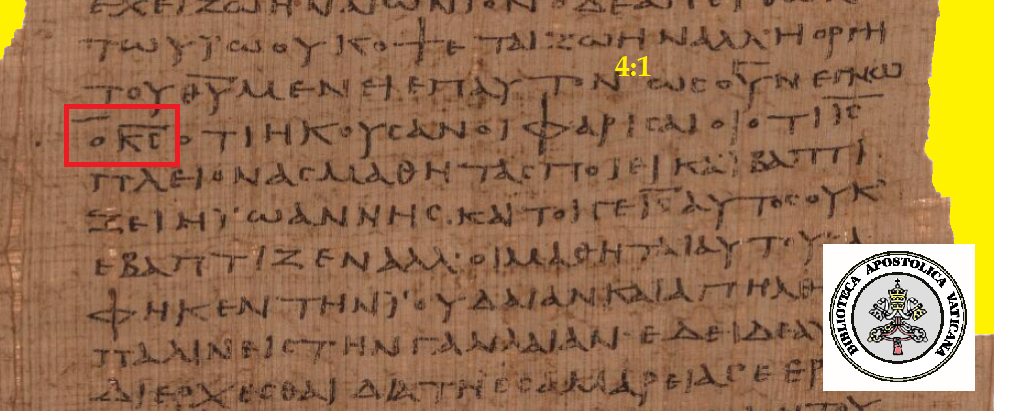
John 4:1 - "Jesus" or "The Lord"?
| Papyrus 75 |
In the
Evangelical Heritage Version, the English Standard Version, the Christian
Standard Bible, the Contemporary English Version, the Holman Christian Standard
Bible, the Legacy Standard Bible, the NET, New International Version, the NRSV,
and the New Living Translation, “Jesus” fills the place where “the Lord” appears
near the beginning of the verse.

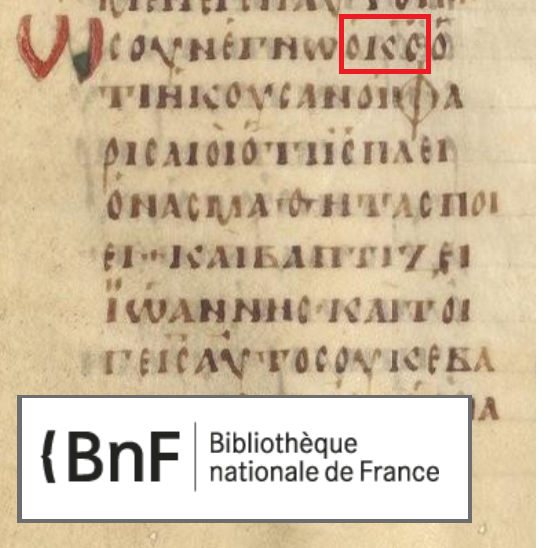
Codex 032 (W supplement)
Have
the ESV, NIV, NRSV, and NLT rejected the reading in the majority of manuscripts
in order to conform to the earliest manuscripts? No! Although Papyrus 66* and Codex
Sinaiticus, 05, 038, 039, 086 (a Greek-Coptic fragment that contains John 1:23-26, 3:5-4:18, 4:23-35, and 4:45-49, assigned
to the 500s) and f1 support Ἰησοῦς, Papyrus 66c, Papyrus
75, and Vaticanus support ὁ κύριος, as do A C L Wsupp 044 083 0141
33 700 892 etc. You read that right: the reading in the Byzantine text has earlier
manuscript support than its rival.
Versional
evidence is quite divided. The Vulgate,
the Peshitta, the Harklean Syriac, the Bohairic, the Fayummic, and most Old
Latin copies support Ἰησοῦς. The
Armenian and Georgian versions diverge:
the Armenian version supports Ἰησοῦς but the Georgian version supports ὁ
κύριος. The Sinaitic Syriac supports ὁ
κύριος and the Curetonian Syriac supports Ἰησοῦς – and so does the Sahidic
version, the margin of the Harklean Syriac, and one Bohairic copy.

Codex Regius (L, 019)
Ἰησους
is read by Epiphanius and Chrysostom, whereas Cyril supports ὁ κύριος. Augustine is inconsistent, supporting Ἰησους
in three out of four cases but ὁ κύριος once.
The
NET has a relatively long note arguing for Ἰησοῦς, but the annotator’s argument
is somewhat presumptive: the “immediate
context” is simply asserted to outweigh John’s style, and Ἰησοῦς is simply
asserted to be “the harder reading.” There
really is no reason to regard either Ἰησοῦς or ὁ κύριος as the harder reading
expect the observation that Ἰησοῦς occurs later in the verse – so the adoption
of Ἰησοῦς yields a slightly odd-sounding verse: “Therefore
when Jesus knew that the Pharisees had heard that Jesus was making and
baptizing more disciples than John.”
The scribe of Codex 039 (Λ) may have felt that the second occurrence of Ἰησοῦς seemed
jarring; he left out the second Ἰησοῦς from the text. Likewise in modern times only one occurrence
of “Jesus” is in John 4:1 in the English versions CSB, CEV, EHV, HCSB, NET, NIV,
NLT, although in the Greek base-text of these versions Ἰησοῦς appears twice. In my opinion this shows the translators’
reluctance to have the word “Jesus” appear twice in close proximity – although
that was done in the Rheims version, ESV, LSB, and NRSV.
Bruce Terry, in
defense of the reading Ἰησοῦς, has offered the
theory that “Since “Jesus” occurs twice in the following clauses, copyists were
more likely to change “Jesus” to “the Lord” to improve the style than visa
versa.” The UBS committee was divided
(favoring Ἰησους with a C grade) but Metzger stated that Ἰησοῦς was preferred on the grounds that “it is unlikely
that a scribe would have displaced it [ὁ κύριος] with
Ἰησοῦς.” That is more of an assertion
than an argument.
A better explanation is that early
scribes in the Western transmission-line anticipated that readers would be confused by
the vagueness of “ὁ κύριος” – which could refer to the Father as well as to the Son – and
decided to make the text more specific. This
was adopted in part of the Alexandrian transmission-line. Considering that support for ὁ κύριος comes not
only from the vast majority of witnesses but also from multiple transmission-lines
and from very early witnesses, and that Ἰησοῦς is supported by early Western witnesses in which exchanges
from less specificity to more specificity is typical, the reading Ἰησοῦς should be rejected in
favor of the less specific reading.
Thursday, September 5, 2024
Against Dogmatic KJV-Onlyism: Three Debates
| The Hoffner/Ferrando-Snapp Debate: Should the Interpolation Known as the Comma Johanneum Be Regarded As Scripture? |
In the second debate, - billed as "The Great King-James-Only Debate" - I defend the premise that there are imperfections in the King James Version, against brother Will Kinney who argued that the KJV is 100% perfect. Donny Budinsky was our host on his channel Standing For Truth. We investigated two shortcomings in the KJV in the Old Testament and then examined some flaws in the KJV New Testament.
| The Kinney-Snapp Debate: How To Repair Errors in the KJV |
I am confident that viewers of all three debates will be educated and edified. Each debate can be accessed by clicking on the pictures.
| The Sayers-Snapp Debate: Should We Usurp the Original Text? |
Monday, September 2, 2024
Guest Christopher Yetzer: Is Mark Ward Listening?
| Christopher Yetzer |
Take it away, brother Christopher!
Yetzer: Thanks James. Readers of The Text of the Gospels, I have a question: who isn’t listening to who?
Wednesday, August 7, 2024
Hand to Hand Combat: GA 2414 versus Sinaiticus in John 10 - and a variant in John 10:12-13
How does its (Byzantine) text compare to, say, the text of Sinaiticus in one of the most famous passages in the Gospels - verses 10-16 of Jesus' "Good Shepherd" discourse in John 10? Let's find out, using the text of NA27 as the referee. Trivial deviations from the compilation such as final nu and nomina sacra contractions will be noted but not counted as variants.
10 - has εχουσι instead of εχουσιν (-1)
11 – no variants
12 – has δε between μισθωτὸς and και [+2]
12 – has εισι instead of εστιν [+2, -3]
12 – has τὰ πρόβατα after σκορπίζει [+9]
13 – begins with Ὁ δὲ μισθωτὸς φεύγει [+17]
14 – has γινώσκομαι ὑπο τῶν ἐμῶν instead of γινώσκουσι με τὰ ἐμα [+11, -7]
15 – no variants
16 – transposes, reading με δει instead of δει με
16 – reads γενήσεται instead of γενήσονται [+1, -2]
Now let's compare Sinaiticus' text to NA27:
10 – has αιωνιον after ζωην [+7]10 - has εχουσι instead of εχουσιν (-1)
11 – no variants
12 – has δε between μισθωτὸς and και [+2]
12 – has εισι instead of εστιν [+2, -3]
12 – has τὰ πρόβατα after σκορπίζει [+9]
13 – begins with Ὁ δὲ μισθωτὸς φεύγει [+17]
14 – has γινώσκομαι ὑπο τῶν ἐμῶν instead of γινώσκουσι με τὰ ἐμα [+11, -7]
15 – no variants
16 – transposes, reading με δει instead of δει με
16 – reads γενήσεται instead of γενήσονται [+1, -2]
That’s 18 non-original letters included, and 11 original letters omitted, for a total of 29 letters’ worth of corruption. Codex Sinaiticus wins!
Or so it seems. Much depends on what happens at the end of verse 12 and the beginning of verse 13. The NASB renders these two verses as follows: "He who is a hired hand, and not a shepherd, who is not the owner of the sheep, sees the wolf coming, and leaves the sheep and flees; and the wolf snatches them and scatters the flock. He flees because he is a hired hand and does not care about the sheep."
The italicized words salvage the problem: without them, the antecedent of the entity who flees is the wolf! The shorter Alexandrian reading is clearly the more difficult reading - but it is so difficult that it is rather nonsensical. What, if the Byzantine reading is original, could have elicited the creation of the shorter reading? Simple parablepsis: If a copyist wrote, after a line ending in σκορπίζει, the words τα πρόβατα ὁ δε μισθωτός φευγει, inattentiveness could have cause a subsequent scribe to omit all six words, skipping from -ει to -ει. Major Alexandrian witnesses - P66, P75, Sinaiticus, Vaticanus, 019, etc. - weigh in for the shorter text, as well as 05 032 and the Sinaitic Syriac and the Coptic version.
Byzantine witnesses are not entirely uniform. Most MSS read τα πρόβατα ὁ δε μισθωτός φευγει but Swanson notes that Codex Π 565 and 1071 read ὁ δε μισθωτός φευγει (and the Peshitta and the Latin texts concur) - suggesting to me that an early exemplar written in narrow columns read
πρόβατα καὶ φευγει
και ὁ λύκος ἁρπάζει
αὐτὰ και σκορπίζει
ὁ δε μισθωτός φευγει -
four consecutive lines ending with -ει.
This is an especially notable variation-unit - not only because the non-inclusion of the six or four words is accounted for so readily, but also because the shorter reading is supported by the primary witnesses in both the Alexandrian and Western transmission lines - so the Byzantine reading would be, in theory, a non-Western elaboration. At the same time, the sentence without ὁ δε μισθωτός φευγει is jarring - Jesus' subject jumps from the role of the wolf to the role of the hireling without warning. One could argue that the shorter reading is thus the more difficult reading - but it can also be argued that the shorter reading is so difficult that it is unlikely to be what John initially wrote.
I propose that the text of John 10:13 should be amended in the Nestle-Aland compilation to include ὁ δε μισθωτός φευγει. If the calculation of letters' worth of corruption is altered accordingly, GA 2414 has 38 letters' worth of corruption, and Codex Sinaiticus has 47. Yet again the outcome of the contest depends on the selection of the umpire.