|
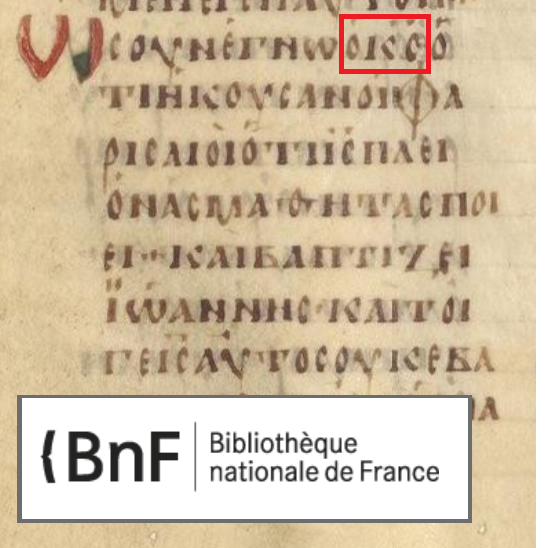
MS 1187's text of John 7:53-8:11
is similar to the text in the margin of 1424.
And they share a large annotation. |
In the
super-sparse apparatus of the Tyndale House edition of the Greek New Testament,
a note mentions that although the
pericope
adulterae (John 7:53-8:11) is absent in the text, the passage is present in
the margin.
Unfortunately, that is about
as close as readers get to a close examination of the testimony of 1424 and its
annotator regarding this passage.
Similarly
in D.A. Carson’s volume on the Gospel of John in the Pillar NT Commentary
series, after acknowledging that John 7:53-8:11 is present “in most of the
medieval Greek miniscule
[sic] manuscripts,” the author states that these
verses “are absent from virtually all early Greek manuscripts that have come
down to us.”
Displaying a degree of
one-sidedness,
Carson
does not discuss
the
Old Latin capitula at all, and he
states – erroneously – “All the early church fathers omit this narrative.”
It is a challenge to imagine how any scholar
can make such a claim, for one would have to ignore well-known references to
the
pericope adulterae in the
writings of Ambrose, Augustine, and Jerome, among many others.
Carson
– clearly echoing Metzger as he keeps readers in the dark about the reasons for
the dislocation of the passage in some manuscripts – is guilty of several other
one-sided statements that cumulatively mold the evidence and give readers a
false impression.
But rather
than dwell on such mistreatments of the evidence, let’s focus today
specifically on the testimony of minuscule 1424.
This manuscript was housed at the
Gruber Rare Books
Collection at the Lutheran School of Theology at
Chicago
until it was recently returned to
Greece.
The entire manuscript has been digitally
photographed by CSNTM, and
the page-views can be
viewed at the CSNTM website.
When we
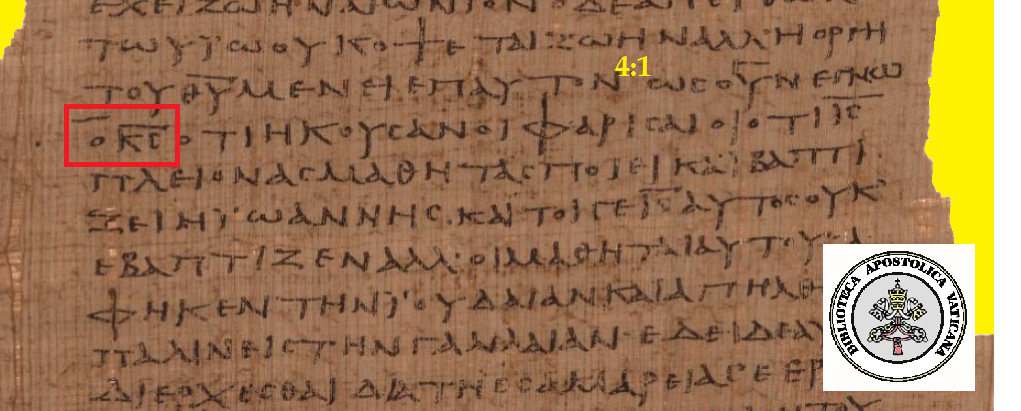
examine the relevant page of minuscule 1424, we see that at the end of 7:52,
above the line, there is a symbol that looks vaguely like the letters O and C
connected by a horizontal line. In the
text, 8:12 begins at the beginning of the next line. The O––C
symbol also appears in the outer margin of the page (although the horizontal
line is broken), accompanied by the text of the pericope adulterae in a form that is very similar to the text of
the pericope adulterae in Codex Λ,
which resembles the text that is presented in the Robinson-Pierpont Byzantine
Textform in italics, beginning with Καὶ ἀπῆλθον ἕκαστος εἰς τὸν οἶκον αὐτοῦ, without πειράζοντες in verse 4, and
without τω δακτύλω in verse 6, and when the page ends, the pericope adulterae has been presented up to a point halfway through
verse 9. Alongside the pericope adulterae in the outer (left)
margin is a stack of asterisks; three are clear and there appear to be two more
beneath then, albeit unclear.
On the
following page, verse 9 resumes, not at the top of the page, but in the lower
margin. A ⁒ symbol appears in the far
left inner margin, above a stack of two asterisks (※) alongside the
margin-text. In 1424’s margin-text, in
verse 9, ὁ Ις appears after κατελείφθη and μόνος does not appear. In verse 11, the text does not have the words
οἱ κατήγοροί σου.
And now for
the interesting part. After 8:11 ends,
there is a note (very faintly written at some points, and with lots of
contraction, so this transcription is tentative): ταυτα εν τισιν αντιγράφοις ου
κειται ουδε [’Απολιναρίου· Εν δε τοις] αρχαιοις όλα κειται· Μνημονευουσι της περικοπης ταυτης και οι
αποστολοι εν αις εξεθεντο διαταξεσιν εις οικοδομην της εκκλησίας.
This is
essential the same note that is found in
Codex Λ (039)
which accompanied John 7:53-8:11 there.
It means:
“This is not in some
copies, nor in those [copies] of Apollinarius.
In the ancient [copies] it is all present.
And this pericope was recollected by the
apostles, which affirms that it is for the edification of the church.”
That last sentence refers to
Apostolic Constitutions 2:24, which was produced around
380.
This portion of
Apostolic Constitutions, designed to prove the premise that “Our
Lord Came to Save Sinners by Repentance,” includes the following statement,
after mentioning Jesus’ statement in Luke 7:47:
“And when the elders had set
another woman which had sinned before Him, and had left the sentence to Him,
and had gone out, our Lord, the Searcher of the hearts, inquiring of her
whether the elders had condemned her, and being told, ‘No,’ said unto her, ‘Go
your way therefore, for neither do I condemn you.’ This Jesus, O you bishops, our Savior, our
King, and our God, ought to be set before you as your pattern.”
This portion of
Apostolic Constitutions can be traced to
an earlier source:
the
Syriac
Didascalia.
In its seventh chapter (or in some formats,
near the end of the sixth chapter), following a discussion on the Prayer of
Manasseh, the author of the Syriac
Didascalia
states:
“For
if thou receive not him who repents, because thou art merciless, thou sinnest
against the Lord God, because thou dost not obey our Lord and God in acting as
He acted; for even He to that woman who had sinned, her whom the elders placed
before him and left it to judgment at His hands, and went away; He them who
searcheth the hearts, asked her and said to her, ‘Have the Elders condemned
thee, my daughter?’ She saith to Him,
‘No, Lord.’ And our Saviour said, ‘Go, and return no more to do this, neither do
I condemn thee.” In this therefore let
our Saviour and King and God be to you a sign, O Bishops!” (Gibson’s
translation)
The Syriac Didascalia
is generally assigned to the first half of the 200s, which makes this
reference pretty much as old as the oldest witnesses for non-inclusion of the pericope adulterae.
The note that
appears in 1424, confirming that the entire passage is not in some copies but
is all present in ancient copies, and so forth, is not only shared by
Codex
Λ but also in
minuscule
1282 (on Image 0214b at CSNTM, at the foot of the page).
In MS 1282, on this page and the one that
follows, a stack of obeli accompanies the text of John 8:3-11 (but not
7:53-8:2) in the outer margin.
(In the
upper margin, the chapter-title “#10 – About the Adulteress” appears in red
ink.)
Minuscule 1443 has a
similar format – John 7:53-8:11 is included in the text, and 8:3-11 is accompanied
by a stack of obeli in the margin – but does not appear to have the note.
Minuscule
1187 also has a similar format – John 7:53-8:11 is included in the text,
and 8:3-11 is accompanied by a stack of obeli in the margin, and in
the
lower margin of 1187 5, there is the note.
The note also
appears (with minor differences) in minuscules 20 (which has the
pericope adulterae after John 21), 215,
262, and 1118.
This points to a common
source, for these manuscripts, along with Codex Λ, feature the
Jerusalem Colophon.
(Tommy Wasserman, using information from
Maurice Robinson and other resources, has confirmed this in
a
detailed essay.)
The presence of the both
the Apollinarius Colophon and the
Jerusalem Colophon in the same manuscript indicates that the “ancient copies”
referred to in the Apollinarius Colophon – in which the entire pericope adulterae is stated to be
present – are the same manuscripts referred to in the Jerusalem Colophon (or,
the prevalent form of it) “the ancient exemplars from Jerusalem preserved on
the holy mountain.”
In addition, the
close similarity of the text of the pericope
adulterae in Codex Λ and in the margin of 1424 and in the text of 1187
suggests that the possibility of a historical link between these three
manuscripts should be explored. Both Λ
and 1424’s margin do not have τω δακτύλω in verse 6, and in 1187, τω δακτύλω is
not in the main text of verse 6 either; it is added as a correction in the
side-margin. (This variant-unit is not covered in NA27.)
So, the next time you see 1424 listed as a witness for non-inclusion of John 7:53-8:11, remember that while that is true, it is also true that a marginal note in 1424 (shared by five other manuscripts) affirms the use of the passage in Apostolic Constitutions (c. 380, echoing a source from the early 200s) and also affirms that in ancient manuscripts, the whole passage is present, and that the ancient manuscripts being referred to were (or were thought to be) cherished copies at a holy mountain.