Followers

Showing posts with label Diatessaron. Show all posts

Tuesday, October 1, 2024

Another Misleading Footnote - First Nations Version

           This is not a review of the First Nations Version of the New Testament, the work of translators such as Terry Wildman and Gordon Campbell, Alvin Deer, Antonia Belindo, Bryan Jon Maciewski and others which was released in 2021.  Today I want to simply point out that despite being recommended by scholars such as Matthew Schlimm (University of Dubuque Theological Seminary) and  L. Daniel Hawk (Ashland Theological Seminary), the First Nations Version perpetuates false information in its footnote at the end of Mark 16:8.  

The footnote says, "Most ancient manuscripts end at this verse.  Some others include verses 9-20 as we have in this translation."

            The problem is that only two ancient Greek manuscripts end the text of Mark at the end of 16:8.  And the "some" is over 1,650 Greek manuscripts.  In addition, earlier witnesses such as Tatian's Diatessaron and Irenaeus (in about 180) support the inclusion of verses 9-20; Irenaeus explicitly cited Mark 16:19 in his third book of Against Heresies.

            I don't know why it seems so hard for some people to write an accurate footnote.  The possibility occurs to me that if they were accurate and let readers know how lopsided the external evidence is in favor of including Mark 16:9-20, readers would stop trusting the scholars who want to erase the passage from the Gospel of Mark.  I suspect that some people are rejecting Mark 16:9-20 not because of the evidence but because they don't like what this Scripture says - they don't like the idea that baptism normally is a step into salvation instead of a consequence of salvation; they want Jesus to say "He who believes and is saved shall be baptized" instead of "He who believes and is baptized shall be saved."  Or perhaps they don't like reading an endorsement of glossolalia from the lips of Jesus because they believe that sort of thing isn't for modern-day Christians.  Whatever the reason, the headings and footnotes in a lot of modern versions at Mark 16:9 are pitiful.  A half-truth is a whole lie.  FIX YOUR FOOTNOTES, Bible publishers.  Crossway and Holman and Zondervan, I'm talking to you.  You can do it if you want to.

Wednesday, October 4, 2023

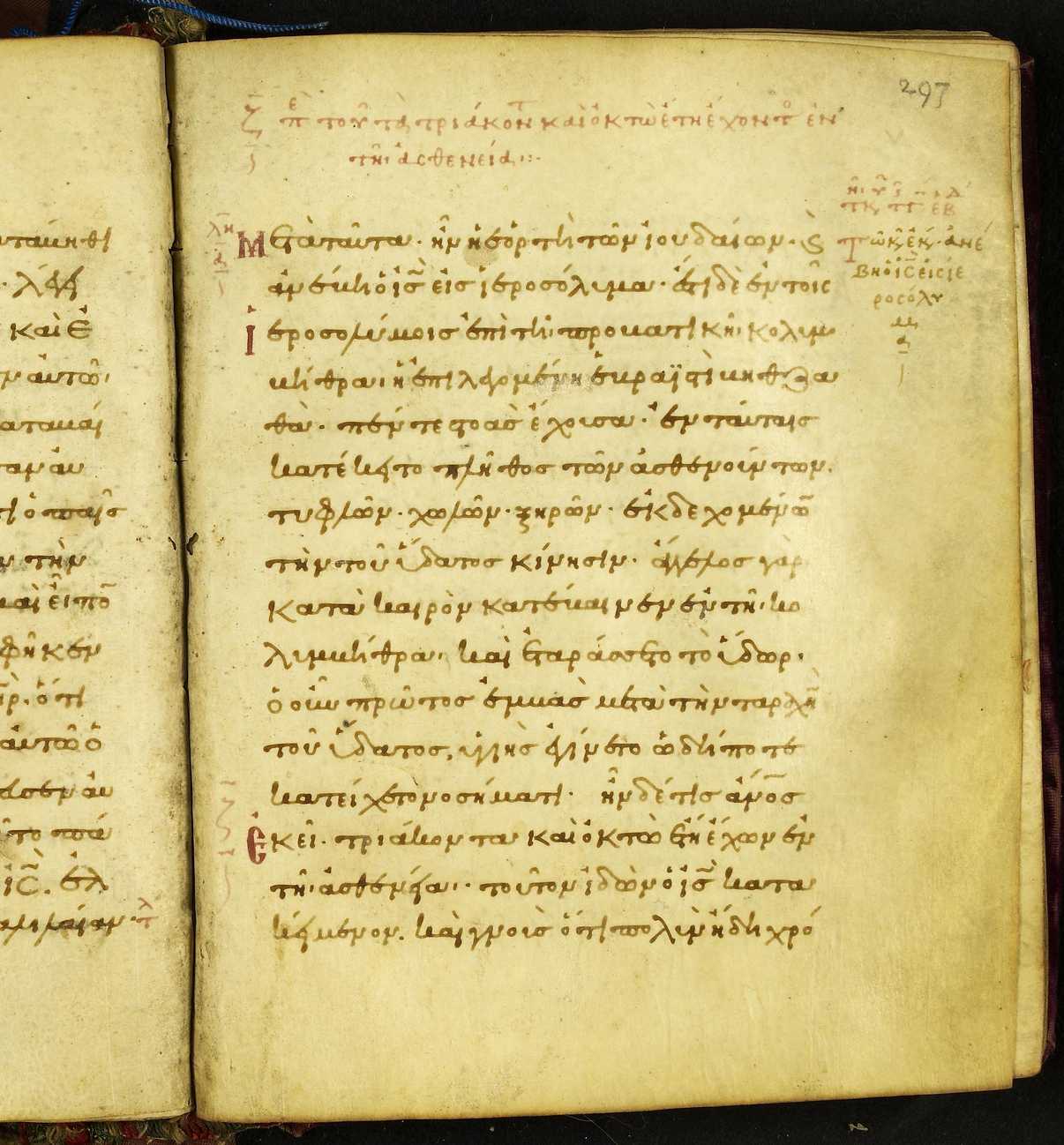
John 5:3b-4: Original or Not?

            Metzger’s observation that 5:3b contains two “non-Johannine” words is lightweight, considering that John had few other occasions to use either ἐκδέχεσθαι or κίνησις.

            (I commend to readers both the article written by Zane Hodges in 1979 in Bibliotheca Sacra 136, pp. 25-39, and the article by Gordon Fee which appeared in Evangelical Quarterly 54 (pp. 207-218.)              

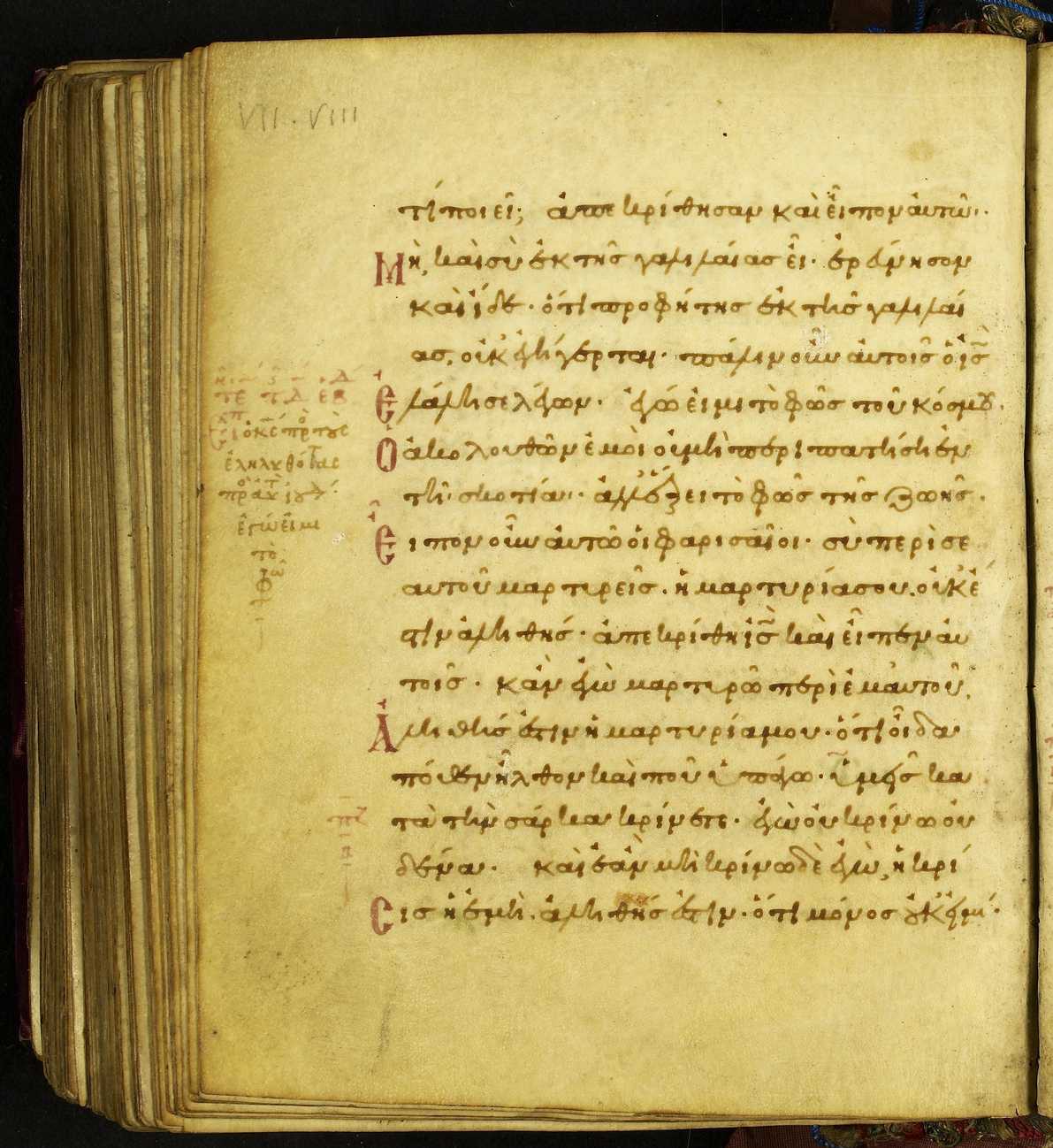
            Before reaching a conclusion about John 5:3b, let’s investigate 5:4.  Dr. Bill Mounce addressed this variant briefly, but his treatment is extremely oversimplified.  More is required.  First, we must get an idea of how much textual variation there is within this verse.  In A K L Y Δ Π, κυρίου (ΚΥ) appears after αγγελος γαρ (or, in L, αγγελος δε).  And instead of κατέβεινεν, A K Π Ψ 579 have ἐλούετο.  And A (supported by some Bohairic manuscripts) has ουν between δήποτ’ and κατείχετο.  Instead of δήποτε, K and Π have δ’ αν.  In Cc H M U Y Δ Λ Π 078 and at least 17 lectionaries, instead of ἐτάρασσεν, the text reads ἐταράσσετο.  The Ethiopic version also supports ἐταράσσετο.   Swanson erroneously lists Δ as if it reads ἐταράσσετο and ἐτάρασσεν; a check of the manuscript show that it supports ἐταράσσε το (the το being the το before ὕδωρ).  

            Plus, in S Λ Π 047, and 72 minuscules, the passage is marked with asterisks.  The Harklean Syriac also features the verse marked with asterisks.

             The external evidence mostly aligns with the external evidence for 5:3b – but not quite. D Wsupp 33, 2718, and the Armenian and Georgian versions, which include 4:3b, do not imclude 5:4.  5:4 is supported by Tatian’s Diatessaron (as demonstrated by a comment by Ephrem in his commentary ), by Ambrose, by Tertullian, by Chrysostom (who was listed in UBS1 as a witness for both inclusion and non-inclusion), and Cyril.  

            Tertullian, in De Baptismo 5, near the end of the chapter, wrote, “If it seems an unheard-of thing that an angel should interfere with water, there was a precedent for that which was to be. The pool of Bethsaida ‘was stirred’ by the intervention of ‘an angel.’  Those who complained of their health used to watch for him. For anyone who had first descended there ceased to complain after a bath. This picture of bodily cure was prophetic of spiritual cure, according to the practice by which things carnal always precede, being a picture of things spiritual. As, therefore, the grace of God spread among men, greater power was added to the waters and the angel.”

            Tertullian goes on to say, “Those who healed bodily defects now heal the spirit.  Those who worked temporal salvation now restore for us everlasting salvation.  Those who freed one once a year, [this indicates how Tertullian understood κατά καιρόν] now daily save communities, death being destroyed by the washing away of sins.”  Tertullian clearly had no problem reading this verse and applying it to the life of the church.

            Chrysostom commented on 5:3b-4 in detail in his commentary on John, perceiving in the paralytic’s healing a thematic template of baptism and salvation. 

            Tertullian, in Latin, and Chrysostom, in Greek, demonstrate the antiquity of the passage in the text, as early as two papyri from c. 200 and c. 400 would.  Chrysostom also shows that John 5:4 was read in the text of the church in Byzantium during his bishopric.  Amphilochius of Iconium (340-403; bishop after 374) – cousin of Gregory of Nazianzus – does not include 5:4 in the text he used.  Both the non-inclusion and inclusion of 5:4 are very early readings.

            What phenomenon, occurring sometime between 90 (when the Gospel of John was written – unless John Robinson’s redating to pre-70 – in light of (among other things) 5:2 – is adopted) and 200, could elicit one transmission-stream to include John 5:4 (in the case of Tertullian’s text of John), and another transmission-stream to not include John 5:4 (in the case of P75, À, and B)? 

            I am willing to posit that an anomaly in the autograph of the Gospel of John itself elicited different treatments of John 5:3b-4.  Picture John reading chapter 5 to his listeners from the autograph for the very first time – without 5:3b-4.  Inevitably, someone would ask, “John, why were these sick, blind, lame, and paralyzed people waiting near the pool instead of swimming in its water?”  And I can imagine that John added an explanatory note in the margin, “waiting for the moving of the waters.”

            And then someone asked, “What agitated the pool’s water?”.  And John, realizing that his listeners in Ephesus were oblivious to the background of the pool at Bethesda, added another note – and thus verse 4 came into existence as a second marginal note.  When John died, the autograph was entrusted to the Christian community at Ephesus – and they treated the annotations in three different ways in the next generation:

            In the ancestor of Byzantine manuscripts, the notes were either blended into the main text (as John 21 has been), or else copies just the way they appeared in the autograph, in the margin with symbols to connect them to John 5:3-5.  In the ancestor of Alexandrian manuscripts, receiving the text of the autograph slightly later (being in Egypt, not Ephesus), the notes were assumed to have originated with someone other than John, and were therefore not considered worthy to be included in either the main text or in the margin. 

            Another consideration might have been in play in the mind of the early Alexandrian scribe who decided not to include verse 4:  a desire to protect John from the charge of promoting superstition.  A scribe who thought he knew that water in the pool of Bethesda was agitated by entirely natural forces could easily persuade himself that the marginal note in his exemplar, stating that an angel of the Lord bathed in the pool of Bethesda, could not have been written by an inspired author; in addition, he did not wish to appear to commend Asklepieions.

            The testimony of P and its relatives which have John 5:4 with asterisks commends family P as an excellent representative of the autograph of the text of the Gospels.  The form of verse 4 that appears in Codex P is the form which should be adopted, instead of the readings found in the majority of manuscripts.

            An addition question is sure to be asked:  what should English Bible editors do with John 5:3-4?  I have no objection to the inclusion of 5:3-4 in the main text, or in the margin, with a note stating that the passage appears in the margin, or not at all, in a few early manuscripts.  But to omit it entirely would guarantee that English readers would perpetually ask, as John’s first listeners did, “Why weren’t they all swimming?” or, “Who or what stirred up the waters?”

            Another question may be on the minds of some readers:  Would an inspired author expand on his own narrative in this way, adding marginalia?  I see no reason why not.  Many a Spirit-led preacher reading from a manuscript he wrote has spontaneously clarified himself mid-sermon.  Even Saint Paul, in First Corinthians 1:16, clarified that he had baptized the household of Stephanas (who, according to tradition, was the jailor in Acts 16), right after saying, “I baptized none of you except Crispus and Gaius.”  I Cor. 1:16 may have originally been a note in the margin added by Paul as he proof-read the letter; no one at Corinth, however, would have doubted its veracity.


Thursday, August 25, 2022

Tatian and Mark 16:9-20

           Recently the website of the Text & Canon Institute featured a case for Mark 16:9-20, by me, and a case against Mark 16:9-20, by Dr. Peter Head.   My attention in this post is focused on Dr. Head’s reluctance to admit that Tatian knew Mark 16:9-20 and used material from Mark 16:9-20 in the Diatessaron.

          Dr. Head wrote about coming to  more cautious conclusions about Tatian’s Diatessaron” because “Snapp’s evidence for this second-century harmony actually comes from a sixth-century Latin manuscript and a fourth-century Syriac commentary.”  The sixth-century Latin manuscript to which he referred is Codex Fuldensis.  The fourth-century Syriac commentary to which he referred is the commentary by Ephrem Syrus (d. 373). 

          Before looking into Ephrem’s commentary and Codex Fuldensis further, two things should be pointed out. 

          (1) Dr. Head’s own footnote for the above quotation runs as follows:   “Within this Syriac commentary, the only evidence for the Longer Ending of Mark comes in the form of Jesus’ commission:  ‘Go forth into the whole world, and baptize in the name of the Father, and of the Son, and of the Spirit.”  This admittedly, does seem like a conflation of Mark 16:15 and Matt 28:19.  But that is the only direct evidence.  Quoted from C. McCarthy, Saint Ephrem’s Commentary on Tatian’s Diatessaron: An English Translation of Chester Beatty Syriac MS 709 with Introduction and Notes (JSSS 2; Oxford: OUP, 1993), 289.”  Notice the line, “This admittedly, does seem like a conflation of Mark 16:15 and Matt 28:19.”  What else does Dr. Head imagine that it could be?         

          (2) Contrary to Dr. Head’s footnote, the passage on page 289 of McCarthy’s book is notthe only direct evidence.”  On page 145, near the beginning of Part VIII of Ephrem’s commentary as preserved in Chester Beatty Syriac MS 709 (made in 480-500; see pp. 138-139 of Michelle Brown’s In the Beginning:  Bibles Before the Year 1000 for a picture), McCarthy provides the part of the commentary in which Ephrem’s main focus is on the occasion of the sending of the disciples (in Matthew 10 and Luke 10).  After noting that on this occasion, Jesus “restrained his disciples, lest they preach to the Gentiles,” Ephrem wrote,  “After they had crucified him, he commanded his disciples, ‘Go out into the whole world and proclaim my Gospel to the whole of creation, and baptize all the Gentiles.” (Comm. VIII  §1b in McCarthy 1993).  This was indexed as a reference to Matthew 28:18, but it is clearly based on Mark 16:15. McCarthy notes that §1b “is absent from the Armenian version.

         Now let’s review some developments in the study of the Diatessaron.  In 1880, in Institute Lectures, Ezra Abbot speculated that the Armenian version of Ephrem’s commentary was “made, it is supposed, in the fifth century” (Institute Lectures p. 173).  (The Armenian manuscripts themselves were from 1195.)  A Latin translation of the Armenian text that had been prepared by J. P. Aucher (using one Armenian manuscript) and edited by George Moesinger (using another Armenian manuscript) was published in 1876, and, Abbot reported, it went “almost unnoticed by scholars.”  

James Rendel Harris 
          J. Rendel Harris, in The Diatessaron of Tatian:  A Preliminary Study, (1890) offered a few more details about this Armenian text of Ephrem’s commentary, beginning on page 22, pointing out that Paul de Lagarde was an exception to Abbot’s generalization.   Harris then described the 1881 work of Theodor Zahn, in Forschungen zur Geschichte des Neutestamentlichen Kanons, Theil. 1, “Tatian’s Diatessaron, as “a skillful combination of this work of Ephrem with the earlier Syriac writers” that provides the means to “very nearly judge without the Arabic Harmony, what sequence Tatian followed, what passages he omitted, and what additions his text shews when compared with later texts.”

          Zahn’s work was eclipsed in 1888 by the publication of Tatiani Evangeliorum Harmoniae Arabice by Agostino Ciasca, in which Ciasca presented the Arabic text of the Diatessaron as found in two manuscripts, from the 1100s and 1300s.   Harris reported (on page 8) that in the manuscript from the 1300s, a colophon states that it was translated from Syriac into Arabic by Abu-l-Faraj Abdullah Ben-at-tîb, and that its Syriac basis had been made by ʻIsa ben Ali Almottabbeb, a disciple of Abu Zaid Honain ben Ishaq.

          Harris went on to say that Abu Zaid Honain ben Ishaq was “a famous Syrian physician and writer in medicine, who died in the year 873, and whose headquarters were at Bagdad.”  He also mentions that Bar-hebraeus, a later writer, gives the date of the death of Abdulfarag as A.D. 1043.

          Harris wrote, “The Diatessaron had seen 700 years of Syriac life before its translation into Arabic; and we can readily infer that the Syriac at the time of translation must have been in many points altered from its original cast.  Still, the comparison with the collateral evidence is sufficient to justify us in our belief that we have here substantially the work of Tatian.”

          Mark 16:9-20 is plainly incorporated into the text of the Arabic Diatessaron that was published by Ciasca.  We should ask, then, (1) Is the inclusion of Mark 16:9-20 in the Arabic Diatessaron a result of an expansion based on the Peshitta (the Syriac text), and (2) Is the inclusion of Mark 16:9-20 in Codex Fuldensis a result of an expansion based on the Vulgate?” 

          To find the answer to this question, we must compare the arrangement of Mark 16:9-20 in the Arabic (Syriac-based) Diatessaron (an Eastern witness) and the arrangement of Mark 16:9-20 in Codex Fuldensis (a Western witness).    

          I should first briefly introduce Codex Fuldensis.  This manuscript was produced in 541-546, under the supervision of bishop Victor of Capua (in Italy).  The Gospels-text in Codex Fuldensis is a Vulgate text, but Victor reported that its arrangement in Codex Fuldensis was based on the arrangement of an older Latin text which Victor suspected of being a translation of Tatian’s Diatessaron.  It is described a little more by J. M. Harden in Some Manuscripts of the Vulgate New Testament.  

          By comparing the arrangement of the material from Mark 16:9–20 in the Arabic Diatessaron, and the arrangement of the material from Mark 16:9–20 and Codex Fuldensis, we can discern whether their arrangements can be reasonably attributed to two independent harmonists, or if they are so similar as to demand to be recognized as a trait derived from Tatian’s Diatessaron.

          Using, for convenience, J. Hamlyn Hill’s 1894 English translation of the Arabic Diatessaron and the presentation of the Latin text of Codex Fuldensis made by Ernestus Ranke (1868), a comparison can be made of eleven aspects of their arrangements of Mark 16:9–20. (“Arab D” represents the Arabic Diatessaron, and “Fuld” represents Codex Fuldensis.)


1►    Arab D 53 has Mk 16:9 after Jn 20:2–17.

1►    Fuld 174 has part of Mk 16:9 between Jn 20:2–10 and 20:11–17.


2►    Arab D 53 uses Mk 16:10 after Lk 24:9.

2►    Fuld 176 uses Mk 16:10 after Lk 24:9.


3►    Arab D 53 uses Mk 16:11 between Lk 24:10 and 24:11.

3►    Fuld 176 uses Mk 16:11 between Lk 24:9 and 24:11.


4►    Arab D 53 uses Mk 16:12 between Lk 24:11 and 24:13.

4►    Fuld 177 uses Mk 16:12 between Lk 24:11 and 24:13.


5►    Arab D 53 uses Mk 16:13b between Lk 24:13b–35 and part of Lk 24:36.

5►    Fuld 178 uses Mk 16:13b between Lk 24:13–35 and part of Lk 24:36.


6►    Arab D 55 uses Mk 16:14 between Mt 28:17 and 28:18.

6►    Fuld 182 uses Mk 16:14 between Mt 28:17 and 28:18.


7►    Arab D 55 uses Mk 16:15 between Mt 28:18 and Mt 28:19.

7►    Fuld 182 uses Mk 16:15 between Mt 28:18 and 28:19.

          (The Arabic text also includes “For even as my Father sent me, so I also send you,” which is normally found in Jn 20:21 but is also in the Peshitta in Mt 28:18.  The Syriac text translated into Arabic was probably conformed to the Peshitta to this extent.)

8►    Arab D uses Mk 16:16–18 between Mt 28:20 and Lk 24:49.

8►    Fuld 182 uses Mk 16:16–18 between Mt 28:20 and Lk 24:49.


9►    Arab D blends “And our Lord Jesus,” from Mk 16:19 with Lk 24:50.

9►    Fuld 182 does not.


10►  Arab D uses “and sat down at the right hand of God” (from Mk 16:19) between Lk 24:51 and 24:52.

10►  Fuld 182 uses “and sat down at the right hand of God” (from Mk 16:19) between Lk 24:51 and 24:52.


11►  Arab D uses Mk 16:20 between Lk 24:53 and Jn 21:25.

11►  Fuld 182 uses Mk 16:20 after Lk 24:53 and ends there with “Amen.” (In Codex Fuldensis, Jn 21:25 appears at the end of 181.)

           So:  there are small differences, but the arrangement of the contents of Mark 16:9–20 in Codex Fuldensis, and the arrangement of the contents of Mark 16:9–20 in the Arabic Diatessaron, are essentially the same. (By the way, this evidence was presented by me in 2012 in The Heroic Age.)

          The agreement between Codex Fuldensis and the Arabic Diatessaron, as evidence that Tatian’s Diatessaron included Mark 16:9-20, has  corroborative witnesses besides Ephrem’s commentary.  One of them is Aphrahat, a Syriac writer who used the Diatessaron.  According to Harris, Aphrahat’s “first 22 homilies are based upon the text of the Diatessaron.”  Harris says that these homilies “were written about the year 336 A.D., and a supplementary 23rd homily was added in the year 345.”

           In Aphrahat’s first homily, also called “Demonstration One:  Of Faith,” he wrote in chapter 17, “When our Lord gave the sacrament of baptism to his apostles, he said thus to them: Whosoever believes and is baptized shall live, and whosoever believes not shall be condemned,” and, “Again he said thus: ‘This shall be the sign for those that believe; they shall speak with new tongues and shall cast out demons, and they shall lay their hands on the sick and they shall be made whole’” (See John Gwynn’s 1898 Selections, Translated into English, from the Hymns and Homilies of Ephrem, and from the Demonstrations of Aphrahat the Persian Sage, on page 351).

          (Aphrahat’s Demonstration One was misidentified in the textual apparatus of the UBS Greek New Testament (1966) as a work of Jacob of Nisibis, even though John Burgon had corrected such misidentification in 1871 on page 258 of The Last Twelve Verses of Mark.)

          In conclusion:  there is no real justification for Dr. Head’s caution, and there should be no doubt at all that Mark 16:9-20 was in Tatian’s Diatessaron.


Thursday, June 25, 2020

Video Lecture: How To Use the Nestle-Aland Apparatus

            Now on YouTube:  the seventh lecture in the series Introduction to NT Textual Criticism!  In this 23-minute lecture, I discuss the textual apparatus in the 27th edition of the Nestle-Aland Novum Testamentum Graece and the United Bible Societies Greek New Testament, and explain many of the symbols and features found therein. 
https://www.youtube.com/watch?v=UQQr2DeeTl4

(At around the 5:43 mark, the slide that refers to letters should refer instead to numbers.)


Saturday, February 22, 2020

The Adventures of the Peckover Manuscripts

Algerina Peckover (1841-1927)
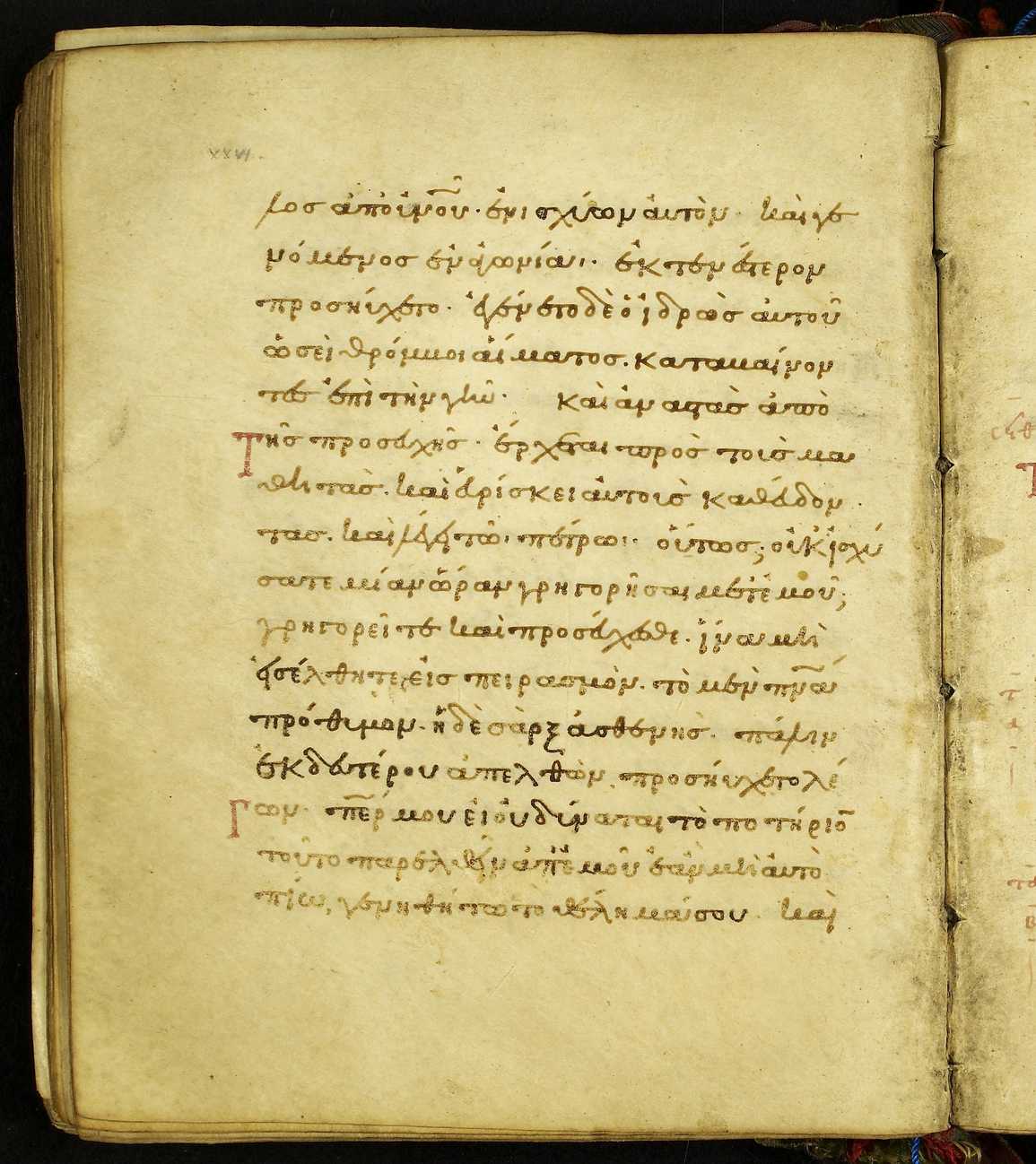
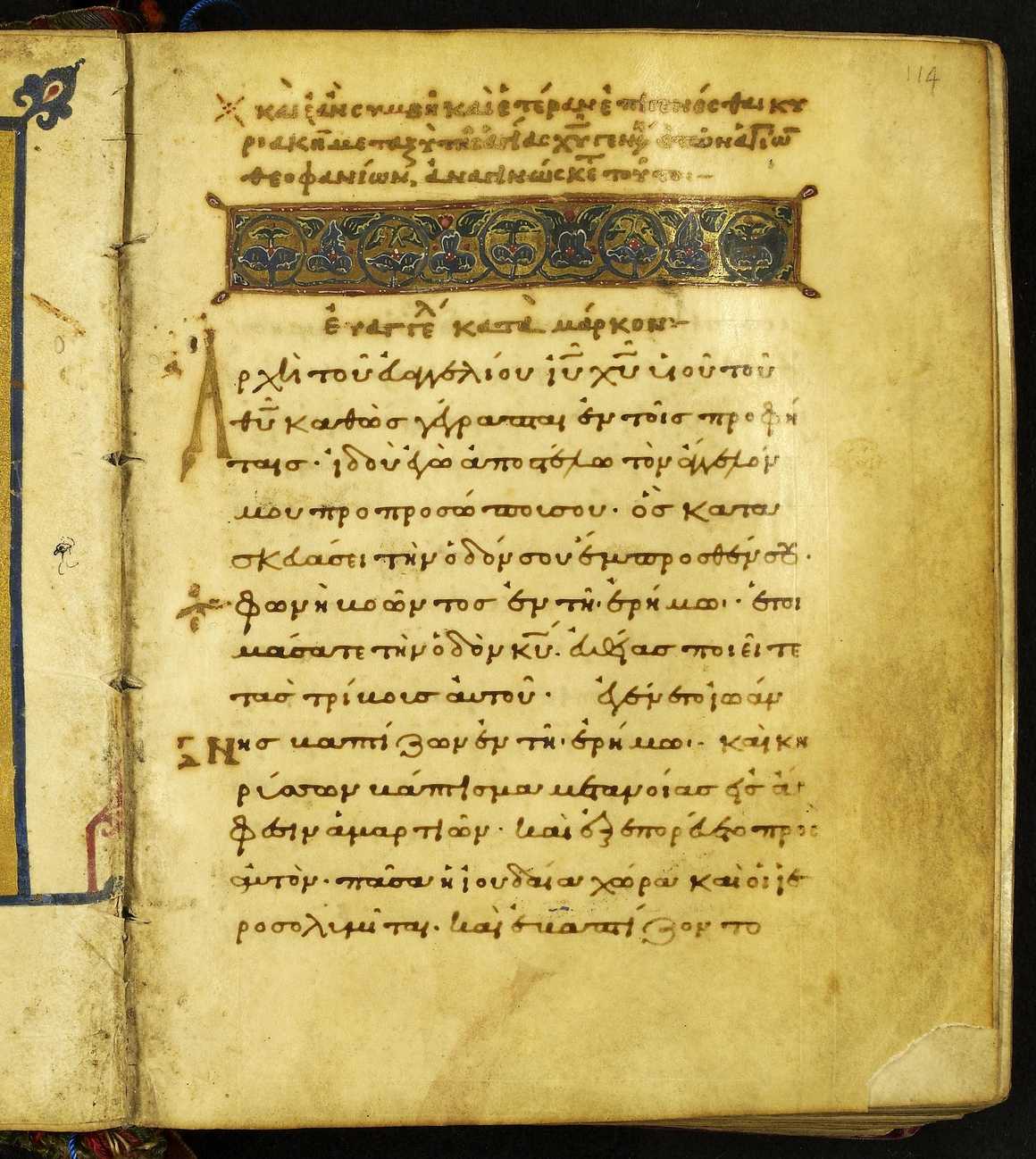
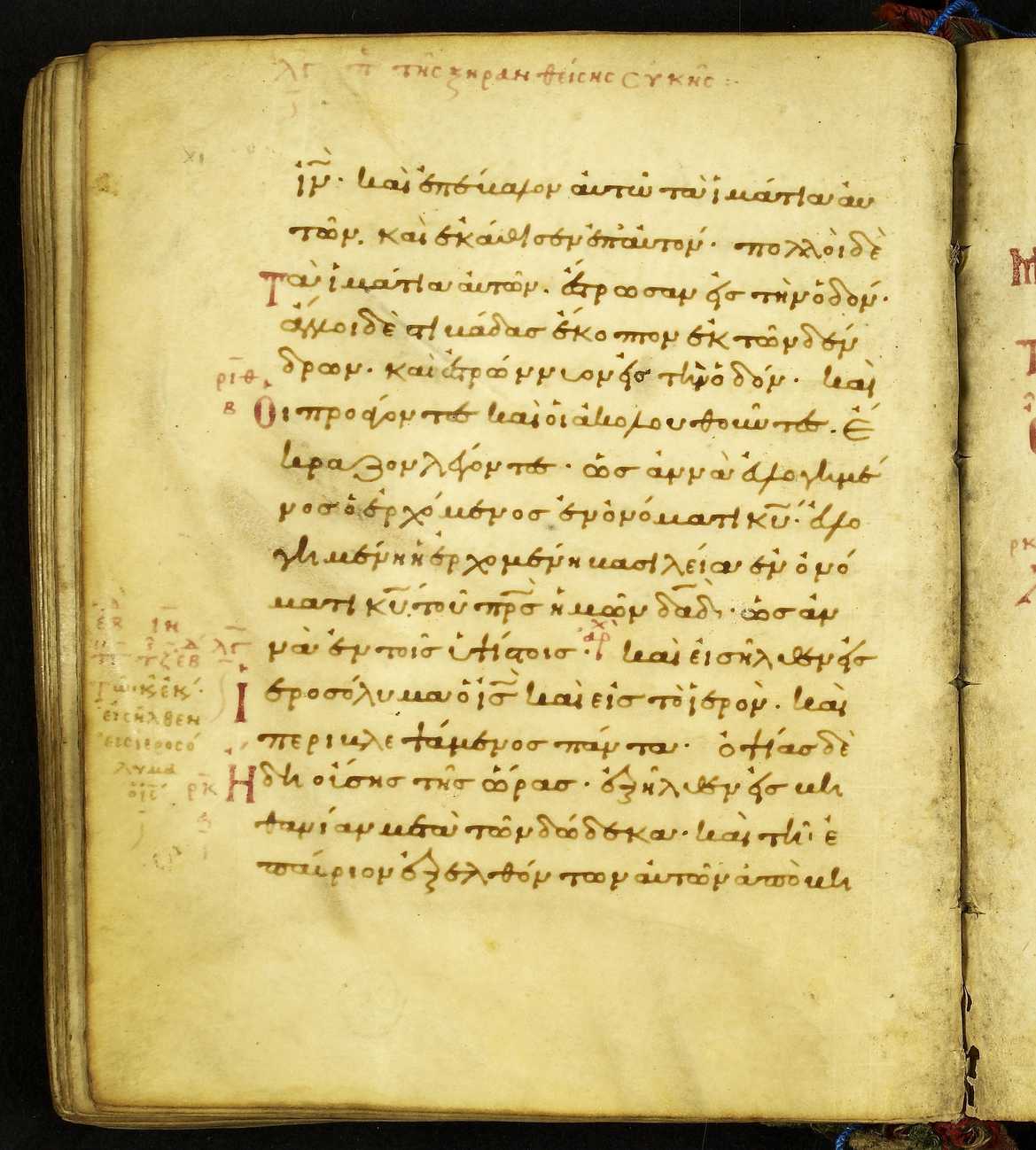
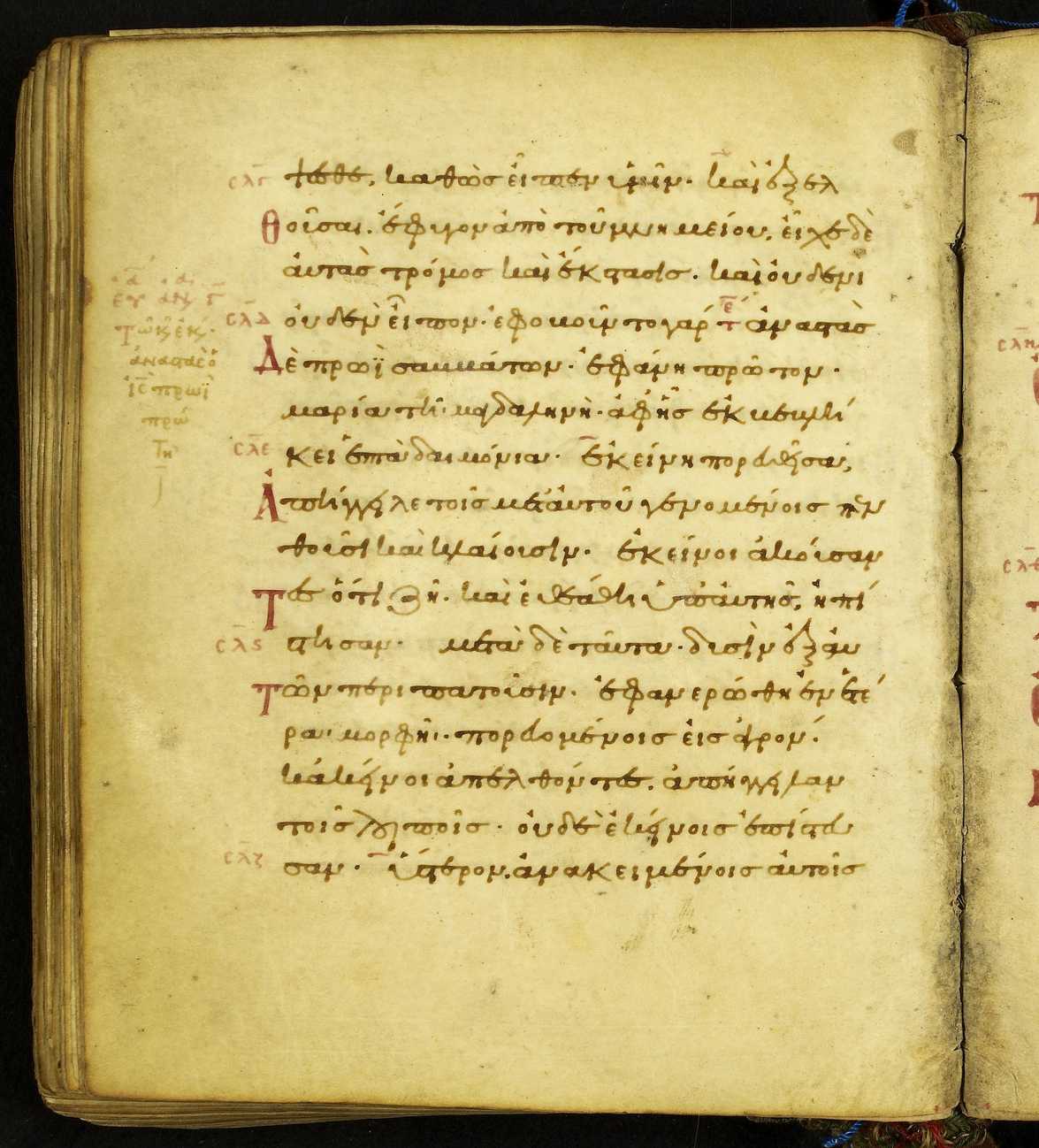
            In 1876, Bernard Quaritch sold two Greek New Testament manuscripts to Alexander Peckover of Wisbech, in Great Britain.  They were later entrusted to his sister, Algerina Peckover.  One of these two manuscripts is GA 713, which is somewhat more famous than the average manuscript, on account of its ambiguous relationship to the family-13 cluster of manuscripts (13, 69, 124, 346, etc. – 230, 543, 826, 828, 788, 983 and 1689 are also members).  Like the main members of family-13, GA 713 has Luke 22:43-44 inserted into the text between Matthew 26:39 and 26:40.  Unlike the main members of family-13, GA 713 does not contain the pericope adulterae at all, whereas they retain it at the close of Luke 21.
            J. Rendel Harris provided a description of GA 713 (then known as Cod. Ev. 561) in 1886 in the pages of the Journal of the Exegetical Society.  It is a nearly complete Gospels-manuscript (three sheets, i.e., six pages front-and-back, are missing in John), produced in the 1000s or 1100s.  On a page before the Gospels, part of Eusebius’ Ad Carpianus is written within a quatrefoil frame.  This page (and adjacent pages, and pages at the end of the manuscript) is a palimpsest; the lower uncial writing is part of Lectionary 586, assigned to the 900s.  Notes in the manuscript (at Mt. 5:14 and Mt. 16:15) indicate that it was used at Hagia Sophia in Constantinople.  Harris mentions several intriguing readings in GA 713, including: 
            ● In Matthew 13:35, its text names Isaiah as the prophet being quoted (although the citation is from Psalm 72) – a reading supported by the f13 text, and by Codex ℵ (Sinaiticus).
            ● In Matthew 17:27 (concluding the episode about the temple-tax), the text in 713 is somewhat tweaked so that Peter says, “Yes” after Jesus’ statement in v. 26 that the children are free, and then Jesus prefaces His instructions to Peter by saying, “Therefore, you give also, as a stranger to them.”  This little addition probably goes all the way back to the Diatessaron.
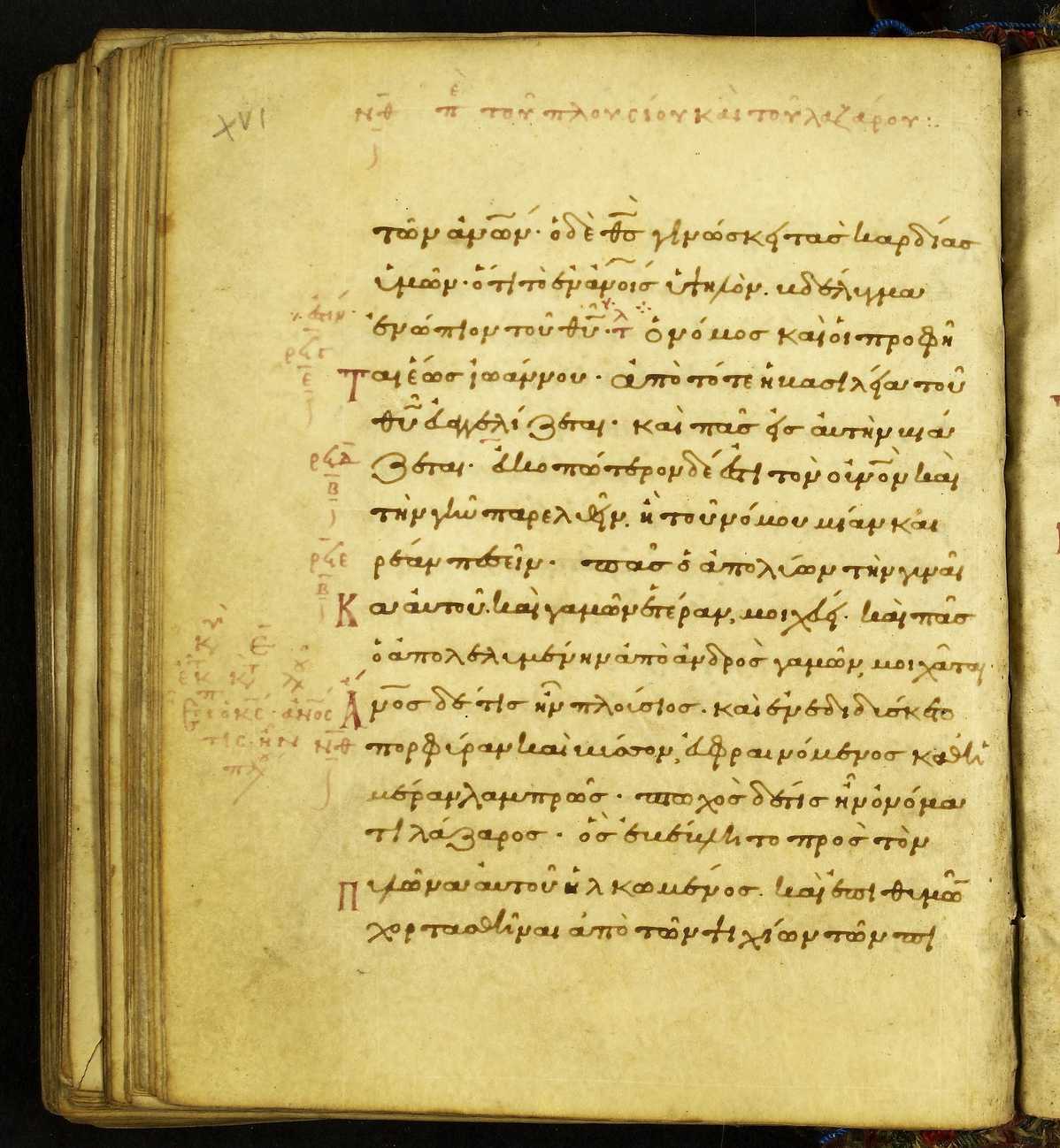
            ● In Matthew 24:45, it reads οἰκίας instead of θεραπείας – agreeing with 69 and with Codex ℵ. 
            ● In Mark 14:41, it has the reading ἀπέχει τὸ τέλος (a reading also found in the f13 text, and which Burgon (in a footnote on p. 226 of The Last Twelve Verses of Mark Defended, 1871) had already proposed is accounted for as the intrusion of a margin-note indicating the end of a lection).
            ● In Luke 14:24, it has “For many are called, but few are chosen” – again agreeing with the f13 text.
            ● In John 7:8, it reads ὁ κληρος (portion) instead of ὁ καίρος (time), which (as Harris deduced) indicated that somewhere in 713’s ancestry, the copyist of an uncial manuscript confused the letters Η and Ι (an ordinary case of itacism), and a copyist also confused the letters Α and Λ (not a hard mistake to make in uncial script, but harder in minuscule script).
            GA 713, to which Harris gave the name Codex Algerina Peckover, instructively shows that when attempting to establish relationships among manuscripts and their texts, one should keep in mind the potential influence of liturgical treatments of the text, which can independently affect the texts of manuscripts in the same way at the same point, and even do so in multiple passages, although the manuscripts themselves are not closely related.
           
Baron Peckover's coat-of-arms
            But although GA 713 has greater text-critical significance than GA 712, it is to GA 712 that we now turn our attention.  Scrivener, in his Plain Introduction, described GA 712 as “an exquisite specimen” from the 1000s, containing the Gospels, Acts, and Epistles – that is, a complete New Testament except for Revelation.   It features portraits of the four Evangelists.  This codex is presently extant as two items in two distant libraries:  the main portion is in the United States – specifically, in California, at UCLA at the Charles E. Young Research Library’s Special Collections, where it is catalogued as item 170/347, the “Peckover-Foot Codex.” – and a much smaller portion (in which the only New Testament text is the last part of the Epistle of Jude) that consists of five folios is at the Russian National Library in St. Petersburg.
            The story of how two different portions of the same manuscript ended up in two collections separated by 5,700 miles is told by Julia Verkholantsev in the 2017 article From Sinai to California:  The Trajectory of Greek NT Codex 712 from the UCLA Young Research Library’s Special Collections (170/347), which was published in Manuscript Studies, A Journal of the Schoenberg Institute for Manuscript Studies. 
            To grasp the details of the history of GA 712’s travels, Verkholantsev’s article is indispensable.  Briefly, what appears to have happened is that when Porfirii Uspenskii (sometimes spelled Uspensky – the Uspensky Gospels, GA 461, is named after him) was studying manuscripts in Cairo, at a metochion – basically, a satellite – of Saint Catherine’s monastery, in the Juvania district (or, perhaps, on a street called Juvania) and there he encountered GA 712.  He proceeded to describe it in his catalogue of Greek manuscripts, including the closing note by the scribe Iōannikios.  Uspenskii died in 1885, but eventually, his catalogue of manuscripts was edited and published in 1911 by Vladimir Beneshevich – a Russian Orthodox scholar who was eventually executed by the Soviet Union – under the title Catalogus Codicum Manuscriptorum Graecorum.  (The description of GA 712 begins on page 90, as entry 73). 
  
One of the pages (from the Euthalian
Prologue to Acts
) that Uspenskii
took from GA 712.
         
Uspenskii also took five folios of GA 712 from the metochion of Saint Catherine’s Monastery (just as he had taken recycled fragments of Codex Sinaiticus from where he had found them in the bindings of other manuscripts in the collection – later describing, but not taking, pages from the main volume).  That is how that section of GA 712 ended up at the National Library of Russia.   
            But how did the main portion of the manuscript end up in California?  Verkholantsev’s article provides some tantalizing clues, but no conclusion.  The exact path that GA 712 took from the collection of Saint Catherine’s Monastery’s satellite-church in Cairo, in 1860, to the collection of Bernard Quaritch in 1876 remains, at this time, an unsolved mystery.
            Perhaps there are notes in other manuscripts that were once in the Peckovers’ collection (some of which were sold in 1927-1951 in a series of auctions) that can contribute to a solution to this question.  Here are a few of them:
            Morgan Library MS 737 (Latin), a Sacramentary from the mid-1100s.  
            ● Morgan Library MS 783 (Syriac), a Gospels-MS from the 500s.
            Goodspeed Collection MS 953 (Latin), Pauline and General Epistles from the 1400s.
            Gwynn’s Peshitta Codex 20 (Syriac), from the 1400s.
            The Peckover Hours (Latin), a Book of Hours from c. 1490.
            The Peckover Psalter (Latin), from 1220-1240.
            ●  A Summary of the Sacred History (Armenian), from 1693, now in Israel.

            Page-views of GA 713, including, near the beginning and the end, the palimpsest-pages with text from Romans, I Corinthians, and II Corinthians, can be accessed at the University of Birmingham’s ePapers Repository, where GA 713 is catalogued as Peckover Greek 7 in the Mingana Collection of Middle Eastern Manuscripts.   Here is a selective index:
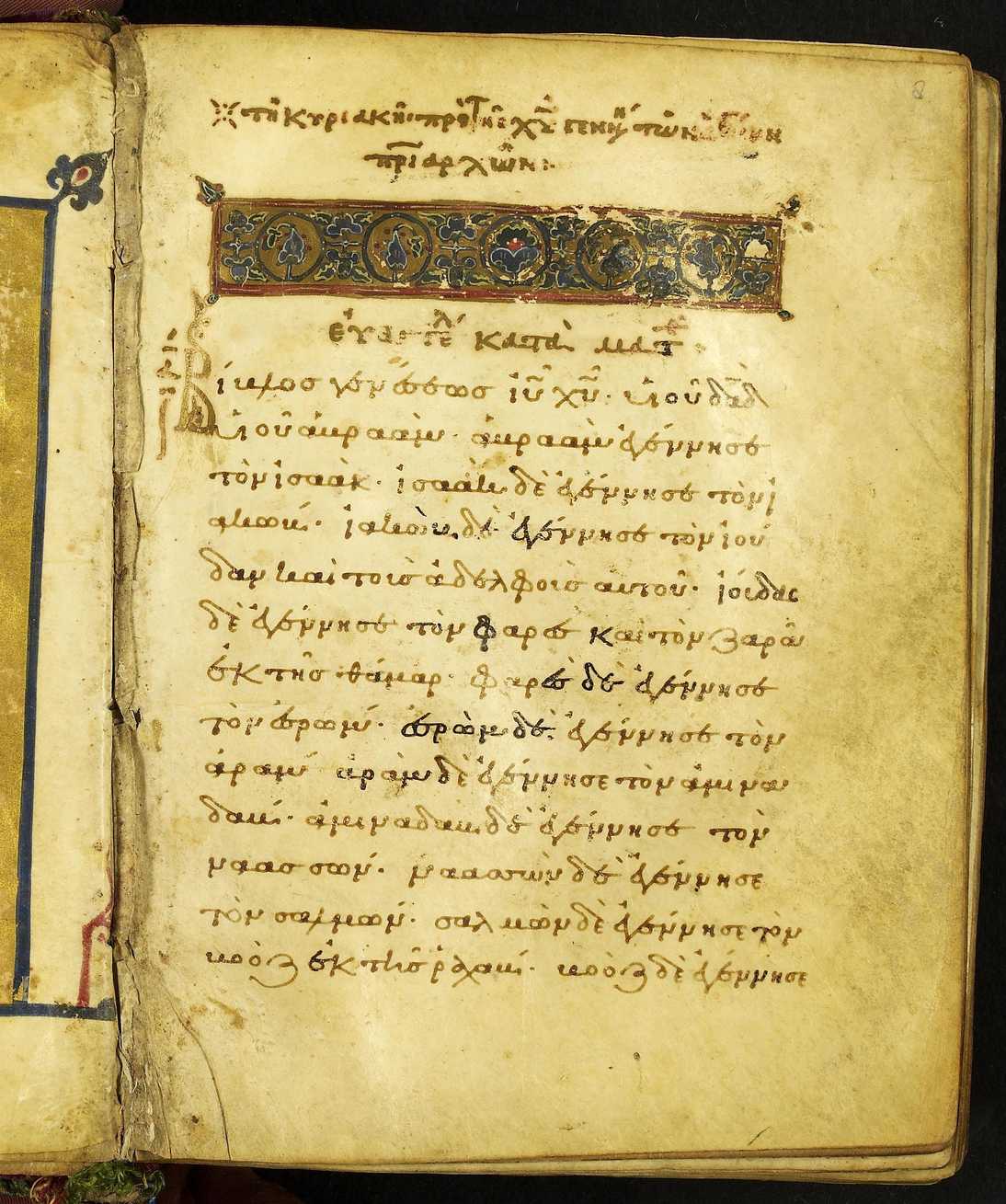
            Link 17 = Matthew 1:1
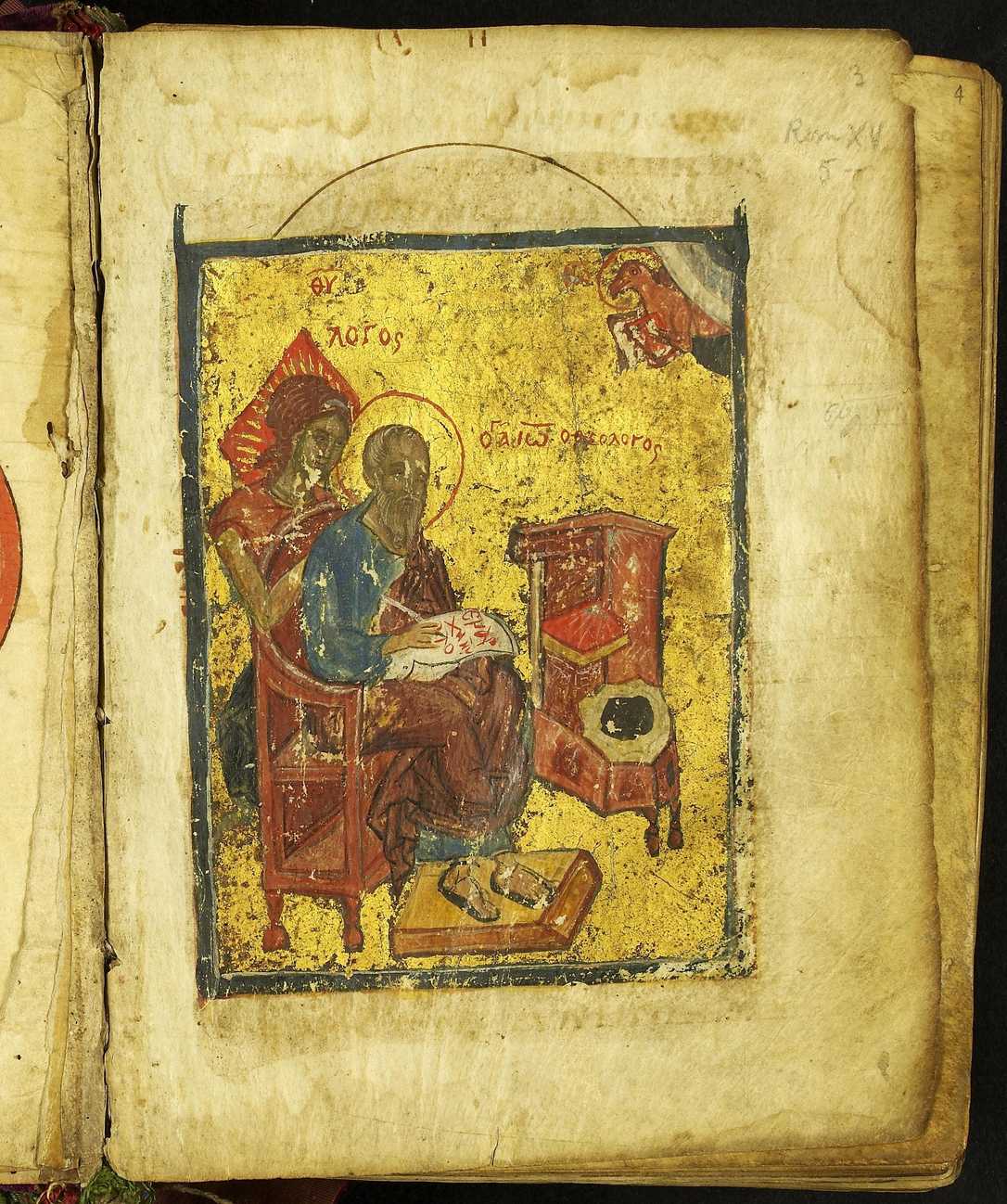
Uncial text from Romans 15
lurks under this picture near
the beginning of GA 713,
which depicts the inspiration of John.
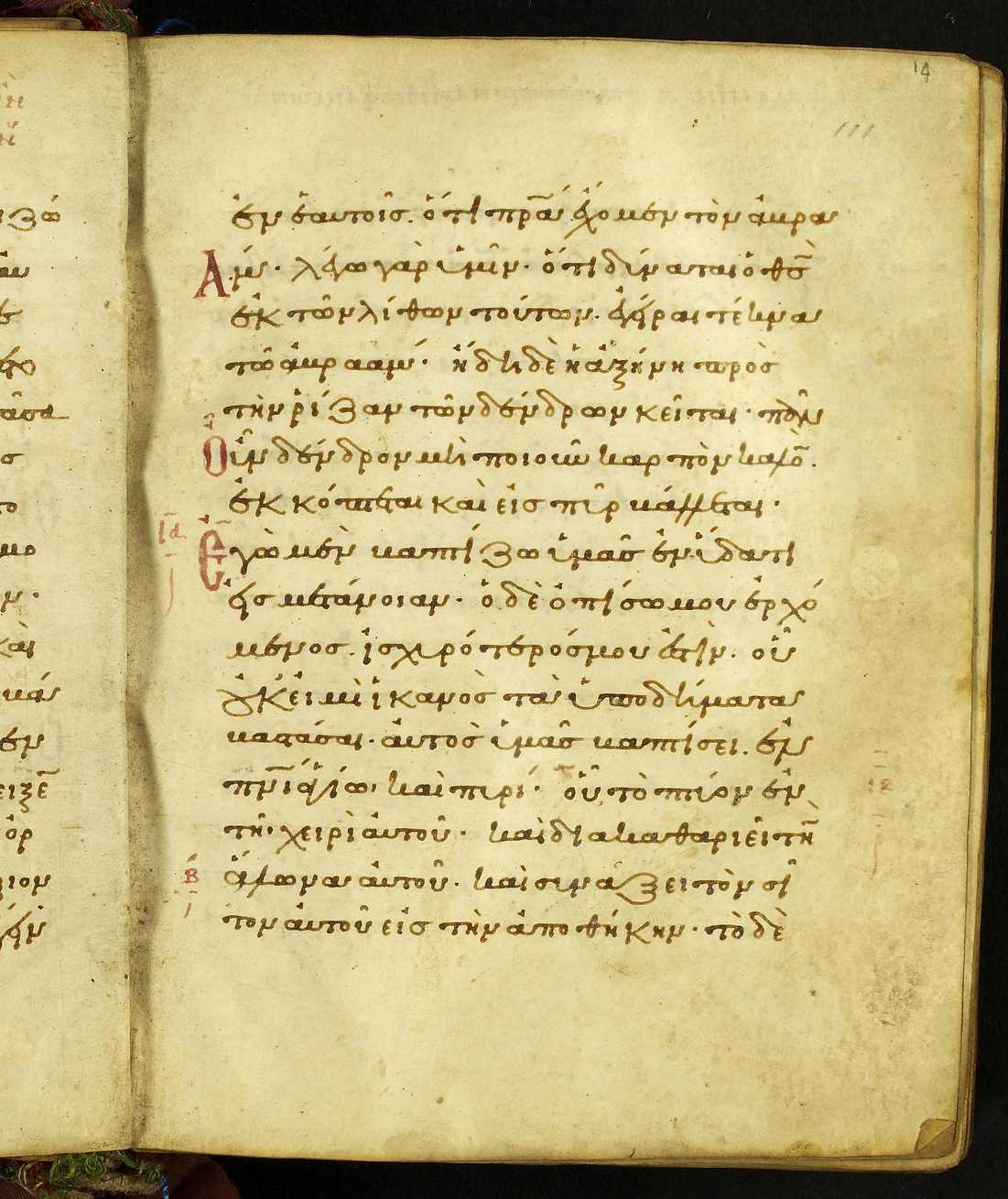
            Link 29 = Matthew 3:9
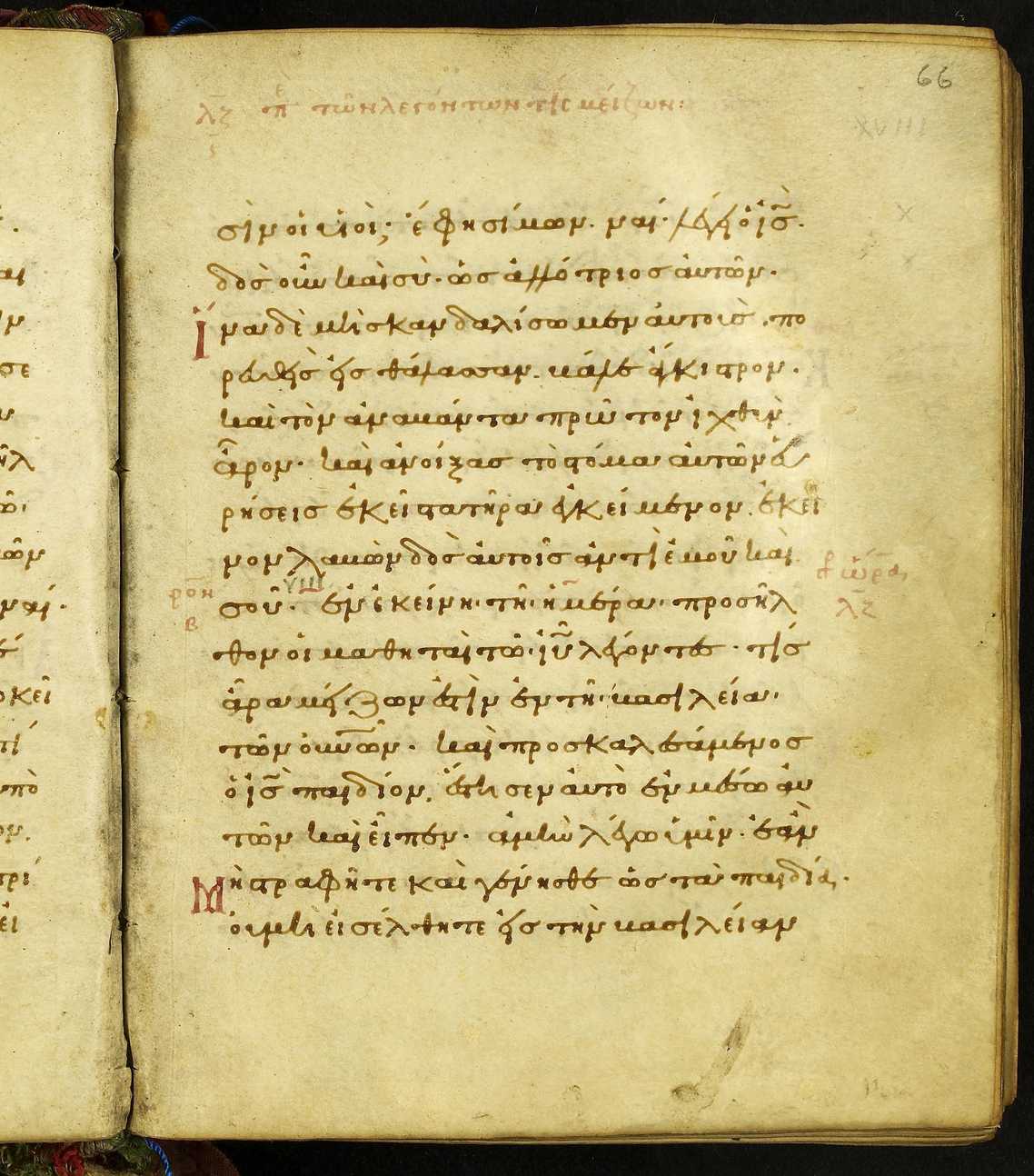
            Link 37 = Matthew 5:7
            Link 60 = Matthew 8:8
            Link 99 = Matthew 13:13
            Link 133 = Matthew 17:26
            Link 200 = Luke 22:43, in Matthew 26
            Link 229 = Mark 1:1
            Link 312 = Mark 11:7
            Link 356 = Mark 16:7
            Link 365 = Luke 1:1
            Link 422 = Luke 7:8
            Link 500 = Luke 16:15
            Link 540 = Luke 22:30
            Link 567 = John 1:1
            Link 595 = John 5:1
            Link 622 = John 7:51
            Link 660 = John 14:1
            Link 704 = John 21:24
           
GA 712, as far as I can tell, has not yet been digitized.


Readers are invited to check the data in this post. 


Tuesday, August 6, 2019

Mark 10:24: Is It Easy to Enter the Kingdom?


            In Mark 10:23, Jesus told His followers, “How difficult it is for those who have riches to enter the kingdom of God.”  This was just after a young man with many possessions had gone away from Jesus, after Jesus had invited him to sell everything he had, and give to the poor, and expect heavenly treasures instead.  The disciples were astonished.  But then, in Mark 10:24, Jesus affirmed:  “Children, how hard it is for those who trust in riches to enter into the kingdom of God!”
Mark 10:24 in GA 2474 (900s).
            That is Jesus’ statement in the vast majority of Greek manuscripts of the Gospel of Mark, representative of a broad assortment of locales.  The same sense is given in the KJV, the NKJV, the EHV (Evangelical Heritage Version), the MEV (Modern English Version), and the WEB (World English Bible).  The Latin Vulgate (produced by Jerome in 383), the Gothic Version (produced by Wulfilas in the mid-300s), the Peshitta (the dominant Syriac version, probably produced in the late 300s), the Sinaitic Syriac, and most Old Latin copies (representing Latin translations made before the Vulgate) agree with this.
            Yet, when one turns to popular modern English versions such as the ESV, NIV, and CSB, the text of Mark 10:24 is shorter:  the phrase “for those who trust in riches” is absent.  This is not due to any editorial decision on the part of translators:  the phrase is missing in four important early manuscripts Sinaiticus (ℵ), Vaticanus (B), Delta (Δ), and Ψ, and in the Old Latin Codex Bobbiensis (k), and two Egyptian versions (the Sahidic and Bohairic). 
            Although ℵ, B, and k are old (from the fourth and fifth centuries) they are relatively isolated.  Furthermore, this is one of those cases – not as rare as one might think – in which our earliest manuscripts are not our earliest evidence.  Two important patristic writers provide significantly older evidence:  Clement of Alexandria (in the fourth chapter of his composition Who Is The Rich Man Who Shall Be Saved?), and Ephrem Syrus (in his Commentary on the Diatessaron). Let’s look at them one at a time.
            The exact years of Clement of Alexandria’s birth and death are unknown, but it can be safely deduced that he served the church from some time in the 180s to some time in the 210s.  Clement espoused various controversial doctrines, but for today’s purposes, we may zoom in on his quotations in the composition Who Is the Rich Man Who Shall Be Saved?:  in chapter 4, Clement makes an extensive quotation from Mark 10:17-31, specifically stating (at the outset of the next chapter) that he is drawing on text from the Gospel of Mark.  The text of Clement’s work was the subject of a doctoral dissertation by Reuben Swanson, and in his volume on Mark in the New Testament Greek Manuscripts series, he provides the relevant extract from Mark 10:23:
            περιβλεψαμενος δε ο Ιησους λεγει τοις μαθηταις αυτου, πως δυσκολως οι τα χρηματα (χρημα 1 ms) εχοντες ειςελευσονται εις την βασιλειαν του θεου.   
            Here is the Byzantine text of Mark 10:23, with differences noted:
            Και περιβλεψαμενος [Clement has και before περιβλεψαμενος, instead of δε after it]
            ο Ιησους λεγει τοις μαθηταις αυτου, [no differences]
            πως δυσκολως οι τα χρηματα (χρημα 1 ms) [no differences]
            εχοντες εις την βασιλειαν του θεου ειςελευσονται [Clement has ειςελευσονται before the words εις την βασιλειαν του θεου instead of after them].  

            Likewise for Mark 10:24, Swanson has provided Clement’s text:
            Οι δε μαθηται εθαμβουντο επι τοις λογοις αυτου.   παλιν δε ο Ιησους αποκριθεις λεγει αυτοις, Τεκνα, πως δυσκολον εστι τους πεποιθοτας επι χρημσασιν εις την βασιλειαν του θεου εισελθειν.
            Comparing this to the Byzantine text of Mark 10:24, bit by bit, we see the following differences:
            Οι δε μαθηται εθαμβουντο επι τοις λογοις αυτου.   [no differences]
            παλιν δε ο Ιησους αποκριθεις λεγει αυτοις, [transposition of παλιν]
            Τεκνα, πως δυσκολον εστιν τους πεποιθοτας επι χρημσασιν [spelling; χρημασιν]
            εις την βασιλειαν του θεου εισελθειν [no differences].
            (I think Swanson’s transcription contains a typo and should read χρημασιν.)

            The thing to see is that as Clement quotes Mark 10:24, he quotes it with the words τους πεποιθοτας επι χρημσασιν – not in the Alexandrian form (which lacks this phrase), and not in the Western form (in which verse 24 appears after verse 25).  Thus we have confirmation, in a patristic composition written around the year 200 in Egypt, of the presence of this phrase in Mark 10:24.
            Now we turn to Ephrem Syrus.  Ephrem wrote in the mid-300s, in Syria, in the Syriac language.  The Diatessaron – the text upon which he wrote a commentary – is older; an individual named Tatian compiled the Diatessaron as a combination of all four Gospel accounts, in the early 170s.  The discovery of an important manuscript of Ephrem’s commentary on the Diatessaron was announced in 1957, when Syriac MS 709, assigned to the late 400s, was added to the Chester Beatty collection – and subsequently additional parts of Ephrem’s commentary were found, including two more portions of Chester Beatty Syriac MS 709 in the 1980s.  Not only was this evidence was unavailable to Hort in 1881; it was unavailable to Metzger when he wrote his Textual Commentary on the New Testament. 
            When we look into Ephrem’s quotations from Tatian’s Diatessaron, (cf. page 231 of Carmel McCarthy’s Saint Ephrem’s Commentary on Tatian’s Diatessaron:  An English Translation of Chester Beatty Syriac MS 709 with an Introduction and Notes) we see this statement:  “When he turned away, our Lord said, It is difficult for those who trust in their own riches.”  One might initially suspect that Ephrem has merely cited 10:23, but the quotation does not refer merely to those who possess wealth; it refers to those who trust in their wealth – a statement not found in Mark 10:23, nor in the parallel accounts in Matthew 19:23-24 and Luke 18:24-25, but exclusively in Mark 10:24.
            Via Ephrem’s comment, we may see the Gospels-text used by Tatian in the 170s – a text in which Mark 10:24 included the phrase “for those who trust in riches.”
            Thus two very early patristic writers, from two far-removed branches of the transmission-stream, constitute strong support for the inclusion of the words “for those who trust in riches” in the text of Mark 10:24; finding these citations in the quotations of Clement and Ephrem is roughly congruent to finding small second-century papyrus fragments of Mark 10:24 in Alexandria (where Clement wrote) and in Rome (where Tatian studied under Justin Martyr).
            Nevertheless, what answer shall be given to Metzger’s theory (phrased as an assertion):  “The rigor of Jesus’ saying was softened by the insertion of one or another qualification that limited its generality and brought it into closer connection with the context”?  Besides mentioning the usual reading, he adds that two different readings are attested:  Codex W and itc support πλουσιον, and 1241 reads οι τα χρηματα εχοντες.  The counter-point is not hard to find: πλουσιον is not a wholesale insertion, but a harmonization to the parallels in Matthew and Luke; meanwhile οι τα χρηματα εχοντες is a harmonization to the identical phrase in Mark 10:23.  (Willker mentions that the latter harmonization is read by five other minuscules, 588, 973. 1090, 2791, and 2812.)
            Finally, we may consider the simple mechanics by which the phrase for those who trust in riches could be lost.  This phrase – τους πεποιθοτας επι χρημασιν – ends with the same two letters that come before it, at the end of the word εστιν.  If an early copyist’s line of sight drifted from the letters ιν at the end of εστιν to the letters εστιν at the end of χρημασιν a line or two later, the accidental disappearance of the phrase in an early transmission-stream in Egypt is accounted for.  Meanwhile, everywhere else, the phrase was included, perpetuating the original reading, though in some witnesses it was expanded (so as to read “in their riches”) or harmonized to the parallels in Matthew and Luke or to the preceding verse.

            So, rather than tell His disciples that it is hard to enter into the kingdom of God, Jesus did not contradict what He said elsewhere, that His yoke is easy and His burden is light.  Entering God’s kingdom can be hard indeed, if we attach ourselves to the things of this world and turn them into priorities above the will of God.  But if we let go of the things of this world, and trust in the atoning work of Christ, with surrendered hearts, then the entrance into God’s kingdom, even through tribulations, can become not only easy, but joyful.


Wednesday, October 4, 2017

Mark 1:2 (Part 3) - Irenaeus and Tatian

[Continued from the previous post]
 
            Continuing our investigation about the text of Mark 1:2, let’s turn now to Irenaeus, the earliest evidence for Mark 1:2.  Irenaeus had grown up in Asia Minor (he states in Against Heresies 3:3:4 that he saw Polycarp at Smyrna), and served as bishop in the city of Lugdunum (now Lyons), in Gaul (now France).  He also visited Rome in 177, when Roman persecution targeted Lugdunum.  He wrote the third book of his most famous work, Against Heresies, in about 184, which means that his quotations of Mark are from a manuscript earlier than any known to exist.            
A Vulgate copy
from the 800s,
with "in Isaiah the prophet"
in Mark 1:2.
            Considerable sections of Against Heresies are extant only in Latin or Syriac, rather than in the Greek language in which Irenaeus wrote.  For this reason, some scholars have suspected that when we encounter quotations of Mark 1:2 with “in the prophets” in Against Heresies, we are seeing the hand of a Latin translator who replaced Irenaeus’ quotations with a text more familiar to the translator.  However, the Old Latin and Vulgate firmly support “in Isaiah the prophet” – so whoever suggests that the Latin translator made Irenaeus’ Greek quotation agree with some Latin text that read “in the prophets” in Mark 1:2 should identify what Latin text he has in mind.
            In Against Heresies 3:10:5, Irenaeus wrote, “Wherefore also Mark, the interpreter and follower of Peter, does thus commence his Gospel narrative:  ‘The beginning of the gospel of Jesus Christ, the Son of God, as it is written in the prophets, Behold, I send my messenger before your face, who shall prepare your way.  The voice of one crying in the wilderness, Prepare the way of the Lord; make the paths straight before our God.’  Plainly does the commencement of the Gospel quote the words of the holy prophets, and point out Him at once, whom they confessed as God and Lord, Him, the Father of our Lord Jesus Christ, who had also made promise to Him, that He would send His messenger before His face, who was John, crying in the wilderness, in the spirit and power of Elijah, ‘Prepare ye the way of the Lord; make straight paths before our God.’”
            (The combination of variants in this citation is interesting, and merits closer study:  “Son of God” is included in verse 1, and “in the prophets” is read in verse 2; yet “before you” is not read at the end of verse 2, and the close of the quotation seems to be conformed to the text of Isaiah 40:3.)
            Against the idea that Irenaeus’ text has been altered here by a copyist of his works, it should be noticed that Irenaeus, commenting on the passage, did not proceed to say that one prophet (i.e., Isaiah) thus testified, but that they (i.e., the prophets) confessed him as God and Lord, and he made this affirmation as he saw no need for further comment.
            However, in Against Heresies 3:11:8, which is preserved in Greek and Latin, Irenaeus quotes Mark 1:1-2 with “in Isaiah the prophet.”  In addition, his brief quotation does not include the phrase “the Son of God” – Ἀρχὴ τοῦ εὐαγγελίου Ἰησοῦ Χριστοῦ ὡς γέγραπται ἐν Ἡσαΐα τῷ προφήτη.  This form of Mark 1:1-2a, excluding “Son of God” and including “in Isaiah the prophet” without τῷ before Ἡσαΐα, is rare; it is attested only in Codex Θ and in the Armenian and Georgian versions, and a few respectably early patristic compositions, as far as I can tell.  While nothing precludes the idea that Irenaeus possessed the kind of text displayed in Codex Θ (and in Oxyrhynchus Papyri LXXVI 5073, a talisman probably made in the late 200s), there is another possibility:  that at this point Irenaeus was incorporating the contents of an earlier source into his own composition.        
            Let’s take a look at the context of the quotation in Against Heresies 3:11:8:  it arrives as Irenaeus is defending the idea that there are four, and only four, Gospels. Just as there are four cherubim around God’s heavenly throne; each angelic likeness is associated with one of the four Gospels.  Using Revelation 4:7, Irenaeus explains that the Gospel of John corresponds to the confident lion; the Gospel of Luke corresponds to the ox; the Gospel of Matthew corresponds to the man, and the Gospel of Mark corresponds to the eagle – this last association being based on the swiftness of an eagle’s flight and the swiftness with which Mark summarizes Jesus’ activities, providing a quick overview:  “Mark, on the other hand, commences with the prophetical spirit coming down from on high to men, saying, ‘The beginning of the gospel of Jesus Christ, as it is written in Isaiah the prophet,’ – pointing to the winged aspect of the gospel; and on this account he made a compendious and cursory narrative, for such is the prophetical character.”
            Further along in Against Heresies, in 3:16:3, Irenaeus again refers to Mark 1:2.  He specifically quotes from Mark:  “Wherefore Mark also says, ‘The beginning of the gospel of Jesus Christ, the Son of God, as it is written in the prophets.’  Knowing one and the same Son of God, Jesus Christ, who was announced by the prophets . . . .”
            In the two instances where Irenaeus quotes Mark 1:1-2a with “Son of God” and “in the prophets,” the adjacent comments from Irenaeus do not give any hint that his own text has been replaced with something else; his comments interlock with a text of Mark in which those two readings are in the text.  But at the same time, there is no sign of tampering in the quotation in which Irenaeus fails to use “Son of God” and in which he names Isaiah the prophet.
            None of these passages in Against Heresies shows any sign of tampering by the Latin translator of Against Heresies.  It looks like Irenaeus used two different forms of the text of Mark 1:2 – one which read, “in the prophets,” and one which read “in Isaiah the prophet,” in the Western form of the Greek text (ἐν Ἠσαίᾳ τῷ προφήτῃ).  The only conclusion this evidence points to is that two forms of Mark 1:2 – one reading “in Isaiah the prophet” and another reading “in the prophets” – were in circulation in the 180’s. 

            Now let’s turn to a comment made by a Syriac writer named Isho’dad of Merv, around A.D. 850.  Though later than Charlemagne, Isho’dad’s writings are valuable, inasmuch as he frequently relied upon older compositions.  Isho’dad acknowledged a difficulty in the Syriac text of Mark 1:2 (where the Peshitta reads “in Isaiah the prophet”) and he mentioned five proposals about how to resolve it, without expressing a preference for any of them: 
            “It is asked, ‘Why did Mark say, “As it is written in Isaiah the prophet, ‘Behold, I send My messenger before Thy face,’” etc., when it is written in Malachi? 
            “Some say that it was in Isaiah and was lost.  Other say that he put to the voice of one crying in the wilderness, ‘Prepare the way,’ etc., this sign as an answer.  Others say that because it was translated from Roman [i.e., Latin; this reflects a tradition that Mark originally wrote in Latin] to Greek, and from that to Syriac, the interpreters made a mistake, and put ‘Isaiah’ instead of ‘Malachi.’ 
            “Others say that he [i.e., Mark] is not concerned to be meticulously precise about the reference, as is the custom of the Scriptures. 
            “Others say that the Diatessaron-book, which was composed in Alexandria, instead of this ‘as it is written by Isaiah the prophet,’ says, ‘by the prophets.’”  (See Margaret Gibson’s The Commentaries of Isho’dad of Merv, 1911, Vol. 1, page 126). 
            Let’s zoom in on that last proposal.  Isho’dad, in his description of the Diatessaron as a text composed in Alexandria, has probably confused the Diatessaron of Ammonius of Alexandria – a Matthew-centered cross-reference system mentioned in the much-circulated Ad Carpian, but not known to be extant – with the Diatessaron produced by Tatian (in the early 170’s), in which the contents of the four Gospels were blended together into a single non-repeating narrative. 
            The text that Tatian produced – whether Greek or Syriac – is not extant, and its fullest echo, the Arabic Diatessaron, has been extensively (but not entirely) conformed to the Peshitta. (That is, the arrangement of the text was substantially retained, but because Tatian was suspected of heresy due to his asceticism, the text itself was adjusted to agree (mostly) with the Peshitta, and this Syriac text was subsequently translated into Arabic.)  Isho’dad’s statement here, then, may be the only extant indication that Tatian’s Diatessaron originally contained the reading “in the prophets” extracted from Mark 1:2. 
            J. Rendel Harris, in the preface to Gibson’s translation of Isho’dad’s Commentary (p. xxviii), mentioned that a later Syriac writer, Jacob Bar-Salibi (d. 1171), expanded Isho’dad’s remark:  “Others [say] that in the book Diatessaron which is preserved [or was composed] in Alexandria and was written by Tatianus the bishop, as also in the Greek Gospel and in the Harkalian, it is written ‘in the prophet,’ without explaining what prophet.”
            If indeed Tatian’s Diatessaron read “in the prophets,” then this would constitute another second-century witness for that reading.

Continued in Part Four:  Mark 1:2 and Some Other Evidence