Followers

Showing posts with label NRSV. Show all posts

Thursday, November 28, 2024

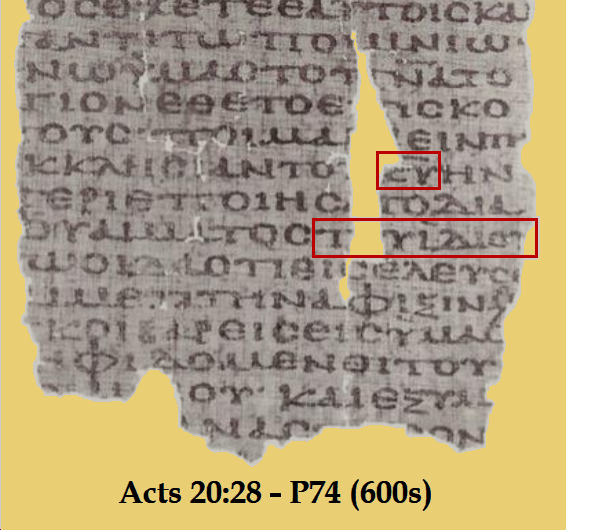
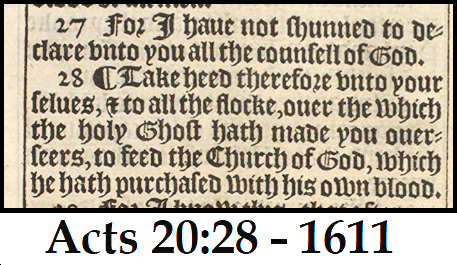
Acts 20:28 – Smuggling in an Emendation?

          Two textual issues in Acts 20:28 have impacted translations of the verse:  First:   did Luke refer to the church as the “church of God,” the “church of the Lord,” or the “church of the Lord and God”?  Second, at the end of the verse, did Luke write that the church was obtained through his blood, or through the blood of his Son?

          Let’s review the external evidence:
          Greek Support for ἐκκλησίαν τοῦ θεοῦ includes ﬡ B 056 614 1175 1611 104 2147 1505 Byz, Lectionary 60, l592, l598, l603, l1021, and l1439.  Versional support is provided by the Vulgate, the Peshitta, the Harklean Syriac, the Georgian version, and itar, c, dem, ph, ro, w and a Bohairic copy.  Patristic support for ἐκκλησίαν τοῦ θεοῦ is supplied by Athanasius, Basil, Epiphanius, Chrysostom, Cyril, and Ambrose.    

          Greek support for ἐκκλησίαν τοῦ κυρίου includes P74 A C* D E Ψ 33 181 307 453 547 610 945 945 1678 1739 1891 2344 2464 and l599.  Versional support for ἐκκλησίαν τοῦ κυρίου is supplied by itd, e, gig, p the margin of the Harklean Syriac, Sahidic, Bohairic, and Armenian versions.  Patristic support for ἐκκλησίαν τοῦ κυρίου comes from Irenaeus (in Latin), Didymus (in Latin), Theodoret, Ambrosiaster, Jerome, and Pelagius.      

          Greek support for ἐκκλησίαν τοῦ κυρίου καί θεοῦ includes H L P C3 049 1 69 88 226 323 330 440 618 927 1241 1245 1270 1828 1854 2492 and most lectionaries.  Versional support is limited to a Slavic lectionary copy.

          (In addition, Swanson recorded GA 1837’s ἐκκλησίαν τοῦ κυ ιυ καί θῦ.)

          The KJV, reflecting the Textus Receptus, reads “Take heed therefore unto yourselves, and to all the flock, over the which the Holy Ghost hath made you overseers, to feed the church of God, which he hath purchased with his own blood.” [emphasis added here, and in the following quotations]

           Similarly, the Christian Standard Bible reads “shepherd the church of God, which he purchased with his own blood.”  The Evangelical Heritage Version reads “shepherd the church of God, which he purchased with his own blood.”  The ESV reads “care for the church of God, which he obtained with his own blood.”  The NIV reads “shepherds of the church of God, which he bought with his own blood.” 

          The World English Bible, following the Byzantine Text, reads, “Take heed, therefore, to yourselves, and to all the flock, in which the Holy Spirit has made you overseers, to shepherd the assembly of the Lord and God which he purchased with his own blood.”

          Modern versions render Acts 20:28 in quite diverse ways:  usually the base-text τοῦ θεοῦ is followed, not only in the English Standard Version, NIV, EHV and CSB but also in the NET, RSV, NRSV, CEB, and CEV.

          The New World Translation (a translation produced for the cult known as “Jehovah’s Witnesses,” also known as the Watchtower Society) reads “Pay attention to yourselves and to all the flock, among which the holy spirit has appointed you overseers, to shepherd the congregation of God, which he purchased with the blood of his own Son.”           Inasmuch as no manuscript of Acts reads “of his own Son,” it appears that the modern Arian cult has added to the words of God.  But the Jehovah’s Witnesses Bible butchers are not alone in this respect.  The NET also renders Acts 20:28 with an appeal “to shepherd the church of God that he obtained with the blood of his own Son.”

          Likewise  the NRSV (including the compromised Updated Edition) have Paul tell the Ephesian elders to “shepherd the church of God that he obtained with the blood of his own Son” – echoing the RSV, which reads, “care for the church of God which he obtained with the blood of his own Son.”  The relatively recent Common English Bible reads “shepherd God’s church, which he obtained with the death of his own Son.”  The CEV (Contemporary English Version) reads, “Be like shepherds to God’s church. It is the flock he bought with the blood of his own Son.”  

          The Lexham English Bible likewise reads, “shepherd the church of God which he obtained through the blood of his own Son.  The Complete Jewish Bible reads “shepherd God’s Messianic community, which he won for himself at the cost of his own Son’s blood.”  The Good News Translation reads “shepherds of the church of God, which he made his own through the blood of his Son.”  The New Century Version says “You must be like shepherds to the church of God, which he bought with the death of his own son.”  The Mounce Reverse Interlinear New Testament reads, “shepherd the church of God, which he purchased with the blood of his own Son.”  The Voice says “Shepherd the church of God, this precious church which He made His own through the blood of His own Son.” 

          English versions which end Acts 20:28 with a clear reference to the blood of God’s Son – even though the Greek equivalent of the word “son” is not in the base-text – include the NWT, NET, RSV, NRSV, CEV, Lexham, GNT, Mounce, The Voice, and CEB.

          In 1881 Hort wrote over three columns of his Notes on Select Readings about Acts 20:28 and concluded that “It is by no means impossible that ΥΙΟΥ dropped out after ΤΟΥΙΔΙΟΥ at some very early transcription affecting all existing documents.  Its insertion leaves the whole passage free from difficulty of any kind.”  Metzger mentioned that Hort’s proposal is not necessary – but no less than nine modern English versions appear to be conformed to Hort’s proposed emendation!

Metzger dismissed the majority reading as “obviously conflate.”  The  Byzantine reading τοῦ κυρίου καί θεοῦ may account for both of the longer readings, however, if early scribes committed parablepsis, skipping from the –ou of κυρίου to the –ου of θεοῦ (producing ἐκκλησίαν τοῦ κυρίου), and some subsequently substituting θεοῦ in place of κυρίου, resisting the idea of God having blood.   

          The Tyndale House Greek New Testament reads “ἐκκλησίαν τοῦ κυρίου” and concludes with “αἵματος τοῦ ἰδίου.”  Holmes’ SBL-GNT reads “ἐκκλησίαν τοῦ θεοῦ” and concludes the verse with “αἵματος τοῦ ἰδίου.” 


          It may be worthwhile to consider the thoughts of some who have approached the textual issue from a pastoral perspective – for example Bob Luginbill, Sam Shamoun, and the La Vista Church of Christ (near Omaha Nebraska).

          Considering that the longer reading’s earliest appearance is relatively late, and that ἐκκλησίαν τοῦ θεοῦ is supported by the Peshitta, the Vulgate, Chrysostom and Athanasius, ἐκκλησίαν τοῦ θεοῦ should be adopted, being early, geographically widely supported, and attested in multiple transmission-lines.  GA 1739’s text may be adopted for the entire verse.   

          English readers should be aware that at least eight modern versions essentially echo a conjectural emendation in this verse.


Sunday, September 8, 2024

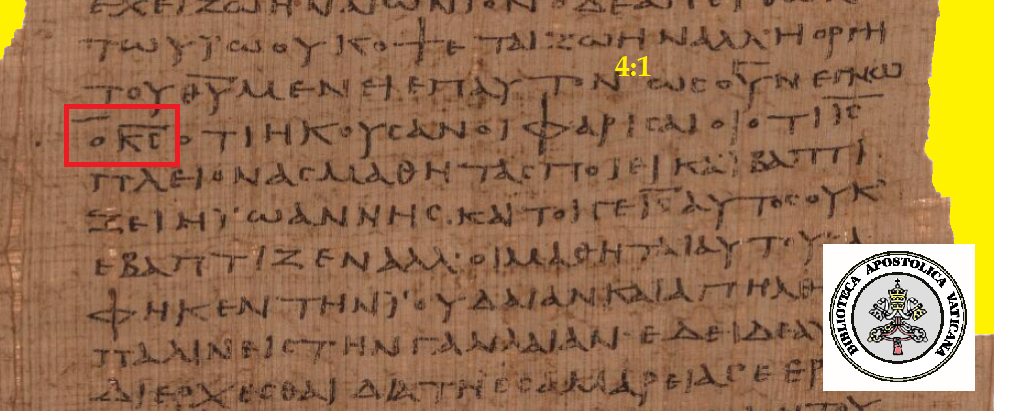
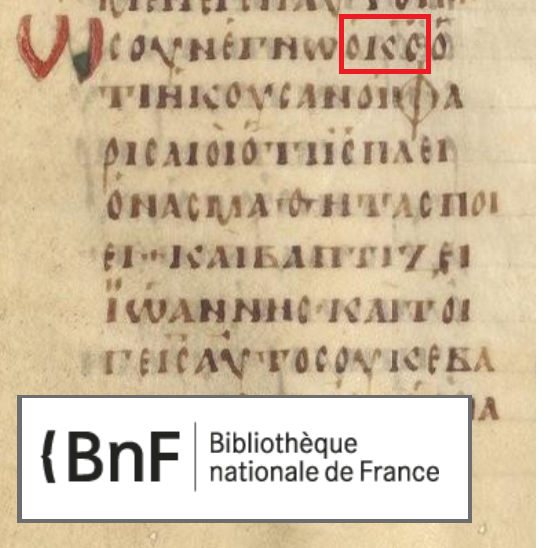
John 4:1 - "Jesus" or "The Lord"?

Papyrus 75
           At the beginning of the fourth chapter of the Gospel of John readers of modern Bibles encounter a minor deviation from the usual text:  The Byzantine text reads “When therefore the Lord knew how the Pharisees had heard that Jesus made and baptized more disciples than John.”  Agreeing with the Byzantine text are versions such as the KJV, MEV, NKJV, and RSV.   The Tyndale House GNT, echoing Tregelles, also has “ὁ κύριος,” as did Scholz’s 1836 compilation, Nestle’s Greek New Testament in 1899, and Nestle’s 1948 Novum Testamentum Graece.  The 1881 compilation by Westcott and Hort also read ὁ κύριος.   

          In the Evangelical Heritage Version, the English Standard Version, the Christian Standard Bible, the Contemporary English Version, the Holman Christian Standard Bible, the Legacy Standard Bible, the NET, New International Version, the NRSV, and the New Living Translation, “Jesus” fills the place where “the Lord” appears near the beginning of the verse.

Codex 032 (W supplement)
          Have the ESV, NIV, NRSV, and NLT rejected the reading in the majority of manuscripts in order to conform to the earliest manuscripts?  No! Although Papyrus 66* and Codex Sinaiticus, 05, 038, 039, 086 (a Greek-Coptic fragment that contains
 John 1:23-26, 3:5-4:18, 4:23-35, and 4:45-49, assigned to the 500s) and f1 support Ἰησοῦς, Papyrus 66c, Papyrus 75, and Vaticanus support ὁ κύριος, as do A C L Wsupp 044 083 0141 33 700 892 etc.  You read that right:  the reading in the Byzantine text has earlier manuscript support than its rival.

          Versional evidence is quite divided.  The Vulgate, the Peshitta, the Harklean Syriac, the Bohairic, the Fayummic, and most Old Latin copies support Ἰησοῦς.  The Armenian and Georgian versions diverge:  the Armenian version supports Ἰησοῦς but the Georgian version supports ὁ κύριος.  The Sinaitic Syriac supports ὁ κύριος and the Curetonian Syriac supports Ἰησοῦς – and so does the Sahidic version, the margin of the Harklean Syriac, and one Bohairic copy. 

Codex Regius (L, 019)
          Ἰησους is read by Epiphanius and Chrysostom, whereas Cyril supports ὁ κύριος.  Augustine is inconsistent, supporting Ἰησους in three out of four cases but ὁ κύριος once. 

          The NET has a relatively long note arguing for Ἰησοῦς, but the annotator’s argument is somewhat presumptive:  the “immediate context” is simply asserted to outweigh John’s style, and Ἰησοῦς is simply asserted to be “the harder reading.”  There really is no reason to regard either Ἰησοῦς or ὁ κύριος as the harder reading expect the observation that Ἰησοῦς occurs later in the verse – so the adoption of Ἰησοῦς yields a slightly odd-sounding verse:  Therefore when Jesus knew that the Pharisees had heard that Jesus was making and baptizing more disciples than John.”

          The scribe of Codex 039 (Λ) may have felt that the second occurrence of Ἰησοῦς seemed jarring; he left out the second Ἰησοῦς from the text.  Likewise in modern times only one occurrence of “Jesus” is in John 4:1 in the English versions CSB, CEV, EHV, HCSB, NET, NIV, NLT, although in the Greek base-text of these versions Ἰησοῦς appears twice.  In my opinion this shows the translators’ reluctance to have the word “Jesus” appear twice in close proximity – although that was done in the Rheims version, ESV, LSB, and NRSV.        

          Bruce Terry, in defense of the reading Ἰησος, has offered the theory that “Since “Jesus” occurs twice in the following clauses, copyists were more likely to change “Jesus” to “the Lord” to improve the style than visa versa.”  The UBS committee was divided (favoring Ἰησους with a C grade) but Metzger stated that Ἰησος was preferred on the grounds that “it is unlikely that a scribe would have displaced it [ὁ κύριος] with Ἰησοῦς.”   That is more of an assertion than an argument.  

          A better explanation is that early scribes in the Western transmission-line  anticipated that readers would be confused by the vagueness of “ὁ κύριος” – which could refer to the Father as well as to the Son – and decided to make the text more specific.  This was adopted in part of the Alexandrian transmission-line.  Considering that support for ὁ κύριος comes not only from the vast majority of witnesses but also from multiple transmission-lines and from very early witnesses, and that Ἰησος is supported by early Western witnesses in which exchanges from less specificity to more specificity is typical, the reading Ἰησος should be rejected in favor of the less specific reading.


Thursday, November 8, 2018

Lessons from GA 2437


            Practically every manuscript of the Gospels is textually interesting in some way.  Today, let’s take a look at the medieval minuscule 2437 – the oldest New Testament manuscript in South America – and see what we can learn from its contents.  2437 is a Gospels-manuscript from the 1000s or 1100s.  It is damaged; the text of Matthew 1:1-9:16 is absent, and so are the pages that contained John 17:14-18:2.  It was prepared for reading in church-services, as is indicated by the presence of marks delineating the beginnings and ends of lections embedded within the text.  Its text is Byzantine with some minor deviations, plus one major one. Page-views of all extant pages of this manuscript can be viewed, fully indexed, at the website of the Center for the Study of New Testament Manuscripts.  (Some pages are out of order.)  A PDF of the manuscript is also available online, from the National Library of Brasil.    

            What can we learn from this manuscript?

            One thing we can learn from 2437 is that it is potentially very helpful to have digital reproductions of manuscripts.  This manuscript is housed in Rio de Janeiro, Brazil, and there was recently a terrible fire at the National Museum in which over three-fourths of the 20 milllion items in the museum’s collections were lost.  Fortunately 2437 was housed elsewhere in Rio de Janeiro (at the National Library), but the tragic fire nearby serves as a reminder that digital  reproductions can ensure that the manuscript-evidence is disaster-proof.    
Another thing we can learn from 2437 is that many Byzantine manuscripts of the Gospels contain some liturgical expansions.  Exhibit A in this regard is in Luke 14:24.  The main text of the Robinson-Pierpont Byzantine Textform contains an extra phrase at the end of Luke 14:24:  “for many are called, but few are chosen” – the same words found in Matthew 22:14.  A hyphen in the margin of RP2005 conveys that this phrase is not in a significant portion of Byzantine manuscripts.  The Textus Receptus does not have this phrase in Luke 14:24, and thus the KJV and NKJV do not have it either.  The family-35 archetype reconstructed by Wilbur Pickering does not have it; neither does the Hodges-Farstad Majority Text (1982). 
2437 provides evidence of how this phrase entered the text of Luke 14:24:  it was used as a liturgical flourish at the end of a lection.  The main text of Luke 14:24 in 2437 does not contain the phrase, but it is written in the margin – in red, as part of the lectionary apparatus, instructing the lector about how to finish the lection. A similar marginal note appears in Codex S, also in red:  “for many are called.”  This illustrates how this phrase entered the text – not just in relatively young manuscripts, but also in earlier manuscripts such as Codex Y (034), from the 800s.  
Codex Macedonianus' text has absorbed
the flourish found in the margin of 2437
.
A takeaway from this should be that when we find short phrases in some manuscripts that are absent from other manuscripts, we should ask if the phrase appears at the end of a lection, and if it could be used as a concluding flourish for a lection – and if the answers are“Yes,” then that is a strong indication of the origin of the phrase.  It ought to be noted that this accretion is supported by family-13 manuscripts, indicating that the form of text in family-13 is essentially a text that was prepared as a sort of liturgical hybrid:  a Gospels-text edited to facilitate the needs of lectors.
Similarly, 2437 shows how accretions occasionally slipped into the text at the beginnings of lections.  In Luke 7:31, the Byzantine Text does not have the phrase “And the Lord said,” but the Textus Receptus does.  These words originated not with Saint Luke but as an incipit, or introductory phrase for lection-reading, which can be seen in 2437, in red (as part of the lectionary apparatus) in an abbreviated form, between Luke 7:30 and 7:31.
Luke 7:30-32 in 2437.
A third lesson from 2437 is that even the most ordinary-seeming manuscript can have surprising and unusual readings.  Taking in hand the UBS Greek New Testament, and turning to Matthew 22-27, there are hardly any contests in the textual apparatus in which 2437 does not agree with the Byzantine text.  Exceptions, however, include a variant-unit in 24:31, where 2437 agrees with the unusual reading in Codex Bezae (and 1241 and the Vulgate and most Old Latin witnesses) – the equivalent of “with a trumpet and a loud voice” instead of “with a great voice of a trumpet.”  
Even more remarkable is a variant in Matthew 27:49, where 2437 agrees (mostly) with the fourth-century Alexandrian codices Vaticanus and Sinaiticus (and Codex Regius) by including a statement at the end of the verse that someone came and took a spear and pierced His side, and water and blood came out.  In Codex Vaticanus the reading is as follows:  αλλος δε λαβων λογχην ενυξεν αυτου την πλευραν και εξηλθεν ϋδωρ και αιμα.
Someone tried to erase three lines written
by the scribe of 2437 in Matthew 27:49.
            2437 is one of thirty-five Greek manuscripts which have (or had) this unusual reading in Matthew 27:49.  (See Dirk Jongkind’s data for a complete list.)  In addition to those witnesses, the testimony of Codex Y should not be overlooked; while it does not have this variant in its text, it has a red wavy obelus (~ with a dot above and below the ~ ) between the end of Matthew 27:49 and the beginning of 27:50; the same symbol appears in the inner margin.            
This reading is remarkable for several reasons.  Perhaps the paramount reason is that although it is supported by two manuscripts (Vaticanus and Sinaiticus) that are often referred to as our “most reliable” manuscripts, if it were to be included in the text, it would form a contradiction with the parallel-passage in John 19 by stating that Jesus was pierced before He died; John’s account specifies that Jesus’ body was pierced, and that blood and water flowed from the wound, after He was dead.   
It is no surprise that there is no footnote about this reading in the Christian Standard Bible and the English Standard Bible, for their publishers probably did not want to bear the burden of telling their evangelical customers that if their two “oldest and most reliable” manuscripts were consistently followed – the two manuscripts which steered the compilation of their base-text to a large extent – their text would not be inerrant.    
            Another reason why this reading is interesting is that Severus of Antioch, a patristic writer in the first half of the 500s, commented about it in his Epistle 107, written to Thomas, another bishop.  In his younger days, Severus had studied in Alexandria, Egypt, and this may explain why he was aware of this reading, about which he wrote along these lines:
            “The holy evangelist John, and no one else, recorded that our Lord Jesus Christ was pierced in the side with a lance by a soldier, after He gave up the ghost, and blood and water came forth from it in a miraculous manner.  But certain persons have clearly falsified the Gospel of Matthew and inserted this very passage, when the contrary is the fact, in order to show that it was while He was alive that the soldier pierced His side with the spear, and afterwards He gave up the ghost.”
            Severus continues on this subject for several paragraphs, mentioning at one point that the question about whether this passage belongs in Matthew or not was resolved via a consultation of a copy of the Gospel of Matthew – perhaps the autograph is intended to be meant – which was (according to Severus) found in the tomb of Saint Barnabas; this volume, stored in the royal palace in Constantinople, was examined and found to not contain the passage in Matthew. 
            Severus proceeds to raise a question about John Chrysostom’s treatment of Matthew 27:49-50 in Chrysostom’s Homily 88 on Matthew, a text which is still extant.  Chrysostom (c. 400) cited Matthew 27:49 and included the reading about another coming to Jesus and piercing His side with a spear – but then Chrysostom affirmed that Jesus was dead when he was struck.  No wonder Severus was puzzled.
            More of Severus’ comments, and some additional information about this variant, can be found in Wieland Willker’s Textual Commentary on the Greek Gospels.  One point worth special notice is that Eusebius of Caesarea included John 19:34 in the tenth list of passages in his Canon Tables, and the tenth list was reserved for material found in only one Gospel – which clearly implies that Eusebius did not find the passage about Jesus being struck with a spear anywhere but in the Gospel of John.  (This reduces the plausibility of the theory that Eusebius was directly involved with the production of Vaticanus and/or Sinaiticus.)
            In 2437, the text of the Alexandrian reading occupied three lines when the manuscript was produced, but the text there has been erased.  Enough traces of the writing have survived, however, not only to confirm that it is the same variant, but that in 2437, the phrase ended with “blood and water” (as in John 19:34) rather than “water and blood.”  
            Hort, one of the scholars who prepared the 1881 revised text, studied this reading, and called it a corruption, but he favored agreements of Vaticanus and Sinaiticus so much that he kept it in the main text, within double-brackets.  Hort categorized this reading – or rather, the non-inclusion of this reading – as a “Western Non-interpolation” – that is, as an interpolation found in all early forms of text except the Western Text.  Thanks largely to the discovery of Papyrus 75, the collection of verses and phrases in Luke 24 which Hort considered spurious – favoring the shorter Western variants at those points (some of which were also missing in the Revised Standard Version) have been restored to the text.  This reading in Matthew, however, has not been adopted, and it is rare to find a modern version that even mentions it in a footnote (the NRSV and the NET being two exceptions.)  The recently published Tyndale House edition of the Greek New Testament does not acknowledge its existence at all.
An annotation in the margin of minuscule 72,
alongside Matthew 27:48-50.
            John Burgon also gave this reading some attention, and the results of his research can be found in Appendix H of his 1871 book The Last Twelve Verses of Mark.  He concluded that the variant is probably an extract from Tatian’s Diatessaron (a continuous combination of the four Gospels, produced in the 170s).  Evidence for this position may be found in a margin-note in manuscript 72 which states that “In the Gospel account, according to a report of Diodorus and Tatian and assorted other holy fathers, this is also there:  “Another came with a spear and pierced His side, and there came forth water and blood.”  This is also said by Chrysostom.”
            Another possibility exists.  Just as some marginal notes in 2437 related to liturgical Scripture-reading are formatted as part of the text in other manuscripts, the phrase “And another came with a spear and pierced His side, and there came forth water and blood” may have stood as a marginal note in an early lector’s copy – not with the intention that the phrase should be added after Matthew 27:49, but as a signal to the lector that in the annual Scripture-readings on Good Friday, the lector was to turn to the excerpt in John in which this occurred – that is, the lector was to stop reading from Matthew 27 at this point, and continue the narrative by turning to John 19:31-35 (or 19:31-37).
            In other words, this variant originated as the equivalent of an early chapter-title in the margin, rather than as something intended to be inserted in the text.  The surprising thing is not that it entered the Alexandrian Text (in much the same way that the accretions in Luke 14:24 and 14:31 entered many Byzantine copies), but that it was replicated in some Old Latin copies (echoed by extant Latin copies such as the Garland of Howth, the Book of Mulling, the Book of Armagh, and the Book of Kells (all with the word-order “water and blood” at the end), in the Middle Egyptian version, and in over two dozen Byzantine manuscripts such as 2437.    
            In closing, I wish to briefly delve into what may seem to be a tangential subject:  lection-divisions in the closing chapters of the Gospel of John.   If this allows readers to decipher the marginalia which appears in 2437 in those chapters, in addition to illustrating a theory about the possible origin of the variant in Matthew 27:49, this scenic detour will be time well spent. 
            The Byzantine chapters in John are much fewer than in the other three Gospels, being only 18 in number (or 19, with the story of the adulteress listed as a chapter).  The last chapter begins at John 19:38, and the next-to-last chapter begins at 15:26.  But one also finds marks and marginal notes designating smaller segments of the text:  lections which were read especially at Eastertime.  In 2437, in addition to faint marks identifying John 15:26 as the beginning of chapter 17, and John 19:38 as the beginning of chapter 18, there are designations for the beginnings of lections (or portions of lections) at the following points:

● in John 16:2, where the mark ⁜ appears (= lection for the Tuesday of the seventh week after Easter),
● before John 16:15 (= lection for the Wednesday of the seventh week after Easter),
● in John 16:23 (= lection for the Thursday of the seventh week after Easter),
● in 17:1 (= lection for the seventh Sunday after Easter),
● at the beginning of 18:28 (= first segment of the Gospels-lection for the ninth hour of Good Friday),
●  at 19:20 (= lection for the second hour of Good Friday),
● 19:25 – archou (“Resume”) (= first segment of the lection for the ninth hour of Good Friday),
● 19:31 – archou (“Resume”).  (= second segment of the lection for the ninth hour of Good Friday),
● 19:38 (= the beginning of chapter 18, and the fourth in a series of lections (Matthew 27:1-38 + Luke 23:39-43 + Matthew 27:39-54 + John 19:31-37 + Matthew 27:55-61 + First Corinthians 1:18-2:1) in the liturgy for Good Friday).
                                    
            The arrangement of the series of lections in the liturgy for Good Friday – in which John 19:31-37 is flanked by passages from Matthew 27 – probably resembles, approximately, the kind of liturgical arrangement which was expressed in the marginal note that found its way into an ancestor of 2437.  (It could feasibly have been modeled on Tatian’s Diatessaron, which would explain, at least in part, the annotation in 72.)  Such a note could not possibly reach Vaticanus, Sinaiticus, the Middle Egyptian version (as represented by Codex Schøyen 2650, from the 300s), the copies mentioned by Severus, several important Latin Gospels-manuscripts, and the ancestor of over two dozen Byzantine manuscripts (such as 2437) unless somewhere in their ancestry their texts were all influenced by the early introduction of the same (or very similar) notations which expressed the arrangement of text-segments to be read on Good Friday.  This implies that at some point in the 100s, or the early 200s at the latest, a reading-cycle for major Christian feast-days existed; its influence was widespread, and, where it was not understood by copyists, it was capable of impacting the Gospels-text.


Readers are encouraged to explore the embedded links for additional resources.

Saturday, July 21, 2018

Mark 6:22 - Whose Daughter Danced?

             The first phrase in Mark 6:22 says different things depending on which version is read:  
                   
Mark 6:22 (NET):  “When his daughter Herodias34 came in and danced . . .”
Mark 6:22 (NRSV):  “When his daughter Herodiasq came in and danced . . .”
Mark 6:22 (NIV):  “When the daughter ofa Herodias came in and danced . . .”
Mark 6:22 (CSB®):  “When Herodias’ own daughterp came in and danced . . .”
Mark 6:22 (ESV):  “For when Herodias’ daughter came in and danced . . .”
Mark 6:22 (KJV):  “And when the daughter of the said Herodias came in, and danced . . .”

Whose daughter danced for Herod?  Was it his own daughter, or the daughter of Herodias?  The first-century historian Josephus reports (in Antiquities of the Jews, Book 18)) that Herodias’ daughter was named Salome and that she was Herod’s grand-niece, not his daughter.  Matthew 14:6 affirms that she was Herodias’ daughter. 
          Not only was the dancer not Herod’s physical daughter; she was not Herod’s daughter under Mosaic Law, either:  her mother Herodias, after marrying Herod II (the son of Herod the Great and Mariamne II), had divorced him, and – against Jewish Law – married his brother, Herod Antipas.  As Josephus stated:  “Herodias took it upon herself to confound the laws of our country, and divorced herself from her husband while he was alive, and was married to Herod Antipas.”  It was because of this violation of Jewish law that John the Baptist, according to Matthew 14:3-4 and Mark 6:17-18, had spoken out against the unlawful marriage – with the result that Herod Antipas had John the Baptist imprisoned.

           With that background in mind, we come to the textual problem.  As the superscripted numbers and letters in the NET, NRSV, NIV, and CSB suggest, the difference in these translations’ rendering of Mark 6:22 is due to a difference in manuscripts.  The footnotes in the NRSV, the NIV, and CSB are (as usual) too vague to do much more than confuse their readers.  
            Quite a bit more data is found in the NET’s textual note, in which the annotator explains that the NET’s editors chose to have their translation say that the dancer was Herod’s daughter despite the “historical difficulties” that it involves.  Or to put it another way:  even though Matthew says that Herodias was the dancer’s mother, the NET’s editors chose to adopt the reading in which Mark says otherwise, because it is the most difficult reading – difficult, because it is erroneous – and thus the reading which copyists were most likely to alter.
          (By the way:  what are the odds that the similarity between Metzger’s references to “historical and contextual difficulties” and “external attestation” in his comment on this variant-unit, and the NET annotator’s references to “historical difficulties” and “external attestation,” rather than being sheer coincidence, is the result of the NET’s annotator attempting to summarize Metzger’s comments?  Rather high I think.)

          Let’s take a look at the rival variants that are found in Mark 6:22:

● τῆς θυγατρὸς αὐτου Ἡρῳδιάδος – “his daughter Herodias” – is supported by À B D L Δ 238 and 565. 

● τῆς θυγατρὸς τῆς Ἡρῳδιάδος – “the daughter of Herodias” – is supported by family 1, 15 minuscules, and by four Old Latin manuscripts (aur, b, c, and f – that is, VL 15 (Codex Aureus Holmiensis, copied c. 775), VL 4 (Codex Veronensis, copied at the end of the 400s), VL 6 (Codex Colbertinus, copied in the 1100s), and VL 10 (Codex Brixianus, copied in the 500s)).  Allied with them, according to the textual apparatus in the fourth edition of the UBS Greek New Testament, are the Sinaitic Syriac manuscript, the Peshitta, the Palestinian Aramaic version, the Sahidic version, the Bohairic version, the Gothic version, the Armenian version, the Old Georgian version, and the Ethiopic version.    

● τῆς θυγατρὸς αὐτῆς τῆς Ἡρῳδιάδος – “the daughter of Herodias herself” or “the daughter of this same Herodias” – is supported by about 99% of the Greek manuscripts of Mark, including Codices A C K M N U Γ Θ Π fam-13, 33, 157, 579, 700, 892, 1010, 1195, 1241, 1424, and 2474.  Allied with this mainly (but by no means exclusively) Byzantine army of witnesses are the Harklean Syriac (produced in 616), the Vulgate (produced in 383), and Old Latin manuscripts a, d, ff2, i, l, q, and r1 – that is, VL 3 (Codex Vercellensis, copied in the late 300s), VL 5 (the Latin section of Codex Bezae, copied in the 400s or 500s), VL 8 (Codex Corbeiensis Secundus, copied in the 400s), VL 17 (Codex Vindobonensis, copied in the late 400s), VL 11 (Codex Rehdigeranus, copied in the early 700s),  Codex Monacensis, copied in the 500s or 600s), and VL 14 (Codex Usserianus Primus, copied c. 600). 

● τῆς θυγατρὸς αὐτῆς Ἡρῳδιάδος – “her daughter Herodias” – is supported by Codex W and a smattering of minuscules. 

The Byzantine reading, supported by a very wide
array of evidence, including hundreds of Greek MSS.
It should be noted that the second reading (“the daughter of Herodias”) and the third reading (“the daughter of Herodias herself”) mean basically the same thing.  Both refer to the dancer as the daughter of Herodias.  Only the first reading says that the dancer was the daughter of Herod – a claim that appears to contradict both Matthew 14:6 and Josephus’ statements.  In other words, by adopting this reading, the Nestle-Aland/UBS editors appear to have placed an erroneous statement into the text.
Why, then, did the editors of the current edition of the Nestle-Aland compilation adopt a reading which makes Mark appear to contradict his fellow-evangelist Matthew and the historical data from Josephus?  Because textual critics tend to accept the principle that the more difficult a reading is, the more likely it is to be original – which means in this case that the first reading is more likely to be original because it is the variant that copyists would be most likely to attempt to adjust.   That, at least, was the reasoning at the conclusion of the NET’s defense of the reading:  “It most likely gave rise to the other readings as scribes sought to correct it.”   (So much for the annotator’s “embarrassment of riches,” when he declares that at this point in the text, 99.9% of the coins in the treasury are most likely counterfeit!)
The "his daughter" variant in Codex 037.
Neverthless, Metzger, instead of promoting the reading with αὐτου on internal grounds, stated that the UBS Committee narrowly decided in its favor due to the external evidence, stating in his Textual Commentary, “A majority of the Committee decided, somewhat reluctantly, that the reading with αὐτου [i.e., the first reading], despite the historical and contextual difficulties, must be adopted on the strength of its external attestation.”  This illustrates that “reasoned eclectic” approach of the UBS editors is, to a very large extent, eclectic in name only, favoring the joint testimony of a very small team of manuscripts over virtually everything else.    
    
The Tyndale House edition of the Greek New Testament, however, reads τῆς θυγατρὸς αὐτῆς τῆς Ἡρῳδιάδος (“the daughter of Herodias herself”), and its apparatus does not even include an entry to alert readers of the existence that a textual contest exists at this point.  Many other compilations of the Greek New Testament agree with the reading in the Tyndale House edition at this point, including not only the Robinson-Pierpont Byzantine Textform, but also the Greek New Testament compilations prepared by J. M. A. Scholz (1829), by Karl Lachmann (1831), by J. M. S. Baljon (1898), by Eberhard Nestle (1904), by Alexander Souter (1910), and the 1969 edition of the Nestle-Aland compilation.
In addition, when we compare the four rival readings side-by-side –

            ● τῆς θυγατρὸς αὐτου Ἡρῳδιάδος
            ● τῆς θυγατρὸς τῆς Ἡρῳδιάδος
            ● τῆς θυγατρὸς αὐτῆς τῆς Ἡρῳδιάδος
            ● τῆς θυγατρὸς αὐτῆς Ἡρῳδιάδος

– it becomes clear that the second and fourth readings can be explained as the effects of momentary carelessness on the part of copyists whose exemplars contained the third reading:  the second reading was produced by a copyist who accidentally omitted αὐτῆς when his line of sight drifted from the ς at the end of θυγατρὸς, and the fourth reading was produced by a copyist who accidentally omitted τῆς when his line of sight drifted from the ς at the end of αὐτῆς to the ς at the end of τῆς.  Thus all of the witnesses for the second, third, and fourth reading may be considered allies which favor τῆς θυγατρὸς αὐτῆς τῆς Ἡρῳδιάδος, directly or indirectly.
Yet the NET’s annotator claims that this is not adequate external support.  Whatever approach is reflected by such claims, it is not really eclecticism.

Some clarity about the reliability of the main witnesses for the reading with αὐτου (“his”) in 6:22 may be gained by considering some of their readings in nearby passages. 
■ In 6:17, the copyist of Codex Vaticanus did not include the words τὴν γυναῖκα (the words are added in the margin by a corrector). 
■ In 6:22b, À B C* L Δ and 33 and a smattering of minuscules read ἤρεσεν instead of καὶ ἀρεσάσης which is supported by all other Greek manuscripts.  The editors of the Nestle-Aland/UBS compilation preferred the Alexandrian reading here – and in doing so, they rejected the testimony of Papyrus 45, the earliest manuscript of this part of the Gospel of Mark.  Although P45 is extensively damaged in chapter 6, this reading is preserved.  This constitutes an agreement between the Byzantine Text and the earliest manuscript of this part of Mark.    
■ In 6:22c, the words in the opening phrase are transposed and slightly different in Sinaiticus, Vaticanus, C* L and Δ – ὁ δὲ βασιλεὺς εἶπεν – instead of the usual εἶπεν ὁ βασιλεὺς.  These manuscripts disagree with the word-order in the earliest manuscript, Papyrus 45, in which ν [the final surviving letter of εἶπεν] ὁ Ἡρώδης was written before Ἡρώδης was corrected (above the line) to βασιλεὺς.        
          In all three of these variant-units, the SBL-GNT, compiled by Michael Holmes, supports the Byzantine reading.  So does the Tyndale House GNT.  The SBLGNT also reads τῆς θυγατρὸς αὐτῆς τῆς Ἡρῳδιάδος (the daughter of Herodias herself).   Clearly not everyone is convinced that the Alexandrian witnesses are especially reliable in this particular passage.
         
          Having established that the support for τῆς θυγατρὸς αὐτου Ἡρῳδιάδος is extremely limited, and that the supportive manuscripts seem to be less reliable than usual elsewhere in the verse, let’s turn to a couple of issues concerning the internal evidence. 
First, how would copyists start with τῆς θυγατρὸς αὐτῆς τῆς Ἡρῳδιάδος and end up with τῆς θυγατρὸς αὐτου Ἡρῳδιάδος?  Such a transition is not difficult if an early copyist had an exemplar with the reading found in Codex W (τῆς θυγατρὸς αὐτῆς Ἡρῳδιάδος), and, with Herod prominent in his mind as the focus of the previous verse, inattentively wrote αὐτου instead of αὐτῆς.  The few subsequent copyists who preserved the resultant reading τῆς θυγατρὸς αὐτου Ἡρῳδιάδος rationalized that Mark must have used the term “daughter” to refer to a step-daughter, and that the dancer, like several members of Herod’s extended family, shared a name with another family-member. 
Second, is it plausible that Mark wrote τῆς θυγατρὸς αὐτου Ἡρῳδιάδος?  The answer is firmly no.  Introducing the dancer as Herod’s daughter, fully aware that she was Herodias’ daughter (as Mark affirms in 6:24), immediately after explaining that Herod’s marriage to Herodias was not valid, would be like saying that a man and a woman were committing adultery, and then saying that the woman’s daughter was nevertheless the daughter of the adulterer – and that she happened to have the same name as the adulteress.  It is extremely unlikely that Mark would ever drop such a statement upon his readers without explanation; it is much more likely that an early copyist made a simple mistake, which a small number of disciplined copyists perpetuated.
Third, how would copyists be likely to adjust the text if they found τῆς θυγατρὸς αὐτου Ἡρῳδιάδος in their exemplars and considered such a statement (that the dancer was Herod’s daughter, and that she was named Herodias) historically erroneous?  Their first resort would be to conform the Markan text to the parallel-passage in Matthew 14:6 – but such a conformation to ἡ θυγάτηρ τῆς Ἡρῳδιάδος does not seem to have been attempted by any copyists.  The only obvious scribal recklessness in Matthew 14:6 is displayed in Codex Bezae, where the text reads αὐτου (“his”) instead of τῆς, and Ἡρῳδιὰς instead of Ἡρῳδιάδος. 
          These three considerations in unison attest that the Byzantine reading at this point in Mark 6:22 is original, and that the Alexandrian reading is a mistake, albeit not quite so nonsensical that every copyist would recognize it as such.  (It might be worth mentioning the possibility, however speculative, that in an ancient exemplar, αὐτου was omitted from verse 21 after μεγιστᾶσιν (an omission attested by Codex Bezae and by MSS 1 and 1582), and after the missing word was supplied in the margin nearby, it was misinterpreted as if it was intended to replace the similar word in verse 22 rather than supplement verse 21.)            

Presently, readers of the CSB and NIV only encounter the English echo of a scribal mistake in Mark 6:22 in their Bible’s footnotes, and ESV-readers do not encounter it at all.  But as long as these three versions are subject to constant revision, there is a very real possibility that in a future edition of the ESV or CSB or NIV, the English text of Mark 6:22 may be changed to resemble the errant text found in the NET and NRSV, corresponding to the errant text in the Nestle-Aland compilation.                                                    
                                     

Quotations designated NET are from the NET Bible® copyright ©1996-2016 by Biblical Studies Press, L.L.C. http://netbible.com All rights reserved.

Quotations designated NIV are from the NIV New International Version (NIV) Holy Bible, New International Version®, NIV® Copyright ©1973, 1978, 1984, 2011 by Biblica, Inc.®  Used by permission of Zondervan.  All rights reserved worldwide. 

Quotations designated NRSV are from the Revised Standard Version of the Bible, copyright © 1946, 1952, and 1971 National Council of the Churches of Christ in the United States of America. Used by permission. All rights reserved.

Quotations designated ESV are from The ESV® Bible (The Holy Bible, English Standard Version®), copyright © 2001 by Crossway, a publishing ministry of Good News Publishers. Used by permission. All rights reserved.”

Quotations designated CSB® are taken from the Christian Standard Bible®, Copyright © 2017 by Holman Bible Publishers. Used by permission. Christian Standard Bible®, and CSB® are federally registered trademarks of Holman Bible Publishers.


Tuesday, September 19, 2017

Hand to Hand Combat: Codex D versus 1324

            It’s time once again for hand-to-hand combat!  Today’s combatants are Codex Bezae and minuscule 1324.  The arena is Luke 8:19-25.
            Codex Bezae, also known as Codex 05 and as Codex D, is named after Theodore Beza, an important Protestant theologian and textual researcher of the 1500’s who owned the manuscript, and who donated it to Cambridge University in 1581, where it resides to this day.  (Because it is at Cambridge, it is also known as Codex Bezae Cantabrigiensis.) 
            Readings from Codex Bezae were cited, albeit inaccurately, in the footnotes of Stephanus’ 1550 edition of the Greek New Testament.  This poses a problem for those who claim that the Textus Receptus was compiled using only late manuscripts, because Codex D is not late.  It has been assigned to the end of the 300’s or early 400’s by David C. Parker (though earlier researchers considered it a century younger).  It is the primary Greek support for what has been called the “Western” text of the Gospels. 
            Codex Bezae is a Greek-Latin manuscript; it contains not only the Greek text of (most of) the Gospels and Acts, but also the Latin text, on alternating pages, so if one opens the codex to any undamaged portion, the Greek text of a passage will be on the page to the reader’s left, and the Latin text of approximately the same passage will be on the page to the reader’s right.  (Also, a Latin page containing a snippet of text from the end of Third John survives, testifying that the codex originally had more books than it does now.)
            Minuscule 1324 is a Greek Gospels-manuscript from the 1000’s, and is part of the collection held by the Jerusalem Patriarchate; it is catalogued as Panagios Taphos 60.  Before the text of the Gospels begins, 1324 has the Eusebian Canon-tables, elaborately decorated, and before the canon-tables is Ad Carpianus (a letter from Eusebius to Carpian, which serves as a manual on how to use the canon-tables to find parallel-passages in the Gospels).
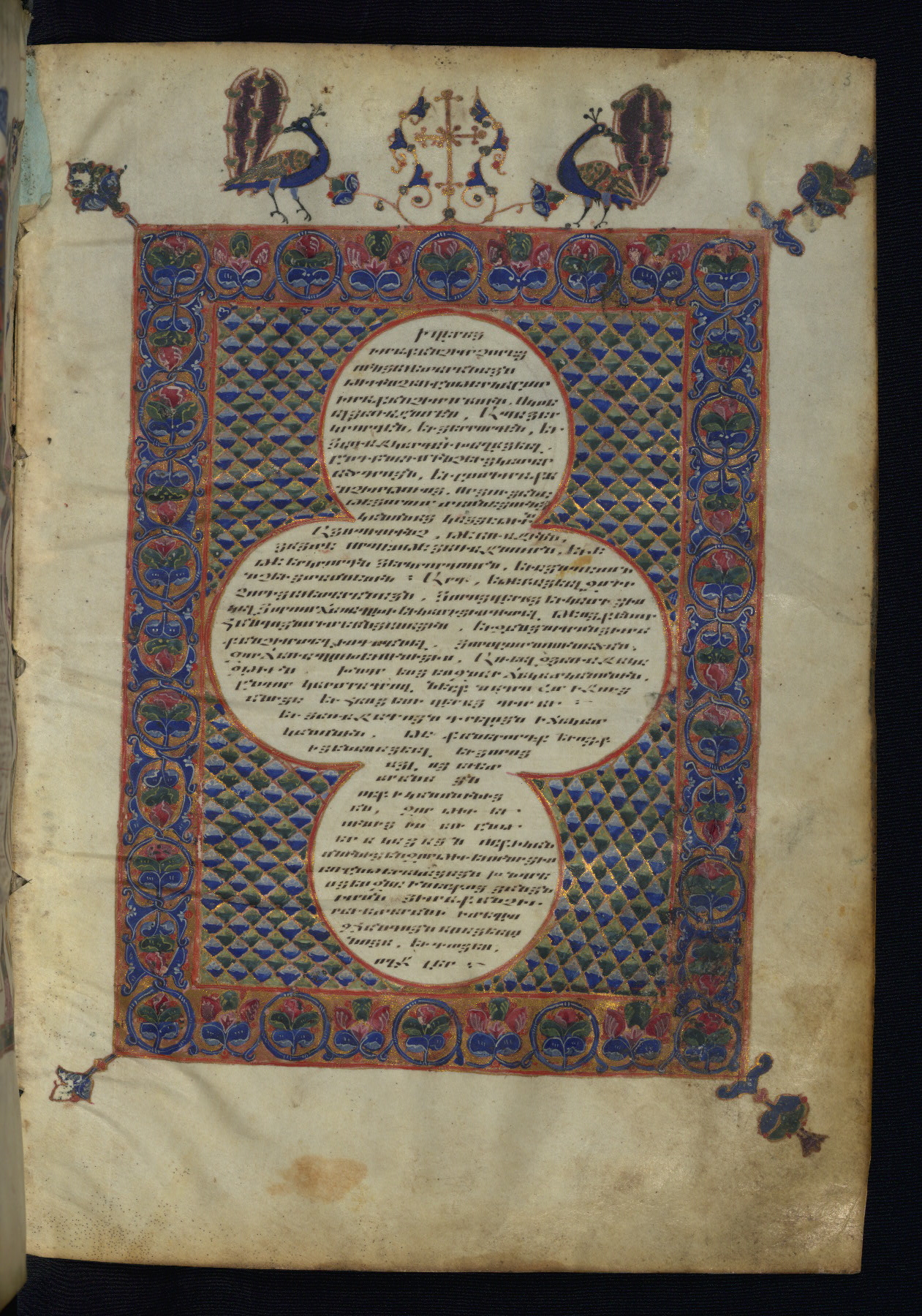
            Notably, the text of Ad Carpianus is framed within a quatrefoil, similar to the same feature in minuscule 157, and also like the empty framework found in minuscule 1191 (a Gospels-manuscript at Saint Catherine’s monastery), and like the format of the Armenian text of Ad Carpianus in Walters MS 538 – but especially reminiscent of the cut-out framework of Ad Carpianus in minuscule 2812 (the Zelada Gospels).
            Miniscule 1324 is a beautiful manuscript, neatly written and finely illustrated.  Each Gospel in Codex Bezae begins with red text (see Matthew, John, Luke, and Mark), and its lettering is sufficiently neat, but the artistry in 1324 is far more impressive; each Gospel in 1324 has a full-page illustration of its author, and an intricately detailed headpiece (see Matthew, Mark, Luke, and John).  (In these pages, by the way, notice the use of a metobelus-mark (÷) to signify the beginning of a section of text, rather than a textual variant.)  In addition, the parchment of the pages on which the chapter-lists for the Gospels are written has been dyed purple – a rare and sumptuous feature.
            But how will the text of 1324 perform in the ring against an opponent that is 600 years older?  Let’s find out by comparing the text of Luke 8:19-25 in each manuscript to the text of the 27th edition of the Nestle-Aland Novum Testamentum Graece.     
            First, the rules of the ring:  each non-original letter in a manuscript’s text is counted as a point, and each original letter that is absent in a manuscript’s text is counted as a point; the winner will be the manuscript with fewer points.  Transpositions are mentioned but not counted if no text is lost.  Contractions are not considered variants.  Itacisms, iota adscript/subscript, and movable-nu variants will be listed and counted, but a separate calculation will be made which does not take them into consideration. (These inconsequential variants are indicated by underlined verse-numbers.)  
            Here is a comparison of 1324’s text to the text of NA27: 

19 – 1324 reads Παρεγένοντο instead of Παρεγένετο (+2, -1)
19 – 1324 reads αυτωι instead of αὐτῷ (+1)
20 – 1324 reads Καὶ before ἀπηγγέλη instead of δὲ after it (+3, -2)
20 – 1324 reads λέγοντων after αὐτῷ (+8)
20 – 1324 reads σε θέλοντες instead of θέλοντες σε (transposition)
21 – 1324 reads αὐτόν at the end of the verse (+5) [This Byzantine reading is not noted in NA27.]
22 – no variants.
23 – 1324 reads ἀφύπωσε instead of ἀφύπωσεν (-1)
23 – no variants.
24 – 1324 reads Καὶ before προσεθόντες instead of δὲ after it (+3, -2)
24 – 1324 reads ἐγερθεὶς instead  of διεγερθεὶς (-2) [This Byzantine reading is not noted in NA27.]
24 – 1324 reads ἐπετίμησε instead of ἐπετίμησεν (-1)
24 – 1324 reads ἀνέμωι instead of ἀνέμῳ (+1)
24 – 1324 reads τωι instead of τῳ (+1)
24 – 1324 reads μεγάλη after γαλήνη (+6)
25 – 1324 reads ἐστιν after ποῦ (+5)
25 – 1324 reads τωι instead of τῳ (+1)
25 – 1324 reads αυτωι instead of αὐτῷ (+1)

            Thus, in these six verses, 1324 has 37 non-original letters, and is missing 9 original letters, for a total of 46 letters’ worth of corruption.  When inconsequential orthographic variants are removed from the equation, 1324 has 32 non-original letters, and is missing 7 original letters, for a total of 39 letters’ worth of corruption.  

            Now let’s compare Codex Bezae’s text of Luke 8:19-25 to NA27, and see how well “one of our oldest witnesses” (as described by Bart Ehrman) performs:

19 – D reads αυτου after μήτηρ (+5)
19 – D reads οτι after αυτω (+3)
20 – D reads εξω εστήκασιν instead of εστήκασιν εξω (transposition)
20 – D reads ζητουντες instead of ιδειν θέλοντες (+5, -9)
21 – D does not have προς after ειπεν (-4) 
21 – D reads αυτοις instead of αυτους (+1, -1)
21 – D reads οι before αδελφοι (+2)
22 – D does not have και after ημερων (-3)
22 – D reads αναβηναι αυτον instead of αυτος ενεβη (+6, -3, assuming a transposition)
23 – D reads λελαψ instead of λαιλαψ (+1, -2)
23 – D reads πολλη after ανεμου (+5)
24 – D reads κε κε (i.e., κυριε κυριε) instead of επιστατα επιστατα (+4, -16) [This could fairly be counted as +10, -16.]
24 – D reads ἐγερθεὶς instead  of διεγερθεὶς (-2)
24 – D reads επετειμησεν instead of επετιμησεν (+1)
24 – D does not have του υδατος (-9) 
25 – D reads εστιν after που (+5)

            Thus Codex D has 38 non-original letters in Luke 8:19-25, and is missing 49 original letters, for a total of 87 letters’ worth of corruption.  When inconsequential orthographic variants are removed from the equation, Codex D has 36 non-original letters, and is missing 47 original letters, for a total of 83 letters’ worth of corruption. 

            Let’s go to the scorecards.  When accretions are compared, 1324 wins:  it has only 32, whereas D has 36.  (Even if itacisms and such were considered, 1324 still wins by one.)  And when omissions are compared, 1324 virtually knocks Codex Bezae out of the ring:  1324 omitted 7 original letters but Codex D omitted 47!  The clear winner:  minuscule 1324! 

Some Post-Fight Analysis

            This comparison, though anecdotal, suggests that a few common axioms should be challenged or significantly adjusted:
            ● The oldest manuscripts should be preferred . . . right? 
            It seems perfectly reasonable to think that the older a manuscript is, the better its text is likely to be.  Every time the text was copied, there was a risk of the introduction of new corruptions.  The older a manuscript is, the fewer generations of copies are likely to be between it and the autograph. 
            However, the force of this mere likelihood shrinks when one observes the liberties that were taken by the copyists in the Western textual tradition in the second and third centuries.  Situated in locales where Greek and Latin competed to be the lingua franca, Western copyists prioritized the meaning of the text, and were not averse to replacing original expressions with different expressions that seemed to them to be more precise, more reverent, and less vulnerable to misunderstanding. 
            An example:  in Mark 7:19, Jesus says that after a man has eaten food, what remains – that is, dung – “goeth out into the draught,” as the KJV puts it.  The “draught” (Greek ἀφεδρῶνα) is a latrine or toilet.  Some English translators, softening Jesus’ earthy reference, translate this as “sewer” (see for example the MEV, NET, NLT, and NRSV).  Some others are yet more evasive, simply saying that the food is eliminated or expelled from the body (see for example the NKJV, ESV, CSB, NIV, and NASB).  Just as our modern English translators have tended to avoid Jesus’ reference to a latrine or toilet in Mark 7:19, so did the person or persons responsible for the Western Text:  Codex D replaces the latrine with a sewer, reading οχετον (i.e., “sewer”). 
            One might say that if the text of the Gospels were translated into English using a “dynamic equivalence” technique, occasionally resorting to paraphrase, and then translate the resultant English text back into Greek, the result would be similar to the Western Text.  Very many alterations to the form of the text resulted as copyists attempted to maximize what they perceived to be the meaning of the text – and this was happening in the 100’s and 200’s (not, as far as the Gospels-text is concerned, as a one-time revision, but as an ongoing process).  There is thus no reason to expect that manuscripts fished out of a transmission-stream heavily contaminated by Western corruptions will have fewer corruptions than  manuscripts from some other transmission-stream, regardless of their ages.
            If the editors of the Textus Receptus had trusted their earliest available manuscript in the 1500’s, then instead of introducing 33 letters’ worth of corruption (working from the premise that NA27’s compilation of Luke 8:19-25 is completely correct), they would have introduced 83 letters’ worth of corruption.

            ● Scribes tended to add rather than omit . . . right? 
            In Luke 8:24, 1324 displays a harmonization:  “great” (μεγάλη) was added to “calm” (γαλήνη), which brings the passage into closer agreement with the parallel-passage in Matthew 8:26 and Mark 4:39.  Yet, on balance, when compared to Codex D – a manuscript 500 years older – 1324 has slightly fewer accretions in Luke 9:19-25.  If (as Daniel Wallace has claimed) copyists were applying “If in doubt, don’t throw it out” as a basic principle, and were thus expanding the text for 600 years (from 400 to 1000), how is it that the Byzantine manuscript from the 1000’s has a text of Luke 8:19-25 with fewer accretions than a text from the early 400’s?       
            The more the text-critical canon, “prefer the shorter reading” is tested, the more its wrongness is demonstrated.  Yet the critical text of Nestle-Aland/UBS still agrees quite closely with the Westcott-Hort 1881 compilation, for which this canon was constantly in play.            

            ● The Western Text of the Gospels is characterized by expansion and elaboration . . . right?
            The Western Text, according to the late Bruce Metzger (see p. 213, The Text of the New Testament) “is usually considered to be the result of an undisciplined and ‘wild’ growth of manuscript tradition and translational activity.”  I draw your attention to the word “growth.”  A better term might be “change,” because it is not unusual at all to find readings in the Western Text that are shorter than their rivals.  In the six verses studied here, inasmuch as Codex D’s text has 36 non-original letters, and is missing 47 original letters, its text is 11 letters shorter than the original text (using NA27 as the basis of comparison). 
            In one variation-unit in this passage, the text of D is shorter because of the excision of perceived superfluity:  in verse 24, the phrase “of the water” has disappeared, and one can picture a Western copyist thinking, “There’s no need to say that the waves were made of water.”  The same phenomenon is observable in modern paraphrases; look in the CEV, the Easy-To-Read Version, the God’s Word translation, the hyper-paraphrase known as “The Message,” and the New American Bible for examples.    
            Therefore, when encountering a Byzantine reading that is longer than its Western rival, we should consider the intrinsic character of the Byzantine reading, and ask, “Could a translator consider the content of this variant superfluous?” and if the answer is “Yes” then the Western reading should be considered suspect.  Perhaps one could go further and say that the same approach should be in play when comparing Byzantine and Alexandrian readings – and it does not seem absurd to suggest that when Alexandrian and Western witnesses support the non-inclusion of a superfluous-seeming word or phrase, we may be seeing the effects of the same scribal tendency in both transmission-streams.
           
            ● The Textus Receptus is essentially a late medieval text . . . right? 
            Setting aside itacisms and other such variations, the Textus Receptus reads just like 1324 in Luke 8:19-25, with a few exceptions:
            22 – TR reads Καὶ εγένετο instead of Ἐγένετο δε (+3, -2)
            24 – TR reads προσεθόντες δὲ instead of Καὶ προσεθόντες (agreeing with NA27)
            24 – TR does not read μεγάλη after γαλήνη (agreeing with NA27)
Which means that the Textus Receptus is slightly more accurate in Luke 8:19-25 than 1324’s text.  If one were to select any medieval Byzantine manuscript at random, its text of Luke 8:19-25 would very probably trounce the text of Codex D in a direct comparison.  


_______________
Readers are invited to double-check the data and calculations in this post.