Followers

Showing posts with label Vulgate. Show all posts

Thursday, November 28, 2024

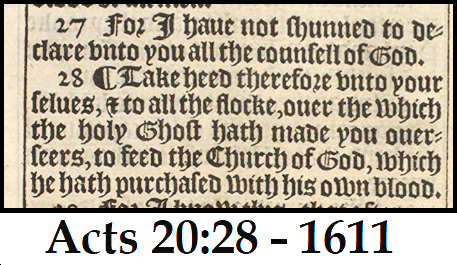
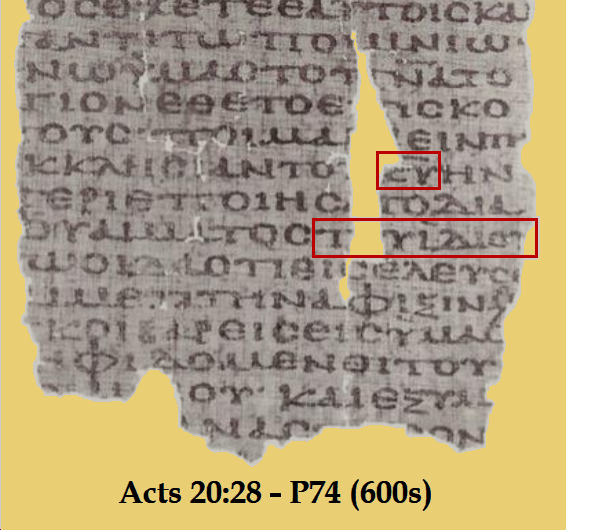
Acts 20:28 – Smuggling in an Emendation?

          Two textual issues in Acts 20:28 have impacted translations of the verse:  First:   did Luke refer to the church as the “church of God,” the “church of the Lord,” or the “church of the Lord and God”?  Second, at the end of the verse, did Luke write that the church was obtained through his blood, or through the blood of his Son?

          Let’s review the external evidence:
          Greek Support for ἐκκλησίαν τοῦ θεοῦ includes ﬡ B 056 614 1175 1611 104 2147 1505 Byz, Lectionary 60, l592, l598, l603, l1021, and l1439.  Versional support is provided by the Vulgate, the Peshitta, the Harklean Syriac, the Georgian version, and itar, c, dem, ph, ro, w and a Bohairic copy.  Patristic support for ἐκκλησίαν τοῦ θεοῦ is supplied by Athanasius, Basil, Epiphanius, Chrysostom, Cyril, and Ambrose.    

          Greek support for ἐκκλησίαν τοῦ κυρίου includes P74 A C* D E Ψ 33 181 307 453 547 610 945 945 1678 1739 1891 2344 2464 and l599.  Versional support for ἐκκλησίαν τοῦ κυρίου is supplied by itd, e, gig, p the margin of the Harklean Syriac, Sahidic, Bohairic, and Armenian versions.  Patristic support for ἐκκλησίαν τοῦ κυρίου comes from Irenaeus (in Latin), Didymus (in Latin), Theodoret, Ambrosiaster, Jerome, and Pelagius.      

          Greek support for ἐκκλησίαν τοῦ κυρίου καί θεοῦ includes H L P C3 049 1 69 88 226 323 330 440 618 927 1241 1245 1270 1828 1854 2492 and most lectionaries.  Versional support is limited to a Slavic lectionary copy.

          (In addition, Swanson recorded GA 1837’s ἐκκλησίαν τοῦ κυ ιυ καί θῦ.)

          The KJV, reflecting the Textus Receptus, reads “Take heed therefore unto yourselves, and to all the flock, over the which the Holy Ghost hath made you overseers, to feed the church of God, which he hath purchased with his own blood.” [emphasis added here, and in the following quotations]

           Similarly, the Christian Standard Bible reads “shepherd the church of God, which he purchased with his own blood.”  The Evangelical Heritage Version reads “shepherd the church of God, which he purchased with his own blood.”  The ESV reads “care for the church of God, which he obtained with his own blood.”  The NIV reads “shepherds of the church of God, which he bought with his own blood.” 

          The World English Bible, following the Byzantine Text, reads, “Take heed, therefore, to yourselves, and to all the flock, in which the Holy Spirit has made you overseers, to shepherd the assembly of the Lord and God which he purchased with his own blood.”

          Modern versions render Acts 20:28 in quite diverse ways:  usually the base-text τοῦ θεοῦ is followed, not only in the English Standard Version, NIV, EHV and CSB but also in the NET, RSV, NRSV, CEB, and CEV.

          The New World Translation (a translation produced for the cult known as “Jehovah’s Witnesses,” also known as the Watchtower Society) reads “Pay attention to yourselves and to all the flock, among which the holy spirit has appointed you overseers, to shepherd the congregation of God, which he purchased with the blood of his own Son.”           Inasmuch as no manuscript of Acts reads “of his own Son,” it appears that the modern Arian cult has added to the words of God.  But the Jehovah’s Witnesses Bible butchers are not alone in this respect.  The NET also renders Acts 20:28 with an appeal “to shepherd the church of God that he obtained with the blood of his own Son.”

          Likewise  the NRSV (including the compromised Updated Edition) have Paul tell the Ephesian elders to “shepherd the church of God that he obtained with the blood of his own Son” – echoing the RSV, which reads, “care for the church of God which he obtained with the blood of his own Son.”  The relatively recent Common English Bible reads “shepherd God’s church, which he obtained with the death of his own Son.”  The CEV (Contemporary English Version) reads, “Be like shepherds to God’s church. It is the flock he bought with the blood of his own Son.”  

          The Lexham English Bible likewise reads, “shepherd the church of God which he obtained through the blood of his own Son.  The Complete Jewish Bible reads “shepherd God’s Messianic community, which he won for himself at the cost of his own Son’s blood.”  The Good News Translation reads “shepherds of the church of God, which he made his own through the blood of his Son.”  The New Century Version says “You must be like shepherds to the church of God, which he bought with the death of his own son.”  The Mounce Reverse Interlinear New Testament reads, “shepherd the church of God, which he purchased with the blood of his own Son.”  The Voice says “Shepherd the church of God, this precious church which He made His own through the blood of His own Son.” 

          English versions which end Acts 20:28 with a clear reference to the blood of God’s Son – even though the Greek equivalent of the word “son” is not in the base-text – include the NWT, NET, RSV, NRSV, CEV, Lexham, GNT, Mounce, The Voice, and CEB.

          In 1881 Hort wrote over three columns of his Notes on Select Readings about Acts 20:28 and concluded that “It is by no means impossible that ΥΙΟΥ dropped out after ΤΟΥΙΔΙΟΥ at some very early transcription affecting all existing documents.  Its insertion leaves the whole passage free from difficulty of any kind.”  Metzger mentioned that Hort’s proposal is not necessary – but no less than nine modern English versions appear to be conformed to Hort’s proposed emendation!

Metzger dismissed the majority reading as “obviously conflate.”  The  Byzantine reading τοῦ κυρίου καί θεοῦ may account for both of the longer readings, however, if early scribes committed parablepsis, skipping from the –ou of κυρίου to the –ου of θεοῦ (producing ἐκκλησίαν τοῦ κυρίου), and some subsequently substituting θεοῦ in place of κυρίου, resisting the idea of God having blood.   

          The Tyndale House Greek New Testament reads “ἐκκλησίαν τοῦ κυρίου” and concludes with “αἵματος τοῦ ἰδίου.”  Holmes’ SBL-GNT reads “ἐκκλησίαν τοῦ θεοῦ” and concludes the verse with “αἵματος τοῦ ἰδίου.” 


          It may be worthwhile to consider the thoughts of some who have approached the textual issue from a pastoral perspective – for example Bob Luginbill, Sam Shamoun, and the La Vista Church of Christ (near Omaha Nebraska).

          Considering that the longer reading’s earliest appearance is relatively late, and that ἐκκλησίαν τοῦ θεοῦ is supported by the Peshitta, the Vulgate, Chrysostom and Athanasius, ἐκκλησίαν τοῦ θεοῦ should be adopted, being early, geographically widely supported, and attested in multiple transmission-lines.  GA 1739’s text may be adopted for the entire verse.   

          English readers should be aware that at least eight modern versions essentially echo a conjectural emendation in this verse.


Sunday, January 19, 2020

First John 5:7 and Greek Manuscripts

           Earlier this month over at the Evangelical Textual Criticism blog, Elijah Hixson offered an informative post which included pictures of the few Greek manuscripts which have the Comma Johanneum in the text of First John 5:7.  The earliest is GA 629, a Latin-Greek manuscript dated to 1362.  I offered some analysis of the text of First John 5:7 in GA 629 in August of 2016 (see the replica of the relevant part of 629 at this link, or a page-view of the manuscript itself at the Vatican Library’s website at this link).  The second-oldest manuscript of First John that has the Comma Johanneum in the text of 5:7 is GA 61, which was made in the early 1500s.  The third-oldest Greek manuscript with the Comma Johanneum in the text of First John 5:7 is GA 918.  Hixson, by a series of simple deductions, narrowed his estimate of its production-date to the 1570s. 
GA 641:  The Comma Johanneum is absent.
            And that’s it, unless we include GA 2473 (from 1634) and 2318 (from the 1700s) – both of which were made after printed editions of the Greek New Testament were made, and which very probably include the Comma Johanneum because their copyists used a printed Greek New Testament as an exemplar. 
            The other manuscripts do not have the Comma Johanneum in the text; the Comma Johanneum is written in the margin instead.  Hixson’s post includes pictures of the relevant portions of these manuscripts, so I will only spend a little time reviewing them here: 
            ● In GA 221, a manuscript from the 900s, the Comma Johanneum is written in the margin, but it appears that the Comma Johanneum arrived there rather recently, considering that (as Hixson reports) a description of GA 221 made in 1854 says that the manuscript does not have the Comma Johanneum, with nothing said about a margin-note. 
            ● In GA 177, the Comma Johanneum is written in the upper margin of the page and is identified by its verse-number, which means that the Comma Johanneum was placed in the margin of GA 177 sometime after 1550.  (Dan Wallace noticed the Comma Johanneum in the margin of GA 177 in 2010.)   Hixson offers a more precise date, however:  the annotator of this manuscript left his name in it:  Ignatius Hardt, who was born in 1749.  Guided by a little more data about Hardt’s career, Hixson estimates that Hardt wrote the Comma Johanneum in the margin of 177 no earlier than the 1770s.
            ● In GA 88, a manuscript from the 1100s, the Comma Johanneum appears in the margin with almost no clues about who added it or when.   Almost no clues:  as Hixson observed, whereas copyists routinely contracted sacred names such as “Father” and “Spirit,” in the margin-note in 88 these words are written out in full, which may indicate that the person writing them was using as his source a printed book, rather than a manuscript.
            ● In GA 429, a manuscript from the 1300s, the Comma Johanneum is written in the margin, and it matches up with the text of the Comma Johanneum printed in Erasmus’ third edition – because, as Hixson explains, Erasmus’ third edition was its source.
            ● In GA 636, a manuscript from the 1400s, the Comma Johanneum is written in the margin, and is missing the articles, which is consistent with a scenario in which it was translated from Latin. 
                       
            Let’s review the implications of this evidence:  First, there is no Greek manuscript made before the 1500s in which the Comma Johanneum appears in the text of First John in a form which does not appear to be derived from Latin; strictly speaking, the exact text of the Comma Johanneum that appears in the Textus Receptus does not appear in the text of any Greek manuscript made before the 1500s.  Second, in the Greek manuscripts in which the Comma Johanneum appears in the margin, it either appears to be derived from Latin, or else it appears to have been copied from a printed source. 
           
            Now let’s look on the other side of the equation.  Here, from researcher Timothy Berg, is a list of the Greek manuscripts that contain First John but do not have the Comma Johanneum in the text:

Manuscripts Produced Before the 700s:  01, 03, 02, 048, 0296
Manuscripts Produced in the 700s-800s:  018, 020, 025, 049, 0142, 1424, 1862, 1895, 2464
Manuscripts Assigned to the 900s:  044, 056, 82, 93, 175, 181, 221, 307, 326, 398, 450, 454, 456, 457, 602, 605, 619, 627, 832, 920, 1066, 1175, 1720, 1739, 1829, 1836, 1837, 1841, 1845, 1851, 1871, 1874, 1875, 1880, 1891, 2125, 2147,     
Manuscripts Assigned to the 1000s:  35, 36, 2, 42, 43, 81, 104, 131, 133, 142, 177, 250, 302, 325, 312, 314, 424, 436, 451, 458, 459,   462, 464, 465, 466, 491, 506, 517, 547, 606, 607, 617, 623, 624, 635, 638, 639, 641, 699, 796,   901, 910, 919, 945, 1162, 1243, 1244, 1270, 1311, 1384, 1521, 1668, 1724, 1730, 1735, 1738, 1828, 1835, 1838, 1846, 1847, 1849, 1854, 1870, 1888, 2138, 2191, 2344, 2475, 2587, 2723,   2746     
Manuscripts Assigned to the 1100s:  3, 38, 1, 57, 88, 94, 97, 103, 105, 110, 180, 203, 226, 256, 319, 321, 323, 330, 337, 365, 431, 440, 442, 452, 618, 620, 622, 625, 632, 637, 656, 720, 876, 917, 922, 927, 1058, 1115, 1127, 1241, 1245, 1315, 1319, 1359, 1360, 1448, 1490, 1505, 1573, 1611, 1646, 1673, 1718, 1737, 1740, 1743, 1752, 1754, 1850, 1853, 1863, 1867, 1868, 1872, 1885, 1889, 1893, 1894, 1897, 2127, 2143, 2186, 2194, 2289, 2298, 2401, 2412, 2541, 2625, 2712, 2718, 2736, 2805     
Manuscripts Assigned to the 1200s:  4, 5, 6, 51, 204, 206, 172, 141, 218, 234, 263, 327, 328, 378, 383, 384, 390, 460, 468, 469, 479, 483, 496, 592, 601, 614, 643, 665, 757, 912, 914, 915, 941, 999, 1069, 1070, 1072, 1094, 1103, 1107, 1149, 1161, 1242, 1251, 1292, 1297, 1352, 1398, 1400, 1404, 1456, 1501, 1509, 1523, 1563, 1594, 1595, 1597, 1609, 1642, 1719, 1722, 1727, 1728, 1731, 1736, 1758, 1780, 1827, 1839, 1842, 1843, 1852, 1855, 1857, 1858, 1860, 1864, 1865, 1873, 2180, 2374, 2400, 2404, 2423, 2483, 2502, 2558, 2627, 2696       
Manuscripts Assigned to the 1300s:  18, 62, 76, 189, 201, 209, 216, 223, 254, 308, 363, 367, 386, 393, 394, 404, 421, 425, 429, 453,  489, 498, 582, 603, 604, 608, 621, 628, 630, 633, 634, 680, 743, 794, 808, 824, 913, 921, 928, 935, 959, 986, 996, 1022, 1040, 1067, 1075, 1099, 1100, 1102, 1106, 1248, 1249, 1354, 1390, 1409, 1482, 1495, 1503, 1524, 1548, 1598, 1599, 1610, 1618, 1619, 1622, 1637, 1643, 1661, 1678, 1717, 1723, 1725, 1726, 1732, 1733, 1741, 1742, 1744, 1746, 1747, 1753, 1761, 1762, 1765, 1769, 1831, 1832, 1856, 1859, 1866, 1877, 1881, 1882, 1886, 1890, 1892, 1899, 1902, 2080, 2085, 2086,  2197, 2200, 2261, 2279, 2356, 2431, 2466, 2484, 2492, 2494, 2508, 2511, 2527, 2626, 2675, 2705, 2716, 2774, 2777
Manuscripts Assigned to the 1400s:  69, 102, 149, 205, 322, 368, 385, 400, 432, 444, 467, 615, 616, 631, 636, 664, 801, 1003, 1105, 1247, 1250, 1367, 1405, 1508, 1626, 1628, 1636, 1649, 1656, 1729, 1745, 1750, 1751, 1757, 1763, 1767, 1830, 1876, 1896, 2131, 2221, 2288, 2352, 2495, 2523, 2554, 2652, 2653, 2691, 2704
Manuscripts Assigned to the 1500s and Later:  90, 296, 522, 1702, 1704, 1749, 1768, 1840, 1844, 1861, 2130, 2218, 2255, 2378, 2501, 2516, 2544, 1101, 1721, 1748, 1869, 1903, 2243, 2674, 2776, 2473, 1104

            With this data in mind, let’s consider a few extracts from a defense of the Comma Johanneum recently offered by Taylor DeSoto of Agros Reformed Baptist Church in Arizona: 
            “There is manuscript evidence for it.”  True, but as Hixson’s analysis shows, the Greek manuscript evidence for the Comma Johanneum is sparse, late, and shows clear signs of being derived either from Latin or from a printed text.   
            “It has more manuscript evidence support than let’s just say, the Gospel of Mark without 16:9-20.”  That is not quite the case; there are three Greek manuscripts in which Mark 16 ends at 16:8 (À, B, and 304  all with other anomalous features), so technically, the quantities are equal.  But it would be foolish to use simple quantities to frame this evidence, because B and À are the two earliest manuscripts of Mark 16 known to exist, while GA 629 is from the mid-1300s, 61 is from the early 1500s, and 918 is from the 1570s, and the rest, as Hixson’s data shows, are either dependent on Latin, or else extremely late.  
            As a defender of the genuineness of Mark 16:9-20, I do not grant to B and À the level of weight that was given to them by Westcott and Hort (and which continues, in some circles, to be assumed).  But it is not just the testimony of B and À which we ought to consider.  It is also the testimony of 02, 048, 0296, 018, 020, 025, 049, 0142, 1424, 1862, 1895, 2464, 044, 056, 82, 93, 175, 181, 221, 307, 326, 398, 450, 454, 456, 457, 602, 605, 619, 627, 832, 920, 1066, 1175, 1720, 1739, 1829, 1836, 1837, 1841, 1845, 1851, 1871, 1874, 1875, 1880, 1891, 2125, 2147, 35, 36, 2, 42, 43, 81, 104, 131, 133, 142, 177, 250, 302, 325, 312, 314, 424, 436, 451, 458, 459,   462, 464, 465, 466, 491, 506, 517, 547, 606, 607, 617, 623, 624, 635, 638, 639, 641, 699, 796,   901, 910, 919, 945, 1162, 1243, 1244, 1270, 1311, 1384, 1521, 1668, 1724, 1730, 1735, 1738, 1828, 1835, 1838, 1846, 1847, 1849, 1854, 1870, 1888, 2138, 2191, 2344, 2475, 2587, 2723, 2746, 3, 38, 1, 57, 88, 94, 97, 103, 105, 110, 180, 203, 226, 256, 319, 321, 323, 330, 337, 365, 431, 440, 442, 452, 618, 620, 622, 625, 632, 637, 656, 720, 876, 917, 922, 927, 1058, 1115, 1127, 1241, 1245, 1315, 1319, 1359, 1360, 1448, 1490, 1505, 1573, 1611, 1646, 1673, 1718, 1737, 1740, 1743, 1752, 1754, 1850, 1853, 1863, 1867, 1868, 1872, 1885, 1889, 1893, 1894, 1897, 2127, 2143, 2186, 2194, 2289, 2298, 2401, 2412, 2541, 2625, 2712, 2718, 2736, 2805, and so forth. 
            “Those who attack the authenticity of this reading appeal to the assumption that it was introduced from a Latin manuscript.”  Mr. DeSoto writes as if there is no basis for this “assumption.”  However, it is not an assumption; it is a deduction from evidence:  in the Old Latin text of First John 5:8 (as I have explained already in an earlier post), the nouns are typically transposed to the order water-blood-spirit, which is conducive to a figurative interpretation in which the water represents the Father, the blood represents the Son, and the Spirit represents, of course, the Holy Spirit.  And that interpretation is the Comma Johanneum – an interpretive gloss that was inserted into the Old Latin text (and from there into the later medieval Vulgate text).  Its origin is linked to the transposition:  in evidence uninfluenced by Latin, where the transposition is absent, the Comma Johanneum is absent as well.
            “Can 1 John 5:7 be said to have been definitively introduced from the Latin, as though it were never found in a Greek manuscript?”  Yes, it can.  All one needs to do is observe the evidence and think it through:  everything is completely consistent with precisely that scenario.  Just look at the Latin text that runs parallel to the Greek text in 629, and look at the absence of the articles, and look at the absence of the Comma Johanneum in 02, 048, 0296, 018, 020, 025, 049, 0142, 1424, 1862, 1895, 2464, 044, 056, 82, 93, 175, 181, 221, 307, 326, 398, 450, 454, 456, 457, 602, 605, 619, 627, 832, 920, 1066, 1175, 1720, 1739, 1829, 1836, 1837, 1841, 1845, 1851, 1871, 1874, 1875, 1880, 1891, 2125, 2147, 35, 36, 2, 42, 43, 81, 104, 131, 133, 142, 177, 250, 302, 325, 312, 314, 424, 436, 451, 458, 459, 462, 464, 465, 466, 491, 506, 517, 547, 606, 607, 617, 623, 624, 635, 638, 639, 641, 699, 796, 901, 910, 919, 945, 1162, 1243, 1244, 1270, 1311, 1384, 1521, 1668, 1724, 1730, 1735, 1738, 1828, 1835, 1838, 1846, 1847, 1849, 1854, 1870, 1888, 2138, 2191, 2344, 2475, 2587, 2723, 2746, 3, 38, 1, 57, 88, 94, 97, 103, 105, 110, 180, 203, 226, 256, 319, 321, 323, 330, 337, 365, 431, 440, 442, 452, 618, 620, 622, 625, 632, 637, 656, 720, 876, 917, 922, 927, 1058, 1115, 1127, 1241, 1245, 1315, 1319, 1359, 1360, 1448, 1490, 1505, 1573, 1611, 1646, 1673, 1718, 1737, 1740, 1743, 1752, 1754, 1850, 1853, 1863, 1867, 1868, 1872, 1885, 1889, 1893, 1894, 1897, 2127, 2143, 2186, 2194, 2289, 2298, 2401, 2412, 2541, 2625, 2712, 2718, 2736, 2805, and so forth.  Then ask, what more could I possibly ask for, if I were asking for evidence that the Comma Johanneum drifted into a few Greek manuscripts due to the actions of copyists who wanted to make their Greek copies conform more precisely to the meaning of their Latin copies? 
            Nevertheless Mr. DeSoto states, “I have yet to see a scholar actually produce a manuscript, or historical source from antiquity which demonstrates that this verse was added from the Latin.”   It seems to me that he is simply resisting the plain implications of the evidence. 
            In addition. Mr. DeSoto resorts to a grammatical argument (offered in a past generation by commentator Robert Dabney) as evidence for the genuineness of the Comma Johanneum – and then states, “The only people I have seen stand against this grammatical argument are people who self-admittedly are rusty in Greek.”  However, this whole approach is a nothingburger, as demonstrated already by Dr. Barry Hofstetter in the 2018 post, The Comma Johanneum and Greek Grammar. 
            Furthermore, Mr. DeSoto misrepresents the evidence when he states that “Jerome and Nazianzes comment on it.”  By “Jerome” he appears to mean the author of the Preface to the Canonical Epistles – an author who (as I have already pointed out) used the transposed form of First John 5:8.  And by saying that “Gregory of Nazianzes comments on it,” he seems to be referring to the statement by Gregory of Nazianzus where, after stating that John says “that there are three that bear witness, the Spirit and the water and the blood” – as we find verse 8 in most manuscripts, without the phrase “on earth” – he bring up a frivolous objection from a posited grammarian only in order to tear it down, stating “You see how completely your argument from con-numeration has completely broken down, and is refuted by all these instances,” and he goes on from there – not once citing any part of the Comma Johanneum.  
            It is simply false to claim that Gregory of Nazianzus commented on the Comma Johanneum.  He did not do so.   Furthermore, in the very next chapter of his composition, Gregory of Nazianzus refers to the Father, and the Son, and the Holy Spirit, without referencing the Comma Johanneum.
            Mr. DeSoto did not leave that falsehood without company.  He also claimed, “The Comma Johanneum was seated at 1 John 5:7 until evangelical textual critics began deconstructing the Scriptures.”  As long as one ignores the testimony of 02, 048, 0296, 018, 020, 025, 049, 0142, 1424, 1862, 1895, 2464, 044, 056, 82, 93, 175, 181, 221, 307, 326, 398, 450, 454, 456, 457, 602, 605, 619, 627, 832, 920, 1066, 1175, 1720, 1739, 1829, 1836, 1837, 1841, 1845, 1851, 1871, 1874, 1875, 1880, 1891, 2125, 2147, 35, 36, 2, 42, 43, 81, 104, 131, 133, 142, 177, 250, 302, 325, 312, 314, 424, 436, 451, 458, 459, 462, 464, 465, 466, 491, 506, 517, 547, 606, 607, 617, 623, 624, 635, 638, 639, 641, 699, 796, 901, 910, 919, 945, 1162, 1243, 1244, 1270, 1311, 1384, 1521, 1668, 1724, 1730, 1735, 1738, 1828, 1835, 1838, 1846, 1847, 1849, 1854, 1870, 1888, 2138, 2191, 2344, 2475, 2587, 2723, 2746, 3, 38, 1, 57, 88, 94, 97, 103, 105, 110, 180, 203, 226, 256, 319, 321, 323, 330, 337, 365, 431, 440, 442, 452, 618, 620, 622, 625, 632, 637, 656, 720, 876, 917, 922, 927, 1058, 1115, 1127, 1241, 1245, 1315, 1319, 1359, 1360, 1448, 1490, 1505, 1573, 1611, 1646, 1673, 1718, 1737, 1740, 1743, 1752, 1754, 1850, 1853, 1863, 1867, 1868, 1872, 1885, 1889, 1893, 1894, 1897, 2127, 2143, 2186, 2194, 2289, 2298, 2401, 2412, 2541, 2625, 2712, 2718, 2736, 2805, and so forth, that is something that can be honestly said.  Yes, if you resolve to be blind to these Greek manuscripts, and focus instead, like a horse wearing blinders, upon interpolated and transposed Latin texts, and on a few late manuscripts influenced by them, then you can say that you have a basis for keeping the Comma Johanneum in your text of First John.  But if you are going to say that it was a good thing that at some point in the past, the Latin text was on the throne, and that the Greek text was usurped and pushed to the side, and that such ought to be the case today, then you thus are not actually recognizing the authority of the original text.      
            Finally, after asking a series of rhetorical questions, Mr. DeSoto asks, Do we gain anything by removing this passage?”  To which I say, first, that this is a trick question, because when we look at 02, 048, 0296, 018, 020, 025, 049, 0142, 1424, 1862, 1895, 2464, 044, 056, 82, 93, 175, 181, 221, 307, 326, 398, 450, 454, 456, 457, 602, 605, 619, 627, 832, 920, 1066, 1175, 1720, 1739, 1829, 1836, 1837, 1841, 1845, 1851, 1871, 1874, 1875, 1880, 1891, 2125, 2147, 35, 36, 2, 42, 43, 81, 104, 131, 133, 142, 177, 250, 302, 325, 312, 314, 424, 436, 451, 458, 459, 462, 464, 465, 466, 491, 506, 517, 547, 606, 607, 617, 623, 624, 635, 638, 639, 641, 699, 796, 901, 910, 919, 945, 1162, 1243, 1244, 1270, 1311, 1384, 1521, 1668, 1724, 1730, 1735, 1738, 1828, 1835, 1838, 1846, 1847, 1849, 1854, 1870, 1888, 2138, 2191, 2344, 2475, 2587, 2723, 2746, 3, 38, 1, 57, 88, 94, 97, 103, 105, 110, 180, 203, 226, 256, 319, 321, 323, 330, 337, 365, 431, 440, 442, 452, 618, 620, 622, 625, 632, 637, 656, 720, 876, 917, 922, 927, 1058, 1115, 1127, 1241, 1245, 1315, 1319, 1359, 1360, 1448, 1490, 1505, 1573, 1611, 1646, 1673, 1718, 1737, 1740, 1743, 1752, 1754, 1850, 1853, 1863, 1867, 1868, 1872, 1885, 1889, 1893, 1894, 1897, 2127, 2143, 2186, 2194, 2289, 2298, 2401, 2412, 2541, 2625, 2712, 2718, 2736, 2805, and so forth, nobody is removing the passage; it is not there to begin with. 
            But taking the question as it stands:  yes we certainly do gain something.  First, we gain a purer, less corrupted text, which more closely resembles the original inspired text.  Mr. DeSoto recently stated in another post, “We need to receive the text as it has been passed down.”  I point out again that in the text of First John 5:7-8 that has been passed down in 99.2% of the handed-down Greek manuscripts, the Comma Johanneum is unsupported.  I point out again that the non-inclusion of the Comma Johanneum is supported.  I point out again that at this particular point, the Textus Receptus does not represent the text-that-was-handed-down, or the Byzantine Text, or the “Antiochan line.”  Yet this fact seems to have no effect on Mr. DeSoto’s position.  It seems abundantly clear that his goal is neither to defend the original text nor the text that has been handed down in Greek manuscripts; his agenda is to defend the contents of the Textus Receptus.
            (In addition, one must ask, Which text that has been passed down?”, because the manuscripts that have survived to the present day do not always agree.  When asking, “Is this reading authoritative?” the decisive sub-question is not, Is it popular?, or “Is it familiar to a particular group of people?” (such as English readers of the KJV, or formulators of a particular creed from the 1600s), but, “Is it original?.)    
            Second, we lose the stigma of desperation which is the inevitable consequence of treating an interpolation as if deserves to be a foundation for Christian doctrine, as if the Textus Receptus must be right, and all those other manuscripts must be wrong.  It is morally wrong and strategically unwise to employ falsehoods – such as the false claim that John wrote the Comma Johanneum – in the service of the truth.  To continue to do so is to run the risk that onlookers will conclude that the orthodox view of the Trinity is so weak that its defenders must adopt non-original readings in order to defend it.  I would point out that few early theologians were as Trinitarian as Gregory of Nazianzus and Cyril of Alexandria – yet they did not use the Comma Johanneum, because it was not the Greek texts that they used. 
            Third, we gain the time that would otherwise be wasted continuing to discuss a textual variant which ought to be easily recognized as an interpolation.


Readers are invited to double-check the data in this post.


Saturday, November 9, 2019

Matthew 28:19 - Baptism In Whose Name?

Matthew 28:19-20a in Codex F,
beside part of the chapter-list for Mark
.

            “This is perhaps a case of late interpolation.”  That was liberal scholar Rudolph Bultmann’s opinion of the words “in the name of the Father, and of the Son, and of the Holy Spirit” in Matthew 28:19.  
            Earlier, in 1902, Frederick C. Conybeare – who might be considered the Bart Ehrman of his day – claimed in a detailed essay in The Hibbert Journal (and in 1901 in Zeitschrift fur Neutestamentlich Wissenschaft, pp. 275-288) that he had found patristic evidence against the genuineness of this phrase “so weighty that in [the] future the most conservative of divines will shrink from resting on it any dogmatic fabric at all.” 
            At this very moment, there are some in the Oneness Pentecostal denomination who similarly regard the threefold formula “in the name of the Father, and of the Son, and of the Holy Spirit” as an early scribal corruption.  The theological impetus for this position is not hard to find:  throughout the book of Acts, Luke reports that the early Christians baptized “in the name of Jesus Christ” (2:38), or “in the name of the Lord Jesus” (8:16), or “in the name of the Lord” (10:48); the use of a threefold declaration at baptism is never mentioned by Luke. 
            Some Oneness Pentecostals have attempted to resolve this apparent discrepancy by taking a theological step that is not far from – and perhaps indistinguishable from – the early heresy of modalism:  they baptize without such a threefold formula, and insist that the name “Jesus” is the name of the Father, and the name of the Son, and the name of the Holy Spirit.  Others, while theologically greatly distanced from Bultmann and Conybeare, share with them a rejection of the authority of Matthew 28:19 on the grounds that the phrase “in the name of the Father, and of the Son, and of the Holy Spirit” is not authentic.  Some Islamic groups similarly reject the genuineness of this phrase.
            Usually when a reading has the support of every Greek manuscript in existence in which a passage is extant – as is the case here at the end of Matthew – there is no text-critical issue and it is accepted as genuine, as a matter of course.  Even Bart Ehrman – who has proposed (like Gordon Fee before him) that First Corinthians 14:34-35, despite having enormous manuscript support, contains a lengthy interpolation – recently wrote, “It is usually thought that Matt. 28:19-20 is referring to the practice in Matthew’s own community, some 50 years after Jesus’ death, not to the words Jesus himself actually spoke.”  (Readers of such comments should understand that when Ehrman employs phrases such as “It is usually thought,” he means, “It is usually thought among my colleagues who deny supernatural events in general.”)  Regarding those who, instead, claim to reject the phrase on text-critical grounds:  what are their grounds? 
            Their go-to source is Eusebius of Caesarea, the influential and not-entirely-orthodox historian of the early 300s, best-known for his composition Ecclesiastical History.  As Conybeare documented, Eusebius utilized Matthew 28:19 seventeen times in ways that indicate that his text of the verse read πορευθέντες μαθητεύσατε πάντα τὰ ἔθνη ἐν τῷ ὀνόματί μου, that is, “As you go, make disciples of all nations in My name.”  Part of Conybeare’s argument that this reading should be given exceptional weight is that Eusebius was stationed in Caesarea, where in the previous generation Origen had enlarged the library with his own manuscripts; thus, it may be reasonably thought that among the manuscripts accessible to Eusebius in the early 300s were some copies from the early 200s, earlier than any existing copies of Matthew 28:19.
            Conybeare’s quotations from Eusebius may have initially appeared to justify his confident assertions, but he was quickly answered by J. R. Wilkinson in The Hibbert Journal in 1902, in the second part of an article titled, Mr. Conybeare’s Textual Theories (beginning on p. 96 of the journal issued in October of 1902, and on p. 571 of the digitally archived copy).  Wilkinson granted that Eusebius used a text in which “in My name” was in the first part of Matthew 28:19, referring to disciple-making, but he reasoned that this does not imply that “in the name of the Father, and of the Son, and of the Holy Spirit” was absent from the second part of the verse, referring to baptism.     The textual critic Frederick Chase also wrote a response against Conybeare’s approach in 1905 in the Journal of Theological Studies (beginning on p. 481). 
            A comprehensive, and decisive, answer against Conybeare’s proposal appeared in 1923 in Bernard Henry Cuneo’s published dissertation, The Lord’s Command to Baptise:  An Historico-Critical Investigation With Special Reference to the Works of Eusebius of Caesarea.  Cuneo systematically scrutinized Conybeare’s quotations from Eusebius, one by one, along with other quotations, and showed that Eusebius, like some other patristic writers, tended to limit his quotations to the segments of Scripture that were relevant to the topic that he was discussing at a given point.  
            For example, Cuneo examples Eusebius’ statement in Ecclesiastical History 3:5 and considers the development of Eusebius’ argument in which the quotation occurs:  Eusebius quoted Matthew 28:19a, not to say something about baptism, but to confirm a parenthetical point; in the course of describing the Roman siege of Jerusalem, he writes:
            “. . . because the Jews continued to persecute His disciples, by stoning Stephen, beheading James the brother of John, and putting to death James the bishop of Jerusalem; and because they afflicted the other apostles so severely that they fled from Palestine and began to preach the Gospel to all the nations – imbued with the power of Christ who had said to them, “Going, make disciples of all the nations in my name” – and when all the Christians had left Jerusalem and fled to Pella, then the divine vengeance visited upon Jerusalem the crimes of which that city had been guilty against Christ and his disciples.”
            In Demonstration of the Gospel 1:6, Eusebius wrote, “Our Lord and Savior, Jesus the Son of God, said to His disciples after His resurrection, ‘Go and make disciples of all the nations,’ and added, ‘Teaching them to observe all things whatsoever I have commanded you.’”  Here we do not see the middle of verse 19 because it is not pertinent to Eusebius’ present subject, whereas the beginning and end are pertinent. 
            Although this frugality may seem strange nowadays – that is, modern readers may understandably ask, “Why not just quote the whole verse?” – we ought to remember that nobody quoted from the New Testament in terms of chapter-and-verse divisions as we know them until the mid-1500s.  Quoting only what needed to be quoted in order to support a particular point was common in ancient times; Eusebius shows the same tendency toward brevity in his quotations of Matthew 11:27, 16:18, etc.
            Cuneo’s cumulative case is so effective that I recommend it to everyone who might encounter echoes of Conybeare’s argument; The Lord’s Command to Baptise is available online as a free download at Google Books.  Archive.org also has a copy.  Cuneo reminds readers about other patristic evidence in favor of the inclusion of the words “in the name of the Father, and of the Son, and of the Holy Spirit.”  For example:

Didache, chapter 7 (early 100s):  “Concerning baptism, baptize thus:  having first rehearsed all these things, baptize in the name of the Father and of the Son and of the Holy Spirit, in running water.  But if you have no running water, baptize in other water, and if you cannot in cold, then in warm.  But if you have neither, pour water three times on the head ‘in the name of the Father, Son and Holy Ghost.’”

● Irenaeus, Against Heresies, Book 3, part 17 (c. 180):  concluding a series of proof-texts supporting his contention that it was not a Christ-persona, but the Holy Spirit, who descended upon Jesus:  “He said to them, Go and teach all nations, baptizing them in the name of the Father, and of the Son, and of the Holy Spirit.”

● Tertullian, De Baptismo, ch. 13 (c. 200):  “The law of baptism was enjoined and its ritual prescribed.  ‘Go,’ He says, ‘teach the nations, baptizing them in the name of Father and Son and Holy Spirit.’  The addition to this law of the regulation: ‘Except one be born again of water and spirit, he shall not enter into the kingdom of heaven,’ bound faith to the necessity of baptism.  Consequently from that time all believers were baptized.”

● Tertullian, De Praescriptione Haereticorum ch. 20 (c. 200):  He commanded the eleven others, on His departure to the Father, to go and teach all nations, who were to be baptized into the Father, and into the Son, and into the Holy Ghost.”  

● Hippolytus, Contra Noetum, ch. 14 (early 200s):  “The Father’s Word, therefore, knowing the economy (i.e., disposition) and the will of the Father, that is, that the Father seeks to be worshipped in no other way than this, gave this charge to the disciples after He rose from the dead:  ‘Go and teach all nations, baptizing them in the name of the Father, and of the Son, and of the Holy Spirit.’  And by this He showed that whosoever omitted any one of these, failed in glorifying God perfectly.”

Acts of Thomas 9:4 (early 200s):  “And the apostle, having taken oil, and poured it over their head, and salved and anointed them, began to say, ‘Come, holy name of Christ, which is above every name; come, power of the Most High . . .  come, Holy Spirit, and purify their reins and heart, and seal them in the name of Father, and Son, and Holy Spirit.’” 

● Participants at the Seventh Council of Carthage (257), which was focused on the subject of baptism, included
            Lucius of Castra Galbae, who quoted Christ’s words from Matthew 28:18-19, including “Go and teach all nations, baptizing them in the name of the Father, and of the Son, and of the Holy Spirit.”   
            Munnulus of Girba, who stated, “our Lord says, “Go ye and baptize the nations, in the name of the Father, of the Son, and of the Holy Spirit.”
            Euchratius of Thence, who said that Jesus Christ, teaching the apostles with His own mouth, “has entirely completed our faith, and the grace of baptism, and the rule of the ecclesiastical law, saying, “Go ye and teach all nations, baptizing them in the name of the Father, and of the Son, and of the Holy Spirit.”
            Vincentius of Thibaris, who, in addition to alluding to Mark 16:15-18, said that the Lord said, in another place, “Go ye and teach the nations, baptizing them in the name of the Father, of the Son, and of the Holy Spirit.”

            Cuneo also spent several pages showing that Eusebius of Caesarea was indeed the author of Against Marcellus (336/337) and A Letter to the Caesareans Concerning the Council of Nicea.  In the second composition, Eusebius introduces and repeats his own creed, which, he says, was read at the Council of Nicea in the presence of Emperor Constantine:

            “As we have received from the bishops who preceded us, and in our first catechisms, and when we received the holy laver [i.e., at baptism], and as we have learned from the divine Scriptures, and as we believed and taught in the presbytery, and in the episcopate itself, so believing also at the time present, we report to you our faith, and it is this:
            “We believe in One God, the Father Almighty, the Maker of all things visible and invisible.  And in One Lord Jesus Christ, the Word of God, God from God, Light from Light, Life from Life, Son Only-begotten, first-born of every creature, before all the ages, begotten from the Father, by Whom also all things were made; Who for our salvation was made flesh, and lived among men, and suffered, and rose again the third day, and ascended to the Father, and will come again in glory to judge the quick and dead. And we believe also in One Holy Ghost.”
            This is followed by an addition affirmation: 
            “Believing each of these to be and to exist, the Father truly Father, and the Son truly Son, and the Holy Ghost truly Holy Ghost, as also our Lord, sending forth His disciples for the preaching, said, ‘Go teach all nations, baptizing them in the name of the Father and of the Son, and of the Holy Ghost.’  Concerning whom we confidently affirm that so we hold, and so we think, and so we have held previously, and we maintain this faith unto the death, condemning every  godless heresy.”    

            In another composition, the rarely cited Syriac Theophania, Eusebius of Caesarea made a full quotation of Matthew 28:17-20 in Book IV, chapter 8:     After His resurrection from the dead, all of them [i.e., the eleven apostles], being together as they had been commanded, went to Galilee, as He had said to them. But, when they saw Him, some worshipped Him, but others doubted.  But He drew near to them, spoke with them, and said, ‘All power in heaven and earth, is given to me of my Father.  Go ye and make disciples of all nations, and baptize them in the name of the Father, and of the Son, and of the Holy Ghost. And teach them to observe all that I have commanded you.  And, behold!  I am with you always even to the end of the world.’  Observe now, in these things, the consideration and caution evinced by the disciples . . . .”     
            (In the same composition, which its translator, Samuel Lee, translated from a Syriac manuscript which had been obtained by Henry Tattam at the Monastery of the Blessed Virgin in the Nitrian Desert – a manuscript which Lee assigned to a period no later than the 400s – Eusebius explicitly quotes Matthew 28:19a with “in My name” as part of the text, saying in Book 5 chapter 46, “It was not that He commanded them, simply and indiscriminately, to go and make disciples of all nations, but with this excellent addition which He delivered, specifically, ‘in My name.’”)

            In addition to demolishing Conybeare’s case against the phrase “in the name of the Father, and of the Son, and of the Holy Spirit,” Cuneo offered an explanation for the presence of the words “in My name” in Eusebius’ text of Matthew 28:19a:  it is a simple harmonization drawn from Luke 24:47.
            This introduces a fresh subject:  the abundance of alterations, harmonistic or otherwise, that are clustered in the Gospels’ accounts of Jesus’ post-resurrection appearances.  These passages were among the most-used parts of the Gospels in early church-services, and were thus especially vulnerable to early liturgical influence.  Here are a few examples:
            ● In the Peshitta version of Matthew, Matthew 28:18 features an insertion drawn from John 20:21; after the usual words of the verse, the Peshitta adds, “As the Father sent Me, so also I send you.”  (Codex Θ also has this feature.)
            ● In the Alexandrian text of Luke 24:42, there is no mention of honeycomb.  The words και απο μελσσίου κηριου could have been accidentally skipped due to early scribal inattentiveness; και follows κηριου in the next sentence.  But another possibility is that these words – supported by Tertullian, the vast majority of Greek manuscripts, the Vulgate, the Armenian version, etc.  – were removed intentionally to avoid incorporating honey into annual Easter-time worship-services. 
 
Extra words appear in the text of
Luke 24:43 in Codex K.
          
● In Luke 24:43, after the usual statement that Jesus “took and ate in their presence,” several significant manuscripts – including K, Θ, Π*, and members of f13, as well as the Vulgate and, according to Tregelles, the Curetonian Syriac and the Armenian and Ethiopic versions, also say, “and gave the rest to them.”  (Θ does not include “and.”)  This phrase may have been added when and where the passage had been interpreted somewhat mystically – the fish in the narrative being seen as congruent to the presence of Christ, ΙΧΘΥΣ – and when this point was reached in the Scripture-reading in the worship-service, the celebration of the Lord’s Supper commenced.    
            ● In Luke 24:36, after Jesus’ appearance in the midst of the disciples, He says to them, “Peace to you!”  In a small number of Greek manuscripts (including uncials G and P), and in the Vulgate, Jesus says a bit more; He goes on to say, “It is I; do not be afraid.”  These extra words – drawn from John 6:20 – are supported, according to the UBS apparatus, by the Vulgate, the Peshitta, the Harklean Syriac, the Armenian version, and by Ambrose and Augustine (in Contra Felicem Manichaeum).   In addition, in Codex W, “It is I; do not be afraid” appears before “Peace to you.”   
            All these witnesses may echo early Easter-time liturgical arrangements of the blended-together Gospel-accounts.  An early attempt to remove the intruding words appears to have gone too far; in several Old Latin manuscripts and in Codex Bezae, the entire phrase – “and said to them, “Peace to you” – is missing.  (This is one of the “Western Non-interpolations” which appear in Luke 24.)  Another possibility is that the phrase was skipped by accident.
            The worship-services of the early churches had a detectable impact upon the text of the New Testament.  But the impact of the text of the New Testament upon the early churches was far greater.  As far as the use of the words, “in the name of the Father, and of the Son, and of the Holy Spirit,” are concerned, there was one reason for the early Christians to use these words:  they were attributed to Christ in every copy of the Gospel of Matthew.


Readers are invited to double-check the data in this post.


Thursday, October 31, 2019

A Halloween Special: Textual Diversity in the 300s


            A few days ago, a video by Jonathan A. Sheffield appeared on YouTube entitled, “A James White Halloween Special:  The Textual Frankenstein of Modern Critical Text Theory.”   Since this 21-minute animated video has a text-critical focus, I thought it might be a good idea to offer a few observations about it.  I recommend watching the video (which can be viewed here) but for those who would rather have it summarized, here is a summary:   
____________________ 

            
After a few minutes of amusing cameos (by Bart Ehrman, Dan Wallace, and others) the stage is set for James White to go on a Halloween-themed time-traveling journey with Family Guy character Stewie, in a role comparable to Doc Brown (from Back to the Future, complete with a DeLorean time machine).  Stewie – Sheffield’s proxy throughout the video – tells White that past events have created “a mess” where the text of the New Testament is concerned. 
            Stewie points out that White, on his program Dividing Line, has tended to overlook the real problem with the modern critical text:  the weakness of Hort’s reasons for rejecting the Byzantine Text.  After the DeLorean time machine lands, Stewie summarizes Hort’s theory that Chrysostom used an essentially Byzantine text that had been created around A.D. 300 by an editor – perhaps Lucian of Antioch – who selected readings from older texts.    Hort, Stewie explains – as Hort is represented onscreen by a wizard – reduced the weight of all Byzantine manuscripts – “thousands of independent witnesses” – down to one.
            Stewie then says that Hort’s theory implies that for 1,500 years after Chrysostom, Greek, Syriac, and Latin-speaking churches throughout the Byzantine Empire used “the wrong type of text.”  White objects, stating that no bona fide textual scholar still subscribes to Hort’s theory – except maybe Dan Wallace.  Stewie replies that although White rejects Hort’s theory about the Lucianic Recension (called the “Lucan Recession” in the video), White still promotes Hort’s conclusion that the Byzantine text ought to be rejected. 
            About nine minutes into the video, Stewie explains that Hort, guided by principles of “German rationalism,” replaced the text of Antioch with a text “of unknown provenance.”  Earlier textual critics – Jerome, who produced the Latin Vulgate, Thomas of Harkel (who produced the Harklean Syriac version) and Ximenes (who oversaw the production of the Complutensian Polyglot) – used ecclesiastical texts, but Hort did not.  By preferring readings from manuscripts of unknown provenance, Hort created a “textual Frankenstein” which cannot be shown to have been used by any apostolic church before 1881. 
            Twelve minutes into the video, the subject turns to the Coherence Based Genealogical Method.  Dr. Peter Gurry confirms that there was no Lucan (i.e., Lucianic) recension.  A little later, after Stewie summarizes the concept of text-types (Alexandrian, Byzantine, Western, and Caesarean) and their importance in the argumentation of the late Bruce Metzger in his defense of the heavily Alexandrian UBS compilation, Gurry offers an important pronouncement:  the Coherence-Based Genealogical Method implies that “text-types are unhelpful for making textual decisions.” 
            This gives the impression of invalidating the basic text-critical approach that has guided the field of New Testament textual criticism for over a century, and Stewie runs with this statement; the basic premises that drove pro-Alexandrian textual criticism throughout the 1900s, Stewie says, have been a “phony baloney sandwich from the start.”
            Around 17 minutes into the video, James White is pictured on the floor with his arms curled around his legs, in a state of shock at how thoroughly the foundation of his position has been destroyed.   Then Stewie, Igor (Dr. Gurry’s assistant), and White undertake an examination of the “oldest and best manuscripts” upon which the Nestle-Aland text is based.  James White briefly takes on the persona of Gollum as he looks at Sinaiticus and Vaticanus, saying, “My precious.” 
            A little later, White objects to treating Vaticanus and Sinaiticus as if they have no provenance, stating that they were clearly used by the churches.   In response, Dr. Tommy Wasserman steps out of the background and affirms that the origins of Vaticanus and Sinaiticus are “elusive.”  Stewie proceeds to contrast the elusiveness of the origins of Vaticanus and Sinaiticus with the known provenance of the text that was in use in apostolic churches in Antioch, North Africa, and Rome in the fourth century.  The Vulgate, Stewie explains, opposes the critical text promoted by James White. 
            Stewie then asks why the CBGM’s promoters and the editors of the Nestle-Aland text continue to use unprovenanced manuscripts as the primary basis for their compilations.  Onscreen, there is a picture of two individuals:  one has a hat on which “Nestle Aland” is written, sitting on a pile of money; the other one, holding money, wears a suit with a tag that says “UBS.”  Stewie then raises a question:  why do these editors continue to spread the Nestle-Aland/UBS compilation even though all the premises supporting it have been falsified?  He then says, “Is it because when you move off these mixed texts, and have to resolve the differences between the Vulgate,  the Byzantium, and the Peshitta, it leads us back to the TR?”
            James White finally speaks:  “That is heresy, Stewie!”  But Stewie resumes, and proposes that since the Textus Receptus is in the public domain, the primary reason why the scholars and publishers responsible for the NA/UBS text continue to make new editions is financial.  White protests that he does not want to hear this, but Stewie continues, mentioning that without new critical editions, White could not make new Halloween costumes modeled after the latest edition of the critical text.  White screams in frustration. 
____________________

            Stewie – that is, Sheffield – thus makes five proposals:
(1)    Preference for Alexandrian readings began with Hort and his German rationalism.
(2)    Since Hort’s theory that the Byzantine Text originated as a recension is incorrect, there is no reason to adopt non-Byzantine readings.
(3)    The very use of the Alexandrian Text is problematic because we don’t know where it came from, unlike the texts used by Jerome in the late 300s, by Thomas of Harkel in the early 600s, and by Ximenes in the early 1500s.
(4)    If researchers were to compile a text on the basis of the Byzantine Text, the Vulgate, and the Peshitta, the result would be the Textus Receptus.    
(5)    The researchers involved in the production of the Nestle-Aland and United Bible Societies’ Greek compilations are primarily motivated by financial gain.

            All five of Sheffield’s proposals are wrong, and his whole approach seems like an excuse for maintaining 100% of the Textus Receptus.  Let’s consider these points one by one.

DID DIVERGENCE FROM THE TEXTUS RECEPTUS BEGIN WITH HORT?

            No.  Researchers before Hort, such as Bengel, Griesbach, Scholz, Lachmann, and Tischendorf (and, even earlier, Walton) saw the advantage of collecting readings from all areas where Christianity spread in its early centuries.

DOES THE REJECTION OF HORT’S THEORY OF A LUCIANIC RECENSION JUSTIFY THE REJECTION OF ALL READINGS THAT DIVERGE FROM THE TEXTUS RECEPTUS?

            No, for two reasons:  first, the Textus Receptus has hundreds of translatable differences from the Byzantine Text.  Even if we were to say, “Let’s just reconstruct the text that Chrysostom used,” this would generally yield something like the Byzantine Textform, rather than the Textus Receptus.  Second, Chrysostom’s text does not represent the only ecclesiastically utilized form of the text from the 300s.  (Nor is it a purely Byzantine text:  in Stephen Carlson’s edition of the text of Galatians (2015) he records non-Byzantine readings supported by Chrysostom in Galatians 1:3, 1:4, 1:11, 1:12, 2:6, 2:16, 3:7, 5:17, 6:13, and 6:17.  And – to give just one more example – according to UBS4, in John 20:23, Chrysostom supports ἀφέωνται where the Byzantine Text (and the TR), the Vulgate, and the Peshitta support ἀφίενται.)
            Other forms of the text were used in other places.  Eusebius’ text of Matthew, at Caesarea, for instance, was mainly Alexandrian; Augustine’s Latin text in North Africa contained many non-Byzantine readings.  The Old Latin translation(s) also contained many non-Byzantine readings.  It would be arbitrary to ignore these other ancient local texts.
            Without Hort’s Lucianic Recension in the picture, the Byzantine Text deserves to stand as an essentially independent local text, but that does not mean that its exact form is always correct, or that the effects of mixture (i.e., mixture with other local texts) and liturgically motivated adjustments cannot be detected in it. 

DOES THE PROVENANCE OF THE ALEXANDRIAN TEXT POSE A SPECIAL DIFFICULTY? 

            No.  We do not know the specific origins of Vaticanus and Sinaiticus but this is true of practically every single parchment codex of New Testament books that has survived from before the 500s, whether Greek or Latin or Syriac or whatever.  The area in which the Alexandrian Text was used is no mystery:  it was used in Egypt, as can be seen by the consistent similarly of Vaticanus’ text with the Sahidic version.  And many non-Byzantine readings were in the manuscripts utilized by patristic authors in Chrysostom’s time and earlier, in other locales.  Granting that we do not know the names and exact locations of the individuals who perpetuated the New Testament text in Egypt, this is also true of the individuals who made Athanasius’ manuscripts, and Jerome’s manuscripts, and Augustine’s manuscripts, and Ambrose’s manuscripts, and Chrysostom’s manuscripts.  Noticing where a manuscript was used is not the same as knowing where its readings originated.     
            Sheffield asserts that ancient scholars such as Jerome and Thomas of Harkel used only “ecclesiastical” texts.  But when we examine the actual contents of the Vulgate and the Harklean Syriac, we don’t see exclusively Byzantine readings; both the Vulgate and the Harklean Syriac have many non-Byzantine readings, as anyone can verify by comparing the Byzantine Text, the Vulgate, and the Harklean Syriac side-by-side-by-side in the General Epistles.  If one grants that the Vulgate and the Harklean Syriac were based exclusively on ecclesiastical sources, it follows irresistibly that the Byzantine Text was not the only ecclesiastical source available.   

WOULD A COMPILATION BASED ON THE BYZANTINE TEXT, THE VULGATE, AND THE PESHITTA PRODUCE THE TEXTUS RECEPTUS?

            No.  The Peshitta, as initially issued, did not contain the books of Second Peter, Second John, Third John, Jude, and Revelation, and at many points the Peshitta disagrees with the Textus Receptus (and with the Byzantine text).  The Vulgate also has many disagreements with the Textus Receptus (and with the Byzantine text).  And the Byzantine Text itself, as presented in the Robinson-Pierpont Byzantine Textform, has many disagreements with the Textus Receptus. 
            Certainly in many textual contests the Vulgate, the Peshitta, and the Byzantine Text all point in the same direction, uniformly disagreeing with the Alexandrian Text, as we see in Matthew 1:25 and Matthew 20:16 and Mark 15:28 and Mark 16:9-20 and Luke 22:43-44 and John 3:13, etc., etc.  But most of the minority-readings of the Textus Receptus would not be vindicated by such a compilation; in addition, the Byzantine reading is sometimes opposed by both the Vulgate and Peshitta (in Ephesians 5:9 and James 4:4, for example).  Sheffield’s picture of a world in the fourth century where there was one uniform text used in the churches is not realistic; even less realistic is the idea that this uniform ecclesiastical fourth-century text was the Textus Receptus.                

IS FINANCIAL GAIN THE MOTIVE FOR THE PUBLICATION OF NEW EDITIONS OF THE NESTLE-ALAND COMPILATION OF THE GREEK NEW TESTAMENT? 

            Sheffield is not the first person to wonder about the motives of liberal scholars such as David Trobisch.  But if anyone wants to see the text of the 28th edition of the Nestle-Aland compilation, it is free online, as are many other editions of the critical text.  And not only is the 2005 Robinson-Pierpont Byzantine Textform also free online, but it is a public domain text, prefaced by a statement that “Anyone is permitted to copy and distribute this text or any portion of this text.” 

            In short:  Sheffield’s criticism of researchers who reject the theory of the Lucianic recension, and yet continue to treat the Byzantine Text as if almost all of its distinct readings are secondary, is applauded.  However, if Sheffield’s assumptions about the text of Chrysostom were valid, they would tend to favor the Byzantine Text rather than the minority-readings embedded in the Textus Receptus.  An awareness of the variety of local texts in the fourth century renders Sheffield’s whole approach, undertaken to maintain the Textus Receptus, untenable at every turn.


Readers are invited to double-check the data in this post.