Followers

Showing posts with label RSV. Show all posts

Thursday, November 28, 2024

Acts 20:28 – Smuggling in an Emendation?

          Two textual issues in Acts 20:28 have impacted translations of the verse:  First:   did Luke refer to the church as the “church of God,” the “church of the Lord,” or the “church of the Lord and God”?  Second, at the end of the verse, did Luke write that the church was obtained through his blood, or through the blood of his Son?

          Let’s review the external evidence:
          Greek Support for ἐκκλησίαν τοῦ θεοῦ includes ﬡ B 056 614 1175 1611 104 2147 1505 Byz, Lectionary 60, l592, l598, l603, l1021, and l1439.  Versional support is provided by the Vulgate, the Peshitta, the Harklean Syriac, the Georgian version, and itar, c, dem, ph, ro, w and a Bohairic copy.  Patristic support for ἐκκλησίαν τοῦ θεοῦ is supplied by Athanasius, Basil, Epiphanius, Chrysostom, Cyril, and Ambrose.    
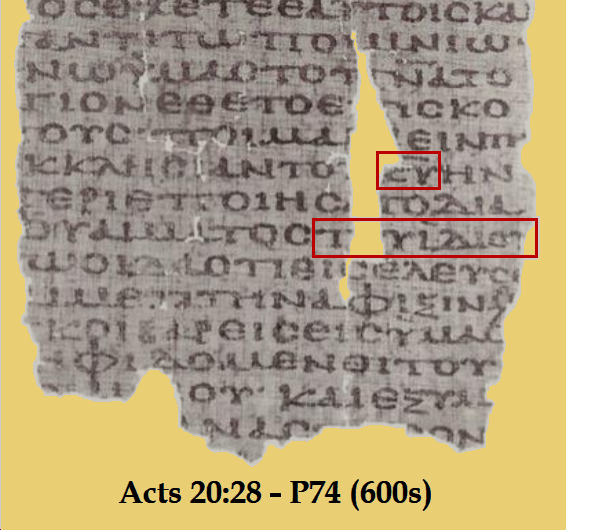
          Greek support for ἐκκλησίαν τοῦ κυρίου includes P74 A C* D E Ψ 33 181 307 453 547 610 945 945 1678 1739 1891 2344 2464 and l599.  Versional support for ἐκκλησίαν τοῦ κυρίου is supplied by itd, e, gig, p the margin of the Harklean Syriac, Sahidic, Bohairic, and Armenian versions.  Patristic support for ἐκκλησίαν τοῦ κυρίου comes from Irenaeus (in Latin), Didymus (in Latin), Theodoret, Ambrosiaster, Jerome, and Pelagius.      

          Greek support for ἐκκλησίαν τοῦ κυρίου καί θεοῦ includes H L P C3 049 1 69 88 226 323 330 440 618 927 1241 1245 1270 1828 1854 2492 and most lectionaries.  Versional support is limited to a Slavic lectionary copy.

          (In addition, Swanson recorded GA 1837’s ἐκκλησίαν τοῦ κυ ιυ καί θῦ.)

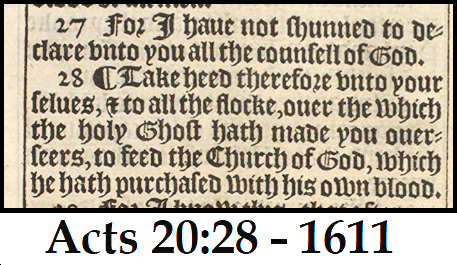
          The KJV, reflecting the Textus Receptus, reads “Take heed therefore unto yourselves, and to all the flock, over the which the Holy Ghost hath made you overseers, to feed the church of God, which he hath purchased with his own blood.” [emphasis added here, and in the following quotations]

           Similarly, the Christian Standard Bible reads “shepherd the church of God, which he purchased with his own blood.”  The Evangelical Heritage Version reads “shepherd the church of God, which he purchased with his own blood.”  The ESV reads “care for the church of God, which he obtained with his own blood.”  The NIV reads “shepherds of the church of God, which he bought with his own blood.” 

          The World English Bible, following the Byzantine Text, reads, “Take heed, therefore, to yourselves, and to all the flock, in which the Holy Spirit has made you overseers, to shepherd the assembly of the Lord and God which he purchased with his own blood.”

          Modern versions render Acts 20:28 in quite diverse ways:  usually the base-text τοῦ θεοῦ is followed, not only in the English Standard Version, NIV, EHV and CSB but also in the NET, RSV, NRSV, CEB, and CEV.

          The New World Translation (a translation produced for the cult known as “Jehovah’s Witnesses,” also known as the Watchtower Society) reads “Pay attention to yourselves and to all the flock, among which the holy spirit has appointed you overseers, to shepherd the congregation of God, which he purchased with the blood of his own Son.”           Inasmuch as no manuscript of Acts reads “of his own Son,” it appears that the modern Arian cult has added to the words of God.  But the Jehovah’s Witnesses Bible butchers are not alone in this respect.  The NET also renders Acts 20:28 with an appeal “to shepherd the church of God that he obtained with the blood of his own Son.”

          Likewise  the NRSV (including the compromised Updated Edition) have Paul tell the Ephesian elders to “shepherd the church of God that he obtained with the blood of his own Son” – echoing the RSV, which reads, “care for the church of God which he obtained with the blood of his own Son.”  The relatively recent Common English Bible reads “shepherd God’s church, which he obtained with the death of his own Son.”  The CEV (Contemporary English Version) reads, “Be like shepherds to God’s church. It is the flock he bought with the blood of his own Son.”  

          The Lexham English Bible likewise reads, “shepherd the church of God which he obtained through the blood of his own Son.  The Complete Jewish Bible reads “shepherd God’s Messianic community, which he won for himself at the cost of his own Son’s blood.”  The Good News Translation reads “shepherds of the church of God, which he made his own through the blood of his Son.”  The New Century Version says “You must be like shepherds to the church of God, which he bought with the death of his own son.”  The Mounce Reverse Interlinear New Testament reads, “shepherd the church of God, which he purchased with the blood of his own Son.”  The Voice says “Shepherd the church of God, this precious church which He made His own through the blood of His own Son.” 

          English versions which end Acts 20:28 with a clear reference to the blood of God’s Son – even though the Greek equivalent of the word “son” is not in the base-text – include the NWT, NET, RSV, NRSV, CEV, Lexham, GNT, Mounce, The Voice, and CEB.

          In 1881 Hort wrote over three columns of his Notes on Select Readings about Acts 20:28 and concluded that “It is by no means impossible that ΥΙΟΥ dropped out after ΤΟΥΙΔΙΟΥ at some very early transcription affecting all existing documents.  Its insertion leaves the whole passage free from difficulty of any kind.”  Metzger mentioned that Hort’s proposal is not necessary – but no less than nine modern English versions appear to be conformed to Hort’s proposed emendation!
Metzger dismissed the majority reading as “obviously conflate.”  The  Byzantine reading τοῦ κυρίου καί θεοῦ may account for both of the longer readings, however, if early scribes committed parablepsis, skipping from the –ou of κυρίου to the –ου of θεοῦ (producing ἐκκλησίαν τοῦ κυρίου), and some subsequently substituting θεοῦ in place of κυρίου, resisting the idea of God having blood.   

          The Tyndale House Greek New Testament reads “ἐκκλησίαν τοῦ κυρίου” and concludes with “αἵματος τοῦ ἰδίου.”  Holmes’ SBL-GNT reads “ἐκκλησίαν τοῦ θεοῦ” and concludes the verse with “αἵματος τοῦ ἰδίου.” 


          It may be worthwhile to consider the thoughts of some who have approached the textual issue from a pastoral perspective – for example Bob Luginbill, Sam Shamoun, and the La Vista Church of Christ (near Omaha Nebraska).

          Considering that the longer reading’s earliest appearance is relatively late, and that ἐκκλησίαν τοῦ θεοῦ is supported by the Peshitta, the Vulgate, Chrysostom and Athanasius, ἐκκλησίαν τοῦ θεοῦ should be adopted, being early, geographically widely supported, and attested in multiple transmission-lines.  GA 1739’s text may be adopted for the entire verse.   

          English readers should be aware that at least eight modern versions essentially echo a conjectural emendation in this verse.


Saturday, July 23, 2016

News: Papyrus 75 Is Online

          Papyrus 75 was donated to the Vatican Library in 2007 by the Hanna family and the Solidarity Foundation.  It was formerly known as Bodmer Papyri XIV and XV; now it is called the Hanna Papyrus.  It contains text from the Gospel of Luke (from 3:18 onward, with damage) and the Gospel of John (from 1:1-15:10, with damage), and its production-date has been assigned to c. 225 (although researcher Brent Nongbri has proposed that the paleographical evidence allows a significantly later date).
          For details about the contents of P75, see the profile at the Encyclopedia of New Testament Textual Criticism website and the transcription at the Nazaroo Files.  Its contents can also be found in print in P. W. Comfort’s and David Barrett’s The Complete Text of the Earliest New Testament Manuscripts, although when using that book one should keep in mind the detailed review offered by Maurice Robinson in 2001.
   
      The format of the page-views of Papyrus 75 at the Vatican Library website is easy to navigate.  Although there is no index-page (as far as I can tell), the page-views can be selected from a scrolling menu at the bottom of the page, and when a page-view is selected, the viewer can easily zoom in on the handwritten notes alongside each page which identify the text on that page.  The page of Papyrus 75 upon which the Gospel of Luke ends and the Gospel of John begins is 2A.8r.  All of the new page-views are watermarked, but not in an interfering way.

          How important is this manuscript?  Well, how important are the following phrases in Luke 24? –

Luke 24:3:  “of the Lord Jesus.”
Luke 24:5:  “He is not here, but has risen.”
Luke 24:12 – the entire verse.
Luke 24:36 – “And said to them, ‘Peace be unto you.’”
Luke 24:40 – the entire verse, “And when He had said this, He showed them His hands and His feet.”
Luke 24:51 – “and was carried up into heaven.”
Luke 24:52 – “and they worshipped him.”

          When the Revised Standard Version was issued in 1946, and again in 1952, it did not contain those verses.  This is because the scholars responsible for the RSV New Testament’s base-text subscribed to Hort’s theory of “Western Non-Interpolations” – which is a technical way of saying that they did not believe that these verses and phrases were genuine.  The reason they did not think these verses were genuine is that these verses and phrases, despite being supported by a huge majority (over 99%) of Greek manuscripts, are absent from Codex Bezae.  Back in 1881, Hort had proposed that Codex Bezae’s text is typical of an early form of the text developed by copyists who tended to expand the text – adding extra words so as to clarify the meaning of sentences, turning references to “Jesus Christ” into “our Lord Jesus Christ,” and so forth. 
          Hort reasoned that since the Western form of the text is characterized by embellishment, making it longer, the testimony of the Western text has special importance, or weight, when it is shorter.  And at these points in Luke 24, it is shorter.  Hort thought that this implies that at these particular points, all the manuscripts that have these verses and phrases have been expanded (or, interpolated) and the Western Text alone has not been interpolated. 
          If Papyrus 75 had not been discovered, it is very likely that Hort’s theory about Western Non-Interpolations would have continued to be believed by the scholars responsible for compiling the Greek texts upon which modern New Testaments are based. 
          When Papyrus 75 was discovered and its text was published, it became clear that all of the passages in Luke 24 which were rendered suspect (or which were outright rejected) due to Hort’s theory of Western Non-Interpolations were present in the manuscript.  Some textual critics – most notably, Bart Ehrman – continue to believe Hort’s theory, not letting things like evidence get in the way of a good theory. 
          Most textual critics, though, were persuaded by the evidence, and it was for this reason that after the discovery and publication of Papyrus 75, subsequent English versions such as the New International Version, the New American Standard Version, and the New Revised Standard Version retained all those verses and phrases in Luke 24 which the RSV had relegated to the footnotes. 
          Advocates of the KJV in 1881 felt considerable consternation that Westcott and Hort had turned a single Greek manuscript (Codex Bezae, with a smattering of Old Latin allies) into the pivot upon which several verses and phrases in Luke 24 would either remain in the text, or be jettisoned.  Similarly advocates of the KJV, in the 1970’s, felt considerable vindication when the compilers of the predominantly Alexandrian Nestle-Aland and United Bible Societies compilations, on the basis of the discovery of one manuscript, felt obligated to pivot back toward the text that the KJV’s translators had used at these particular points in Luke 24.  (For the most part, however, the text of Papyrus 75 has an Alexandrian text, agreeing (against the KJV’s base-text) with the manuscripts upon which the Nestle-Aland compilation heavily depends, especially Codex Vaticanus – which can also be viewed page-by-page at the website of the Vatican Library.)