Followers

Showing posts with label Greek. Show all posts

Friday, December 10, 2021

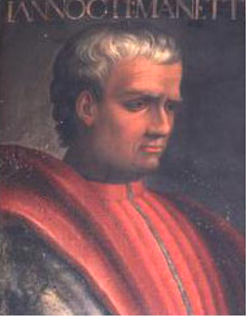
Manetti and the Greek New Testament

Giannozzo
Manetti


         Giannozzo Manetti (1396-1459) is not mentioned in either Metzger’s The Text of the New Testament or in Aland & Aland’s The Text of the New Testament.  But all students of the field of New Testament textual criticism should learn his name.  It was Manetti, a generation before Erasmus, who completed the first Latin translation of the New Testament (since the time of Jerome) that was based primarily on Greek manuscripts. 

         Born into a wealthy family in the city of Florence, Italy, Manetti was taught by the famous historian (and Chancellor of Florence) Leonardo Bruni, and was trained in classical Latin and Greek.  Manetti was committed to the principle of ad fontes before it was cool:   he learned Hebrew in order to produce a Latin translation of the Psalms, and defended his renderings against anticipated objections from fans of the traditional Vulgate in a detailed five-volume work titled Apologeticus.   He also wrote On Human Worth and Excellence, in which he maintained that human beings are creatures of dignity and quality.

          Shortly after the fall of Constantinople in 1453, Manetti began his work on a Latin translation of the New Testament. Because much of Manetti’s library was donated to the Vatican (he had been friends with Pope Nicholas V in his youth), we can identify exactly which Greek manuscripts he used as his sources.  They reside to this day in the Vatican Library: 

          Pal.Gr. 171 (GA 171), which is a full Greek New Testament (including Revelation), Pal. Gr. 189, (GA 156) a Greek Gospels-MS (with illustrated headpieces before each Gospel; the text on the last page of John is cruciform and is followed by generous liturgical appendices), and Pal. Gr. 229 (a diglot, Greek-Latin, manuscript of the Gospels.  A supplemental Latin manuscript also used by Manetti was Pal. Lat.18, containing a Vulgate text of the Old Testament and New Testament.

           Two copies of Manetti’s Latin translation of the New Testament are also at the Vatican Library:  First is Pal. Lat. 45, which presents a straightforward Latin text.  The attribution to Manetti can be seen before each Gospel:  Matthew on fol. 1rMark on fol. 21r  (where it can be seen that Manetti rendered his Greek text in Mark 1:2 as “est in prophetis,” unlike the Vulgate’s “est in Esaia propheta.”), Luke on fol. 33v, and John on fol. 55v.

Annet den Haan
          Second is Urb. Lat. 6, a more ornate copy, produced after Manetti’s death. 

           Two modern-day researchers, Annet den Haan and David Marsh, have made major contributions to a revival of interest in Manetti’s translation-work.  Marsh has written a detailed biography of Manetti, available from Harvard University Press.  Annet den Haan of Utrecht University has become a one-woman encyclopedia of all things related to Giannozzo Manetti, and has made many of her articles and essays available at Academia.edu for free.  Additional information about Manetti, his writings, and his manuscripts can be found at this link


Wednesday, January 22, 2020

Lectionary 60 - The One With Runes

Runes on the frontispiece of Lect 60.

            Lectionary 60 was made in the year 1022, and is thus almost one thousand years old.  It has a very unusual feature on its frontis-piece-page (which displays the remains of a picture of Christ, surrounded by symbols of the Evangelists):  runes.  The rune-inscription identifies the manuscript as the property of Saint Dionysius’ church – the famous basilica north of Paris where kings in France were entombed since Dagobert in 639. 
            Perhaps someone at St.-Denis, noticing that past generations of monks had been obligated to pay Vikings to spare the basilica, and to ransom their abbot, considered it wise to write this note in a language which Vikings could understand – just in case the Vikings might wonder where to send the ransom-note.  Or perhaps a Viking church-member wrote it.
            This existence of this lectionary ought to dissuade us from picturing the history of the Greek New Testament as an exclusively non-European thing – as if Greek manuscripts did not show up in western Europe until the 1400s.  Lectionary 60 shows that Greek manuscripts were not only read, but were produced, in France in the century before the First Crusade.  
            This arrangement of the text in Lectionary 60 tends to follow the pattern for the Synaxarion – movable days – given at Robert Waltz’s Encyclopedia of New Testament Textual Criticism.  Beginning at Easter-time, lections (i.e., selections for reading in church-services) from the Gospel of John are presented, along with lections from the book of Acts.  Lectionary 60 has lections for week-days as well as for Saturdays and Sundays.  After Pentecost, the lections are excerpted from the Gospel of Matthew and from Paul’s Epistles, beginning with Romans.  Twelve weeks’ worth of lections later, the lections are taken from the Gospel of Mark and from Paul’s other epistles.  Lectionary 60 has the lection-cycle for Easter-week, with the Twelve Gospel-readings for Good Friday, and the Readings for the Vigil at the first, third, sixth, and ninth hours, other Easter-time readings, and the Heothina-series.  On page 162, the Menologion section begins.
            There are, however, variations from the Byzantine pattern – especially when it comes to the lection that was to be read in honor of Saint Dionysius the Areopagite.  This lection was particularly esteemed at the church that was named in Saint Dionysius’ honor.  Why Dionysius had received that honor might take some explaining: 
            There are three Dionysiuses in the picture.  First there was Dionysius the Areopagite, who was converted to Christianity by the preaching of Paul in Athens, as reported in chapter 17 of the book of Acts.  Second, there was the patron saint of France, Saint Denis (Denis is short for “Dionysius”), a bishop who was beheaded in Paris in a wave of persecution initiated by Emperor Decius in the mid-200s.  (This martyr was commemorated by the famous Oriflamme banner.)  Third, there was the anonymous author of several influential philosophical compositions that were circulated in the late 400s and early 500s; this author is known as Pseudo-Dionysius.
            Among medieval clerics who thought that Pseudo-Dionysius was actually Dionysius the Areopagite (an impression which Pseudo-Dionysius’ writings encouraged), there was also confusion between Dionysius the Areopagite and Dionysius the third-century martyr.  This may account for the emphasis (a natural emphasis at the basilica of Saint Denis) on the lection for Dionysius the Areopagite (Acts 17:22-34) in Lectionary 60:  it appears in the lectionary three times.  First, it is written in Greek (but in Latin-like handwriting) on page 55, after an acrostic (ΔΟΞΑ ΤΩ ΘΕΩ ΑΜΗΝ) which interrupts the lectionary-material.  It is also found on fol. 153, in a Latin-like script completely unlike the main copyist’s handwriting; the person who wrote this lection seems to have had a gift for finding unusual ways to spell words in Greek.  (Apparently, there had been blank pages in the manuscript, leftover between sections, and someone used them as the material upon which to write this particular lection.)  And it is written near the very end of the lectionary, in much better (recent?) handwriting, with a Latin heading. 
            Two lections in two different kinds of handwriting occupy fol. 154a:  Luke 6:17-23 is written, in something like sense-lines, before Matthew 4:25-5:3a.   Near the bottom of the page, there is an inartistic Greek alphabet and, in Latin, a curse upon anyone who steals this holy book from the library of the St-Denis church.  (Another Greek alphabet appears in the lower margin of fol. 82.)
             
            Once one gets used to the handwriting and untrained initial-drawing of the main copyist in Lectionary 60, its text is not bad at all (although the spelling is phenomenally bad).  Here, as a sort of spot-check, are comparisons of four passages in Lectionary 60 to the Robinson-Pierpont Byzantine Textform; I have disregarded incipit-phrases, and most itacisms (which are everywhere):
            John 9:1-10 (p. 39):  in v. 7, Lect 60 does not have ουν (“therefore”), and in v. 10, Lect 60 has ηνεόχθησάν instead of ανεώχθησάν [NA:  ηνεώχθησάν]
            John 14:1-4 (p. 44):  in v. 1, Lect 60 has μηδε διλιτω [≈14:27], in v. 2, Lect 60 has δια τα εργα αυτα before ειπον [≈14:11],
            First Corinthians 4:1-5 (p. 68):  in v. 2, λοιπόν is absent, in v. 4, Lect has γαρ instead of δε before ανακρίνων [-νον in Lect 60],
            Mark 1:1-5 (p. 178):  in v. 5, Lect 60 does not have ἡ after πασα, in v. 5, and Lect 60 has ϊερουσαλημ instead of οι ιεροσολυμιται.  In v. 4, John’s name is written as ιω.  
                       
            Here are some interesting textual features, and other features, of Lectionary 60:
            ● Mark 16:9-20 is included (on p. 156); it is one of the readings in the Heothina-series
            ● John 5:3-4 is included (on p. 7), and the angel is described as the angel of the Lord (αγγελος γαρ κυ)
            ● Acts 8:37 is not included (on p. 25)
            ● Luke 22:43-45a is included in the text of Matthew, following Mt. 26:39 (on p. 125b, page-view 262 at CSNTM)  (This is normal in Byzantine Gospels-lectionaries – but still interesting.)
            ● In Matthew 10:8 (on fol. 152b, p. 316 at CSNTM), νεκρους εγειρεται (“raise the dead”) is included, but not immediately following “heal the sick.”  Instead, it appears at a later point in the verse, between εκβάλλεται and the first δωρεὰν. P and W and Δ share this reading with Lectionary 60.  (On the same page, there is something strange about the text of Matthew 11:27.)
            ● On page 9, the number Β (2) appears in the upper outer corner of the page; on page 97, the number ΙΓ (13) appears; on page 145, ΙΘ, that is, 19, appears.  Perhaps these are quire-numbers, and perhaps there were once more numbers on other pages, written a little further to the right, but the others have been trimmed away.  (Some notes in the upper margin have been trimmed away; some have been half-trimmed away.)

            ● The margins of Lectionary 60 have quite a few notes, mostly in Latin.  (They are not all from the same hand.)  For example, on page 154b, where Matthew 1:1 begins the text, the opening Latin phrase of Matthew 1:1 is written in the margin.  130b contains a good example of Latin notes alongside Greek notes.
            ● On page 55, the lectionary-material is interrupted by an acrostic poem. (The initials say ΔΟΞΑ ΤΩ ΘΕΩ ΑΜΗΝ)  (This is followed by the St. Dionysius lection, already described.)
            ● The parchment that was used for Lectionary 60 was not of high quality; the copyist(s) frequently had to adapt to uneven pages and pages with holes.
            ● Lectionary 60 includes lections from Matthew, Mark, Luke, John, Acts, Romans, First Corinthians, Second Corinthians, Hebrews, Galatians, Ephesians, Colossians, First Thessalonians, First Timothy, Second Timothy, and Philippians.
            ● On fol. 108 there is a little prayer-note in the lower margin.
            ● Although I did not investigate the question thoroughly, I suspect that at least two copyists, besides later supplement-providers, worked on this lectionary. 
            ● A colophon on fol. 193 supplies the name of a copyist, his location, and the production-date of the manuscript:  ἐτελ[ε]ιοθ[η]  τω παρον εκλογαδ[ιον] δια χειρος Ηλιοῦ πρεσβυτερου κ[αι] μοναχου σπιλεό [?] του μη[νος] Νοεμβριω κς ημερα κυ[ριακῇ], ωρ[α] θ.  τε. ϛφλ ινδ. Ε εν χόρα φραγκι καστρο δε κολόνιας.  –  Something like, “The gift of this Eclogadion was completed through the hand of Elias, presbyter and monk, stained [?] in the month of November, on the 25th day, Sunday, at the 9th hour, year 6,530 in the fifth indiction.  In the country of France, in the castle of Kolonia.”  Someone did the calculations and wrote the implied production-date, 1022, in the margin.

            Lectionary 60 is presently housed at the Bibliothèque Nationale de France (the national Library of France), where it is cataloged as Grec 375.  A digital file of the entire manuscript can be downloaded from the Gallica website.


Readers are invited to double-check the data in this post.


Thursday, May 23, 2019

How to Read a Greek Gospels Manuscript


            Today, let’s look into how to read a Greek manuscript of the Gospels – an important skill that every New Testament textual critic should have.  If you do not already know some New Testament Greek, use This List of Free Resources for Learning New Testament Greek, and after a year or so you should have enough skill to understand everything that I am about to describe.
            Now let’s explore an important medieval Greek manuscript of the Gospels:  minuscule 9.  All Greek manuscripts are important, but this one is especially significant historically, because it was used by the scholar Robert Stephanus in his compilation of the Greek New Testament in 1550.  That is, out of the hundreds of Greek Gospels-manuscripts that exist, this is one that was studied and used the most in the 1500s, as the Textus Receptus – the base-text for the King James Version – was developed. Minuscule 9 – called witness ιβ′ (i.e., #12) by Stephanus – is kept at the National Library of France.  It was produced in 1168.  You can download page-views of the entire manuscript from the Gallica website – just select “Manuscripts” from the options in the first sub-menu there, and then search for Grec 83, and use the menu on the far left of the page to complete the download.  (You will need to agree to Gallica’s Terms & Conditions.)
           
            After opening the manuscript, the first thing we find is a summary of the manuscript’s contents, written relatively recently.  Most manuscripts that are kept in library-collections have this sort of note, and if we pay attention to their contents, we may save some time; these notes often tell readers a little about the manuscript’s history, and list the page-numbers on which each Gospel begins, and also tell about whatever sections might be missing or out of order.  We can deduce from the information on this page that minuscule 9 was once known as Regius 83 (when it was in the library of the king of France), a useful data-nugget if one ever wishes to look for references to this manuscript in books written before its Gregory-Aland inventory number became the standard nomenclature by which it was known.
            Next, we encounter in minuscule 9 a one-page Prologue to the Four Gospels.  It looks like someone had intended to draw the symbols of the Evangelists in the four corners of the page, surrounding the semi-cruciform text – if you look closely you can see the sketched outline of Mark’s lion in the northwest corner – but this task was never completed.  The Prologue explains the symbolic connection between the Gospels and their symbols (man, lion, ox, and eagle).
            On the next page, framed within a red border, is Eusebius of Caesarea’s letter To Carpian (Ad Carpianus), which provides brief instruction on how to use the Eusebian Canons, Eusebius’ cross-reference system for the Gospels.  The title appears in uncial letters, the outlines of which were drawn, and then filled with red pigment.  There is an elaborate initial “A” in which blue, red, and yellow pigment has been used.  Within the text, the letter omicron and a few other letters are sporadically filled in or outlined in red.  (This feature appears frequently in the Gospels-text as well.)  An English translation of Eusebius’ letter to Carpian is online, and so is a table of the Canons themselves.
            Next, several pages are filled by the Eusebian Canons.  The canon-lists are framed by decorative columns, resembling rounded doorways at the entrance to a temple.  At the end of the canons, two columns have been left blank.  Then comes the Kephalaia, or chapter-list, for the Gospel of Matthew, filling a page and a half. 
            After a blank page, the text of the Gospel of Matthew begins, after its title, which is written in large red letters.  A huge initial “B,” somewhat reminiscent of the initials in the Bury Bible, but not quite as ornate, fills most of the page; the rest of the text on the page is written in uncials.
            On the next page, the text of Matthew continues.  The Greek book-title has been written at the top of the page, and at some point this was supplemented by the Latin book-title as well. 
            Continuing to the following page, readers may notice small Greek letters beta and gamma in the outer margin.  These are section-numbers, corresponding to the section-numbers that appear in the Eusebian Canon-tables.  Within the text, one can detect small breaks where one section ends and another begins; the first letter of the new chapter is written in red. Also, you can see at the beginning of the chapter a small “+” symbol.  Often (as we see here in minuscule 9 at the third section), this “+” is accompanied by another symbol that represents the word arche, “beginning/”  This means that at this point, a daily reading begins.  Often the arche-symbols are supplements by telos-symbols, signifying the ends of the segment for the daily reading.   (If we turn ahead to page 11, at the end of Matthew 2:12 we can see a telos-symbol at the end of a line, and alongside the next line, the arche-symbol is in the margin.)
            By the way, if you have learned your Greek numerals, you can easily follow along with the section-numbers that are in the inner margin of the 27th edition of the Nestle-Aland Novum Testamentum Graece.  Sometimes, a manuscript’s section-numbers will not correspond exactly to the Nestle-Aland arrangement, but they usually do.
            In minuscule 9, ordinary page-numbers have been added in the upper right corner of the page – although it is more precise to call the numbers in this manuscript leaf-numbers rather than page-numbers, because they appear on every other page, denoting the individual leaf, on which there is (a) a front page, and (b) a back page.  If we turn to page 10a, we will see in the left margin a stack of four symbols (each looking like “├”).  Sometimes such marks appear in the form of little arrow-markers (>).  They are there to indicate that in the lines of text that they accompany, there is a quotation from the Old Testament.
            If we look at the bottom of page 10a, we will see a chapter-number – α – and the chapter-title (περι των μαγων, that is, About the Wise Men).  At the top of leaf 12, the next chapter-number and chapter-title (titloi – the same as the Kephalaia, except they appear here one at a time) are supplied at the top of the page, and the chapter-title also appears in the outer margin alongside the exact point where the chapter begins – in this case, at Matthew 2:16.  (For more information about the Kephalaia, see the post Kephalaia:  The Ancient Chapters of the Gospels.)  Sometimes, the titloi appear at the foot of the page.
            Occasionally, one will encounter a hole in the parchment, such as the one in minuscule 9 on leaf 17.  Almost always, these holes were made during the preparation of the parchment, and scribes simply wrote around them. 
            Also in minuscule 9, one will occasionally find little notes written in Latin in the margin.  Four such notes can be seen on the front of leaf 20.
            On leaf 22, some damage has occurred to the manuscript, and a repair has been attempted: part of the lower portion of the leaf has been ripped away.  Newer parchment has been glued to the old parchment, and the small portion of the text that was lost has been supplied in different handwriting.  Technically, this small bit of writing (less than four full lines) on the younger parchment qualifies as a supplement.
            On leaf 24, we see the effect of a recurring problem in medieval manuscripts:  when manuscripts were bound or rebound, sometimes their pages were also recut, and sometimes this was carelessly done, resulting in over-trimming.  Fortunately in this case, no Gospels-text was lost, but the book-title at the top of the page has been cut.  (Also notice on this page the Latin translations of the chapter-numbers and chapter-titles.)
            On the back of leaf 27, there is something interesting:  in the text, Matthew 9:26 ought to read, και εξηλθεν η φημη αυτη εις ολην την γην εκεινην.  However, the copyist skipped the words η φημη.  When this scribal error was detected, the missing words were added in the margin, accompanied by a triangular set of red dots (\), and the same symbol was added in the text at the point where the words η φημη should be read.
            On leaf 28b, we encounter two more interesting features:  first, at Matthew 10:4, there is a short margin-note about Judas.  And in the text of Matthew 10:5, the copyist momentarily omitted the word εθνων but caught his mistake and added the word above the line at the place where it belongs.
            On leaf 29a, there is another \ mark in the margin, but in this case it is not in red, and there is no identical mark in the text; instead, in the outer margin, there is a Latin note accompanied by two dots – – a distigma, or umlaut-like symbol.
            Moving along to leaf 37, we can see that somebody added red “<” marks in the outer margin, to acknowledge the quotation from Isaiah 42 that Matthew makes in 12:18-21.  These marks are not as neat as some others, though, so it is possible that a different scribe is responsible.
            On 37b and 38a, the original book-title that had been at the top of the page, apparently trimmed away, has been replaced in very different handwriting.
            In the margin of 53a, alongside Matthew 19:27, there is a lectionary-related symbol in the margin:  in addition to arche and telos, here we see arcou – that is, “resume.”  Sometimes a lection consisted of more than one segment of text, and this symbol introduced the second segment.           
            On 59a , there is another example of the use of the mark.  In this case, the appears directly above the telos symbol that follows the end of Matthew 21:43, and another appears in the margin, accompanying the note του ορθρου.  This indicates that this passage was a morning-time reading in the lection-cycle.   If this echoes the treatment of this passage in some otherwise unknown early lection-cycle, it might have something to do with the absence of Matthew 21:44 in a few early witnesses – but such a lection-cycle would have to be extremely early, inasmuch as one of the witnesses in which Matthew 21:44 appears to be missing is Papyrus 104, which competes with Papyrus 52 for the title of the earliest extant fragment of the New Testament text.
             On 67a, in the margin alongside the end of Matthew 24:37, we encounter another lectionary-related mark:  υπ, written with the υ below the π.  This abbreviation stands for hyperbale, or, “jump ahead, signifying that the rest of the lection consisted was somewhere other than the immediately-following text.  In this case, we find arcou “resume”) just a little further down the page, alongside Matthew 24:43. 
            On page 80a, there is a textual variant in the margin:  νυκτος is added to Mt. 27:64, between αυτου and κλέψωσιν.  This reading is supported by L M 565 700 892 1424 and the Sinaitic Syriac manuscript, and a correction in 1582.
            At the end of Matthew, on 81b, only slightly separated from the end of 28:20, there is a colophon, that is, a closing-note by the scribe:  the end of the words of Matthew, from the Gospel according to Matthew, which Matthew wrote in Hebrew in Palestine, in the eighth year after the ascension of Lord.  Written in 2,522 remata, 2,560 stichoi.    This is followed by what appears to be the name of the scribe, Solomon, in stylized lettering.
            On the very next page, 82a, the Kephalaia are listed for the Gospel of Mark, below a braided heading-marker, for which red, blue, yellow, and green pigments were used.   
            A few pages appear to be missing – the last page of the Kephalaia-list has been replaced – but the Gospel of Mark begins intact, with a very large initial “A” on 85a.  The opening title, drawn in red hollow uncials, is rather unusual.           
Getting crazy with the flourishes.
            On several of the pages of Mark which follow, one may notice an idiosyncrasy of the scribe: when the word και appeared in the last line on a page, he often wrote it as a και-compendium, i.e., an abbreviation, and extended the final stroke in a fancy design below the line.  Sometimes the flourish is reinforced with red ink (as on page 111.)  The stalks of the letters φ and ψ on the last line of a page are sometimes similarly embellished.
            The Gospel of Mark ends on 131b, and a nice little headpiece introduced the Kephalaia-list for Luke, with a red cross in the margin.
            On 133b, in the space left after the end of Luke Kephalaia-list, someone has added a portrait of Luke the Evangelist, writing his Gospel at a desk, framed within a heavy green background on three sides.  What appears to be a blue easel with clawed legs sits nearby.
            On 134a, the text of the Gospel of Luke begins, below the unusual title and alongside a large initial “E.”  On the next page, the book restarts at verse 5 (which is not unusual in medieval manuscripts) and there is another large initial “E,” very different in style from the first one.
            On 137b, the copyist made an embarrassing mistake:  he completely skipped Luke 1:51, right in the middle of the Magnificat.  The missing verse has been added in the margin.  A smaller mistake was made in 2:15; the words το γεγονος are missing in the text; they have been supplied in the margin.
            On 144b, the genealogy begins, and the format is unusual:  numbers are assigned to each individual, and the numbers continue on the next page, on which the text is arranged in three columns.  On 145b, the scribe returns to a single-column format, but the numbers continue, all the way up to the reference to God, at the end, who is numbered 77.
            On leaf 179 there is a small patch at the bottom.
            On 183b, in Luke 13:28, there is an initial omicron that is shaped like a fish.  Another fish-initial is on 214a.  Similar initials occur in some lectionaries. 
            In the first line of 187b, the initial in Luke 15:11 is unusually large.
            On 199a, the scribe skipped the words εν ποια in Luke 20:2.  They are added in the margin.
            The Kephalaia-list for the Gospel of John is on 215a, with a red and green braided headpiece.  On the opposite side of the page there is a full-page portrait of John, composing his Gospel, framed on three sides by a thick green border. 
            The next leaf is clearly a supplement, the original opening page containing the text of John 1:1-14a, is lost. 
            On 237a, there is a “jump ahead” symbol alongside the line where John 7:53 begins, instructing the lector to move ahead to 8:12 on the next page, where an αρξου (“Resume”) symbol appears.  (This neatly illustrates a hypothesis regarding the early loss of John 7:53-8:11: an early copyist, unfamiliar with the local lectionary in which John 7:53-8:11 was skipped in the lection for Pentecost-Day, possessed an exemplar in which he saw instructions to “Jump ahead” at the end of John 7:52, and to “Resume” at 8:12, and, thinking the instructions were meant for him rather than for the lector, omitted the intervening verses.  (See for more information my e-book, A Fresh Analysis of John 7:53-8:11).
             On 239a, a distigma () appears in the margin of John 8:36, where the copyist left out the word ουν.  Another distigma appears in the text to indicate where the word belongs.
           
The full-page colophon
after the end of John.
The text of John concludes on 241a.  241b contains a cruciform-framed colophon that includes stichiometric information.  
            Beginning on 272a below a decorative headpiece, there is a lection-calendar for Sunday lections, beginning with the lection for Easter.  Incipit-phrases (the opening words of a lection as read in the church-service) are included.  This is the normal annual Synaxarion calendar.  An interesting minor detail in these pages is the assorted knot-like designs which occasionally appear, apparently serving no practical purpose – they seem to be doodles. Similar knots appear in a wide range of manuscripts.
            On 280a, a braided headpiece precedes another part of the lection-calendar. 
            Another headpiece is on 285b; yet another one begins 287a, which has as part of its design a “Jesus Christ, Victor” cross.  The incipit-phrases for Easter-week lections follow.
            On 288a, after another headpiece, the Heothina-series of lections is covered, even though no special marks accompany the text of these lections in the Gospels-text.    
           
On 288b, there is another headpiece.  The heading introduces the Menologion-readings for the month of September. That is, unlike the first part of the lection-calendar, in which all dates are arranged in relation to Easter, these feast-days are assigned to dates on the calendar.
            On 289b, another headpiece introduces incipit-phrases for the Menologion-readings for the month of October.  On 290a, we see that Sergius and Bacchus’ feast-day is commemorated on October 7, and Pelagia’s feast-day is commemorated on October 8.  This is consistent with the designation of John 8:3-11 as the lection in the Menologion for October 8. 
            At the top of 290b, another headpiece introduces incipit-phrases for the Menologion-readings for the month of November.
            At the top of 291b, there is another headpiece – better executed than some of the others.  The list that follows provides incipit-phrases for the lections read in December.
            More headpieces and more monthly lection-lists, with more knot-doodles in the margins, along with simple pictures of the symbols of the Evangelists, continue, to the end of the manuscript’s text on 248b.  Then after a few blank pages, the back cover is reached.

            All in all, minuscule 9 is a pretty good manuscript to use to get acquainted with the standard format of medieval Greek Gospels-manuscripts.  It does not have an overwhelming amount of marginalia; its script is reasonably neat; its appearance is not marred by incessant corrections. I hope this review of minuscule 9 has been informative and instructive. 


Readers are invited to double-check and supplement the data in this post.

Monday, February 18, 2019

Erasmus' Manuscript of Revelation


            Erasmus’ first edition of the printed Greek New Testament – it was released by the printer Johann Froben in 1516 – has several famous features.  One of them involves the way Erasmus treated the last six verses of Revelation.  Erasmus had only one Greek manuscript of Revelation when he compiled the text for his Novum Instrumentum (the official name of the first edition):  GA 2814, which had been loaned to Erasmus by Johann Reuchlin.  (For a long time, this manuscript was simply referred to as manuscript 1r.)
            Page-views of the entire manuscript can be now accessed at the website of the library of the University of Augsburg.  (You may need to reload the page once or twice to get to the page-views.)  
A page (31v) of the manuscript
of Revelation used by Erasmus,
now at the University of Augsburg.
            (Shown:  part of Andreas of Caesarea’s commentary, followed by Rev. 8:13, followed by some commentary and a heading (in red), followed by Rev. 9:1-5a.  (The text is accompanied in the margin by red > marks.)  Notice the textual variant in 8:13:  this manuscript reads αγγελου (“angel”) although the Byzantine text (and the Nestle-Aland compilation) reads αετου (“eagle”).  Oikoumenios (keep reading for more information about him) also used the reading “eagle” in his commentary on Revelation, stating, “The eagle in midheaven, looking sadly at the misfortunes of those on earth, you will understand is a kind of divine angel sympathizing with the plight of human beings.” (Cf. John N. Suggit’s translation.)   
            If you consult the final pages of the manuscript, you can see that at the foot of fol. 92v, most of the text of Rev. 22:16 appears, interrupted by, and followed by, Andreas’ commentary – and on the next extant page (93r), we find ourselves in the summary of the contents of Revelation with which Andreas ended his commentary.  On 93v, Andreas’ review of the contents of Revelation continues, and then on 94r, in entirely different handwriting (as if someone had noticed that the manuscript had been damaged, and made this replacement-page, although the entire loss was not detected), we find the last words of Andreas’ commentary.   There are a few more pages, but they are blank.  (It looks like 95v may have been prepared to hold a framed illustration which was never added.)    
           
            This fits the description that was supplied by Erasmus regarding the manuscript that he used as the main basis for his compilation of the text of Revelation.  Erasmus mentioned that he used a Greek manuscript which was deficient at the end:  in the course of correspondence with Edward Lee, Erasmus wrote: 
            In calce Apocalypsis in exemplari, quod tum nobis erat unicum, nam is liber apud Graecos rarus est inventu, deerat unus atque alter versus.  Eos nos addidimus secuti Latinos codices.  Et erant ejusmodi, ut ex his quae praecesserant possent reponi. 
            That is, in English:  “At the end of my exemplar of Revelation – of which I had only one, because Greek copies of this book are rare – a few lines were missing.  I added them, using Latin copies as the basis.  These lines were of the sort that could be reconstructed [in Greek] by consulting the preceding text.” 
            This accounts for the very unusual Greek text of Revelation 22:16b-21 in Erasmus’ compilation.  For these verses, Erasmus took in hand a copy of the Vulgate, and translated its Latin text of Revelation 22:16b-21 into Greek (beginning with ὁ ἀστήρ). 
            Erasmus’ reconstruction of this passage, however, does not match up with any Greek manuscripts at several points (at least, not with any Greek manuscripts made prior to his compilation).  Although the Textus Receptus went through several revisions in the 1500s, Erasmus’ retro-translation of Revelation 22:16b-21 survived the process; as a result, the Textus Receptus continues to perpetuate some Greek readings in this passage that originated with Erasmus.  Bruce Metzger (in a footnote on page 100 of The Text of the New Testament, third edition) wrote about some of them: 
            “For example ἀκαθάρτητος (Rev. xvii. 4; there is, however, no such word in the Greek language as ἀκαθάρτης, meaning ‘uncleanness’); ὀρθρινός (xxii. 16); ἐλθέ twice, ἐλθέτω (xxii. 17); συμμαρτυροῦμαι γάρ . . . ἐπιτιθῇ πρὸς ταῦτα (xxii. 18); ἀφαιρῇ βίβλου . . . ἀφαιρήσει (future for ἀφελεῖ!!), βίβλου (second occurrence) (xxii. 19); ὑμῶν (xxii. 21).”
            How significant are these variations?  Almost all of them are trivial.  If one takes in hand the KJV and the NASB, and compares the two, it appears that the most of the new readings invented by Erasmus made no difference in translation: 
            v. 18:  KJV:  “For” / NASB does not have “For.”
            v. 19:  KJV:  “the book of life” / NASB:  “the tree of life”
            v. 19:  KJV:  “and from the things which are written” / NASB:  “which are written.”  (That is, in the KJV, three things are referred to:  the book of life, the holy city, and the things written in this book.  Whereas in the NASB, two things are referred to:  the book of life and the holy city, which are written about in this book.)
            v. 20:  KJV:  Even so, come” / NASB:  does not have “Even so.”      
            v. 21:  KJV:  our Lord Jesus Christ” / NASB:  “the Lord Jesus.” 
            v. 21:  KJV:  you all” / NASB:  “all.”

            Only the difference between “tree of life” and “book of life” yields a significant change to the meaning of the text.  Metzger, in his Textual Commentary on the Greek New Testament (albeit not in all editions), proposed a theory to account for this:  “The corruption of “tree” into “book” had occurred earlier in the transmission of the Latin text when a scribe accidentally miscopied the correct word ligno (“tree”) as libro (“book”).” 
           If Metzger’s theory is true, the confusion between ligno and libro may have occurred much earlier – early enough to affect some early Latin texts and the Bohairic version.  All Greek manuscripts of Revelation, however – at least, all Greek manuscripts prior to Erasmus’ printed text – support the reading “tree of life.”
           
            Some more information about Erasmus’ manuscript of Revelation may be helpful.  For many years after Erasmus used it, its location was not publicly known, and there was some concern that it had been lost.  In 1861, however, it turned up, and the scholar who discovered it – Franz Delitsch – wrote a detailed essay (in German) describing its readings, and showing how tightly its contents match up with Erasmus’ compilation, leaving no doubt that it was indeed Codex Reuchlins, the manuscript used by Erasmus.  It was later given a new identification-number (GA 2814).  

           Accompanying the text of Revelation in 2814 is a commentary which was composed by archbishop Andreas of Caesarea in 611.  Contrary to a recent claim made by James White, this commentary is not written in Latin; it is Greek.  Prior to Andreas of Caesarea (this Caesarea is the same place as Kayseri in Turkey, not the Caesarea on the coast of Israel), a writer named Oikoumenios had also written a commentary on Revelation, in the late 500s.  The work of Oikoumenios was known to Andreas; he refers to it repeatedly.  There is not a lot of data about the setting in which Oikoumenios wrote, but one of his statements indicates the time when he wrote:  he stated specifically that more than 500 years had passed since John wrote the book of Revelation.  The time between the composition of Oikoumenios’ commentary, and the commentary by Andreas, cannot have been great. 
            Andreas’ commentary became something of a standard work. (Meanwhile the Latin commentary on Revelation by the fourth-century writer Tyconius similarly was widely used, despite Tyconius’ Donatist views.)  It was often copied with the text of Revelation itself, in a specialized format, which Metzger described in The Text of the New Testament:  “He divided the book into twenty-four λόγοι, or discourses, because of the twenty-four elders sitting on thrones about the throne of God (Rev. iv. 4).  He further reflected that the nature of each of the twenty-four elders was tripartite (σῶμα, ψυχή, and πνεῦμα), and therefore divided each λόγος into three κεφάλαια, making a total of seventy-two chapters for the entire book.”
            An English translation of Andreas’ commentary on Revelation, with an insightful introduction, was recently completed by Eugenia Constantinou.  It can be downloaded for free – although you might have to spend a few minutes tracking it down from a large collection of academic papers.  It is also available to purchase as a paper book.   The Greek text of Andreas’ commentary, extracted from Volume 106 of Migne’s Patrologia Graece series, is also online.                   


Post-script

            Some writers who tend to defend the Textus Receptus, such as Thomas Holland and Chris Thomas, have insisted that Erasmus did not reconstruct Revelation 22:16-21 from Latin, or at least that there is little evidence for such a reconstruction.  Jan Krans has issued a detailed and remarkably effective reply, and his general conclusions are confirmed beyond all doubt by the examination of the online page-views of 2814.

Friday, February 8, 2019

Parablepsis: When Nothing Is Something


             Parablepsis is what happens when a copyist’s line of sight drifts from one word or set of letters in his master-copy to the same (or similar) word or set of letters a little further along in his master-copy, accidentally skipping the words or letters in between.  When manuscripts share arrays of short readings that look like they were caused by parablepsis, it’s reasonable to posit a relationship of some sort between the manuscripts with those short readings.  Before looking into that further, let’s take a look at four examples of parablepsis that appear in the Gospel of Matthew in one of the most important manuscripts we have:  Codex Sinaiticus

Matthew 7:27 – In the description of the fall of the house of the foolish builder, the scribe’s line of sight drifted from ποταμοὶ καὶ to ἄνεμοι καὶ, accidentally losing the phrase about the blowing winds.  The scribe of minuscule 579 made the same mistake in verse 25.  Another Alexandrian manuscript’s scribe made a worse mistake:  the scribe of minuscule 33 skipped from the words τη οικία ἐκείνη (“that house”) in verse 25 to to the same words in verse 27, skipping verse 26 entirely and producing a Greek sentence which says that when storms came to the wise man’s house, it fell with a great crash!

● Matthew 9:15 – The scribe of À skipped from the word νυμφίος at the end of Jesus’ question to the recurrence of the same word, losing the phrase “But days will come when the bridegroom will be taken away from them.” 

Matthew 13:39 – The scribe of À skipped from the letters ο δε after διάβολος to the similar letters οι δε before θερισται, thus missing the phrase “the harvest is the end of the age.” 

Matthew 21:19 – The scribe of À did not write the word ευρεν (“found”) between the word ουδεν and the word εν.  The omission could have been elicited by either homoioteleuton (“same endings” or by homeoarcton (“same beginnings”). 

            As far as I know, Codex Sinaiticus is the only manuscript that has all four of these readings.  If we were to find another manuscript, and all we knew about it was that it contained these three exact readings, I would strongly suspect that it was extremely closely related to Codex Sinaiticus.   As Kirsopp Lake wrote, “Whereas agreement in a correct reading is no criterion of similarity of origin, agreement in erroneous readings is a very good criterion.”  The odds seem extremely low that two copyists would make the same series of parableptic errors.  The thing to see is that by observing readings in manuscripts that can be accounted for by parablepsis, we can deduce that the manuscripts that share those readings are related to one another.
            Consider Matthew 12:47:  this verse is not in the English Standard Version, because the editors of the ESV relied so heavily on the Alexandrian Text.  But the absence of this verse is elegantly accounted for as a parableptic error; an early copyist’s line of sight jumped from the word λαλησαι (“to speak”) at the end of verse 46 to the same word at the end of verse 47, losing the words in between, which constitute verse 47.  Are the manuscripts that lack verse 47 closely related?  While there are a smattering of unrelated manuscripts that do not include this verse, the major Greek manuscripts for non-inclusion are Sinaiticus, Vaticanus, Codex L, and Codex Γ, and although Codex Γ’s text is Byzantine, the other three are flagship manuscripts of the Alexandrian Text.  Even Codex Γ reveals the influence of Alexandrian manuscripts in its ancestry; it includes a rare interpolation in Matthew 27:49 that is also attested by À, B, and L. (For more about Mt. 12:47, see this post.)  The ESV really should put this verse back in the text where it belongs.

            Now let’s aim this principle at some readings in the Byzantine Text that are shorter than their rival readings in the Alexandrian Text.  There are hundreds of such readings; here I will briefly focus on just 20 – five from each Gospel.

Matthew 10:8 – If the text originally read Ασθενουντας θεραπεύετε νεκρους εγείρετε λεπρους καθαρίζετε (Heal the sick, raise the dead, cleanse lepers), the shorter Byzantine reading can be accounted for by a parableptic error from -ετε to -ετε. 
Matthew 13:40 – If the text originally read κατακαίεται, an accidental skip from κα- to κα- would account for the Byzantine reading.
Matthew 19:24 – If the text originally read πλούσιον εισελθειν εις την βασιλείαν του θεου, a parableptic error from εισ- to εις could elicit the loss of the intervening letters, eliciting further the movement of εισελθειν to the end of the verse.     
● Matthew 24:38 – If the text originally read εν ταις ημέραις εκείναις, an accidental skip from –αις to –αις could result in the loss of the word εκείναις.
Matthew 27:40 – If the text originally read και κατάβηθι, an accidental skip from κα- to κα- could result in the loss of the word και.

Mark 2:21 – If the text originally read απ’ αυτου, an accidental skip from α- to α- could result in the loss of απ’.
● Mark 3:28 – If the text originally read και αι, an accidental skip from -αι to αι could result in the loss of αι.
● Mark 4:18 –If the text originally read ουτοί εισιν οι τον, an accidental skip from ο- to ο- could result in the loss of ουτοί εισιν.
Mark 12:8 – If the text originally read εξέβαλον αυτον, an accidental skip from -ον to ον could result in the loss of αυτον.
● Mark 14:21 – If the text originally read Οτιμεν, an accidental skip from Ο- to could result in the loss of Οτι.

Luke 11:20 If the text originally read εγω εκβαλλω, an accidental skip from ε- to ε- could result in the loss of εγω.
Luke 19:4 – If the text originally read εις το εμπροσθεν, an accidental skip from ε- to ε- could result in the loss of εις το.
Luke 20:19 – If the text originally read εφοβήθησαν τον λαόν, an accidental skip from to –ν could result in the loss of τον λαόν.    
Luke 22:18 – If the text originally read απο του νυν απο, an accidental skip from απο to απο could result in the loss of απο του νυν.
Luke 22:30 If the text originally read τραπέζης μου εν τη βασιλεία μου, an accidental skip from μου to μου could result in the loss of εν τη βασιλεία μου.  (Many Byzantine manuscripts, including manuscripts used to form the Textus Receptus, have the longer reading here.)

John 1:19 – If the text originally read οτε απέστειλαν προς αυτον οι, an accidental skip from
to could result in the loss of προς αυτον.
John 1:50 – If the text originally read οτι ειπόν σοι, οτι ειδον, an accidental skip from to could result in the loss of οτι.
John 4:3 – If the text originally read και απηλθεν παλιν εις την Γαλιλαίαν, an accidental skip from to –ν could result in the loss of παλιν.
John 11:30 – If the text originally read αλλ’ ην ετι εν τω τόπω, an accidental skip from ε- to ε- could result in the loss of ετι.
● John 21:21 – If the text originally read Τουτον ουν ιδων ο Πέτρος, an accidental skip from to could result in the loss of ουν.   

            There are many more textual contests in the New Testament in which (a) the Byzantine Text has a reading that is shorter than its rival Alexandrian reading, and (b) the shorter reading can be accounted for as a result of parablepsis.  For example, in the Byzantine Text, James 4:12 does not have the words και κριτής (“and Judge”), a short reading which can be explained if the verse originally began with Εις εστιν νομοθέτης και κριτης and an accidental skip was made from the -της at the end of νομοθέτης to the -της at the end of κριτης. 

From all this, we should draw two conclusions:

(1)  If is acknowledged that, say, half of these short Byzantine readings are the result of parablepsis, then unless we assume that scribes independently made the same mistake at the same point in the text ten times – which seems highly improbable – then they must echo an earlier ancestor-manuscript in which the text of these passages had been shortened via parableptic error. 

(2) Textual critics should use manuscript-evidence that represents different text-types, not just the Byzantine Text.  This is the only way to detect (and remedy) parableptic errors in which some text was lost but a sensible sentence was formed nevertheless.  It appears that most Byzantine Gospels-manuscripts are descended from a master-copy or master-copies in which some small snippets of the text have been lost via parablepsis.  It also appears, from other research, that most Alexandrian Gospels-manuscripts are descended from a master-copy or master-copies in which much more text has been lost via parablepsis.  To depend too heavily on one form of the text, merely because its oldest representatives lasted longer in Egypt’s low-humidity climate, or upon another form of the text, because it has circulated in a much higher number of manuscripts, is not our best option.