Followers

Showing posts with label CEV. Show all posts

Thursday, November 28, 2024

Acts 20:28 – Smuggling in an Emendation?

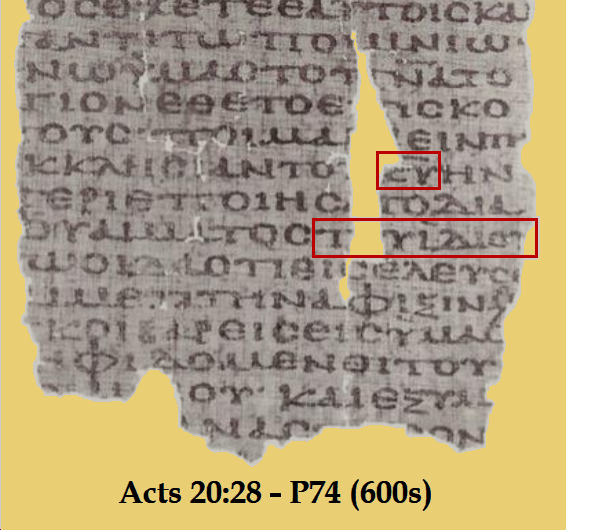
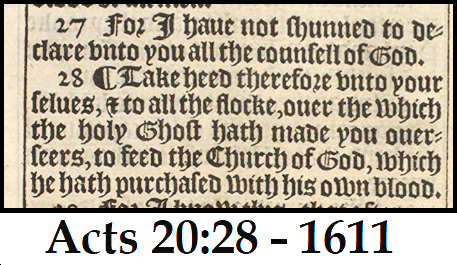
          Two textual issues in Acts 20:28 have impacted translations of the verse:  First:   did Luke refer to the church as the “church of God,” the “church of the Lord,” or the “church of the Lord and God”?  Second, at the end of the verse, did Luke write that the church was obtained through his blood, or through the blood of his Son?

          Let’s review the external evidence:
          Greek Support for ἐκκλησίαν τοῦ θεοῦ includes ﬡ B 056 614 1175 1611 104 2147 1505 Byz, Lectionary 60, l592, l598, l603, l1021, and l1439.  Versional support is provided by the Vulgate, the Peshitta, the Harklean Syriac, the Georgian version, and itar, c, dem, ph, ro, w and a Bohairic copy.  Patristic support for ἐκκλησίαν τοῦ θεοῦ is supplied by Athanasius, Basil, Epiphanius, Chrysostom, Cyril, and Ambrose.    

          Greek support for ἐκκλησίαν τοῦ κυρίου includes P74 A C* D E Ψ 33 181 307 453 547 610 945 945 1678 1739 1891 2344 2464 and l599.  Versional support for ἐκκλησίαν τοῦ κυρίου is supplied by itd, e, gig, p the margin of the Harklean Syriac, Sahidic, Bohairic, and Armenian versions.  Patristic support for ἐκκλησίαν τοῦ κυρίου comes from Irenaeus (in Latin), Didymus (in Latin), Theodoret, Ambrosiaster, Jerome, and Pelagius.      

          Greek support for ἐκκλησίαν τοῦ κυρίου καί θεοῦ includes H L P C3 049 1 69 88 226 323 330 440 618 927 1241 1245 1270 1828 1854 2492 and most lectionaries.  Versional support is limited to a Slavic lectionary copy.

          (In addition, Swanson recorded GA 1837’s ἐκκλησίαν τοῦ κυ ιυ καί θῦ.)

          The KJV, reflecting the Textus Receptus, reads “Take heed therefore unto yourselves, and to all the flock, over the which the Holy Ghost hath made you overseers, to feed the church of God, which he hath purchased with his own blood.” [emphasis added here, and in the following quotations]

           Similarly, the Christian Standard Bible reads “shepherd the church of God, which he purchased with his own blood.”  The Evangelical Heritage Version reads “shepherd the church of God, which he purchased with his own blood.”  The ESV reads “care for the church of God, which he obtained with his own blood.”  The NIV reads “shepherds of the church of God, which he bought with his own blood.” 

          The World English Bible, following the Byzantine Text, reads, “Take heed, therefore, to yourselves, and to all the flock, in which the Holy Spirit has made you overseers, to shepherd the assembly of the Lord and God which he purchased with his own blood.”

          Modern versions render Acts 20:28 in quite diverse ways:  usually the base-text τοῦ θεοῦ is followed, not only in the English Standard Version, NIV, EHV and CSB but also in the NET, RSV, NRSV, CEB, and CEV.

          The New World Translation (a translation produced for the cult known as “Jehovah’s Witnesses,” also known as the Watchtower Society) reads “Pay attention to yourselves and to all the flock, among which the holy spirit has appointed you overseers, to shepherd the congregation of God, which he purchased with the blood of his own Son.”           Inasmuch as no manuscript of Acts reads “of his own Son,” it appears that the modern Arian cult has added to the words of God.  But the Jehovah’s Witnesses Bible butchers are not alone in this respect.  The NET also renders Acts 20:28 with an appeal “to shepherd the church of God that he obtained with the blood of his own Son.”

          Likewise  the NRSV (including the compromised Updated Edition) have Paul tell the Ephesian elders to “shepherd the church of God that he obtained with the blood of his own Son” – echoing the RSV, which reads, “care for the church of God which he obtained with the blood of his own Son.”  The relatively recent Common English Bible reads “shepherd God’s church, which he obtained with the death of his own Son.”  The CEV (Contemporary English Version) reads, “Be like shepherds to God’s church. It is the flock he bought with the blood of his own Son.”  

          The Lexham English Bible likewise reads, “shepherd the church of God which he obtained through the blood of his own Son.  The Complete Jewish Bible reads “shepherd God’s Messianic community, which he won for himself at the cost of his own Son’s blood.”  The Good News Translation reads “shepherds of the church of God, which he made his own through the blood of his Son.”  The New Century Version says “You must be like shepherds to the church of God, which he bought with the death of his own son.”  The Mounce Reverse Interlinear New Testament reads, “shepherd the church of God, which he purchased with the blood of his own Son.”  The Voice says “Shepherd the church of God, this precious church which He made His own through the blood of His own Son.” 

          English versions which end Acts 20:28 with a clear reference to the blood of God’s Son – even though the Greek equivalent of the word “son” is not in the base-text – include the NWT, NET, RSV, NRSV, CEV, Lexham, GNT, Mounce, The Voice, and CEB.

          In 1881 Hort wrote over three columns of his Notes on Select Readings about Acts 20:28 and concluded that “It is by no means impossible that ΥΙΟΥ dropped out after ΤΟΥΙΔΙΟΥ at some very early transcription affecting all existing documents.  Its insertion leaves the whole passage free from difficulty of any kind.”  Metzger mentioned that Hort’s proposal is not necessary – but no less than nine modern English versions appear to be conformed to Hort’s proposed emendation!

Metzger dismissed the majority reading as “obviously conflate.”  The  Byzantine reading τοῦ κυρίου καί θεοῦ may account for both of the longer readings, however, if early scribes committed parablepsis, skipping from the –ou of κυρίου to the –ου of θεοῦ (producing ἐκκλησίαν τοῦ κυρίου), and some subsequently substituting θεοῦ in place of κυρίου, resisting the idea of God having blood.   

          The Tyndale House Greek New Testament reads “ἐκκλησίαν τοῦ κυρίου” and concludes with “αἵματος τοῦ ἰδίου.”  Holmes’ SBL-GNT reads “ἐκκλησίαν τοῦ θεοῦ” and concludes the verse with “αἵματος τοῦ ἰδίου.” 


          It may be worthwhile to consider the thoughts of some who have approached the textual issue from a pastoral perspective – for example Bob Luginbill, Sam Shamoun, and the La Vista Church of Christ (near Omaha Nebraska).

          Considering that the longer reading’s earliest appearance is relatively late, and that ἐκκλησίαν τοῦ θεοῦ is supported by the Peshitta, the Vulgate, Chrysostom and Athanasius, ἐκκλησίαν τοῦ θεοῦ should be adopted, being early, geographically widely supported, and attested in multiple transmission-lines.  GA 1739’s text may be adopted for the entire verse.   

          English readers should be aware that at least eight modern versions essentially echo a conjectural emendation in this verse.


Saturday, July 24, 2021

Lecture 24: Conjectural Emendation

Lecture 24 

 The ongoing series of lectures "Introduction to New Testament Textual Criticism" continues with Lecture 24, at https://www.youtube.com/watch?v=HHYcBlwAqzc , about conjectural emendations.  I had a stroke on June 14, and you may notice in this video that I am speaking more slowly than before.  Also for some reason I repeatedly didn't say "chi" correctly.  Oh well; hopefully improvement will continue.  I covered some of the passages mentioned in this lecture back in 2017 (in the "Cracks in the Text posts, part 1 and part 2).  Here is a transcript of the video!


Welcome to the twenty-fourth lecture in the series, Introduction to New Testament Textual Criticism.  Let’s begin with prayer.

Heavenly Father,

          Thank You for giving Your people the fruit of Your Spirit.  Influence us to long to be more loving, modeling your love.  Make us more joyful as we remember Your promises to us.  Make us peaceful, in light of the peace you have provided.  Make us patient, kind, and good, seeking to conform to the image of your Son.  Make us gentle, seeking to represent Your kingdom in every circumstance.  And give us self-control, that all our actions may be guided by our awareness of Your presence. Through Your Son Christ our Lord, Amen.

          Today we are investigating one of the most controversial areas in the field of New Testament textual criticism:  the creation and adoption of conjectural  emendations.  A conjectural emendation is a reading that is not directly supported by any witnesses.  Conjectural emendations are driven by the premise that on some rare occasions, the reading that accounts for all other readings is a reading that is not extant.

          Even in the earliest days of the printed text of the Greek New Testament, some conjectural emendations were proposed:   in James 4:2, Erasmus did not think that it was plausible that the readers of James’ letter would kill, so he introduced the idea that James originally wrote that his letters’ recipients were envious.  Erasmus’ conjecture influenced some future translations, including Martin Luther’s translation, and the 1557 Geneva Translation.

          By the late 1700s, so many conjectural emendations had been proposed that a printer named William Bowyer collected them in a book in 1772 that was over 600 pages long, titled Critical Conjectures and Observations on the New Testament.  Many of the conjectures were apologetically driven and resolved historical questions rather than textual ones, and many others implied a magical stupidity on the part of copyists. 

          But in 1881, when Westcott and Hort printed their Greek New Testament, they were willing to grant the possibility that 60 passages in the New Testament contain a primitive corruption, where only by conjecture could the original reading be recovered.  Other scholars have seriously argued for the adoption of non-extant readings in a few other places.

          We’re not going to look into each and every one of those 60 passages today, but we will look into some of them, especially the ones that have affected some English translations.         

Mark 15:25 – One of the earliest conjectural emendations is from Ammonius of Alexandria, from the 200s, whose proposal was passed along by Eusebius of Caesarea and others.  Ammonius suggested a conjectural emendation that could harmonize Mark’s statement (in Mark 15:25) that Jesus was crucified at the third hour, and John’s statement (in John 19:14) that Jesus was being sentenced by Pilate at the sixth hour.  Rather than imagine that different methods of hour-reckoning are involved, Ammonius proposed that the text of John 19:14 contains an ancient error, and that the Greek numeral Γ,  which stands for “3,” was misread as if it was the obsolete letter digamma, which stands for “6”).   Some copyists apparently thought that this idea must be correct, and wrote the Greek equivalent of “sixth” in Mark 15:25; a few others (including the copyists of Codex L and Codex Δ) wrote the equivalent of “third” in John 19:14.  

 John 1:13 – Another early church writer, Tertullian, proposed that the extant reading of John 1:13 is not the original reading.  In chapter 19 of his composition On the Flesh of Christ, he insisted that the reading that is found in our New Testaments is the result of heretical tampering, and that the verse initially referred specifically to Christ.  Not only Tertullian but also Irenaeus and the author of the little-known Epistula Apostolorum appear to cite John 1:13  with a singular subject rather than a plural one.          

John 7:52 – No reading that is supported exclusively by papyri has been adopted in place of readings that were already extant.  But a reading of Papyrus 66 comes very close to doing so.   William Bowyer’s 1772 book included a theory that had been expressed by Dr. Henry Owen about John 7:52:  Owen had written, “The Greek text, I apprehend, is not perfectly right:  and our English Version has carried it still farther from the true meaning.  Is it possible the Jews could say, “that out of Galilee hath arisen no prophet;” when several (no less perhaps than six) of their own prophets were natives of that country?  . . . I conclude, that what they really said, and what the reading ought to be, was … That the prophet is not to arise out of Galilee:  from whence they supposed Jesus to have sprung.”   

            The key component of Owen’s proposal was vindicated by the discovery of Papyrus 66, which has the Greek equivalent of “the” before the word “prophet” – just what Owen thought was the original reading. 

Some commentators have considered it implausible that John would report, in John 19:29, that the soldiers at the crucifixion would offer to Jesus a sponge filled with sour wine upon a stick of hyssop.  In 1572, Joachim Camerarius the Elder proposed that originally John had written about  a javelin, or spear, and that after this had been expressed by the words ὑσσῷ προπεριθέντες, scribes mangled the text so as to produce the reference to hyssop.  This conjecture, which was modified by Beza, was adopted by the scholars who made the New English Bible New Testament in 1961.

In Acts 7:46, textual critics have to choose between the reading of most manuscripts, which is the statement that David asked to be allowed to find a dwelling-place for the God of Jacob, and the statement that David asked to be allowed to find a dwelling-place for the house of Jacob (which is the reading in the Nestle-Aland compilation). 

            The second reading is more difficult, because it seems to say that David asked to build a house for a house.  Even when the second “house” is understood to refer to the nation descended from Jacob, the problem does not go away, since the temple was for God, not for the people, who were not looking for a new place to reside in the days of David.  In 1881, Hort proposed that “οἴκω can hardly be genuine,” but instead of accepting the Byzantine reading, he conjectured that neither reading is original, and that the original text was τω Κυριω (“the Lord”), which was contracted, and then inattentive copyists misread it as ΤΩ ΟΙΚΩ.         

In Acts 16:12, Bruce Metzger was overruled by the other editors of the United Bible Societies’ Committee, and an imaginary reading was adopted into the UBS compilation:  πρώτης was adopted, instead of πρώτης της μερίδος, so as to mean that Philippi was a “first city” of the district of Macedonia.  Metzger insisted that the extant text was capable of being translated as “a leading city of the district of Macedonia.”   

● Acts 20:28 – Bruce Metzger dedicated two full pages of his Textual Commentary to consider the variants in Acts 20:28.  Did the original text refer to “the church of God,” or to “the church of the Lord,” or to “the church of the Lord and God”?  The contest between “God” and “Lord” amounts to the difference of a single letter:  if we set  aside the Byzantine reading, once the sacred names are contracted, it’s a contest between ΘΥ, and ΚΥ.    If the contest is decided in favor of ΘΥ, then a second question arises:  did Luke report that Paul stated that God purchased the church with His own blood? 

           Many apologists have used this verse to demonstrate Paul’s advocacy of the divinity of Christ.  Hort, however, expressed echoed the suspicion of an earlier scholar, Georg Christian Knapp, that at the end of the verse, after the words “through His own blood”, there was originally the word υἱοῦ (“Son”).      

            The Contemporary English Version, advertised as “an accurate and faithful translation of the original manuscripts,” seems to adopt this conjecture.  It has the word “Son” in its text of Acts 20:28b:  “Be like shepherds to God’s church.  It is the flock that he bought with the blood of his own Son.” 

The Greek evidence is in agreement about how First Corinthians 6:5 ends.  But the Peshitta disagrees.  The reading in the Peshitta implies that its Greek base-text included the phrase καὶ τοῦ ἀδελφοῦ (“and a brother”). 

           The first part of Paul’s statement in this verse is something to the effect of, “Is there not even one person among you – just one! – who shall be able to judge between” – and that’s where the difficulty appears.  The Greek text just mentions one brother, whereas the idea of judgment between two parties seems to demand that more than one brother should be mentioned. 

            Although the Textus Receptus has the equivalent of between his brother” – which is clearly singular – the KJV’s translators concluded the verse with “between his brethren” (which is clearly plural).  The CSB, the NIV, and the NASB likewise render the text as if the verse ends with a plural word rather than a singular one.  All such treatments of the text make the problem all the obvious:  the first part of the sentence, in Greek, anticipates two brothers, while the second part of the sentence mentions only one.          

            In light of such strong internal evidence, Michael Holmes, the compiler of the SBLGNT, recommended the adoption of a conjectural emendation at this point, so that καὶ τοῦ ἀδελφοῦ (“and the brother”) appears at the very end of the verse. 

             A fairly recent development in textual criticism is the tendency to regard First Corinthians 14:34-35 as non-original even though the words are in every manuscript of First Corinthians.  In a few copies they appear after verse 40.  The usual form of this conjecture is that the words began as a marginal note and were gradually adopted into the text.  

          Gordon Fee advocated this view in his commentary on First Corinthians and it has grown in popularity since then, especially among interpreters who favor an egalitarian view on the question of gender roles in the church.  One of the interesting aspects of this  issue is the impact of the double-dots, or distigme, that appear in the margin of Codex Vaticanus to signify a variation between the text of that manuscript and the text in another document.

 ● A much older scholarly debate has orbited the phrase “Now this Hagar is Mount Sinai in Arabia” in Galatians 4:25.  This sentence is included the Nestle-Aland compilation; however, it has been proposed that the entire phrase originated as a marginal note.  This conjecture goes back at least to the early 1700s, with Richard Bentley.  More recently, Stephen Carlson has argued in favor of the same idea. 

In Hebrews 11:37, as the sufferings endured by spiritual heroes are listed, one of those things is not like the others:  they are all somewhat unusual experiences, except for “they were tempted.”  Some textual critics have suspected that the word ἐπειράσθησαν originated when a copyist committed dittography – writing twice what should be written once; in this case, the preceding word the means “they were sawn in two” – and that subsequent copyists changed it into something meaningful.  Others have thought that this relatively common term replaced one that was less common – perhaps another word that meant “they were pierced,” or “they were sold”. 

            Presently the Nestle-Aland compilation, deviating from the 25th edition, simply does not include ἐπειράσθησαν  in the text, following Papyrus 46.  But Papyrus 13  appears to support the inclusion of ἐπειράσθησαν and it has a very impressive array of allies.  I would advise readers to not get used to the current form of this verse in the critical text, for it seems to be merely a place-holder that might be blown away by the appearance of new evidence or slightly different analysis.    

● First Peter 3:19 – The most popular conjectural emendation of all time was favored by the textual expert J. Rendel Harris, who encountered a very brief form of it in William Bowyer’s book.  The extant text of First Peter 3:19 says, “in which he went and proclaimed to the spirits in prison.”  Verse 18 refers to Christ, and nobody else is introduced into the text, so verse 19 has been understood to mean that during the time between Jesus’ death and resurrection, He visited the realm of the dead, and visited the spirits of those who had been disobedient in the days of Noah, prior to the great flood – and delivered a message to them. 

            However, Harris, proposed that the original text was different.  He thought that Peter had in mind a scene that is related in the pseudepigraphical Book of Enoch. In this text, Enoch is depicted delivering a message of condemnation to the fallen spirits who corrupted human beings so thoroughly that the great flood was introduced as the means of amputating the moral infection they had induced.

            Harris proposed that the opening words of the original text of 3:19 were ἐν ᾧ καὶ Ἐνώχ (“in which also Enoch”), assigning the subsequent action not to Christ, but to Enoch.   There are two ways in which the name “Enoch” could have fallen out of the sentence.              

          1.  If the original text were simply Ἐνώχ (without ἐν ᾧ καὶ), then, in majuscule script, the chi was susceptible to being misread as an abbreviation for the word και (“and”) [a kai-compendium].  A copyist could easily decide to write the whole word instead of the abbreviation, and thus Enoch’s name would become ἐν ᾧ καὶ.

            2.  Or, if the original text were ἐν ᾧ καὶ Ἐνώχ, a copyist could read the chi as an abbreviation for και [again, a kai-compendium], and assume that the scribe who made his exemplar had inadvertently repeated three words. Attempting a correction, he would remove “Ἐνώχ.”

            Against the charge that the introduction of Enoch’s name “disturbs the otherwise smooth context,” the answer is that a reference to Enoch is not out of place, inasmuch as Enoch’s story sets the stage for the story of Noah and his family, whose deliverance through water Peter frames as a pattern of salvation.

            If this conjectural emendation were adopted, it would have at least a little doctrinal impact, by diminishing the Biblical basis for the phrase “He descended into hell” found in the Apostles’ Creed. 

Finally, in First Peter 3:10, we encounter an imaginary Greek reading that has been adopted into the text of the 28th edition of the Nestle-Aland Greek New Testament.  Rejecting the assortment of contending variant offered by the Greek manuscripts, the editors have preferred the reading that is implied by a reading for which the external support is only extant in Coptic and Syriac.  However, the judgment of the scholars who gave up on the extant Greek readings may have been premature.

 The text is sufficiently clear with the reading, “will be found,” while it is also puzzling enough to provoke attempts at simplification.

         Only two of these conjectural emendations are mentioned in the 28th edition of the Nestle-Aland Greek New Testament; the 27th edition was the last one to list include conjectural emendations in its textual apparatus.   

          Some readers may be taken aback by the idea that some of the inspired words in the Word of God can only be reconstructed in the imaginations of scholars.  A realistic pushback against the idea of adopting any conjectural emendation is the question, “Does it really seem feasible that every scribe in every transmission-stream got it wrong?”  If scholars reject singular readings simply because they are singular, then non-existent readings should be even more disqualified, as a point of consistency.  It also seems very inconsistent to criticize advocates of poorly attested readings only to turn around and advocate readings with zero external support.

              It has been said by some very influential textual critics that New Testament textual criticism is both an art and a science.  But it should be all science, and not art, because it is an enterprise of reconstruction, not construction.  Its methods may validly be creative and inventive, and even intuitive, but not its product.  Conjectural emendation is the only aspect of textual criticism that potentially involves the researcher’s artistic or creative skill. 

            In my view, no conjectural emendation should ever be placed in a compilation of the text of the Greek New Testament.  At the same time, the task of proposing conjectural emendations as possible readings which account for their rivals serves a valuable purpose:  to demonstrate the heavy weight of the internal evidence in favor of such readings in the event that they are discovered in an actual Greek manuscript. 

            Thank you.           


Tuesday, September 19, 2017

Hand to Hand Combat: Codex D versus 1324

            It’s time once again for hand-to-hand combat!  Today’s combatants are Codex Bezae and minuscule 1324.  The arena is Luke 8:19-25.
            Codex Bezae, also known as Codex 05 and as Codex D, is named after Theodore Beza, an important Protestant theologian and textual researcher of the 1500’s who owned the manuscript, and who donated it to Cambridge University in 1581, where it resides to this day.  (Because it is at Cambridge, it is also known as Codex Bezae Cantabrigiensis.) 
            Readings from Codex Bezae were cited, albeit inaccurately, in the footnotes of Stephanus’ 1550 edition of the Greek New Testament.  This poses a problem for those who claim that the Textus Receptus was compiled using only late manuscripts, because Codex D is not late.  It has been assigned to the end of the 300’s or early 400’s by David C. Parker (though earlier researchers considered it a century younger).  It is the primary Greek support for what has been called the “Western” text of the Gospels. 
            Codex Bezae is a Greek-Latin manuscript; it contains not only the Greek text of (most of) the Gospels and Acts, but also the Latin text, on alternating pages, so if one opens the codex to any undamaged portion, the Greek text of a passage will be on the page to the reader’s left, and the Latin text of approximately the same passage will be on the page to the reader’s right.  (Also, a Latin page containing a snippet of text from the end of Third John survives, testifying that the codex originally had more books than it does now.)
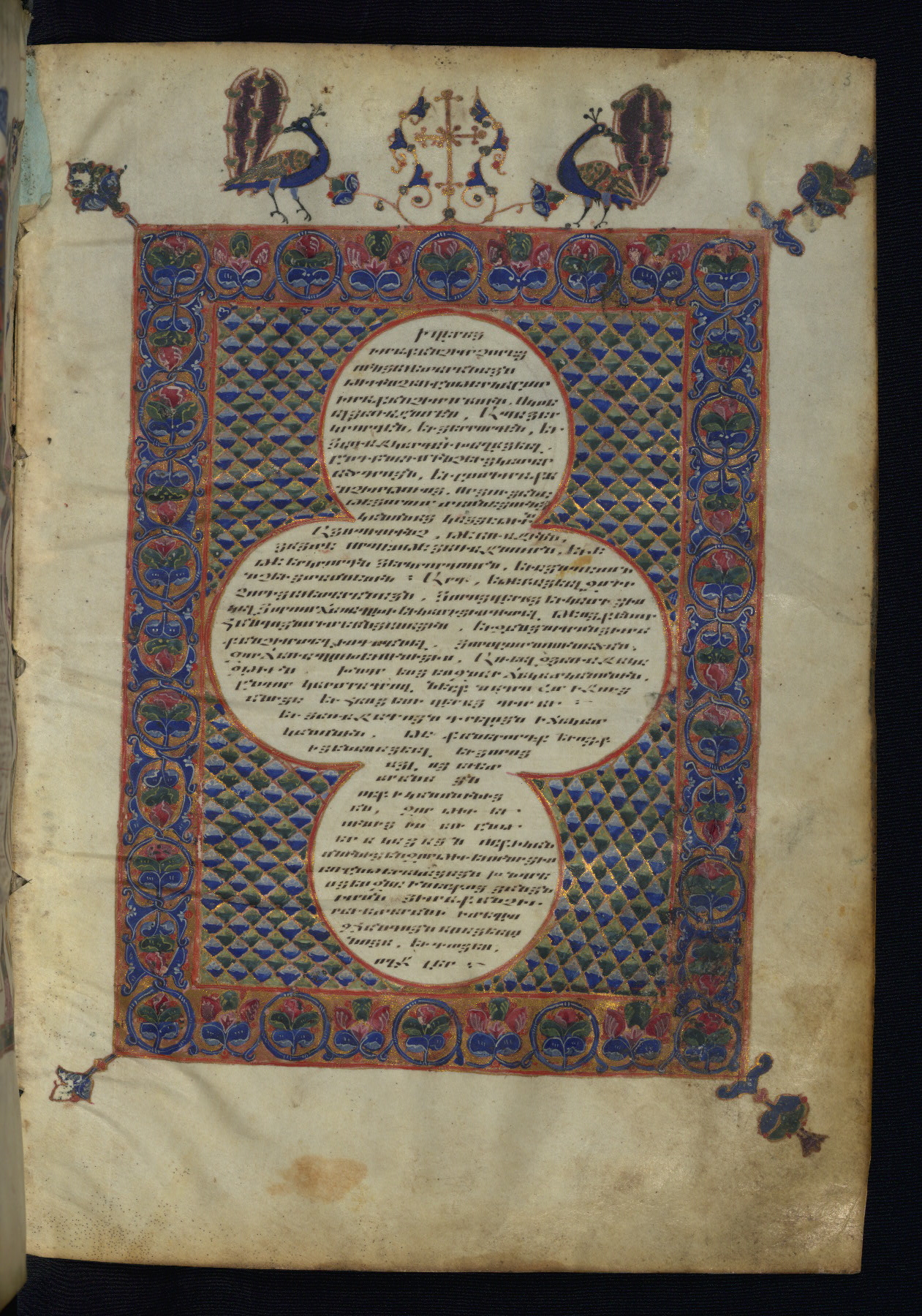
            Minuscule 1324 is a Greek Gospels-manuscript from the 1000’s, and is part of the collection held by the Jerusalem Patriarchate; it is catalogued as Panagios Taphos 60.  Before the text of the Gospels begins, 1324 has the Eusebian Canon-tables, elaborately decorated, and before the canon-tables is Ad Carpianus (a letter from Eusebius to Carpian, which serves as a manual on how to use the canon-tables to find parallel-passages in the Gospels).
            Notably, the text of Ad Carpianus is framed within a quatrefoil, similar to the same feature in minuscule 157, and also like the empty framework found in minuscule 1191 (a Gospels-manuscript at Saint Catherine’s monastery), and like the format of the Armenian text of Ad Carpianus in Walters MS 538 – but especially reminiscent of the cut-out framework of Ad Carpianus in minuscule 2812 (the Zelada Gospels).
            Miniscule 1324 is a beautiful manuscript, neatly written and finely illustrated.  Each Gospel in Codex Bezae begins with red text (see Matthew, John, Luke, and Mark), and its lettering is sufficiently neat, but the artistry in 1324 is far more impressive; each Gospel in 1324 has a full-page illustration of its author, and an intricately detailed headpiece (see Matthew, Mark, Luke, and John).  (In these pages, by the way, notice the use of a metobelus-mark (÷) to signify the beginning of a section of text, rather than a textual variant.)  In addition, the parchment of the pages on which the chapter-lists for the Gospels are written has been dyed purple – a rare and sumptuous feature.
            But how will the text of 1324 perform in the ring against an opponent that is 600 years older?  Let’s find out by comparing the text of Luke 8:19-25 in each manuscript to the text of the 27th edition of the Nestle-Aland Novum Testamentum Graece.     
            First, the rules of the ring:  each non-original letter in a manuscript’s text is counted as a point, and each original letter that is absent in a manuscript’s text is counted as a point; the winner will be the manuscript with fewer points.  Transpositions are mentioned but not counted if no text is lost.  Contractions are not considered variants.  Itacisms, iota adscript/subscript, and movable-nu variants will be listed and counted, but a separate calculation will be made which does not take them into consideration. (These inconsequential variants are indicated by underlined verse-numbers.)  
            Here is a comparison of 1324’s text to the text of NA27: 

19 – 1324 reads Παρεγένοντο instead of Παρεγένετο (+2, -1)
19 – 1324 reads αυτωι instead of αὐτῷ (+1)
20 – 1324 reads Καὶ before ἀπηγγέλη instead of δὲ after it (+3, -2)
20 – 1324 reads λέγοντων after αὐτῷ (+8)
20 – 1324 reads σε θέλοντες instead of θέλοντες σε (transposition)
21 – 1324 reads αὐτόν at the end of the verse (+5) [This Byzantine reading is not noted in NA27.]
22 – no variants.
23 – 1324 reads ἀφύπωσε instead of ἀφύπωσεν (-1)
23 – no variants.
24 – 1324 reads Καὶ before προσεθόντες instead of δὲ after it (+3, -2)
24 – 1324 reads ἐγερθεὶς instead  of διεγερθεὶς (-2) [This Byzantine reading is not noted in NA27.]
24 – 1324 reads ἐπετίμησε instead of ἐπετίμησεν (-1)
24 – 1324 reads ἀνέμωι instead of ἀνέμῳ (+1)
24 – 1324 reads τωι instead of τῳ (+1)
24 – 1324 reads μεγάλη after γαλήνη (+6)
25 – 1324 reads ἐστιν after ποῦ (+5)
25 – 1324 reads τωι instead of τῳ (+1)
25 – 1324 reads αυτωι instead of αὐτῷ (+1)

            Thus, in these six verses, 1324 has 37 non-original letters, and is missing 9 original letters, for a total of 46 letters’ worth of corruption.  When inconsequential orthographic variants are removed from the equation, 1324 has 32 non-original letters, and is missing 7 original letters, for a total of 39 letters’ worth of corruption.  

            Now let’s compare Codex Bezae’s text of Luke 8:19-25 to NA27, and see how well “one of our oldest witnesses” (as described by Bart Ehrman) performs:

19 – D reads αυτου after μήτηρ (+5)
19 – D reads οτι after αυτω (+3)
20 – D reads εξω εστήκασιν instead of εστήκασιν εξω (transposition)
20 – D reads ζητουντες instead of ιδειν θέλοντες (+5, -9)
21 – D does not have προς after ειπεν (-4) 
21 – D reads αυτοις instead of αυτους (+1, -1)
21 – D reads οι before αδελφοι (+2)
22 – D does not have και after ημερων (-3)
22 – D reads αναβηναι αυτον instead of αυτος ενεβη (+6, -3, assuming a transposition)
23 – D reads λελαψ instead of λαιλαψ (+1, -2)
23 – D reads πολλη after ανεμου (+5)
24 – D reads κε κε (i.e., κυριε κυριε) instead of επιστατα επιστατα (+4, -16) [This could fairly be counted as +10, -16.]
24 – D reads ἐγερθεὶς instead  of διεγερθεὶς (-2)
24 – D reads επετειμησεν instead of επετιμησεν (+1)
24 – D does not have του υδατος (-9) 
25 – D reads εστιν after που (+5)

            Thus Codex D has 38 non-original letters in Luke 8:19-25, and is missing 49 original letters, for a total of 87 letters’ worth of corruption.  When inconsequential orthographic variants are removed from the equation, Codex D has 36 non-original letters, and is missing 47 original letters, for a total of 83 letters’ worth of corruption. 

            Let’s go to the scorecards.  When accretions are compared, 1324 wins:  it has only 32, whereas D has 36.  (Even if itacisms and such were considered, 1324 still wins by one.)  And when omissions are compared, 1324 virtually knocks Codex Bezae out of the ring:  1324 omitted 7 original letters but Codex D omitted 47!  The clear winner:  minuscule 1324! 

Some Post-Fight Analysis

            This comparison, though anecdotal, suggests that a few common axioms should be challenged or significantly adjusted:
            ● The oldest manuscripts should be preferred . . . right? 
            It seems perfectly reasonable to think that the older a manuscript is, the better its text is likely to be.  Every time the text was copied, there was a risk of the introduction of new corruptions.  The older a manuscript is, the fewer generations of copies are likely to be between it and the autograph. 
            However, the force of this mere likelihood shrinks when one observes the liberties that were taken by the copyists in the Western textual tradition in the second and third centuries.  Situated in locales where Greek and Latin competed to be the lingua franca, Western copyists prioritized the meaning of the text, and were not averse to replacing original expressions with different expressions that seemed to them to be more precise, more reverent, and less vulnerable to misunderstanding. 
            An example:  in Mark 7:19, Jesus says that after a man has eaten food, what remains – that is, dung – “goeth out into the draught,” as the KJV puts it.  The “draught” (Greek ἀφεδρῶνα) is a latrine or toilet.  Some English translators, softening Jesus’ earthy reference, translate this as “sewer” (see for example the MEV, NET, NLT, and NRSV).  Some others are yet more evasive, simply saying that the food is eliminated or expelled from the body (see for example the NKJV, ESV, CSB, NIV, and NASB).  Just as our modern English translators have tended to avoid Jesus’ reference to a latrine or toilet in Mark 7:19, so did the person or persons responsible for the Western Text:  Codex D replaces the latrine with a sewer, reading οχετον (i.e., “sewer”). 
            One might say that if the text of the Gospels were translated into English using a “dynamic equivalence” technique, occasionally resorting to paraphrase, and then translate the resultant English text back into Greek, the result would be similar to the Western Text.  Very many alterations to the form of the text resulted as copyists attempted to maximize what they perceived to be the meaning of the text – and this was happening in the 100’s and 200’s (not, as far as the Gospels-text is concerned, as a one-time revision, but as an ongoing process).  There is thus no reason to expect that manuscripts fished out of a transmission-stream heavily contaminated by Western corruptions will have fewer corruptions than  manuscripts from some other transmission-stream, regardless of their ages.
            If the editors of the Textus Receptus had trusted their earliest available manuscript in the 1500’s, then instead of introducing 33 letters’ worth of corruption (working from the premise that NA27’s compilation of Luke 8:19-25 is completely correct), they would have introduced 83 letters’ worth of corruption.

            ● Scribes tended to add rather than omit . . . right? 
            In Luke 8:24, 1324 displays a harmonization:  “great” (μεγάλη) was added to “calm” (γαλήνη), which brings the passage into closer agreement with the parallel-passage in Matthew 8:26 and Mark 4:39.  Yet, on balance, when compared to Codex D – a manuscript 500 years older – 1324 has slightly fewer accretions in Luke 9:19-25.  If (as Daniel Wallace has claimed) copyists were applying “If in doubt, don’t throw it out” as a basic principle, and were thus expanding the text for 600 years (from 400 to 1000), how is it that the Byzantine manuscript from the 1000’s has a text of Luke 8:19-25 with fewer accretions than a text from the early 400’s?       
            The more the text-critical canon, “prefer the shorter reading” is tested, the more its wrongness is demonstrated.  Yet the critical text of Nestle-Aland/UBS still agrees quite closely with the Westcott-Hort 1881 compilation, for which this canon was constantly in play.            

            ● The Western Text of the Gospels is characterized by expansion and elaboration . . . right?
            The Western Text, according to the late Bruce Metzger (see p. 213, The Text of the New Testament) “is usually considered to be the result of an undisciplined and ‘wild’ growth of manuscript tradition and translational activity.”  I draw your attention to the word “growth.”  A better term might be “change,” because it is not unusual at all to find readings in the Western Text that are shorter than their rivals.  In the six verses studied here, inasmuch as Codex D’s text has 36 non-original letters, and is missing 47 original letters, its text is 11 letters shorter than the original text (using NA27 as the basis of comparison). 
            In one variation-unit in this passage, the text of D is shorter because of the excision of perceived superfluity:  in verse 24, the phrase “of the water” has disappeared, and one can picture a Western copyist thinking, “There’s no need to say that the waves were made of water.”  The same phenomenon is observable in modern paraphrases; look in the CEV, the Easy-To-Read Version, the God’s Word translation, the hyper-paraphrase known as “The Message,” and the New American Bible for examples.    
            Therefore, when encountering a Byzantine reading that is longer than its Western rival, we should consider the intrinsic character of the Byzantine reading, and ask, “Could a translator consider the content of this variant superfluous?” and if the answer is “Yes” then the Western reading should be considered suspect.  Perhaps one could go further and say that the same approach should be in play when comparing Byzantine and Alexandrian readings – and it does not seem absurd to suggest that when Alexandrian and Western witnesses support the non-inclusion of a superfluous-seeming word or phrase, we may be seeing the effects of the same scribal tendency in both transmission-streams.
           
            ● The Textus Receptus is essentially a late medieval text . . . right? 
            Setting aside itacisms and other such variations, the Textus Receptus reads just like 1324 in Luke 8:19-25, with a few exceptions:
            22 – TR reads Καὶ εγένετο instead of Ἐγένετο δε (+3, -2)
            24 – TR reads προσεθόντες δὲ instead of Καὶ προσεθόντες (agreeing with NA27)
            24 – TR does not read μεγάλη after γαλήνη (agreeing with NA27)
Which means that the Textus Receptus is slightly more accurate in Luke 8:19-25 than 1324’s text.  If one were to select any medieval Byzantine manuscript at random, its text of Luke 8:19-25 would very probably trounce the text of Codex D in a direct comparison.  


_______________
Readers are invited to double-check the data and calculations in this post.  

Sunday, August 6, 2017

More Cracks in Nestle-Aland 28 (Acts-Revelation)

            In the previous post, I described some passages in the Gospels where the rival variants may receive different treatment in future editions of the critical text of the Greek New Testament, and/or in English translations based on it – including a few passages where the editors may adopt readings with no Greek manuscript-support, as the editors of the 28th edition of the Nestle-Aland Novum Testamentum Graece recently did in Second Peter 3:10.  Today, let’s look at a dozen passages in the rest of the New Testament which may be similarly vulnerable to the effects of thoroughgoing eclecticism.

Acts 6:9 – The scholar Friedrich Blass (1843-1907), in the course of his detailed study of the Greek text of the Gospels and Acts, detected something abnormal about the mention of Libertines in Acts 6:9:  why did Luke resort to Λιβερτίνων, a Latin-based term, rather than simply write Ἀπελεύθεροι?  And why, followed by various geographically based terms, is this one not also geographically based? 
            Such questions elicited a search for answers.  Blass discovered that he was not the first reader to hum upon encountering the term Λιβερτίνων in this verse.  A long line of researchers, going all the way back to Beza, had sensed that something about this word was amiss. 
            Blass was informed by J. Rendel Harris that in the Armenian version, the reference was not to Libertines, but to Libyans.  How, though, could a reference to Libyans ever be misconstrued as Libertines?  And if the Armenian version’s base-text had referred to Libertines, how did the Armenian version end up with Libyans?  With remarkable determination, Blass dug a little deeper into this puzzle, and discovered, among the Latin poems of Catullus, the use of a rare term that satisfied his curiosity; transliterated into Greek, it is Λιβυστίνων – inhabitants of the area west of Cyrene.      
            This conjectural emendation resembles the extant text; it fits the context, it makes sense, and it introduces nothing problematic.  Future editors may reason that the rareness of the term Λιβυστίνων provoked early copyists to misread it, and also provoked the translators of the Armenian version to loosely approximate its meaning with a more familiar term.       

● Acts 7:46 – Working within the extant evidence, textual critics must choose between the statement that David asked to be allowed to find a dwelling-place for the God of Jacob (a reading supported by Codices A, C, E, 1739, the vast majority of manuscripts, and broad versional evidence), or a dwelling-place for the house of Jacob (which is the reading in the Nestle-Aland compilation, and which is supported by a small cluster of early manuscripts, including Papyrus 74, Vaticanus, Sinaiticus, and Bezae). 
            The Alexandrian reading is certainly more difficult, because it seems to say that David asked to build a house for a house.  Even when the second “house” is understood to refer to the nation descended from Jacob, the problem does not go away, since the temple was for God, not for the people, who were not looking for a new residence in the days of David. 
            The reading οἴκω (“house”) has been considered too difficult by some textual critics, including Hort, who wrote in 1881, “οἴκω can hardly be genuine,” but rather than accept the Byzantine reading, he proposed that probably neither reading is original.  Instead, he conjectured that the original text was τω Κυριω (“the Lord”), which was contracted to ΤΩ ΚΩ, which was misread by inattentive copyists as ΤΩΟΙΚΩ.  If future editors of the Nestle-Aland compilation are unwilling to adopt Hort’s conjecture, they might at least acknowledge the force of his admission of the implausibility of the Alexandrian reading, and adopt the other reading, for which the diversity of the external support is very impressive.        

Acts 12:25 – In the description of the action taken by Barnabas and Saul in this verse, there is a four-horse race, so to speak: 
            ἀπο Ἰερουσαλὴμ (“from Jerusalem”), supported by Codex D, Ψ, 614, several Old Latin copies, a significant minority of Byzantine manuscripts, the Vulgate, et al.
            εἰς Ἰερουσαλὴμ (“to Jerusalem”), supported by Codices א, B, and most Byzantine manuscripts.
            ἐξ Ἰερουσαλὴμ (“from Jerusalem”), supported by Papyrus 74, Codex A, et al.                       
            ἐξ Ἰερουσαλὴμ εἰς Ἀντιόχιαν (“from Jerusalem to Antioch”), supported by Codex E, 1739, the Peshitta, the Sahidic version, et al.
            The most difficult option is the variant with εἰς, because (1) when last seen in the narrative (in 11:30), Paul and Barnabas were already going to Jerusalem, and (2) in the very next scene (at the beginning of chapter 13), Paul and Barnabas are present at Antioch, not at Jerusalem.  Even though εἰς is in the Nestle-Aland compilation, some translators of modern versions have rejected this reading; for example, the NASB states, “And Barnabas and Saul returned from Jerusalem,” implying a base-text with either ἀπο or ἐξ.  The ESV reads identically (as of 10:00 p.m., August 4, 2017):  “And Barnabas and Saul returned from Jerusalem.”  The NIV also rejects εἰς, stating, “When Barnabas and Saul had finished their mission, they returned from Jerusalem.” 
            Nobody (other than avid advocates of the Peshitta) seems to think that the longest reading is original, because it looks like just the sort of textual adjustment that a copyist might make to alleviate a difficulty.  The contest, then, is between εἰς, ἐξ, and ἀπο.  Theoretically, if, in a scriptorium where a group of copyists worked from dictation, their supervisor read ἐξ, a copyist could mishear it as εἰς – but the theory works as well in the opposite direction. 
            Thoroughgoing eclecticism turns the race into a five-horse contest.  Hort suggested in 1881 that the original word-order has been garbled by copyists, and that the original text read τὴν εἰς Ἰερουσαλὴμ πληρώσαντες διακονίαν, so as to merely report that Barnabas and Saul returned, having completed their service in Jerusalem.  F. F. Bruce, whose confident comments about the reliability of New Testament manuscripts have been thoroughly recycled by many apologists, did not refuse to embrace a conjectural emendation in this passage; he held that in the original text there was no prepositional phrase at all, and that marginal glosses have impacted the text in Acts 12:25 in all extant manuscripts.
            Although textual critics often regard a higher degree of difficulty as a quality of the most-likely-original reading, it is possible that future editors may regard the currently printed reading here as simply too difficult, and either adopt ἐξ, or adopt ἀπο, or resort to conjectural emendation.     

Acts 20:28 – Bruce Metzger dedicated a full two pages of his Textual Commentary to a consideration of this passage.  The initial question is, did the original text refer to “the church of God,” or to “the church of the Lord,” or to “the church of the Lord and God”?  Like John 1:18, the contest between “God” and “Lord” is a contest amounting to the difference of a single letter, once one accounts for the contraction of sacred names:  Θεοῦ (“of God”) becomes ΘΥ and Κυρίου (“of the Lord”) becomes ΚΥ.
            If that contest is decided in favor of Θεοῦ (on the grounds that this is supported by ﬡ, B, the Vulgate, the Peshitta, and a significant minority of Byzantine manuscripts, including the Textus Receptus), then a second question arises:  did Luke report that Paul stated that God purchased the church with His own blood?  Many an apologist has used this verse to demonstrate Paul’s advocacy of the divinity of Christ, inasmuch it was neither the Father, nor the Spirit, whose blood was shed.  Hort, however, expressed a suspicion (which, it seems, was first expressed in 1797 by Georg Christian Knapp) that at the end of the verse, following the words διὰ τοῦ αἴματος τοῦ ἰδίου (“through His own blood”), there was originally the word υἱοῦ (“Son”).      
            It is possible that future editors, may decide that the inclusion of υἱοῦ in this verse is required by internal evidence, and that it is feasible that the word υἱοῦ was accidentally lost very early via a common parableptic error (when a copyist’s line of sight drifted from the letters ΙΟΥ at the end of ἰδίου to the same letters at the end of υἱοῦ.  Already, the Contemporary English Version, advertised as “an accurate and faithful translation of the original manuscripts,” has the word “Son” in its text of Acts 20:28b:  “Be like shepherds to God’s church.  It is the flock that he bought with the blood of his own Son.”  A footnote informs the CEV’s readers about the meaning of the extant text.
           
First Corinthians 6:5 – The Greek evidence, from Papyrus 46 to the Textus Receptus, is in agreement about how this verse ends.  However, the Peshitta – a Syriac version traceable to the late 300’s (followed by a period of standardization), but possibly earlier – disagrees.  The reading in the Peshitta implies that its Greek base-text included the phrase καὶ τοῦ ἀδελφοῦ (“and a brother”). 
            The momentum for this reading is drawn from a grammatical oddity in the usual Greek text.  The first part of Paul’s statement in this verse is something to the effect of, “Is there not even one person among you – just one! – who shall be able to judge between” – and that’s where the difficulty appears, because the Greek text just mentions one brother, whereas the idea of judgment between two parties seems to demand that more than one brother should be mentioned. 
            The KJV’s translators, although the Textus Receptus reads ἀνα μέσον τοῦ ἀδελφοῦ αὐτοῦ (“between his brother” – which is clearly singular), concludes the verse with “between his brethren” (which is clearly plural).  The NET is similar (“between fellow Christians”); the difference is due to the NET’s enlightened gender-neutral treatment of the term ἀδελφοῦ, not to any new feature in the Greek base-text.  The CSB, the NIV, and even the NASB likewise render the text as if the verse ends with a plural word rather than a singular one.  All such treatments of the text make the problem all the obvious:  the first part of the sentence, in Greek, anticipates two brothers, while the second part of the sentence mentions only one.             
            In light of such strong internal evidence, Michael Holmes, the compiler of the SBLGNT, recommended the adoption of a conjectural emendation at this point, so that καὶ τοῦ ἀδελφοῦ (“and the brother”) appears at the very end of the verse.  It is possible that future compilers of the Nestle-Aland text will concur.  If that happens, it will have hardly any effect on English translations, most of which already translate the passage as if the wording proposed by Dr. Holmes is extant in the manuscripts.   

Galatians 4:25 – For almost 300 years, a scholarly debate has orbited part of this verse.  The phrase “Now this Hagar is Mount Sinai in Arabia” is presently in the Nestle-Aland compilation (as τὸ δὲ Ἁγὰρ Σινᾶ ὅρος ἐστιν ἐν τῇ Ἀραβίᾳ, though this is contested by four slightly different rival forms).  However, it has been proposed that the entire phrase originated as a marginal note, and does not belong in the text.  This conjecture goes back at least as far as Richard Bentley (a gifted British cleric, 1662-1742, who advanced the field of New Testament textual criticism more than anyone else in his generation).  Recently Stephen Carlson, who has conducted a stemmatics-based analysis of the text of Galatians, has argued in favor of the same idea.  (Robert Waltz, however, retained the phrase in his compilation of the text of Galatians.)  If future editors of NTG concur with Carlson, the phrase might be exiled to the footnotes.

A Syriac manuscript at Saint
Catherine's Monastery displays
an adjustment of the text of
Hebrews 2:9.
(Charley Ellis pointed out this
feature of the MS to me.)
● Hebrews 2:9 – In Bart Ehrman’s 2005 book Misquoting Jesus, the author noted that instead of reading χάριτι θεοῦ (“by the grace of God”), a smattering of witnesses supports χωρὶς θεοῦ (“without God”).  Origen, in the 200’s, was aware of both variants.  Opposing an array of witnesses that includes Papyrus 46, Vaticanus, Sinaiticus, Claromontanus, the Byzantine Text, and broad versional support, Ehrman proposed that χωρὶς θεοῦ was the original reading, and that an early copyist altered the text so that it said something less provocative – and this unknown copyist was so influential that his alteration has affected almost all extant Greek copies of Hebrews.
            As Ehrman noted in his book, the existence of the variant χωρὶς θεοῦ has been accounted for by some textual critics via the idea that it was written in the margin by someone who intended for the phrase to be a qualification of the sentiment of the preceding verse – the idea being that all things except God were subject to the authority of Christ – an exception mentioned by Paul in First Corinthians 15:27.  Resisting this proposal, Ehrman objected that if this had been an annotator’s intent, “Would he not have written “except for God” (EKTOS THEOU – the phrase that actually occurs in the I Corinthians passage) rather than “apart from God (CHŌRIS THEOU – a phrase not found in I Corinthians)?” 
            Ehrman’s objection loses much force when one observes that the phrase EKTOS THEOU does not, in fact, occur anywhere in First Corinthians.  Ehrman also overstates the evidence when he claims that “Origen tells us that this [χωρὶς θεοῦ] was the reading of the majority of manuscripts in his own day,” for Origen cites this reading and then says that some copies have the other reading, χάριτι θεοῦ; nowhere does Origen say that his collection of manuscripts at Caesarea was typical of the manuscripts of Hebrews that existed throughout the world.  Most readers of Ehrman’s book, however, will probably not double-check his confidently worded assertions.
            Centuries ago, the devout scholar John Bengel (1687-1752) cautiously favored the reading χωρὶς θεοῦ and argued that its meaning is not scandalous, but theologically profound.  Bengel proposed that it was intended to mean that the Son of God, and not God the Father, tasted death for everyone – an idea that is consistent with the text of Hebrews 1:3, where, in Papyrus 46 and the Byzantine Text, Jesus is said to have made atonement by Himself
            Another theory, wounded but not killed by the grammatical quirk that it involves, proposes that χωρὶς θεοῦ is original, and that the author intended to thus qualify the words ὑπὲρ παντὸς (“for all”), so as to convey the idea that Christ tasted death for everyone except God.  This is how Origen interpreted this variant, without dogmatically deciding in favor of either variant.
            Meanwhile, F. F. Bruce proposed an alternative solution:  he conjectured that χωρὶς θεοῦ originated as a note in the margin, and that subsequently a copyist replaced that note with one that read χάριτι θεοῦ, and that both readings have slid into the text – in other words, Bruce suspected that neither phrase is original! 

● Hebrews 11:11 –As the list of variants in the textual apparatus of the STEP-Bible shows, the textual racetrack in Hebrews 11:11 is crowded with rival variants.  This sort of contest is difficult for the Coherence-Based Genealogical Method – the newly developed mapping-program used by some of the Nestle-Aland editors – to handle.  Researcher J. Harold Greenlee (a scholar in the same league as Bruce Metzger), proposed that the original text of this verse did not contain σπεῖρα or ἡ σπεῖρα (that is, it did not specifically say that Sarah was barren).  Michael Holmes’ SBLGNT likewise does not have σπεῖρα or ἡ σπεῖρα in its text. 
            This constitutes preference for a Byzantine reading (supported by ﬡ, A, and minuscules 33 and 1175, et al).  The effect of this textual decision (and some nuanced syntax-related translational decisions) can be seen via a comparison of the text of the NIV 2011 (which adopts it) and the text of the 1973 NIV (which does not):
            NIV 1973:  “By faith Abraham, even though he was past age – and Sarah herself was barren – was enabled to become a father because he considered him faithful who had made the promise.” 
            NIV 2011:  “And by faith even Sarah, who was past childbearing age, was enabled to bear children because she considered him faithful who had made the promise.”
            Whether future editors will continue this trend remains to be seen, particularly because the loss of σπεῖρα can be attributed to parableptic error, when a copyist’s like of sight drifted from the last two letters of Σάρρα (“Sarah”) to the same two letters in σπεῖρα (“barren”).    
           
● Hebrews 11:37 – In the list of the sufferings of spiritual heroes, one of those things is not like the others:  they are all somewhat unusual experiences, except for ἐπειράσθησαν, “they were tempted.”  Some textual critics have suspected that this word originated when a copyist committed dittography – writing twice what should be written once; in this case, the preceding word ἐπρίσθησαν (“they were sawn in two”), and that subsequent copyists, not realizing the mistake in their exemplar, changed it into something meaningful.  Others have thought that this relatively common term replaced one that was less common – perhaps ἐπάθησαν (“they were pierced”) or ἐπράσθησαν (“they were sold”). 
            Presently the Nestle-Aland compilation, deviating from the 25th edition, simply does not include ἐπειράσθησαν in the text, adopting instead the reading of Papyrus 46, which is very ancient.  Papyrus 13, however, is also very ancient, and appears to support the inclusion of ἐπειράσθησαν, in which case it has a very impressive array of allies.  I would advise readers to not get used to the NTG’s current form of this verse, for it seems to be merely a place-holder that might be blown away by the appearance of even the slightest new evidence, and even by an intrinsically appealing conjecture.    

● First Peter 3:19 – What may be the most popular conjectural emendation of all time was favored by the erudite textual expert J. Rendel Harris (1852-1941), who encountered a form of it in William Bowyer’s 1782 book Critical Conjectures and Observations on the New Testament.  The extant text of First Peter 3:19 says, “in which he went and proclaimed to the spirits in prison.”  Verse 18 refers to Christ, and nobody else is introduced into the text, so verse 19 has been interpreted to mean that during the time between Jesus’ death and resurrection, He visited the realm of the dead – specifically visiting the spirits of those who had been disobedient in the days of Noah, prior to the great flood – and delivered a message (ἐκήρυξεν) to them. 
            Harris, however, proposed that the original text was different.  He thought that Peter had in mind a scene that is related in the pseudepigraphical amalgamation known as the Book of Enoch (the first section of which is quoted by Jude in verses 14-15 of his epistle), in which Enoch is depicted delivering a message of condemnation to the fallen spirits who corrupted human beings so thoroughly that the great flood was introduced as the means of amputating the moral infection they had induced.
            Specifically, what Harris proposed was that the opening words of the original text of 3:19 were ἐν ᾧ καὶ Ἐνώχ (“in which also Enoch”), thus assigning the subsequent action not to Christ, but to Enoch.  (A variation on this idea is that the original text read Ἐνώχ instead of ἐν ᾧ καὶ.) 
            (It should, perhaps, be noted that Irenaeus, in Against Heresies Book 4,16:2, took for granted the veracity of the tradition that Enoch had brought God’s message to fallen angels; these fallen angels being the “sons of God” mentioned in Genesis 6:2-4.)
            How could the name “Enoch” have fallen out of the sentence?  In two ways:
            1.  If the original text were simply Ἐνώχ (without ἐν ᾧ καὶ), then, in uncial letters, the χ was susceptible to being misread as a και-compendium (that is, a common abbreviation for the word και (“and”)).  A copyist could easily decide to write the whole word instead of the abbreviation, and thus Enoch’s name would become ἐν ᾧ καὶ.
            2.  If the original text were ἐν ᾧ καὶ Ἐνώχ, a copyist, reading the χ as a και-compendium, could assume that the scribe who made his exemplar had inadvertently repeated three words, and, attempting a correction, remove “Ἐνώχ.”
            Against the charge that the introduction of Enoch’s name “disturbs the otherwise smooth context” (as Metzger claimed in 1963) the answer may be given that a reference to Enoch is not out of place, inasmuch as Enoch’s story sets the stage for the story of Noah and his family, whose deliverance through water Peter frames as a sort of pattern of the salvation of the church.
               Future compilers willing to engage in conjectural emendation might consider the internal arguments in favor of the inclusion of Enoch’s name in First Peter 3:19 to be too attractive to resist.  If that turns out to be the case, then it would certainly have some doctrinal impact, significantly diminishing the Biblical basis for the phrase “He descended into hell” found in the Apostles Creed.” 

● Jude verses 22-23 – Even though Tommy Wasserman has collated every known Greek manuscript of the book of Jude, plenty of questions remain about how that data should be interpreted.  Like Hebrews 11:11, verses 22-23 of the Epistle of Jude verse have multiple rival variants.  Here I shall spare readers the fine details of the case, and simply note that it is possible that future editors may discern here a threefold command, and that the first command from Jude is to refute (ἐλέγχετε) those who cause divisions.  Some copyists, with the earlier mention of mercy in verse 21 (ἔλεος) fresh in their minds, may have allowed their memory of it to complete the similarly started word in verse 22. 
            The reading with ἐλέγχετε is supported not only by Codices A and C* but also by members of manuscript-clusters represented by  minuscule 1739 and minuscule 1611; both of these clusters have special weight (as the echoes of distinct and ancient transmission-lines) in the Catholic (General) Epistles.  Even though the Nestle-Aland editors have already sifted through the text of Jude, they might take another look at this variation-unit. 

● Revelation 7:6 More than one commentator on the book of Revelation has admitted to being puzzled by a feature of the list of the twelve tribes of the children of Israel:  inasmuch as the tribe of Joseph is included, why is the tribe of Manasseh (Joseph’s son) also listed, but not Ephraim?  Another question:  why, in the extant Greek manuscripts of Revelation 7:6, is Manasseh’s name spelled in so many different ways?  
            A conjectural emendation answers both of those questions:  in the original text, the last portion of verse 6 did not refer to the tribe of Manasseh, but to the otherwise unmentioned tribe of Dan, and an early copyist misread ΔΑΝ as ΜΑΝ, and understood it to be an abbreviation of Manasseh’s name.  Thus ΜΑΝ originated, and different copyists with different orthography proceeded to spell out the name.  The Bohairic version supports this idea; in this verse the Bohairic text does not refer to Manasseh, but to Dan.  Perhaps future advocates of thoroughgoing eclecticism, on the strength of the Bohairic reading’s intrinsic appeal, will bring ΔΑΝ into the text.

In Conclusion . . . 

            Some readers, looking over these passages, and the passages from the Gospels described in the preceding post, may feel a measure of consternation, particularly because seven of them – in Matthew 1:16, Matthew 28:19, Mark 1:1, John 1:18, Acts 20:28, Hebrews 2:9, and First Peter 3:19 – have been used as a basis for establishing doctrine.  However, only in the case of First Peter 3:19, and the teaching that Christ visited imprisoned spirits, could it be argued that a doctrine stands or falls on the acceptance or rejection of a particular reading or conjecture (and even then, a case could be made that Paul teaches essentially the same doctrine in Ephesians 3:9-10, minus the specificity in First Peter).  
            (Apologists for Islam may sense a different sort of consternation, inasmuch as even with the allowance of conjectural emendation in the picture, the application of thoroughgoing eclecticism elicits nothing remotely close to the level of textual alteration that would bring the doctrinal teachings of the New Testament into harmony with the teachings of the Quran.  The charge, often made by Muslim apologists, that the New Testament agreed with the Quran until Christian copyists altered the text of the New Testament, simply lacks a historical foundation.)      
              It is sometimes said (because Bruce Metzger said it) that New Testament textual criticism is both an art and a science.  But it should be all science, and not art, because it is an enterprise of reconstruction, not construction.  Its methods may validly be creative and inventive – even intuitive – but not its product.  Conjectural emendation is the only aspect of textual criticism that involves the researcher’s artistic or creative skill. 
            No conjectural emendation should ever be placed in a compilation of the text of the Greek New Testament.  At the same time, the task of proposing possible readings which account for their rivals, or which otherwise resolve perceived oddities in the extant text, serves a valuable purpose:  to demonstrate the enormous weight of the intrinsic evidence in favor of such readings in the event that they are ever discovered in a Greek manuscript. 


_______________

Quotations from the ESV have been taken from The Holy Bible, English Standard Version. ESV® Permanent Text Edition® (2016). Copyright © 2001 by Crossway Bibles, a publishing ministry of Good News Publishers.

Quotations from the NIV (2011 edition) have been taken from the Holy Bible, New International Version®, NIV® Copyright ©1973, 1978, 1984, 2011 by Biblica, Inc.®  Used by permission. All rights reserved worldwide.

Scripture quotations marked CSB have been taken from the Christian Standard Bible®, Copyright © 2017 by Holman Bible Publishers.  Used by permission.  Christian Standard Bible® and CSB® are federally registered trademarks of Holman Bible Publishers.

Scripture quotations marked NASB taken from the New American Standard Bible®, Copyright © 1960, 1962, 1963, 1968, 1971, 1972, 1973, 1975, 1977, 1995 by The Lockman Foundation.  Used by permission.

Scripture quotations marked CEV are taken from the Contemporary English Version (CEV), Copyright ©  1995 by American Bible Society.

Quotations designated NET are from the NET Bible® copyright ©1996-2006 by Biblical Studies Press, L.L.C. http://netbible.com All rights reserved.

The NIV (1973 edition, no longer in print) is Copyright © 1973 by New York Bible Society International, and published by The Zondervan Corporation, Grand Rapids, Michigan 49506, USA.

Misquoting Jesus:  The Story Behind Who Changed the Bible and Why, is Copyright © 2005 by Bart D. Ehrman, and published by HarperCollins Publishers, New York, New York.  All rights reserved.