Followers

Showing posts with label Old Latin. Show all posts

Sunday, March 15, 2026

Mark 5:22 - Who's That Guy? (How to Spell "Jairus")


             The character known as Jairus appears on one occasion in the Gospels, in an episode described in Matthew 9:18-26, Mark 5:22-43, and Luke 8:40-56.  Matthew did not provide his name, but both Mark and Luke do so – except in Codex 05 the name is not included in the Gospel of Mark.  Usually the name “Jairus” appears as  ̓Ιάειρος.  That was the spelling in Mark 5:22 in the Textus Receptus, in the Robinson-Pierpont Byzantine Textform,  in the solid Rock Greek New Testament, in the Hodges-Farstad GNT According to the Majority Text, and in earlier printed Greek Gospels such as those issued by Tregelles, Westcott & Hort, and Baljon.  The Tyndale House GNT echoes Tregelles.  The UBS GNT has always printed ̓Ιάιρος in Mark 5:22, and so do Michael Holmes’ SBL GNT and Wayne A. Mitchell’s Greek New Testament (4th edition).

            But why the change?   Swanson’s list of witnesses for Ιάιρος consists of merely 01 and 33, while Ιάειρος is supported by 02 03 019 032 038  and all other Greek witnesses except C (which reads Ιάερος) and 28 (which reads Ιάιαρος).  032 and 038 and 565 and 700 together support  ᾧ ὀνόμα ̓Ιάειρος, harmonizing with Luke 8:41.  Considering what a notoriously bad speller the main scribe of Sinaiticus was, the decision to print ̓Ιάιρος instead of Ιάειρος seems incredibly tenuous and arbitrary.  Future editions should adopt Ιάειρος, both in Mark 5:22 and in Luke 8:41 (a verse for which the UBS compilation has zero support, exposing its “frankentext” nature).

            Finally, a more subtle question:  was Jairus’ name originally in Mark 5:22?   It’s missing in 05 and in some Old Latin copies – specifically, a (Codex Vercellensis) e (Codex Palatinus )  ff2 (Codex Corbeiensis secundus) and i (Codex Vindobonensis).  Bruce Metzger spent nearly two pages on this question in his Textual Commentary on the Greek New Testament, and both Vincent Taylor and J. K. Elliott suspected that non-inclusion is original here.  No major English version has failed to include Jairus’ name in Mark 5:22 – a sign of ecclesiastical resistance to the idea that the mere shortness of shorter Western readings commends them as original.  Mysteries they may be, but arbitrary brevity is no more of a sign of authenticity than arbitrary verbosity.  

Notice the absence of "named Jairus" 


Wednesday, December 4, 2024

John 17:9 - A Glitch in the Matrix

          In John 17:8 there is an interesting textual variant which, as far as I know, receives no attention in the footnotes of any major English translation.  It is not noticed in the UBS Greek New Testament (4th edition), although Metzger made a brief commend about it in his Textual Commentary on the GNT.

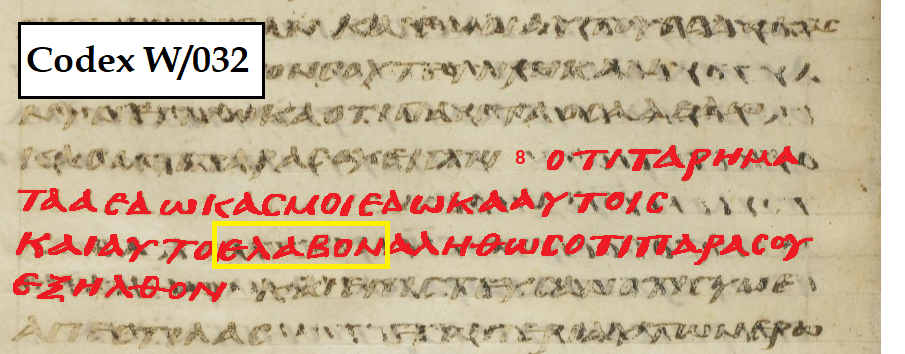
          Following ἔλαβον, the words καὶ ἔγνωσαν (“and knew”) are absent in ﬡ*, A, D, W, 0211, pc, a, d, e, q, ac2, vgms, pbo, and the Gothic version.  The Old Latin presented with Beuron numbers = VL 3 (Vercellensis), VL 5 (Bezae), VL 2 (Palatinus) VL 13 (Frisingensis/Monacensis) and VL 16 (Fragmenta Curiensa).

          This has to have been a very early variant, considering that it somehow spread to early representatives of Alexandrian, Western, and Byzantine transmission-lines. Since there is more or less no way to connect these particular witnesses closely through a textual relationship, logic seems to require positing a scenario in which the omission of καὶ ἔγνωσαν was elicited in the minds of two or more scribes independently in separate transmission-lines.  In other words, more than one early scribe fell to the temptation to relieve a perceived difficulty by removing the ostensibly problematic text.  The suspicion of Marie-Joseph Lagrange – that καὶ ἔγνωσαν was omitted because it seemed to collide with John 6:69 – is probably correct.

Sunday, June 25, 2023

Matthew 26:28: My Blood of the New Covenant

            In Matthew 26:28, did Jesus say, "This is my blood of the new covenant"?  Or did he say, "This is my blood of the covenant'?  The contest, in Greek, is between τὸ τῆς καινῆς and τῆς.  The external evidence - as presented in the apparatus of Wayne Mitchell's The Greek New Testament, 4th edition - shows that representatives of multiple text-types support τὸ τῆς καινῆς or τῆς καινῆς:  the Byzantine text finds allies in A, C, D (without the τὸ), E, F, G. H. K, M, S, U, W, Γ, Δ, Π Ω 074vid f1  f13 28 205 565 579 597 700 892 1006 1071 1241 1243 1342 1505 1582 Lect  the Old Latin and Vulgate, the Peshitta, Palestinian Aramaic, Sahidic and Bohairic versions (except for one Bohairic copy, and Schenke's Middle Egyptian), Armenian, Ethiopic, and part of the Old Georgian version. The Byzantine reading also has support from Irenaeus (in Latin), Origen (in Latin), Theophilus of Alexandria, Theodoret, Jerome, and Augustine.

           P45 (damaged, but with space-considerations taken into account) and P37 agree with Vaticanus and Sinaiticus (and 019 035 038 33) on the shorter reading.  Irenaeus (as preserved in Armenian) agrees with the shorter reading, and so do Cyprian and Cyril.
           Both readings are clearly ancient.
           Looking at the parallel in Mark 14:24, the longer reading is paralleled word for word in the Byzantine Text.  Meanwhile, the passage without "new" is supported by Vaticanus, Sinaiticus, and L D P W Z Θ Ψ and Old Latin Codex Bobbiensis.  

          Metzger proposed that the longer reading in Mt. 26:28 originated via a harmonization to Luke 22:20.  I propose, however, that something else has affected the text of Matthew 26:28. And it wasn't Marcionism.  It could be imagined that Marcion or a Marcionite created the shorter reading because to Marcion, Jesus Christ did not introduce a new covenant; to Marcion, the one true God had nothing to do with the covenant of the Law. 
           Metzger asserted that if καινῆς had been present in the original text of Matthew 26:28, "there is no good reason why anyone would have deleted it."  Some might insist that a Marcionite's theology would be, to him, a reason to delete it.  But can a Marcionite's influence upon the Alexandrian text of Matthew have been so strong?  Marcion himself only accepted his own edited text of the Gospel of Luke.  So the idea that Marcionism was a factor seems unlikely. 
           But the flimsiness of an arrow thrown at the shorter reading does not really prove the strength of the shorter reading.  If the shorter reading is regarded as original, then the text of Matthew 26:28 must have been harmonized to Luke 22:20 in multiple transmission-streams (affecting the Byzantine Text, the Old Latin and Vulgate, the Sahidic, the Sinaitic Syriac, Armenian, Ethiopic, and Slavic versions).  Neither Lachman nor Tregelles seems to have thought that was a plausible option.

            A less sinister mechanism than Marcionism seems to have been at work in the Alexandrian text of Matthew 26:28:  simple parablepsis.  A scribe beginning with τῆς καινῆς before διαθήκης could skip καινῆς by accidentally jumping from the -ῆς in τῆς to the -ῆς at the end of καινῆς.  Perhaps slightly facilitating the omission of καινῆς was the influence of scribes' recollection of Exodus 24:8 as written in the Septuagint, where Moses "took the blood, sprinkled it on the people, and said, 'This is the blood of the covenant which the LORD has made with you according to all these words.'"  There is no καινῆς in Exodus 24:8, the passage that Christ's words in Matthew 26 reflect.  Contrary to Metzger's assertion that "there is no good reason" for a deletion in Matthew 26:28, it is easy to see that a mechanism of deliberate harmonization (to Exodus 24:8) and a mechanism of accidental omission could both contribute to the creation of the shorter reading.  (Whenever an accidental omission occurs,  aren't observations about the lack of motive superfluous?)

          A wild card should not be overlooked:  the word τὸ before τῆς καινῆς in the Byzantine Text.  Non-Greek scribes might not have bothered with this; Greek scribes may have naturally added τὸ, regarding the resultant reading to be a slight stylistic improvement not affecting the meaning of the text.  (Conversely, Alexandrian scribes might have considered it unnecessary.)  This detail need not be resolved to maintain the conclusion that καινῆς was part of the original text of Matthew 26:28.


Thursday, December 16, 2021

A New Book About the Text of Codex Bezae

Peter Lorenz

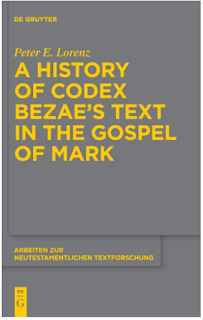
           You might think that there would be little more to say about the text of Codex Bezae after D. C. Parker’s 1992 Codex Bezae - An Early Christian Manuscript and Its Text.  But Peter Lorenz has a lot more to say in his new book, A History of Codex Bezae’s Text in the Gospel of MarkReaders of Dr. Lorenz’s blog will be aware that he has been studying Codex Bezae for some time.  His new book is based on the dissertation that he successfully defended in July of 2020.

          Lorenz calls into question the idea that Codex Bezae’s distinctive Greek text of the Gospels and Acts represents an ancient native Greek tradition that begat the Old Latin version(s).  Lorenz argues that the Greek text found in Codex Bezae should be assigned to the late 300s, immediately prior to the production of the manuscript, and represents the conformation of a Greek text to a Latin model (different from the Latin text preserved in the manuscript itself). 


Here are ten intriguing implications of Lorenz’s analysis, in his own words:

● (1) there are very few parallels between Bezae’s distinctive text and Justin Martyr or Marcion, certainly not enough to justify the view that they knew a text like Bezae’s,

● (2) Bezae’s parallels with Irenaeus appear to be secondary relative to this author’s text, 

● (3) Bezae’s nomina sacra reflect Latin practice in the choice and representation of sacred names,

● (4) Bezae’s Greek and Latin columns are independent of each other, i.e. in general, the Greek text has not been corrected to the Latin column and the Latin column is not a translation of the Greek text,

● (5) Bezae’s text does not seem to represent the source of the Latin version or, at least, this version does not require a text like Bezae’s to account for its distinctive readings,

● (6) much of Bezae’s text is quite close to the Greek “mainstream”, much more than is generally observed, it is certainly not a “paraphrase,”

● (7) Bezae’s text appears to contain erroneously copied corrections suggesting that its text derives from heavily corrected exemplar,

● (8) Bezae’s distinctive parallels with the Latin version apparently reflect instances of borrowing from the Latin version, i.e. like Jerome’s revision of the Old Latin version to Greek copies, only in reverse,

● (9) Bezae’s distinctive variations are not evenly distributed throughout its text but tend to concentrate in certain places,

● (10) Bezae’s producers seem not to have been native speakers of either Greek or Latin. 

          Incidentally, Lorenz’s research (already released in the Tyndale Bulletin and described at his blog in October 2021) does not bode well at all for the 2011 NIV’s adoption of οργισθεις in its base-text of Mark 1:41.  Bill Mounce, take note! 

           A History of Codex Bezae’s Text in the Gospel of Mark is available as a hardcover at Amazon for $150 – just in time for Christmas!


Friday, May 22, 2020

Video Lecture: Early Versions of the New Testament

Lecture 4:  Early Versions of the NT
The lecture-series Introduction to New Testament Textual Criticism continues at YouTube:

Lecture 04: Early Versions of the New Testament


(20 minutes) With captions!


An outline:

Alexander Souter: “The history of the New Testament text cannot be understood without a knowledge of the history of the church.”

          Part of that history is the history of the early translations of the New Testament text.  Today we are taking a closer look at some of the early versions of the New Testament – especially early translations of the Gospels. 

This involves mainly the study of early translations into Latin, Coptic, and Syriac, but there are other important versions of the New Testament too.

The Old Latin, also called the Vetus Latine:

          Acts of the Scillitan Martyrs (180) - A transcript of a trial during a persecution in Carthageduring the trial:

          Saturninus the governor:   “What sort of things do you have in that case of yours?”

          Speratus (Christian):  “Books and letters of Paul, a righteous man.”

The Old Latin” might be a misleading term.

Different Latin transmission-lines:      African, European, Italian, & Spanish.       

Do they go back to one Latin text?    Or to one Greek text?              

Mark 9:15 – gaudentes, “rejoicing” instead of “running”  

Two Christian writers around the late 300s and early 400s – Jerome and Augustine – said that there were many Latin versions, with a range of quality.

Once-used Greek words – translated the same way?

The earliest Latin Gospels-text tends to be “Western.”    

Text types –

Western:  tweaked to increase clarity in a particular way, like the text of the Gospels and Acts in Codex Bezae.

Byzantine:  agreeing with the text that was in dominant use in the vicinity of Byzantium (Constantinople).

Alexandrianagreeing with the text of Codex Vaticanus (and allies).

Caesarean (Gospels):  agreeing with the text of family-1

In witnesses with a Western form of the text, the Gospels often appear in this order:      Mt – Jn – Lk – Mk.

Vulgate:  Gospels:  by Jerome.               

        Gregory the Great (590 to 604):  still the “new” version.          

But it’s not as if we can pick up any Vulgate manuscript and expect to see every reading that Jerome adopted. Some Old Latin readings were mixed into Vulgate texts.

There were later revisions:   Alcuin.  Theodulf. Others.

The representation of Old Latin witnesses: 

Old identification-method: witnesses are represented by lower case letters, by lower case letters with superscripted numerals, and by short abbreviations.

New identification-method: Beuron numbers, so-called because this method was developed by members of the Vetus Latina Institut in Europe.

Gospels manuscripts have numbers 1-49;    Acts/Catholics/Revelation are 50-74;

Pauline Epistles are 75-99.

A lot of Old Latin witnesses are only partly Old Latin, side-by-side with Vulgate texts. 

Production-dates don’t always mean anything.

Coptic:  different transmission-lines in different dialects.

SahidicBarcelona codices. –                

Alexandrian Gospels    

Sahidic version in Acts 27:37 – agrees w/B. 

(Suggests a close relationship.)          

Codex T:  “diglot” – Sahidic and Greek side by side.               

The Western text was also in Egypt:

          G67:  Acts in “Middle Egyptian.”

Middle Egyptian:  basically three manuscripts:

          G67, Codex Schoyen 2650 (Matthew), and the Schiede Codex (Matthew)

Lycopolitan:  the Qua Codex (300s).

Proto-Bohairic:  Papyrus Bodmer III (300s).   Includes the Gospel of John.  Alexandrian. 

          Strange treatment of sacred names in John 1:1 & 1:18.

BohairicHuntington MS 17 (from 1174)

Achmimic: incomplete.  Mt, Lk,  Jn, Romans, Gal., James, Jude.

Fayyumic:  fragmentary

Syriac:  different transmission-lines.

          Tatian’s Diatessaron. In Syria, this appears to have been the dominant Gospels-based text until the Peshitta emerged (late 300s?).  The Diatessaron did not have the

genealogies. But Aphrahat apparently has something else, with genealogies.

Old Syriac:  Sinaitic Syriac.  Curetonian Syriac.  Codex at St. Catherine’s, Syriac 37.

Peshitta:  usually agrees with the Byzantine Text.

         Not included:  Second Peter, Second John, Third John, Jude, and Revelation.

Peshitta MSS of special interest:                 

Codex Phillips 1388               

        B.L. Add MS 14470               

        Rabbula Gospels           

Philoxenian – includes the books not in the Peshitta

Harklean Syriac:    Echoes an ancient Greek text in the General

Epistles.      Extremely literal. Finished in 616 – using ancient MSS near Alexandria.

Has its own limited apparatus in the margin.

Palestinian Aramaic – mainly extant in lectionaries. Has the story of the adulteress at the end of John.

Other Versions:

Gothic:  mid-300s. 

Main witness:  Codex Argenteus.  Wulfilas – an Arian.  Was he an Arian when he did the translation-work?  We don’t know.

Armenian and Georgian

         Armenia:  first Christian nation (early 300s)         

         Mesrop:  made the Armenian alphabet, and translated the Bible.

         Thought to have a basis in a Syriac text.  (Maybe some Diatessaron influence?)

         First edition – finished c. 411.

Revision – 430s.  Based on a Greek codex from Constantinople.

800s and 900s = Old for Armenian.           

Late revisions (esp. in Cilician Armenia) toward the Byz. Text (Nerses of Lambron) and toward the Vulgate (1100/1200s).

There are different kinds of script used for writing Armenian:

          erkat’agir = iron letters (because of the ink?) – has a better chance of not

being a medieval revision.
          bolorgir = rounder and smaller

          notrgir = cursive (later)

         shghagir = modern slanted cursive

The older an Armenian Gospels MS is, the more likely it appears to be based on a text that was like the text of f1.             

The same is true of Old Georgian Gospels-MSS’ textual character.

Georgian:  translated from Armenian. But some Georgian witnesses are older than most  Armenian witnesses.

         Oldest substantial Gospels-MS: Adysh MS:  897 A.D.

         The Old Georgian is an echo of an echo, but the voice is old.

         The Old Georgian also goes back to the 400s.

         George of Athos:  early 1000s – revision of the Gospels in     Georgian.  His revision made the Georgian text more Byzantine.

         Revelation may have a different kind of base-text than the rest.

Armenian and Georgian copyists went all over the place – Egypt, Jerusalem, etc.

Some quirk-readings may have been acquired from a particular locale.

Ethiopic (Ge’ez)

                   Christianity in Ethiopia:          

                   Beta Samati site – church in the early 300s.

                   Chrysostom (380s) – mentioned that the Gospel of John had been translated into Ethiopic.

                   Consistently translated from Greek.

Garima Gospels:  produced in the 500s.  And it’s fancy.

Most Ethiopic MSS:  1300s or later.           

          Tends to match up with the Peshitta – mainly Byzantine.         

          Does not have the PA.

          There are over 500 Ethiopic NT MSS.

          John seems less Byzantine.

Arabic

          First layer:  600s or even earlier.

         Najran, in southern Arabia:  a Christian center in the 400s.

Base-texts of Arabic versions echo families of texts.

Some families echo the Peshitta, but at least two echo Greek texts.

0136/0137 – Greek-Arabic diglot (frag., Mt)

Sinai Arabic MSS 8 and 28 = Codex Sinaiticus Arabicus (CSA)

Families A and C echo Greek texts (more than 70% Byzantine).

Family B in Lk. 16:19:  the rich man's name:  Nineveh (comp. Sahidic and P75)


Old Church Slavonic - 800s. 

Glagolithic alphabet, and Cyrillic alphabet.


Nubian - A Christmastime lectionary and assorted inscriptions.         


Caucasian Albanian - New Finds (1975) at Saint Catherine’s Monastery


Takeaway #1:       

Early versions can be extremely valuable to track the scope of readings and groups of readings. 

Q:  What was the early range of rival readings?


Takeaway #2:

Early versions shouldn’t be asked to do things that they can’t do.  Sometimes, articles are not transferable.  Sometimes word-order cannot be expected to reflect the Greek word-order.  Some languages don’t have exact parallels for the nuances of Greek.


Takeaway #3:

Early versions should be considered with an awareness of stages in their histories. 

Early versions’ testimonies should generally be boiled down to reflect the history of the text of the version, keeping in mind when and where the versional text was revised, in cases where this can be observed.


Takeaway #4:

Instead of thinking of the versions uniformly as “Versions “of the New Testament,”      early versions should generally be separated into Gospels, Acts, Pauline Epistles, General Epistles, and Revelation.


Thursday, October 10, 2019

Book Review: To Cast the First Stone


            Last year, Princeton University Press released To Cast the First Stone, a book by Tommy Wasserman and Jennifer Knust about the story of the adulteress (John 7:53-8:11).  Tommy Wasserman (academic dean at Örebro Theological Seminary in Sweden, about 120 miles west of Stockholm) is perhaps best known to American scholars as the author of The Epistle of Jude:  Its Text and Transmission (2006), and as the General Editor of the online TC-Journal.  He is also involved in the International Greek New Testament Project.  Jennifer Knust is a professor of Religious Studies at Duke University, and is the author of Unprotected Texts.
            Back in 2014, Wasserman and Knust were among the participants in a symposium on the pericope adulterae (“section about the adulteress”) at Southeast Baptist Theological Seminary in Wake Forest, North Carolina – a symposium which concluded with an affirmation by all of the participants that the pericope adulterae should be proclaimed in churches.  Instead of a Perspectives-style volume in which all symposium-participants present their views, we have, five years later, To Cast the First Stone:  The Transmission of a Gospel Story.
            This is not the text-critically focused volume that some readers might expect.  Nowhere in its 344 pages (440 if the bibliography and indices are counted) is there a straightforward list of Greek manuscripts in which John 7:53-8:11 follows John 7:52, and of Greek manuscripts which have nothing at all between John 7:52 and John 8:11, and of Greek manuscripts which move all twelve verses to another location (after John 21, or after Luke 21:38, for example), and of Greek manuscripts which have only part of the passage (either John 7:53-8:2, or John 8:3-11).  Readers must reach the table on pages 280-281 to find a presentation of how the passage is treated in uncial manuscripts.  In a book which Bart Ehrman has predicted to be “definitive,” this is a major shortcoming, especially when one notices how much of the book dwells upon minutiae.  The description of patristic evidence presented by Wasserman and Knust is likewise insufficient. (Prosper of Aquitaine?  Faustus?  These names do not appear.)
            Readers are sure to learn much, however, about a wide variety of peripheral subjects.  For example, Marcion (an infamous heretic of the second century) is thoroughly rehabilitated; Wasserman and Knust declare that he was actually “a modest rather than a radical redactor” (p. 113).  Several pages (pp. 185-191) address the question of the provenance of Codex Vaticanus and Codex Sinaiticus – inconclusively.  Mark 16:9-20 comes up again and again, although Wasserman and Knust avoid going into much detail about the voluminous support this passage receives.  They affirm that the passage should be viewed as “unquestionably canonical” (p. 19). 
            Other subjects covered in the first half of the book include Julius Africanus’ rejection of the book of Susanna, singular omissions in early Greek manuscripts of John, the significance of asterisks and obeloi in Origen’s Hexapla, the story of Judith, the prayer of Sarah in the book of Tobit, an episode in the “Martyrdom of Peter,” the Roman story of the rape of Lucretia, the debauchery of Claudius’ wife Messalina, and even Cleopatra.  Readers may find the first half of the book rather padded.
            Things get better after the first 200 pages.  Chapter 6 begins with an account of fourth-century references to the pericope adulterae in Latin patristic writings.  Unfortunately, little care has been taken to differentiate between quotations and allusions and possible quotations and possible allusions.  A statement by Hilary of Poitiers is called an allusion although it may be a case of coincidental uses of the same common terms.  The authors describe the statement of the monk Gnositheos, including the phrase, “if anyone is without sin,” as “a brief allusion to the adulteress” (p. 203) although the similarity to John 8:7 may be entirely coincidental. 
            Wasserman and Knust go into detail about two pieces of evidence which will doubtlessly be of interest to many readers, for these important details have not been covered in popular materials such as Metzger’s Textual Commentary:  (1)  the Greek base-text of Ambrose’s quotations of the pericope adulterae, and (2) the support given to the pericope adulterae as part of the text of the Gospel of John following 7:52 and preceding 8:12, in the Old Latin capitula, or chapter-summaries.   
            Ambrose, the authors observe, “appears either to have translated directly from the Greek or to have consulted diverse Latin witnesses or, as is more likely, both options” (p. 220).   They point out that Ambrose’s term amodo, in his quotation of John 8:11, has no support in Latin manuscripts, and should be considered “a calque, that is, a new Latin word designed to match the Greek phrase ἀπὸ τοῦ νῦν (or ἀπ’ ἄρτι)”  (p. 222).
            The Latin capitulaa subject I have visited previously – were collected, compared, and published by Donatien De Bruyne in 1914.  Wasserman and Knust present De Bruyne’s data showing that the Latin capitula exist in multiple forms that in one way or another mention the account of the adulteress.  Two of these forms of the capitula are especially interesting:  “Form Cy” (“Cy” stands for Cyprian) was assigned by De Bruyne to the time of Cyprian or shortly thereafter, that is, to the mid-200s.  It has the phrase ub adulteram dimisit at the beginning of a chapter-summary, stating that after Jesus dismissed the adulteress, He testified that He is the light of the world, speaking at the treasury in the temple, etc.  Wasserman and Knust also point out that another form, “Form I,” uses the Greek loanword moechatione; this may confirm that the Old Latin text(s) of the pericope adulterae was translated from Greek.           
            Somewhat surprisingly – considering that Wasserman and Knust repeatedly affirm their belief that the pericope adulterae is not original – the authors grant that if De Bruyne is correct in his dating of the Old Latin capitula forms, and also correct in his view that ub adulteram dimisit is not an interpolation (and Wasserman and Knust present nothing to support any other view), then “the pericope adulterae was present in John in a Latin context by the third century” (p. 263).  This admission – basically conceding that the Old Latin capitula constitute plausible evidence that the story of the adulteress was in the Greek text of John from which Latin translations were made in the 100s (“by the third century”) – renders the earliest evidence for the inclusion of the passage practically contemporary with the earliest manuscript-evidence for its non-inclusion.  (I see no way to reconcile this with the authors’ statement on page 268 that “It seems likely that the Johannine pericope adulterae was interpolated in the early third century.”)
            Other evidence is also covered:  the treatment of John 7:53-8:11 in Codex Bezae and its marginalia, Jerome’s reference to the inclusion of the story of the adulteress in many manuscripts, both Greek and Latin, the assignment of a chapter-heading to the passage in some medieval manuscripts, the support for the pericope adulterae in most Old Latin manuscripts, and corrections of some misinformation that has been spread about the passage.   Regarding this last subject, some readers may be shocked by the mercifully brief critique the authors supply as they test the accuracy of a paragraph from Metzger’s Textual Commentary on page 251.  For those who have trusted D. A. Carson’s claim that “All the early church fathers omit this narrative,” or Steven Cole’s claim that no early versions include the story of the adulteress, the data provided by Wasserman and Knust should be illuminating, the way being struck with a cattle prod is illuminating.     
           
            Some readers may be exasperated by the amount of information in this book that does not pertain directly to the text of the story about the adulteress; it pertains instead to what may be called “ancient Christian book culture.”  The tour of ecclesiastical treatment of the New Testament text is far too scenic.  Yet this may be advantageous to readers who might appreciate being told things such as the following:
            Codex Bezae might have been copied from a third-century bilingual exemplar (p. 236).
            ● Eighteen papyri manuscripts from the 100s and 200s with text from the Gospel of John have been found, but only two of them (P66 and P75) contain John 7:52 and 8:12. (p. 67)
            ● “In the case of the Gospel of John, a circle of friends added a series of postresurrection appearances to the end of the Gospel.” (p. 91, footnote, referring to John 21.)
            This last data-nugget may serve as a sort of model for the authors’ solution to the question, “What should be done with the story about the adulteress, and why?”.   It would have seemed heavy-handed if they had said, “The passage is not original, but it should be retained because the Council of Trent said so,” or, “The passage is not original, but it should be retained because it has been declared “inspired, authentic, canonical Scripture” by the Orthodox Church.”  Instead, Wasserman and Knust affirm that the pericope adulterae is not original, but offer a more nuanced basis for an argument for its inclusion:  on balance, ancient Christian book culture affirmed the passage and proclaimed its message.  Can a convincing case be made that John did not write the pericope adulterae as part of the Gospel of John?  Yes, say Wasserman and Knust – but similarly they are convinced that John, anticipating his death, did not write the twenty-first chapter of the Gospel of John; the embrace of the supplemented text in ancient Christian book culture may be considered a better guide, when it comes to defining the canonical text, than strict matters of authorship.

            Some readers (myself included) may be disappointed that Wasserman and Knust did not spend more time engaging Maurice Robinson’s theory (presented at the 2014 symposium) that the pericope adulterae is an original segment of the Gospel of John which fell out of the text in an early influential transmission-stream.   Robinson proposed that in an early lection-cycle, the annual reading for Pentecost was John 7:37-52 with 8:12 attached (as it is in the Byzantine lectionary).  An early copyist, either deliberately adjusting the text to make the lector’s job easier, or accidentally misinterpreting marginalia that told the lector to skip ahead to 8:12, omitted 7:53-8:11.  Thus, the theory goes, the pericope adulterae was dropped from the text – not due to anyone’s desire to suppress it, but as a conformation of the form of the text used in a rudimentary lection-cycle. 
            Wasserman and Knust attempt to refute Robinson’s theory by citing the Typikon of the Great Church – a ninth-century liturgical book in which, among other things, Gospels-segments are arranged for each day of the year.  The authors grant that in this source, the Gospels-segment for Pentecost was indeed John 7:37-52 with 8:12 attached.  They also observe that in this Pentecost-lection, there are no instructions to skip from the main segment (John 7:37-52) to the closing segment (8:12), although such skip-from-here-to-there instructions appear for other lections which consist of more than one segment of text.  “This evidence,” Wasserman and Knust state on page 298, “suggests to us that the Johannine pericope adulterae was simply missing from copies available in Constantinople when the Pentecost lection was assigned,” and (p. 299) “It seems fairly certain that the pericope adulterae did not enter Byzantine copies of John until the close of the fourth century, or even later.” 
            Explanations for the Typikon’s non-use of skip-from-here-to-there instructions for the Pentecost lection can easily be imagined, but the thing to see is that the authors’ proposal that the pericope adulterae was not in the text at Constantinople when the Pentecost lection was assigned does not really touch Robinson’s model, in which the basic Byzantine lection-cycle echoes an earlier lection-cycle in which the loss of the pericope adulterae had already occurred.    
            Wasserman and Knust do not adequate address Robinson’s point that it is difficult to picture a Byzantine scribe deciding to insert the pericope adulterae within the lection for Pentecost, when simpler options existed, such as putting it at John 7:36 (so as to immediately precede the Pentecost lection).  They simply acknowledge, “This aspect of Robinson’s argument is convincing.”  So how do they explain the presence of the pericope adulterae within the Pentecost lection in over 1,400 manuscripts of John?  Similarly they offer no explanation for the first sentence of the pericope adulterae:   as Robinson asked in 2014, what kind of freestanding story begins with “Then everyone went home.”???
            A more satisfying explanation is given for the migration of the pericope adulterae to a place after Luke 21:38 in family-13 manuscripts (et al).  As Chris Keith has already shown, the insertion of the pericope adulterae to follow Luke 21:38 is an effect of treating the passage like a lection; the movement to this location made the lector’s job easier; the lector could thus find the lection for Oct. 8 (the Feast of Pelagia) near the lection for Oct. 7 (the Feast of Sergius and Bacchus).  Everything you have read or heard to the effect that the pericope adulterae is shown to be a “floating anecdote” by its appearance after Luke 21:38 in family-13 manuscripts can be safely ignored.

            A few shortcomings of To Cast the First Stone may be covered briefly:
            ● There is no variant-by-variant treatment of the text of the pericope adulterae.  An opportunity has thus been missed to show readers the differences in the forms in which the pericope adulterae appears in various sets of witnesses.  The interesting distinctive readings in the passage in the family-1 manuscripts are never given a spotlight.  In a book that gives two full pages to the Lothair Crystal, this was neglectful. 
            ● Asterisks were discussed briefly but the authors seem to have given up any attempt to analyze their use by scribes producing Gospel-manuscripts:  “The precise meaning of asteriskoi in Byzantine Gospel manuscripts remains opaque,” they acknowledge on page 128.  But what would have been a better occasion to shine a strong light upon copyists’ use of asterisks and other marks than when investigating the pericope adulterae?
            ● Only slight attention is given to the pericope adulterae in the Armenian version; no attention is given to the Georgian version.  No explanation is offered for the treatment of the pericope adulterae in a small group of Georgian copies in which the passage appears after John 7:44.  This is unfortunate, inasmuch as the Christian Standard Bible has a footnote which mentions this dislocation; CSB-readers are bound to think (incorrectly) that the footnote describes Greek manuscripts.             
            ● Wasserman and Knust treat Jerome’s affirmation (in Against the Pelagians 2:17) that the story of the adulteress is found in many copies, both Greek and Latin, with unwarranted skepticism:   “The existence of many copies of John “in both Greek and Latin” with the pericope adulterae,” they write on p. 236, “though presupposed by Jerome, cannot easily be confirmed.”  This is certainly true once one no longer considers a statement (not a presupposition but an assertion) from the supreme scholar of his age to be confirmation.  It seems bold – not in a good way – to look back 1,600 years, squint, and say that Jerome’s claim “may have been an exaggeration.” 
            ● Too little attention is given to Codex Macedonianus; unless readers consults a detail in the footnote on pages 280-281, below the two-page table, they could get a false impression from the table.  Codex Ebnerianus should have been featured, and more attention should have been given to the Palestinian Syriac lectionary’s dislocation of John 8:3-11 to the end of the Gospel.  Also, readers could have benefited from some acknowledgement that dozens of the manuscripts in which the pericope adulterae does not appear are copies of the same medieval commentary, and thus boil down to a single relatively late source.
            ● Codex Fuldensis is erroneously assigned to 569 on page 230; the correct date (546) is stated in a footnote on page 4.  Also, it is difficult to explain the description of Codex Fuldensis as “a fifth-century Latin Gospel harmony” on page 260.
            ● No detailed analysis of the lacuna in Codex Alexandrinus was provided; this would have been helpful.
            ● Annotations found in 039 and in minuscules 34, 135, 1187, 1282, and 1424 should have been included in the discussion of critical notes on pages 279ff.
            ● The description of GA 1333’s secondary inclusion of John 8:3-11 between Luke and John is insufficient.
            ● Didymus the Blind stated in his commentary on Ecclesiastes that there had been found, “in certain Gospels” – ἔν τισιν εὐαγγελίοις – an account in which Jesus says, “Whoever has not sinned, let him take up a stone and cast it” regarding a woman the Jews had accused of sin.  The authors’ case for their view that Didymus was referring to some extra-canonical composition as “Gospels,” rather than to copies containing Matthew, Mark, Luke, and John, is not solid at all. 
            ● No foundation is given for the recurring claim that Eusebius “omitted the passage” (see p. 11, p. 23, 176ff. 181, 284) when preparing his Canon-tables.  However reasonable it may be to assume that Eusebius preferred a form of John that did not have the passage, Section 86 looks the same in the Eusebian Canons with or without the pericope adulterae.  
            ● The index is somewhat spotty.

            In closing:  Wasserman and Knust have provided a fascinating and valuable portrait of the ancient Christian book culture in which John 7:53-8:11 was accepted as a canonical part of the Gospel of John.  Their proposal that a non-original reading – one which, they argue, was not part of the text of the Gospel of John until a century after John’s death – should be considered canonical because of that ecclesiastical acceptance invites some problems.  For instance, if widespread ecclesiastical acceptance can veto text-critical analysis, why not simplify the text-critical enterprise by accepting all readings upon which the Vulgate, the Peshitta, and the Byzantine Text agree?  Or, even more simply, if ecclesiastical acceptance is decisive, why not accept, as a matter of course, all readings in the Byzantine Text which are supported by over 85% of the extant manuscripts?  
             To Cast the First Stone contains a lot of helpful data; nevertheless, important aspects of the evidence have been overlooked.  This is far from what a definitive book about the story of the adulteress ought to be. 


To Cast the First Stone:  The Transmission of a Gospel Story is Copyright © 2019 by Princeton University Press. 


P.S. I have written a book, A Fresh Analysis of John 7:53-8:11, maintaining that the pericope adulterae was originally part of the Gospel of John.  It is available as an e-book on Amazon.