Followers

Showing posts with label Papyrus 66. Show all posts

Saturday, October 27, 2018

Todd Friel, the KJV, and Wretched Oversimplifications

Todd Friel

            I’m not sure that Todd Friel asserted anything in his recent Wretched program in which he addressed KJV-Onlyism.  But amid all the question-raising, question-rephrasing, tangent-chasing, suggestion-making, and excerpt-taking from another video, I think Todd Friel said a few things that need to be clarified – not to promote KJV-Onlyism, but to reduce inaccuracies in how Friel’s audience might picture the manuscript-evidence as a result of some shortcomings in Friel’s descriptions of it. 
            When Friel said, “We’ve found better manuscripts than the Textus Receptus,” he was correct; the  Greek text from which the New Testament was translated in the KJV includes some words that originated with copyists rather than with the authors of the New Testament, and it also leaves out some words that were written by the authors.  It is true that we have better manuscripts today than in 1611.  So, Friel is partly right.    
            But then Friel said, “We’ve found thousands of manuscripts – which is rockin’ cool.”  That also is true – but something important went unsaid.  Most of those thousands of Greek manuscripts discovered in the past 400 years agree with the Textus Receptus far more often than with the Greek compilations on which the NIV, ESV, and CSB are based.  This is especially true regarding manuscripts of the Gospels. 
            To put this another way:  suppose we were to simultaneously read aloud the KJV’s base-text of the Gospels and one of the Greek Gospels-manuscripts discovered after 1611, making a note each time they were materially different.  And suppose that we did the same thing using the Nestle-Aland compilation (the base-text of the NIV, ESV, and CSB) and one of those Greek Gospels-manuscripts.  And suppose that we did this for every Greek Gospels-manuscript, setting aside instances where a manuscript diverged from the Textus Receptus and the Nestle-Aland compilation.  We would see that most of the Gospels-manuscripts discovered since the early 1600s agree with the KJV’s base-text far more frequently than they agree with the NIV’s base-text. 
            The impression given by Friel – that thousands of manuscripts have been found that point away from the KJV’s base-text – is not an accurate picture of what the manuscripts actually say.  Granting that some readings in the Textus Receptus are supported only by a small minority of manuscripts, the Textus Receptus is far closer to the majority text of the Gospels than the Nestle-Aland compilation is. 
            I do not mean to contend that the analysis of textual variants should be like a democratic election, with the majority always winning.  The thing to see is that when someone points out that we have “thousands of manuscripts” now, as opposed to relatively few in the 1500s, the vast majority of those manuscripts display a Byzantine Text.  Unlike the ESV, they include Matthew 12:47, Matthew 17:21, Matthew 18:11, Mark 7:16, Mark 9:44, Mark 9:46, Mark 15:28, Luke 22:43-44 (included in the ESV today, but give it time), Luke 23:34a (included in the ESV today, but give it time), and Luke 23:17.  They support the reading “firstborn” in Matthew 1:25, and the reading “in the prophets” in Mark 1:2, and they do not convey that Matthew confused king Asa with the psalmist Asaph, or that Matthew confused king Amon with the prophet Amos.  And when we survey the Gospels-manuscripts that have been discovered in the past 400 years, we see that 85% of them support the inclusion of John 7:53-8:11, and over 99% of them support the inclusion of Mark 16:9-20.
            If the differences between the KJV and modern versions were merely the differences between the Textus Receptus and the readings in the majority of Greek manuscripts, then the significant differences would not involve any of those verses.  They would involve instead the Textus Receptus’ minority readings, in passages such as Luke 2:22, Acts 8:37, Acts 9:6, Ephesians 3:9, and First John 5:7.      
            So I have three suggestions for Todd Friel’s audience.

            ● First, those who listen to Todd Friel ought to be informed – when he defends the ESV and NIV by pointing out the existence of thousands of manuscripts discovered subsequent to 1611 – that the vast majority of those manuscripts agree with the KJV (and NKJV, and MEV, and WEB, not exactly “pretty much every other translation except KJV,” contra Friel) far more often than they agree with ESV and NIV. 


            ● My second suggestion:  when Todd Friel refers to the “eclectic” text, listeners should understand that for all practical purposes he is referring to the Alexandrian Text.  The base-text that he considers superior to the Textus Receptus – and to the Byzantine Text – is “eclectic” in about the same way that a group of 19 housecats and one parakeet is a zoo.  To put it another way:  in Matthew-Jude, the so-called “eclectic” base-text of the NIV is over 95% Alexandrian in the textual contests where the Byzantine Text and the Alexandrian Text disagree. 


            ● Thirdly, I suggest that Friel’s audience should filter his appeals to older manuscripts through the sieve of knowledge about the background of those manuscripts.  When Friel appeals to older manuscripts, he refers to manuscripts found in Egypt.  Due to the especially low level of humidity in Egypt, papyrus lasts longer there than it does in other places; this is why we have so many more papyrus copies of New Testament books (and assorted other books, and letters, and receipts) from Egypt.  But it is not as if younger copies from other locales sprang up out of the ground; they had ancestor-manuscripts which have not survived.  To reject the readings in younger manuscripts merely because the material on which they are written is younger would be tantamount to letting the weather make one’s text-critical decisions. 


            Also, Friel’s audience should be aware that in many cases, the earliest manuscript disagrees with the NIV and ESV.  For example, the Textus Receptus has the word οτι in the first part of First Peter 5:8, represented in the KJV by the word “because.”  You will not find the word “because” in First Peter 5:8 in the ESV and ESV, because the word οτι is not in their Greek base-text.  Yet if you consult Papyrus 72 at the Vatican Library’s website, you will see the word οτι in its text.
John 7:8 in Papyrus 66.
            Another example:  the Textus Receptus has the word ουπω in John 7:8, where the Nestle-Aland compilation has the word ουκ.  Accordingly, in the KJV, Jesus says, “I go not up yet unto this feast,” where in the ESV, Jesus says, “I am not going up to this feast,” and in the NIV (using the same base-text as the ESV), “I am not going up to this festival.”  (Verse 10 then explains that Jesus proceeded to secretly go to the feast.)  One might think, if one believed Todd Friel, that our earliest manuscripts support the NIV’s reading, and the Textus Receptus’ reading was concocted by “some overly ambitious scribes” in the Middle Ages.  But when we consult Papyrus 66 and Papyrus 75, we find that they both support the reading ουπω.        
            Hundreds of other examples could be supplied of readings in the papyri (readings capable of impacting translation) that are not adopted in the Nestle-Aland compilation.  These include a substantial number of Byzantine readings. 
            So:  when Friel appeals to quantities of manuscripts, keep in mind that that manuscript-mountain affirms the KJV’s readings much more than it opposes them (and that that manuscript-mountain opposes the NIV’s readings much more than it affirms them).  And when Friel appeals to older manuscripts, keep in mind that this is frequently not the case; the Nestle-Aland compilation still depends heavily on Codex Vaticanus, which is younger than witnesses such as Papyrus 66, Papyrus 45, Papyrus 46, Papyrus 75, and patristic testimony from authors such as Irenaeus, Tertullian, Hippolytus, Cyprian, and Origen.  I am not arguing here that this means that Vaticanus’ text is inferior to the others; the thing to see is that it is an oversimplification to assume that quantity and age are assured measurements of quality.  Without that wretched oversimplification, Friel’s case against the KJV is just an assertion, or a suggestion – not anything remotely close to a real case.


Wednesday, February 28, 2018

John 3:13: The Son of Man Who is in Heaven


            Today we shall look into the question of whether or not the phrase “who is in heaven” was in the original text of John 3:13.
            In two recently published translations of the New Testament – the Evangelical Heritage Version and the Modern English Version – John 3:13 ends with the phrase, “who is in heaven.”  This is also the reading of the King James Version.  It is supported by the vast majority (over 95%) of Greek manuscripts, as well as the Old Latin, the Vulgate, the Peshitta, the Ethiopic version, and a wide variety of early patristic writers. 
Manuscript 0141, in which the text of John is
interspersed with extracts from patristic commentaries, has
an unusual difficulty-relieving variant in John 3:13.
            The NIV and ESV, however, do not include this phrase, following instead the shorter Alexandrian text that is displayed in Papyrus 66, Papyrus 75, Vaticanus, Sinaiticus, some Egyptian versions, and some patristic writers. 
            The late Bruce Metzger, in his Textual Commentary on the Greek New Testament, defended the decision of the compilers of the United Bible Societies’ printed Greek New Testament to reject this phrase:  “The majority of the Committee, impressed by the quality of the external attestation supporting the shorter reading, regarded the words ὁ ὢν ἐν τῷ οὐρανῷ as an interpretive gloss, reflecting later Christological development.” 
            Against this theory of “later” – but earlier than Hippolytus, who cited John 3:13 with the phrase “who is in heaven” in Against Noetus – expansion, Wieland Willker responded effectively:  “Internally the longer reading is clearly the harder reading and there is no reason why the words should have been added.  Metzger says it could be an “interpretive gloss, reflecting later Christological development”, but is this probable?  It seems more probable that scribes omitted the difficult words or changed them as 0141, Sy-S [the Sinaitic Syriac] and e [Old Latin codex Palatinus, from the mid-400s], Sy-C [the Curetonian Syriac] did.” 
            Willker was referring to alterations in the text of Old Latin codex Palatinus (from the mid-400s) and the Curetonian Syriac that yield the meaning of “was in heaven” and in the Sinaitic Syriac manuscript that yields the meaning of “is from heaven.”
            This textual variant overlaps with an interpretive question:  writing in ancient Greek with no (or only minimal) punctuation, did John intend to report that Jesus told Nicodemus, at the time of their conversation, that the Son of Man was in heaven?  Or, if the phrase is assumed to be original, was it intended to be understood, not as part of Jesus’ words, but as a parenthetical phrase made by John? 
            As Willker noticed, it is not hard to see why early copyists would consider the phrase puzzling:  if the phrase is not understood as a parenthetical comment by John, then Jesus seems to say that the Son of Man is in heaven, while He is right there on the scene talking to Nicodemus.  Internal considerations thus weigh in heavily against the shorter reading:  to remove this phrase would be to reduce the risk of misinterpretation, whereas a copyist who added this phrase would be adding an interpretive difficulty where there previously was none.    
The phrase “ὁ ὢν ἐν τῷ οὐρανῷ” is far more likely to be part of the original text, excised in the Alexandrian text-stream by a copyist prone to relieve perceived difficulties, that it is to have originated as a scribal expansion.  The absence of this phrase in the fifth edition of the UBS/Biblica Greek New Testament, and in the 28th edition of the Nestle-Aland Novum Testatementum Graece, is an echo of previous compilers’ reliance upon poorly represented data combined with a preference for manuscripts that happened to be stored in a dry climate.  In the Sinaitic Syriac and the Curetonian Syriac and the Old Latin Codex Palatinus (and in the uncial 0141, in which the closing phrase states that the Son of Man is from heaven) we see copyists surrendering to the temptation to alter the text in order to resolve a perceived difficulty; the manuscripts that lack the phrase echo the work of an early scribe who took things a little further.  
(Those who would object, “But we should follow the oldest manuscripts” are advised to notice that Papyrus 75 reads πιστεύετε (not πιστεύσετε) at the end of 3:12, and in nearby 3:31, the scribe of papyrus 66 initially omitted the word ἐρχόμενος, and also in 3:31, the scribes of Papyrus 75 and Sinaiticus both did not include the final phrase ἐπάνω πάντων ἐστίν; the compilers of the UBS/NA texts obviously felt no obligation to follow the oldest manuscripts unthinkingly.  Nor should we.)

The recently published Tyndale House edition of the Greek New Testament likewise omits the phrase; the pitiable brevity of its apparatus prevents the reader from seeing the early patristic evidence.  Had the editors accepted the judgment of Samuel Tregelles, the scholar from the 1800s whose work laid the foundation for the THEGNT, this phrase would have been retained.  (But at least they mention the variant; the New American Standard does not even do that.)
Those who wish to read more about this variant-unit may wish to consult Dr. David Alan Blacks article (from Grace Theological Journal, 1985) on the subject.


P.S.  A comparison of the treatment of John 3:13 in different editions of the UBS Greek New Testament does not build confidence in the reliability of the resources upon which the Committee-members depended, or in the consistency of their presentations of the evidence.  In the first edition (1966), the Ethiopic version was listed as a witness for the non-inclusion of “who is in heaven.”  The Arabic Diatessaron was listed as a witness for the inclusion of the phrase.  The Georgian version was listed in support of the longer reading.  Didymus was listed as a witness for both readings.  In the fourth edition (1993), part of the Georgian evidence was listed as support for the shorter reading, the Diatessaron was only listed for the shorter reading, Didymus was listed only as support for the shorter reading, and the Ethiopic version switched sides, favoring the inclusion of the phrase.  And the certainty-rate varied from A (“the text is certain”) to C (“the Committee had difficulty”) to B (“the text is almost certain”).   

[Readers are invited to double-check the data in this post.]


Saturday, November 11, 2017

If In Doubt, Sort It Out

 
Curious incidents
in the Byzantine Text
.
          “If in doubt, don’t throw it out.”
  That is the way in which Dan Wallace has asserted that Byzantine copyists handled the text of the New Testament when they had two exemplars that said two different things.  That is essentially a restatement of the claim made by J. J. Griesbach over 200 years ago:  “Scribes were much more prone to add than to omit.  They hardly ever leave out anything on purpose, but they added much.” 
            That idea – one of the fundamental principles used by textual critics throughout the 1800’s and 1900’s – was effectively erased by the data and analysis which was published by James Royse in 2010 in Scribal Habits in Early Greek New Testament Papyri.  Royse observed that the rate at which the copyists of some early papyri made omissions is higher than the rate at which those copyists made additions; the ratio works out to about 3:2.  This means that scribes were more prone to omit than to add.  Griesbach had it backwards, and everyone who has relied on the validity of the axiom, “Prefer the shorter reading” has had it backwards – including Bruce Metzger.
            It shouldn’t have taken until 2010 for researchers to acknowledge that Griesbach’s claim was standing on thin ice.  (And some already did; in each generation at least a few scholars maintained that the New Testament text’s transmission-history resembled the clothes in a traveling salesman’s suitcase, losing a sock at every hotel.)  To researchers equipped with (mostly) accurate transcripts of Codices Alexandrinus, Vaticanus, Bezae, and Sinaiticus, it should have been clear that if the Byzantine Text originated as an amalgamation of Alexandrian and Western readings, its creators must have frequently rejected the readings in their exemplars.  That is, one can believe Hort’s theory of the Lucianic recension, or one can believe that scribes using more than one exemplar typically expanded the text, but not both. 
            The following readings, all taken from the first five chapters of the Gospel of John, demonstrate this with particular force.  In each case, the Byzantine reading is shorter than a reading found in leading Alexandrian and/or Western witnesses. 
            ● 1:6 – Byz does not read ἦν
            ● 1:19 – Byz does not read πρὸς αὐτον after ἀπέστειλαν
            ● 1:21 – Byz does not read πάλιν after αὐτὸν (cf. Codex Wsupp)
            ● 1:28 – Byz does not read ὁ before Ἰωἀννης
            ● 1:38 – Byz does not prefix μεθ- to ἐρμηνευόμενον
            ● 1:39 – Byz does not read οὖν after ἦλθον
            ● 1:46 – Byz does not read ὁ before Φίλιππος
            ● 1:50 – Byz does not read ὄτι
            ● 2:4 – Byz does not read Καὶ before λέγει
            ● 2:17 – Byz does not read ὄτι after ἐστίν
            ● 3:5 – Byz does not read ὁ before Ἰησοῦς
            ● 3:28 – Byz does not read ὄτι after εἶπον
            ● 4:3 – Byz does not read γῆν before καὶ
            ● 4:3 – Byz does not read πάλιν before εἰς (Bc, À, P66, P75, D, and L all read πάλιν)
            ● 4:5 – Byz does not read τῷ after Ἰακὼβ
            ● 4:14 – Byz does not read ἐγὼ before δώσω (cf. Codex Wsupp) 
            ● 4:15 – Byz does not prefix δι- to έρχομαι
            ● 4:27 – Byz does not read αὐτῷ after εἶπεν
            ● 5:5 – Byz does not read αὐτοῦ after ἀσθενείᾳ
            ● 5:9 – Byz does not read ἐγερθεὶς
            ● 5:10 – Byz does not read καὶ after ἐστιν
            ● 5:10 – Byz does not read σου after κράβαττόν
            ● 5:15 – Byz does not read οὖν after ἀπῆλθεν
            ● 5:19 – Byz does not read τοῦ ἀνθρώπου after υἱὸς
            ● 5:26 – Byz does not read ὁ ζῶν before ἒχει
            ● 5:40 – Byz does not read αἰώνιον after ζωὴν
           
            That’s 26 non-expansions in five chapters, an average of five non-expansions per chapter.  Extrapolating, we might find over 100 such non-expansions in the entire text of John, and over 400 such non-expansions in all four Gospels.  
            (In addition, one might profit from considering all the Byzantine readings that are not significantly longer than their Alexandrian and Western rivals, but are simply different – variants such as the reading ὡσεὶ (instead of ὡς) in John 4:7, and the transposition at the end of John 4:20, and the reading Βηθεσδὰ in John 5:2 (where Vaticanus reads Βηθσαιδὰ, Sinaiticus reads Βηθζαθὰ, and D reads Βελζεθὰ).  
            How can one say that the Alexandrian and Western readings in the listed passages have not been thrown out?  And how can the Byzantine Text, at these points, be considered derivative of text-forms whose readings are rejected?
            Hort’s eight conflations have been used as proof that Byzantine scribes applied the principle, “If in doubt, don’t throw it out.”  Meanwhile, a tour through just the first five chapters of John reveals three times as many instances where, if Byzantine copyists accessed Alexandrian and Western exemplars (as advocates of the Lucianic recension believe that they did) – they must have thrown out Alexandrian or Western readings. 
            This does not mean that as more and more non-Byzantine manuscripts (with non-Byzantine readings) were encountered in the areas now known as Syria, Turkey, Cyprus, and Greece in the 300’s, they had no effect whatsoever on the local text.  This data does not refute the idea that in some passages of the Byzantine Text (I am thinking specifically of some of Hort’s alleged conflations), an early local reading, which once agreed exclusively with either the Alexandrian or Western reading, has been completely supplanted by an expansion that was elicited by the arrival, from another locale, of an attractive rival reading.  (Something similar happened occasionally in the Alexandrian transmission-stream, as Wilbur Pickering has demonstrated; see, for examples, Mark 1:28, John 7:39, Ephesians 2:5, and Colossians 1:12.)  But it does imply that to describe Byzantine scribes as if they never met an expansion they didn’t like is to spread an essentially false characterization.
            The evidence supports instead the position that the typical attitude of Byzantine scribes, when and where they encountered unfamiliar readings from non-local exemplars, was one of caution:  “If in doubt, sort it out.”  Otherwise these 26 short Byzantine readings in John chapters 1-5 would be longer.          


Monday, October 16, 2017

ARTMYN's Digital Presentation of Papyrus 66

Papyrus 66 (text shown:  John 1:48-2:3).
This seems so old-fashioned now.
          I hope to soon present a post about Papyrus 64 and Papyrus 67, but in the course of looking into those fragments, I found an outstanding resource on a much more substantial manuscript:  Papyrus 66, an early an important manuscript of the Gospel of John.  Papyrus 66 is generally assigned to the early 200s, although some researchers have thought that it was even earlier.
            There is plenty of information about the text of Papyrus 66 online, so here I will just provide a link to the new resource which has been produced by ARTMYN.  This format is the Rolls Royce of digitalized manuscript-views.  Not only are the images zoomable, but they can be tilted and rotated, and even the light-angle can be adjusted.  There is even a guided tour.
            Only direct experience with this format can convey its elegance.  Only the first page of the manuscript can be viewed at present, as far as I can tell, but even with just one page you can see the value of the viewing-tool.  Here is the link:
            https://www.artmyn.com/partners/fondation-bodmer/Papyrus_StJohnP66/ .
            The site includes a tutorial on how to view the manuscript.  A brief video-guide to the use of ARTMYN on tablets is also available at the Sothebys website.
            The Chrome browser is recommended when using this resource, and so is the strongest internet signal you can get.
            Other manuscripts and antiquities that have been prepared for the ARTMYN viewing-tool can be accessed at https://www.artmyn.com/partners/fondation-bodmer/ .


Friday, August 4, 2017

Nestle-Aland, Edition 28: Cracks in the Text

          The Nestle-Aland Novum Testamentum Graece is the base-text of most major modern English versions of the New Testament.  The editors of the 28th edition of NTG introduced 34 changes to the text, all in the General Epistles (James-Jude).  Since the text of the 27th edition of NTG was the same as the text in the 26th edition (published in 1979), this means that all of the discoveries and research of the past 38 years might as well not exist as far as the standard critical text of the other 20 books of the New Testament are concerned.  
          But changes are coming.  If the changes introduced in NA28 are indicators of the kinds of changes yet to be seen in the rest of the New Testament, two things are clear: 
          (1) Whereas NA27 disagreed with the Byzantine Text in James-Jude 279 times, NA28 disagrees with the Byzantine Text in those seven books 272 times.  There is thus a very slight increase in the value assigned to Byzantine readings.
          (2) One of the changes introduced in NA28 was a conjectural emendation.  In Second Peter 3:10, where previous editions read εὑρεθήσεται (“shall be found”), NA28 adds a word, with the result that the sentence conveys precisely the opposite meaning – οὐχ εὑρεθήσεται (“shall not be found”). Although Second Peter 3:10 also ends with “shall not be found” in the Sahidic version and in a manuscript of the Harklean Syriac version (or of the Philoxenian Syriac; I have seen this evidence cited in more than one way), there is no Greek support for the inclusion of the word οὐχ.  Thus there is a slight increase in the value assigned to conjectural emendations of the Greek text.  (One could say that Greek support is non-existent for 3% of the readings (1 out of 34) introduced into the text of NA28.)

 
Second Peter 3:9b-12a in Sahidic.
        It may seem at first that these two tendencies represent two opposite approaches, as if one group of editors valued the reading found in the vast majority of Greek manuscripts, and another group of editors was willing to adopt readings that are not found in any Greek manuscripts.  However, they are both effects of the rise of the same approach:  thoroughgoing eclecticism, in which the textual editors adopt whatever reading they consider to best account for its rivals, even when its Greek support is weak or non-existent.        
          What might future editions of the critical text look like if the editors apply thoroughgoing eclecticism to the text from Matthew to Revelation?  Here is a list of some cracks in the text – places where changes to the Nestle-Aland compilation are most likely to occur in the future, mainly due to the editors’ openness to adopt readings with minimal or non-existent Greek support, and sometimes due to a higher value assigned to Byzantine readings with widespread support.      

● Matthew 1:16 – Instead of the usual text that means that Joseph was betrothed to Mary, and that Jesus, who is called the Christ, was born of Mary, the Sinaitic Syriac manuscript says that Joseph, to whom the virgin Mary was betrothed, begat Jesus, who is called the Christ.”  This was all it took, in Hermann von Soden’s compilation of the Greek New Testament (published in a series of volumes in 1902-1910), to rationalize altering the Greek text of Matthew 1:16b so as to read Ἰωσὴφ δε. ᾧ ἐμνηστεύθη παρθένος Μαριάμ, ἐγέννησεν Ἰησοῦν τὸν λεγόμενον Χριστόν, as if the original text meant the same thing as the Syriac text in the Sinaitic Syriac manuscript. 
            When J. R .Moffatt made his 1917 version of the New Testament, he used von Soden’s compilation as his base-base text; consequently, Moffatt rendered Matthew 1:18 as “Jacob the father of Joseph, and Joseph (to whom the virgin Mary was betrothed) the father of Jesus, who is called ‘Christ.’”  (The Sinaitic Syriac also adds the clause “to you” in Matthew 1:21, and omits the phrase “and he knew her not” in Matthew 1:25, and then states that “She bore to him a son.”)  One might suppose that Christian academia would consider this scandalous or heretical, but as it turned out, Moffatt was later chosen to serve on the translation-committee for the Revised Standard Version.  Von Soden’s treatment of Matthew 1:16, though, has been abandoned . . . so far.      

● Matthew 21:44 – Although this verse is only missing in a few Greek manuscripts and assorted versional and patristic witnesses (mainly Old Latin copies and the Sinaitic Syriac manuscript), and it could be argued that simple scribal careless is the reason (inasmuch as Καὶ begins this verse and the next one), its non-inclusion is noted in footnotes in the ESV, CSB, and NRSV, and it is feasible that future editors may relegate it to a footnote.   

● Matthew 28:19 – The reference to the baptismal formula “in the name of the Father, and of the Son, and of the Holy Spirit” is in all Greek manuscripts of the passage.  In a quotation of the passage by Eusebius of Caesarea (who lived in the late 200’s and early 300’s), the passage is cited as if Jesus said, “Go and make disciples of all nations in My name.”  In his Oration in Praise of Constantine (16:8), Eusebius likewise utilizes Matthew 28:19 as if Jesus said, “Go and make disciples of all nations in My name.”  In 1902, researcher F. C. Conybeare argued in an article in The Hibbert Journal that the triune formula was an early interpolation, and that although Eusebius also quoted the passage with the entire formula included, the shorter reading is the original one.  (Responses to Conybeare’s case were hammered out almost as soon as his article was released.) 
 
The textual apparatus for the final
verses of Matthew 28 in the 16th
edition of the Nestle compilation.
           The reading εν τω ονοματι μου (“in my name”) used to be in the apparatus of the Nestle compilation – see for example the 16th edition, from 1935 – but was later expunged.  It is possible that it might reappear in the apparatus in future editions, which would probably delight some Unitarians and Oneness Pentecostals.       

● Mark 1:1 – The phrase “Son of God” is missing from a smattering of manuscripts, and this has led some textual critics (including Michael Holmes, editor of the SBLGNT) to regard the words as an addition by copyists.  It is possible that future editors of the Nestle-Aland compilation may agree.

● Mark 1:41 – Although only one Greek manuscript – Codex Bezae – reads ὀργισθεὶς (the Greek equivalent of “angry”), the 2011 edition of the NIV used that as its base-text, instead of σπλαγχνισθεὶς (“filled with compassion”) which was adopted (without a footnote) in the 1984 NIV.  Σπλαγχνισθεὶς is read by the Byzantine Text, by Codex Vaticanus, by Codex Sinaiticus, and by pretty much all other Greek manuscripts of any significance.  (A few medieval copies don’t have either term, harmonizing the passage with the text of the parallel-account in Matthew 8.)  I have explained that the reading in Codex Bezae is intrinsically improbable, and is likely the result of an attempt to retro-translate the Greek text to correspond to the Latin text (Codex Bezae is a Greek-Latin manuscript, in which the text is written in Greek, and then the same, or approximately same, passage is written on the opposite page).  Nevertheless it is possible that future editors, favoring the shallow arguments that have been offered by Bart Ehrman in favor of ὀργισθεὶς, may introduce it into the text.

● Mark 5:22 – Whose daughter did Jesus raise from the dead?  Mark and Luke tell us his name.  Why did Matthew leave out this little detail?  Researcher J. K. Elliott has suggested that one possible explanation is that Matthew left it out because it was not in his copy of the Gospel of Mark – and that although the non-inclusion of the words ὀνόματι Ἰάϊρος (“named Jairus”) is attested only by Codex Bezae and a few Old Latin copies, internal evidence tips the scales toward non-inclusion of these words, the idea being that there seems to be no obvious reason why they would be removed if they were originally present. 

● Mark 15:25 – Various commentators on the Gospels have perceived an apparent discrepancy between Mark’s statement that Jesus was crucified at the third hour, and the statement in John 19:14 that Jesus was being sentenced by Pilate at the sixth hour.  Rather than imagine that different methods of hour-reckoning are involved, some individuals, ancient and modern, have proposed that either the text of Mark 15:25 or the text of John 19:14 contains an ancient error, and that the Greek numeral ϝ (the obsolete letter digamma, which stands for “6” when written as a numeral, and which was written in a few different forms, one of which looks like the English letter F) was misread as if it was Γ (the letter gamma, which stands for “3” when written as a numeral).  Some copyists apparently thought that this idea must be correct, and wrote the Greek equivalent of “sixth” in Mark 15:25; a few others (including the copyists of the important uncials L and Δ) wrote the equivalent of “third” in John 19:14.  Future editors might consider either reading original, arguing that John was aware of the Gospel of Mark and would not starkly contradict Mark.   

● Luke 1:46 – Although all Greek manuscripts of this passage state that Mary is the person who spoke the Magnificat, a few early Old Latin witnesses attribute the song to Elizabeth instead.  Jeffrey Kloha, who was recently recruited by the Museum of the Bible to be its director of Collections Operations, has offered an interesting case for this reading.

● Luke 4:44 – Two of the most important textual critics of the 1800’s – Samuel Tregelles and Constantine von Tischendorf – adopted the Byzantine reading Γαλιλαίας (of Galilee) rather than the Alexandrian reading Ἴουδαίας (of Judea).  The reason is clear:  before verse 44, Luke describes Jesus’ ministry in Galilee, and after verse 44, Luke is still describing Jesus’ ministry in Galilee.  There seems to be no impetus for the sudden mention of Judea.  The NASB resorts to guiding its readers to a resolution of this problem, not by adopting or even mentioning the reading found in the vast majority of manuscripts, but by explaining in a footnote that Luke intended to refer to “the country of the Jews (including Galilee).”  This seems rather facile – but how else can one accept the text of Luke 4:44 in the Nestle-Aland compilation without conceding that Luke inexplicably confused Judea and Galilee
            Of course the scholars in charge of the Nestle-Aland compilation harbor no reluctance to attribute errors to Luke; their greater difficulty here is to explain how Luke – whose grasp of the geography in his narratives seems well-grounded – managed to make such an incredible mistake.  Future editors may conclude that such a mistake is less likely to have originated with Luke and more likely originated with a very early copyist (earlier than Papyrus 75, which supports Ἴουδαίας), not unlike the reading in Codex Sinaiticus in Luke 1:26, which says that Nazareth was a city in Judea
               
● Luke 6:1 – It is possible that instead of σαββάτω, future editors might prefer the very widely attested, but difficult to understand, Byzantine reading, σαββάτω δευτερωπρώτω.  All manner of hypotheses have been offered to explain the Byzantine reading and its tenacious ability to survive being copied by scribes who are supposed to have been allergic to difficulties.  The theory proposed by the late Bruce Metzger (in his Textual Commentary on the Greek New Testament) seems rather dubious.  Future editors might surrender to the force of the internal evidence, and admit that in this case it was Alexandrian copyists, rather than Byzantine ones, who excised a difficult feature in their exemplars.

● John 1:13 – All Greek manuscripts of this passage display a text which refers collectively to those “who were born, not of natural descent, or of the will of the flesh, or of the will of man, but of God,” as the CSB renders the passage.  However, some early writers – including Irenaeus and Tertullian – cite the verse as if it refers specifically to Christ, via a singular reference, rather than a plural one.  Tertullian (who wrote in Latin in North Africa) shows that he is also aware of the plural reading, but he insists that the singular reading is correct, and in chapter 19 of his composition On the Flesh of Christ, Tertullian boldly proposes that the plural reading is an effect of tampering.  This might be enough to provoke a footnote here in some English translations in the future.     
           
● John 1:18 – Although “only-begotten God” (misrendered “the only God” in the ESV) has achieved wide acceptance, especially after it was found in Papyrus 66, there may be something to the suspicion that the adoption of this reading was a sort of theological trade-off in the shift from the Textus Receptus to the text of Westcott & Hort, and then to the Nestle-Aland compilation(s):  theologians who were reluctant to say good-bye to proof-texts such as the Comma Johanneum and First Timothy 3:16 could say hello to new affirmations of Christ’s deity via the acceptance of the Granville Sharp rule in Second Peter 1:1 (as long as the text of Codex Sinaiticus was avoided) and Titus 2:13 – and via the acceptaince of the reading Θεός in John 1:18. 
            However, not only is μονογενὴς Θεός an entirely non-Johannine term (unless one accepts it as genuine, of course), but some translators of major English versions that are based on the Nestle-Aland compilation seem reluctant to translate it accurately.  The CSB, for example, renders John 1:18 as follows:  “No one has ever seen God.  The one and only Son, who is himself God and is at the Father’s side – he has revealed him.”  Just what is the CSB’s textual justification for including both the word “Son” and the phrase “who is himself God” in this verse??? 
            The NIV is equally bad:  “No one has ever seen God, but the one and only Son, who is himself God and is in closest relationship with the Father, has made him known.”  The reading ὁ μονογενὴς Θεός, which is supported by Papyrus 75,  demands a rendering like what is in the NASB:  “the only begotten God.”  But what if the article (ὁ) disappears, as it does in P66, Sinaiticus, Vaticanus, and the Nestle-Aland compilation?  The annotator of the NET has argued for the article-free reading, on the grounds that “θεός without the article is a much harder reading.”  The NET also states that “Although υἱός fits the immediate context more readily, θεός is much more difficult.”  That is true, no doubt, but is it likely that John would produce such a difficult term, and never mention it again?  The NET resorts to an inventive rendering to circumvent what would otherwise seem to be a reference to a god:  “The only one, himself God.”
            A purely theological case against the reading μονογενὴς Θεός might be proposed in light of the various ways in which several of the translations have mangled its meaning and thus confused their readers, on the grounds that God is not the author of confusion.  A more scientific case against μονογενὴς Θεός might be put together via (a) careful consideration of the immense span of the patristic support for ὁ μονογενὴς υἱός, and (b) the observation that the case for Θεός, with or without ὁ, involves the admission that Byzantine scribes declined to adopt a reading which, according to some apologists for the Alexandrian Text, would have been theologically enormously helpful.
            It is not impossible that a third reading, ὁ μονογενὴς, despite being poorly attested – it is supported by Ephrem Syrus (citing the Diatessaron), by the Palestinian Syriac version, by two Vulgate manuscripts, and by Pseudo-Vigilius – might be considered by some future editors to be the variant which best explains its rivals.  Charles Burney also offered a conjecture:  μονογενὴς θεοῦ (“only-begotten of God”).
            In any event, it would not be surprising if future editors and translators alter their treatment of this passage, perhaps by returning to the very widespread reading ὁ μονογενὴς υἱός (the only-begotten Son) in John 1:18 on the basis of the theory that the introduction of Θεός – rather than being the effect of Valentinian tampering, as some have suspected – was due to the early accidental confusion of one sacred-name contraction for another, and that the loss of the article was just one of many such losses typical of the Alexandrian Text.

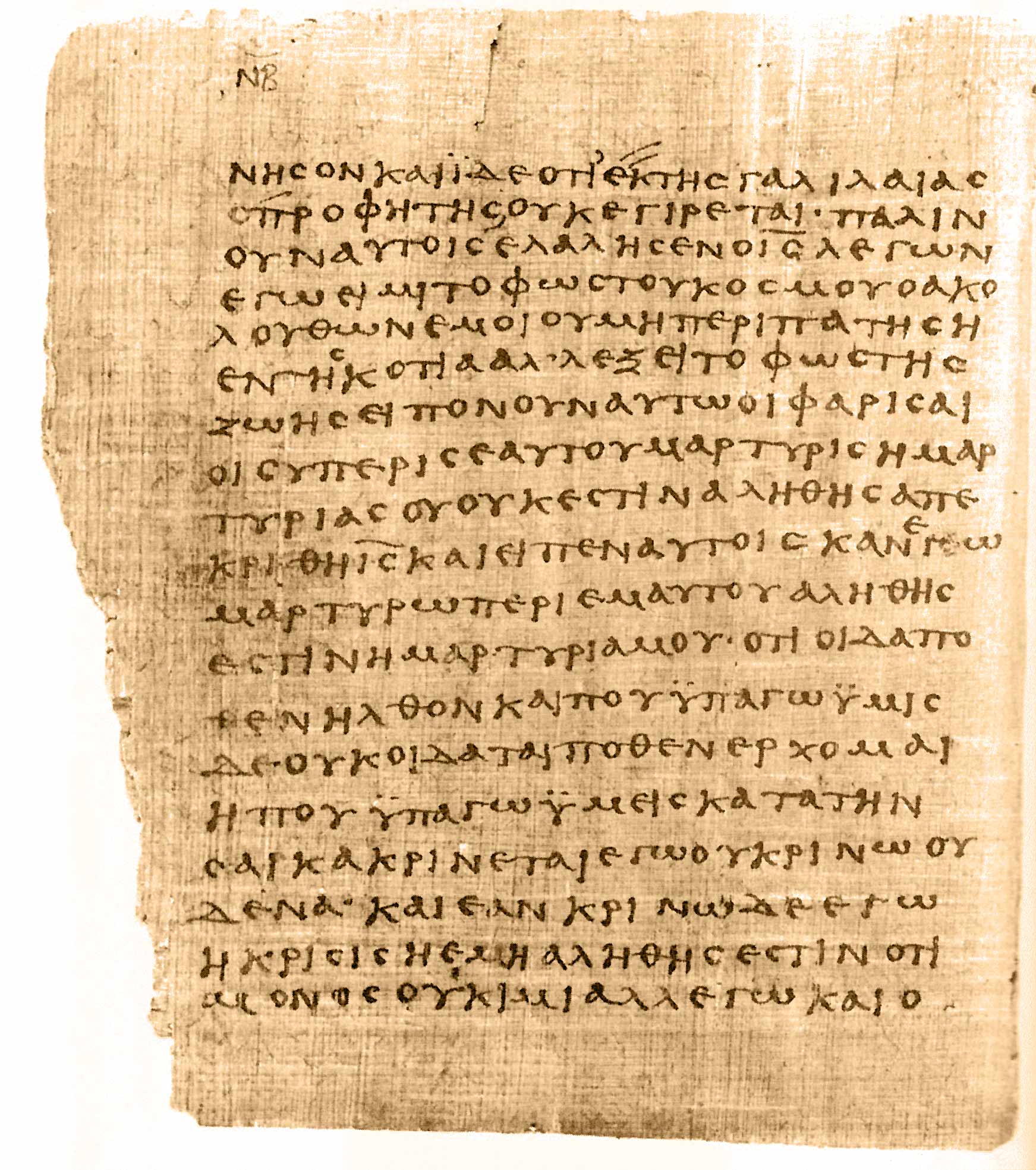
● John 7:52 – It is sometimes said that the excellence of the preservation of the New Testament text in the extant manuscripts is demonstrated by the observation that despite all of the discoveries of papyrus manuscripts in the late 1800’s and 1900’s, no reading that is supported exclusively by the papyri has been adopted in place of readings that were already extant.  However, a reading of Papyrus 66 might come closer to doing so than any other variant in the papyri. 
  
John 7:52 in Papyrus 66.
          William Bowyer
’s 1782 book Critical Conjectures and Observations on the New Testament included a theory expressed by Dr. Henry Owen about John 7:52:   “The Greek text, I apprehend, is not perfectly right:  and our English Version has carried it still farther from the true meaning.  Is it possible the Jews could say, “that out of Galilee hath arisen no prophet;” when several (no less perhaps than six) of their own prophets were natives of that country?  When they tell Nicodemus to search the Scriptures (see Cambr. MS. and Vulgate Version), they plainly meant, for the birth-place of the prophet that was to come, i.e., the Messiah; which he would find to be, not any town of Galilee, but Bethlehem in the land of Judea.  Hence then I conclude, that what they really said, and what the reading ought to be, was – ὅτι Ὁ ΠΡΟΦΗΤΗΣ ἐκ τῆς Γαλιλαίας οὐκ ΕΓΕΙΡΕΤΑΙ:  That the prophet is not to arise out of Galilee:  from whence they supposed Jesus to have sprung.”   
            The second part of Owen’s proposal was adopted by textual critics in the 1800’s, for ἐγείρεται is supported by a variety of important manuscripts (including א B D N W Δ).  The first part, though, was not vindicated until the discovery of Papyrus 66, which has the Greek equivalent of “the” before the word “prophet” – exactly what Owen, in the 1780’s, thought was the original reading. 
            (It is sometimes claimed that Papyrus 75 also supports this reading; however, the digital online image of the passage in Papyrus 75 shows that Papyrus 75 has no testimony about this one way or the other, due to thorough damage to the papyrus after the Γαλιλα of the second occurrence of Γαλιλαίας.) 
            It is possible that future editors, impressed by the cogency of Owen’s argument as well as by the early date of the manuscript with which it interlocks, may move the article into the text.        

            The Gospels are not the only part of the New Testament in which non-extant readings, and variants with very slight external support, may be embraced in the future.  God willing, in my next post, I will examine ten other passages, outside the Gospels, which have invited conjectural emendation in the past, and which may do so in the future.


_______________


Quotations from the ESV have been taken from The Holy Bible, English Standard Version. ESV® Permanent Text Edition® (2016). Copyright © 2001 by Crossway Bibles, a publishing ministry of Good News Publishers.

Quotations from the NIV have been taken from the Holy Bible, New International Version®, NIV® Copyright ©1973, 1978, 1984, 2011 by Biblica, Inc.®  Used by permission. All rights reserved worldwide.

Scripture quotations marked CSB have been taken from the Christian Standard Bible®, Copyright © 2017 by Holman Bible Publishers.  Used by permission.  Christian Standard Bible® and CSB® are federally registered trademarks of Holman Bible Publishers.

Scripture quotations marked NASB taken from the New American Standard Bible®, Copyright © 1960, 1962, 1963, 1968, 1971, 1972, 1973, 1975, 1977, 1995 by The Lockman Foundation.  Used by permission.