Followers

Showing posts with label Lectionaries. Show all posts

Tuesday, January 14, 2020

The British Library 2020: Manuscript Index


            The British Library houses Codex Sinaiticus (most of it, at least) and Codex Alexandrinus.  As reported at the British Library’s website, 905 Greek manuscripts in the British Library’s large collection of Greek manuscripts have been digitized.  This includes not only Codices À (Sinaiticus) and A (Alexandrinus), and assorted works by secular authors, and by patristic writers, but also the following New Testament manuscripts – 115 continuous-text manuscripts, and 62 lectionaries.
            Each link should take you to a page where each manuscript is briefly described, and where access to page-views of each manuscript is provided.

GA 011 (Codex Seidelianus I, Gospels, 800s, damaged)
GA 027 (Codex Nitriensis, 500s, palimpsest)
GA 0121a (900s)
GA 0133, 0269, 0271, 0272, 0273, 0297, Lect 334 (Codex Blenheimius, 700s lower writing, palimpsest)

GA 44 (Gospels, 1100s)
GA 65 (Gospels, 1100s)
GA 72 (Gospels, 1100s, interesting marginalia)
GA 81 (Acts, 1044)

GA 104 (New Testament, 1087)
GA 109 (Gospels, 1300s/1400s)
GA 110 (New Testament, 1100s)
GA 113 (Gospels, 1100s, illustrated)
GA 114 (Gospels, 1000s or later.  quatrefoil Ad Carpianus)
GA 115 (Gospels, 1000s, heavily damaged)
GA 116 (Gospels, 1100s/1200s)
GA 117 and Lect 1357 (Gospels and Acts, early 1500s)

GA 201 (New Testament, 1357)
GA 202 (Gospels, 1100s)
GA 203 (New Testament except for Gospels, 1108)
GA 272 (Gospels, 1000s/1100s)

GA 308 (Acts and Epistles, 1300s)
GA 312 (Vol. 1) (Acts and Epistles, 1000s-1100s)
GA 312 (Vol. 2) (Epistles, 1000s-1100s)
GA 321 (Acts and Epistles, 1100s or later)
GA 322 (Acts and Epistles, 1500s)
GA 384 (Acts and Epistles, 1200s)
GA 385 (Acts, Epistles, Revelation, 1407)

            Golden Canon Tables (500s or 600s – in situ with 438)

GA 445 (Gospels, 1506)
GA 446 (Gospels, 1400s)
GA 447 (Gospels, 1500s)
GA 448 (Gospels, 1478)

GA 476 (Gospels, 1000s)
GA 478 (Gospels, 900s-1000s)
GA 480 (Gospels and part of Hebrews, 1366)
GA 481 (Gospels, 900s-1100s, Evangelists portraits) (Burney Gospels 19)
GA 482 (Gospels, 1285, Evangelists’ portraits)
GA 484 (Gospels, 1291, quatrefoil headpiece)
GA 485 (Gospels, 1100s, semi-quatrefoil Ad Carpianus)
GA 490 (Gospels, 1000s, quatrefoil Ad Carpianus and quatrefoil headpiece)
GA 491 (New Testament except Revelation, 1000s)
GA 492 (Gospels, 1325)
GA 493 (Gospels, 1400s)
GA 494 (Gospels, 1300s)
GA 495 (Gospels, 1100s, Evangelists’ portraits)
GA 496 (New Testament except Revelation, 1200s)
GA 497 (Gospels, 1000s)
GA 498 (New Testament, missing some pages, 1300s)
GA 499 (Gospels, 1100s)

GA 500 (Gospels, 1200s)
GA 501 (Gospels, 1200s, some later supplements)
GA 502 (Gospels, 1200s)
GA 503 (John, 1200s)
GA 504 (Gospels, 1033)
GA 505 (Gospels, 1100s, quatrefoil headpiece)
GA 547 (New Testament except Revelation, 1000s)
GA 548 (Gospels, 1100s)
GA 549 (Gospels, 1000s, commentary)
GA 550 (Gospels, 1100s)
GA 551 (Gospels, 1100s-1400s)
GA 552 (Gospels, 1100s)
GA 553 (Gospels, 1200s)

GA 640 (James, fragment, 1000s-1100s, commentary)
GA 641 (Acts and Epistles, 1000s, commentary)
GA 643 (Vol. 1) (Pauline Epistles, 1300s, Chrysostom commentary)
GA 643 (Vol. 2) (Pauline Epistles w/Chrysostom comm., and General Epistles, 1300s)
GA 644 (Pauline Epistles, incomplete, 1300s)
GA 645 (Gospels, 1304)
GA 686 (Gospels, 1337)
GA 687 (fragments of Matthew, 1000s)
GA 688 (Gospels, 1179)
GA 689 (Gospels, 1200s)
GA 690 (Gospels, 1200s-1300s)
GA 691 (Gospels, 1200s-1300s)
GA 692 (Gospels, 1200s-1300s, quatrefoil headpiece)
GA 693 (Gospels, 1200s-1300s)
GA 694 (Gospels, 1400s)
GA 695 (Gospels, 1200s)
GA 696 (Gospels, 1300s)
GA 697 (Gospels, 1200s) (decorated, fox & snake initial)
GA 698 (Matthew, Mark, Luke, 1300s)
GA 699 / GA 699 (Guest-Coutts NT) (Gospels, Acts, Epistles, 900s)

GA 700 (Gospels, 1000s) (Hoskier’s Codex)
GA 714 (Gospels, 1100s-1200s)
GA 715 (Gospels, 1200s, quatrefoil headpiece)
GA 716 (Gospels, 1300s, quatrefoil headpiece)
GA 892 (Gospels, 800s with later supplements)

GA 910 (Acts and Epistles, 1009)
GA 911 (Acts and Epistles, 1000s)
GA 911(2040) (Revelation, 1000s)
GA 912 (Acts and Epistles, 1200s)
GA 913 (Acts and Epistles, 1300s)

GA 1268 (Gospels, 1200s, commentary)
GA 1274 (Vol. 1) (Palimpsest – parts of Matthew and Mark, 1100s/1400s)
GA 1274 (Vol. 2) – Luke, Matthew, Mark) and GA 2823  and GA 2822 (Palimpsest – part of James and Jude, 1100s/1400s)
GA 1279 (Gospels, 1100s-1200s)
GA 1280 (Gospels, 1100s-1400s)

GA 1765 (Acts and Epistles, 1300s)

GA 1911 (Romans-Jude, 1500s.  This is Harley MS 5552, likely a transcript of Erasmus’ first edition)
GA 1956 (Pauline Epistles, 1200s, catena)

GA 2041 (Revelation, 1300s)
GA 2099 (Gospels, 1200s)

GA 2277 (Gospels, 1000s-1300s)
GA 2278 (Gospels, 1314)
GA 2279 (Acts and Epistles, 1300s)
GA 2280 (Gospels, 1100s)
GA 2290 (Gospels, 900s with supplements from 1600s)
GA 2291 (Vol. 1) (Matthew and Mark, 1200s)
GA 2291 (Vol. 2) (Luke and John, 1200s)

GA 2484 (Acts and Epistles, 1312)

LECTIONARIES

Lect 25a and 25b (partly palimpsest)

Lect 150 (995, uncial)
Lect 151 (1100s, quatrefoil headpiece)
Lect 152 (800s-900s, uncial)
Lect 169 (1200s, Acts and Epistles)
Lect 183 (nice uncial lectionary)
Lect 184 (late 900s)
Lect 187 (1100s-1200s)
Lect 189 (1100s)
Lect 190 (1000s, fragment)
Lect 191 (1100s)
Lect 192 (1200s)
Lect 193 (1334)

Lect 233 (1100s, cruciform text)
Lect 237 & Lect 2310 (1100s and 1600s)
Lect 238 (1000s-1100s)
Lect 257 (1306, Acts and Epistles)

Lect 318 (1000s)
Lect 319 (1100s-1200s, quatrefoil headpiece)
Lect 320 (1300s, damaged)
Lect 321 (1100s-1200s)
Lect 322 (1000s)
Lect 323 (1100s-1200s)
Lect 324 (1200s)
Lect 325 (1200s)
Lect 326 (1100s)
Lect 327 (1300s)
Lect 328 (1300s)
Lect 329 (900s-1000s)

Lect 330 & 331 (1272)   
Lect 332 (1300s)
Lect 333 1200s)
Lect 335 (1100s)
Lect 336 (1100s-1300s)
Lect 337 (1200s)
Lect 338 (900s lower writing, palimpsest)
Lect 339 (1100s)
Lect 340 (1200s) 
Lect 344 (1100s-1300s)
Lect 346 (1100s-1300s)

Lect 927 (1200s-1300s)
Lect 930 (1200s)
Lect 932 (1200s)
Lect 939 (1100s)
Lect 940 (1200s)
Lect 941 (1100s)

Lect 1053 (1000s-1100s, fragment)
Lect 1234 (1300s)
Lect 1317 (800s and 1400s, palimpsest)

Lect 1490 (1100s)
Lect 1491 (1008)
Lect 1492 (late 1000s)
Lect 1493 (1000s)
Lect 1494 (1100s-1200s)
Lect 1495 (1200s)
Lect 1496 (1413)

Lect 1742 (late 1300s)
Lect 1743 (1256)

Lect 2376 (1000s, quatrefoil headpiece)

Also of interest:
Collation of GA 71 (Codex Ephesinus), made in 1679
Add. MS 34186 – Wax Tablets  (Probably similar to what Zachariah used in Luke 1:63)

In addition, the British Library’s website offers several essays on subjects relevant in one way or another to the field of New Testament textual criticism, including the following:

Scribes and Scholars in Byzantium (Georgi Parpulov)
Manuscripts of the Christian Bible (Scot McKendrick)
Ancient Books (Cillian O’Hogan)
Ancient Libraries (Matthew Nicholls)
Book Illumination in Antiquity (Cillian O’Hogan) (featuring Codex N)
Biblical Illumination (Kathleen Doyle)
Byzantine Bookbindings (Ann Tomalak)
Byzantine Book Epigrams (Julie Boeten and Sien De Groot)
Illuminated Gospel-books (Kathleen Maxwell)
The Earliest Greek Bibles (David C. Parker) (featuring Papyrus 5)


Readers are invited to double-check the data in this post.


Sunday, October 1, 2017

Mark 1:2 - In Isaiah, or In the Prophets?


[Note:  Readers are encouraged to explore the embedded links in this four-part essay, many of which lead to digital images of Mark 1:2 in manuscripts.]

Part 1:  Reviewing the Greek Manuscript Evidence

            Did Mark 1:2 originally say “in the prophets” (ἐν τοῖς προφήταις) or “in Isaiah the prophet” (ἐν τῷ Ἠσαίᾳ τῷ προφήτῃ)?  As we embark on a multi-part exploration of this question, let’s thoroughly describe the external evidence, beginning with the manuscript-evidence for each rival variant: 

● ἐν τοῖς προφήταις, according to the UBS apparatus, is supported by Codex Alexandrinus (A, 02), Codex Washingtoniensis (W, 032), f13, 28, 180, 579, 597, 1006, 1010, 1292, 1342, 1424, 1505, and Byz.
            “Byz” represents not only hundreds of Greek Gospels-manuscripts that are less than 900 years old, but also the following manuscripts: 

            Codex Basiliensis (E, 07), Codex Boreelianus (F, 09), Codex Seidelianus II (H, 013), Codex Cyprius (K, 017), Codex Campianus (M, 021, which has “Isaiah” in the margin), Codex Guelferbytanus A (Pe, 024), Codex Vaticanus 354 (S, 028), Codex Nanianus (U, 030), Codex Mosquensis II (V, 031), Codex Monacensis (X, 033), Codex Macedonianus (Y, 034), Codex Petropolitanus (Π, 041), Codex Rossanensis (Σ, 042, from the 500’s), Codex Beratinus (Φ, 043), Codex Athous Dionysiou (Ω, 045), 047, 0133, and minuscules 24, 27, 29, 34, 67, 100, 106, 123, 134, 135, 144, 150, 161, 175, 259, 262, 274, 299, 300, 338, 344, 348, 364, 371, 376, 399, 405, 411, 420, 422, 478, 481, 564, 566 (paired with Λ, 039), 568, 652, 669, 771, 773, 785, 875, 942, 1055, 1073, 1076, 1077, 1078, 1079, 1080, 1110, 1120, 1172, 1187, 1203, 1223, 1225, 1266, 1281, 1346, 1347, 1357, 1379, 1392, 1422, 1426, 1444, 1458, 1507, 1662, 1663, 1701, 1816, 2142, 2172, 2193, 2290, 2324, 2368, 2369, 2370, 2373, 2414, 2474, 2509, 2545, 2722, 2790, 2800, 2811, 2812, 2854, 2907, and 2929.  


● ἐν τῷ Ἠσαίᾳ τῷ προφήτῃ is supported by Oxyrhynchus Papyri LXXVI 5073, Codex Sinaiticus (01, Aleph (À), Codex Vaticanus (B, 03), Codex Regius (L, 019, “Isaiah” is spelled Ϊσαϊα), Codex Sangellensis (Δ, 037, Greek-Latin), 33, 151, 892, 1241, about 10 other minuscules, and the D’Hendecourt Scroll (from the 1300’s).  (Minuscule 151’s retention of this reading may have something to do with the inclusion of Eusebius’ apologetical composition Ad Marinum in the same volume.)

● ἐν Ἠσαίᾳ τῷ προφήτῃ is supported by Codex Bezae (D, 05, Greek-Latin), Codex Koridethi (Θ, 038), the core members of f1, 565, and 205 (from the mid-1400’s), plus 700, 1243, and 1071.  (Only these last three lack close affiliation with either the Western or Caesarean Text.)  A few other minuscules support ἐν Ἠσαίᾳ τῷ προφήτῃ but were not listed in the UBS apparatus; these include 22.  Minuscule 22 shares some readings with f1 and 205, and also shares a note about the ending of Mark; in 22 the note is shorter (failing to claim that the Eusebian Canons omit Mk. 16:9-20, very probably because where and where 22 was made, the Canons had been adjusted to include those verses) but it is recognizably the same note. (Minuscules 15, 22, 1110, 1192, and 1210 all have the note about Mark 16:9-20.)  Also included:  61 (Codex Montfortianus, on 55r; this manuscript is famous for its inclusion of the Comma Johanneum), 372 (assigned to the 1500’s, with some Latin notes in the margins), and 391 (produced in 1055).

● ἐν βίβλω λόγων Ἠσαΐου τοῦ προφήτου is read by 1273 (the George Grey Gospels) and 544 and a similar text is in the book in a full-page picture of Mark in Lectionary 1635.

            For a convenient summary of versional and patristic evidence, see the STEPBible Textual Apparatus and Wieland Willker’s Textual Commentary on the Greek Gospels – Volume 2, Mark, 2015 Edition.  Readers should be aware that 2427 (cited throughout Mark in the 27th edition of the Nestle-Aland Novum Testamentum Graece) has been proven to be a forgery, based on a printed text from the 1800’s, and that although f1 is cited for “in Isaiah the prophet,” this represents only a consensus of its core members.)
            The Armenian version was listed in UBS2 as support for ἐν τοῖς προφήταις, but in UBS4 the Armenian version was listed as support for ἐν Ἠσαίᾳ τῷ προφήτῃ.  The older Armenian manuscripts tend to not have “Son of God” in Mark 1:1, and to read “in Isaiah the prophet” in 1:2 – following the Caesarean form.  However, a competition of influences upon the Armenian tradition began very early in its history, in addition to later influence from the Vulgate. 

            Most of the Greek lectionaries, such as Lect 123 (an illustrated lectionary from the 900’s), Lect 379 (from the 800’s), Lect 1599 (from the 900’s), Lect 71 (from 1066), Lect 183 (from the 800’s or 900’s), and the illustrated Lect 120 (from the 1100’s) support ἐν τοῖς προφήταις, but there are some exceptions, such as Lect 562 (from A.D. 991), which supports ἐν Ἠσαίᾳ τῷ προφήτῃ.
           
● One more variant seems to be attested by the Old Latin Codex Usserianus Primus (VL 14); the Byzantine and Alexandrian readings are combined, so as to read, “in Isaiah and in the prophets.”  However the text is difficult to read due to damage to the parchment (See fol. 150r at the page-views at the Trinity College Dublin website .)

            In this essay, the reading “in the prophets” will be defended as original, and I will argue that its Alexandrian and Western rivals originated in the following way:
            In the 100’s, some copyists were mildly averse to non-specific references to Old Testament books, and added specific names in place of the original non-specific references.  Mark 1:2 is one of the passages affected by this tendency toward specificity.  Some copyists, understanding the paraphrastic opening phrase – which could be understood as a reference to Exodus 23:20 (in the Law, rather than the Prophets) – as merely an introduction to Isaiah’s words, adjusted the text so as to identify the prophet being cited. 
           
            This happened independently in Alexandrian and Western transmission-streams, which is why the Alexandrian witnesses consistently have τῷ before Ἠσαίᾳ, while the major Western and Caesarean witnesses do not.  When (and where) copyists and commentators were confident that Mark was using Malachi rather than Exodus, Christian scholars whose manuscripts read “in Isaiah the prophet” developed inventive explanations about how Mark could appear to identify Malachi’s words as if they had been written by Isaiah.  These explanations were sufficiently convincing to allow the reading to remain in the Alexandrian and Western transmission-lines. 

            The insertion of specific names, where the original text has no specific name, is a recurring scribal practice, and one which is observable in some of our very earliest New Testament manuscripts.  For example, in the early Alexandrian transmission-stream, in Luke 16:19, in the story about the rich man and Lazarus, the rich man was given a name:  he was named Nineveh.  This reading is found in Luke 16:19 in Sahidic copies, and in the manuscript known as Codex Sinaiticus Arabicus, or CSA, one of the documents discovered at St. Catherine’s Monastery in 1975.  (A collation of CSA by Hikmat Kachouh was released in 2008 in the journal Novum Testamentum.)  But there is much earlier evidence for that reading.  Papyrus 75 reads named Neuhs in the same passage (ονοματι νευης), and this is the same name, Nineveh, disfigured by a parableptic error in which the copyist skipped the first syllable.  (Two Greek manuscripts, minuscules 36 and 37, have margin-notes which also identify the rich man as Nineveh.)
            When a character in the Gospels plays a prominent role, but has no name, frequently a name is provided.  Bruce Metzger documented this phenomenon in his essay, Names for the Nameless in the New Testament, which serves as chapter 2 of New Testament Studies:  Philological, Versional, and Patristic
            The scribal tendency to provide names for unnamed individuals comes into play repeatedly in passages where the text refers to the fulfillment of prophecies.  The non-specific attribution “through the prophet” is often turned into a specific attribution.  Usually the attribution is correct, but sometimes it is incorrect.
            The Old Latin Codex Colbertinus (VL 6) displays this tendency.  Its text of Mark 15:27 provides names for the two robbers who were crucified with Jesus – Zoathan and Chammatha.  VL 6, like practically all Latin manuscripts of Mark, also reads “in Isaiah the prophet” in Mark 1:2.  In Matthew 1:22 – where Matthew quoted Isaiah without naming him (simply saying that “what was spoken by the Lord through the prophet” was fulfilled) –  Codex Colbertinus states specifically that the prophecy was given by Isaiah.
            This phenomenon is not limited to one medieval Old Latin copy.  Codex Bezae, which D. C. Parker has assigned to c. 400, also includes Isaiah’s name in the text of Matthew 1:22, both in its Latin text and in its corresponding Greek text.  Old Latin Codex Veronensis (VL 4, from the 400’s) also has Isaiah’s name in Matthew 1:22.  So do the Old Latin codices Brixianus (VL 10, from the 500’s) and Sangermanensis (VL 7, c. 810) and Vercellensis (VL 3, probably from the 370’s).  (Metzger expressed some uncertainty about Codex Vercellensis’ reading in his Textual Commentary, but “ESEIAM PROPHETAM” is shown clearly in Irici’s 1748 presentation of Codex Vercellensis.)  “Isaiah” is practically the normal Old Latin reading in Matthew 1:22. 
            The earliest evidence for the reading “in Isaiah the prophet” in Matthew 1:22, however, may be even earlier than the earliest Old Latin manuscript:  in the Latin text of Irenaeus’ Against Heresies 3:21:4 (composed in Greek c. 184), Irenaeus quotes Matthew 1:22:  “et quoniam Angelus in somnis dixit ad Joseph:  Hoc autem factum est, ut adimpleretur quod dictum est ab Esaia Propheta:  Ecce virgo it utero concipiet.”  It is possible that the form of this quotation was altered by the Latin translator of Irenaeus’ work, but that too would be early testimony.  
            In the Syriac tradition, the same scribal tendency is on display.  In Matthew 1:22, the inclusion of the name “Isaiah” is attested by the Sinaitic Syriac, the Curetonian Syriac, the Harklean Syriac, and the Palestinian Aramaic.
            Another Western witness that displays the tendency to fill the vacuum when a prophet’s statements are cited without specifying his name is the Middle Egyptian Glazier Codex of Acts (G67, from the 400’s).  Instead of “in the prophets” in Acts 13:30, G67 reads, “in Habakkuk the prophet.”
           
            The scribal tendency toward specificity is also displayed by the core members of family-1.  Although these manuscripts are medieval, they are generally thought to represent a text of the Gospels similar to a text used by Origen at Caesarea in the 200’s; this is indicated by their support for the reading “Jesus Barabbas” in Matthew 27:17; according to a Latin translation of Origen’s Commentary on Matthew, Origen stated that some of his copies had this reading.
            The text of f1 indicates that copyists of the manuscripts used by Origen were not exempt from the tendency toward specificity, and that occasionally the scribal attempt to make the text more specific was poorly executed.  In Matthew 13:35, where most manuscripts simply read “by the prophet,” without naming the prophet being quoted, the text in f1 includes a specific name:  Isaiah. 
            That is not a correct reference; Matthew’s quotation clearly comes from Psalm 78:2, which was composed by Asaph, not by Isaiah.  Yet an early copyist’s need for specificity was greater than his grasp of the contents of the Old Testament, and the name “Isaiah” was perpetuated in various manuscripts, including minuscules 1, 543, 788, 230, 983, and 1582 (and some others), and Codex Θ. 
            Eusebius of Caesarea, in his Commentary on the Psalms, mentioned that some copies read “in Isaiah the prophet” in Matthew 13:35, but not the accurate copies. 
            Jerome, in his Homily 11 on Psalm 77 (our Psalm 78), cited Matthew 13:35 and claimed that the reading “through the prophet Asaph” is supported by “all the ancient copies” – “in omnibus ueteribus codicibus” – but it was changed by ignorant individuals (see Amy Donaldson’s Explicit References to New Testament Variant Readings Among Greek and Latin Church Fathers, Vol. 2, pages 369-370).  In addition, Jerome wrote that Porphyry (an anti-Christian author who wrote c. 270) made an accusation against Matthew that can only be accounted for by Porphyry’s use of a copy of Matthew with the reading “in Isaiah the prophet” in Matthew 13:35:
            “Porphyry, that unbeliever . . . says, ‘Your evangelist, Matthew, was so ignorant that he said, “What is written in Isaiah the prophet:  I will open my mouth in parables, I will utter mysteries from of old.”’ . . .  Now, just as this was the scribes’ error, it was, likewise, their error to write ‘Isaiah’ instead of ‘Asaph.’” 
            Jerome proceeded to offer a theory that some early copyist, reading “Asaph the prophet” in his exemplar, did not recognize the name “Asaph,” and replaced it with “Isaiah.”  He offered the same line of reasoning in his Commentary on Matthew.  On the premise that Jerome was not being altogether deceptive, it would appear that the text of Matthew 13:35 in copies that he considered ancient had been expanded to include Asaph’s name.  (We shall take a closer look at Jerome’s testimony later.)
            The tendency to make non-specific quotations of Old Testament prophets more specific – via the insertion of a prophet’s proper name rather than “through the prophet” or “by the prophet” – was so strong that copyists in the Western and Caesarean transmission-streams inserted prophets’ names in various passages – and, in the case of Matthew 13:35 in the Caesarean transmission-stream, perpetuated a specific name even when it was the wrong name.   
            The scribal tendency toward specificity was so strong in the Old Latin transmission-line that in Old Latin Codex Vercellensis (VL 3) a copyist felt that it was necessary to identify the prophet being quoted in Matthew 2:5.  Four copies of the Harklean Syriac display the same tendency, but their copyists exercised restraint by only putting Micah’s name in the margin of this passage.  In VL 3 (probably produced in the 370’s), the copyist (or his exemplar’s copyist) embedded the prophet’s name directly into the text – and, making matters worse – the identification is incorrect:  VL3 reads there, “per Eseiam propheta,” that is, “through Isaiah the prophet.”

            What about Alexandrian witnesses?  Yes; although not as heavily as elsewhere, the tendency toward specificity impacted Alexandrian manuscripts too:  “Isaiah the prophet” is the reading of Codex ﬡ at Matthew 13:35.
            In the margin of Matthew 2:15 in Codex Sinaiticus, we see how precarious it would be to assume that copyists knew the Old Testament too well to attribute to Isaiah a passage from a different Old Testament book.  Matthew 2:15 contains a quotation of Hosea 11:1 – “that it might be fulfilled which was spoken by the Lord through the prophet, saying, ‘Out of Egypt I called My Son.’”  Someone did not recognize that the passage being quoted was Hosea 11:1 (because in the Septuagint, Hosea 11:1 reads differently, as “When Israel was a child then I loved him, and called his sons out of Egypt”) and thought instead that Matthew was referring to a passage in Numbers – maybe 15:41 or 20:16 – and for that reason, he wrote in the margin of Codex Sinaiticus, in small vertically stacked lettering, “In Numbers.” 
            However reasonable it might seem to assume that copyists knew the Old Testament so well that they would not have risked giving the impression that they attributed a passage to Isaiah that did not originate with Isaiah, there is evidence against such an assumption.  Not only does the text of VL3 attribute Micah 5:2 to Isaiah in Matthew 2:5, but in Matthew 21:4 (according to Metzger in Textual Commentary, page 54), a few Vulgate copies, Bohairic copies, and Ethiopic copies add Isaiah’s name, although the quotation is from Zechariah. 
            Not all copyists were familiar with the Old Testament text, and for most of those who did know the Old Testament well, the text they knew was the Septuagint. Consequently there was a risk that copyists would imagine that their exemplars contained an error when a Gospels-manuscript contained a form of an Old Testament passage that did not match up with the form in which it was found in the Septuagint. 
            Mark’s use of Malachi 3:1 is one such case.  His utilization of Malachi 3:1 closes with the phrase, “who shall prepare your way” (ὃς κατασκευάσει τὴν ὁδόν σου) in the Alexandrian text, or, in the Byzantine Text, “who shall prepare your way before you” (ὃς κατασκευάσει τὴν ὁδόν σου ἔμπροσθέν σου).  Neither is an exact match with the text of Malachi 3:1 in the Septuagint, which ends with the phrase “καὶ ἐπιβλέψεται ὁδόν πρὸ προσώπου μου” – “and he shall carefully look for a way before me.”  (See Maurice Robinson’s article Two Passages in Mark in Faith & Mission, 13/2 (Spring 1996), pp. 66-111.)  An additional factor to consider is that the Septuagint’s text of Exodus 23:20a reads Καὶ ἰδοὺ ἐγὼ ἀποστέλλω τὸν ἄγγελόν μου πρὸ προσώπου σου – “And behold, I send my messenger before your face” – which might have caused some copyists to wonder if the readers of their copies would suppose that Mark was using a passage in the Law, rather than in the Prophets.    
            So if anyone wonders, “If the reading ‘in Isaiah the prophet’ in Mark 1:2 is not original, where did it originate?”, let the copyists of ﬡ, D, Θ, the Old Latin copies, and the main manuscripts of f1 reply:  from the same place that their readings “in Isaiah the prophet” in Matthew 1:22, Matthew 2:5, and Matthew 13:35 originated:  from the propensity of some early scribes to make non-specific references more specific.
            A faint echo of the kind of scribal confusion that led to the insertion of Isaiah’s name in Mark 1:2 (or an independent repetition of it) may be seen in two medieval Bohairic manuscripts.  Boh-E1 (a Coptic-Arabic manuscript produced in 1208), has the Bohairic words for “Exodus” and for “Malachi” in the margin near Mark 1:2.  An Arabic note says, “A copy has, ‘the prophets.’”  Boh-O1 (a Coptic manuscript produced in the 1300’s) has an Arabic note that says, “Isaiah prophesied with the voice of one crying, and Moses and Malachi prophesied with the sending of the messenger.”  The notes in both copies show that to some copyists, Mark 1:2 was understood to refer not just to the Prophets, but to a passage in Exodus.


To be continued in Part Two:  Mark 1:2, Origen, and Jerome

Friday, September 1, 2017

Seventy-seven Manuscripts from Jerusalem

The Mar Saba Monastery
            In the year 483, a monk named Sabbas founded a monastery about eight miles east of Bethlehem in the rugged Kidron ValleyThis monastery – the Holy Lavra of Saint Sabbas the Sanctified – gradually grew into a highly influential theological center.  John of Damascus worked there, and his tomb is there.  Although the premises were temporarily abandoned in the 1400’s due to constant raids by nearby nomadic tribes, it was reactivated, and in 1625 formally joined the Greek Orthodox Patriarchate of Jerusalem.
            Much of the manuscript collection of the Saint Sabbas Monastery is presently housed in Jerusalem.  In 1949-1950, an expedition led by Kenneth W. Clark visited the collections overseen by the Jerusalem Patriarchate, and photographed almost all of their manuscripts.  The Library of Congress recently released the photographs of these images online, making them freely available.  Many of these manuscripts consist of copies of the Psalms, saints’ biographies, history books, patristic compositions, liturgical texts, and even an occasional work by an ancient Greek author, such as Aristotle.  The collections also include some New Testament manuscripts.
            The New Testament manuscripts from the Saint Sabbas Collection are listed here, with embedded links to images of each manuscript.  

The headpiece of Matthew
in GA 1335 (Sabas 248)
GA 1335:  Hagios Sabas 248 - Four Gospels (The Gospel of Matthew in this manuscript has one of the strangest headpieces I have ever seen.)
GA 2926:  Hagios Sabas 676 - Revelation and Praxapostolos (This was catalogued as a Praxapostolos manuscript, but it begins with the continuous text of Revelation; Acts begins after that.)

            In addition to those 23 continuous-text manuscripts, the collection from the Saint Sabbas Monastery includes the following lectionaries: 
The first and last page
of Revelation in GA 2926


Hagios Sabas 360 - Evangelion (Weird script in the preface – stylized Georgian?)

            Another collection held at the Jerusalem Patriarchate is categorized as the Panagios Taphu collection, and it, too, includes some New Testament manuscripts, listed here with embedded links:

GA 1318:  Panagios Taphu 46 - Four Gospels (Neatly written.  Merits closer study.)
GA 1321:  Panagios Taphu 49 - Four Gospels (Some pages from a lectionary at the beginning)
GA 1325:  Panagios Taphu 62 Four Gospels (Made in 1724 – Greek and Modern Turkish Greek)

            Besides the 15 continuous-text manuscripts listed above, the Panagios Taphu collection also includes the following nine lectionaries: 

Panagios Taphu 33 - Evangelion (900’s/1000’s) (Elaborately executed)
Panagios Taphu 43 - Praxapostolos (Damaged; text begins in Acts 12)
Panagios Taphu 530 - Evangelion (made in 1744 – Greek and modern Turkish Greek)

[A couple of manuscripts were in the Checklist of manuscripts in the Jerusalem Patriarchate’s holdings, but I could not find photographs of them:  Hagios Sabas 413 (GA 1344, a manuscript of the Gospels) and Hagios Sabas 154 (an Evangelion).]


Thanks to the Library of Congress for making these images available.  Thanks, too, to Peter Montero and Peter Gurry for sharing the news about their release. 

Tuesday, July 5, 2016

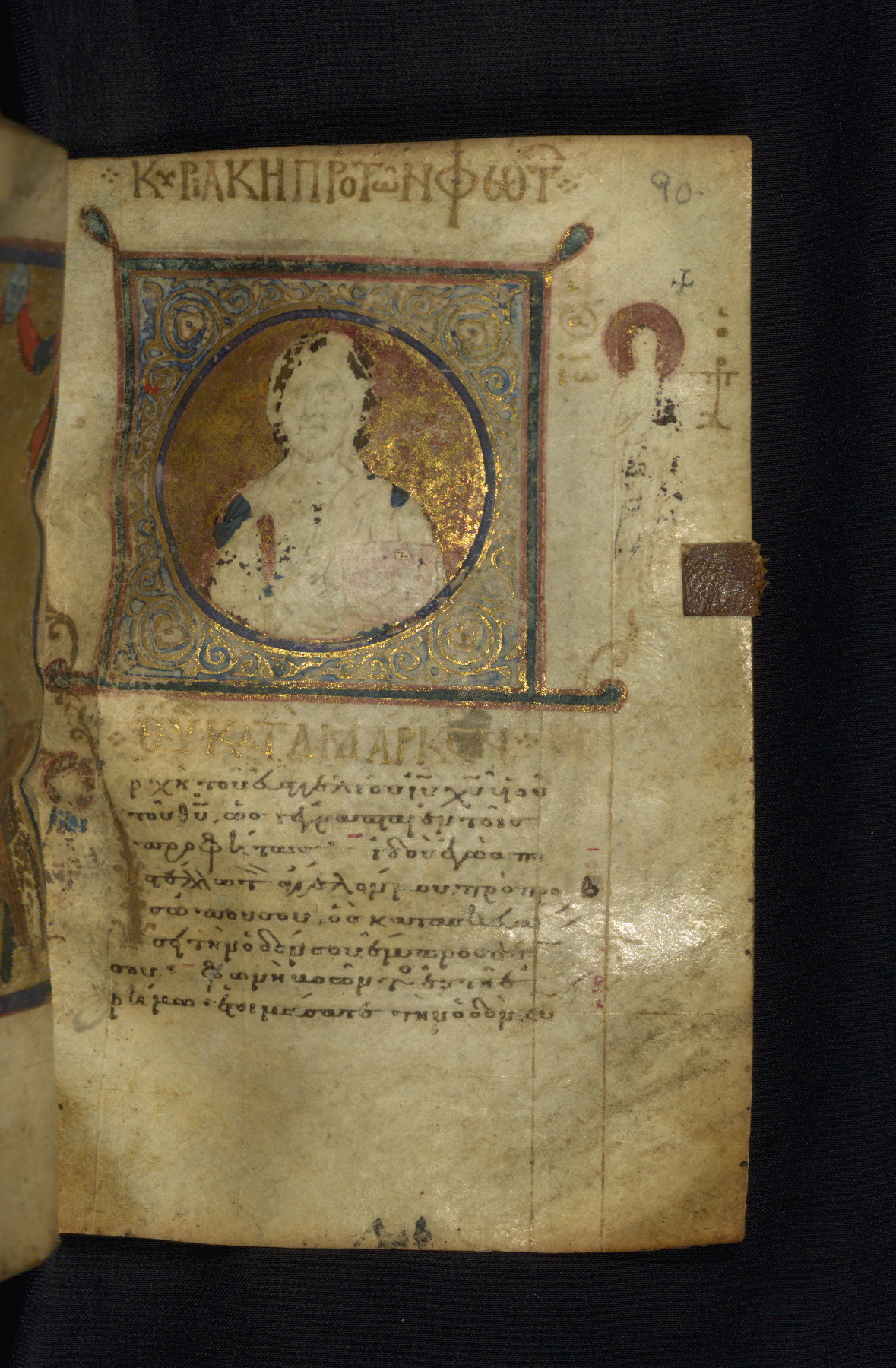
Free Manuscript Downloads from the Walters Art Museum

          The Walters Art Museum, in Baltimore, Maryland, is famous for its world-class art exhibits, but its manuscript collections are also of considerable significance.   In 2004, a catalogue of the Walters Art Museum’s Greek manuscripts was prepared by Georgi R. Parpulov.  Among the 19 Greek manuscripts in the collection are six copies of the four Gospels, two copies of Acts and the Epistles, and two Gospels-lectionaries, along with some fragments.    
          Most of these manuscripts can be viewed page-by-page at the Walters Art Museum’s website.  If that had been the only contribution that the Walters Art Museum had made to the field of New Testament textual criticism, it would be sufficient to deserve high praise.  But there is more:  each of the following manuscripts can be downloaded for free as a PDF:  
W. 520, a lectionary
written in Greek uncial script.
        
Walters 520 (GA Lect 1629):  Gospels lectionary, 900’s.  PDF of W. 520.
Walters 522 (GA 2370):  Gospels, 1000’s/1100’s.  PDF of W. 522.             
Walters 523 (GA 2369):  Gospels, 900’s (with replacement-pages).  PDF of W. 523.
Walters 524 (GA 2373):  Gospels, 900’s.  PDF of W. 524.           
Walters 525 (GA 2374):  Gospels, Acts, and Epistles, c. 1300.  PDF of W. 525.            
Walters 528 (GA 2372):  Gospels, early 1200’s.  PDF of W. 528.            
Walters 531 (GA 2375):  Gospels, c. 1150.  The Trebizond Gospels.  PDF of W. 531
Walters 533 (GA 1022):  Acts and Epistles, early 1100’s.  PDF of W. 533.          
Walters 535 (GA Lect 1029):  late (1594) lectionary copied by Luke the Cypriot, with many illustrations.  PDF of W. 535.
            
          Details about the contents and special features of these manuscripts can be found in the catalogue prepared by Georgi R. Parpulov.  Many more manuscripts – including the Reichenau Gospels, the Freising Gospels, and the Claricia Psalter – are at the Walters Art Museum’s website; I have not mentioned many other exquisite manuscripts, so as to encourage readers to visit the website directly and enjoy exploring it for themselves.  
W. 47 features a large illustration
of the assassination
of Thomas Becket
.
          Some other Greek manuscripts are too fragile to digitize at present; these include Walters 532 (GA 1346, a Gospels manuscript from c. 1100) and Walters 529 (GA 647 and 2371), the latter of which is formatted similarly to GA 1175.  Among the fragments which consist of only one or two images, are Walters 530A (a miniature of Mark), Walters 530C (GA 2191) (with text from John 21).  Walters 526 (GA 1531, from the late 1200’s) and Walters 527 (GA 2368) are more substantial, but full digital views of these Gospels-copies are not yet available:             
          An abundance of versional manuscripts resides in the Walters Art Museum’s collection, including Walters 537, the oldest substantial Armenian Gospels-manuscript in North America.  (PDF of Walters 537.)  Other interesting non-Greek manuscripts include the following:

Walters 836, an Ethiopic Gospels from the 1300’s.  PDF of Walters 836.   
Walters 751, the Corvey Gospel Fragment (Latin, 950-975). 
Walters 592, an illustrated Arabic Gospels made in 1684.  PDF of W. 592.   
Walters 739, a Coptic fragment of Exodus (with text from chapters 21 & 23).
Walters 47, the Psalter-Hours of Brother Guimier (Latin, late 1200’s).

          Congratulations and thanks are extended to the staff of, and donors to, the Walters Art Museum for making these tremendous resources available! 

Friday, October 9, 2015

Greek Lectionaries at the Bibliothèque Nationale de France

          Besides releasing page-views of images from 57 continuous-text Greek New Testament manuscripts, the National Library of France (Bibliothèque nationale de France) has made available page-views of 21 Greek lectionaries at the Gallica website.  The list here gives the Gregory-Aland identification-number, with the catalogue-number in parentheses.  For some lectionaries, the affinity of the text (according to data provided at the Center for the Study and Preservation of the Majority Text) is provided within brackets.

Lectionary 12 (Greek 310) l-e [Phi-Maj]  Divergent text.  Produced in the 1200s.    
       
Lectionary 15 (Greek 302) l-e [K] – Produced in the 1200s.            

Lectionary 63 (Greek 277) – The “Blue Fish Lectionary,” produced in the 900s.  Full-color images.  Written in uncial-script with colorful initials.  

Fol. 105 of a lectionary from the 800s
written in uncial script.
Lectionary 64 (Greek 281) l-esk – Uncial lectionary, produced in the 800s. 

Lectionary 68 (Greek 285) l-e [Phi-Maj] – Produced in the 1100s.              

Lectionary 69 (Greek 286) l-e [Phi-Maj] – Produced in the 1100s.
            
Lectionary 70 (Greek 288) l-e [Phi-Maj] – Produced in the 1100s.
            
Lectionary 72 & Lectionary 1358 (Greek 290) l-esk – Uncial end-leaves.

Lectionary 74 (Greek 292) l-esk 

Lectionary 75 (Greek 293) l-e [Phi-Maj]
            
Lectionary 77 (Greek 296) l-esk – Produced in the 1100s.

Lectionary 83 (Greek 294) l-e – Produced in the 1000s or 1100s.

MS 9, fol. 436 (from 1167/8):
John, writing his Gospel
and getting his picture taken.
Lectionary 86 (Greek 311) l-e [Kr/f35] – Produced in 1336.

Lectionary 87 (Greek 313) l-esk – Produced in the 1300s. 

Lectionary 89 (Greek 316) l-esk – Produced in the 1300s.

Lectionary 90 (Greek 317) l-esk – Produced in 1553.

Lectionary 91 (Greek 318) l-esk – Produced in the 1300s. 

Lectionary 92 (Greek 324) l-akp – Produced in the 1300s. 

Lectionary 99 (Greek 380) l-esk – Produced in the 1500s.
             
Lectionary 100 (Greek 381) l-esk – Produced in 1550.

Lectionary 147 (Greek 319) l-ae – Produced in the 1100s.

Lectionary 148 (Greek 320) l-ae – Produced in the 1100s. 

          In addition, a Greek Gospels-manuscript which was not mentioned in the earlier list of Greek manuscripts at Gallica should be included.  Its catalog-number is MS 1.916 at the National and University Library of Strasbourg, but I have not tracked down its Gregory-Aland identification-number.  Its full-color page-views include the opening pages of Matthew, Mark, Luke, and John

          Another lectionary is listed only as National and University Library of Strasbourg MS 1.914.
           
         Many manuscripts, while not lectionaries, contain lection-lists and calendars of lections.  For example, minuscule 9 – Greek 82 at Gallica/BnF (considered to be the manuscript cited by Stephanus as ιβʹ) – not only contains the Gospels of Matthew, Mark, Luke, and John, but also features an index of lections.