Followers

Showing posts with label minuscules. Show all posts

Friday, June 25, 2021

Scrivener: Principles of Comparative Criticism - Part 2

[This is a continuation of what F.H.A. Scrivener wrote about different approaches to New Testament textual criticism in 1858.]

        The reputation of Tischendorf is so firmly grounded on his editions of the famous Codices Ephraemi and Claromontanus, on his Monumenta Sacra Inedita and other learned works, that his opinion on the great questions of sacred criticism cannot fail to be regarded with considerable interest.  In his 1849 manual edition of the New Testament his practice must be regarded on the whole as adverse to me.  His list of authorities in the Gospels is limited to the uncial MSS, and to a few of the cursive whose variations from the common standard text are most conspicuous (e.g. 1, 13, 33, 69, 102, 131).  Occasionally indeed he estimates (very roughly of course) the number of later copies supposed to countenance a reading of his uncials, yet I nowhere perceive that he gives much weight to such testimony in the arrangement of his text.  The edition of 1849, however, must be considered as quite superseded by another (which, reckoning several [editions] little known in England, Tischendorf calls his seventh), now issuing in parts from the Leipsic Press.

This, the latest fruits of his persevering toil, is far more comprehensive in plan and (experto credite) more accurate in execution than its predecessor.  In compiling it he has freely availed himself of the labors of others in this field of Biblical research, has cited the cursive MSS as much perhaps as is expedient in a volume intended for general use, and in exercising his judgment on the materials he has brought together, has produced a text (as Dr. Wordsworth has observed before me) much more closely resembling the Textus Receptus than that he had formed before.1  [1 – Thus, for example, Tischendorf’s 7th edition, in St. Matthew alone, returns to the received readings he had rejected in 1849 in no less than 187 passages.  The instances in which he abided by the common text in 1849, but subsequently deserts it, are 56 in St. Matthew’s Gospel, but about nine-tenths of them consist of Alexandrine forms (e. g. εἶδαν, εἶπαν, ἦλθαν, etc.) which he now prefers to the common ones.]  I cannot help believing this gradual and (as it would appear) almost unconscious approximation to the views I am advocating, into which more exact study and larger experience have led so eminent a scholar, to be no slight assurance that those views are founded in reasonableness and truth.2  [2 – It has been said indeed (in Journal of Philology, Vol. IV, March 1858, p. 107) that “the impression that Tischendorf is now beginning to entertain some respect for the textus receptus is quite unfounded.  Many of his present readings accidentally coincide with the ‘received’ readings, but that is all.  It is not that he prefers the bulk of late evidence to the weight of early evidence: but that he makes the worst or at least very bad evidence, if supported by a canon of probability, outweigh the best evidence standing alone.”  On a point of this kind there is nothing like coming to the test of facts. 

I select the third chapter of St. Matthew partly for its brevity. partly because the loss of cod. A (the first-rate authority which most resembles the later text) in this chapter, will so far assist the learned reviewer’s case.  Exclusive of his constant use of ν εφελευσικον and οὑτως (v. 15), Tischendorf in his edition of 1849 departs from the textus receptus 13 times; in his seventh edition he returns to it seven times out of the thirteen.  Now one of these seven instances I think favorable to the reviewer:  certainly there is considerable, perhaps even preponderating evidence (for versions can be relied on in such a. variation) for adding ποτάμῳ to Ἰορδάνη in v. 6; Tischendorf now rejects it, as if it were borrowed from Mark 1:5.  The other six passages seem fatal to the notion that internal evidence, not diplomatic authority, is the operating cause which is bringing Tischendorf’s text so much nearer what we believe to be the true one.  These passages are v. 2 και restored before λέγων; v. 7 αυτου restored after βάπτισμα; v. 14 Ἰωάννης restored, v. 15 προς αυτον of the common text replaces αυτω; v. 16 και βαπτισθεις replaces βαπτισθεις δε; v. 16 και is restored before ἐρχόμενον.  In each of these texts Tischendorf in 1849 rejected the common reading on the slender testimony of a single uncial, B, countenanced by one or more of the Egyptian and Latin versions or Fathers, and by a very few cursive MSS, sometimes by none at all!  Surely it is because he has seen the insufficiency of such evidence, that he has judiciously retraced his steps, rather than from “an increasing tendency to set private canons above the authority of manuscripts, versions, and Fathers.”]

    Yet even in the Prolegomena to his edition of 1849 (no critical Introduction to his 7th edition has yet appeared) I find little from which I should withhold my assent. “Textus” he observes “petendus est unicè ex antiquis testibus, et potissimum quidem e graecis codicibus, sed interpretationum patrumque testimoniis minimè neglectis” (Proleg. p. XII).  The drift of this self-evident proposition appears from the next sentence:  “Itaque omnis textûs nostri confirmatio ab ipsis testibus proficisci debebat, non a receptâ quam dicunt editione.”  Very true: I for one see nothing in the history or sources of the received text to entitle it, of itself, to peculiar deference.  I esteem it so far as it represents the readings best supported by documentary evidence, and no further.  If in my judgment the Elzevir text approaches nearer on the whole to the sacred autographs than that formed by Tischendorf, it is only because I believe that it is better attested to by the very witnesses to whom Tischendorf himself appeals:  the MSS, the versions, the Primitive Fathers.  I enquire not whether this general purity (for it is but general) arises from chance, or editorial skill, or (as some have piously thought) from Providential arrangement; I am content to deal with it as a fact.  Perhaps Dean Alford’s plan is preferable (N. T. Proleg. p. 69, Vol. 1. 1st edition), who, in difficult cases, where testimony seems evenly balanced, would give “the benefit of the doubt” to the Textus Receptus; but the practical difference between the two principles will be found, I imagine, very slight indeed.

     And now recurs the question, what we shall understand by “antiqui testes” in the case of Greek Manuscripts? In the first rank Tischendorf justly places those dating from the fourth to the ninth century, and among them, to the oldest he attributes the highest authority.  “Haec auctoritas ut magnoperè augetur si interpretationum ac patrum accedunt testimonia, ita non superatur dissensione plurimorum vel etiam omnium codicum recentiorum, i.e. eorum qui a decimo saeculo usque ad decimum sextum exarati sunt” (p. XII).  If this canon is to extend only to cases wherein the most ancient witnesses in competent numbers unanimously support a variation from the common text, I do not conceive that any judicious critic would object to its temperate application, though he may reasonably suspect that where the earliest available evidence is thus overwhelming, a portion of the later manuscripts will always be found to accord with it. What we do resist is a scheme, which, however guardedly proposed, shall exclude the cursive MSS from all real influence in determining the sacred text.  This is Dr. Tregelles’ avowed principle; that it is not Tischendorf’s (however much he may have once seemed to countenance it by his practice) plainly appears from his own distinct assertions:  “codices post octavum vel nonum saeculum scriptos negligendos aut parvi aestimandos non esse . . . . . . recentiorum codicum lectiones quas easdem antiquissimi interpretes ac patres testimonio suo confirment, antiquitatis commendatione minimè destitutas esse” (Proleg. p. XIII).  On this ground he praises the design of Reich, “praestantissimis codicibus minusculis denuo examinandis,” declaring of it “ea perquam utilia fore arbitror et ad historiam et ad emendationem textus (p. XXXIII, not).


To be continued, God willing . . . 

Thursday, June 24, 2021

Scrivener: On the Principles of Comparative Criticism, Part 1 (1858)

      The following is an extract from F.H.A. Scrivenener's 1858/59 "Contributions to the Criticism of the Greek New Testament," which appeared as the Introduction to an Edition of the Codex Augiensis and 50 Other Manuscripts.  Only a few years later, Scrivener's work was eclipsed by the publication of Codex Sinaiticus, but there is much in his observations that remains relevant to the field of NTTC to this day.

     I have added a few notes for the sake of clarifying the meaning of some obscure words and references, and inserted his footnotes adjacent to his main comments, but for the most part Scrivener's comments are unchanged from the form in which they initially appeared.

●●●●●●●●●●●●●●


The term “Comparative Criticism” has been happily applied to that delicate and important process of investigation whereby we seek to trace the relative value and mutual connection of the authorities upon which the Greek Text of the New Testament is based, whether they be manuscripts of the original, early versions, or citations by the Christian Fathers.  Our accurate acquaintance with these authorities is very limited, much that we know about them being due to the exertions of scholars yet living.  Yet we are sufficiently aware of the extent of the subject,1 and the minute and perplexing inquiries which beset the Biblical student at every step, not to seize with hearty welcome any clue that may promise to guide us through a labyrinth thus dark and doubtful.  To this natural feeling, far more than to any external evidence or internal probability of the theories themselves, I would ascribe the favor extended to the schemes of recension promulgated by Griesbach and his imitators in the last generation.  Men wished such compendious methods of settling the sacred text to be true, and as demonstrated truths they accordingly accepted them.  These systems, bold, ingenious, imposing, but utterly groundless, I have elsewhere discussed at length (Collation of the Holy Gospels, Introd. Chap. 1); it were needless to revert to them, for I believe that no one at the present day seriously entertains any one of them.  

[1 – I can hardly estimate the number of copies containing the Gospels alone (including Evangelistaria) to be much under a thousand, nineteen-twentieths of which are for critical purposes as good as uncollated.]  

     As Griesbach’s scheme and its subsequent modifications were gradually abandoned by critics, a more simple, but (I am persuaded) a no less mistaken theory grew up in its place, which, under the seemly profession of recurring to ancient authorities alone for the remodeling of the text, deliberately refuses so much as to hearken to the testimony of the vast majority of documents that freely offer themselves to the researches of patient industry.  This certainly appears a short and easy road to Scriptural science, but, like some other short routes, it may prove the longest in the end: yet it is recommended to us by names I cannot mention without deference and respect.  The countenance which Dr. Davidson lends to this principle is neither unreserved, nor supported by arguments he can well deem conclusive.  

     Tischendorf practically adopted it in his earlier works, but even then made concessions amounting to nearly all a discreet adversary would be disposed to claim: in Dr. Tregelles, however, it finds an advocate learned, able, uncompromising.1  [1 – I refer to Dr. Davidson’s “Treatise on Biblical Criticism,” Vol. II. 1852; Tischendorf’s Prolegomena to his manual Greek Testament, Lips. 1849; and Tregelles’ “Account of the Printed Text of the Greek New Testament,” 1854.  These three works I shall cite throughout the present chapter, simply by the page affixed to their authors’ names.]     In my endeavor to refute what I conceive to be erroneous in his views on this subject, I trust I shall not be betrayed into one expression that may give him pain.  I honor the devotion and singleness of purpose he has brought to bear on these divine pursuits; I am sure that his edition of the New Testament by reason of the large accession it will make to our existing store of critical materials, and of its great accuracy so far as it has yet been tested, will possess, when completed,2 what he modestly hopes for it:  “distinctive value to the Biblical student.”  I am not the less earnest in hailing the fruits of his long and persevering toil, because I fear that, as a clergyman of the English Church, I differ from him on matters of even more consideration than systems of Comparative Criticism.


[2 – At present (July 1858) but one part of this laborious Work has issued from the press, for the use of Subscribers only.  It contains the Gospels of St Matthew and St. Mark.]


PART 1


     For Dr. Davidson a short notice will suffice. In his chapter (an excellent one on the whole) entitled “General Observations on MSS,” he tells us that “The first thing is to collate the oldest thoroughly and accurately, publishing the text in facsimile or otherwise, so that they need not be re-examined.  All the rest, or the great mass of juniors, may be dispensed with.  They are scarcely needed, because the uncials are numerous.  At present they do nothing but hinder the advancement of critical science, by drawing off to them time and attention which might be better devoted to older documents.” (Davidson, p. 328, etc.)  He then states (I am not concerned to say how truly) that Scholz, from attempting too much, accomplished little, and adds, “Critics have discovered a better way than Scholz’s diffuse perfunctory method.”  No profound discovery surely; that it is better to do a little well than much carelessly is an axiom tolerably familiar to most of us. Yet why must what is done well be of necessity but little? 

     Dr. Davidson’s judgment, with regard to the order in which the work should be executed, must be assented to by every reasonable person.  Of course there is a presumption beforehand that the older MSS written in uncial characters will prove of more weight than comparatively modern copies in cursive letters: the rule of common sense is to examine first what promises the most richly to reward our pains. Yet has not this been done?

     Which of the uncial codices of the Greek Testament not previously published in full, has escaped the unwearied zeal of Tischendorf on the continent, of Tregelles at home?  I really know of none, except those printed in my present and former volume, and four Evangelistaria in England (Barocc. 202, Canonici Graeci, 85 and 92 in the Bodleian, and Wheeler 3 at Lincoln College), and perhaps a few abroad.  Now respecting Evangelistaria and Lectionaries, Dr. Davidson holds that “till the ancient codices are collated and applied, it were better not to meddle with them.  They must have been oftener copied, and therefore are more liable to errors of transcription.”  I may question alike his fact, his inference and his conclusion on this point, yet at any rate we have here a reason, satisfactory to himself, why the whole process of collation should not be suspended till a few Evangelistaria shall be examined, hardly any of which date higher than the tenth century.

     But the mass of juniors, he tells us, are scarcely needed, “because the uncials are numerous.”  On a first perusal I was fairly at a loss to account for such a statement from so well-informed a source.  At length I came to recollect that “numerous,” like some others, is only a relative term, conveying to different minds widely different ideas.  One person will think it a “long distance” from London to Lancashire; another uses the same expression when speaking of the space between this earth and 61 Cygni, some sixty-three billions [i.e., trillions - JSJ] of miles.  We shall therefore best see Dr. Davidson’s meaning when we come to simple numbers.   

     In the Apocalypse the uncial MSS are three:  one of first-rate consequence, complete and well-known (A), another very ancient and well-known, but a mere heap of fragments (C), and the third of late date, hastily collated, and now virtually inaccessible (B).  These, I conceive, are not so “numerous” as to tempt us to dispense with further information, when we fortunately have it within our reach.  In the case of the Acts and Epistles matters are not much better. In the Acts, three MSS are very old (ABC); the last of them is a fragment: two incomplete (DE) exceedingly precious, but not so early; one (Fa) a fragment containing just seven verses; one (I) of 42 verses; two (GH) imperfect copies of the ninth century; in all nine.  

     In the Catholic Epistles we find four entire MSS, one fragment.  The list for the Pauline Epistles is nominally thirteen; from which deduct E a mere transcript of D, make allowance for the intimate connection subsisting between F and G, and reckon several as mere fragments, three of but a few passages (FaIL): not one of the thirteen is complete.

     Dr. Davidson will probably tell us that he used the term “numerous” with reference to the uncial MSS of the Gospels; if so the fact should be stated, lest we be induced to throw aside the cursive copies of other parts of the New Testament as if they might be “dispensed with.”  Yet I really know not that his case is materially strengthened even in the Gospels. True, the list of uncials is formidable enough at a rapid glance.  Tischendorf’s catalogue (N. T. 7th edition, 1856) extends to thirty-two.  Let us briefly analyze its contents.

     In the first place we notice ten which consist of only a few leaves, some of but a few verses (FaJNOR1TWY1ΘΛ): they are beyond all price as specimens of the state of the text at periods varying from the sixth to the tenth century, yet I doubt whether all put together contain as much matter as St. Luke’s Gospel.  PQZ exhibit larger fragments, Z indeed a considerable portion of the single Gospel of St. Matthew: these three may contain about as much as the sum of the other ten.  The Nitrian palimpsest R consists of fragments of St Luke on 45 leaves; the two Bodleian MSS Γ and Λ are considerable, and between them contain about as much matter as one complete copy (see Tischendorf, Anecdota Sacra et Profana, pp. 4-6).  Then we must in fairness deduct six, which, being not earlier and some of them decidedly later than the tenth century (GHMSUX), are entitled to no more weight than many “junior copies" of the same age.  This observation applies, though with diminished force to five (FKVΓΔ) ascribed to the ninth, and even to three (ELΛ) of about the eighth century.  There will then remain but the four primary authorities ABCD, of which B alone is complete, A and C being seriously mutilated. I cannot imagine that many will judge this apparatus criticus so comprehensive, as to render further investigation superfluous.

     Notwithstanding the sentiments on which I have commented, it would be wrong to regard Dr. Davidson as a willing advocate for the suppression of all manuscript evidence not written in uncial letters.  I shall presently have occasion to confirm my own argument by statements of his respecting the importance of the cursive or later codices, quite as full as anything I could hope to say.  The fact is that Davidson, himself no mean example of the dignity of intellectual toil, despairs of a thorough collation of all existing materials from the languid students of our age.  “It is sufficient for one man to collate well several important documents, whether they be versions, MSS, or patristic citations.  It exhausts his patience and energy.” (Davidson, p. 105).  So discouraging a representation of energy and patience exhausted by a few slight efforts cannot, must not, be true of the younger school of Biblical critics in our two great Universities; I will leave Dr. Dobbin, the editor of the Codex Montfortianus, to speak for that of Dublin.  These men will not surely much longer suffer the manuscript treasures of their public libraries to lie neglected or unapplied. The very repulsiveness of this task, at its first aspect, is to the earnest student only one reason the more for prosecuting it with ever-growing interest;

Et non sentitur SEDULITATE labor.


To be continued in PART TWO


Thursday, May 7, 2020

Video Lecture: Kinds of Greek NT Manuscripts

Lecture 02 -
Kinds of Greek NT Manuscripts
            The second video lecture in the series Introduction to New Testament Textual Criticism is online.  This lecture, a little more than 20 minutes long, reviews different kinds of continuous-text Greek manuscripts of books of the New Testament – papyri, uncials (majuscules), and minuscules – and some of their distinctive features. 
            Sub-titles provide a running outline of the lecture.

On YouTube at
https://www.youtube.com/watch?v=RACT7JaKOXo

Here is an excerpt:

            In our first lecture, I mentioned that there are five kinds of witnesses to the New Testament text:  (1) manuscripts, (2) versions, (3) patristic writings, (4) lectionaries, and (5) talismans and inscriptions.  Today we are taking a closer look into the distinct characteristics of each kind of continuous-text Greek manuscript.

Let me tell you an old story [Jadecarver and Student] . . . 

             Before we do anything else - before we learn the guidelines of how to make text-critical decisions, before we learn about the impact they can have upon the text, and before we investigate controversies in the field - we get to know the materials.

             A New Testament Greek manuscript is a witness that contains the Greek text of one or more New Testament books, initially formatted as one or more New Testament books.  For everything else I’m going to describe, it is probably safe to add the words:   “There are some exceptions.”  Today, we’re not exploring exceptional cases.  They’re out there, but we can look into them later.             

             With some exceptions, every substantial New Testament manuscript in existence was a codex when it was produced.  A codex is a handmade book, as opposed to a scroll.  Some witnesses used to be codices but only a single fragment of a single page has survived. 

            If a fragment has writing on both sides, from the same composition, that’s a giveaway that it was part of a codex. 

            If an early fragment has writing on just one side, and it’s not the end of the composition, that indicates that it was part of a scroll. 

            If an early fragment, such as Papyrus 13, has writing on both sides, but the writing on one side is from a different composition compared to the text on the other side, that indicates that it was part of a scroll, which first had writing on one side, and then someone decided to recycle it, and wrote on the other side.

           Our earliest witnesses were written on papyrus, pages made from the processed fibers of papyrus plants that grew along the Nile River.         

            In the 300s, after Christianity was legalized, books continued to be made out of papyrus, but parchment began to be the preferred material for New Testament manuscript-makers.   Parchment is made out of animal-skin.  At the end of the lecture, I will mention some resources that should give you a good idea of what goes into making papyrus, and what goes into the process of turning the skin of an animal into the pages of a book.

            In the Middle Ages, manuscripts began to be made out of a different material, called paper.  Some manuscripts have portions that are parchment, and portions that are paper, especially in cases where a parchment manuscript was damaged, and paper was used to replace the damaged pages.

          Now let’s consider the different kinds of continuous-text Greek manuscripts.

            First, there are the papyri.                     

            Papyrus-material, by the way, is still produced today; here’s a piece. 

            Papyrus manuscripts of New Testament books have their own catalog-numbers or names in the libraries where they reside, but for general purposes they are known by the letter “P” and a number, which represents the order in which they were found.  So, Papyrus 52 was approximately the 52nd New Testament papyrus to be found, identified, and catalogued.  

            Papyrus manuscripts are typically the first witnesses mentioned when comparing the support for rival readings.  The earliest papyri echo a period that is earlier than all other manuscripts.  So it is natural to give them a high level of importance.  But there are seven things that should be kept in mind about the papyri.

             ● First, it is not unusual for papyri to be cited for readings that do not appear in the surviving part of the manuscript.  When it comes to papyrus fragments, there is often more to see than just what you can see.  Depending on how much text survives in a fragment, on how many pages, it is sometimes possible to create what is called a codicological reconstruction of part of the non-extant part of the manuscript.  For example, if you have fragments of two pages of a manuscript, you might be able to tell approximately how much text was on each page of the manuscript, and approximately how many pages it had.  The further the reconstruction gets from the extant text, the less useful it is for text-critical purposes.   But if a variant is large, and relatively close to the extant text, codicological reconstruction can serve as the basis on which to form a strong suspicion about whether the variant was present or absent in the manuscript, on the basis of space-considerations.     

            ● Second:  there is nothing magical about papyrus.  Copyists did not suddenly become more accurate just by writing the text on papyrus.  Papyrus 72 was probably made in the 300s, and it is one of the earliest manuscripts of the books that it contains.  But if you compare its text of the Epistle of Jude to the text of Jude in an ordinary late medieval manuscript, the text in the medieval manuscript will be far closer to the original text.    

            ● Third:  while the papyri are very old, many of them are not remarkably old.  Right now, we have about 140 papyrus manuscripts.   Forty of them were produced after the fall of the Roman Empire, in the 500s or later.    

            ● Fourth:  almost all of the papyri are fragmentary, and most of the papyri are very fragmentary.  Less than 30 early papyri – and by “early” I mean, “earlier than Jerome” – before the late 300s – consist of more than two pages. 

            ● Fifth:  the primary value and use of the papyri, by far, has been to confirm readings that were already known from other witnesses.  The number of readings found exclusively in papyri that have been securely adopted in any major edition of the Greek New Testament is zero.  In the late 1800s, textual critics had practically no papyri to work with; now we have 140, and in terms of the contents of the text, they have made very little difference.

            ● Sixth:  almost all of the papyri were found in Egypt.  That is because papyrus tends to gradually decay in climates that are not very dry, and the climate in parts of Egypt is very dry.  So if a textual critic were to say, “Let’s reconstruct the text based on the earliest manuscript,” he would produce a text based on evidence from Egypt, at least in the passages for which there is an early papyri – because that’s where papyrus lasted longer than in other places.  That kind of approach might give us a good look at the texts that were used in Egypt.  But it doesn’t really help us see what the text looked like in other locations, where there was more rain – such as the location of every church mentioned in the New Testament.  Saying, “Let’s depend primarily on the oldest evidence” is like saying, “Let’s depend primarily on the evidence that experienced the best weather.”

            ● Seventh, the production-date assigned to a papyrus manuscript is usually an estimate, with a range of 100 years.  The analysis of ancient writing, called paleography, is used to arrive at these production-dates.  In rare cases, the circumstances in which a New Testament manuscript has been found sets some parameters for its production-date; for example, if a manuscript is found in the ruins of a city that was destroyed in a particular year, we can deduce that it was not produced after that year.  But usually, paleographers assign production-dates according to the Greek script that the copyist used.

             If you look at printed English fonts from 300 years ago, and compare them to fonts in use today, you will see some differences.  The same sort of thing is true of ancient Greek handwriting; different styles of script were dominant at different times.  Paleographers study the script in detail.  But they can’t look at a script and tell you how old a copyist was when he wrote it. 

            If you reckon that a copyist in the ancient world engaged in a peaceful profession that involved copying books, he could copy a book at age 20, or at age 70 – and use the same handwriting he had learned when he had first learned to write.  There’s no way to tell if he was young, and would go on using that handwriting for another 50 years, or if he was old, and had been using that handwriting for 50 years.  So this range of about 50 years in both directions is built-into most paleographically assigned production-dates. 

           Now let’s consider the uncial manuscripts, also called majuscules.  When you read the textual apparatus in a Nestle-Aland or United Bible Societies or Tyndale House Greek New Testament, you can tell when a witness is a papyrus, because it is identified by a number after the letter P.   Similarly, you can tell when a witness is an uncial, because all uncials are numbered with numbers that begin with the numeral 0.  Codex Sinaiticus is 01, Codex Alexandrinus is 02, Codex Vaticanus is 03, and so forth.  Whether an uncial is a massive codex like Codex Sinaiticus, or a Gospels-book like Codex Cyprius, or a small fragment like 0315, every one gets its own number.  These numbers are called the Gregory-Aland numbers, because this kind of identification-system was developed by the scholar C. R. Gregory and expanded by Kurt Aland.  Different identification-systems were used before this became the standard identification-method; a comparison-chart of the obsolete methods and the standard method can be found online at the Encyclopedia of New Testament Textual Criticism.

            That is the first standard way in which uncials are identified.  But there is another method:  some uncials are also represented by letters of the English alphabet, and some uncials are represented by letters of the Greek alphabet.  Codex Alexandrinus is Codex A, Codex Vaticanus is Codex B, and so forth.  Codex Sinaiticus is represented as À, the first letter of the Hebrew alphabet.  Generally, the more important an uncial is, the more likely it is to be better-known by its letter than by its number.

            There are only 26 English letters and 24 Greek letters, and we have a lot more than 50 uncial manuscripts.  Sometimes the same letter is used for different manuscripts in different parts of the New Testament.  For example, “D” is Codex Bezae in the Gospels and Acts, but in the Epistles, “D” represents Codex Claromontanus.  “E” is Codex Basiliensis in the Gospels, but in Acts, “E” is Codex Laudianus. 

            The numerical system is less likely to cause confusion, because each number represents exactly one manuscript.  But the letter-based system is easy to remember and it is used in the printed textual apparatus of the major editions of the Greek New Testament.  The only safe course of action is to learn both identification systems.

             It is not unusual for an uncial manuscript of the four Gospels to contain more than just the text of the four Gospels.  A Gospels-codex may begin with the Eusebian canons before the text of the Gospels begins, introduced by Eusebius’ letter to Carpian explaining how to use the Canons as a cross-reference tool.  Each Gospel may also be preceded by a list of its chapters; these chapter-lists are called Kephalaia.  The chapter-titles may be repeated at the top or bottom of the page of text where they begin; at these locations, they are called the titloi.  And at the end of each Gospel, one usually finds the closing-title.             

            Next come the minuscules – that’s minUscules.  Whereas uncial manuscripts are written in large letters that are usually separated from one another, minuscules are written in small letters that tend to be connected to one another in words.  Minuscule copies of New Testament books go back as early as the early 800s.  Uncial manuscripts continued to be made after that, but by the 1000s, minuscule script became dominant.  It took less time and required less materials to make a minuscule manuscript. 

            Here are a few things to know about minuscules:

            ● Minuscules should not be belittled simply because they are minuscules.  Kirsopp Lake said, “It is neither the date nor the script of a MS which determines its value for the critic, but the textual history of its ancestors.”

             ● Some minuscules are not technically continuous-text manuscripts:  they are commentaries, in which a portion of the New Testament text is written, followed by a portion of commentary, followed by the next portion of New Testament text, followed by a portion of commentary, and so forth.   This is not much different from a truly continuous-text manuscript that has the same commentary-material in the outer margins.  When several copies of the same commentary also share the same form of the New Testament text, divided into the same portions, it is clear that they share the same ancestry, and their weight should be boiled down.

            ● Some minuscules contain a high amount of abbreviation.

            ● Some uncials are partly minuscule.  It is not rare to see uncial letters and minuscule letters on the same page – occasionally, comments are written in minuscule script and the text is written in uncial script, to help prevent readers from getting them confused.

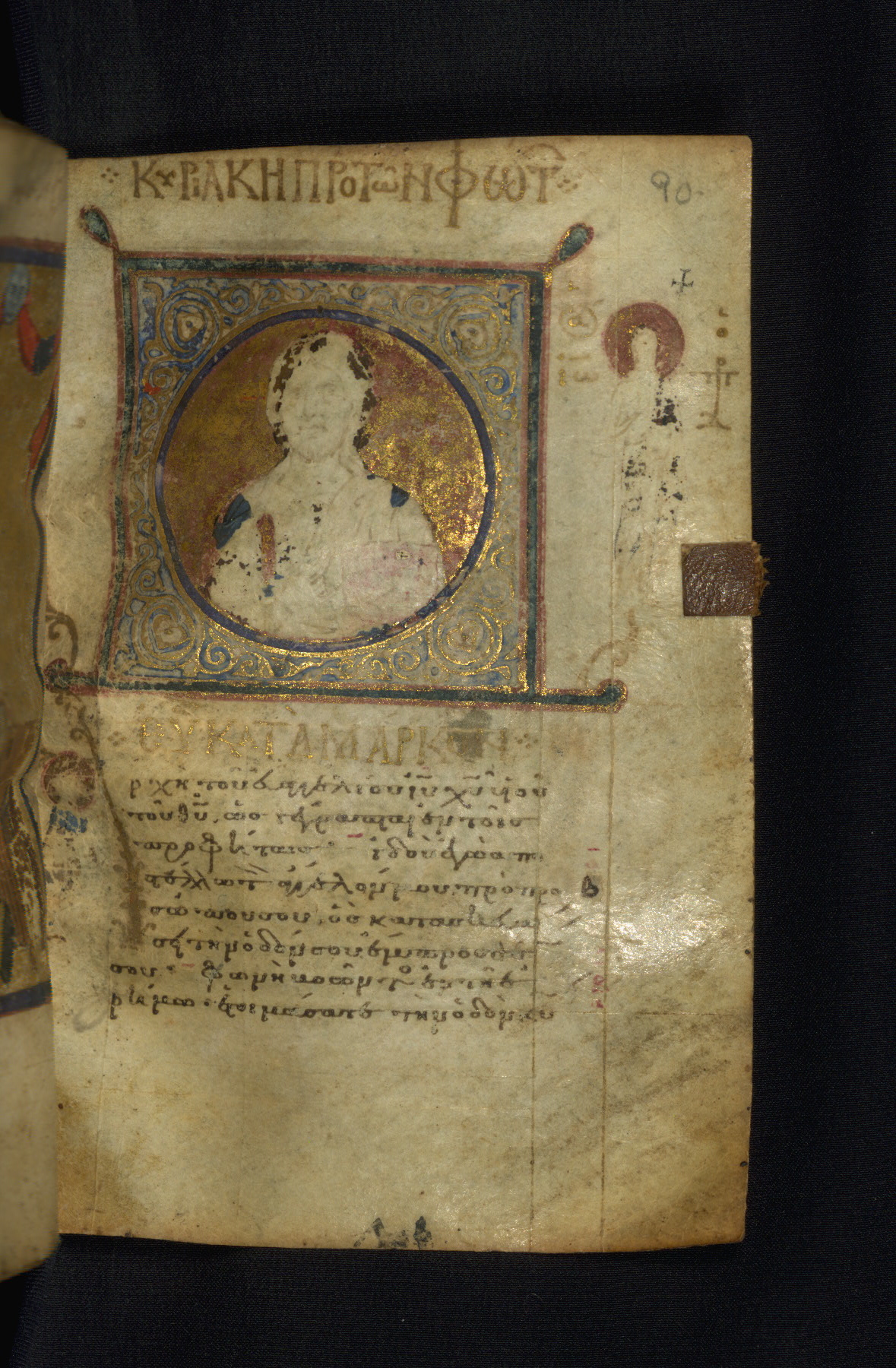
            ● Some minuscules are illustrated.  Minuscule copies of the Gospels may include full-page miniature portraits of each Evangelist before his Gospel begins.  In this context, the term “miniature” does not describe the size of the portrait; a “miniature” is a picture framed in pigment that contains red lead – a pigment called minium. 

             Often each evangelist in these pictures is accompanied by a symbolic representation:  usually for Matthew, it is a man or angel.  For Mark, it is a lion.  For Luke, it is an ox.  And for John, it is an eagle.  The symbolism is based on the visions of the seraphim around God’s throne in the books of Ezekiel and Revelation.

            Also, the initial letter of a book, or in some cases, many of the initial letters at the beginnings of sections of a book, may be artistically stylized.  When an initial is made to resemble an animal, this is called a zoomorphic initial.  In many manuscripts, at the beginning of a book, there is a large ornamental design, called a headpiece, accompanied by the title of the book.

            ● In some minuscules of the Gospels, in addition to the Eusebian Canons and chapter-lists, there are book-introductions, or summaries.  Sometimes there are lists of rare words.  In some copies of Acts, there is an itinerary of the journeys of Paul.  And sometimes, at the end of the book, there is a scribal note, or colophon, which might include information about when and where it was copied. 

           Regarding all other witnesses to the Greek New Testament:  we will hopefully look into them in future lectures.  Representatives of the Greek text of the New Testament tend to take center stage, because everything else does not contain the text that is being reconstructed.  But other witnesses are extremely important when it comes to tracking specific readings and building a history of separate forms of the text.              For example, when you see a rare reading in a Coptic manuscript from Egypt, and it also shows up in a Latin manuscript that was made in Ireland, it raises a question about how the text in these two geographically separated places is connected.  And if you see that the same reading in the same passage was quoted and interpreted by two early writers in two different locations, you can thus observe that the reading was widely distributed – and sometimes this evidence is earlier than any extant evidence from continuous-text Greek manuscripts.

             To learn more about early papyrus manuscripts and parchment manuscripts and how they were made, download Sitterly’s 1898 book Praxis in Manuscripts of the Greek Testament, and read chapters 1, 2, and 3.

            Also, watch the video, 8 minutes and 44 seconds long, that you can find at YouTube by searching there for “Beloved Essences How To Make Papyrus” –

            And another video, 3 minutes and 42 seconds long, that you can find at YouTube by searching there for “Texas Film Studio How To Make Papyrus.”

            And, watch the video about how to make parchment at Mike Rowe’s Dirty Jobs series, Season 4, Episode 26, which is also accessible at YouTube, beginning in the 20th minute of the video.

            And, watch the video about how paper was made in the late Middle Ages at YouTube; search there for a video 15 minutes and 18 seconds long, called “Papermaking by Hand at Hayle Mill.”

           Also, if you can acquire Larry Stone’s book The Story of the Bible, do so, and read chapters 1 and 3, and be sure to look inside the pouches. 


Sunday, October 1, 2017

Mark 1:2 - In Isaiah, or In the Prophets?


[Note:  Readers are encouraged to explore the embedded links in this four-part essay, many of which lead to digital images of Mark 1:2 in manuscripts.]

Part 1:  Reviewing the Greek Manuscript Evidence

            Did Mark 1:2 originally say “in the prophets” (ἐν τοῖς προφήταις) or “in Isaiah the prophet” (ἐν τῷ Ἠσαίᾳ τῷ προφήτῃ)?  As we embark on a multi-part exploration of this question, let’s thoroughly describe the external evidence, beginning with the manuscript-evidence for each rival variant: 

● ἐν τοῖς προφήταις, according to the UBS apparatus, is supported by Codex Alexandrinus (A, 02), Codex Washingtoniensis (W, 032), f13, 28, 180, 579, 597, 1006, 1010, 1292, 1342, 1424, 1505, and Byz.
            “Byz” represents not only hundreds of Greek Gospels-manuscripts that are less than 900 years old, but also the following manuscripts: 

            Codex Basiliensis (E, 07), Codex Boreelianus (F, 09), Codex Seidelianus II (H, 013), Codex Cyprius (K, 017), Codex Campianus (M, 021, which has “Isaiah” in the margin), Codex Guelferbytanus A (Pe, 024), Codex Vaticanus 354 (S, 028), Codex Nanianus (U, 030), Codex Mosquensis II (V, 031), Codex Monacensis (X, 033), Codex Macedonianus (Y, 034), Codex Petropolitanus (Π, 041), Codex Rossanensis (Σ, 042, from the 500’s), Codex Beratinus (Φ, 043), Codex Athous Dionysiou (Ω, 045), 047, 0133, and minuscules 24, 27, 29, 34, 67, 100, 106, 123, 134, 135, 144, 150, 161, 175, 259, 262, 274, 299, 300, 338, 344, 348, 364, 371, 376, 399, 405, 411, 420, 422, 478, 481, 564, 566 (paired with Λ, 039), 568, 652, 669, 771, 773, 785, 875, 942, 1055, 1073, 1076, 1077, 1078, 1079, 1080, 1110, 1120, 1172, 1187, 1203, 1223, 1225, 1266, 1281, 1346, 1347, 1357, 1379, 1392, 1422, 1426, 1444, 1458, 1507, 1662, 1663, 1701, 1816, 2142, 2172, 2193, 2290, 2324, 2368, 2369, 2370, 2373, 2414, 2474, 2509, 2545, 2722, 2790, 2800, 2811, 2812, 2854, 2907, and 2929.  


● ἐν τῷ Ἠσαίᾳ τῷ προφήτῃ is supported by Oxyrhynchus Papyri LXXVI 5073, Codex Sinaiticus (01, Aleph (À), Codex Vaticanus (B, 03), Codex Regius (L, 019, “Isaiah” is spelled Ϊσαϊα), Codex Sangellensis (Δ, 037, Greek-Latin), 33, 151, 892, 1241, about 10 other minuscules, and the D’Hendecourt Scroll (from the 1300’s).  (Minuscule 151’s retention of this reading may have something to do with the inclusion of Eusebius’ apologetical composition Ad Marinum in the same volume.)

● ἐν Ἠσαίᾳ τῷ προφήτῃ is supported by Codex Bezae (D, 05, Greek-Latin), Codex Koridethi (Θ, 038), the core members of f1, 565, and 205 (from the mid-1400’s), plus 700, 1243, and 1071.  (Only these last three lack close affiliation with either the Western or Caesarean Text.)  A few other minuscules support ἐν Ἠσαίᾳ τῷ προφήτῃ but were not listed in the UBS apparatus; these include 22.  Minuscule 22 shares some readings with f1 and 205, and also shares a note about the ending of Mark; in 22 the note is shorter (failing to claim that the Eusebian Canons omit Mk. 16:9-20, very probably because where and where 22 was made, the Canons had been adjusted to include those verses) but it is recognizably the same note. (Minuscules 15, 22, 1110, 1192, and 1210 all have the note about Mark 16:9-20.)  Also included:  61 (Codex Montfortianus, on 55r; this manuscript is famous for its inclusion of the Comma Johanneum), 372 (assigned to the 1500’s, with some Latin notes in the margins), and 391 (produced in 1055).

● ἐν βίβλω λόγων Ἠσαΐου τοῦ προφήτου is read by 1273 (the George Grey Gospels) and 544 and a similar text is in the book in a full-page picture of Mark in Lectionary 1635.

            For a convenient summary of versional and patristic evidence, see the STEPBible Textual Apparatus and Wieland Willker’s Textual Commentary on the Greek Gospels – Volume 2, Mark, 2015 Edition.  Readers should be aware that 2427 (cited throughout Mark in the 27th edition of the Nestle-Aland Novum Testamentum Graece) has been proven to be a forgery, based on a printed text from the 1800’s, and that although f1 is cited for “in Isaiah the prophet,” this represents only a consensus of its core members.)
            The Armenian version was listed in UBS2 as support for ἐν τοῖς προφήταις, but in UBS4 the Armenian version was listed as support for ἐν Ἠσαίᾳ τῷ προφήτῃ.  The older Armenian manuscripts tend to not have “Son of God” in Mark 1:1, and to read “in Isaiah the prophet” in 1:2 – following the Caesarean form.  However, a competition of influences upon the Armenian tradition began very early in its history, in addition to later influence from the Vulgate. 

            Most of the Greek lectionaries, such as Lect 123 (an illustrated lectionary from the 900’s), Lect 379 (from the 800’s), Lect 1599 (from the 900’s), Lect 71 (from 1066), Lect 183 (from the 800’s or 900’s), and the illustrated Lect 120 (from the 1100’s) support ἐν τοῖς προφήταις, but there are some exceptions, such as Lect 562 (from A.D. 991), which supports ἐν Ἠσαίᾳ τῷ προφήτῃ.
           
● One more variant seems to be attested by the Old Latin Codex Usserianus Primus (VL 14); the Byzantine and Alexandrian readings are combined, so as to read, “in Isaiah and in the prophets.”  However the text is difficult to read due to damage to the parchment (See fol. 150r at the page-views at the Trinity College Dublin website .)

            In this essay, the reading “in the prophets” will be defended as original, and I will argue that its Alexandrian and Western rivals originated in the following way:
            In the 100’s, some copyists were mildly averse to non-specific references to Old Testament books, and added specific names in place of the original non-specific references.  Mark 1:2 is one of the passages affected by this tendency toward specificity.  Some copyists, understanding the paraphrastic opening phrase – which could be understood as a reference to Exodus 23:20 (in the Law, rather than the Prophets) – as merely an introduction to Isaiah’s words, adjusted the text so as to identify the prophet being cited. 
           
            This happened independently in Alexandrian and Western transmission-streams, which is why the Alexandrian witnesses consistently have τῷ before Ἠσαίᾳ, while the major Western and Caesarean witnesses do not.  When (and where) copyists and commentators were confident that Mark was using Malachi rather than Exodus, Christian scholars whose manuscripts read “in Isaiah the prophet” developed inventive explanations about how Mark could appear to identify Malachi’s words as if they had been written by Isaiah.  These explanations were sufficiently convincing to allow the reading to remain in the Alexandrian and Western transmission-lines. 

            The insertion of specific names, where the original text has no specific name, is a recurring scribal practice, and one which is observable in some of our very earliest New Testament manuscripts.  For example, in the early Alexandrian transmission-stream, in Luke 16:19, in the story about the rich man and Lazarus, the rich man was given a name:  he was named Nineveh.  This reading is found in Luke 16:19 in Sahidic copies, and in the manuscript known as Codex Sinaiticus Arabicus, or CSA, one of the documents discovered at St. Catherine’s Monastery in 1975.  (A collation of CSA by Hikmat Kachouh was released in 2008 in the journal Novum Testamentum.)  But there is much earlier evidence for that reading.  Papyrus 75 reads named Neuhs in the same passage (ονοματι νευης), and this is the same name, Nineveh, disfigured by a parableptic error in which the copyist skipped the first syllable.  (Two Greek manuscripts, minuscules 36 and 37, have margin-notes which also identify the rich man as Nineveh.)
            When a character in the Gospels plays a prominent role, but has no name, frequently a name is provided.  Bruce Metzger documented this phenomenon in his essay, Names for the Nameless in the New Testament, which serves as chapter 2 of New Testament Studies:  Philological, Versional, and Patristic. 
            The scribal tendency to provide names for unnamed individuals comes into play repeatedly in passages where the text refers to the fulfillment of prophecies.  The non-specific attribution “through the prophet” is often turned into a specific attribution.  Usually the attribution is correct, but sometimes it is incorrect.
            The Old Latin Codex Colbertinus (VL 6) displays this tendency.  Its text of Mark 15:27 provides names for the two robbers who were crucified with Jesus – Zoathan and Chammatha.  VL 6, like practically all Latin manuscripts of Mark, also reads “in Isaiah the prophet” in Mark 1:2.  In Matthew 1:22 – where Matthew quoted Isaiah without naming him (simply saying that “what was spoken by the Lord through the prophet” was fulfilled) –  Codex Colbertinus states specifically that the prophecy was given by Isaiah.
            This phenomenon is not limited to one medieval Old Latin copy.  Codex Bezae, which D. C. Parker has assigned to c. 400, also includes Isaiah’s name in the text of Matthew 1:22, both in its Latin text and in its corresponding Greek text.  Old Latin Codex Veronensis (VL 4, from the 400’s) also has Isaiah’s name in Matthew 1:22.  So do the Old Latin codices Brixianus (VL 10, from the 500’s) and Sangermanensis (VL 7, c. 810) and Vercellensis (VL 3, probably from the 370’s).  (Metzger expressed some uncertainty about Codex Vercellensis’ reading in his Textual Commentary, but “ESEIAM PROPHETAM” is shown clearly in Irici’s 1748 presentation of Codex Vercellensis.)  “Isaiah” is practically the normal Old Latin reading in Matthew 1:22. 
            The earliest evidence for the reading “in Isaiah the prophet” in Matthew 1:22, however, may be even earlier than the earliest Old Latin manuscript:  in the Latin text of Irenaeus’ Against Heresies 3:21:4 (composed in Greek c. 184), Irenaeus quotes Matthew 1:22:  “et quoniam Angelus in somnis dixit ad Joseph:  Hoc autem factum est, ut adimpleretur quod dictum est ab Esaia Propheta:  Ecce virgo it utero concipiet.”  It is possible that the form of this quotation was altered by the Latin translator of Irenaeus’ work, but that too would be early testimony.  
            In the Syriac tradition, the same scribal tendency is on display.  In Matthew 1:22, the inclusion of the name “Isaiah” is attested by the Sinaitic Syriac, the Curetonian Syriac, the Harklean Syriac, and the Palestinian Aramaic.
            Another Western witness that displays the tendency to fill the vacuum when a prophet’s statements are cited without specifying his name is the Middle Egyptian Glazier Codex of Acts (G67, from the 400’s).  Instead of “in the prophets” in Acts 13:30, G67 reads, “in Habakkuk the prophet.”
           
            The scribal tendency toward specificity is also displayed by the core members of family-1.  Although these manuscripts are medieval, they are generally thought to represent a text of the Gospels similar to a text used by Origen at Caesarea in the 200’s; this is indicated by their support for the reading “Jesus Barabbas” in Matthew 27:17; according to a Latin translation of Origen’s Commentary on Matthew, Origen stated that some of his copies had this reading.
            The text of f1 indicates that copyists of the manuscripts used by Origen were not exempt from the tendency toward specificity, and that occasionally the scribal attempt to make the text more specific was poorly executed.  In Matthew 13:35, where most manuscripts simply read “by the prophet,” without naming the prophet being quoted, the text in f1 includes a specific name:  Isaiah. 
            That is not a correct reference; Matthew’s quotation clearly comes from Psalm 78:2, which was composed by Asaph, not by Isaiah.  Yet an early copyist’s need for specificity was greater than his grasp of the contents of the Old Testament, and the name “Isaiah” was perpetuated in various manuscripts, including minuscules 1, 543, 788, 230, 983, and 1582 (and some others), and Codex Θ. 
            Eusebius of Caesarea, in his Commentary on the Psalms, mentioned that some copies read “in Isaiah the prophet” in Matthew 13:35, but not the accurate copies. 
            Jerome, in his Homily 11 on Psalm 77 (our Psalm 78), cited Matthew 13:35 and claimed that the reading “through the prophet Asaph” is supported by “all the ancient copies” – “in omnibus ueteribus codicibus” – but it was changed by ignorant individuals (see Amy Donaldson’s Explicit References to New Testament Variant Readings Among Greek and Latin Church Fathers, Vol. 2, pages 369-370).  In addition, Jerome wrote that Porphyry (an anti-Christian author who wrote c. 270) made an accusation against Matthew that can only be accounted for by Porphyry’s use of a copy of Matthew with the reading “in Isaiah the prophet” in Matthew 13:35:
            “Porphyry, that unbeliever . . . says, ‘Your evangelist, Matthew, was so ignorant that he said, “What is written in Isaiah the prophet:  I will open my mouth in parables, I will utter mysteries from of old.”’ . . .  Now, just as this was the scribes’ error, it was, likewise, their error to write ‘Isaiah’ instead of ‘Asaph.’” 
            Jerome proceeded to offer a theory that some early copyist, reading “Asaph the prophet” in his exemplar, did not recognize the name “Asaph,” and replaced it with “Isaiah.”  He offered the same line of reasoning in his Commentary on Matthew.  On the premise that Jerome was not being altogether deceptive, it would appear that the text of Matthew 13:35 in copies that he considered ancient had been expanded to include Asaph’s name.  (We shall take a closer look at Jerome’s testimony later.)
            The tendency to make non-specific quotations of Old Testament prophets more specific – via the insertion of a prophet’s proper name rather than “through the prophet” or “by the prophet” – was so strong that copyists in the Western and Caesarean transmission-streams inserted prophets’ names in various passages – and, in the case of Matthew 13:35 in the Caesarean transmission-stream, perpetuated a specific name even when it was the wrong name.   
            The scribal tendency toward specificity was so strong in the Old Latin transmission-line that in Old Latin Codex Vercellensis (VL 3) a copyist felt that it was necessary to identify the prophet being quoted in Matthew 2:5.  Four copies of the Harklean Syriac display the same tendency, but their copyists exercised restraint by only putting Micah’s name in the margin of this passage.  In VL 3 (probably produced in the 370’s), the copyist (or his exemplar’s copyist) embedded the prophet’s name directly into the text – and, making matters worse – the identification is incorrect:  VL3 reads there, “per Eseiam propheta,” that is, “through Isaiah the prophet.”

            What about Alexandrian witnesses?  Yes; although not as heavily as elsewhere, the tendency toward specificity impacted Alexandrian manuscripts too:  “Isaiah the prophet” is the reading of Codex ﬡ at Matthew 13:35.
            In the margin of Matthew 2:15 in Codex Sinaiticus, we see how precarious it would be to assume that copyists knew the Old Testament too well to attribute to Isaiah a passage from a different Old Testament book.  Matthew 2:15 contains a quotation of Hosea 11:1 – “that it might be fulfilled which was spoken by the Lord through the prophet, saying, ‘Out of Egypt I called My Son.’”  Someone did not recognize that the passage being quoted was Hosea 11:1 (because in the Septuagint, Hosea 11:1 reads differently, as “When Israel was a child then I loved him, and called his sons out of Egypt”) and thought instead that Matthew was referring to a passage in Numbers – maybe 15:41 or 20:16 – and for that reason, he wrote in the margin of Codex Sinaiticus, in small vertically stacked lettering, “In Numbers.” 
            However reasonable it might seem to assume that copyists knew the Old Testament so well that they would not have risked giving the impression that they attributed a passage to Isaiah that did not originate with Isaiah, there is evidence against such an assumption.  Not only does the text of VL3 attribute Micah 5:2 to Isaiah in Matthew 2:5, but in Matthew 21:4 (according to Metzger in Textual Commentary, page 54), a few Vulgate copies, Bohairic copies, and Ethiopic copies add Isaiah’s name, although the quotation is from Zechariah. 
            Not all copyists were familiar with the Old Testament text, and for most of those who did know the Old Testament well, the text they knew was the Septuagint. Consequently there was a risk that copyists would imagine that their exemplars contained an error when a Gospels-manuscript contained a form of an Old Testament passage that did not match up with the form in which it was found in the Septuagint. 
            Mark’s use of Malachi 3:1 is one such case.  His utilization of Malachi 3:1 closes with the phrase, “who shall prepare your way” (ὃς κατασκευάσει τὴν ὁδόν σου) in the Alexandrian text, or, in the Byzantine Text, “who shall prepare your way before you” (ὃς κατασκευάσει τὴν ὁδόν σου ἔμπροσθέν σου).  Neither is an exact match with the text of Malachi 3:1 in the Septuagint, which ends with the phrase “καὶ ἐπιβλέψεται ὁδόν πρὸ προσώπου μου” – “and he shall carefully look for a way before me.”  (See Maurice Robinson’s article Two Passages in Mark in Faith & Mission, 13/2 (Spring 1996), pp. 66-111.)  An additional factor to consider is that the Septuagint’s text of Exodus 23:20a reads Καὶ ἰδοὺ ἐγὼ ἀποστέλλω τὸν ἄγγελόν μου πρὸ προσώπου σου – “And behold, I send my messenger before your face” – which might have caused some copyists to wonder if the readers of their copies would suppose that Mark was using a passage in the Law, rather than in the Prophets.    
            So if anyone wonders, “If the reading ‘in Isaiah the prophet’ in Mark 1:2 is not original, where did it originate?”, let the copyists of ﬡ, D, Θ, the Old Latin copies, and the main manuscripts of f1 reply:  from the same place that their readings “in Isaiah the prophet” in Matthew 1:22, Matthew 2:5, and Matthew 13:35 originated:  from the propensity of some early scribes to make non-specific references more specific.
            A faint echo of the kind of scribal confusion that led to the insertion of Isaiah’s name in Mark 1:2 (or an independent repetition of it) may be seen in two medieval Bohairic manuscripts.  Boh-E1 (a Coptic-Arabic manuscript produced in 1208), has the Bohairic words for “Exodus” and for “Malachi” in the margin near Mark 1:2.  An Arabic note says, “A copy has, ‘the prophets.’”  Boh-O1 (a Coptic manuscript produced in the 1300’s) has an Arabic note that says, “Isaiah prophesied with the voice of one crying, and Moses and Malachi prophesied with the sending of the messenger.”  The notes in both copies show that to some copyists, Mark 1:2 was understood to refer not just to the Prophets, but to a passage in Exodus.


To be continued in Part Two:  Mark 1:2, Origen, and Jerome