Followers

Thursday, March 31, 2022

News: Peiresc's Lost Cargo: Recovered!

 
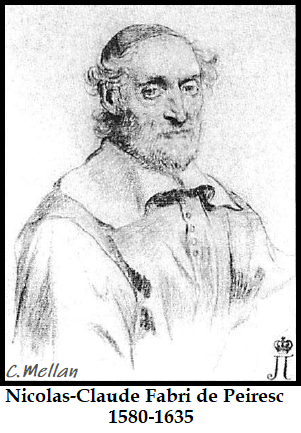
        April 20, 1629 was not a good day for the French polymath and research-sponsor Nicholas-Claude Fabri de Peiresc.  His merchant ship Ambassadrice – a type of small ship known as a polacca – returning from Egypt and carrying miscellaneous antiquities which Pieresc’s agents had obtained there, had inconveniently sunk near Marsamuscetto Harbor in Malta on its return voyage to Marseille, after incurring heavy damage in a storm.  

         Peiresc’s agents, Théophile Minuti and Jacque-Auguste de Thou, wrote to Peiresc that they had managed to recover some items from the shipwreck, including a small box which held an assortment of small relics, coins, and medals, and a vellum codex (which turned out to be a Coptic lectionary) that had survived fairly intact, thanks to the several layers of envelopes in which it had been packaged.  But these were merely souvenirs compared to the other valuable Egyptian antiquities that the ship had been carrying. 

          The disaster of the sinking of the Ambassadrice was greatly regretted at the time – but soon forgotten.  It was not until recently that interest in excavating the remains of the Ambassadrice gained momentum, when Barry  Clifford – the American responsible for the recovery of the wreck of the pirate ship Whydah – was recruited by the government of Malta to explore the wreckage of the Ambassadrice.  What Clifford’s diving expedition found is unique in the history of marine salvage:  inside the remains of several trunks, still sitting on the hull of the wreck, were six large slabs of spermaceti wax (so called because it is extracted from sperm whales).  Apparently someone in Peiresc’s agents’ employ had prepared his materials within the wax as a safeguard against just the thing that had befallen the Ambassadrice. 

          When specialists in the salvage operation carefully heated and removed the wax, they found several items were embedded within, including the manuscripts that Peiresc’s agents had obtained in Egypt 400 years ago.  They are:

           Eight Coptic texts of the Gospels, two of which are in jeweled bindings

          An early Greek-Bohairic lectionary, prefaced by a glossary of rare Bohairic words.

          A Sefer Torah scroll, 

          A hitherto-unknown composition by Dioscorus (bishop of Alexandria during the Council of Ephesus in the 400s), interspersed with supplemental comments by Balatro Aibreán.

           A hitherto-unknown composition by Peter Mongus of Alexandria (late 400s), with many Scripture-citations, and

          An incomplete parchment copy of Breviarium by Liberatus of Carthage (500s). 

    The sixth slab contained four ornate ivory diptychs, with the hinges removed, all carved with scenes from the life of St. Anthony.  With them were numerous Egyptian and North African coins from different eras, a silver aspergillum, a gold and silver buckle inlaid with lapis lazuli, and several amulets and rings.

          The texts recovered from the Ambassadrice are scheduled to be published soon in a yet-untitled open-access book from Brill Academic Publishers, and the other items will be the subject of a series of forthcoming articles in Biblische Zeitschrift.  In addition to an undisclosed payment for his supervision of the underwater salvage operation, Barry Clifford was awarded the Medal for Service to the Republic of Malta.   Addition information about the salvage of the Ambassadrice can be found in Maltese news-articles here and here


Happy April Fools Day 2022!

.


Friday, March 25, 2022

John 6:15 - An Interesting Little Detail

           Near the end of John 6:15 – following John’s account of the feeding of the 5,000 – there is an interesting variant-unit:  did John write that Jesus withdrew again (ἀνεχώρησεν πάλιν) to the mountain by himself, or that Jesus withdrew (ἀνεχώρησεν) (without “again”) to the mountain by himself, or that Jesus “fled again” φεύγει πάλιν) to the mountain by himself?

          John does not use ἀνεχώρησεν anywhere else, so perhaps there is something to be said in favor of φεύγει:  the idea is that copyists changed the wording of Jesus’ movement to avoid giving the impression that Jesus was running away like Brave Sir Robin.  On the other hand, John does not use φεύγει anywhere else, either. 

          Constantine von Tischendorf was willing to let Codex Sinaiticus overrule all other Greek manuscripts in existence in John 6:15, in his eighth edition of the Greek New Testament.  Scholars less entranced with À have not concurred, arguing (as Metzger reports in his Textual Commentary) that φεύγει originated as a Western reading.  It had to be introduced as a sort of paraphrase fairly early, inasmuch as it is supported by Tertullian, De Rebaptismate, Ambrose, Jerome (who placed fugit in the Vulgate, agreeing with several Old Latin copies) and Augustine.  (Tertullian’s reference is not airtight, however:  in On Idolatry XVIII, he simply says that Christ “shrank back from being made a king,” without explicitly quoting John 6:15.)     

          Ἀνεχώρησεν is read in all text-types:  Alexandrian (P75, B, L), Western (D), Byzantine (A, K, Λ, Π, N) and Caesarean (f1).   But did John write only ἀνεχώρησεν or ἀνεχώρησεν πάλιν?  Manuscripts without πάλιν here include W, Δ, Ψ, and most Byzantine copies.  The Peshitta, likewise, does not support πάλιν.  The word could perhaps have been skipped accidentally, if a copyist’s line of sight slid from the ν at the end of ἀνεχώρησεν to the ν at the end of πάλιν.  Or, having just read John 6:3’s account of Jesus going up into the mountain, early copyists couldn’t resist harmlessly adding πάλιν – but one would have to believe this happened at least twice for πάλιν to drift into A, D, Π, N, and Y.    

          The Curetonian Syriac, interestingly, supports a conflate reading:  fled and withdrew again.  

          Readers of the Nestle-Aland Novum Testamentum Graece compilation would never detect that the reading found in the Byzantine Text, W, and the Peshitta exists:  the N-A apparatus mentions the reading in À but not the reading of most manuscripts – an omission that is difficult to explain except as an effect of the editors’ pro-Alexandrian bias.  The UBS apparatus doesn’t mention the non-inclusion of πάλιν either; nor does they Tyndale House GNT’s apparatus.    

          The non-original reading φεύγει is more interesting than it looks – not only because it was temporarily favored by a leading textual critic in the 1800s, but because it reveals that retro-translation sporadically affected the Greek text in the exemplar of the opening chapters of John in Sinaiticus – the same sort of Western phenomenon that has unfortunately affected the NIV 2011’s base-text of Mark 1:41.


Monday, March 7, 2022

The Gangster's Bible: Lectionary 1599

           At the University of Chicago, among the manuscripts that form the Goodspeed Manuscript Collection,  is a medieval lectionary called the Argos Lectionary – named after the ancient city of Argos, in Greece.  Its is also known as Lectionary 1599, or, in the catalog of the collection, MS 128.  But another name is often given to it:  “The Gangster’s Bible.”

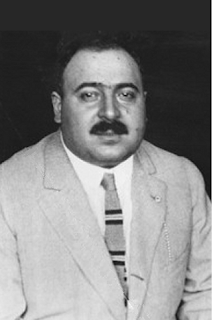
Vincenzo Colosimo
         The story of this moniker begins, as Michael Hirsley reported in the Chicago Tribune in 1993, when, following Edgar Goodspeed’s acquisition of  GA 2400 (an extensively illustrated New Testament made around the 1100s), a student of Goodspeed showed him the Argos Lectionary.  Goodspeed wanted to find out more about it, and this led to a meeting between Goodspeed and one of the owners of Colosimo’s restaurant in Chicago – named after Vincenzo “Diamond Jim” Colosimo, who had been killed – some reports said the killer was John Torrio; others say it was Al Capone – on May 11, 1920. 

          Apparently some of the mobsters in Chicago had a special use for the Argos Lectionary:  it was used as the book on which gang-members took oaths (possibly similar to the oaths described by Michael Franzese).   

          Eventually, with the involvement of Harold R. Willoughby, the University of Chicago purchased the Argos Lectionary from its owner on very agreeable terms, and it took its place in the Goodspeed Manuscript Collection, where it is to this day. 


         Lectionary 1599 was made in the 800s or 900s, and its text is written in two columns per page measuring approximately 29 x 22 cm.   It has endured significant damage, but plenty of pages have survived which contain text from the Gospels.  Its text, like most lectionaries, is essentially Byzantine.  A few textual features may be mentioned:

Image 122:  Luke 22:4 includes και γραμματευσιν, similar to the reading in C, N, P, 157, 700.  

Image 190:  Mark 15:28 is not in the text.

Image 228:  In Matthew 27:55, εκει appears after γυναικες.

Images 134, 135, & 136:  John 13:3-17 follows the end of Matthew 28, and is followed by text from Matthew 26:21.  (This liturgical arrangement for Maundy Thursday explains why, in GA 225, John 13:3-17 is found after after Matthew 26:20.)

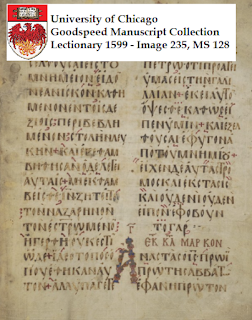
Images 235, 236, & 237 – Mark 16:9-20 is the third of the eleven Heothina readings.

Image 242 – In John 21:1, the incipit-phrase (used to begin the reading, in the lower right-hand column 0f text) includes αὐτοῦ ἐγέρθεις ἐκ νεκρῶν, a reading also found in Γ (036)  f13 1241 and 1424.

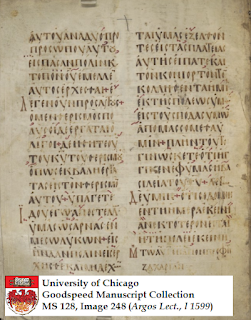
Image 248 – In Luke 10:8-10, near the end of the first column of text, the scribe made a parableptic error when his line of sight drifted from εἰσέρχησθε καὶ in 10:8 to καὶ μὴ δέχωνται in 10:10.  Also, in Luke 10:11, the text of l1599 includes  (“from your feet”).

Image 261 – In a list of feast-days in October, the saints honored on Oct. 7 are listed as Sergius and Bacchus.  The saint honored on October 8 is listed as Saint Pelagia.  This implies that John 8:3-11 was initially included in the lectionary, before it was damaged.   This arrangement also explains why the story of the adulteress is found in family 13 in Luke 21, shortly after where the reading for Saints Sergius and Bacchus (Luke 21:12-19) is located.  This kind of textual transplant was simply for the convenience of the lector.


Friday, February 18, 2022

The EOB New Testament: Best English Translation Ever

             I am pleased to present and review a relatively new English New Testament:  the Eastern/Greek Orthodox New Testament, also known as the New Testament portion of the Eastern Orthodox Bible (abbreviated from here on as “EOB-NT”), which was initially published in 2013.

Laurent
Cleenewerck

         “The EOB New Testament,” says its online presentation at Amazon, “is a new translation of the official Greek Orthodox text called the Patriarchal Text of 1904.”  It goes on to say that the EOB-NT is “a fresh and accessible translation created within the Orthodox community.”   Its editor is identified as Laurent Cleenewerck.  Presbyter Cleenewerck currently serves as the rector of Saint Innocent Orthodox Christian Church in Eureka, CA.

            New English translations are not uncommon nowadays:  the past 50 years have seen the premiere of the NIV 1984 (now discontinued), NASB (updated in 1995), ESV (updated in 2016), HCSB, CSB (2017), CEB, CEV, NLT, TNIV (now discontinued), NIV 2011, NRSVue, and so forth.  Meanwhile, many advocates of the KJV have resisted these translations, arguing (among other things) that they either omit a significant number of verses and phrases, or relegate them to the footnotes.

            The EOB New Testament poses a challenge to such objections.  In its extensive introduction (p. viii),  one finds a statement that the purpose of its Greek base-text “is not to offer an always speculative reconstruction of the original autographs but to provide a uniform ecclesiastical text which is a reliable and accurate witness to the truth of the Christian faith.”

            Because it is based on the 1904 Patriarchal Text, the EOB-NT includes all these verses and phrases (with footnotes mentioning the reading of the CT – Critical Text – in each case):  Matthew 6:13b, Matthew 12:47, Matthew 13:14 “spoken of by Daniel the prophet,” Matthew 16:2b-3, Matthew 17:21, Matthew 18:11, Matthew 20:16b, Matthew 23:14 (as 23:13), Mark 6:11b, Mark 7:16, Mark 9:29 “and fasting,” Mark 9:44, Mark 9:46, Mark 11:26, Mark 14:24 “new,” Mark 15:28, Mark 16:9-20, Luke 4:8, Luke 9:55-56, Luke 11:2b, Luke 11:4b, Luke 17:36, Luke 22:43-44, Luke 23:17, Luke 23:34a, Luke 24:12, Luke 24:40, Luke 24:42b, Luke 24:51b, John 3:13, “who is in heaven,” John 5:3-4, John 7:53-8:11, Acts 8:37, Acts 9:5-6, Acts 13:42, Acts 15:34, Acts 23:9b, Acts 24:6-8, Acts 28:29, Romans 1:16, “of Christ,” Romans 16:24, and First John 5:7-8.

            Although the EOB-NT contains the Johannine Comma in First John, its footnote states explicitly that this reading is supported by “a few recent Greek manuscripts,” and that “This passage is undoubtedly an interpolation or later theological comment seemingly of Spanish-Latin origin.”

            Unlike the NKJV and MEV, the EOB-NT rejects many of the readings in the Textus Receptus (and KJV) which are not supported by the Byzantine Text.  It is similar to the World English Bible (which makes sense considering that, as its introduction says, the EOB-NT “began as a revision of the WEB”).  Here are some examples of readings in the Gospel of Matthew in the EOB-NT that are different from the KJV due to different readings in their base-texts:

            3:8 – “fruit” (notfruits”)

            5:47 – “friends (not “brethren)

            7:2 – does not have “again”

            8:15 – “him” (not “them”)

            9:36 – “weary” (notfainted”)

            12:35 – does not have “of the heart”

            18:19 – “Again, amen” (not just “Again”)

            18:29 – does not have “all”

            20:22 – “or” (not “and”)

            20:26 – “shall be (not “let him be”)

            21:1 – “Bethsphage” (not “Bethphage”)

            26:26 – gave thanks for it” (not “blessed it”)

            27:35 – does not have “that it might be fulfilled which was spoken by the prophet, They parted my garments among them, and upon my vesture did they cast lots”

            27:41 – includes “and the Pharisees”


            The influence of a better and broader array of evidence manifests itself in many other passages.  Some samples: 

          ● Luke 7:31 does not begin with “And the Lord said,”

          ● John 1:28 refers to Bethany (not Bethabara),

          ● Acts 9:5 does not include “It is hard for thee to kick against the pricks,”

          ● Acts 9:6 does not include “And he trembling and astonished said, ‘Lord, what wilt thou have me to do?’ And the Lord said unto him,”

          ● Ephesians 3:9 reads “dispensation,”

          ● Philippians 4:3 begins with “Yes” (not “And”)

          ● Colossians 1:6 includes “and growing,”

          ● Colossians 1:14 does not include “through his blood,”

          ● James 4:12 includes “and judge,”

          ● First Peter 2:2 includes “in salvation.”

          ● Jude verse 4 refers to “our only Master and Lord Jesus Christ,”

          ● Revelation 6:12 refers to the “whole moon,”

          ● Revelation 8:13 refers to “an eagle,” and

          ● Revelation 22:20 refers to the “tree of life” (not “book of life” as in the KJV).

            At all these points (and many more) the EOB-NT’s base-text has preserved the original text better than the Textus Receptus.

            To illustrate the EOB-NT's translation-technique, here are three sample extracts from the EOB-NT:

            JOHN 1:12:  “But as many as received him, to them he gave the ability to become God’s children, to those who believe in his Name.”

            FIRST TIMOTHY 3:2:  “The overseer must be irreproachable, a husband of one wife, self-controlled, sensible, modest, hospitable and a good teacher.”

            TITUS 3:4-5:  “But when the kindness of God our Savior and his love toward mankind appeared (not by works of righteousness which we did ourselves, but according to his mercy), he saved us through the washing of regeneration and renewing of the Holy Spirit.”

            The translation-technique of the EOB-NT comes very close to Bruce Metzger’s ideal of “as literal as possible, as free as necessary.”  Monetary terms and ancient measurement-units are not converted into their modern equivalents; instead, footnotes explain the ancient terms via modern counterparts.  The most unusual rendering is perhaps found in Philippians 4:3, where the Greek word that is often rendered “yokefellow” or “fellow-worker” is rendered in the EOB-NT as a proper name, Syzygus – with a footnote conveying that this rendering is not airtight.    

            Extensive quotations from the Old Testament are italicized.

            Instead of resorting to headings that interrupt the text, all of the EOB-NT’s headings are in the side-margin, in italicized red print.

            The myriad footnotes in the EOB-NT mention very many textual variants in the Textus Receptus, the Majority Text, and the Critical Text – far more than the footnotes in the ESV and NIV and CSB – almost enough to give 100% validation to the introduction’s claim that “All significant variants between PT/MT/TR and CT have been studied and footnoted to provide variant readings.”  Even some of Codex Bezae’s very unusual readings have found a home in the EOB-NT’s footnotes, such as at Matthew 20:28, Luke 22:19, 24:3, etc. – but not in the book of Acts.

            Many footnotes point out passages where a New Testament author’s citation of an Old Testament passage agrees with the Septuagint.   Most of the footnotes are brief, but some come close to commentary-summarizations; for instance, the footnotes for John 1:1-2, John 8:58, and Second Thessalonians 2:7 seem too prolix.

            Footnote-readers will encounter occasional Greek words.  And, unlike the writers of the footnotes in other English New Testaments, the EOB-NT’s footnote-writer was not afraid to mention patristic writers such as Irenaeus, Clement, Hippolytus, Origen, Epiphanius, Jerome, Basil, Hilary, Gregory of Nyssa, Cyril of Alexandria, and Theodoret.  It is highly recommended that readers carefully absorb the Introduction to the EOB-NT and the prefatory Abbreviations and Codes (which identifies, among other things, the abbreviations for several English translations and 21 witnesses (mainly Greek manuscripts).  However, that will not help the typical American reader to whom patristic authors are, sadly, a complete mystery.  Such readers will just have to learn!                   

        I suspect that the EOB-NT embodies the kind of revision of the traditional New Testament text that John Burgon wished for in the late 1800s – avoiding the Egypt-centric compilation that is currently presented as the text of “reasonable eclecticism” (in real life, it is 99% Alexandrian), and which is the basis of the New Testament in the ESV, NIV, CSB, NASB, NRSV, and NLT.  The EOB-NT stands apart from these versions and is superior to them all.

            This is not to say that the EOB-NT is flawless.  Some of the readings in its base-text are not original.  For instance, Matthew 25:13 in the EOB-NT concludes with “that the Son of Man is coming,” which surely originated in the Byzantine Text for the purpose of wrapping up a lection.  But as far as I can tell, these accretions are, one and all, quite benign, and they tend to clarify the meaning of the passage in which they occur, just as the NIV routinely inserts a proper name where there is no proper name in its base-text.
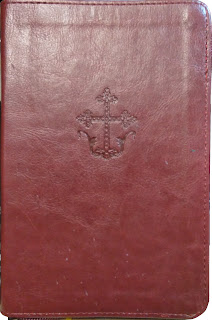
         I have only physically met the EOB-NT in the form of its Portable Edition, which was published by New Rome Press in 2019 (and can be purchased for $40 at their website).  The features of the EOB-NT Portable Edition are notable: 

            Its burgundy leather cover has two ribbons, yellow and red.  A zipper protects the pages (but also prevents them from laying flat).  The print is small; some readers may need a magnifying-glass.  There are two columns of text on each page.

            The text is formatted into logical paragraphs.

            An unfortunate formatting-error has survived in Matthew 27:31:  the words “Simon of Cyrene–The way to Golgotha– The crucifixion of the Lord” were intended to be in the margin in red print, but somehow they have been presented as if they are part of the text.  (Hopefully this will be remedied in future editions.)

            As one handles the EOB-NT Portable Edition, one may feel as if a New Testament manuscript is being held.  Each Gospel is preceded by a full-page illustration, and illustrations – more like icons – also appear before First Corinthians, and after Revelation.   Each book of the New Testament, large or small, is introduced with an artistic, uncomplicated red headpiece, and the book-title in artistic red lettering. Chapter-numbers and superscripted verse-numbers are red.  Footnote-numbers, in black, are also superscripted.

            The text is supplemented by useful colorful maps that deserve special mention.  They depict the Roman Empire, Jesus’ Ministry in Galilee, Jesus’ Journeys to Jerusalem, The Jewish Diaspora at Pentecost, Paul’s Early Travels, Paul’s Third Missionary Journey, Paul’s Trip to Rome, The Ministry of Peter and Philip, the Spread of Christianity During the 1st and 2nd Centuries A.D., and Early Christian Communities, followed by an icon of the Harrowing of Hell with Romans 8:31-34.  

            More information about the EOB-NT Portable Edition can be found in the video-reviews by Orthodox Review and R. Grant Jones and Biblical Studies and Reviews.


Wednesday, February 9, 2022

Hand to Hand Combat: GA 1690 versus Codex Sinaiticus in John 3:22-36

          Today we present a thrilling skirmish in the arena of John 3:22-26:  Codex Sinaiticus (from the mid-300s) vs. minuscule 1690 (at the National Library of Greece, from the 1200s or 1300s).  Digital page-views of 1690 are at the CSNTM website, and Codex Sinaiticus can be viewed at Codex Sinaiticus.org .    The text of John 3:22-36 in UBS4 (which is the same in UBS5 and NA27 and NA28) shall serve as referee.  The usual rules apply:  nomina sacra contractions shall not be considered variants, and transcriptions shall be noted but not considered variants unless they involve some addition or loss of letters.


John 3:22-36 in GA 1690:

22 – has διέτριβε instead of διέτριβεν (-1)

23 – Ἰωάννης is written as ιω

23 – has σαλημ instead of σαλείμ (+1, -2)

23 – has παρεγένοντο instead of παρεγίνοντο (+1, -1)

24 – Ἰωάννης is written as ιω

25 – has Ἰωάννου written as ιω

26 – has Ἰωάννην written as ιω

26 – has ειπον instead of ειπαν (+1, -1)

26 – has μεμαρτύρεκας instead of μεμαρτύρηκας (+1, -1)

27 – has Ἰωάννης written as ιω

27 – has λαμβάνει instead of λαμβάνειν (-1)

27 – has ουδεν instead of ουδε εν (-1)

28 – does not have μοι (-3)

28 – does not have [οτι] (-3)

29 – has ἐιστηκως instead of ἐστηκως (+1)

30 – has ἐστι instead of ἐστιν (-1)

31 – has ἐστι instead of ἐστιν at the end of the verse (-1)

32 – begins the verse with και (+3)

32 – has ἑώρακε instead of ἑώρακεν (-1)

32 – has ηκουσε instead of ηκουσεν (-1)

33 – has αυτου transposed to follow μαρτυρίαν instead of after λαβων

33 – has ὁ θς after δίδωσιν (+5, expanding the nomen sacrum)

34 – no variants

35 – no variants

36 – has την before ζωήν (+3)

          The text of John 3:22-36 in 1690 is missing 18 original letters and includes 16 original letters, for a total of 34 letters’ worth of corruption.  Now let’s see how the text of À does.

John 3:22-36 in Sinaiticus:

22 – transposes και οι μαθηται αυτου to follow εις την Ιουδαιαν γην 

22 – has κακει instead of και εκει (-2)

23 – has ενγυς instead of εγγυς +1, -1)

23 – has παρεγεινοντο instead of παρεγίνοντο (+1, -1)

24 – does not have ὁ (added by a corrector) (-1)

24 – has δε συν- before ζήτησις (a corector has overdotted and written ουν above the line) (+5)

24 – has μετα ϊουδαιων instead of μετα ιουδαιου (changed by a corrector) (+2, -2)

25 – has ειπον instead of ειπαν (+1, -1)

26 – has ραββει instead of ραββι (+1)

26 – has βαπτιζι instead of βαπτιζει (-1)

27 – has λαβιν instead of λαμβάνειν (-4)

27 – has ουδεν instead of ουδε εν (-1)

28 – has υμις instead of υμεις (-1)

28 – has μαρτυριται instead of μαρτυρειτε (-2, +2)

28 – does not have [οτι] (-3)

29 – has αυτου after ἑστηκως (transposed)

30 – has αυξανιν instead of αυξανειν (-1)

31 – has ο δε ων instead of ὁ ων (+2)

31 – has επι instead of the first εκ (+2, -10

31 – does not have ἑπάνω πάντων ἐστιν (-16)

32 – begins the verse with ον (+2)

32 – has ἑώρακε instead of ἑώρακεν (ν is added above the line) (-1)

32 – has ηκουσε instead of ηκουσεν (ν is added above the line) (-1)

32 – has ουδις instead of ουδεις (-1)

33 – no variants

34 – has απεστιλεν instead of απεστειλεν (-1)

34 – has δίδωσι instead of δίδωσιν (-1)

35 – no variants

36 – does not have δε (-2)

36 – has απιθων instead of απειθων (-1)

36 – has εχει instead of ὄψεται (+4, -6)

36 – transposes μένει to the end of the verse

          The text of John 3:22-36 in  À is missing 61 original letters and includes 23 non-original letters, for a total of 94 letters’ worth of corruption. Wait; 1690 has just 34 letters’ worth of corruption here and À has 94?


         Let’s drop all those itacisms and final-νs and transpositions from consideration, boiling things down a bit, and see how things stand:

1690:

27 – has ουδεν instead of ουδε εν (-1)

28 – does not have μοι (-3)

28 – does not have [οτι] (-3)

32 – begins the verse with και (+3)

33 – has ὁ θς after δίδωσιν (+5, if the nomen sacrum is expanded)

36 – has την before ζωήν (+3)

          With trivialities set aside, the text of John 3:22-36 in 1690 is missing 7 original letters and includes 11 original letters, for a total of 18 letters’ worth of corruption.  Now let’s see how the text of À does:


Sinaiticus’ text of John 3:22-36:

23 – has ενγυς instead of εγγυς +1, -1)

24 – does not have ὁ (added by a corrector) (-1)

24 – has δε συν- before ζήτησις (a corector has overdotted and written ουν above the line) (+5)

24 – has μετα ϊουδαιων instead of μετα ιουδαιου (changed by a corrector) (+2, -2)

27 – has λαβιν instead of λαμβάνειν (-4)

27 – has ουδεν instead of ουδε εν (-1)

28 – does not have [οτι] (-3)

31 – has ο δε ων instead of ὁ ων (+2)

31 – has επι instead of the first εκ (+2, -1)

31 – does not have ἑπάνω πάντων ἐστιν (-16)

32 – begins the verse with ον (+2)

36 – does not have δε (-2)

36 – has εχει instead of ὄψεται (+4, -6)

          With trivialities set aside, the text of John 3:22-36 in À is missing 17 original letters and includes 37 non-original letters, for a total of 54 letters’ worth of corruption. (That's assuming, remember, that the editors of UBS4 got things right here.  That οτι in verse 28, and a couple of other points, look very suspect.)  

          Wait; even with trivial itacisms and final-νs and transpositions set aside, and even with UBS4 (brackets and all!) officiating, the text in 1690 (from the 1200s or 1300s) clobbers the text in À, from the 300s, by a score of 18 letters’ worth of corruption to 54 letters’ worth of corruption?  Yes. 

           1690 appears to be a member of Family Π (“Ka”).  1690 was observed by Michael Bruce Morrill (in A Complete Collation and Analysis of All Greek Manuscripts of John 18) to be in agreement with the Majority Text 96.5% of the time in John 18.  Its text of John 18 is very close to the text of 1627, 1699, 2404, and 2902.  Its text’s resilience in this passage is almost as interesting as its use of ιω as a sacred name within the text.   


[Readers are welcome to check the accuracy of this post.]


Wednesday, February 2, 2022

Family Π in John 7:39

            In the middle of John 7:39, there are two significant units of textual variation, both of which impact translation.  Jesus’ statement here is translated as follows in nine English versions:

            “for the Holy Ghost was not yet given.” – King James Version

            “for the Holy Spirit was not yet given.” – New King James Version – with a footnote:  “NU omits Holy.”

            “For the Holy Spirit was not yet given.” – World English Bible (digital edition)

            “For the Holy Spirit had not yet come.” – Evangelical Heritage Version – with a  footnote:  “Some witnesses to the text omit Holy.

            “for the Spirit had not yet been given.” – Christian Standard Version – with two  footnotes:  “Other mss read Holy Spirit” and “Lit the Spirit was not yet.”

            “for as yet the Spirit had not been given.” – English Standard Version

            “for the Spirit was not yet given.” – New American Standard Version

            “Up to that time the Spirit had not been given.” – New International Version

            But the Spirit had not yet been given.” – New Living Translation – with a footnote:  “some manuscripts read But as yet there was no [Holy] Spirit.”

            “for as yet there was no Spirit.” – New Revised Standard Version – with a footnote:  “Other ancient authorities read for as yet the Spirit (others, Holy Spirit) had not been given.”                       

            The renderings in these versions, if considered apart from the rest of Scripture, allow starkly different impressions of the meaning of the phrase:  readers of the NRSV’s “for as yet there was no Spirit”  might think that there are here grounds for imagining that John is saying that the Holy Spirit did not yet exist.  Meanwhile, readers of the ESV and NIV might think that nothing here could conceivably suggest such a thing.

            Let’s investigate the first variation-unit first:  some MSS say “Holy Spirit” while others simply say “Spirit.”  “Holy Spirit” is quite an early reading, and quite widespread – found in Papyrus 66, B. L, W, N (as a correction), S, X, Y, Δ, 0105, 0141,  f1, 33, 565, 700, 1241, 1424, and in the very many manuscripts (both continuous-text and lectionaries) representing the Byzantine Text, as well as  most Old Latin copies, the Gothic version, and patristic writers such as Athanasius, Didymus the Blind, Chrysostom, Cyril of Alexandria, and Theodoret, and, Hugh Houghton has observed (in Augustine’s Text of John, 2008), the Old Latin text in Palatinus, Veronensis, Bezae, Brixianus, and Monacensis.  (The Greek text of Codex D also reads πνα ἄγιον, with το added above the line between πνα and ἄγιον.)  The non-inclusion of  “Holy” (ἄγιον) is supported by P75, a correction in P66, À, K, N (as the initial reading), T, Θ, Π, and Ψ, as well as the Sinaitic Syriac, the Curetonian Syriac, the Peshitta, the Armenian version and the Ethiopic version.    

            If one uses the principle lectio difficilior potior as a sort of filter, it ought to be pretty clear, although “Holy” is found in a diverse array of evidence, that “Holy” (ἄγιον) originated as a benign scribal addition, added in order to convey precisely that the Holy Spirit was being referenced.   Nevertheless, the editors of the Tyndale House GNT have, somewhat incredibly, adopted ἄγιον after πνεῦμα – dissenting from the “A” rating (conveying, as the Introduction to the UBS GNT explains near its outset, “that the text is certain”) given to the shorter reading in the UBS compilation. 

 
          Now let’s investigate the pertinent evidence regarding John 7:39’s second variation-unit.   

John 7:39 in GA 114
Notice the margin-note!
            We begin with the quotation of John 7:39 found in the Latin composition De Rebaptismate, which was composed in the year 258.  In chapter 14, its unknown author cited this part of John 7:39 as “But the Spirit was not yet given, because Jesus was not yet glorified.”  Origen, however, does not support the inclusion of the word “given” in his quotation of John 7:39 that occurs in chapter 40 of Book 12 of his Commentary on Matthew.   Patristic writers who support the longer reading (with δεδόμενον, “given”), according to the UBS textual apparatus,  include Eusebius, Ambrosiaster, Victorinus of Rome, Ambrose, Gaudentius (d. 410), Jerome, and Augustine.  Δεδόμενον is also supported by the Palestinian Syriac version.  But the shorter reading here (without δεδόμενον) is supported not only by Origen, but also by P66, P75, À, Κ, Π, Ψ, Y, the myriad of MSS that support the Byzantine Text, and Hesychius.

            The diversity of renderings in modern English versions is nothing new:  ancient manuscripts and ancient versions also varied.  Although some copies of the Vulgate support δεδόμενον (reading “erat spiritus datus”), the shorter reading appears to be the Vulgate’s initial reading.  Codex D includes, after ἄγιον, ἐπ’ ἀυτοῖς, which was cleverly corrected to ἐπ’ ἀυτους by turning the “I” into the trunk of a large “Υ.”    The text of Gothic Codex Argenteus appears to correspond to D’s initial Greek reading; according to Willker it supports “but not yet was the Holy Spirit upon him” (in the word-order “but not yet was spirit the holy on him”).   

John 7:39 in GA 265
            The resistance of the transmission-line of K and Π against scribal expansion here in John 7:39 ought to be contrasted with Codex Vaticanus:  B has ἄγιον, and B has δεδόμενον.  Κ and Π support neither of these readings, and Codex Macedonianus (Y) has ἄγιον but not δεδόμενον.  2474, and 72, like most Byzantine MSS, also have ἄγιον but not δεδόμενον.  114 and 265 (a manuscript in which the majuscule text of Eusebius of Caesarea’s guide to the Eusebian Canons, Ad Carpianus, is framed within a quatrefoil) agree with K and Π, lacking both ἄγιον and δεδόμενον.  Some members of Family Π certainly deserve more attention than they have received from the editors of the Nestle-Aland/UBS compilation.

            The text of Κ and Π is very much commended by its reading in John 7:39.  There is no discernible reason why the scribes of K, Π, 114, 265, et al (or a scribe of an ancestor-MS shared by all three) would omit ἄγιον and δεδόμενον, while there are very clear motives for the addition of ἄγιον and δεδόμενον.

            The NET has the following interesting footnote to John 7:39:  Grk for the Spirit was not yet.”  “Although only B and a handful of other NT MSS supply the participle δεδομένον (dedomenon), this is followed in the translation to avoid misunderstanding by the modern English reader that prior to this time the Spirit did not exist.  John’s phrase is expressed from a human standpoint and has nothing to do with the preexistence of the third Person of the Godhead.  The meaning is that the era of the Holy Spirit had not yet arrived; the Spirit was not yet at work in a way he later would be because Jesus had not yet returned to his Father.  Cf. also Acts 19:2.” (NET Copyright Ó 1996-2005 Biblical Studies Press)

            The NET’s editors’ candid preference for the inclusion of δεδομένον on grounds of its clarity – colliding with lectio difficilior potior – is probably illustrative of the motivations of many translators, ancient and modern, in their treatment of the second half of John 7:39.