Followers

Showing posts with label translation. Show all posts

Friday, February 18, 2022

The EOB New Testament: Best English Translation Ever

             I am pleased to present and review a relatively new English New Testament:  the Eastern/Greek Orthodox New Testament, also known as the New Testament portion of the Eastern Orthodox Bible (abbreviated from here on as “EOB-NT”), which was initially published in 2013.

Laurent
Cleenewerck

         “The EOB New Testament,” says its online presentation at Amazon, “is a new translation of the official Greek Orthodox text called the Patriarchal Text of 1904.”  It goes on to say that the EOB-NT is “a fresh and accessible translation created within the Orthodox community.”   Its editor is identified as Laurent Cleenewerck.  Presbyter Cleenewerck currently serves as the rector of Saint Innocent Orthodox Christian Church in Eureka, CA.

            New English translations are not uncommon nowadays:  the past 50 years have seen the premiere of the NIV 1984 (now discontinued), NASB (updated in 1995), ESV (updated in 2016), HCSB, CSB (2017), CEB, CEV, NLT, TNIV (now discontinued), NIV 2011, NRSVue, and so forth.  Meanwhile, many advocates of the KJV have resisted these translations, arguing (among other things) that they either omit a significant number of verses and phrases, or relegate them to the footnotes.

            The EOB New Testament poses a challenge to such objections.  In its extensive introduction (p. viii),  one finds a statement that the purpose of its Greek base-text “is not to offer an always speculative reconstruction of the original autographs but to provide a uniform ecclesiastical text which is a reliable and accurate witness to the truth of the Christian faith.”

            Because it is based on the 1904 Patriarchal Text, the EOB-NT includes all these verses and phrases (with footnotes mentioning the reading of the CT – Critical Text – in each case):  Matthew 6:13b, Matthew 12:47, Matthew 13:14 “spoken of by Daniel the prophet,” Matthew 16:2b-3, Matthew 17:21, Matthew 18:11, Matthew 20:16b, Matthew 23:14 (as 23:13), Mark 6:11b, Mark 7:16, Mark 9:29 “and fasting,” Mark 9:44, Mark 9:46, Mark 11:26, Mark 14:24 “new,” Mark 15:28, Mark 16:9-20, Luke 4:8, Luke 9:55-56, Luke 11:2b, Luke 11:4b, Luke 17:36, Luke 22:43-44, Luke 23:17, Luke 23:34a, Luke 24:12, Luke 24:40, Luke 24:42b, Luke 24:51b, John 3:13, “who is in heaven,” John 5:3-4, John 7:53-8:11, Acts 8:37, Acts 9:5-6, Acts 13:42, Acts 15:34, Acts 23:9b, Acts 24:6-8, Acts 28:29, Romans 1:16, “of Christ,” Romans 16:24, and First John 5:7-8.

            Although the EOB-NT contains the Johannine Comma in First John, its footnote states explicitly that this reading is supported by “a few recent Greek manuscripts,” and that “This passage is undoubtedly an interpolation or later theological comment seemingly of Spanish-Latin origin.”

            Unlike the NKJV and MEV, the EOB-NT rejects many of the readings in the Textus Receptus (and KJV) which are not supported by the Byzantine Text.  It is similar to the World English Bible (which makes sense considering that, as its introduction says, the EOB-NT “began as a revision of the WEB”).  Here are some examples of readings in the Gospel of Matthew in the EOB-NT that are different from the KJV due to different readings in their base-texts:

            3:8 – “fruit” (notfruits”)

            5:47 – “friends (not “brethren)

            7:2 – does not have “again”

            8:15 – “him” (not “them”)

            9:36 – “weary” (notfainted”)

            12:35 – does not have “of the heart”

            18:19 – “Again, amen” (not just “Again”)

            18:29 – does not have “all”

            20:22 – “or” (not “and”)

            20:26 – “shall be (not “let him be”)

            21:1 – “Bethsphage” (not “Bethphage”)

            26:26 – gave thanks for it” (not “blessed it”)

            27:35 – does not have “that it might be fulfilled which was spoken by the prophet, They parted my garments among them, and upon my vesture did they cast lots”

            27:41 – includes “and the Pharisees”


            The influence of a better and broader array of evidence manifests itself in many other passages.  Some samples: 

          ● Luke 7:31 does not begin with “And the Lord said,”

          ● John 1:28 refers to Bethany (not Bethabara),

          ● Acts 9:5 does not include “It is hard for thee to kick against the pricks,”

          ● Acts 9:6 does not include “And he trembling and astonished said, ‘Lord, what wilt thou have me to do?’ And the Lord said unto him,”

          ● Ephesians 3:9 reads “dispensation,”

          ● Philippians 4:3 begins with “Yes” (not “And”)

          ● Colossians 1:6 includes “and growing,”

          ● Colossians 1:14 does not include “through his blood,”

          ● James 4:12 includes “and judge,”

          ● First Peter 2:2 includes “in salvation.”

          ● Jude verse 4 refers to “our only Master and Lord Jesus Christ,”

          ● Revelation 6:12 refers to the “whole moon,”

          ● Revelation 8:13 refers to “an eagle,” and

          ● Revelation 22:20 refers to the “tree of life” (not “book of life” as in the KJV).

            At all these points (and many more) the EOB-NT’s base-text has preserved the original text better than the Textus Receptus.

            To illustrate the EOB-NT's translation-technique, here are three sample extracts from the EOB-NT:

            JOHN 1:12:  “But as many as received him, to them he gave the ability to become God’s children, to those who believe in his Name.”

            FIRST TIMOTHY 3:2:  “The overseer must be irreproachable, a husband of one wife, self-controlled, sensible, modest, hospitable and a good teacher.”

            TITUS 3:4-5:  “But when the kindness of God our Savior and his love toward mankind appeared (not by works of righteousness which we did ourselves, but according to his mercy), he saved us through the washing of regeneration and renewing of the Holy Spirit.”

            The translation-technique of the EOB-NT comes very close to Bruce Metzger’s ideal of “as literal as possible, as free as necessary.”  Monetary terms and ancient measurement-units are not converted into their modern equivalents; instead, footnotes explain the ancient terms via modern counterparts.  The most unusual rendering is perhaps found in Philippians 4:3, where the Greek word that is often rendered “yokefellow” or “fellow-worker” is rendered in the EOB-NT as a proper name, Syzygus – with a footnote conveying that this rendering is not airtight.    

            Extensive quotations from the Old Testament are italicized.

            Instead of resorting to headings that interrupt the text, all of the EOB-NT’s headings are in the side-margin, in italicized red print.

            The myriad footnotes in the EOB-NT mention very many textual variants in the Textus Receptus, the Majority Text, and the Critical Text – far more than the footnotes in the ESV and NIV and CSB – almost enough to give 100% validation to the introduction’s claim that “All significant variants between PT/MT/TR and CT have been studied and footnoted to provide variant readings.”  Even some of Codex Bezae’s very unusual readings have found a home in the EOB-NT’s footnotes, such as at Matthew 20:28, Luke 22:19, 24:3, etc. – but not in the book of Acts.

            Many footnotes point out passages where a New Testament author’s citation of an Old Testament passage agrees with the Septuagint.   Most of the footnotes are brief, but some come close to commentary-summarizations; for instance, the footnotes for John 1:1-2, John 8:58, and Second Thessalonians 2:7 seem too prolix.

            Footnote-readers will encounter occasional Greek words.  And, unlike the writers of the footnotes in other English New Testaments, the EOB-NT’s footnote-writer was not afraid to mention patristic writers such as Irenaeus, Clement, Hippolytus, Origen, Epiphanius, Jerome, Basil, Hilary, Gregory of Nyssa, Cyril of Alexandria, and Theodoret.  It is highly recommended that readers carefully absorb the Introduction to the EOB-NT and the prefatory Abbreviations and Codes (which identifies, among other things, the abbreviations for several English translations and 21 witnesses (mainly Greek manuscripts).  However, that will not help the typical American reader to whom patristic authors are, sadly, a complete mystery.  Such readers will just have to learn!                   

        I suspect that the EOB-NT embodies the kind of revision of the traditional New Testament text that John Burgon wished for in the late 1800s – avoiding the Egypt-centric compilation that is currently presented as the text of “reasonable eclecticism” (in real life, it is 99% Alexandrian), and which is the basis of the New Testament in the ESV, NIV, CSB, NASB, NRSV, and NLT.  The EOB-NT stands apart from these versions and is superior to them all.

            This is not to say that the EOB-NT is flawless.  Some of the readings in its base-text are not original.  For instance, Matthew 25:13 in the EOB-NT concludes with “that the Son of Man is coming,” which surely originated in the Byzantine Text for the purpose of wrapping up a lection.  But as far as I can tell, these accretions are, one and all, quite benign, and they tend to clarify the meaning of the passage in which they occur, just as the NIV routinely inserts a proper name where there is no proper name in its base-text.
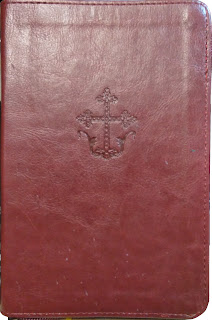
         I have only physically met the EOB-NT in the form of its Portable Edition, which was published by New Rome Press in 2019 (and can be purchased for $40 at their website).  The features of the EOB-NT Portable Edition are notable: 

            Its burgundy leather cover has two ribbons, yellow and red.  A zipper protects the pages (but also prevents them from laying flat).  The print is small; some readers may need a magnifying-glass.  There are two columns of text on each page.

            The text is formatted into logical paragraphs.

            An unfortunate formatting-error has survived in Matthew 27:31:  the words “Simon of Cyrene–The way to Golgotha– The crucifixion of the Lord” were intended to be in the margin in red print, but somehow they have been presented as if they are part of the text.  (Hopefully this will be remedied in future editions.)

            As one handles the EOB-NT Portable Edition, one may feel as if a New Testament manuscript is being held.  Each Gospel is preceded by a full-page illustration, and illustrations – more like icons – also appear before First Corinthians, and after Revelation.   Each book of the New Testament, large or small, is introduced with an artistic, uncomplicated red headpiece, and the book-title in artistic red lettering. Chapter-numbers and superscripted verse-numbers are red.  Footnote-numbers, in black, are also superscripted.

            The text is supplemented by useful colorful maps that deserve special mention.  They depict the Roman Empire, Jesus’ Ministry in Galilee, Jesus’ Journeys to Jerusalem, The Jewish Diaspora at Pentecost, Paul’s Early Travels, Paul’s Third Missionary Journey, Paul’s Trip to Rome, The Ministry of Peter and Philip, the Spread of Christianity During the 1st and 2nd Centuries A.D., and Early Christian Communities, followed by an icon of the Harrowing of Hell with Romans 8:31-34.  

            More information about the EOB-NT Portable Edition can be found in the video-reviews by Orthodox Review and R. Grant Jones and Biblical Studies and Reviews.


Friday, December 10, 2021

Manetti and the Greek New Testament

Giannozzo
Manetti


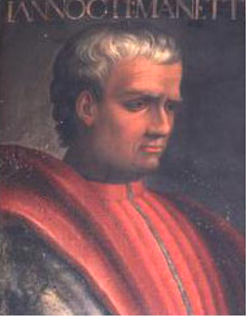
         Giannozzo Manetti (1396-1459) is not mentioned in either Metzger’s The Text of the New Testament or in Aland & Aland’s The Text of the New Testament.  But all students of the field of New Testament textual criticism should learn his name.  It was Manetti, a generation before Erasmus, who completed the first Latin translation of the New Testament (since the time of Jerome) that was based primarily on Greek manuscripts. 

         Born into a wealthy family in the city of Florence, Italy, Manetti was taught by the famous historian (and Chancellor of Florence) Leonardo Bruni, and was trained in classical Latin and Greek.  Manetti was committed to the principle of ad fontes before it was cool:   he learned Hebrew in order to produce a Latin translation of the Psalms, and defended his renderings against anticipated objections from fans of the traditional Vulgate in a detailed five-volume work titled Apologeticus.   He also wrote On Human Worth and Excellence, in which he maintained that human beings are creatures of dignity and quality.

          Shortly after the fall of Constantinople in 1453, Manetti began his work on a Latin translation of the New Testament. Because much of Manetti’s library was donated to the Vatican (he had been friends with Pope Nicholas V in his youth), we can identify exactly which Greek manuscripts he used as his sources.  They reside to this day in the Vatican Library: 

          Pal.Gr. 171 (GA 171), which is a full Greek New Testament (including Revelation), Pal. Gr. 189, (GA 156) a Greek Gospels-MS (with illustrated headpieces before each Gospel; the text on the last page of John is cruciform and is followed by generous liturgical appendices), and Pal. Gr. 229 (a diglot, Greek-Latin, manuscript of the Gospels.  A supplemental Latin manuscript also used by Manetti was Pal. Lat.18, containing a Vulgate text of the Old Testament and New Testament.

           Two copies of Manetti’s Latin translation of the New Testament are also at the Vatican Library:  First is Pal. Lat. 45, which presents a straightforward Latin text.  The attribution to Manetti can be seen before each Gospel:  Matthew on fol. 1rMark on fol. 21r  (where it can be seen that Manetti rendered his Greek text in Mark 1:2 as “est in prophetis,” unlike the Vulgate’s “est in Esaia propheta.”), Luke on fol. 33v, and John on fol. 55v.

Annet den Haan
          Second is Urb. Lat. 6, a more ornate copy, produced after Manetti’s death. 

           Two modern-day researchers, Annet den Haan and David Marsh, have made major contributions to a revival of interest in Manetti’s translation-work.  Marsh has written a detailed biography of Manetti, available from Harvard University Press.  Annet den Haan of Utrecht University has become a one-woman encyclopedia of all things related to Giannozzo Manetti, and has made many of her articles and essays available at Academia.edu for free.  Additional information about Manetti, his writings, and his manuscripts can be found at this link


Tuesday, January 1, 2019

The Evangelical Heritage Version New Testament - A Review


            In 2017, the Evangelical Heritage Translation of the New Testament and Psalms was published.  Let’s take a look at this new translation (focusing on the New Testament portion)!   
            The EHV is mercifully free of arbitrary paraphrase.  An Introduction explains that the EHV is intended to be “an all-purpose Bible for the church,” and this has elicited a balanced approach.  Terms such as “justify,” “flesh,” “mammon,” and “saints” have not been shunned.  Conveyance of the meaning of the original text was, according to the EHV’s Introduction, a higher priority than elegant English style.  The issue of gender-inclusivity was specifically addressed:  “In the use of so-called “gender-accurate language,” the translator will strive to be inclusive where the original is inclusive and exclusive where the original is exclusive.”  Other principles of translation that were engaged in the production of the EHV can be found at the Wartburg Project website.
            The New Testament base-text of the EHV is somewhat unique; the editors attempted to avoid a bias toward any single textual tradition, whether Alexandrian or Byzantine.  Their approach is described at the website:
            “In general, as we examine significant variants, the reading in a set of variants that has the earliest and widest support in the witnesses is the one included in the text. The other readings in a set of variants are dealt with in one of three ways:
            ● A reading that has very little early or widespread support in the witnesses is not footnoted in order to avoid an overabundance of textual notes.
            ● A reading with significant early and/or widespread support but not as much early or widespread evidence as the other reading is reflected in a footnote that says, “Some witnesses to the text read/add/omit: . . . .”
            ● A familiar or notable reading from the King James tradition (e.g. the addition or omission of a whole verse) whose support is not nearly as early or widespread as the other reading can be reflected in a footnote that says, “A few witnesses to the text read/add/omit: . . . .”

            In short, readings and verses that are omitted from UBS/Nestle-based versions of the New Testament, which have textual support that is ancient and widespread are included in our translation.”
            That is a generalization, and readers of the EHV should not expect to see it applied evenly.  For instance, in Acts 9:5, the KJV’s phrase, “It is hard for thee to kick against the pricks,” for which the manuscript-support is lightweight, is neither in the EHV’s text nor in a footnote.  Similarly, there is (thankfully) no footnote drawing Matthew 12:47 into question, although the ESV omitted it from the text on the basis of relatively few manuscripts. 
            A few sample-readings from each Gospel may give readers a sense of the EHV’s eclectic nature:

Matthew 1:25 – “until she gave birth to her firstborn son” (A footnotes states, “Some witnesses to the text omit firstborn and simply read she gave birth to a son.”)
Matthew 6:13 – “but deliver us from evil.”  (“For yours is the kingdom,” etc. is in a footnote, not in the text, attributed to “Some witnesses.”)
Matthew 17:21 – included in the text.  A footnote says that “A few witnesses” omit the verse.
Mark 1:2 – “This is how it is written in the prophet Isaiah” (The reading “in the prophets” is attributed to “Some witnesses” in a footnote.)
►  Mark 1:14 – “the gospel of the kingdom of God” (A footnote attributes the non-inclusion of “of the kingdom” to “A few witnesses.”)
Mark 1:41 – “Moved with compassion” is in the text; there is no footnote.
Mark 3:5 – “as whole as the other” is not in the text; there is no footnote.
Mark 6:22 – “When the daughter of Herodias came in” is in the text; there is no footnote.
Mark 9:29 – “except by prayer and fasting” is in the text; a footnote states that a few witnesses omit “and fasting.”
Mark 10:24 – “for those who trust in their riches” is in the text; there is no footnote.
Mark 11:26 is in the text; a footnote states that a few witnesses do not include the verse.
Mark 15:28 is not in the text; it is in a footnote, attributed to “Some witnesses.”
Luke 2:14 – “and on earth peace, good will toward mankind” is in the text; a footnote states that a few witnesses read “among people of his good will.”
Luke 9:55-56 include the portion that is not included in the ESV’s text; a footnote states that some witnesses omit this quotation.
► Luke 22:43-44 is included in the text; a footnote states that a few witnesses omit these verses.
Luke 23:34 is all in the text; there is no footnote.
Luke 24:12 is in the text; there is no footnote.
Luke 24:51 is all in the text; there is no footnote.  (Yet there is a footnote for the phrase about the honeycomb in 24:42.)
John 1:18 – “The only-begotten Son” is in the text; a footnote states that some witnesses read The only-begotten God.
John 3:13 – “who is in heaven” is in the text; a footnotes states that a few witnesses omit these words.
John 5:3-4 is all in the text; a footnote states that some witnesses omit the passage.
John 7:8 – “I am not going up to this festival yet” is in the text; a footnote states that some witnesses omit “yet.”  (This ought to be changed, inasmuch as the support for “yet” is both more ancient and more widespread than the evidence for the alternative reading.)
John 9:35 – “Son of God” is in the text; a footnote states that some witnesses read “Son of Man.”

            In the epistles, quite a few readings found in the majority of manuscripts go unmentioned:  “of Christ” does not appear in Romans 1:16 (no footnote); “adultery” does not appear in Galatians 5:19 (no footnote); Galatians 5:24 reads “to Christ Jesus” (no footnote); “through Jesus Christ” does not appear in Ephesians 3:9 (no footnote); Ephesians 5:9 reads “of the light” (no footnote), James 4:12 includes “and judge” (no footnote); First Peter 1:23 does not have “forever” (no footnote), etc.  Yet there are also plenty of Alexandrian readings which have been quietly rejected; Matthew 16:2-3, for example, is all included in the text with no footnote, and Philippians 4:13 says, “through Christ, who strengthens me” with no footnote. 
            Occasionally a reading that is found in the majority of manuscripts is described in a footnote as if it supported by “A few manuscripts.” Hopefully this will be corrected in the future, so as to differentiate between minority readings found in the Textus Receptus and the readings of the Byzantine Text.  (Perhaps the footnotes could be improved by simply referring to the Byzantine Text and Alexandrian Text, so as to avoid describing two different groups of manuscripts in the same terms.)
           
            No doubt readers want to know how the EHV treats Mark 16:9-20.  I am pleased to report that the EHV fully includes these 12 verses in the text with no brackets.  The EHV’s footnote should be read with attention:  “This translation includes verses 9-20 because they are included in the vast majority of Greek manuscripts that have been handed down to us.  Evidence for the existence of this long ending extends back to the 2nd century.  In the early centuries of the church, these verses were read in worship services on Easter and Ascension Day.   However, a few early manuscripts and early translations omit verses 9-20, and a few manuscripts have a different ending.”  One might wish that this note were improved (we have only two early Greek manuscripts that stop Mark’s text at 16:8, for one thing) but it is far better than the misleading treatment found in some other versions. 
            John7:53-8:11 is also fully included in the text.  A note for John 7:53 states, “Some witnesses to the text omit 7:53-8:11 or include these verses in other places within John’s Gospel, The witnesses that include these verses are early and widespread throughout most of the early church.”  This is a welcome clarification – one might even say correction – of the unhelpful vagueness that characterizes the treatment of this passage in some other versions.  (Instead of “in other places” the note could say “before or after the Pentecost-lection, or at the end of the book with a note stating that it was previously found after 7:52,” but this might be too much to hope for.)

            In First John 5:7, the EHV does not have the Comma Johanneum in the text.  A footnote states, “Only a very few late witnesses to the text read testify in heaven:  the Father, the Word, and the Holy Spirit, and these three are one. 8And there are three that testify on earth”.”  This could be improved by referring to “Very few late Greek manuscripts,” inasmuch the Latin evidence for this interpolation is plentiful.
                       
            Now about the formatting of the EHV’s text:  it is arranged in paragraph-form, and simple headings, set off from the main text via the use of a different font, regularly separate blocks of text, filling the same role as the ancient kephalaia (chapter-titles) fill in our Greek manuscripts.  In the Gospels, the headings are supplemented in smaller print by mention of parallel-passages.  Extensive poetic passages and extensive quotations are indented.  Luke 1:46-55 (the Magnificat) is all indented; Luke 1:68-79 (Zechariah’s Song) is all indented; Luke 2:29-32 (the Nunc Dimittis) is all indented.  Likewise First Corinthians 3b-5 and the last six lines of First Timothy 3:16 (beginning with “He was revealed in the flesh”) are indented.  Philippians 2:5ff., however, has no special indentation.
            Old Testament quotations, whether extensive or not, are identified in footnotes.  Footnotes also serve to occasionally supply or define terms for which there is no exact modern equivalent, such as monetary units and measurements of weight and volume. 
            The formatting is, in a word, excellent.  Some sections are much longer than others, but this is perhaps an unavoidable effect of following the natural structure of the text. 

            As a translation – setting aside questions about the base-text – the EHV New Testament is a model of skillful, accurate work.  The translators have generally taken a conservative approach, avoiding needless imprecision while recognizing the need to treat idioms with reasonable freedom.  Its treatment of passages which, in some recent translations, have been adulterated in the service of egalitarian theology or feminism, is above reproach.  The EHV is remarkably clear and candid in First Corinthians 14:34-35, First Timothy 2:12, First Timothy 3:1-7, and Titus 1:5-9.  Likewise the EHV’s renderings of passages about homosexual acts are unlikely to be welcomed by those who want to advance an ungodly agenda. 
            Only occasionally does the EHV resort to unconventional renderings:  “Gentlemen,” for instance, appears repeatedly at the beginnings of speeches in the book of Acts; yet this is not necessarily a bad thing; this modern English term is, I think, a perfect proxy for the Greek word which several modern translations fail to translate altogether.  Another fresh and admirable rendering is found in the EHV in Christ’s words in John 21:5 – “Boys, don’t you have any fish?”.  More debatable:  the decision to present what are, in other versions, some references to the Spirit, as references to the spirit (meaning, according to a footnote attached to Galatians 5:16, “the new nature in contrast with the sinful flesh”), and the decision to translate what has traditionally been rendered as “born again” as, instead, “born from above.”
            Much more information about the Evangelical Heritage Version can be found at the Wartburg Project website, which features, among other things, an expanded Introduction, 49 Frequently Asked Questions and their answers, and a comparison of the Christmas story in the EHV and some other translations.  It should not be overlooked that while the EHV is not the official version of any denomination, it is, by design, a translation made by individuals professing to be spiritually invested in the church.  Members of the Wisconsin Evangelical Lutheran Synod have overseen its production.  Brian R. Keller served as the New Testament Editor.   
            While I would prefer a version based on a Greek text with more Byzantine readings, the EHV New Testament’s base-text avoids the extreme dependence upon poorly attested Alexandrian readings which characterizes the base-text of the ESV, NIV, NLT, etc.; as I have stated in the past, given the choice, I would rather sail in a ship with harmless barnacles on its hull than in a ship with holes in its hull.  All in all, the EHV New Testament is a superb translation which deserves to be warmly welcomed by evangelical Christians.  It merits the consideration, especially, of ministers and congregations who favored the (discontinued) New International Version of 1984, but who recognize that the 2011 edition of the New International Version, post-TNIV, is significantly flawed.  It is available to purchase online at the Wartburg Project, at Amazon (where the entire Gospel of Matthew can be previewed), and (with bulk discounts) at the website of its publisher, Northwestern Publishing House.
            The EHV Bible is scheduled to be available in summer of 2019.    

Thursday, July 13, 2017

Eugene Peterson and The Message, Revisited

The Message:  Remix 2017
          Now that Eugene Peterson has advocated gay marriage – not just as a legal right, but as something that the body of Christ ought to bless – he should be regarded as one who has fallen away from the faith handed down to the saints.  I believe that this is how each and every one of Christ’s commissioned apostles would respond, prayerfully hoping and praying for him to repent.  [Update - July 13, 4:15 pm:  Peterson has retracted his earlier endorsement of gay marriage as a church rite.  Prayers answered, and quickly!]  
            With that in mind, I implore my fellow preachers, and anyone who has been treating Peterson’s “translation of tone,” The Message, as if it is a Bible translation, to stop using The Message in any ministry-context that would give people the impression that it is a Bible.  In February of 2015, I demonstrated that The Message is too inaccurate to qualify as a Bible translation.  Using Matthew 10 as a sample-passage, I showed that it is badly contaminated with additions, deletions, and alterations of various kinds which render it useless as a representation of the message conveyed by the original text of the Bible. 

            Why should Peterson’s affirmation that he would officiate at a same-sex marriage if he were asked to do so mean that Christians should not use The Message?  Perhaps for the same reason that when the author of How To Safely Drive a Car drives his car headlong into a wall at 100 miles an hour, it raises doubts about the wisdom of using his book to teach students how to drive.  Common sense ought to suggest that when someone openly defies the teachings of Scripture, his presentation of the meaning of Scripture might not be trustworthy. 
            But let’s not commit the genetic fallacy, right?  [Update, July 13, 4:15 pm:  whatever position Peterson holds - and earlier today, he affirmed that he subscribes to a Biblical view of marriage, one man to one woman - the flaws in The Message are still there.]  A close look at the contents of The Message reveals plenty of reasons to avoid using it.  Let’s examine specifically part of The Message that seems to have been adulterated because of the view which Peterson just now affirmed:  First Corinthians 6.

            For the first several verses of this chapter, Peterson’s paraphrase conveys the gist of the meaning of the original text; it is embellished but not obscured – until verse 6.  Where the text should mention that one brother take another brother to court (ἀδελφὸς μετὰ ἀδελφου), Peterson’s rendering loses the gender, stating only that “you are taking each other to court.”  But this is minor compared to what follows:  Peterson inserted a full sentence into end of verse 6:  “How can they render justice if they don’t believe in the God of justice?” 
            In First Corinthians 6:6, the Greek text is ἀλλα ἀδελφὸς μετὰ ἀδελφου κρίνεται, καί τουτο ἐπὶ ἀπίστων – but brother takes brother to judgment, and that before unbelievers.  This is adequately represented in The Message by the first part of verse 6:  “And here you are taking each other to court before people who don’t even believe in God!”  The rest of verse 6 in The Message – “How can they render justice if they don’t believe in the God of justice?” – has no foundation in the Greek text.  It comes from Eugene Peterson, not from Paul. 
            Perhaps one could overlook that in a “translation of tone,” regarding the insertion as completely unauthorized but rather benign.  Let’s move along to verses 9-10.  First, here are these two verses from the English Standard Version:

            “Or do you not know that the unrighteous will not inherit the kingdom of God?  Do not be deceived:  neither the sexually immoral, nor idolaters, nor men who practice homosexuality, nor thieves, nor the greedy, nor drunkards, nor revilers, nor swindlers will inherit the kingdom of God.”

Here is how the Christian Standard Bible renders the passage:
            “Don’t you know that the unrighteous will not inherit God’s kingdom?  Do not be deceived:  No sexually immoral people, idolaters, adulterers, or males who have sex with males, no thieves, greedy people, drunkards, verbally abusive people, or swindlers will inherit the kingdom of God.” 

And here’s verses 9-10 as they appear in the New International Version (2011 revision):  
            “Or do you not know that wrongdoers will not inherit the kingdom of God?  Do not be deceived:  Neither the sexually immoral nor idolaters nor adulterers nor men who have sex with men nor thieves nor the greedy nor drunkards nor slanderers nor swindlers will inherit the kingdom of God.”

You may notice that all three of these versions have something in common between the reference to adulterers and the reference to thieves, where the Greek text reads οὕτε ἀρσενοκοιται:
            ESV:  nor men who practice homosexuality
            CSB:  or males who have sex with males
            NIV:  nor men who have sex with men.

Yet in The Message this is what we find: 
            “Don’t you realize that this is not the way to live?  Unjust people who don’t care about God will not be joining in his kingdom.  Those who use and abuse each other, use and abuse sex, use and abuse the earth and everything in it, don’t qualify as citizens in God’s kingdom.”

            A more blatant case of watering down the meaning of Scripture would be hard to find.  Peterson butchered the text of First Corinthians 6:9-10 by removing Paul’s specific references to idolaters, adulterers, men who practice homosexuality, thieves, the greedy, drunkards, slanderers, and swindlers, with generalizations – and, as if this was not enough, he added something brand new – “use and abuse the earth and everything in it” (which has no foundation in the Greek text).  Peterson thus erased Paul’s warning against committing homosexual acts (and other acts), and put words in Paul’s mouth as if Paul wrote something here against littering and pollution.  Both of these things are irresponsible – and some of those who have approved or recommended such butchery, committed under the cover of paraphrase, were also irresponsible.  (Looking at you, Darrell Bock of Dallas Theological Seminary.  You too, Michael Card and Max Lucado.) 

            Via this swindle of words, Peterson not only obscured the inspired apostle’s condemnation of fornication, adultery, sodomy, thievery, and so forth, but he also obscured the next verse’s statement that salvation is freely offered for those who repent of those acts.  A real Bible would inform its readers in First Corinthians 6:11 that among the Christians at Corinth, there were some individuals who had committed the specific acts that Paul warns against in verses 9-10 – and that they had been forgiven of those sins, as the New American Standard Bible puts it:  “Such were some of you; but you were washed, but you were sanctified, but you were justified in the name of the Lord Jesus Christ and in the Spirit of our God.” 
 
NavPress, something is wrong
with your product
.
         
The original text of First Corinthians 6:9-11 makes it clear that sodomy is classified as a sin, along with adultery and thievery; it also clearly states that those sins can be forgiven and that the guilty person who repents of those sins can be restored and become a child of God.  The Message does neither of those things in First Corinthians 6:9-11, because it is a counterfeit, not a real Bible.  It shouldn’t be called a Bible, and NavPress should never have marketed it as a Bible. 
            When The Message began to be deceitfully marketed as if it is the Word of God, I should have protested more vocally than we did.  I can’t go back in time and state my protests more forcefully.  I wish I could.  But I can say this:  I have no use for The Message as a paraphrase, and it is not very good as a commentary, either.  There is no good reason to preach or teach from The Message as if it is a Bible.  I advise everyone who has access to the KJV or NKJV or WEB or NIV or ESV or CSB or NASB to do to their copy of The Message what Eugene Peterson did to the meaning of the original text of First Corinthians 6:9-11:  tear it up and throw it away. 

_______________

Quotations from The Message are . . . oops; the copyright page is torn apart.  Let's see here . . . . 

The Message is Copyright © 1993, 1994, 1995, 1996, 2000, 2001, 2002 by Eugene H. Peterson.
Quotations from the ESV have been taken from The Holy Bible, English Standard Version. ESV® Permanent Text Edition® (2016). Copyright © 2001 by Crossway Bibles, a publishing ministry of Good News Publishers.
Quotations from the NIV have been taken from the Holy Bible, New International Version®, NIV® Copyright ©1973, 1978, 1984, 2011 by Biblica, Inc.®  Used by permission. All rights reserved worldwide.
Scripture quotations marked CSB have been taken from the Christian Standard Bible®, Copyright © 2017 by Holman Bible Publishers.  Used by permission.  Christian Standard Bible® and CSB® are federally registered trademarks of Holman Bible Publishers.


Tuesday, August 9, 2016

Why Codex Sinaiticus Doesn't Say What Its Website Says It Says

The website of Codex Sinaiticus
has been online since 2009
.
How important is Codex Sinaiticus as a witness to the text of the New Testament?  So important that it has its own website, which features an English translation of portions of the manuscript’s contents, including the entire New Testament.

Or does it?  The home page of the website gives visitors no reason to reach any other conclusion about the English translation – but if one pokes around a bit, searching for information about the translation, this note can be found:
  
English translation
The Codex Sinaiticus Project was primarily a conservation, digitisation, transcription and publication project.  It did not aim to undertake a new English translation of the writings preserved in the manuscript.”

Henry Tompkins Anderson
1812-1872
The note continues:  “The English translation of the New Testament part of Codex Sinaiticus used on the website was taken from the translation by Henry Tompkins Anderson in The New Testament: translated from the Sinaitic manuscript discovered by Constantine Tischendorf at Mt Sinai (Cincinnati, 1918). This out-of-copyright translation does not provide a literal translation of the text in Codex Sinaiticus, but was included in the website to serve as a navigational aid.”

In other words:  when you read the English translation of the New Testament books at the Codex Sinaiticus website, you are not really reading an English translation of the contents of Codex Sinaiticus!  You are reading a translation made by Henry Tompkins Anderson, who was a Christian preacher in Harrodsburg, Kentucky in the 1860’s – a translation which at many points does not represent the text of Codex Sinaiticus.  The only way to know whether or not the English translation really conveys what Codex Sinaiticus says is to compare the translation to the Greek text itself.   

          Here are fifteen of the many disagreements between the translation at the Codex Sinaiticus website and the text of the manuscript.  

Matthew 5:19:  Whoever therefore shall make void one of the least of these commandments, and shall teach men so, shall be called least in the kingdom of the heavens; but whoever shall do and teach, he shall be called great in the kingdom of the heavens.

          In Codex Sinaiticus, the copyist skipped the Greek words represented by “but whoever shall do and teach, he shall be called great in the kingdom of the heavens.”  This blunder was caused when a copyist’s line of sight drifted ahead to similar letters; the technical term for the recurrence of similar letters or words, eliciting such mistakes, is homoeoteleuton (“same ending”).  

Matthew 7:27:  “And the rain descended, and the floods came, and the winds blew, and they beat upon that house, and it fell; and great was its fall.”

          The copyist of Codex Sinaiticus skipped the Greek words represented by “and the winds blew,” another mistake elicited by homoeoteleuton.

 Matthew 8:13:  “And Jesus said to the centurion:  Go; as thou hast believed, be it done for thee. And the servant was restored to health in that hour.”

          The text written by the copyist of Codex Sinaiticus has a bit more text which says, “And the centurion, returning to his house in that hour, found his servant in good health.”   This is a very bad attempt at harmonization, loosely based on the parallel in Luke 7:10.  (Also, considering that this verse ends the standard Gospels-lection to be read annually on the fourth Sunday after Pentecost, the expansion may be an early attempt to round off the anecdote with a flourish.)

Matthew 12:13:  “Then he says to the man: Stretch forth thy hand. And he stretched it forth; and it was restored to soundness as the other.”

          Codex Sinaiticus’ copyist did not write the Greek words that mean “as the other.”

Matthew 12:47:  And some one said to him: Behold, thy mother and thy brothers stand with out, seeking to speak to thee.

          In Codex Sinaiticus, this verse is missing.  This appears to have been elicited by another case of homoeoteleuton; verses 46 and 47 end with the same word.  

Matthew 23:35:  “that there may come on you all the righteous blood shed on the earth, from the blood of Abel the righteous to the blood of Zachariah son of Barachiah, whom you murdered between the temple and the altar.”

          The text of Codex Sinaiticus does not have the Greek equivalent of the words “son of Barachiah.”  This could be another example of parablepsis (the technical term for the “sight detours” that sometimes occurred when a copyist lost his line of sight, especially due to homoeoteleuton or to homoeoarcton (same beginning, or similar beginnings, of words).  But it may also be a copyist’s attempt to remove a perceived difficulty from the text, if the copyist understood this passage to refer to the events in Second Chronicles 24:20-22, and believed that that this passage in Matthew referred to Zechariah the priest – who was the son of Jehoida, rather than the son of Barachiah – instead of the prophet Zechariah.

Matthew 27:48-50:  “And immediately one of them ran and took a sponge, and having filled it with vinegar and put it on a reed, gave it to him to drink.  But the rest said: Wait, let us see if Elijah is coming to save him.  But Jesus again cried out with a loud voice, and gave up the spirit.”

          In Codex Sinaiticus (and in Codex Vaticanus) there is additional material after verse 49.  Codex Sinaiticus says, “But another took a spear and pierced his side, and water and blood flowed forth.”  Now I invite those apologists who commonly claim that textual variants do not have an impact on significant Christian doctrine to explain how, if this variant were to be adopted into the text, the doctrine of inerrancy would survive.  It is obvious that this reading in Codex Sinaiticus says that Jesus was pierced before He died, and it is equally obvious that John 19:30-37 says that Jesus was pierced after He died.  Let it be noted that there is more Greek manuscript support for the inclusion of this sentence than there is for the non-inclusion of Mark 16:9-20.  (Codex Sinaiticus also lacks the Greek equivalent of the words “of them” in verse 48.)   

Mark 7:4a:  “And when they come from market, unless they immerse themselves, they eat not.”

          In Codex Sinaiticus (and in Codex Vaticanus), the Greek word βαπτισωνται, which refers to washing by immersion in water, has been replaced by ραντισωνται, which refers to washing by the pouring of water.    

 Luke 8:47:  And the woman, seeing that she had not escaped notice, came trembling, and having fallen before him told before all the people for what cause she had touched him, and how she had been immediately restored to health.”

          The Greek text in Codex Sinaiticus is much shorter, omitting all the words in bold print, so that the text simply says, “And falling before Him, she told before all the people how she had been immediately restored to health.”

John 4:19-20:  “The woman says to him:  Sir, I perceive that thou art a prophet.  Our fathers worshipped in this mountain; and you say that in Jerusalem is the place where we ought to worship.”

          The copyist of Codex Sinaiticus did not write Κύριε (the Greek word for “Lord,” rendered as “Sir” in this context) in verse 19, and also did not write ὁ τόπος (“the place”) in verse 20.  

John 9:37-39:  “Jesus said to him:  Thou hast both seen him, and he it is that talks with thee.  He said, Lord, I believe; and he worshiped him.  And Jesus said:  For judgment have I come into this world, that those that see not may see, and that those that see may become blind.”

          The copyist of Codex Sinaiticus did not write the bold-print words in verses 38 and 39.  These words are also missing in Papyrus 75 and Codex W – apparently the result of an early Alexandrian copyist’s misunderstanding of an exemplar in which the passage was marked for liturgical use.

John 10:40:  “And he went away again beyond the Jordan into the place where John was first baptizing, and abode there.”

          Codex Sinaiticus’ copyist did not write the Greek words εις τον τόπον.  There is nothing to elicit an accidental mistake here.  This reading is probably a deliberate omission by someone who considered these words superfluous.

First Corinthians 13:3:  “And though I give all my goods away in food, and though I deliver up my body that I may be burned, but have not love, I am profited nothing.”

          Instead of the usual reading καυθήσωμαι, Codex Sinaiticus (and Papyrus 46 and Codex Vaticanus) reads καυχήσωμαι, which means, “that I may boast.” 

Second Peter 1:1:  “Simon Peter, a servant and apostle of Jesus Christ, to those that have obtained equally precious faith with us in the righteousness of our God and Saviour Jesus Christ.”

          This verse is sometimes used as proof that the author affirmed the deity of Christ, particularly when the Granville Sharp rule is applied to it.  However, with or without the Granville Sharp rule, Codex Sinaiticus does not support the deity of Christ in this verse:  instead of the name-abbreviation for the word “God” (Θυ, that is, Θεου), Codex Sinaiticus’ copyist wrote the name-abbreviation for the word “Lord” (Κυ, that is, Κυριου).  I doubt that a modern translation with this reading could easily escape the charge that it was produced by Arians.

Jude verse 3a:  Beloved, giving all diligence to write to you concerning this common salvation, I found it necessary to write to you.”   

          The actual reading of Codex Sinaiticus is different:  instead of referring only to salvation, the text of Codex Sinaiticus refers to “our common salvation and life.”  This is a remarkable reading, because it is a conflation, or combination, of two other readings:  σωτηρίας (salvation, the reading found in most manuscripts) and ζωης (life, the reading found in a group of medieval manuscripts known as family 2138, also called the Harklean Group because the text in these manuscripts frequently agrees with the Harklean Syriac version).  Although the Greek manuscripts in this group are not particularly ancient, the reading of Codex Sinaiticus in this verse suggests that ancestor-manuscripts with a text of the General Epistles similar to what is attested by the members of family 2138 – minuscule manuscripts such as 1505, 1611, 2138, and 2412 – existed prior to the production of Codex Sinaiticus.

          As you can see, as a representation of the contents of Codex Sinaiticus, the translation made by H. T. Anderson is highly inaccurate.  If the Codex Sinaiticus website is going to continue using Anderson’s translation, its creators should take whatever steps are necessary to ensure that visitors cannot use Anderson’s translation without being informed that it is provided for navigation-purposes only and that it deviates frequently from the actual text of the manuscript.  There is no good reason to hide this important explanation on a secondary webpage.  (Another option, of course, is to adjust the translation so as to accurately conform to the contents of the manuscript.)


Wednesday, November 25, 2015

The Clear Word: Clear, But Far from Pure

Paraphrasing is not
a license to embellish.
(A review of The Clear Word, by Jack J. Blanco, Copyright © 2003 by Review and Herald® Publishing Association)

          I am not sure what disturbs me more:  that the paraphrase-commentary hybrid known as The Clear Word could be created by a former dean of a Seventh-day Adventist university, or that Seventh-Day Adventists would welcome it, promote it, and distribute it.  Jack J. Blanco’s The Clear Word is one of the most corrupt forms of the English Bible being sold today.  Its author has smuggled thousands of man-made additions into the Biblical text.
          I have little doubt that the author’s intentions to create a “devotional paraphrase expanded for clarity” were noble.  This review is not intended as an evaluation of intentions, but of results.  The author of The Clear Word has essentially squeezed and molded Scripture into the shape of the teachings of Seventh-Day Adventism.
          Several authors have already reviewed some of the renderings in The Clear Word that have a distinctly Adventist doctrinal spin.  For example, at the CARM website, one can find explanations of how the Scriptural text has been manipulated and changed in The Clear Word so as to support annihilationism, and the belief that Jesus and the archangel Michael are identical (Revelation 12:7b:  “God’s Son Michael and the loyal angels fought against the dragon and his angels.”), and other unusual beliefs.
More examinations of The Clear Word
are at the CARM website
.
(This is not an endorsement.)
          Even if all of those doctrinally driven anomalies were corrected, The Clear Word would still be useless for anyone who wants to know what the Bible says, because The Clear Word is full of commentary-material that has been blended into the text.  It is not as if commentary-material is in a side-bar, or in footnotes, as is the case with various Study Bibles.  The commentary-material is blended directly into the text.  This unfortunate trait contaminates every page of The Clear Word.  I will supply some samples from Genesis and the Gospels.  Comparisons of these passages to translations such as the KJV, NKJV, HCSB, ESV, or NASB will illustrate the same thing:  The Clear Word is saturated with man-made insertions.  In the following six quotations from Genesis in The Clear Word, passages that are neither translation, nor paraphrase, but simply insertions, are highlighted and are in bold print:   

(1)  Genesis 3:6:  “As Eve watched the serpent eat the delicious fruit, she suddenly felt a strong urge to taste it too.  She reached out and touched the fruit and nothing happened.  Then she picked it, took a bite and instantly felt a surge of energy.  Excited, she took more fruit and ran to find her husband.  When Adam saw her, he sensed what she had done.  But in the blush of her excitement, she looked more beautiful than ever.  He couldn’t bear the thought of living without her, so he took the fruit and ate it also.”

(2)  Genesis 3:21:  (KJV:  “Unto Adam and also to his wife did the Lord God make coats of skins, and clothed them.”)  “But God didn’t carry out their sentence that day.  He told them He had a plan to save them.  Adam must sacrifice a lamb as a symbol of the One who would come and die in their place.  God then took the lamb’s skin to cover Adam and Eve’s nakedness.”

(3)  Genesis 6:8:  (KJV:  “But Noah found grace in the eyes of the Lord.”)  “So gradually the Lord laid to rest all those who loved Him, except Noah and his family.  Finally, they were the only ones left alive who found grace in God’s sight because they obeyed the Lord and did what was right.

(4)  Genesis 19:26a:  “Lot’s wife, who had begged to live in Sodom, looked back.”   The phrase, “who had begged to live in Sodom,” is not a paraphrase of anything.   It is simply an insertion. 

(5)  Genesis 22:9:  (KJV:  “And they came to the place which God had told him of; and Abraham built an altar there, and laid the wood in order, and bound Isaac his son, and laid him on the altar upon the wood.”)  “Finally they reached the top.  Together they found some stones, arranged them to build an altar and put the wood on top.  Then Abraham told Isaac what God had said.  Though sad, Isaac saw it as a privilege to give up his life for God while he was young.  He let Abraham tie his hands, then he willingly lay down on the altar.”  The two highlighted sentences are fabricated, and the sense of the final sentence is significantly altered.

(6)  Genesis 25:34:  (KJV:  Then Jacob gave Esau bread and pottage of lentils; and he did eat and drink, and rose up, and went his way:  thus Esau despised his birthright.”)  “Then Jacob gave him as many lentils as he could eat, and Esau ate and drank until he was full.  Without even thinking about what he had just given away, Esau said good-bye and left.  But Jacob had run ahead of God’s providence, just as Abraham had in fathering Ishmael.”  The final sentence has no foundation in the Hebrew text; it is commentary-material.

Many more could be listed.  Let’s turn to the New Testament and look at some of the insertions in the Gospel of Mark and the Gospel of John. 

Mark 1:13:  (KJV:  “And he was there in the wilderness forty days, tempted of Satan; and he was with the wild beasts; and the angels ministered unto him.”)  “He was there for forty days surrounded by wild animals.  He was severely tempted by the devil to use His divine powers to feed Himself.  When it was all over, He was so exhausted that angels from heaven had to come to revive His dying body.”  Wherever Jack J. Blanco got that part about the angels having to “come and revive His dying body,” it was not from the Greek text of the Gospel of Mark. 

Mark 1:45:  (KJV:  “But he went out, and began to publish it much, and to blaze abroad the matter, insomuch that Jesus could no more openly enter into the city, but was without in desert places:  and they came to him from every quarter.”)  “But the man didn’t listen.  He thought that Jesus was just being modest, so he told everyone he met how Jesus had healed him.  This greatly upset the priests, especially since the man hadn’t yet carried out the prescribed ritual.  So Jesus decided to leave town, because He knew He would attract other lepers and be accused of breaking down the restrictions of the ritual law.  He decided to carry on His ministry in a more isolated area, but before long people found Him and once again huge crowds came to see Him.”  Some of the imprecision in this verse could be regarded as paraphrasing – but about half of it has no basis in the Greek text.  

Mark 2:14b:  “Matthew got up, asked his assistant to take over and followed Jesus.”

Mark 2:28:  “I am the Lord of the Sabbath.  I know what’s right to do on the Sabbath and what isn’t.

Mark 3:12:  “Jesus commanded the spirits to stop shouting because this could bring on a public disturbance if the people began to argue over who He was instead of listening to what He had to say.

Mark 4:39a:  “Jesus, knowing that the demons were causing the fierce wind, stood and said to the storm, “Peace, be still.””

Mark 6:22b:  “Having had too much to drink, Herod said to the girl, “Ask for anything you want, and I’ll give it to you.””

Mark 8:33:  “Jesus then turned to His disciples and rebuked the Satanic influence around them, saying, “Get behind Me Satan!”  Looking straight at Peter, He said, “You’re only thinking about what’s important to man, not what’s important to God.”

Mark 11:7:  “They led the donkey to the top of the Mount of OlivesSuddenly they realized that what Jesus was about to do had for centuries been a symbolic act of kings prior to their coronation.  Joyfully, they took off their robes and laid them on the young animal.  Jesus then mounted the donkey, and the disciples led Him into Jerusalem.”

Mark 11:14:  “Jesus said to the tree, “Never again will you deceive people with your pretense.”  The disciples wondered why He would speak that way to a tree, but later they understood that it was a symbol of Israel.”

Mark 12:7:  “What was God telling Moses?  He was telling him that He was the One who activated Sarah’s dead womb, giving through Abraham life to Isaac who, in turn, gave life to Jacob.  Therefore, God is not the end of life but the Giver of life!  So your idea that there is no life after death is wrong.”  (For comparison:  Mark 12:27 in the KJV:  “He is not the God of the dead, but the God of the living; ye therefore do greatly err.”)
 
Mark 14:23-24:  “Then He took the cup of unfermented wine, gave thanks and passed it to the disciples to drink from, which they each did.  Jesus said, “The pure juice which you just drank represents my blood that I will shed for the sins of the world.  This will fulfill the covenant my Father and I made from the beginning.”

Mark 14:28:  But I will always love you.  When I rise again, I’ll meet you by the lake of Galilee where we had such good times together.”

Mark 14:72b:  “Ashamed of what he had just done, Peter hurriedly left the courtyard, ran all the way back to Gethsemane and wept bitterly.”

Now let’s turn to the Gospel of John.

John 2:4-5:  “Jesus answered, “Mother, I love you, but why are you asking me to help them?  I can’t work a miracle unless my Father tells me it is time to do it.”  Mary understood His hesitation but turned to the waiters and said, “Whatever my Son tells you to do, do it.”  (For comparison, here’s John 2:4-5 in the KJV:  “Jesus saith unto her, Woman, what have I to do with thee?  Mine hour is not yet come.  His mother saith unto the servants, Whatsoever he saith unto you, do it.”)

John 3:14:  “The miracle of the new birth was taught by Moses when he put a brass serpent on a makeshift cross and held it up for people to look at.  All those bitten by snakes who looked at it in faith were healed.  That power didn’t come from the cross Moses made, but from the Son of God who would come and die on a cross.  He will soon be lifted up between heaven and earth for all to see,”.  (For comparison, here’s John 3:14 in the KJV:  “And as Moses lifted up the serpent in the wilderness, even so must the Son of Man be lifted up.”)

Now we come to John chapter 8.  The embellishments of this passage are particularly strange.
 
John 8:1-4:  “Toward the end of the day Jesus left the Temple and went out of the city to the top of a hill called the Mount of Olives to spend some time in prayer.  The following morning, He went back to the Temple and sat down in the courtyard to teach, even though the week-long festival was over.  Soon a crowd gathered around Him to listen to what He had to say.  While He was teaching, the Scribes and Pharisees dragged in a prostitute whom they had tricked into adultery so they could use her to confront Jesus.  They pushed her toward Him and said,” ….

Jumping ahead to John 8:8:
“Then He leaned forward and started writing again.  This time the leaders looked at what He was doing and saw traced before them their own secret sins and their part in trapping the woman.

Now, there is a sub-branch of the text of the Gospel of John that contains a reading in this verse to the effect that the religious teachers saw their sins written in the earth.  But there is nothing in the Greek text of John 8:3 that says that the scribes and Pharisees had tricked the woman into committing adultery, and there is nothing that says that they saw, written down, anything about their part in trapping the woman.  All those details are entirely made-up. 

Further along, in chapter 11, The Clear Word adds another made-up detail:
John 11:2:  “His sister Mary was the one who had been caught in adultery, whom the Pharisees wanted to stone but whom Jesus forgave.  She was also the one who later anointed Jesus’ feet with expensive perfume and wiped His feet with her hair shortly before His death.”  I emphasize:  this new claim that Mary of Bethany was the woman caught in adultery does not come from anywhere in the Greek text of John 11:2.

Extra details continue to pop up in the text of The Clear Word:
John 12:8:  “You will have plenty of opportunities to feed the poor, but I’m only here once.  After what I’ve been through, it’s refreshing to be appreciated.

John 13:6-8a in The Clear Word contains some insertions and substitutions, too: 
“When He came to Peter, Peter said, “Lord, you’re the Son of God!  You’re not going to lower yourself by washing my feet!”  Jesus looked at him and said, “Right now you don’t understand why I’m doing this, but after I’m gone, you will.”  Peter said, “I am not letting my God wash my feet!”  This frivolous imprecision risks misleading readers:  some are likely to rely on this passage to prove that the Bible teaches the deity of Christ, only to be shown that the words “my God” do not belong in the text.

A little further on in The Clear Word, John 13:10 looks like this:  “Jesus said, “When a person has had a bath, he only needs to rinse the dust off his feet.  If a man has been born again and baptized, he doesn’t have to be baptized all over again each time he does something wrong.  All of you are clean, except one.””  An entire sentence, attributed to Jesus, appears out of the blue.

          These examples are not exceptional.  Similar insertions appear throughout The Clear Word.  In addition, parallel-passages are frequently altered, removing difficulties at the expense of effectively erasing the text written by the inspired authors.  In The Clear Word, Mark mentions both Gadarene demoniacs, and both blind men at Jericho (not just Bartimaeus) – whereas in the original text of the Gospel of Mark, Mark simply does not do so.  Acts 1:17-18 is barely recognizable in The Clear Word.  This sort of alteration does indeed result in a clear text, but not a pure one.
         
           Without all the baseless embellishments, The Clear Word could be a lucid paraphrase of the same base-text upon which the KJV is based.  Unfortunately, Jack Blanco has created an adulteration, a hybrid that is partly the Word of God, and partly his own ideas (mostly based on the teachings of Ellen G. White), blended together without distinction.  For Christians who want their Bibles to be undiluted, this completely disqualifies The Clear Word from being used for any purpose, except as an example of how translation should not be done.  I encourage the Review and Herald Publishing Association to stop printing it, and I encourage Adventist Bible Centers to stop distributing it.