Followers

Showing posts with label EOB. Show all posts

Thursday, January 26, 2023

The Longer Reading in Matthew 25:13

           A textual variant in Matthew 25:13 may shed some light on a mechanism that elicited some expansions in the Byzantine Text.  In the EOB-NT, Matthew 25:13 reads, “Watch, therefore, for you do not know the day or the hour that the Son of Man is coming.”  The words “that the Son of Man is coming” are framed by “<” and “>.”  The WEB, based on the Majority Text, says similarly, “Watch therefore, for you don’t know the day nor the hour in which the Son of Man is coming.”  The KJV reads similarly, and the Textus Receptus agrees with the Byzantine Textform at this point.  In the EHV, Matthew 25:13 only says, “Therefore, keep watch, because you do not know the day or the hour.”  There is no footnote in the EHV to indicate the existence of the longer Byzantine reading. 

          The ESV, CSB, NIV, and NASB all end the verse at the word “hour.”  The NLT, apparently abandoning its base-text, continues with “of my return.”

          What’s going on here?  Did Matthew write the words ν υἱὸς το νθρπου ερχεται or not?

          Short answer:  Not.

          The Byzantine/Majority Text supports the inclusion of “in which the Son of Man is coming,” but the Peshitta does not.  Codices A, D, L, W, Δ, and Σ end the verse with ραν (hour).  So do some minuscules, including 33, the first hand of 157, 892, and the first hand of 1424.   The Alexandrian codices À and B weigh in for the shorter reading, and so do P35 and Codex D, and patristic witnesses such as Chrysostom, Athanasius, and Augustine.  The Vulgate and the Old Latin also solidly support the shorter reading here.

          To perceive what has happened here, it is helpful to know that Matthew 25:1-13 was the lection assigned to the 17th Saturday after Pentecost in the Byzantine lectionary.  (It is also a lection in Lectionary 846, to be read in honor of female virgins and martyrs.)  When this segment is read separately from the rest of the chapter, the final sentence was expanded to tell listeners what day and hour were referred to (perhaps using Mt. 24:42 and 24:44 as a model). 

          This expansion can be seen happening in Byzantine manuscripts.  In Codex Y (034), the verse ends ραν in the text, but someone – apparently the same person who supplemented the manuscript for lection-reading – added in the margin, “εν η υς του ανου ερχεται.”  There’s the longer variant.

          Bruce Metzger’s dismissal of the longer reading is correct, but his explanation for its existence (as a “pedantic addition”) seems to show little appreciation for the influence of the lectionary on the Byzantine Text.  When Metzger wrote his Textual Commentary, he was all-in on Hort’s now-defunct theory of the Lucianic Recension.   A more mature Metzger would probably adjust his wording, acknowledging the longer reading as having been made under the influence of lectionary-usage.

          When was the longer reading introduced?  Probably sometime after Codex A (400s), and before 017 (Cyprius) (800s) and the marginalia in 034 (800s, if the marginalia is of the same date as the main text).  [Update:  Andy Vogan has observed that 07, assigned to the 700s, also has the longer reading.]  Someone influenced by a lectionary, wishing to benignly introduce an expansion at the end of Mt. 25:13 to wrap up a lection, created the longer reading, and it was so edifying that so many scribes adopted it that it eventually became the majority reading.  The removal of such intrusions into the text can be achieved relatively easily by filtering the majority text against the Alexandrian Text, the Western Text, and the text of family Π.


Friday, February 18, 2022

The EOB New Testament: Best English Translation Ever

             I am pleased to present and review a relatively new English New Testament:  the Eastern/Greek Orthodox New Testament, also known as the New Testament portion of the Eastern Orthodox Bible (abbreviated from here on as “EOB-NT”), which was initially published in 2013.

Laurent
Cleenewerck

         “The EOB New Testament,” says its online presentation at Amazon, “is a new translation of the official Greek Orthodox text called the Patriarchal Text of 1904.”  It goes on to say that the EOB-NT is “a fresh and accessible translation created within the Orthodox community.”   Its editor is identified as Laurent Cleenewerck.  Presbyter Cleenewerck currently serves as the rector of Saint Innocent Orthodox Christian Church in Eureka, CA.

            New English translations are not uncommon nowadays:  the past 50 years have seen the premiere of the NIV 1984 (now discontinued), NASB (updated in 1995), ESV (updated in 2016), HCSB, CSB (2017), CEB, CEV, NLT, TNIV (now discontinued), NIV 2011, NRSVue, and so forth.  Meanwhile, many advocates of the KJV have resisted these translations, arguing (among other things) that they either omit a significant number of verses and phrases, or relegate them to the footnotes.

            The EOB New Testament poses a challenge to such objections.  In its extensive introduction (p. viii),  one finds a statement that the purpose of its Greek base-text “is not to offer an always speculative reconstruction of the original autographs but to provide a uniform ecclesiastical text which is a reliable and accurate witness to the truth of the Christian faith.”

            Because it is based on the 1904 Patriarchal Text, the EOB-NT includes all these verses and phrases (with footnotes mentioning the reading of the CT – Critical Text – in each case):  Matthew 6:13b, Matthew 12:47, Matthew 13:14 “spoken of by Daniel the prophet,” Matthew 16:2b-3, Matthew 17:21, Matthew 18:11, Matthew 20:16b, Matthew 23:14 (as 23:13), Mark 6:11b, Mark 7:16, Mark 9:29 “and fasting,” Mark 9:44, Mark 9:46, Mark 11:26, Mark 14:24 “new,” Mark 15:28, Mark 16:9-20, Luke 4:8, Luke 9:55-56, Luke 11:2b, Luke 11:4b, Luke 17:36, Luke 22:43-44, Luke 23:17, Luke 23:34a, Luke 24:12, Luke 24:40, Luke 24:42b, Luke 24:51b, John 3:13, “who is in heaven,” John 5:3-4, John 7:53-8:11, Acts 8:37, Acts 9:5-6, Acts 13:42, Acts 15:34, Acts 23:9b, Acts 24:6-8, Acts 28:29, Romans 1:16, “of Christ,” Romans 16:24, and First John 5:7-8.

            Although the EOB-NT contains the Johannine Comma in First John, its footnote states explicitly that this reading is supported by “a few recent Greek manuscripts,” and that “This passage is undoubtedly an interpolation or later theological comment seemingly of Spanish-Latin origin.”

            Unlike the NKJV and MEV, the EOB-NT rejects many of the readings in the Textus Receptus (and KJV) which are not supported by the Byzantine Text.  It is similar to the World English Bible (which makes sense considering that, as its introduction says, the EOB-NT “began as a revision of the WEB”).  Here are some examples of readings in the Gospel of Matthew in the EOB-NT that are different from the KJV due to different readings in their base-texts:

            3:8 – “fruit” (notfruits”)

            5:47 – “friends (not “brethren)

            7:2 – does not have “again”

            8:15 – “him” (not “them”)

            9:36 – “weary” (notfainted”)

            12:35 – does not have “of the heart”

            18:19 – “Again, amen” (not just “Again”)

            18:29 – does not have “all”

            20:22 – “or” (not “and”)

            20:26 – “shall be (not “let him be”)

            21:1 – “Bethsphage” (not “Bethphage”)

            26:26 – gave thanks for it” (not “blessed it”)

            27:35 – does not have “that it might be fulfilled which was spoken by the prophet, They parted my garments among them, and upon my vesture did they cast lots”

            27:41 – includes “and the Pharisees”


            The influence of a better and broader array of evidence manifests itself in many other passages.  Some samples: 

          ● Luke 7:31 does not begin with “And the Lord said,”

          ● John 1:28 refers to Bethany (not Bethabara),

          ● Acts 9:5 does not include “It is hard for thee to kick against the pricks,”

          ● Acts 9:6 does not include “And he trembling and astonished said, ‘Lord, what wilt thou have me to do?’ And the Lord said unto him,”

          ● Ephesians 3:9 reads “dispensation,”

          ● Philippians 4:3 begins with “Yes” (not “And”)

          ● Colossians 1:6 includes “and growing,”

          ● Colossians 1:14 does not include “through his blood,”

          ● James 4:12 includes “and judge,”

          ● First Peter 2:2 includes “in salvation.”

          ● Jude verse 4 refers to “our only Master and Lord Jesus Christ,”

          ● Revelation 6:12 refers to the “whole moon,”

          ● Revelation 8:13 refers to “an eagle,” and

          ● Revelation 22:20 refers to the “tree of life” (not “book of life” as in the KJV).

            At all these points (and many more) the EOB-NT’s base-text has preserved the original text better than the Textus Receptus.

            To illustrate the EOB-NT's translation-technique, here are three sample extracts from the EOB-NT:

            JOHN 1:12:  “But as many as received him, to them he gave the ability to become God’s children, to those who believe in his Name.”

            FIRST TIMOTHY 3:2:  “The overseer must be irreproachable, a husband of one wife, self-controlled, sensible, modest, hospitable and a good teacher.”

            TITUS 3:4-5:  “But when the kindness of God our Savior and his love toward mankind appeared (not by works of righteousness which we did ourselves, but according to his mercy), he saved us through the washing of regeneration and renewing of the Holy Spirit.”

            The translation-technique of the EOB-NT comes very close to Bruce Metzger’s ideal of “as literal as possible, as free as necessary.”  Monetary terms and ancient measurement-units are not converted into their modern equivalents; instead, footnotes explain the ancient terms via modern counterparts.  The most unusual rendering is perhaps found in Philippians 4:3, where the Greek word that is often rendered “yokefellow” or “fellow-worker” is rendered in the EOB-NT as a proper name, Syzygus – with a footnote conveying that this rendering is not airtight.    

            Extensive quotations from the Old Testament are italicized.

            Instead of resorting to headings that interrupt the text, all of the EOB-NT’s headings are in the side-margin, in italicized red print.

            The myriad footnotes in the EOB-NT mention very many textual variants in the Textus Receptus, the Majority Text, and the Critical Text – far more than the footnotes in the ESV and NIV and CSB – almost enough to give 100% validation to the introduction’s claim that “All significant variants between PT/MT/TR and CT have been studied and footnoted to provide variant readings.”  Even some of Codex Bezae’s very unusual readings have found a home in the EOB-NT’s footnotes, such as at Matthew 20:28, Luke 22:19, 24:3, etc. – but not in the book of Acts.

            Many footnotes point out passages where a New Testament author’s citation of an Old Testament passage agrees with the Septuagint.   Most of the footnotes are brief, but some come close to commentary-summarizations; for instance, the footnotes for John 1:1-2, John 8:58, and Second Thessalonians 2:7 seem too prolix.

            Footnote-readers will encounter occasional Greek words.  And, unlike the writers of the footnotes in other English New Testaments, the EOB-NT’s footnote-writer was not afraid to mention patristic writers such as Irenaeus, Clement, Hippolytus, Origen, Epiphanius, Jerome, Basil, Hilary, Gregory of Nyssa, Cyril of Alexandria, and Theodoret.  It is highly recommended that readers carefully absorb the Introduction to the EOB-NT and the prefatory Abbreviations and Codes (which identifies, among other things, the abbreviations for several English translations and 21 witnesses (mainly Greek manuscripts).  However, that will not help the typical American reader to whom patristic authors are, sadly, a complete mystery.  Such readers will just have to learn!                   

        I suspect that the EOB-NT embodies the kind of revision of the traditional New Testament text that John Burgon wished for in the late 1800s – avoiding the Egypt-centric compilation that is currently presented as the text of “reasonable eclecticism” (in real life, it is 99% Alexandrian), and which is the basis of the New Testament in the ESV, NIV, CSB, NASB, NRSV, and NLT.  The EOB-NT stands apart from these versions and is superior to them all.

            This is not to say that the EOB-NT is flawless.  Some of the readings in its base-text are not original.  For instance, Matthew 25:13 in the EOB-NT concludes with “that the Son of Man is coming,” which surely originated in the Byzantine Text for the purpose of wrapping up a lection.  But as far as I can tell, these accretions are, one and all, quite benign, and they tend to clarify the meaning of the passage in which they occur, just as the NIV routinely inserts a proper name where there is no proper name in its base-text.
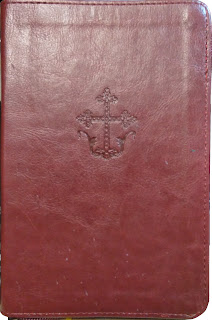
         I have only physically met the EOB-NT in the form of its Portable Edition, which was published by New Rome Press in 2019 (and can be purchased for $40 at their website).  The features of the EOB-NT Portable Edition are notable: 

            Its burgundy leather cover has two ribbons, yellow and red.  A zipper protects the pages (but also prevents them from laying flat).  The print is small; some readers may need a magnifying-glass.  There are two columns of text on each page.

            The text is formatted into logical paragraphs.

            An unfortunate formatting-error has survived in Matthew 27:31:  the words “Simon of Cyrene–The way to Golgotha– The crucifixion of the Lord” were intended to be in the margin in red print, but somehow they have been presented as if they are part of the text.  (Hopefully this will be remedied in future editions.)

            As one handles the EOB-NT Portable Edition, one may feel as if a New Testament manuscript is being held.  Each Gospel is preceded by a full-page illustration, and illustrations – more like icons – also appear before First Corinthians, and after Revelation.   Each book of the New Testament, large or small, is introduced with an artistic, uncomplicated red headpiece, and the book-title in artistic red lettering. Chapter-numbers and superscripted verse-numbers are red.  Footnote-numbers, in black, are also superscripted.

            The text is supplemented by useful colorful maps that deserve special mention.  They depict the Roman Empire, Jesus’ Ministry in Galilee, Jesus’ Journeys to Jerusalem, The Jewish Diaspora at Pentecost, Paul’s Early Travels, Paul’s Third Missionary Journey, Paul’s Trip to Rome, The Ministry of Peter and Philip, the Spread of Christianity During the 1st and 2nd Centuries A.D., and Early Christian Communities, followed by an icon of the Harrowing of Hell with Romans 8:31-34.  

            More information about the EOB-NT Portable Edition can be found in the video-reviews by Orthodox Review and R. Grant Jones and Biblical Studies and Reviews.


Tuesday, January 19, 2021

Video Lecture 22: The New Testament in the Marketplace


            Lecture 22 in the series Introduction to NT Textual Criticism, "The New Testament in the Marketplace," is online at Bitchute and YouTube.  In this 22-minute lecture, I offer a critique of some methods used to market the NIV and other versions, especially the claim that the KJV's base text is late and minimally attested. I review the basis for the KJV's readings in Matthew 17:21, Matthew 18:11, Matthew 20:16, Matthew 23:14, Mark 6:11, Mark 7:16, Mark 9:44, 9:46, Mark 11:26, Mark 15:28, Luke 17:36, Luke 23:17, and John 5:3-4, and draw attention to some non-Alexandrian English versions of the New Testament such as the EOB (Eastern Orthodox New Testament).

Here is an extract:

In 1971, the preface to the RSV was very candid in its criticism of the KJV.  It stated, “The King James Version has grave defects.”   It also stated that the Greek base-text of the New Testament in the KJV was “marred by mistakes containing the accumulated errors of fourteen centuries of manuscript copying.”  It stated that the King James Version’s base-text was essentially the text as edited by Beza in the late 1500s, and that Beza’s text closely followed the work of Erasmus, “which was based upon a few medieval manuscripts.”

             This was technically true, but it is not the whole truth.  This incomplete caricature is still used in the promotion of several translations of the New Testament.  The King James Version is very frequently misrepresented, as if it is only supported by a smattering of late medieval manuscripts.  People are told that scholars today “Now possess many more ancient manuscripts of the New Testament” than were known in the 1500s.

            There are some minority readings in the Textus Receptus.  At Acts 9:5-6, the Textus Receptus has a harmonization that, as far as I can tell, is not supported by any Greek manuscripts.  In Ephesians 3:9 and Philippians 4:3, readings in the Textus Receptus look like the effects of  spelling-mistakes in the manuscripts used in the 1500s.  In First John 5:7-8, the Textus Receptus has a reading that originated in a branch of the Old Latin text, and which only appears in a few late manuscripts as far as Greek copies are concerned.  But these readings do not drastically alter the character of the text:  fewer than 700 readings in the Gospels in the Textus Receptus are not supported by a majority of Greek manuscripts.

            Materials written to promote new versions routinely avoid drawing attention to the strong level of agreement between the Textus Receptus and the majority of Greek New Testament manuscripts.  It is not the Byzantine Text, but the Alexandrian Text, that routinely disagrees with over 90% of the Greek manuscripts.

            But you would never realize this if you relied upon the marketing of modern Bible versions such as the New International Version.  Marketers of modern versions routinely describe the Nestle-Aland base-text as if it is based on very many ancient manuscripts.

            Instead of focusing on the agreements of the Textus Receptus with the majority of manuscripts in the Gospels, Acts, and Epistles, attention is given to the most recent layers of corruption in the Textus Receptus:  as Eberhard Nestle pointed out in 1898:  do we really want to offer readers a text of Revelation that was based on a single manuscript?  Do we really need to go on distributing a text in which the last six verses of Revelation were based on Latin?  Is the Textus Receptus really the best compilation that can be produced?

            Clearly the answer is no.   I have no doubt that Erasmus and Stephanus would agree.  But I am not convinced that they would agree that the need to refine their work justifies throwing out the Byzantine Text and replacing it with the Alexandrian Text, which is what is done by the NIV.  Misrepresentation of the quality and age of the Byzantine Text is a tactic that has been used in many attempts to get people to embrace the Alexandrian Text.  This was done in the 1800s, and it is still attempted today.

            For example, Biblica, formerly known as the International Bible Society, has produced a video called “Is the NIV Bible Missing Verses,” which asks the question, “How did the KJV and other earlier Bibles end up having more words than ours do today?”.  Biblica’s presentation conveys that differences between English versions exist because the Biblical researchers in the 1500s only had a few manuscripts, which were not very early – but researchers today use many more manuscripts that are much more ancient.     

            Specifically, Biblica tells viewers that the main manuscripts used by the producers of the Textus Receptus were just a few hundred years old, only going back to the twelfth century.  In comparison, today’s scholars have “almost 6,000” manuscripts.  In addition, the manuscripts Codex Sinaiticus and Codex Vaticanus provide a “much earlier” text.

            But viewers are not told that the text in the vast majority of those thousands of manuscripts is Byzantine, which means that in most textual contests where the Alexandrian and Byzantine forms disagree, they support the Byzantine reading, and disagree with the Alexandrian form.  In other words, they tend to oppose the base-text upon which the New International Version is based. 

            In addition, viewers are not told how soon the Byzantine readings are supported.  Instead, they are given the impression that their choice is between readings from the 300s, and readings from the 1100s, so, of course they will tend to prefer what they are led to believe is the reading with much earlier support.

             Let’s take a close look at some readings in the Gospels that are included in the King James Version, but are not included in the New International Version – not to delve into the intricacies of each textual contest, but to test how honest, or how dishonest, it is to tell people that when we look at these readings, we are looking at a text from the 300s as the basis for the NIV, versus a text from the 1100s as the basis for the KJV. 

(1) Matthew 17:21 is not in the text of the NIV.  It is supported by over 99% of the Greek manuscripts of Matthew, including Codex D and Codex W.  It is also supported by most of the Old Latin copies of Matthew including Codex Vercellensis.  It is supported by the Vulgate, and was cited by Origen, who died in the mid-200s – before Vaticanus and Sinaiticus.  Other patristic writers who used this verse include Hilary, Basil, Ambrose, Chrysostom, and Augustine, representing five different locales.

(2)  Matthew 18:11 is not in the text of the NIV.  It is supported by the vast majority of manuscripts, including Codex D.  It is also supported by the Vulgate, and by the Peshitta.  It was in the text used by Chrysostom.

(3)  The second part of Matthew 20:16, “For many are called, but few are chosen,” is not in the text of the NIV.  It is supported by most Greek manuscripts of Matthew, including Codex D, and by the Vulgate, and the Peshitta, and it was used by Chrysostom.  An additional consideration is that the final letters of the final word in this phrase are the same as the final letters in the word that comes before this phrase, which could make the whole phrase vulnerable to accidental loss via periblepsis.

(4)  Matthew 23:14 is not in the text of the NIV.  It is supported by the majority of Greek manuscripts of Matthew, including Codex W.  It was quoted by Chrysostom, and is included in the Peshitta.  Another point to consider is the potential of this reading to be accidentally lost via periblepsis, because it begins with the same opening word as the verse before it, and the verse after it. 

(5)  The last part of Mark 6:11 is not in the text of the NIV or the ESV.  It is supported by the vast majority of Greek manuscripts of Mark, including Codex Alexandrinus.  It is also supported by the Gothic version and the Peshitta.

 . . . 

(11)  Luke 23:17 is not in the text of the NIV.  It is included in most Greek manuscripts of Luke, including Codex Sinaiticus and Codex W.  It is supported by the Old Latin text, the Vulgate, and the Peshitta. 

(12)  John 5:3-4 is not in the text of the NIV or the ESV.  It is included in most Greek manuscripts of John, including Codex Alexandrinus.  Tertullian, writing in about the year 200, seems to have used a text of John that has this reference to an angel at the pool of Bethesda.  It inclusion is also supported by the Peshitta, and by Chrysostom in his Homily 36 on John.

             More than nine times out of ten in the Gospels, where a verse or phrase is included in the King James Version but is not in the NIV, its inclusion is supported by the majority of Greek manuscripts, and support for the KJV’s reading can be seen in evidence from the 300s, the same century when Codex Vaticanus and Codex Sinaiticus were made.

            It is simply not true that the verses and phrases that are supported by the Byzantine Text typically only appear in late medieval manuscripts.  Claims that promote the idea that the KJV’s readings typically originate in the 1100s or later should be regarded as propaganda.

            In addition, it should be pointed out that when marketers of the NIV refer to the high number of Greek New Testament manuscripts as an “embarrassment of riches,” they are strangely celebrating the abundance of evidence against the text that they promote, since the vast majority of Greek manuscripts support the readings that are not in the text of English versions such as the NIV, the ESV, the NLT and the NET   

            The base-text of the NIV is often described as an “eclectic” text.  By definition, an “eclectic” compilation takes all transmission-branches into consideration.  But in terms of its content, at points where the Alexandrian Text and the Byzantine Text disagree, the Nestle-Aland compilation adopts the Byzantine reading less than 1% of the time.

            The Nestle-Aland text represents the local text of Egypt, especially as represented by Vaticanus and Sinaiticus, from the fourth century.  Support for many Byzantine readings is just as old, or only slightly later.  For some Byzantine readings, it is earlier

           What about papyrus manuscripts?  Papyrus manuscripts from the 200s confirm the earlier use of the Alexandrian Text in Egypt.  We do not have papyrus evidence from other locations.  But, unless one wants to propose that Christians in the 300s spontaneously threw out the copies of Scripture that their predecessors had endured persecution to protect and preserve, the alternative is to reckon that there were papyrus manuscripts in Italy, Greece, Cyprus, Turkey, and Syria in the 200s, and that they were the ancestors of manuscripts used in the 300s and 400s which contained many Byzantine readings.    

            The humidity-level in Italy, Greece, Cyprus, Turkey, and Syria is not conducive to the preservation of papyrus – but it is not equitable or reasonable to ignore the text from this area because of the weather.  The early stratum of the Byzantine Text deserves attention, especially the readings preserved in writings by individuals such as John Chrysostom, Gregory of Nyssa, Basil of Caesarea, Cyril of Jerusalem, Theodoret of Cyrrhus, and others.

            This does not mean that future investigation of the text that was used in the northeastern Roman Empire in the 300s and 400s will vindicate every reading found in the majority of Greek manuscripts.  It won’t.  But the earliest discernible stratum of the Byzantine Text deserves much more attention than it has received in the so-called “eclectic” compilation upon which the NIV is based.

            There are alternatives to English translations that are based on the 99% Alexandrian Nestle-Aland compilation.  Some Bible-readers, particularly in the United States, have reacted to the challenge posed by new versions by answering all text-critical questions with one response:  “The King James Version is always right.”  That response is not scientifically sustainable, and in many cases it is fueled by a tendency to stick to the New Testament translation one is used to, whether it really is based on the original Greek text or not.    

            Other Bible-readers, acknowledging non-original elements in the Textus Receptus but regarding them as fairly benign, have decided to stick with the King James Version, on the grounds that although its base-text is far from perfect, it has been shown to be sufficiently accurate as an English representation of the meaning of the original text.  

             For Bible-readers who desire their English translation to conform to the original text as closely as possible, rather than be inordinately limited to the local text of Egypt, the challenge posed by the rise of versions based on a pseudo-eclectic base-text should be met by the application of a more equitable eclectic method of textual criticism – an approach that is not biased against the idea that the original text may be found in the Byzantine Text.  With that in mind, I refer you to the following four English translations.

            The base-text of the New Testament in the Evangelical Heritage Version, released in 2017, is far from consistently Byzantine, but its editors have taken the Byzantine Text seriously.  Of the 12 readings reviewed in this lecture, the EHV includes seven of them in the text.  The text of the EHV also includes Mark 16:9-20, Luke 22:43-44, all of Luke 23:34, and John 7:53-8:11.  More information about the Evangelical Heritage Version can be found at  wartburgproject.org – that’s W-a-r-t-b-u-r-g-project.org, all one word.    

            The Eastern Orthodox New Testament reflects an awareness of the critical text in its footnotes, but consistently favors the Byzantine Text.  It can be purchased from New Rome Press, and it can be read online, for instance at the website yorkorthodox.org/bible .  The text of the EOB includes all of the readings reviewed in this lecture, and also includes Mark 16:9-20, Luke 22:43-44, all of Luke 23:34, and John 7:53-8:11.

            The World English Bible is a copyright-free translation of the Old Testament and New Testament.  Its New Testament was intended to be based on the Majority Text.  It is available as a free PDF download at https://worldenglish.bible/ and is also available in print.

            In addition, if you read the New King James Version and pay special attention to its textual footnotes, especially where readings in the Majority Text are mentioned, it will be similar to reading a version based on the Byzantine Text.

             Thank you.