Followers

Showing posts with label Walters. Show all posts

Thursday, December 12, 2019

Christmas Combat: Luke 2:1-18 in Codex Bezae


            It’s time for another round of hand-to-hand combat!  Since it’s almost Christmastime, our combatants will square off in Luke 2:1-18, a passage which contains the accounts of the birth of Christ and the angels’ visit to the shepherds who were keeping watch over their flocks.  The competitors in today’s contest are the famous Codex Bezae (D, 05) – which nowadays is usually assigned to the early 400s – and GA 2370, a remarkably small minuscule Gospels-manuscript from the late 1000s, one of several Greek New Testament manuscripts at the Walters Art Museum (the manuscript is also known as Walters 522). 
            Before proceeding, let’s consider a few details about 2370:
            ● 2370 is a nearly complete copy of the four Gospels; the last verse on its last (damaged) page is John 21:3.
            ● The story of the adulteress is included (7:53 begins on page-view 521, numbered as fol. 253 at the top and as 248 at the bottom).  However, the pages from 247a (numbered as 242 at the bottom) (beginning in John 6:32) to 261 are secondary; the main copyist’s work resumes on 262a (page-view 539) in Jn. 10:14.  A few of the secondary pages were inserted upside-down.
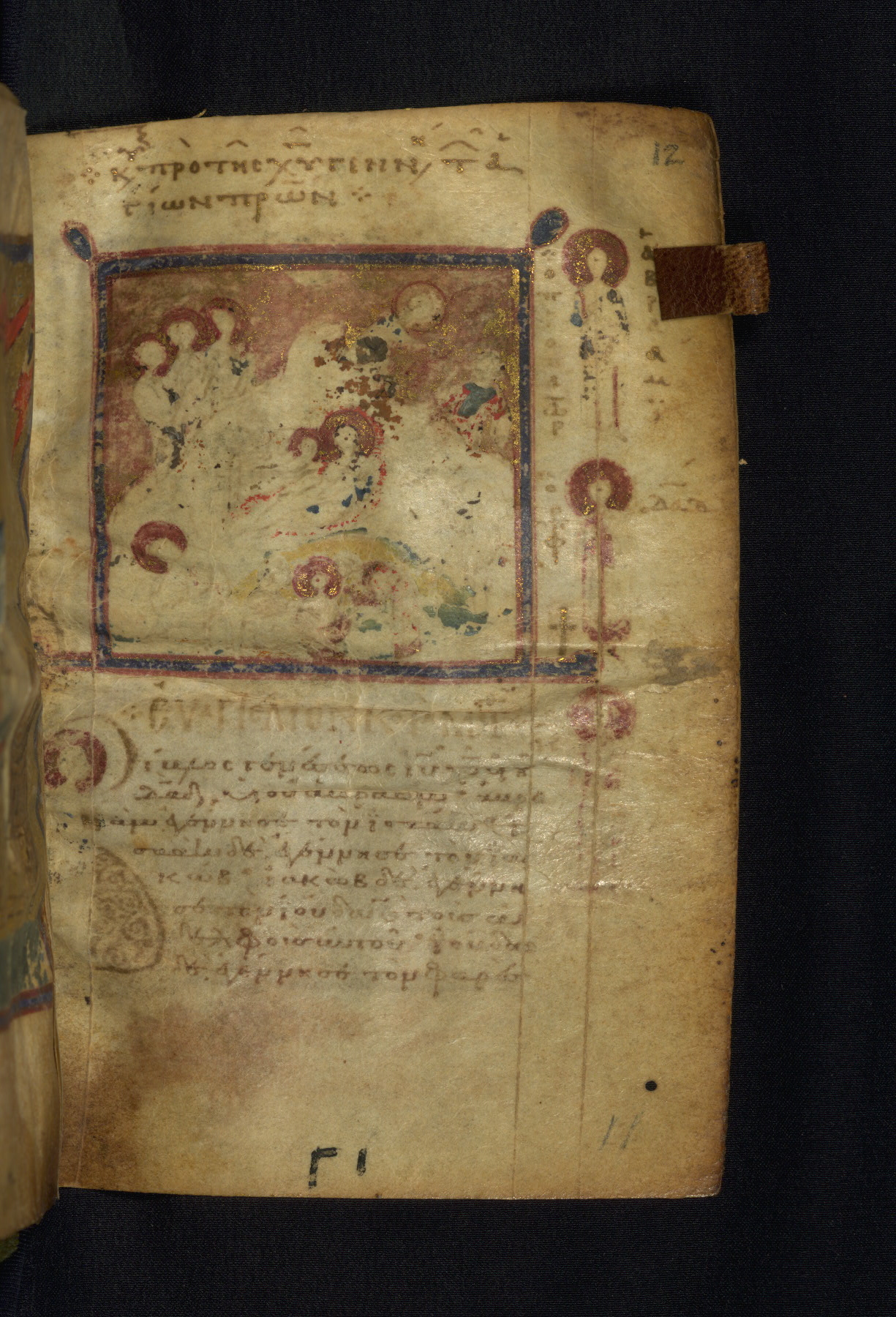
            ● Each Gospel is accompanied by a picture of the Evangelist, and an icon-like headpiece.  For Mark, the headpiece is a portrait of Christ (with hardly any pigment surviving); for Luke, the headpiece is an icon representing the birth of John the Baptist; Zachariah stands in the margin, and Luke is represented in the initial.  For John, the full-page portrait shows John dictating to Prochorus, and the headpiece is a portrait (fairly intact) of Christ.
            ● A detailed description of 2370 can be found in Georgi R. Parpulov’s Catalogue of Greek Manuscripts at the Walters Art Museum, which the author dedicated to the memory of his beloved grandfather, Konstantin Tzitzelkov.

            This contest may provide a convenient test of the idea that the oldest a manuscript is, the better its text tends to be.  If the assigned production-dates for these two manuscripts are correct, then the copyists in the transmission-line of GA 2370 had more than twice as much time as the copyists of in the transmission-line of Codex D to make additions, omissions, and other mistakes in the text.  Let’s compare their contents and see which text is more accurate, using as our standard of comparison the Tyndale House Greek New Testament.
            As in earlier rounds of Hand-to-Hand Combat, a few ground rules are in play.  A point is assigned to each manuscript for each non-original letter in its text, and a point is also assigned to each manuscript for each original letter that is absent from its text.  Transpositions are mentioned, but do not result in any points unless there is an actual loss of a letter or letters.  Nomina sacra (i.e., sacred-name contractions) and other contractions in and of themselves are not considered variants, unless the contraction is of a word that is not in the original text. Movable-nu differences are not noted in this comparison.

Luke 2:1-18 in GA 2370

1 – no variants
2 – has η after αυτη (+1)
3 – has ιδιαν instead of εαυτου (+5, -6)
4 – no variants
5 – has μεμνηστευμένη instead of εμνηστευμενη (+1)
5 – has αυτου instead of αυτω (+2, -1)
5 – has γυναικι before ουση (+7)
5 – has εγκύω instead of ενκύω (+1, -1)
6 – no variants
7 – has τη before φατνη (+2)
8 – no variants
9 – has ιδου before αγγελος (+4)
10 – no variants
11 – no variants
12 – does not have και before κείμενον (-3)
13 – no variants
14 – has ευδοκια instead of ευδοκιας (-1)
15 – has και οι ανθρωποι after αγγελοι (+13)
15 – has ειπον instead of ελάλουν (+5, -7)
16 – has ηλθον instead of ηλθαν (+1, -1)
17 – has διεγνώρισαν instead of εγνώρισαν (+2)
18 – no variants

            Thus, when we look over 2370’s text and compare it to the Tyndale House edition of the Greek New Testament, as if the Tyndale House edition is the original text, 2370’s text of Luke 2:1-18 contains 45 non-original letters, and is missing 20 original letters, for a total of 65 letters’ worth of scribal corruption.  
            Now let’s look at the same passage in Codex Bezae, which is estimated to be at least 500 years older than GA 2370.  In a couple of places, there is a correction in the manuscript; to keep things simple I removed these variants from consideration after making mention of them.

Luke 2:1-18 in Codex Bezae (D, 05)

1 – no variants
2 – transposes to εγενετο απογραφη πρωτη
3 – has πατριδα instead of πολιν (+6, -4)
4 – has Ναζαρεθ instead of Ναζαρετ (+1, -1)
4 – has Ιουδα instead of Ιουδαίαν (-3)
4 – has καλειτε instead of καλειται (+1, -2)
4 – transposes the last phrase of v. 4 and the first phrase of v. 5
5 – has απογράψεσθαι instead of απογράψασθαι (+1, -1)
6 – has ως instead of εγενετο before δε (+2, -7)
6 – has παρεγείνοντο instead of εν τω ειναι αυτους εκει after δε (+12, -19)
6 – has ετελέσθησαν instead of επλήσθησαν (+4, -3)
7 – no variants
8 – has δε after ποιμενες instead of και before ποιμενες (+2, -3)
8 – has χαρα ταυτη instead of χωρα τη αυτη (+1, -2) [correction in MS]
8 – has τας before φυλακας (+3)
9 – has ϊδου before αγγελος (+4)
9 – does not have κυρίου (ΚΥ) after δοξα (-6, or -2 if counted as contracted sacred name)
10 – has υμειν instead of υμιν (+1)
10 – has και before εσται (+3)
11 – has υμειν instead of υμιν (+1)
12 – has υμειν instead of υμιν (+1)
12 – has εστω after σημειον (+4)
12 – does not have και κείμενον (-11)
13 – has στρατειας instead of στρατιας (+1)  
13 – has αιτουντων instead of αινουντων (+1, -1) [correction in MS]
15 – no variants
15 – moves οι αγγελοι to follow απηλθον
15 – has και οι ανθρωποι before οι ποιμενες (+13)
15 – has ειπον instead of ελάλουν (+5, -7)
15 – has γεγονως instead of γεγονος (+1, -1) [correction in MS]
15 – has ημειν instead of ημιν (+1)
16 – has ηλθον instead of ηλθαν (+1, -1)
16 – has σπευδοντες instead of σπευσαντες (+2, -2)
16 – has ευρον instead of ανευρον (-2)
16 – does not have τε before Μαριαμ (-2)
16 – has Μαριαν instead of Μαριαμ (+1, -1)
17 – does not have τουτου (-6)
18 – has ακουοντες instead of ακουσαντες (+1, -2)
18 – has εθαυμαζον instead of εθαυμασαν (+2, -2)

            Thus, when we look over Codex D’s text of Luke 2:1-18, and compare it to the Tyndale House edition of the Greek New Testament, as if the Tyndale House edition is the original text, D’s text of this passage contains 76 non-original letters, and is missing 86 original letters, for a total of 162 letters’ worth of scribal corruption.  
            Can we make the score – only 65 letters’ worth of corruption in 2370’s transmission-line over 900 years, but 162 letters’ worth of corruption in Codex D’s transmission-line over 350 years! – a little closer by removing trivial spelling-related variants from consideration?  If we overlook the variant-units that involve  the spelling of Ναζαρετ in verse 4, καλειται in verse 4, εγκύω in verse 5, απογράψασθαι in verse 5, the corrected reading in verse 8, υμιν in verses 10, 11, and 12, στρατιας in verse 13, the corrected readings in verses 13 and 15, ημιν in verse 15, ηλθαν in verse 16, Μαριαμ in verse 16, and εθαυμασαν in verse 18, Codex D’s text of Luke 2:1-18 still contains 62 non-original letters, and is still missing 74 original letters, yielding a total of 136 letters’ worth of scribal corruptions.
            Thus we see that 2370, a medieval minuscule that is not mentioned in the textual apparatuses of the Nestle-Aland, UBS, or Tyndale House compilations (or any other textual apparatus that I know of), contains a text of Luke 2:1-18 that is, at minimum, twice as accurate as the text of Luke 2:1-18 in Codex Bezae.

            In addition, in at least four places in this passage, I suspect that the Tyndale House edition of the Greek New Testament contains a corruption. 
            ● First, the spelling of ενκύω (εγκύω in NA, in Tregelles, in Scholz, in Baljon, in Souter, in Holmes’ SBLGNT, and in Byz) in 2:5:  what justifies the adoption of this anomaly?
            ● Second, there is the contest involving the final word of Luke 2:14.  Regarding this I have offered an analysis previously, vindicating the reading ευδοκια which is the basis for the phrase (and carol-lyric) “Peace on earth, good will to men.” 
            ● Third, in verse 9, ἰδού is broadly attested by A D Κ Θ Byz 157 1424 OL Vulgate Pesh, and should be retained.  Contrary to Metzger’s proposal that it is difficult to imagine why copyists would have omitted “behold,” it is not hard at all to reckon that they felt over-beholden, in light of the recurrence of the same term in v. 10 (and in 1:20, 1:31, 1:36, 1:38, 1:44, 1:48, and in 2:25).  The word ἰδού is omitted in 2:25 by D and N; it is also omitted by D in 6:23, 7:12, and 8:41, 9:39 (where ℵ also omits), 10:25, 23:15, and 24:13.  The same phenomenon is on display at Lk. 17:21 and 19:19 in 157, and at 22:21 in f13, and at 23:29 in P75, D, and f13, and in 24:49 in P75 and D.  (Readers may also compare how the word “Behold” has disappeared from some English versions, even though ἰδού remains in their base-text.)        
            ● Fourth, in verse 15, it is easy to notice that the words καὶ οἱ ἄνθρωποι are vulnerable to accidental parableptic loss, situated between οἱ ἄγγελοι and οἱ ποιμένες, especially when ἄνθρωποι is written in contracted form (και οι ανθοι οι).  Tregelles included these words in his Greek New Testament, albeit in brackets.  Burgon’s brief comments on this passage (in Causes of Corruption, page 36) remain forceful. 

           Finally, especially in light of the approach of the Christmas season, a feature in 2370 draws our attention:  the headpiece for the Gospel of Matthew is a Nativity icon – or what is left of one.   Mary and the baby Jesus are depicted in the center of the picture; when the icon was pristine, the red paint around Mary represented her red bed-mattress. Joseph and other characters are also in the picture.  Above the picture is the heading for the lection assigned to the Sunday before Christmas (for the Holy Fathers).  In the outer margin next to the main picture are representations of Abraham and David.  This small manuscript was apparently used by some very devout readers, whose kisses gradually took away most of the pigment.      


Readers are invited to double-check the data in this post.  


Saturday, September 3, 2016

Hand-to-Hand Combat: Codex A versus 2222

A miniature of Saint John,
in the left corner of fol. 112v
in the Circle Gospels
.
          Today’s hand-to-hand combat once again features Codex Alexandrinus, an important uncial manuscript from the 400’s.  Codex A hails from the British Library.  In the opposing corner, representing the Goodspeed Manuscript Collection at the University of Chicago, is minuscule 2222, a manuscript which has been assigned a production-date in the 1300’s.  This medieval copy is known as the Circle Gospels due to the rather unusual circular shape in which its copyist frequently wrote the letters omicron, epsilon, and theta.  It is about 900 years younger than Codex A.  Today’s battlefield is John 15:1-9, part of Jesus’ discourse with His disciples on the night before His trials and crucifixion.  
          As we investigate which manuscript has the more accurate text, the usual ground-rules are in play:  the standard of comparison is the text of the 27th edition of the Nestle-Aland compilation.  Words in brackets in NA27 will be treated as part of the text.  Transpositions will be mentioned but not counted in the final totals.  Agreements with the RP2005 Byzantine Textform will be signified by a triangle; agreements with the Hodges-Farstad Majority Text that disagree with RP2005 will be signified by a square. 

Here is how 2222 compares to NA27 in John 15:1-9:

1 – 2222 has εστι instead of εστιν (-1)  ■
2 – 2222 transposes, reading πλειονα καρπον.  (P75 supports this reading, agreeing with 2222 and the Byzantine Text against Vaticanus, Sinaiticus, and D.)  ▲
3 – no differences  ▲
4 – 2222 has δυνατε instead of δυναται (+1, -2)
4 – 2222 has μεινη instead of μενη (+1)  ▲
4 – 2222 has μεινητε instead of μενητε (+1)  ▲
5 – no differences  ▲
6 – 2222 has μεινη instead of μενη (+1)  ▲
6 – 2222 has βαλλουσι instead of βαλλουσιν (-1)  ■
7 – no differences
8 – 2222 has γενησεσθε instead of γενησθε (+2)  ▲ 
9 – 2222 has αγαπησε instead of αγαπησεν (-1)  ■
9 – 2222 transposes, reading ηγαπησα υμας  ▲

          Thus 2222 has six non-original letters in John 15:1-9, and is missing five original letters, for a total of 11 letters’ worth of corruption.  

And here is how Codex Alexandrinus compares to NA27: 

1 – A has αληθεινη instead of αληθινη (+1)
2 – A has φερων instead of φερον (+1, -1)
2 – A has (again) φερων instead of φερον (+1, -1)
2 – A transposes, reading πλειονα καρπον.   (Agreeing, like 2222, with P75)  ▲  
3 – A has εσται instead of εστε (+2, -1)
4 – A has μινατε instead of μεινατε (-1) 
4 – A has μεινη instead of μενη (+1)  ▲  
5 – no differences  ▲
5 – A has δυνασται instead of δυναστε (+2, -1)
6 – A has κεεται instead of καιεται (+1, -2)
7 – A has μεινηται instead of μεινητε (+2, -1)
7 – A has αιτησασθαι instead of αιτησασθε (+2, -1)
8 – A has φερηται instead of φερητε (+2, -1)
8 – A has γενησεσθαι instead of γενησθε (+3, -2) 
9 – A transposes, reading ηγαπησα υμας

          Thus Codex A has 18 non-original letters, and is missing 12 original letters, for a total of 30 letters’ worth of corruption.  At the end of a transmission-stream lasting about 1,260 years, 2222 ended up with 37% as much corruption in John 15:1-9 as we see in the same passage in Codex Alexandrinus, the transmission-stream of which lasted about 360 years.  
          A solid win for 2222!
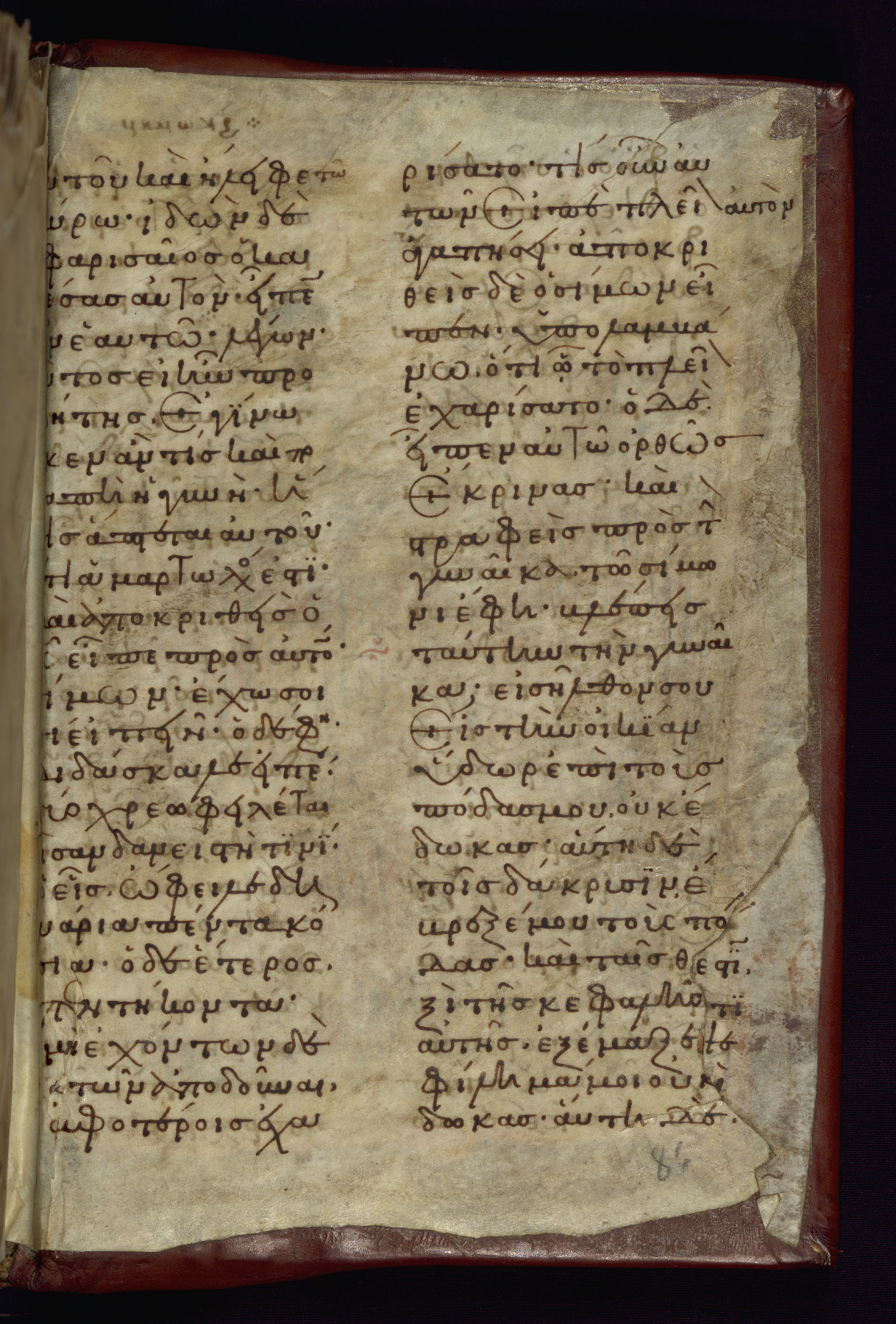
          Incidentally, in addition to the page-views of 2222 at the Goodspeed Manuscript Collection’s website, two more pages of this codex can be seen online.  Someone used two of its pages as binding-material for another, older Gospels-manuscript, minuscule 2369, which is kept at the Walters Art Museum.  The dislocated pages contain Luke 11:53-12:6 and Luke 7:38-45.    


[Readers are invited to double-check the data and math in this post.]


Saturday, February 20, 2016

An Edifying Error in a Syriac Manuscript

          The differences in the text of manuscripts of the Gospels tend to fall into categories.  The chief difference is between readings that are original and readings that are not original.
          Variants in the group of readings that are not original fall into two sub-categories:  first, variations that do not affect the meaning of the text, and variations that do affect the meaning of the text.  Most non-original textual variants fall into the first category, and while they are sometimes helpful for textual criticism, they tend to be considered unimportant because their impact on interpretation is inconsequential.    (Nevertheless, textual critics should not ignore variants that do not impact the meaning of the text, because even minor variants may provide clues about the background of a manuscript and its text.  Spelling-variations may suggest that a manuscript’s copyist was from a particular locale.  A cluster of manuscripts which share the same inconsequential variants are probably related in some way.) 
          The non-original variants that are capable of affecting the meaning of the text may be divided further into sub-categories:  reading which appear to have originated accidentally, and readings which appear to have been deliberate.  The categorization of a particular reading will depend on the text-critical decision about whether it is original or not.  For example, in First Thessalonians 1:1, if the inclusion of the second half of the verse is considered original, then its loss may be explained as an accident, caused when an early copyist’s line of sight drifted from the middle of the verse (“in God the Father and the Lord Jesus Christ”) to the end of it, where a similar phrase recurs (“from God our Father and the Lord Jesus Christ”).  But if it is considered non-original, then its presence can only be accounted for as a deliberate conformation to the opening verses of some of Paul’s other letters (such as Philippians 1:2).
          Accidental variants merely inform us that copyists were not immune to accidents, but readings which are clearly non-original and clearly intentionally created tend to imply an agenda, either in the mind of a manuscript’s copyist, or (more often) in the mind of the earlier individual who created the variant.  And, again, the category of deliberate changes sub-divides into sub-categories:  

● attempts at technical correction (for instance, when it appears that a copyist thought there was an error in his exemplar, and attempted to make an on-the-spot correction), 
● attempts at verbal clarification (for instance, when it appears that a copyist encountered a word or phrase which he thought his readers might misunderstand, and replaced it with a clearer or more common word), 
● attempts at doctrinal clarification (for instance, when it appears that a copyist encountered something in his exemplar which raised a doctrinal question in his mind, or which he suspected would raise a doctrinal question in his readers’ minds, and he adjusted the text into a form more amenable to his own theological preferences), 
● liturgical adjustments (for instance, adding Jesus’ name at the beginning of a section used as a lection, and adjusting statements in the text that were adapted for specific rites and ceremonies), and
● attempts at edification.

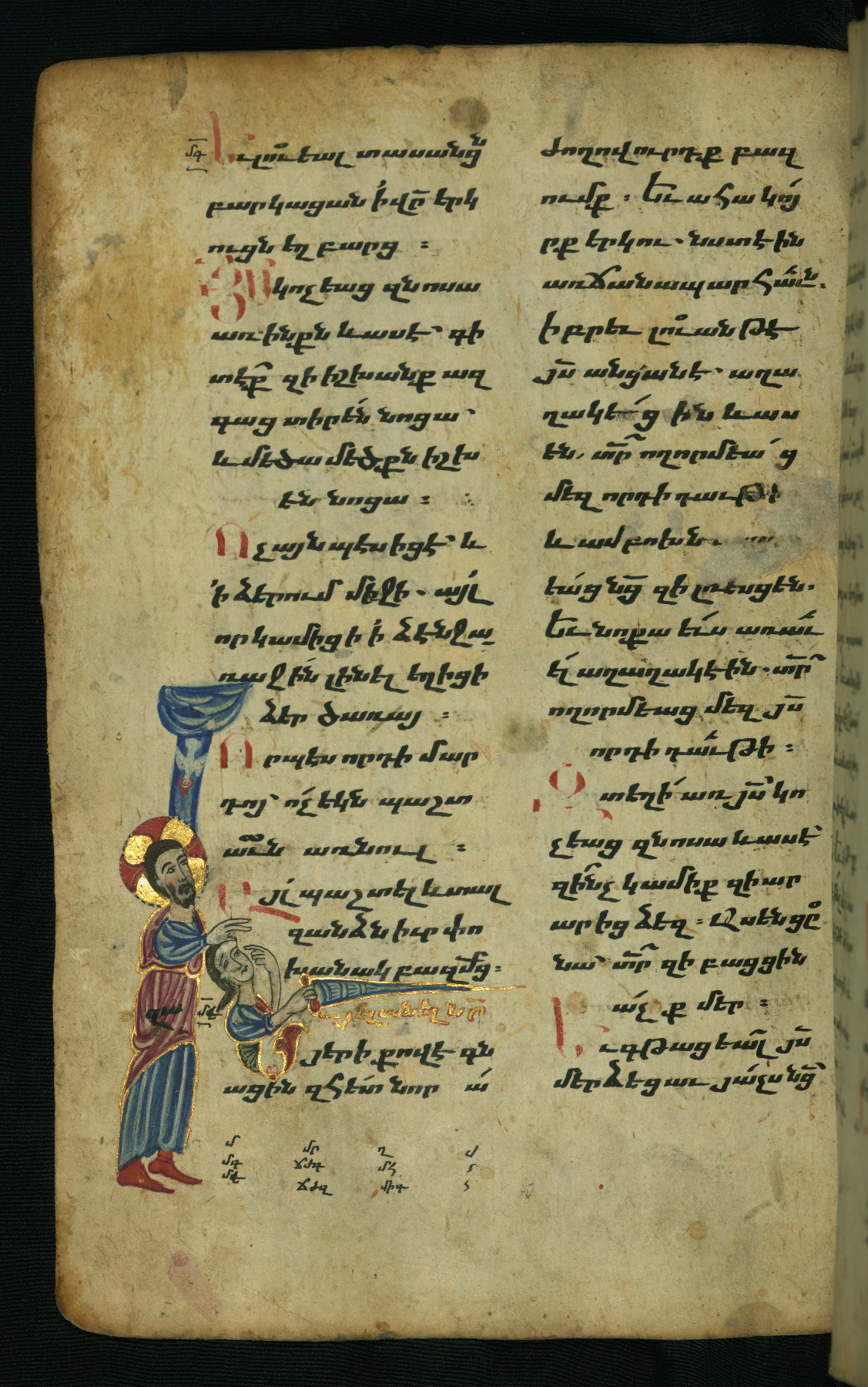
An Armenian manuscript from the 1400s
features an illustration of Jesus and the blind man
(Walters MS 540).
        Examples of this last category – attempts at edification – are very rare, inasmuch as most copyists were content to let the Scriptural text edify and instruct the reader.  The ambition of the typical copyist was simply to make an accurate copy, and for this task, the more robotically he worked, the better – provided that he was working from a legible, complete, and accurately copied exemplar.  Occasionally, though, a copyist came along who considered it his responsibility to improve upon the text which had been handed down to him, either because of reckless pride, or because manuscripts in his care had indeed been poorly copied, or damaged.
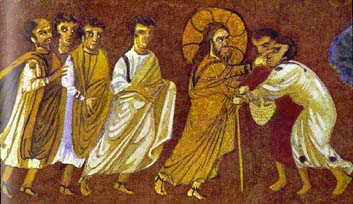
          Two variants, occurring in Matthew 20:33 and Luke 18:41 (parallel-passages that are, in both Gospels, part of the account of the healing of the blind man in Jericho), were apparently made to edify the reader.  They are found only in the Curetonian Syriac manuscript.  (This manuscript is named after William Cureton (1808-1864), who published its contents in 1858.  It is one of a very small group of early witnesses – it probably was produced in the 400s – with text from an early Syriac version of the Gospels which was made before the Peshitta became so dominant that other Syriac versions ceased to be used.)     
          In  Matthew 20, the scene runs as follows:  two blind men, stationed along the road near the city ofJericho, cry out to Jesus as He and his disciples pass by:  “Have mercy on us, O Lord, Son of David!”  Although the crowd discourages their disruptive shouting, Jesus stops and calls them, and asks them what they want.  They answer – in the text of verse 33 that is usually found – “Lord, that our eyes may be opened.”  The Curetonian Syriac reports the same thing, but then adds that the blind men also said, “And to see you.”  
          Luke 18 mentions one blind man (according to Mark 10:46, his name was Bartimaeus); after Jesus asks him, “What do you want me to do for you?”, in the text that is typically found, the man responds:  “Lord, that I may receive my sight.”  And here, again, the text has been altered in the Curetonian Syriac manuscript, with the result that the blind man’s response in verse 41 is, “Lord, that I may receive my sight, and see you.
          It is as if a note that was intended to remind the reader about a sermon-point has somehow crept into the text.     
   
           Although it is often necessary for translators to add extra words to make a translation clearly convey the meaning of the Greek text, the insertion of words that convey some other meaning is not a good thing to do.  But in this case, the insertion is so edifying that the situation seems comparable to finding silver in a gold mine.  For when we come to Christ in a condition of spiritual blindness, before we can see anything as it truly is, we must first see Christ, the light who enlightens everyone.  Whatever blessings or burdens we may observe, and whatever friends, foes, or strangers we meet, we cannot see them properly until we first see Christ, and view everyone and everything else in the light of His presence.  As Jesus said in John 8:12, “The person who follows Me shall not walk in darkness, but shall have the light of life.”  And as Psalm 36:9 says, “In Your light, we shall see light.”
          Every time our eyes open, before we see anything else – let us see Christ first!

Tuesday, February 17, 2015

Major Early Uncials of the Gospels: Online Access

This week, digital images of Codex Vaticanus (B, 03) came online, allowing viewers to see every page of that extremely important Biblical manuscript.  Most of the major early uncial parchment manuscripts containing the Greek text of the Gospels (or portions of the Gospels) are now online.  Manuscript-digitization are underway not only at the Vatican Library but also at the British Library, the University of Chicago, and other institutions.  The Center for the Study of New Testament Manuscripts continues to add to its extensive collection of manuscript-images.      

Here is a list of embedded links to images or PDFs of some major New Testament uncials.  (Clicking on a name will take you to the images, or to a page that features a download-PDF option):
Codex Sinaiticus  (
, 01):
Codex Alexandrinus (A, 02):
Codex Vaticanus (B, 03):
Codex Ephraemi Rescriptus (C, 04)
Codex Bezae (D, 05)
Codex Seidelianus (G, 011) 

Codex Regius (L, 019)
Codex Campianus (M, 021)
Codex Guelpherbytanus B (Q, 026)
Codex Nitriensis (R, 027) 
Codex Washingtoniensis (W, 032)
Codex Monacensis (X, 033) 
Codex Sangallensis (Δ, 037)
Codex Beratinus [one of the Purple Uncials] (Φ, 043)
Codex Macedonianus (Y, 034)

Some manuscripts representing versions of the Gospels are also online:
Latin Gospels of Augustine of Canterbury
Latin Saint Cuthbert's Gospel of John
Latin Book of Kells 

Latin St. Chad/Lichfield Gospels
Coptic Lycopolitan Gospel of John 

Gothic Codex Argenteus
Syriac (Peshitta) Khabouris Codex 
Syriac (Harklean) Mingana Collection, Syriac 124
Armenian Sargis Gospels/Gospels of the Translators  
Ethiopic Tigray Gospels
Slavonic Chrysanthus Gospels

Old English Bath Gospels


In addition, images of minuscule Greek manuscripts of the Gospels, as well as manuscripts of the Gospels in other languages, can be viewed (either page-by-page, or in downloadable PDF's) at CSNTM, the Digitized Manuscripts Collection at the British Library (enter "Gospels" in the Quicksearch box), the Goodspeed Manuscript Collection, the website of the Leimonos Monastery, the Parker Library on the Web, the Digital Walters Art Museum, the World Digital Library, and the George Grey Collection.

Lots of New Testament papyri are online, too, such as the pages of Papyrus 46 at the University of Michigan.  But that's a subject for another day.

O what challenging times in which we live!