Followers

Showing posts with label Cureton. Show all posts

Saturday, April 14, 2018

Five Palimpsests

Mark 16:14-20 in Codex C,
with later Greek text
written over it.
            Today, let’s take a look at some palimpsests among the New Testament manuscripts.  What is a palimpsest?  A palimpsest – so-called because the parchment has been scraped twice; once in the course of the manuscripts’s initial production, and again when it was recycled; the term is derived from the Greek words πάλιν (again) and ψάω (scrape) – is a manuscript that has been recycled.  After the manuscript was initially produced, someone came along, took it apart, and removed the writing by washing and/or scraping it off the parchment, so that the parchment could then be used as writing-material for another composition (sometimes even another copy of part of the New Testament). 
This happened especially (but not exclusively) in places where writers did not know Greek and/or did not have the means to buy (or to easily buy) new parchment.  We are able to read palimpsests because the recyclers’ efforts to scrape away the ink were frequently only partly successful; ink embedded in the parchment-material was not so easy to erase completely.  Sometimes the lower writing (the older writing) is in the same format as the upper writing (the more recent writing that covers the older writing), but in other cases, it is upside down or sideways compared to the upper writing – and this can vary in the same palimpsest.   
            Over 50 palimpsests are continuous-text uncial manuscripts with text from the New Testament.  Here are five of them: 
Codex Ephraimi Rescriptus (C, 04) is an important manuscript made in the 400s.  In the 1100s, someone recycled its pages, and used them as writing-material for a Greek translation of some of the writings of Ephraem the Syrian, written in Greek minuscule script.  That is how the manuscript obtained its name.  For many years, European scholars attempted to read the lower writing, but with limited success.  Finally in 1843-1845, Constantine von Tischendorf (who is perhaps best-known for his acquisition of Codex Sinaiticus) carefully transcribed the text of Codex C, representing part of the Old Testament in the Greek Septuagint version (Job, Proverbs, Ecclesiastes, Song of Solomon, and the apocryphal book Wisdom of Solomon) and almost every book of the New Testament (except Second Thessalonians and Second John).  Tischendorf also noticed the corrections in the text, introduced by three distinct persons in the 500s, 900s, and (probably) the 1200s. 
            Tischendorf’s work, while excellent, could be improved or at least double-checked (as R. W. Lyon attempted in 1958) by the use of multi-spectral imaging.  Hopefully this will be done before the manuscript’s Greek text becomes completely illegible as result of the harmful chemicals that were used upon it in the 1830s in attempts to make its lower writing easier to read.    
           
Codex Nitriensis (R, 027):  In the 700s, a monk named Simeon needed parchment to make a copy of the Syriac composition Against the Impious John the Grammarian, by Severus of Antioch.  To obtain the parchment, a few old Greek manuscripts were recycled:  a manuscript of Homer’s Iliad from the 400s, a manuscript of Euclid’s Elements from the 600s, and a manuscript of the Gospel of Luke from the 600s.  This manuscript was once in the impressive library of the monastery of St. Mary Deipara, which was located in the Nitrian Desert in Egypt; this is why it is called Codex Nitriensis. 
This digitally enhanced
image shows text from
Luke 16 in Codex R (027).
            After this manuscript was purchased, William Cureton (the same researcher who discovered and published the Curetonian Syriac manuscript) published its text of part of the Iliad in 1851.  Its text of Luke was studied by both Samuel Tregelles and Constantine Tischendorf; the latter published it in 1857 in his series Monumenta Sacra Inedita, volume 2 (beginning on page 56 of the downloadable file), and each page’s contents are identified in his transcription. 
Now housed at the British Library (and catalogued as Add. MS 17211), Codex R has been rebound so that the opening pages contain the portion which has text from the Gospel of Luke in the lower writing.  Tischendorf managed to not only transcribe the text but also the Eusebian Section-numbers and the marginal note seen here (which accompanies text from Luke 16 but relates to the parable of the Prodigal Son which was on the preceding page).  On some pages, quite a bit of the Greek text, written in two columns per page, is in the margins and is not obscured by the Syriac upper writing; on other pages practically all of the Greek text is thoroughly eclipsed.  Some of the British Library’s digital images of pages of Luke have been helpfully indexed.
A study of the text of R by Robert Waltz indicated that there is considerable mixture in R’s essentially Byzantine text, especially in chapters 13, 14, and 15.  It is one of the relatively few manuscripts which do not include Luke 22:43-44.  Despite the importance of Codex R, the compilers of the 27th edition of the Nestle-Aland Novum Testamentum Graece deliberately stopped citing it, as stated in the Introduction of that edition.   
           
Codex Guelpherbytanus A (024, Pe) and 026 Codex Guelferbytanus B (026, Q) are two early Greek witnesses to the Byzantine text of the Gospels.  They are often consulted together, because each one was recycled when someone in the 700s used their pages for writing-material with which to make a copy of the Latin text of Isidore of Seville’s Etymologies, a.k.a. Origins, a highly significant work in its own right.  
            The person who prepared this palimpsest also recycled pages from a Latin-Gothic copy of Romans (this text is known as Codex Carolinus, a.k.a. Beuron 79) and the lower writing dates to the 500s or 600s), a Vulgate copy of the book of Judges, a Vulgate copy of Job, a copy of Ambrosiaster’s Commentary on Romans, and a copy of the Roman author Galen’s composition On the Properties of Foods.
Tischendorf gave 024 and 026 his attention and transcribed then both:  024’s text of portions of Matthew, Mark, Luke, and John is recorded in Monumenta Sacra Inedita, Volume 6, published in 1869, following the title-page on digital page 276.  Tischendorf’s transcript of 026’s text of portions of Luke and John (especially Luke) follows digital page 310 in Monumenta Sacra Inedita, Volume 3, published in 1860. 
            Unfortunately, few individuals other than readers of Tischendorf’s publications (in which most of the introductions and notes were written in Latin) seem to have paid much attention to Codices 024 and 026.  Bruce Metzger did not mention them in the chapter Important Witnesses to the Text of the New Testament in his textbook The Text of the New Testament.  026, but not 024, was consulted for the Tyndale House edition of the Greek New Testament.  Hopefully this neglect will not last long.  A complete index of 024 and 026 (facilitating comparisons between the online digital images of the manuscript, and Tischendorf’s page-by-page transcript) is available as a free download among the files stored at the NT Textual Criticism group on Facebook.
            (Those who page through the digital page-views may also notice Isidore’s comments and diagrams about the spherical shape of the earth, the moon’s rotation around the earth, etc.)  
           
On this page from Codex Zacynthius (040),
an excerpt from the writings of Cyril of Alexandria
stands in the upper and lower margins. 
The text of Luke is written in different lettering. 
The old parchment was reused to make a medieval lectionary, written in black and ink.
Codex Zacynthius (040, Ξ) is two New Testament manuscripts in one:  the upper writing is Lectionary 299, produced in the 1200s or 1300s.  The lower writing contains, in uncial script, text from the first half of the Gospel of Luke, and was probably written in the 700s, although some researchers have proposed that it was made in the 600s or even the 500s.  The text of Luke is framed by a  catena-commentary in the margins; the excerpts from patristic writings are also written in uncials, but the letters are smaller and vertically elongated so as to avoid confusion between the Scripture-text and the patristic excerpts. 
Included among the patristic writers cited in the catena – Chrysostom, Origen, Isidore of Pelusium, Titus of Bostra, Cyril of Alexandria (especially) and more – is Severus of Antioch, who wrote in the 500s (the same person whose composition constitutes the upper writing in Codex Nitriensis); this may seem to weigh in against the idea that the catena in Ξ was made during or very shortly after his lifetime; on the other hand, Severus’ name was erased, which suggests that the manuscript was read and used by someone who was apparently not altogether willing to attribute helpful comments to Severus on account of his problematic Christological views.  
            One of the notable features of Codex 040 was noticed by Samuel Tregelles in his 1861 publication of its contents:  chapter-divisions, accompanied by the letter Ψ, are the same as those found in Codex Vaticanus.  This suggested to Tregelles what a detailed study of its text confirmed:  it often agrees with the Alexandran uncials.  At Luke 4:8, for example, Ξ is allied with Vaticanus and Sinaiticus by not including the phrase “Get behind Me, Satan” (Υπαγε οπισω μου σατανα).    
Tregelles avoided using chemicals to restore the text, preferring instead to use “every clear day for about four months” – by which I deduce that he held the pages up to sunlight (or else used a mirror to catch the sunlight and project it onto the pages) to see the lower writing.  Modern-day researchers are using new methods, including multi-spectral imaging, to continue to investigate the text of this palimpsest.

[Readers are encouraged to use the embedded links in this post to explore additional resources.]


Saturday, February 20, 2016

An Edifying Error in a Syriac Manuscript

          The differences in the text of manuscripts of the Gospels tend to fall into categories.  The chief difference is between readings that are original and readings that are not original.
          Variants in the group of readings that are not original fall into two sub-categories:  first, variations that do not affect the meaning of the text, and variations that do affect the meaning of the text.  Most non-original textual variants fall into the first category, and while they are sometimes helpful for textual criticism, they tend to be considered unimportant because their impact on interpretation is inconsequential.    (Nevertheless, textual critics should not ignore variants that do not impact the meaning of the text, because even minor variants may provide clues about the background of a manuscript and its text.  Spelling-variations may suggest that a manuscript’s copyist was from a particular locale.  A cluster of manuscripts which share the same inconsequential variants are probably related in some way.) 
          The non-original variants that are capable of affecting the meaning of the text may be divided further into sub-categories:  reading which appear to have originated accidentally, and readings which appear to have been deliberate.  The categorization of a particular reading will depend on the text-critical decision about whether it is original or not.  For example, in First Thessalonians 1:1, if the inclusion of the second half of the verse is considered original, then its loss may be explained as an accident, caused when an early copyist’s line of sight drifted from the middle of the verse (“in God the Father and the Lord Jesus Christ”) to the end of it, where a similar phrase recurs (“from God our Father and the Lord Jesus Christ”).  But if it is considered non-original, then its presence can only be accounted for as a deliberate conformation to the opening verses of some of Paul’s other letters (such as Philippians 1:2).
          Accidental variants merely inform us that copyists were not immune to accidents, but readings which are clearly non-original and clearly intentionally created tend to imply an agenda, either in the mind of a manuscript’s copyist, or (more often) in the mind of the earlier individual who created the variant.  And, again, the category of deliberate changes sub-divides into sub-categories:  

● attempts at technical correction (for instance, when it appears that a copyist thought there was an error in his exemplar, and attempted to make an on-the-spot correction), 
● attempts at verbal clarification (for instance, when it appears that a copyist encountered a word or phrase which he thought his readers might misunderstand, and replaced it with a clearer or more common word), 
● attempts at doctrinal clarification (for instance, when it appears that a copyist encountered something in his exemplar which raised a doctrinal question in his mind, or which he suspected would raise a doctrinal question in his readers’ minds, and he adjusted the text into a form more amenable to his own theological preferences), 
● liturgical adjustments (for instance, adding Jesus’ name at the beginning of a section used as a lection, and adjusting statements in the text that were adapted for specific rites and ceremonies), and
● attempts at edification.

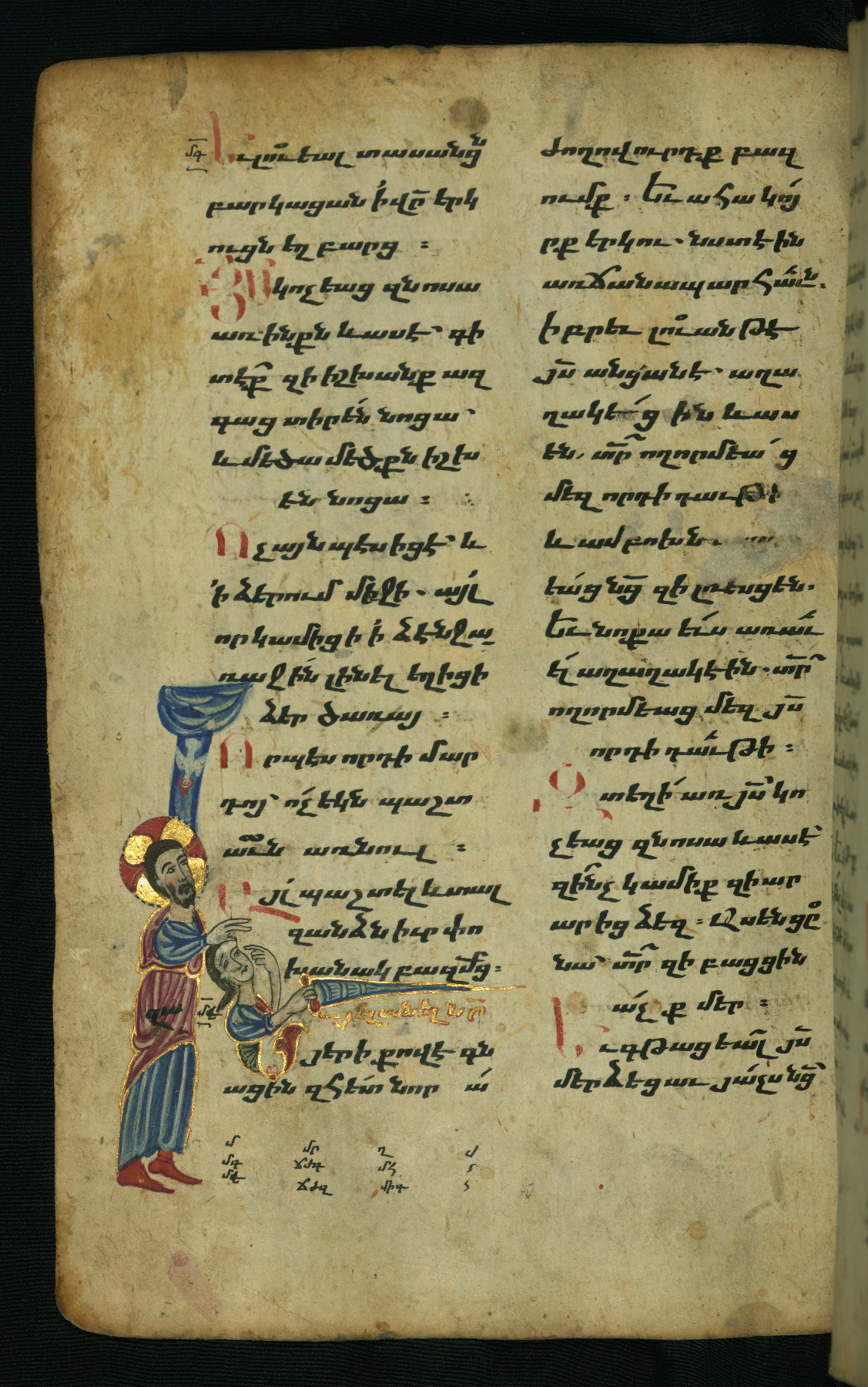
An Armenian manuscript from the 1400s
features an illustration of Jesus and the blind man
(Walters MS 540).
        Examples of this last category – attempts at edification – are very rare, inasmuch as most copyists were content to let the Scriptural text edify and instruct the reader.  The ambition of the typical copyist was simply to make an accurate copy, and for this task, the more robotically he worked, the better – provided that he was working from a legible, complete, and accurately copied exemplar.  Occasionally, though, a copyist came along who considered it his responsibility to improve upon the text which had been handed down to him, either because of reckless pride, or because manuscripts in his care had indeed been poorly copied, or damaged.
          Two variants, occurring in Matthew 20:33 and Luke 18:41 (parallel-passages that are, in both Gospels, part of the account of the healing of the blind man in Jericho), were apparently made to edify the reader.  They are found only in the Curetonian Syriac manuscript.  (This manuscript is named after William Cureton (1808-1864), who published its contents in 1858.  It is one of a very small group of early witnesses – it probably was produced in the 400s – with text from an early Syriac version of the Gospels which was made before the Peshitta became so dominant that other Syriac versions ceased to be used.)     
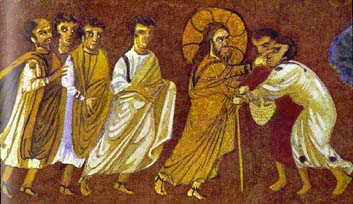
          In  Matthew 20, the scene runs as follows:  two blind men, stationed along the road near the city ofJericho, cry out to Jesus as He and his disciples pass by:  “Have mercy on us, O Lord, Son of David!”  Although the crowd discourages their disruptive shouting, Jesus stops and calls them, and asks them what they want.  They answer – in the text of verse 33 that is usually found – “Lord, that our eyes may be opened.”  The Curetonian Syriac reports the same thing, but then adds that the blind men also said, “And to see you.”  
          Luke 18 mentions one blind man (according to Mark 10:46, his name was Bartimaeus); after Jesus asks him, “What do you want me to do for you?”, in the text that is typically found, the man responds:  “Lord, that I may receive my sight.”  And here, again, the text has been altered in the Curetonian Syriac manuscript, with the result that the blind man’s response in verse 41 is, “Lord, that I may receive my sight, and see you.
          It is as if a note that was intended to remind the reader about a sermon-point has somehow crept into the text.     
   
           Although it is often necessary for translators to add extra words to make a translation clearly convey the meaning of the Greek text, the insertion of words that convey some other meaning is not a good thing to do.  But in this case, the insertion is so edifying that the situation seems comparable to finding silver in a gold mine.  For when we come to Christ in a condition of spiritual blindness, before we can see anything as it truly is, we must first see Christ, the light who enlightens everyone.  Whatever blessings or burdens we may observe, and whatever friends, foes, or strangers we meet, we cannot see them properly until we first see Christ, and view everyone and everything else in the light of His presence.  As Jesus said in John 8:12, “The person who follows Me shall not walk in darkness, but shall have the light of life.”  And as Psalm 36:9 says, “In Your light, we shall see light.”
          Every time our eyes open, before we see anything else – let us see Christ first!

Friday, February 12, 2016

Early Syriac Versions of the Gospels

       The early history of the Syriac versions of the Gospels is as important as it is tenuous.  Theoretically the Syriac version developed like this:  Syria was evangelized in the first century, and for a while, the Christians there were content to use the Greek text of the Gospels.  In the 170’s, Tatian, who had been a student of Justin Martyr in Rome, produced the Diatessaron, a narrative consisting of the contents of the four Gospels blended into one non-repeating narrative.  The Diatessaron was very popular in Syriac-speaking churches.  Tatian’s doctrine, however, was considered by some church-leaders to be overly ascetic, to the point that he dogmatically opposed marriage and meat-eating.  As the scent of heresy from his teachings was detected – rightly or wrongly – in his Gospel-harmony, a new Syriac translation of the four Gospels was made.  This work exists today primarily in two manuscripts (and also in a lectionary, Syriac Gr.Pat. 1 at the Jerusalem Library of the Orthodox Monastery of St. Mark):  the Curetonian Syriac and the Sinaitic Syriac.
Luke 21:12b-26a in the
Curetonian Syriac manuscript.
                 The texts displayed in the Curetonian Syriac manuscript and in the Sinaitic Syriac manuscript are closely related, but they are far from uniform.  Both manuscripts are heavily damaged, and therefore one cannot compare their contents throughout the Gospels (in the Curetonian manuscript, for example, nothing remains of the Gospel of Mark except Mark 16:17-20).  Where the same passage is extant in both manuscripts, however, it is obvious that they share some readings which are almost or entirely unique to these two witnesses.  The following 14 agreements are samples:
            Mt. 1:22 – the prophet’s names is supplied, so as to read, “by the mouth of Isaiah the prophet.”
           Mt. 3:10 – “the axe has arrived” rather than “the axe has been laid.”
           ● Mt. 4:17 – The words “Repent” and “for” are absent.
           ● Mt. 13:33 – Both manuscripts have simply “Another parable:” with no additional phrase (such as “He spoke to them” or “He spoke” or “He gave, saying”).
           Mt. 15:27 – The Canaanite woman’s response ends with the words, “and live.”
           ● Mt. 20:11 – The verse begins with “And when they saw,” instead of “And when they had received.”
           ● Mt. 20:17 – The text says that Jesus took “his twelve,” without the word “disciples.”
           ● Lk. 2:48 – In the Old Syriac text, Mary’s statement ends, “anxiously and with much grief.”
           ● Lk. 8:24 – The words “and they ceased” are not in either manuscript.
           ● Lk. 20:46 – Instead of stating that the scribes desire to walk around in long robes, both Old Syriac manuscripts say that the scribes desire to walk around “in porches.”  Apparently the text of Luke in both the Curetonian and Sinaitic manuscripts descends from an ancestor-manuscript in which, due to a mistake by either the reader or the writer, the Greek word for “robes” (στολαις) was misconstrued as the similar word for “porches” (στοαις).
           ● Jn. 4:31 – This verse is thoroughly paraphrased:  “And His disciples were insisting that He should eat bread with them.”
           ● Jn. 5:21 – At the end of the verse, instead of stating that the Son gives life to whom He will, the Curetonian and Sinaitic manuscripts say, “to those who believe in Him.”
           ● Jn. 6:47 – Both Old Syriac manuscripts say, “He who believes in God” instead of “in Me” (and instead of “He who believes” with no specific object supplied – the Alexandrian reading).
           ● Jn. 7:21 – Both manuscripts add the phrase, “in your sight.”
            (For many more unusual readings shared by these two manuscripts, see Agnes Smith Lewis’ A Translation of the Four Gospels from the Syriac of the Sinai Palimpsest , published in 1894.)

Matthew 1:1-17 is on this damaged
page of the Sinaitic Syriac palimpsest,
under the larger and clearer text.
          
 The distinct agreements between the Curetonian and Sinaitic manuscripts practically compel the conclusion that was reached in the early 1900s by researcher Frederick Burkitt:  “The Sinai palimpsest and Cureton’s manuscript are clearly representatives of one and the same translation.”  This translation, however, seems to have never been very popular among the Syriac-speaking churches; the Old Syriac Gospels never caught up with the Diatessaron’s head start. 
            Even the two copies that we possess have barely survived:  the Sinaitic Syriac is a palimpsest; it has survived, not because anyone valued it as a copy of the Gospels, but because a copyist in the year 778 erased its Gospels-text and recycled the pages as material on which to write part of a later composition (a collection of stories about female saints and martyrs).  Its faded Gospels-text was recovered, following its discovery at St. Catherine’s monastery in the 1890’s, by the gentle application of ammonium hydrosulfide to the parchment.  Part of the Curetonian Syriac manuscript, likewise, was recycled as the fly-sheets, or binding-pages, of another Syriac manuscript.  (William Cureton published the main portion in 1858; the additional pages were published by William Wright in 1872, and were described by Henry M. Harman in the Journal of the Society of Biblical Literature and Exegesis in 1885.)   Meanwhile, a dozen Peshitta manuscripts exist that were made in the 400s-600s.
          Although the agreements of the Sinaitic Syriac and Curetonian Syriac imply that they share a common source, these manuscripts also disagree in important ways.  For example, in the Sinaitic Syriac manuscript, the text of Mark ends at the end of 16:8; in the Curetonian Syriac, the entire text of Mark has been lost due to damage except Mark 16:17-20 (with “in their hands” in verse 18), implying the inclusion of Mark 16:9-20.  And in the Gospel of Luke, the Sinaitic Syriac does not contain Luke 22:43-44 or Luke 23:34a, but the Curetonian Syriac includes both passages.  (Again, Agnes Smith Lewis helpfully identifies their disagreements, as well as their disagreements with the Textus Receptus.) 
Romans 7, in a Peshitta manuscript
which has some unusual readings,
Sinai Syriac MS 3 (Schoyen MS
2530), from the 500s.
            In the early 400s, a different Syriac translation, known as the Peshitta, (a designation first used for it in the Middle Ages, meaning plain, as opposed to the later Harklean Version, which featured many textual notes)  rapidly replaced both the Diatessaron and the Old Syriac.  Theodoret of Cyrrhus (393-457; his bishopric began in 423, more or less) recorded that in more than 200 churches, copies of the Diatessaron – rather than manuscripts of Matthew, Mark, Luke, and John – were being used.  He arranged for the removal of these copies of the Diatessaron, and replaced them with copies of the four Gospels.  The textual character of these freshly introduced 200 copies is not known.  If they were copies of the Old Syriac, resembling the Curetonian and Sinaitic Syriac manuscripts, then they must have been like a wave that washed away the Diatessaron only to be washed away itself by a rapid increase in the popularity of the Peshitta. 
            The production-date of the Peshitta is not entirely resolved.  In the late 1700s, Johann David Michaelis made a detailed case for the position that the Peshitta’s text of the Gospels was translated directly from Greek manuscripts in the early 100s.  His main reasons for this view are as follows:
            Melito, c. 170, refers to a Syriac version when commenting on Genesis 22:13. 
            ● Manichaeus (or, Mani), the founder of Manichaeism in the mid-200s in Mesopotamia, quoted from the New Testament, without knowledge of Greek.
            ● The Peshitta is used by various Syriac denominations which adhered to diverse Christological schools of thought that emerged in the early-mid 400s; it must have been produced prior to these divisions, inasmuch as the members of one sect would not embrace a version produced by another one.
            ● The text of Hebrews in the Peshitta has some characteristics which indicate that it was translated separately from the other Pauline epistles, as if the other epistles were part of a collection that lacked Hebrews.  This suggests an old line of descent.
            ● The Peshitta does not include the book of Revelation and five of the General Epistles (Second Peter, Second John, Third John, and Jude); this indicates an origin prior to the councils in the 300s which decreed their inclusion.
            ● The Peshitta was quoted by Ephrem Syrus, who wrote in the mid-300s. 

            Inasmuch as the Peshitta and the Byzantine text of the Gospels agree far more often than they disagree, the premise that the Peshitta was made in the 100s was used as a defense of the genuineness of the Byzantine Text in the late 1800s.  In the 1897 Oxford Debate on the Textual Criticism of the New Testament, one of the advocates of the Westcott-Hort text referred to the Peshitta as the “sheet-anchor” of the pro-Byzantine position, meaning that it was seldom used, and was only a last resort.  In 1904, Frederick Burkitt systematically deconstructed the case for such an early origin for the Peshitta, arguing, first – with the benefit of the prior discoveries of the Curetonian and Sinaitic Syriac manuscripts – that although an early Syriac translation existed, it was not necessarily the Peshitta, and, second, that when compositions which have been falsely attributed to Ephrem Syrus are set aside, there are no clear utilizations of the Peshitta in his genuine works. 
          Burkitt proposed that the Peshitta was a revision undertaken by the Syriac bishop Rabbula (d. 425) in the city of Edessa.  (This individual should not be confused with the identically named copyist who made the Rabbula Gospels, an illustrated copy of the Peshitta Gospels made in 586.)  As evidence of this, Burkitt emphasized a statement found in the biography of Rabbula, which was written later in the 400s:  “He translated by the wisdom of God that was in him the New Testament from Greek into Syriac, because of its variations, exactly as it was.” 

           Burkitt’s theory became very popular very quickly, and it accelerated the general acceptance of the Westcott-Hort revision by removing what had previously been a major objection against it.  However, Burkitt’s theory was not the last word on the production-date of the Peshitta.  At least one other scenario is feasible:  that the Curetonian and Sinatic manuscripts are the remains of the translation undertaken by Rabbula and that this revision was popularized, temporarily, by Theodoret.  In support of this theory, it may be observed that title of Matthew in the Curetonian Syriac appears to call it the distinct (“Mepharreshe”) Gospel of Matthew (as opposed to the blended Gospel, the Diatessaron).  Following the end of the Gospel of John, a colophon in the Sinaitic Syriac begins, “Here ends the Evangelion da-Mepharreshe, four books.”  This is the same term that was used by Rabbula in a decree:  “Let the elders and deacons diligently ensure that ever church shall possess and use a copy of the distinct Gospels.” 
            A Syriac writer named Bar-Bahlul, writing in the 900s, made the following pertinent comment on the text of Matthew 27:16;17, referring to the name of the criminal who was released at Jesus’ trial:  “His name was Jesus, for so it is written in the Evangelion da-Mepharreshe.”  The Peshitta does not have this reading, but the Sinaitic Syriac does.   (Matthew 27 is not extant in the Curetonian Syriac.) 
            It is also possible that Rabbula inherited not only the Syriac Diatessaron and a form of the Old Syriac Gospels represented by the Curetonian and Sinaitic manuscripts, but also the Peshitta Gospels, and he used whichever he preferred.  It would be strange for the creator and advocate of the Peshitta to utilize the text of its rivals – but when one examines Rabbula’s Syriac translation of De Recta Fide, a composition by his contemporary Cyril of Alexandria, that is exactly what he does when rendering a quotation of John 3:34:  Rabbula, instead of reproducing Cyril’s quotation, or replacing it with the Peshitta’s rendering, replaces it with the rendering that appears in the Curetonian Syriac, verbatim.
            The scholar Matthew Black has proposed that this phenomenon is best accounted for by the theory that although Rabbula was largely responsible for the Peshitta (in roughly the same way that William Tyndale was responsible for the English New Testament), it continued to undergo tweaking in the 400s, and John 3:34 was one passage in which such tweaking occurred.  Against this theory, the erudite Estonian researcher Arthur Vööbus argued that in addition to the Curetonian/Sinaitic Syriac text, there was a third Syriac transmission-stream which may be considered a “Pre-Peshitta” (in which case Rabbula’s work may be more comparable to that of Coverdale, rather than Tyndale).   
            The evidence pertaining to the early Syriac text of the Gospels has complex implications.  Mixture is everywhere.  The textual character of the text of the Sinaitic Syriac is somewhat Western, resembling the text of Codex D, but it often disagrees with D and aligns with B – sometimes almost uniquely, as in Luke 9:2 (where both witnesses do not have the words “the sickat the end of the verse).  Similarly, the text of the Peshitta is mainly Byzantine, but far from fully Byzantine.  (Among the most significant disagreements between the Peshitta and the Byzantine Text is the Peshitta’s non-inclusion of John 7:53-8:11; none of the early Syriac versions have this passage.)
            Because of the complexity of the evidence, it is difficult to conclusively posit a simple chain of events in which the Peshitta is the offspring of the Old Syriac.  For example:  in John 16:21, the Peshitta and the Sinaitic Syriac (the Curetonian Syriac is not extant here) both refer to “the day of her deliverance,” rather than the hour.  It would be easy to conclude that the Peshitta inherited this reading from the Old Syriac, and that it is the result of loose translation-work.  However, this is also the reading found in John 16:21 in Codex Bezae and in Papyrus 66, the earliest Greek manuscript of this verse; nothing precludes the idea that it entered the Peshitta from a Greek exemplar. 
Text from Mark 15 in Vatican Syriac MS 12,
a Peshitta Gospels-manuscript
produced in 548
.
            Likewise consider the rival Syriac readings in Luke 4:29:  the Sinaitic Syriac says that the citizens of Nazareth intended to hang Jesus, but the Peshitta states that they intended to throw Jesus over the cliff.  This reading in the Peshitta could be the result of a fresh consultation of Greek manuscripts in the early 400s in which such errors were weeded out of the Syriac text, but it could just as easily descend from a Syriac transmission-line that existed side-by-side with that of the Curetonian and Sinaitic Syriac texts – a transmission-line in which the Syriac text was not improved, but was simply better than its rivals.  There is some evidence that such a text (alongside the Diatessaron) was used by Aphrahat in the 330’s – about the same time when Codex Vaticanus was made – but this idea awaits new research to be confirmed or dissolved. 
            The question of the origin of the Peshitta is more complicated today than it was when Burkitt wrote.  Burkitt treated the Peshitta as one monolithic revision, whereas subsequent studies of early Peshitta manuscripts, as well as analyses of Syriac writers (such as Rabbula) have shown that its development was more complex.  In 1897 at the Oxford Debate on the Textual Criticism of the New Testament, A. C. Headlam proposed that the uniformity of the text of Peshitta-manuscripts from the 400s-600s “shows almost conclusively that the texts must have been derived from one source, which could not have been very remote.”  In 1904, Burkitt, likewise, submitted that “a long and complicated history” of the Old Syriac version “is proved by the extensive variation” between the Sinaitic and Curetonian manuscripts. 
            The study of manuscripts such as Codex Phillips 11388, Dawkins 3 (see the meticulous work of Andreas Juckel for details), and Vatican Syriac MS 12 (made in 548) proves that extensive variations exist in some of the earliest copies of the Peshitta – and thus, if disagreements validly indicate “a long and complicated history” for the Syriac transmission-stream represented by the Curetonian and Sinaitic manuscripts, then the same is true for the Peshitta.  If tight agreements among manuscripts show that their source “could not have been very remote,” then disagreements in Peshitta-manuscripts (such as Sinai Syriac MS #3, which contains part of the Epistles of Paul) show the opposite.     
            All things considered, Burkitt’s theory that the Peshitta was produced by Rabbula in the early 400s – a theory which was treated as fact for over 50 years, in the service of the mainly Alexandrian compilations of Westcott-Hort, Nestle, et al – should be rejected.  Although the Gospels-text of the Peshitta was not altogether standardized until later, it was essentially extant in the mid-300s (and possibly even in the early 300s), the same period in which Codex Sinaiticus was made.