The differences in the text of manuscripts of the Gospels
tend to fall into categories. The chief difference is between readings that are original and readings that are not original.
Variants in the group of readings that are not original fall into two sub-categories: first, variations that do not affect the meaning of the text, and variations
that do affect the meaning of the text.
Most non-original textual variants fall into the first category, and while they are
sometimes helpful for textual criticism, they tend to be considered unimportant
because their impact on interpretation is inconsequential. (Nevertheless, textual critics should not ignore variants
that do not impact the meaning of the text, because even minor variants
may provide clues about the background of a manuscript and its text. Spelling-variations may suggest that a
manuscript’s copyist was from a particular locale. A cluster of manuscripts which share the same
inconsequential variants are probably related in some way.)
 |
|
|
The non-original variants that are capable of affecting the meaning of the text may be divided further into sub-categories: reading which appear to have originated
accidentally, and readings which appear to have been deliberate. The categorization of a
particular reading will depend on the text-critical decision about whether it is original or not.
For example, in First Thessalonians 1:1, if the inclusion of the second
half of the verse is considered original, then its loss may be explained as an
accident, caused when an early copyist’s line of sight drifted from the middle
of the verse (“in God the Father and the
Lord Jesus Christ”) to the end of it, where a similar phrase recurs (“from God our Father and the Lord Jesus
Christ”). But if it is considered
non-original, then its presence can only be accounted for as a deliberate
conformation to the opening verses of some of Paul’s other letters (such as
Philippians 1:2).
Accidental variants merely inform us that copyists were not
immune to accidents, but readings which are clearly non-original and clearly
intentionally created tend to imply an agenda, either in the mind of a
manuscript’s copyist, or (more often) in the mind of the earlier individual who
created the variant. And, again, the
category of deliberate changes sub-divides into sub-categories:
● attempts at technical correction (for instance, when it appears that a copyist
thought there was an error in his exemplar, and attempted to make an
on-the-spot correction),
● attempts at verbal
clarification (for instance, when it appears that a copyist encountered a
word or phrase which he thought his readers might misunderstand, and replaced
it with a clearer or more common word),
● attempts at doctrinal clarification
(for instance, when it appears that a copyist encountered something in his
exemplar which raised a doctrinal question in his mind, or which he suspected
would raise a doctrinal question in his readers’ minds, and he adjusted the
text into a form more amenable to his own theological preferences),
● liturgical adjustments (for instance,
adding Jesus’ name at the beginning of a section used as a lection, and
adjusting statements in the text that were adapted for specific rites and
ceremonies), and
● attempts at edification.
Examples of this last category – attempts at edification –
are very rare, inasmuch as most copyists were content to let the Scriptural
text edify and instruct the reader. The
ambition of the typical copyist was simply to make an accurate copy, and for
this task, the more robotically he worked, the better – provided that he was
working from a legible, complete, and accurately copied exemplar. Occasionally, though, a copyist came along
who considered it his responsibility to improve upon the text which had been
handed down to him, either because of reckless pride, or because manuscripts in
his care had indeed been poorly copied, or damaged.
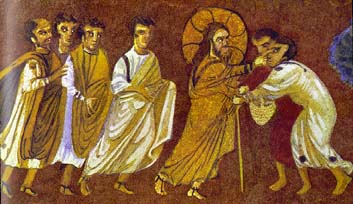
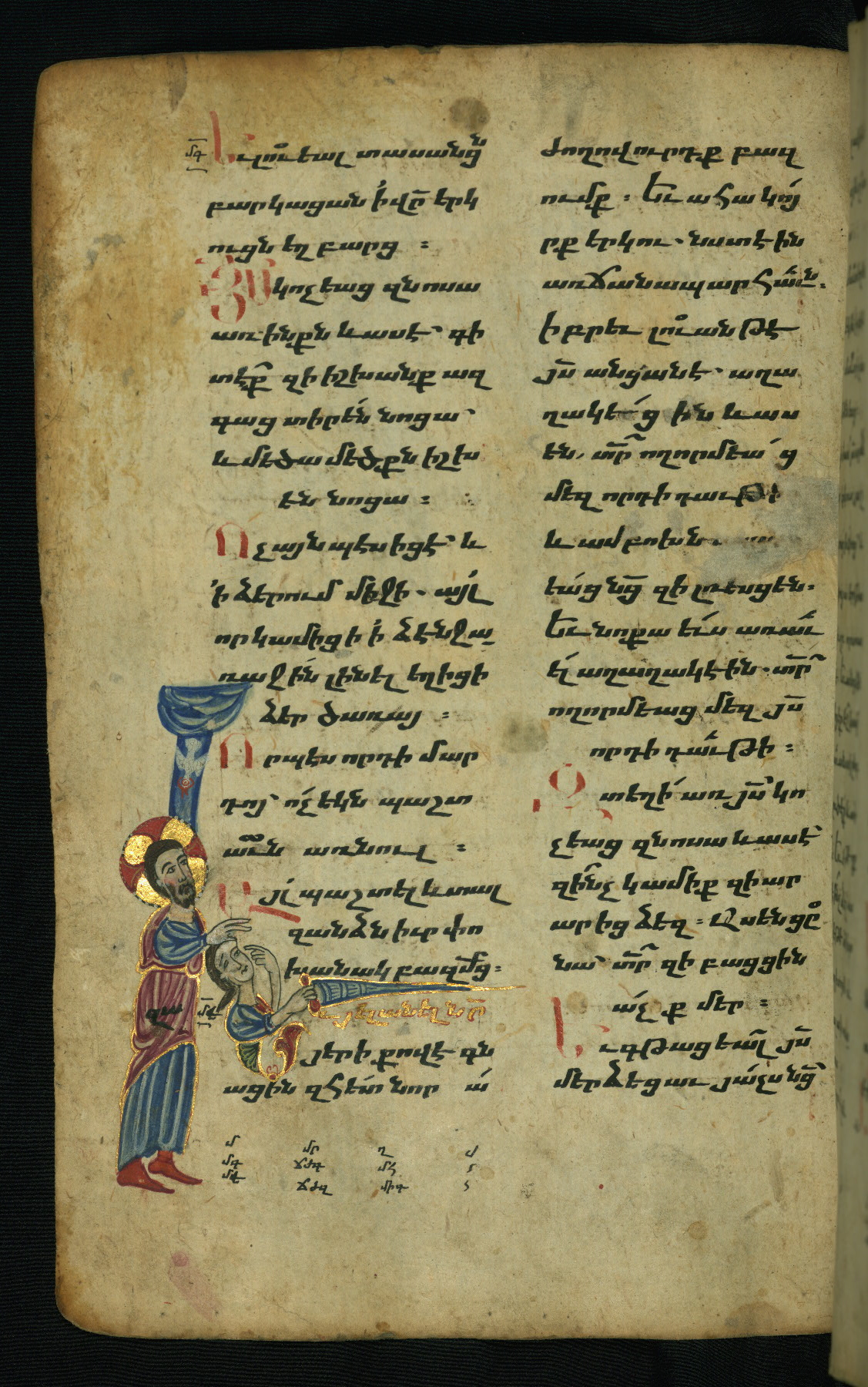
Two variants, occurring in Matthew
20:33 and Luke
18:41
(parallel-passages that are, in both Gospels, part of the account of the
healing of the blind man in
Jericho),
were apparently made to edify the reader.
They are found only in the
Curetonian Syriac manuscript. (This manuscript is named after William
Cureton (1808-1864), who published its contents in 1858. It is one of a very small group of early witnesses
– it probably was produced in the 400s – with text from an early Syriac
version of the Gospels which was made before the
Peshitta became so dominant
that other Syriac versions ceased to be used.)
In
Matthew 20, the scene runs as follows: two blind men, stationed along the road near the city of
Jericho,
cry out to Jesus as He and his disciples pass by: “Have mercy on us, O Lord, Son of
David!” Although the crowd discourages
their disruptive shouting, Jesus stops and calls them, and asks them what they
want. They answer – in the text of verse
33 that is usually found – “Lord, that our eyes may be opened.” The Curetonian Syriac reports the same thing,
but then adds that the blind men also said, “
And to see you.”
Luke 18 mentions one blind man (according to Mark
10:46, his name was
Bartimaeus); after Jesus
asks him, “What do you want me to do for you?”, in the text that is typically
found, the man responds: “Lord, that I
may receive my sight.” And here, again,
the text has been altered in the Curetonian Syriac manuscript, with the result
that the blind man’s response in verse 41 is, “Lord, that I may receive my
sight,
and see you.”
It is as if a note that was intended to remind the reader about a sermon-point has somehow crept into the text.
 |
|
|
Although it is often necessary for translators to add extra words to make a translation clearly convey the meaning of the Greek text, the insertion of words that convey some other meaning is not a good thing to do. But in this case, the
insertion is so edifying that the situation seems comparable to finding silver in a gold
mine. For when we come to Christ in a condition of spiritual blindness, before we can see anything as it truly is, we must first
see Christ,
the light who enlightens everyone. Whatever blessings or burdens
we may observe, and whatever friends, foes, or strangers we meet, we cannot see
them properly until we first see Christ, and view everyone and everything else in the light of His
presence. As Jesus said in
John 8:12, “The person who follows Me shall not walk in darkness, but shall have the light of life.” And as
Psalm 36:9 says, “In Your light, we shall see light.”
Every time our eyes open, before we see anything else – let
us see Christ first!


 Readers of the Nestle-Aland Novum Testamentum Graece compilation would never detect that the
reading found in the Byzantine Text, W, and the Peshitta exists: the N-A apparatus mentions the reading in À but not the reading of most manuscripts – an omission
that is difficult to explain except as an effect of the editors’ pro-Alexandrian
bias. The UBS apparatus doesn’t mention
the non-inclusion of πάλιν either; nor does they Tyndale House GNT’s apparatus.