Followers

Showing posts with label Septuagint. Show all posts

Saturday, May 30, 2026

Read the Fine Print: The KJV and the Byzantine Text

             Many champions of the King James Version emphasize that before the Reformation ever began, the Textus Receptus was the most widely used text throughout Christendom, and that this shows the fulfillment of a divine promise that God would preserve what he revealed in his word – both in terms of its promises (keeping his word), and in terms of its verbal expression – in each generation for his people.  But this is wrong.

            The Textus Receptus – defined as the Greek base-text of the 1611 Authorised Version – has over a thousand readings that are not majority readings, and some readings in the TR  (such as variants in Acts 9:5-6, Luke 2:22 and Eph. 3:9) have very little valid manuscript support – none at all, in the case of Acts 9:5-6.  At such points, what is printed in the Textus Receptus was never the ordinary text of the ordinary church.

            The Westminster Confession of Faith has been used as the basis for regarding both the Textus Receptus and the Byzantine Text (which is very similar to the Textus Receptus without its minority readings) as the  New Testament in Greek that God, “by his singular care and providence kept pure in all ages.”  “The text that the formulators affirmed was, historically, the Textus Receptus.   But we should be aware of how the Received Text was received – as a somewhat fluid quantity.  Consider, in selected segments, how the KJV’s Preface The Translators to the Reader describes various English translations that includes Tyndale’s and the Geneva Bible:

Segment 1:  “We do not deny, nay we affirm and avow, that the very meanest translation of the Bible in English, set forth by men of our profession, (for we have seen none of theirs of the whole Bible as yet) containeth the word of God, nay, is the word of God. As the King’s speech, which he uttereth in Parliament, being translated into French, Dutch, Italian, and Latin, is still the King’s speech, though it be not interpreted by every Translator with the like grace, nor peradventure so fitly for phrase, nor so expressly for sense, everywhere. For it is confessed, that things are to take their denomination of the greater part; and a natural man could say, Verum ubi multa nitent in carmine, non ego paucis offendor maculis, etc. A man may be counted a virtuous man, though he have made many slips in his life, (else, there were none virtuous, for in many things we offend all) [James 3:2] also a comely man and lovely, though he have some warts upon his hand, yea, not only freckles upon his face, but also scars.”

             “Things are to take their denomination of the greater part.” – And the Textus Receptus was
much more pure than impure.  The KJV’s translators, though, must have understood that it did not need to be absolutely pure to be sufficiently pure enough to be considered the word of God, even with textual variations of the kind exhibited in the early English versions prior to 1611.  So although, in Romans  12:11, Tyndale used a Greek text that differed from the KJV’s base-text, this did not disqualify Tyndale’s version - “Applye youre selves to ye tyme” – from being considered the word of God.   Nor did his version of Acts 13:33 –  in which Peter is depicted quoting from the first psalm, rather than the second – condemn Tyndale’s entire New Testament as something impure and unfit to use.  Small variants – characterized as “warts,” and “freckles” and “scars” – even if they  change the meaning of a sentence, were not thought to disqualify a text, provided that it was harmonious with the general message of the New Testament. 

Segment 2:  “No cause therefore why the word translated should be denied to be the word, or forbidden to be current, notwithstanding that some imperfections and blemishes may be noted in the setting forth of it. For what ever was perfect under the Sun, where Apostles or Apostolic men, that is, men endued with an extraordinary measure of God's spirit, and privileged with the privilege of infallibility, had not their hand?”

            Again we see that “some imperfections and blemishes” in other versions of the New Testament made by Protestants did not disqualify them from being considered the word of God.  If the KJV’s translators did not regard those features as fatal, why do KJV-Onlyists insist that deviations from the Textus Receptus are fatal?  Particularly where the KJV echoes a minority reading, some deviations are improvements, resembling more accurately the text written by inspired authors. 

Segment 3:   “The like we are to think of Translations. The translation of the Seventy dissenteth from the Original in many places, neither doth it come near it, for perspicuity, gravity, majesty; yet which of the Apostles did condemn it? Condemn it? Nay, they used it, (as it is apparent, and as Saint Jerome and most learned men do confess) which they would not have done, nor by their example of using it, so grace and commend it to the Church, if it had been unworthy the appellation and name of the word of God.”

            Thus the KJV’s Preface not only affirmed the historical reality of the Septuagint (that is the “translation of the Seventy” referred to), but even grant it status as the word of God in spite of obvious deviations in meaning from the original Hebrew text.  The cry of “Ad Fontes” is thus balanced by the understanding that what the apostles used, the apostolic church may use also.  When a modern translation such as the NET prefers a reading in the Septuagint over the Masoretic Text, it is not necessarily a disqualifying feature.   (The Eastern Orthodox churches to this day appraise the Septuagint as their authoritative text, comparable to how Roman Catholics appraised the Vulgate as their canonical standard.)  Rather than the novel and extreme all-or-nothing approach of KJV-Onlyists, the KJV’s translators subscribed to the belief that a degree of variation did not disqualify a translation.

Available on Amazon 
           When the alternative to the KJV were limited mainly to the Living Oracles, the Revised Version, the American Standard Version, the Revised Standard Version, the New American Standard Version, and the New International Version (1984) – some fans of the KJV could validly argue that these versions were not to be used on the grounds that their New Testament base-text was Alexandrian, not Byzantine (and thus not the same text that was “kept pure in all ages.”  Already in 1982, though, the New King James Version entered the market, and now there are other English New Testaments that are Byzantine-based such as the Eastern Orthodox Bible’s New Testament and the English Majority Text Version (EMTV) and the World English Bible and the Modern Literal Version and the Text-Critical English New Testament.  If the translators of the KJV were alive today, they would probably consider these versions the word of God just as they considered the versions by Wycliffe and Cranmer and the Geneva Bible to be the word of God.  King James Version Onlyism, as a dogma, is not justifiable.


Saturday, March 9, 2019

EES Moves to Publish More New Testament Papyri


            News! the Egypt Exploration Society has announced that it expects to publish 20 or so New Testament papyri in the Oxyrhynchus Papyri series within a few years.  This is the same organization that released the “First Century Mark” fragment that turned out not to be from the first century (but at least it was real, not some publicity stunt), a fragment with text from Luke (Papyrus 138), and an early fragment from the book of Philemon.  
            Along with New Testament documents, the EES expects to publish about ten patristic compositions, as well as dozens of fragment of the Septuagint.
            The official announcement can be found at the EES website.


Sunday, October 1, 2017

Mark 1:2 - In Isaiah, or In the Prophets?


[Note:  Readers are encouraged to explore the embedded links in this four-part essay, many of which lead to digital images of Mark 1:2 in manuscripts.]

Part 1:  Reviewing the Greek Manuscript Evidence

            Did Mark 1:2 originally say “in the prophets” (ἐν τοῖς προφήταις) or “in Isaiah the prophet” (ἐν τῷ Ἠσαίᾳ τῷ προφήτῃ)?  As we embark on a multi-part exploration of this question, let’s thoroughly describe the external evidence, beginning with the manuscript-evidence for each rival variant: 

● ἐν τοῖς προφήταις, according to the UBS apparatus, is supported by Codex Alexandrinus (A, 02), Codex Washingtoniensis (W, 032), f13, 28, 180, 579, 597, 1006, 1010, 1292, 1342, 1424, 1505, and Byz.
            “Byz” represents not only hundreds of Greek Gospels-manuscripts that are less than 900 years old, but also the following manuscripts: 

            Codex Basiliensis (E, 07), Codex Boreelianus (F, 09), Codex Seidelianus II (H, 013), Codex Cyprius (K, 017), Codex Campianus (M, 021, which has “Isaiah” in the margin), Codex Guelferbytanus A (Pe, 024), Codex Vaticanus 354 (S, 028), Codex Nanianus (U, 030), Codex Mosquensis II (V, 031), Codex Monacensis (X, 033), Codex Macedonianus (Y, 034), Codex Petropolitanus (Π, 041), Codex Rossanensis (Σ, 042, from the 500’s), Codex Beratinus (Φ, 043), Codex Athous Dionysiou (Ω, 045), 047, 0133, and minuscules 24, 27, 29, 34, 67, 100, 106, 123, 134, 135, 144, 150, 161, 175, 259, 262, 274, 299, 300, 338, 344, 348, 364, 371, 376, 399, 405, 411, 420, 422, 478, 481, 564, 566 (paired with Λ, 039), 568, 652, 669, 771, 773, 785, 875, 942, 1055, 1073, 1076, 1077, 1078, 1079, 1080, 1110, 1120, 1172, 1187, 1203, 1223, 1225, 1266, 1281, 1346, 1347, 1357, 1379, 1392, 1422, 1426, 1444, 1458, 1507, 1662, 1663, 1701, 1816, 2142, 2172, 2193, 2290, 2324, 2368, 2369, 2370, 2373, 2414, 2474, 2509, 2545, 2722, 2790, 2800, 2811, 2812, 2854, 2907, and 2929.  


● ἐν τῷ Ἠσαίᾳ τῷ προφήτῃ is supported by Oxyrhynchus Papyri LXXVI 5073, Codex Sinaiticus (01, Aleph (À), Codex Vaticanus (B, 03), Codex Regius (L, 019, “Isaiah” is spelled Ϊσαϊα), Codex Sangellensis (Δ, 037, Greek-Latin), 33, 151, 892, 1241, about 10 other minuscules, and the D’Hendecourt Scroll (from the 1300’s).  (Minuscule 151’s retention of this reading may have something to do with the inclusion of Eusebius’ apologetical composition Ad Marinum in the same volume.)

● ἐν Ἠσαίᾳ τῷ προφήτῃ is supported by Codex Bezae (D, 05, Greek-Latin), Codex Koridethi (Θ, 038), the core members of f1, 565, and 205 (from the mid-1400’s), plus 700, 1243, and 1071.  (Only these last three lack close affiliation with either the Western or Caesarean Text.)  A few other minuscules support ἐν Ἠσαίᾳ τῷ προφήτῃ but were not listed in the UBS apparatus; these include 22.  Minuscule 22 shares some readings with f1 and 205, and also shares a note about the ending of Mark; in 22 the note is shorter (failing to claim that the Eusebian Canons omit Mk. 16:9-20, very probably because where and where 22 was made, the Canons had been adjusted to include those verses) but it is recognizably the same note. (Minuscules 15, 22, 1110, 1192, and 1210 all have the note about Mark 16:9-20.)  Also included:  61 (Codex Montfortianus, on 55r; this manuscript is famous for its inclusion of the Comma Johanneum), 372 (assigned to the 1500’s, with some Latin notes in the margins), and 391 (produced in 1055).

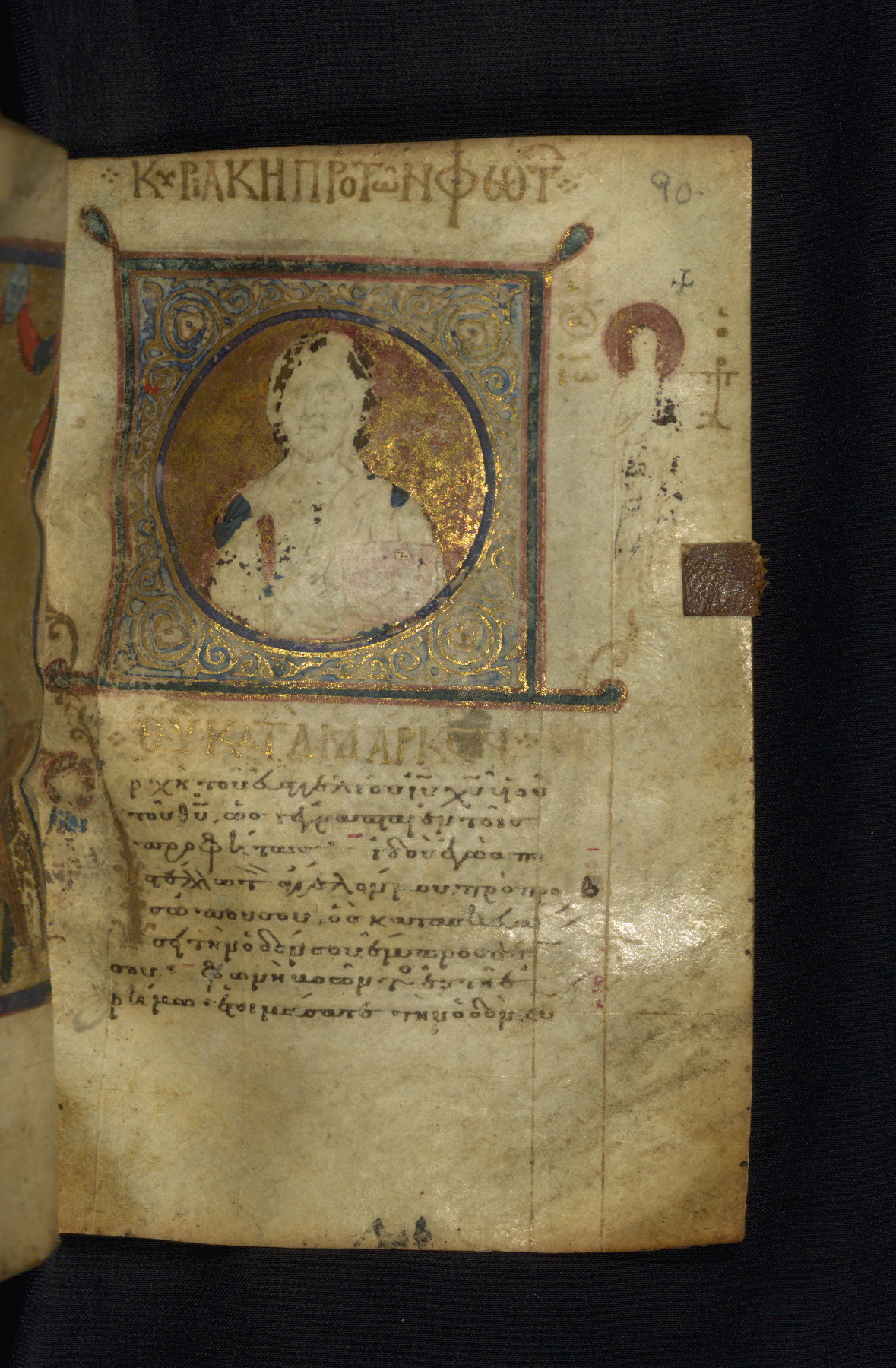
● ἐν βίβλω λόγων Ἠσαΐου τοῦ προφήτου is read by 1273 (the George Grey Gospels) and 544 and a similar text is in the book in a full-page picture of Mark in Lectionary 1635.

            For a convenient summary of versional and patristic evidence, see the STEPBible Textual Apparatus and Wieland Willker’s Textual Commentary on the Greek Gospels – Volume 2, Mark, 2015 Edition.  Readers should be aware that 2427 (cited throughout Mark in the 27th edition of the Nestle-Aland Novum Testamentum Graece) has been proven to be a forgery, based on a printed text from the 1800’s, and that although f1 is cited for “in Isaiah the prophet,” this represents only a consensus of its core members.)
            The Armenian version was listed in UBS2 as support for ἐν τοῖς προφήταις, but in UBS4 the Armenian version was listed as support for ἐν Ἠσαίᾳ τῷ προφήτῃ.  The older Armenian manuscripts tend to not have “Son of God” in Mark 1:1, and to read “in Isaiah the prophet” in 1:2 – following the Caesarean form.  However, a competition of influences upon the Armenian tradition began very early in its history, in addition to later influence from the Vulgate. 

            Most of the Greek lectionaries, such as Lect 123 (an illustrated lectionary from the 900’s), Lect 379 (from the 800’s), Lect 1599 (from the 900’s), Lect 71 (from 1066), Lect 183 (from the 800’s or 900’s), and the illustrated Lect 120 (from the 1100’s) support ἐν τοῖς προφήταις, but there are some exceptions, such as Lect 562 (from A.D. 991), which supports ἐν Ἠσαίᾳ τῷ προφήτῃ.
           
● One more variant seems to be attested by the Old Latin Codex Usserianus Primus (VL 14); the Byzantine and Alexandrian readings are combined, so as to read, “in Isaiah and in the prophets.”  However the text is difficult to read due to damage to the parchment (See fol. 150r at the page-views at the Trinity College Dublin website .)

            In this essay, the reading “in the prophets” will be defended as original, and I will argue that its Alexandrian and Western rivals originated in the following way:
            In the 100’s, some copyists were mildly averse to non-specific references to Old Testament books, and added specific names in place of the original non-specific references.  Mark 1:2 is one of the passages affected by this tendency toward specificity.  Some copyists, understanding the paraphrastic opening phrase – which could be understood as a reference to Exodus 23:20 (in the Law, rather than the Prophets) – as merely an introduction to Isaiah’s words, adjusted the text so as to identify the prophet being cited. 
           
            This happened independently in Alexandrian and Western transmission-streams, which is why the Alexandrian witnesses consistently have τῷ before Ἠσαίᾳ, while the major Western and Caesarean witnesses do not.  When (and where) copyists and commentators were confident that Mark was using Malachi rather than Exodus, Christian scholars whose manuscripts read “in Isaiah the prophet” developed inventive explanations about how Mark could appear to identify Malachi’s words as if they had been written by Isaiah.  These explanations were sufficiently convincing to allow the reading to remain in the Alexandrian and Western transmission-lines. 

            The insertion of specific names, where the original text has no specific name, is a recurring scribal practice, and one which is observable in some of our very earliest New Testament manuscripts.  For example, in the early Alexandrian transmission-stream, in Luke 16:19, in the story about the rich man and Lazarus, the rich man was given a name:  he was named Nineveh.  This reading is found in Luke 16:19 in Sahidic copies, and in the manuscript known as Codex Sinaiticus Arabicus, or CSA, one of the documents discovered at St. Catherine’s Monastery in 1975.  (A collation of CSA by Hikmat Kachouh was released in 2008 in the journal Novum Testamentum.)  But there is much earlier evidence for that reading.  Papyrus 75 reads named Neuhs in the same passage (ονοματι νευης), and this is the same name, Nineveh, disfigured by a parableptic error in which the copyist skipped the first syllable.  (Two Greek manuscripts, minuscules 36 and 37, have margin-notes which also identify the rich man as Nineveh.)
            When a character in the Gospels plays a prominent role, but has no name, frequently a name is provided.  Bruce Metzger documented this phenomenon in his essay, Names for the Nameless in the New Testament, which serves as chapter 2 of New Testament Studies:  Philological, Versional, and Patristic
            The scribal tendency to provide names for unnamed individuals comes into play repeatedly in passages where the text refers to the fulfillment of prophecies.  The non-specific attribution “through the prophet” is often turned into a specific attribution.  Usually the attribution is correct, but sometimes it is incorrect.
            The Old Latin Codex Colbertinus (VL 6) displays this tendency.  Its text of Mark 15:27 provides names for the two robbers who were crucified with Jesus – Zoathan and Chammatha.  VL 6, like practically all Latin manuscripts of Mark, also reads “in Isaiah the prophet” in Mark 1:2.  In Matthew 1:22 – where Matthew quoted Isaiah without naming him (simply saying that “what was spoken by the Lord through the prophet” was fulfilled) –  Codex Colbertinus states specifically that the prophecy was given by Isaiah.
            This phenomenon is not limited to one medieval Old Latin copy.  Codex Bezae, which D. C. Parker has assigned to c. 400, also includes Isaiah’s name in the text of Matthew 1:22, both in its Latin text and in its corresponding Greek text.  Old Latin Codex Veronensis (VL 4, from the 400’s) also has Isaiah’s name in Matthew 1:22.  So do the Old Latin codices Brixianus (VL 10, from the 500’s) and Sangermanensis (VL 7, c. 810) and Vercellensis (VL 3, probably from the 370’s).  (Metzger expressed some uncertainty about Codex Vercellensis’ reading in his Textual Commentary, but “ESEIAM PROPHETAM” is shown clearly in Irici’s 1748 presentation of Codex Vercellensis.)  “Isaiah” is practically the normal Old Latin reading in Matthew 1:22. 
            The earliest evidence for the reading “in Isaiah the prophet” in Matthew 1:22, however, may be even earlier than the earliest Old Latin manuscript:  in the Latin text of Irenaeus’ Against Heresies 3:21:4 (composed in Greek c. 184), Irenaeus quotes Matthew 1:22:  “et quoniam Angelus in somnis dixit ad Joseph:  Hoc autem factum est, ut adimpleretur quod dictum est ab Esaia Propheta:  Ecce virgo it utero concipiet.”  It is possible that the form of this quotation was altered by the Latin translator of Irenaeus’ work, but that too would be early testimony.  
            In the Syriac tradition, the same scribal tendency is on display.  In Matthew 1:22, the inclusion of the name “Isaiah” is attested by the Sinaitic Syriac, the Curetonian Syriac, the Harklean Syriac, and the Palestinian Aramaic.
            Another Western witness that displays the tendency to fill the vacuum when a prophet’s statements are cited without specifying his name is the Middle Egyptian Glazier Codex of Acts (G67, from the 400’s).  Instead of “in the prophets” in Acts 13:30, G67 reads, “in Habakkuk the prophet.”
           
            The scribal tendency toward specificity is also displayed by the core members of family-1.  Although these manuscripts are medieval, they are generally thought to represent a text of the Gospels similar to a text used by Origen at Caesarea in the 200’s; this is indicated by their support for the reading “Jesus Barabbas” in Matthew 27:17; according to a Latin translation of Origen’s Commentary on Matthew, Origen stated that some of his copies had this reading.
            The text of f1 indicates that copyists of the manuscripts used by Origen were not exempt from the tendency toward specificity, and that occasionally the scribal attempt to make the text more specific was poorly executed.  In Matthew 13:35, where most manuscripts simply read “by the prophet,” without naming the prophet being quoted, the text in f1 includes a specific name:  Isaiah. 
            That is not a correct reference; Matthew’s quotation clearly comes from Psalm 78:2, which was composed by Asaph, not by Isaiah.  Yet an early copyist’s need for specificity was greater than his grasp of the contents of the Old Testament, and the name “Isaiah” was perpetuated in various manuscripts, including minuscules 1, 543, 788, 230, 983, and 1582 (and some others), and Codex Θ. 
            Eusebius of Caesarea, in his Commentary on the Psalms, mentioned that some copies read “in Isaiah the prophet” in Matthew 13:35, but not the accurate copies. 
            Jerome, in his Homily 11 on Psalm 77 (our Psalm 78), cited Matthew 13:35 and claimed that the reading “through the prophet Asaph” is supported by “all the ancient copies” – “in omnibus ueteribus codicibus” – but it was changed by ignorant individuals (see Amy Donaldson’s Explicit References to New Testament Variant Readings Among Greek and Latin Church Fathers, Vol. 2, pages 369-370).  In addition, Jerome wrote that Porphyry (an anti-Christian author who wrote c. 270) made an accusation against Matthew that can only be accounted for by Porphyry’s use of a copy of Matthew with the reading “in Isaiah the prophet” in Matthew 13:35:
            “Porphyry, that unbeliever . . . says, ‘Your evangelist, Matthew, was so ignorant that he said, “What is written in Isaiah the prophet:  I will open my mouth in parables, I will utter mysteries from of old.”’ . . .  Now, just as this was the scribes’ error, it was, likewise, their error to write ‘Isaiah’ instead of ‘Asaph.’” 
            Jerome proceeded to offer a theory that some early copyist, reading “Asaph the prophet” in his exemplar, did not recognize the name “Asaph,” and replaced it with “Isaiah.”  He offered the same line of reasoning in his Commentary on Matthew.  On the premise that Jerome was not being altogether deceptive, it would appear that the text of Matthew 13:35 in copies that he considered ancient had been expanded to include Asaph’s name.  (We shall take a closer look at Jerome’s testimony later.)
            The tendency to make non-specific quotations of Old Testament prophets more specific – via the insertion of a prophet’s proper name rather than “through the prophet” or “by the prophet” – was so strong that copyists in the Western and Caesarean transmission-streams inserted prophets’ names in various passages – and, in the case of Matthew 13:35 in the Caesarean transmission-stream, perpetuated a specific name even when it was the wrong name.   
            The scribal tendency toward specificity was so strong in the Old Latin transmission-line that in Old Latin Codex Vercellensis (VL 3) a copyist felt that it was necessary to identify the prophet being quoted in Matthew 2:5.  Four copies of the Harklean Syriac display the same tendency, but their copyists exercised restraint by only putting Micah’s name in the margin of this passage.  In VL 3 (probably produced in the 370’s), the copyist (or his exemplar’s copyist) embedded the prophet’s name directly into the text – and, making matters worse – the identification is incorrect:  VL3 reads there, “per Eseiam propheta,” that is, “through Isaiah the prophet.”

            What about Alexandrian witnesses?  Yes; although not as heavily as elsewhere, the tendency toward specificity impacted Alexandrian manuscripts too:  “Isaiah the prophet” is the reading of Codex ﬡ at Matthew 13:35.
            In the margin of Matthew 2:15 in Codex Sinaiticus, we see how precarious it would be to assume that copyists knew the Old Testament too well to attribute to Isaiah a passage from a different Old Testament book.  Matthew 2:15 contains a quotation of Hosea 11:1 – “that it might be fulfilled which was spoken by the Lord through the prophet, saying, ‘Out of Egypt I called My Son.’”  Someone did not recognize that the passage being quoted was Hosea 11:1 (because in the Septuagint, Hosea 11:1 reads differently, as “When Israel was a child then I loved him, and called his sons out of Egypt”) and thought instead that Matthew was referring to a passage in Numbers – maybe 15:41 or 20:16 – and for that reason, he wrote in the margin of Codex Sinaiticus, in small vertically stacked lettering, “In Numbers.” 
            However reasonable it might seem to assume that copyists knew the Old Testament so well that they would not have risked giving the impression that they attributed a passage to Isaiah that did not originate with Isaiah, there is evidence against such an assumption.  Not only does the text of VL3 attribute Micah 5:2 to Isaiah in Matthew 2:5, but in Matthew 21:4 (according to Metzger in Textual Commentary, page 54), a few Vulgate copies, Bohairic copies, and Ethiopic copies add Isaiah’s name, although the quotation is from Zechariah. 
            Not all copyists were familiar with the Old Testament text, and for most of those who did know the Old Testament well, the text they knew was the Septuagint. Consequently there was a risk that copyists would imagine that their exemplars contained an error when a Gospels-manuscript contained a form of an Old Testament passage that did not match up with the form in which it was found in the Septuagint. 
            Mark’s use of Malachi 3:1 is one such case.  His utilization of Malachi 3:1 closes with the phrase, “who shall prepare your way” (ὃς κατασκευάσει τὴν ὁδόν σου) in the Alexandrian text, or, in the Byzantine Text, “who shall prepare your way before you” (ὃς κατασκευάσει τὴν ὁδόν σου ἔμπροσθέν σου).  Neither is an exact match with the text of Malachi 3:1 in the Septuagint, which ends with the phrase “καὶ ἐπιβλέψεται ὁδόν πρὸ προσώπου μου” – “and he shall carefully look for a way before me.”  (See Maurice Robinson’s article Two Passages in Mark in Faith & Mission, 13/2 (Spring 1996), pp. 66-111.)  An additional factor to consider is that the Septuagint’s text of Exodus 23:20a reads Καὶ ἰδοὺ ἐγὼ ἀποστέλλω τὸν ἄγγελόν μου πρὸ προσώπου σου – “And behold, I send my messenger before your face” – which might have caused some copyists to wonder if the readers of their copies would suppose that Mark was using a passage in the Law, rather than in the Prophets.    
            So if anyone wonders, “If the reading ‘in Isaiah the prophet’ in Mark 1:2 is not original, where did it originate?”, let the copyists of ﬡ, D, Θ, the Old Latin copies, and the main manuscripts of f1 reply:  from the same place that their readings “in Isaiah the prophet” in Matthew 1:22, Matthew 2:5, and Matthew 13:35 originated:  from the propensity of some early scribes to make non-specific references more specific.
            A faint echo of the kind of scribal confusion that led to the insertion of Isaiah’s name in Mark 1:2 (or an independent repetition of it) may be seen in two medieval Bohairic manuscripts.  Boh-E1 (a Coptic-Arabic manuscript produced in 1208), has the Bohairic words for “Exodus” and for “Malachi” in the margin near Mark 1:2.  An Arabic note says, “A copy has, ‘the prophets.’”  Boh-O1 (a Coptic manuscript produced in the 1300’s) has an Arabic note that says, “Isaiah prophesied with the voice of one crying, and Moses and Malachi prophesied with the sending of the messenger.”  The notes in both copies show that to some copyists, Mark 1:2 was understood to refer not just to the Prophets, but to a passage in Exodus.


To be continued in Part Two:  Mark 1:2, Origen, and Jerome

Thursday, April 27, 2017

The Tors-Costa Debate, Part 4

QUESTIONS FROM THE AUDIENCE

            After the main portion of the Tors-Costa debate was completed, audience-members asked questions, which each debater answered.  Some of the questions were relevant to the announced subject of the debate, and some were not. 

First Question:  What do you believe is the authentic conclusion to the Gospel of Mark?

            Costa went first, stating that the authentic text concludes at verse 8.  The early manuscripts, he explained, end there.  He also noted that although Irenaeus knew verses 9-20, he also cited Acts 8:37, which is not a majority-reading.  Costa them pointed out that some early writers raised questions about the authenticity of verses 9-20, such as Jerome, who said that hardly any manuscripts have it, and Eusebius, who said the same thing.  Costa expressed a desire to know what Mark wrote, not what some scribe wrote.  In addition, he argued, when you look at verses 9-20, it looks like a patchwork of pieces from the other Gospel-accounts, pieced together by a later scribe.
            Costa’s take on the internal evidence then went a little further than one might expect from a conservative professor:  he proposed that in the Gospel of Mark, the apostles are ironically depicted as if they never understand who Jesus is, and that the ending at verse 8 is consistent with that theme.  (Does Costa mean that that Mark wanted readers to conclude that the apostles never heard about Jesus’ resurrection?) Costa also offered an interpretation of Mark 8:22-26 which maintains that the episode – in which Jesus makes a blind man see, after spitting on his eyes, and then laying His hands on him – was intended by Mark to somehow convey that the apostles did not see Jesus clearly.  (Does Costa mean that this is what Mark intended to be his readers’ final impression of the apostles?  If not, then what point is he trying to make?) 
            Tors responded:  “The last 12 verses are certainly authentic.”  He pointed out that verses 9-20 are present in 1,700 manuscripts and missing in only two.  (Gaffe:  they are missing in three (taking damage into account) – though their absence in minuscule 304 is barely worth mentioning.)  The testimony of Vaticanus and Sinaiticus is questionable, because Vaticanus has a  blank column after the column in which Mark 16:8 concludes – the only blank column in the entire manuscript (Gaffe:  it is not the only blank column in Vaticanus; there are three others in the Old Testament portion.  But it is the only one that is not the result of a factor that occurred naturally in the production-process.) – as if the scribe knew that more text belonged there.  And in Sinaiticus, (Tors continued,) the original pages containing the end of Mark were replaced long after by a scribe who stretched out his lettering to avoid leaving a blank column.  (Gaffe:  it was the supervisor/proofreader, who did this, not someone long after Sinaiticus was made.)   Regarding Irenaeus, in the first century (Gaffe:  it was the second century) it is not likely that he was wrong; his testimony is joined in the second century by Tatian.  The idea that fourth-century evidence should outweigh this second-century evidence doesn’t fly.          
            The idea that Mark would end at 16:8 does not make sense either.  It doesn’t even seem remotely possible that Mark would intentionally end there.  (Hort agreed with Tors about that.)  Moreover, here we see how historical criticism and rationalistic textual criticism undermine the gospel:  first, Mark is posited as the first Gospel; Q is also posited as source-material for Matthew and Luke.  The rationalistic higher critics say that Q didn’t have a resurrection of Jesus; the rationalistic lower critics say that Mark didn’t have a resurrection of Jesus, and these points are used to undercut the centrality of Jesus’ resurrection.  And regarding the blind man healed at Bethesda (Gaffe:  it was Bethsaida), this is a historical account of a miracle, not some sort of parable about how the apostles perceived Jesus.  (In the course of making this last point, Tors became side-tracked and took up way too much time explaining details about that miracle.)  

Second Question:  (for Dr. Costa)  You said that textual variants do not undermine any significant doctrines.  But doesn’t the removal of Mark 16:9-20 undermine an essential doctrine, specifically, the doctrine that Jesus rose from the dead? 

            Costa answered, “There is a resurrection in Mark 16.”  Three times, Jesus predicts His resurrection.  And in Mark 16, the young man at the tomb announces that Jesus is risen, so in Mark, there is a resurrection.  Mark couldn’t be a Christian if he didn’t believe in the resurrection.  No one can read Mark 16:1-8 and come away thinking that no resurrection has happened.  There is a postmortem appearance that is anticipated in Galilee.  There is a resurrection.

            Tors:  When Jesus appeared to His disciples, they were very difficult to convince.  Even when He shows up, in Luke, they have to touch him.  Thomas insisted that just seeing Him wasn’t enough; he wanted to touch the wounds.  The concept of someone rising from the dead is very difficult to grasp.  To say that He predicted that He would rise from the dead, and that some guy at the tomb claimed that He rose from the dead – that’s a resurrection?  Would you believe that?  Isn’t it more reasonable to think that that guy took away the body?  How can you say there’s a resurrection there?  There’s a claim(One could say that the truth of the predictions is confirmed by the post-resurrection appearances, not the other way around.)    

Third Question:  (for Dr. Costa)  I am an accountant, with many textbooks.  The ones I use a lot get crumpled up; the rarely used ones stay in good shape.  So, is it possible that the Majority Text manuscripts – the “embarrassment of riches” – are descended from earlier manuscripts that are no longer around because they were worn out by regular use, whereas those others – like Sinaiticus, which Tischendorf says that he found as the monks were burning the leaves – survived because they were less-used, and were less-used because they were considered unreliable?

            Costa:  First, Metzger’s phrase “embarrassment of riches” refers to all New Testament manuscripts, not just the Majority Text manuscripts.  (But if one takes them out of the picture, is the remainder still plausibly described as embarrassment of riches?  For it is almost invariably followed by a declaration of how many New Testament manuscripts there are, as we saw in Costa’s opening statement.)  The Byzantine manuscripts were better preserved because they were protected and “regulated” in the Byzantine Empire, safe from the Islamic hordes. 
            About Tischendorf:  “Tischendorf did not say that he found Sinaiticus in a trash bin.”  That is a myth.  He tells us that he saw something in the monastery, and they brought him Sinaiticus, which was covered in a red crimson cover.  It was covered in “a beautiful crimson covering.”  “It was not something that was being thrown out.”  That’s a common myth.  (Super-gaffe:  Costa has been misled by James White, who is very similarly mixed up about how Tischendorf claims to have discovered Sinaiticus.  Costa is describing Tischendorf’s 1853 visit to St. Catherine’s Monastery; it was in 1844 that Tischendorf visited, and it is during that visit – he claimed – that he found pages of Codex Sinaiticus in a basket, as the monks were about to discard them into the fire.  (Tischendorf’s story is highly dubious, and at St. Catherine’s monastery it is maintained that the monks were certainly not about to burn the pages.  But Tischendorf most definitely claimed that this is how he first encountered pages from Codex Sinaiticus, and anyone who still imagines that James White’s (and Tony Costa’s) version of events is well-informed can read about Tischendorf’s 1844 visit, and his 1853 visit, in Tischendorf’s own account.)             
            Costa proceeded to blame “the Muslim hordes” for the loss of many non-Byzantine manuscripts.  He pointed out that although the map that Tors had shown pictured the Byzantine Empire as it existed in the year 600, it didn’t show the impact of the Islamic invasions that happened later.  Instead of seeing things in the year 600, Costa said that he would like to know, “Where are these Byzantine text-types (plural??) in the first 300 years of the church?”.  (Since Costa had just proposed that “the Muslim hordes” destroyed thousands of manuscripts during their conquests of Byzantine territory, the means to supply a strong response was practically served up to Tors on a plate, but the opportunity was not taken.) 
  
            Tors responded:  Tony is missing the point about the Byzantine Empire.  If the Alexandrian manuscripts were so superior and so numerous in the 300’s, then why wasn’t it the Alexandrian Text that was spread throughout the Byzantine Empire from the end of Roman persecution in the early 300’s, to the beginning of the 600’s?  Nothing would prevent that, if it had been the case. The assumption that the Alexandrian Text was dominant in that period is opposed by the evidence.  
            You can’t just go by the number of manuscripts that have survived, (Tors continued) because the survival of early manuscripts is very rare.  Early Alexandrian papyri survived because papyrus is fragile and vulnerable to decay.  And in Egypt, most of these “best manuscripts” (via his inflection, Tors implied “so-called”) come from garbage heaps in Oxyrhynchus, where their owners had torn them up and thrown them out into the garbage.  
           
Fourth Question:  (for Tors)  In Luke 4, a passage from Isaiah 61 is quoted by the Lord, but when we look at the passage in Isaiah, it is different from what is seen in Luke.  So where is the poison:  in Luke, or in Isaiah?  How do you decide which one is correct?  If Jesus’ quotation is correct, is the Masoretic Text wrong?    

            Tors:  This isn’t really a question about New Testament textual criticism.  My understanding is that the Hebrew text used in Jesus’ day was more similar to the Septuagint than the Masoretic Text is, and ancient manuscripts such as the texts from Nahal Hever [especially a scroll-fragment of the Minor Prophets] prove that.  
            Regarding the poison, I’m not blaming textual criticism per se.  It’s the method of textual criticism that elicits mistrust in the authority of Scripture, because it conveys that the original text has errors.  Darwinism and historical criticism, combined with a method of textual criticism that says that the original reading is the one that has errors in it, contribute to this doubt.  Even though people try to explain away the errors in the text as if they are not errors, eventually people are going to conclude that the text has errors.  And this makes people lose confidence in the text; this leads to the erosion of Biblical authority.   

(The questioner spoke up again, but this was a minor breach of protocol.)
 
            Costa:  I agree with John about the current decline in morality.  A lot of that has to do with the Enlightenment.  But the problem is deeper than that. Even when we had a text of Scripture that everyone believed was absolutely reliable, there were still heresies.  Now then: I have issues with John’s view on the Septuagint.  (Tors had given Costa a golden opportunity to point out a contrast between his statement, You can’t just go by the number of manuscripts that have survived, and the statistical case that Tors had used earlier, but this opportunity was not taken.)

Fifth Question:  (for Tors)  In cases where there is a difference in meaning between the Old Testament Hebrew text, and a quotation in the New Testament, how would you ascertain the original reading of the Old Testament passage?

            Tors:  If there’s a difference between the Masoretic Text’s reading and a quotation by Jesus, I would suspect that there is an error in the Masoretic Text.  That doesn’t mean the Old Testament has a flaw; it means that the scribes who transmitted the Old Testament text made an error, like the scribes who made the manuscripts that the NIV is based on.        

            Costa:  “I think what John said would seriously undermine the reliability of the Old Testament.  The Greek Orthodox Church uses the Septuagint as their Old Testament text. Jerome and Augustine had a disagreement about which should be considered authoritative:  Jerome used the Hebrew text but Augustine favored the Septuagint.  This has really hit a nerve.  If John applies the same methodology to the Old Testament that he advocates for the New Testament, we are in big trouble.  (Costa’s straw man reappears; if the baker bakes a can of gasoline ....) This is very, very serious.  Most quotations from the Old Testament in the New Testament agree with the Septuagint word-for-word. 

At this point, moderator Johnny Yao-Chung Chao ended the debate, mentioning that the planned time-limit had been exceeded.  After thanking the audience and those who assisted, he closed with prayer, thanking God for His Word and for the information received in the course of the debate, and asking that it will be used in a way that will promote the unity of the church, and the fulfillment of our mission to make disciples.

●●●●●●●

         One could wish that the debate had maintained a tighter focus in its second half.  Nevertheless, from start to finish, Tors presented his view on the announced subject far more effectively than Costa presented his view. Costa repeatedly got his facts mixed up. (His “family 33” mistake was particularly bad; his confident dismissal of Tischendorf’s story about Sinaiticus can be blamed on James White, whose book was obviously his source.)  Costa’s go-to objection (about the danger of using a Majority Reading approach on the Old Testament text) was merely a straw-man argument.  Tors won this debate, and it was not close.

Monday, April 4, 2016

Codex Vaticanus and the Ending of Mark

            “Some of the earliest manuscripts do not include 16:9-20.”   So says a bracketed heading-note in the English Standard Version.  The number of Greek manuscripts in which the text stops at the end of 16:8 is three.
            Minuscule 304 is one of those three.  It is a medieval commentary-manuscript in which the text of Matthew and Mark is interspersed with commentary-material.  Its text in Mark is essentially Byzantine and the manuscript appears to have undergone some damage near the end.  There’s nothing about 304 that would suggest that it has more weight than any other medieval manuscript. 
            The other two manuscripts in which Mark’s text stops at 16:8 are another story:  Codex Vaticanus (produced c. 325) and Codex Sinaiticus (produced c. 350) are the oldest and second-oldest Greek manuscripts of Mark 16.  (These two manuscripts are not the earliest evidence pertaining to the ending of Mark, just the earliest manuscriptsPatristic writers in the 100’s, 200’s, and early 300’s utilized the contents of Mark 16:9-20, but the manuscripts used by those writers are not extant.)  I have previously described the unusual features in Codex Sinaiticus involving the ending of Mark.  Today, let’s examine the last page of Mark in Codex Vaticanus. 
The last page of Mark in Codex Vaticanus.
          The text on this page begins in 15:43, and ends at the end of 16:8, on the 31st line of the second column.  The closing book-title appears a little further down the second column.  The third column is completely blank.  It was normal for copyists to begin books at the tops of columns, and thus some space was typically left below the end of each book before the next book began at the top of the next column (except in those cases where the book happened to conclude right at the end of a column).  It was not normal, however, for the copyist of Vaticanus to leave an entire column blank.  This is the only blank column in the New Testament portion of Codex Vaticanus.
           Of course this raises a question:  why did the copyist leave this column blank?  The obvious answer is that the copyist was aware of copies that contained verses 9-20, and although his exemplar lacked these verses, he left space to give the eventual owner of the manuscript the option of including them in the event that another exemplar was available.
            The blank space is not quite adequate to include verses 9-20.  If one were to erase the closing-title and write the contents of verses 9-20, beginning at the end of v. 8, using the copyist’s normal handwriting, there would still be four lines of text yet to be written when one reached the end of the last line of the third column.  It is perhaps for this reason that Daniel Wallace, referring to this blank space in his chapter of the 2008 book, Perspectives on the Ending of Mark, has said, “The gap is clearly too small to allow for the LE.”  In the same book, Maurice Robinson affirmed, “The space is insufficient to contain the entire LE.”  Their co-author J. K. Elliott stated less definitively, “Vaticanus actually contains a blank column after 16:8 that could possibly contain verses 9-20, suggesting that its scribe was aware of the existence of the longer reading.”

The last page of Mark in Codex Vaticanus with verses 9-20
in the blank space after v. 8, using cut-and-pasted characters
from Mark 15:43-16:8 on the same page.  
           If a copyist were to resort to compacted lettering – the script that the copyist of Sinaiticus used in the first six columns of the text of Luke – then the blank space is practically an exact fit.  In a reconstruction of Mark 16:9-20 (shown here) in the blank space after 16:8, using characters that were written elsewhere on the page in Mark 15:43-16:8, verse 20 concludes on the next-to-last line of the third column.     
            Although the implication that the copyist of Codex Vaticanus clearly recollected 9-20 when he wrote the text of Mark 16:1-8 from an exemplar that did not have verses 9-20, Daniel Wallace has proposed a different explanation, namely, that the copyist was using an exemplar in which the Gospels, though containing the Alexandrian text, were arranged in the Western order (Mt-Jn-Mk-Lk), and although the copyist rearranged the Gospels into the order Mt-Mk-Lk-Jn, he added a blank space to represent the blank space at the end of his exemplar.  This theory seems like the result of a determined effort to dismiss the obvious implication of the blank column.  Where is the evidence that the Alexandrian form of the Gospels-text was ever anything but in the order Mt-Mk-Lk-Jn?  (In Papyrus 75, John follows Luke.)  And why would any copyist regard the blank space at the end of an exemplar as a feature worth replicating?  Any manuscript, unless its text happened to end at the end of its last column, would contain some blank space at the end.   And why would a copyist replicate such a blank space, but not the order of the books?  And why would a copyist consider such a blank column worth replicating, but not add a blank column between John and Acts, or between Acts and James, or between Jude and Romans? 
            In addition to the contrived idea of an Alexandrian Gospels-exemplar with the Gospels arranged in the Western order with blank space at the end which the copyist wished to replicate, Wallace has questioned the significance of the blank space by pointing out that there are three large blank spaces in the Old Testament portion of Codex Vaticanus.  However, all three of those blank spaces are accounted for by special factors:

One of these blank spaces is the space between the end of the Old Testament and the beginning of the New Testament; the last page of the Old Testament portion concludes with the apocryphal text of Bel and the Dragon, incorporated into the Septuagint’s text of Daniel.  To expect the Gospel of Matthew to begin in the next column would be a preposterous expectation. 
One of these blank spaces occurs at the end of Second Esdras, before the beginning of the book of Psalms.  Only two lines of text are placed in the first column of the last page of Second Esdras, and after the closing-title (and what appears to be the signature of someone named Klement, possibly a former owner of the codex), the rest of the page is blank.  But the reason for this is obvious:  the book of Psalms begins on the very next page, and the text of Psalms is formatted in two columns, rather than three.  It was absolutely necessary to begin Psalms on a new page, due to the difference in the number of columns on the page.
● One of these blank spaces occurs between the end of the book of Tobit and the beginning of the book of Hosea.  The text of Tobit concludes in approximately the middle of the second column of a page, and the third column is blank.  Wallace claimed that “The gap at the end of Tobit lacks sufficient explanation.”  However, the explanation becomes obvious upon close examination.
            One copyist’s work ended at the end of Tobit, and another copyist’s work begins with the Prophetic Books, which begin with the Minor Prophets, which begin with Hosea.  At this point where one copyist’s work was connected to another copyist’s work, what we have after the end of Tobit is simply leftover space.  This should become very obvious when we notice that the leftover space after the end of Tobit did not initially consist of just the remainder of the page.   As Dirk Jongkind mentioned on page 31 of Scribal Habits of Codex Sinaiticus, besides the one and a half columns on the remainder of the page on which Tobit concludes, there was an entire unused page (front and back) after that – the last leaf of quire 49 – that was cut out when the manuscript was sewn together. 
            To restate:  what we have in Codex Vaticanus between Tobit and Hosea is nothing but a “seam,” so to speak, that resulted from the production-process, where one copyist’s work was attached to the pages produced by another copyist.  The situation is entirely different in Mark, where Mark 16:8, and the blank space, are on one side of a page, and the beginning of Luke is on the opposite side, and the text on both sides is, of course, written by the same copyist. 
            Wallace’s claim that “All in all, the reasons for the gaps are anything but clear” is not true.  Every blank space between books in Codex Vaticanus is fully capable of obvious explanation: 
(1)  The blank space before Psalms was required by the shift from a three-column format to a two-column format. 
(2)  The blank space before Hosea is a production-seam, where one copyist’s work was attached to another copyist’s work. 
(3)  The blank space between the Septuagint’s text of Daniel (concluding with the story of Bel and the Dragon) is the end of the Old Testament portion.   
(4)  The blank space after Mark 16:8 was elicited by the copyist’s recollection of verses 9-20.

            So:  there is more to the picture than the simple statement that “Some early manuscripts do not include verses 9-20.”  As far as early Greek manuscripts are concerned, “Some” = two.  “Early” = over 100 years later than clear patristic use of the contents of verses 9-20And “Do not include” = do not include, but show their copyists’ awareness of, verses 9-20.
  

Wednesday, May 7, 2014

The 2014 Pericope Adulterae Symposium: Part 4: Keith: Interpolation by a Mimic to Show that Jesus Could Write

Chris Keith, from St. Mary’s University College in London, regards the PA as an interpolation, but in his presentation, he opposed other commentators who reject the PA about as much as he opposed those who accept it.  He rejected the idea that the PA originated as a “floating” text:  he emphasized that until the 800’s, the only place where the PA is found is after John 7:52.  He rejected the idea that linguistic style (which is the bones and muscles of the internal evidence against the PA) is not a reliable guide.  What, one might ask, could make linguistic style an unreliable guide?  Keith answers:  the involvement of a mimic in the production of the PA. 

This instantly complicates the theory that Keith endorses, because two stages within the production of the PA are thus implied:  the first stage, in which the basic story is produced (and non-Johannine elements are dominant), and the second stage, in which the story is revised by a mimic (who deliberately adds Johannine elements) and is placed within the text of the Gospel of John.  One might ask, what motivated this mimic?  Keith answers:  the mimic was part of a Christian community in which the authority of Jesus was challenged on the grounds that Jesus never wrote anything, and the mimic’s goal was to create a form of the Gospel of John which would contain clear evidence that Jesus could write.

After reviewing, and setting aside, a couple of (improbable) theories based on internal evidence that have been proposed by Josep Rius-Camps and Kent Hughes, Keith used the Longer Ending of Mark i.e., 16:9-20) as an example of mimicry committed by a forger:  the author, he proposed, used material from passages such as Luke 24, Matthew 28:19, and John 3:15-16 to craft an interpolation that was designed for the end of Mark, deliberately imitating Mark and the other Gospels.  Someone else, Keith continues, made the PA, beginning with an already-existing story and finishing with a story with Johannine features, plus introductory verses created to graft the story onto the end of chapter seven of the Gospel of John.

●●●●●●●●●●

Some thoughts: 

My first thought was that if Keith thinks that Mark 16:9-20 was designed to complete the Gospel of Mark, he really, really, really needs to carefully read my book, Authentic:  The Case for Mark 16:9-20, in which I show that the non-transition between Mark 16:8 and 16:9, as well as the contents of verses 9-20, constitutes compelling evidence that Mark 16:9-20 was not written as a continuation from the end of verse 8.  I also point out the lack of real verbal parallels between Mark 16:9-20 and the concluding portions of the other Gospels, tension-causing differences between Mark 16:9-20 and the other accounts, and other features in Mark 16:9-20 that are problematic to the “pastiche” theory that depends for its survival on the idea that Mark 16:9-20 was written by someone aware of the contents of Matthew, Luke, and John.  For example, if the author of Mark 16:9-20 was trying to create an ending for the Gospel of Mark, why would he borrow verbiage from the Gospel of John at all, and why would he zero in on John 3:15-16 while completely ignoring John 21?  The “pastiche” theory about Mark 16:9-20, viewed up close, requires an extremely complicated individual using his sources in an extremely complicated way.

Second, although Keith showed that pagan critics of Christianity (specifically, Celsus) issued jibes about the apostles’ lack of formal education, no evidence exists that this charge was ever made about Christ Himself.  No evidence exists that anyone ever used the PA to rebut an objection that Jesus could not write.  In the Syriac text of the Story of Abgar, Jesus is depicted dictating, rather than personally writing, a letter; this indicates that the author of the story felt no special pressure to depict Jesus in the act of writing.  There is no evidence of the cause or effect of the motivation that Keith attributes to the person who, he claims, peppered the PA with Johannine elements, added the introductory verses, and grafted it into the text of John.

Third, Keith’s presentation, like his work on the PA in general, was a rather effective demolisher of what have previously been regarded as consensus-views on a couple of points.  Writers such as Metzger, Aland, Carson, Comfort, and Fee have claimed that the PA was a “floating” story and this, they claimed, indicated its secondary nature.  Keith gently put that idea down, affirming that the PA was never “floating” until about the 800’s,  Likewise many commentators have insisted that the “style and vocabulary” of the PA constitute strong evidence against a Johannine origin, but Keith challenged that, arguing that special factors, such as an author’s borrowing of verbiage from the Septuagint, can throw off such calculations.  As Keith has stated at his blog, “Linguistic style cannot be a decisive criterion for authorial origin.”  (This is certainly true when a mimic is added to the equation:  everything consistent with the author’s style can be explained by the skill of the mimic!)  Alan Johnson’s analysis of internal evidence in the PA should be visited again and again.

Fourth, although I asked this question at the conference, I am still asking it:   Spyridon, a contemporary of Eusebius of Caesarea, walked out in protest when, at a gathering of bishops on Cyprus, another speaker used the word “skimpoda” instead of the word “krabbaton” when quoting a passage from the Gospels in which the word “krabbaton” appears.  And in the late 300’s, a congregation was thrown into an uproar when the story of Jonah was read from the Vulgate, because the new text referred to a “vine,” instead of to a “gourd” as they were accustomed.  Some Christian leaders and laity were vigilant against the adulteration of Scripture.  

In such a milieu, if the PA had suddenly appeared on the scene, a vigorous reaction and protest seems almost inevitable.  Yet we see bishops such as Ambrose and Augustine defending the PA.  And in an era when the penance-penalties for adultery were severe, this story in which Jesus forgives an adulteress – an adulteress who has not clearly expressed repentance – is supposed to have first appeared in the text of John around 250, and is supposed to have been meekly embraced wherever it went, without a note of protest by anybody.  In a period when Christians were risking imprisonment or death for refusing to hand over their copies of the Gospels, is it plausible that they would lightly and silently accept the sudden appearance of a new story in new copies of the Gospel of John, where no such story had previously existed?