Followers

Showing posts with label Armenian. Show all posts

Wednesday, July 13, 2022

Interview: Jeff Kloha of Museum of the Bible

     Did you know that the Museum of the Bible has a podcast, and that it often orbits the subject of New Testament textual criticism?  Recent interviews at the podcast have featured Tommy Wasserman, Juan Hernandez, and Michael Holmes.  Joining us today is Dr. Jeffrey Kloha, who serves as Chief Curatorial Officer at the Museum of the Bible in Washington, D.C., to tell us more about the MotB podcast, Today at Museum of the Bible.  Which can be heard on Spotify, Google Play, iTunes, and IHeartRadio.

 ● Dr. Kloha, when did MotB’s podcast officially begin? 

 JK:  When COVID shut down the museum, we started posting the audio from the lectures over the past several years so that people had access to museum content online.  In June 2021 we started the interview format, which we now try to post weekly.

 ● Over the course of about 90 episodes so far, the podcast has covered a pretty eclectic mixture of Bible-related topics.  Textual critics interviewed include Elijah Hixson, Peter Gurry, and more.  About how often do you expect to feature topics relevant to New Testament textual criticism?

 JK:  The theme, “Today at Museum of the Bible” reflects the wide variety of ways that people today are researching, teaching, and leading in areas related to the museum themes: the history, stories, and impact of the Bible.  The topics are eclectic because I interview people who visit them museum, or are there for a speaker series, or happen to be in Washington. We’ve had good response at the museum to topics related to manuscripts, translation, and archeology. And the museum’s Scholars Initiative sponsors two excavations in Israel and an imaging project at St. Catherine’s monastery at Mt. Sinai. So those topics do come up regularly in the podcast as well.

● Have you announced any new discoveries related to NT manuscripts on the podcast?  


JK:  No, we haven’t announced new discoveries on the podcast. In the interviews, I try to help convey to a general audience these interesting and sometimes esoteric topics. New discoveries would be announced first in a more formal setting, but we would certainly follow up with a podcast. One topic that we did discuss in a podcast is a revised transcription of the famous “Wyman Fragment” of Romans, which Daniel Stephens will be publishing in the next issue of New Testament Studies. We’ve been able to read more lines of text and individual letters after two rounds of multi-spectral imaging, and he also discusses the results of two C-14 tests. There aren’t any revolutionary findings in the article, but it is always helpful to refine the data and be more precise in what we know about the individual manuscripts.


● Repeatedly the podcast’s focus has been the Shroud of Turin.  Do you think the Shroud of Turin has been studied enough?


JK:  Many people, of course, will tell you that it has not.  There are some pretty intriguing unanswered questions. And as technology is refined and scientific testing becomes more precise, the right additional tests could answer some questions which currently do not have answers.  For example, the image on the Shroud has not been replicated at the same level of detail.  How was it produced?  Even if, somehow, it is connected to the resurrection of Jesus, how did that produce the image?  We’ve had a great response to that exhibit.  It is one of, if not the most, recognizable image of Jesus or any person from the Bible. So, people are familiar with it, familiar with the mystery of the object, and it gives an opportunity to point back to the ways that the Shroud reflects the descriptions of Jesus’ passion in the gospels.


● Is there one exhibit-item at MotB that gets more attention than all others? 


JK:  You mean other than Elvis’ Bible?  Individuals resonate with different items.  But some obvious highlights are the Washington Pentateuch, the P. Bodmer XXIV (Rahlfs 2110) Psalms papyrus, the beautiful, illuminated Hours and Psalter of Elizabeth de Bohun, and on the Impact of the Bible floor, a letter written by Thomas Jefferson in 1809 and the original manuscript draft of the “Battle Hymn of the Republic.”  The breadth of the museum’s collections is impressive, and in one place you can see pretty much the entire history of the Bible, from Ancient Near Eastern backgrounds to the ongoing work of translation that is still happening today.


Dr. Jeffrey Kloha
Our collections web database features over 500 objects with images and descriptions.   [These include P39, illuminated manuscripts, GA 0250 (Codex Climaci Rescriptus) and various highlights.]


● One of your most interesting episodes (to me) was an interview with Fr. Hovsep Karapetyan, about the history of Armenian Christians.  Will he return to the podcast when MotB opens the special Armenian exhibit next year?


JK:  Fr. Hovsep and the entire Armenian community has been wonderful to work with. In addition to Fr. Hovsep we featured Dr. Christina Maranci and Dr. Jesse Arlen on topics related to the Bible and the Armenian people. I’m sure we’ll talk with Fr. Hovsep again.


● Can you tell us what to expect from that upcoming exhibit?  


JK:  Armenians were the first nation to adopt Christianity as its official religion, and their beautiful alphabet was invented to create a written language for the Bible. Their liturgy, church architecture, and manuscripts are both familiar and also have a uniqueness to them. And the story of the history of Christianity among the Armenians is one of perseverance through many challenges: The Parthians, Islam, Mongols, Communism all attempted to stamp out Christian identity. And their resilience even through horrific events like the Armenian Genocide is inspiring. So, in way way, the exhibit will be a “history of the Bible” and “impact of the Bible” exhibition as expressed through the Armenian people.


● Will there be a new Armenian-exhibit-related book?    


JK:  We’re hoping to produce an exhibition guide for the project.  The exhibition will not feature any new finds or research projects.  The Matenadaran has an amazing collection and a very talented staff, and they are in the process of making their resources available more broadly. I really appreciate how the Matenadaran is on the highest hill in Yerevan, with the main boulevard leading up to it. It is a wonderful symbol of the centrality of the written word and the Scriptures to Armenian identity.


● When you interviewed Mark Gaither of CSNTM, he referred to four Greek manuscripts at MotB that a team from CSNTM has photographed.  Those are 0206, GA 1361, GA 2120, and Lect 2383.  Does MotB have more than those four?  What about minuscule 64? 


JK:  We have not imaged that manuscript because it is in fragile condition and will need extra care and time for imaging, more than the CSNTM team had time for.  The museum has received a grant to equip its own imaging lab, so we will make and release high-res images when that equipment is up and running.


● Is there a set of complete digital page-views of GA 1429 that could be made available online? 


JK:  Brian Hyland, one of our curators, has become quite expert at provenance research and tracing down tiny clues to complete a manuscript’s history. The page on our site gives a pretty detailed summary of Brian’s research, and our decision to return this manuscript to the monastery where it was used by the community prior to the terrible looting in 1917. We hope that other institutions with manuscripts from that monastery, including some in the U.S., also return the items in their holdings. 

            We believe that it is the right thing to do, and we were already in discussions with the Ecumenical Patriarchate for a collaboration. We are honored to display several manuscripts on loan from the Patriarchate as well as liturgical objects that show the connection between the biblical text and liturgical practices. So, it has blossomed into a great exhibition for our guests, and the monastery will have their manuscript back again. We will be returning the manuscript physically in late September during an event at the monastery.


● How much stuff does MotB have from the Schoyen Collection?  Will it be the focus on a future podcast-episode?


JK:  We have about a dozen objects that had been in the Schoyen collection previously, including the Wyman Fragment. On our collections database you can search the term “Schoyen” and see most of them. They were released by that collection, placed on the market, and have sufficiently documented ownership history that we can hold and display them.


● Dumbarton Oaks is only about a 15-minute drive from the Museum of the Bible.  Has MotB ever kicked around the idea of working out a co-operative venture with Dumbarton Oaks, displaying the manuscripts and other antiquities that are there?


JK:  One of the great things about Washington is the many museums, many of which have objects that are connected to the Bible and its impact. The National Gallery, of course, has a stunning collection of religious art.  The Walters Museum in Baltimore has a fantastic manuscript collection.  And Dumbarton Oaks has a surprisingly large and deep collection of Byzantine materials, including manuscripts.  Pre-COVID I talked with them about a few potential ideas. But whether those bear fruit or not, people can still head over there and see their collection (and gardens), which is worth a visit all on its own.


● Is there any chance of ever seeing Codex W at the MotB, or highlighted it at the podcast?


JK:   The Freer Gallery, unfortunately, does not display that manuscript.  They do have a full set of high-resolution images online.  But the manuscript is apparently in fragile condition and at this point they are not comfortable displaying it, let alone loaning it.


● Is MotB able to host special events or exhibits featuring items from American manuscript-collections, like the ones at Chicago and Duke?


JK:  Most of the loans are for special exhibitions.  So, if it makes sense for the content and goals of the exhibit, we reach out to institutions for potential loans.  One challenge that many people may not be aware of: almost all museums cap the length of manuscript loans at three months.  Parchment is a very durable material, of course, but travel and changes in relative humidity can cause parchment to buckle, which then may cause ink to flake off the surface.  So, loans for manuscripts are among the most difficult.  For the permanent galleries, we prefer to rely on items from our own collections.


● What subjects can we expect to be covered in 2022-2023 at the podcast?


JK:  In the fall we will have a special exhibition on the Samaritans, and for Christmas one on the Church of the Nativity in Bethlehem – two very interesting topics and great exhibitions.  There will definitely be some conversations about those.  And, in January we will be opening a special “Scripture and Science” exhibition, so again that will be an ongoing topic. And we are also adding lectures featuring archeologists and researchers from the Israel Antiquities Authority—again, archeology is a popular and important topic. Beyond that, it will be pretty much whoever shows up at Museum of the Bible.


Thank you, Dr. Kloha, for sharing about Today at Museum of the Bible.

Friday, May 22, 2020

Video Lecture: Early Versions of the New Testament

Lecture 4:  Early Versions of the NT
The lecture-series Introduction to New Testament Textual Criticism continues at YouTube:

Lecture 04: Early Versions of the New Testament


(20 minutes) With captions!


An outline:

Alexander Souter: “The history of the New Testament text cannot be understood without a knowledge of the history of the church.”

          Part of that history is the history of the early translations of the New Testament text.  Today we are taking a closer look at some of the early versions of the New Testament – especially early translations of the Gospels. 

This involves mainly the study of early translations into Latin, Coptic, and Syriac, but there are other important versions of the New Testament too.

The Old Latin, also called the Vetus Latine:

          Acts of the Scillitan Martyrs (180) - A transcript of a trial during a persecution in Carthageduring the trial:

          Saturninus the governor:   “What sort of things do you have in that case of yours?”

          Speratus (Christian):  “Books and letters of Paul, a righteous man.”

The Old Latin” might be a misleading term.

Different Latin transmission-lines:      African, European, Italian, & Spanish.       

Do they go back to one Latin text?    Or to one Greek text?              

Mark 9:15 – gaudentes, “rejoicing” instead of “running”  

Two Christian writers around the late 300s and early 400s – Jerome and Augustine – said that there were many Latin versions, with a range of quality.

Once-used Greek words – translated the same way?

The earliest Latin Gospels-text tends to be “Western.”    

Text types –

Western:  tweaked to increase clarity in a particular way, like the text of the Gospels and Acts in Codex Bezae.

Byzantine:  agreeing with the text that was in dominant use in the vicinity of Byzantium (Constantinople).

Alexandrianagreeing with the text of Codex Vaticanus (and allies).

Caesarean (Gospels):  agreeing with the text of family-1

In witnesses with a Western form of the text, the Gospels often appear in this order:      Mt – Jn – Lk – Mk.

Vulgate:  Gospels:  by Jerome.               

        Gregory the Great (590 to 604):  still the “new” version.          

But it’s not as if we can pick up any Vulgate manuscript and expect to see every reading that Jerome adopted. Some Old Latin readings were mixed into Vulgate texts.

There were later revisions:   Alcuin.  Theodulf. Others.

The representation of Old Latin witnesses: 

Old identification-method: witnesses are represented by lower case letters, by lower case letters with superscripted numerals, and by short abbreviations.

New identification-method: Beuron numbers, so-called because this method was developed by members of the Vetus Latina Institut in Europe.

Gospels manuscripts have numbers 1-49;    Acts/Catholics/Revelation are 50-74;

Pauline Epistles are 75-99.

A lot of Old Latin witnesses are only partly Old Latin, side-by-side with Vulgate texts. 

Production-dates don’t always mean anything.

Coptic:  different transmission-lines in different dialects.

SahidicBarcelona codices. –                

Alexandrian Gospels    

Sahidic version in Acts 27:37 – agrees w/B. 

(Suggests a close relationship.)          

Codex T:  “diglot” – Sahidic and Greek side by side.               

The Western text was also in Egypt:

          G67:  Acts in “Middle Egyptian.”

Middle Egyptian:  basically three manuscripts:

          G67, Codex Schoyen 2650 (Matthew), and the Schiede Codex (Matthew)

Lycopolitan:  the Qua Codex (300s).

Proto-Bohairic:  Papyrus Bodmer III (300s).   Includes the Gospel of John.  Alexandrian. 

          Strange treatment of sacred names in John 1:1 & 1:18.

BohairicHuntington MS 17 (from 1174)

Achmimic: incomplete.  Mt, Lk,  Jn, Romans, Gal., James, Jude.

Fayyumic:  fragmentary

Syriac:  different transmission-lines.

          Tatian’s Diatessaron. In Syria, this appears to have been the dominant Gospels-based text until the Peshitta emerged (late 300s?).  The Diatessaron did not have the

genealogies. But Aphrahat apparently has something else, with genealogies.

Old Syriac:  Sinaitic Syriac.  Curetonian Syriac.  Codex at St. Catherine’s, Syriac 37.

Peshitta:  usually agrees with the Byzantine Text.

         Not included:  Second Peter, Second John, Third John, Jude, and Revelation.

Peshitta MSS of special interest:                 

Codex Phillips 1388               

        B.L. Add MS 14470               

        Rabbula Gospels           

Philoxenian – includes the books not in the Peshitta

Harklean Syriac:    Echoes an ancient Greek text in the General

Epistles.      Extremely literal. Finished in 616 – using ancient MSS near Alexandria.

Has its own limited apparatus in the margin.

Palestinian Aramaic – mainly extant in lectionaries. Has the story of the adulteress at the end of John.

Other Versions:

Gothic:  mid-300s. 

Main witness:  Codex Argenteus.  Wulfilas – an Arian.  Was he an Arian when he did the translation-work?  We don’t know.

Armenian and Georgian

         Armenia:  first Christian nation (early 300s)         

         Mesrop:  made the Armenian alphabet, and translated the Bible.

         Thought to have a basis in a Syriac text.  (Maybe some Diatessaron influence?)

         First edition – finished c. 411.

Revision – 430s.  Based on a Greek codex from Constantinople.

800s and 900s = Old for Armenian.           

Late revisions (esp. in Cilician Armenia) toward the Byz. Text (Nerses of Lambron) and toward the Vulgate (1100/1200s).

There are different kinds of script used for writing Armenian:

          erkat’agir = iron letters (because of the ink?) – has a better chance of not

being a medieval revision.
          bolorgir = rounder and smaller

          notrgir = cursive (later)

         shghagir = modern slanted cursive

The older an Armenian Gospels MS is, the more likely it appears to be based on a text that was like the text of f1.             

The same is true of Old Georgian Gospels-MSS’ textual character.

Georgian:  translated from Armenian. But some Georgian witnesses are older than most  Armenian witnesses.

         Oldest substantial Gospels-MS: Adysh MS:  897 A.D.

         The Old Georgian is an echo of an echo, but the voice is old.

         The Old Georgian also goes back to the 400s.

         George of Athos:  early 1000s – revision of the Gospels in     Georgian.  His revision made the Georgian text more Byzantine.

         Revelation may have a different kind of base-text than the rest.

Armenian and Georgian copyists went all over the place – Egypt, Jerusalem, etc.

Some quirk-readings may have been acquired from a particular locale.

Ethiopic (Ge’ez)

                   Christianity in Ethiopia:          

                   Beta Samati site – church in the early 300s.

                   Chrysostom (380s) – mentioned that the Gospel of John had been translated into Ethiopic.

                   Consistently translated from Greek.

Garima Gospels:  produced in the 500s.  And it’s fancy.

Most Ethiopic MSS:  1300s or later.           

          Tends to match up with the Peshitta – mainly Byzantine.         

          Does not have the PA.

          There are over 500 Ethiopic NT MSS.

          John seems less Byzantine.

Arabic

          First layer:  600s or even earlier.

         Najran, in southern Arabia:  a Christian center in the 400s.

Base-texts of Arabic versions echo families of texts.

Some families echo the Peshitta, but at least two echo Greek texts.

0136/0137 – Greek-Arabic diglot (frag., Mt)

Sinai Arabic MSS 8 and 28 = Codex Sinaiticus Arabicus (CSA)

Families A and C echo Greek texts (more than 70% Byzantine).

Family B in Lk. 16:19:  the rich man's name:  Nineveh (comp. Sahidic and P75)


Old Church Slavonic - 800s. 

Glagolithic alphabet, and Cyrillic alphabet.


Nubian - A Christmastime lectionary and assorted inscriptions.         


Caucasian Albanian - New Finds (1975) at Saint Catherine’s Monastery


Takeaway #1:       

Early versions can be extremely valuable to track the scope of readings and groups of readings. 

Q:  What was the early range of rival readings?


Takeaway #2:

Early versions shouldn’t be asked to do things that they can’t do.  Sometimes, articles are not transferable.  Sometimes word-order cannot be expected to reflect the Greek word-order.  Some languages don’t have exact parallels for the nuances of Greek.


Takeaway #3:

Early versions should be considered with an awareness of stages in their histories. 

Early versions’ testimonies should generally be boiled down to reflect the history of the text of the version, keeping in mind when and where the versional text was revised, in cases where this can be observed.


Takeaway #4:

Instead of thinking of the versions uniformly as “Versions “of the New Testament,”      early versions should generally be separated into Gospels, Acts, Pauline Epistles, General Epistles, and Revelation.


Sunday, October 1, 2017

Mark 1:2 - In Isaiah, or In the Prophets?


[Note:  Readers are encouraged to explore the embedded links in this four-part essay, many of which lead to digital images of Mark 1:2 in manuscripts.]

Part 1:  Reviewing the Greek Manuscript Evidence

            Did Mark 1:2 originally say “in the prophets” (ἐν τοῖς προφήταις) or “in Isaiah the prophet” (ἐν τῷ Ἠσαίᾳ τῷ προφήτῃ)?  As we embark on a multi-part exploration of this question, let’s thoroughly describe the external evidence, beginning with the manuscript-evidence for each rival variant: 

● ἐν τοῖς προφήταις, according to the UBS apparatus, is supported by Codex Alexandrinus (A, 02), Codex Washingtoniensis (W, 032), f13, 28, 180, 579, 597, 1006, 1010, 1292, 1342, 1424, 1505, and Byz.
            “Byz” represents not only hundreds of Greek Gospels-manuscripts that are less than 900 years old, but also the following manuscripts: 

            Codex Basiliensis (E, 07), Codex Boreelianus (F, 09), Codex Seidelianus II (H, 013), Codex Cyprius (K, 017), Codex Campianus (M, 021, which has “Isaiah” in the margin), Codex Guelferbytanus A (Pe, 024), Codex Vaticanus 354 (S, 028), Codex Nanianus (U, 030), Codex Mosquensis II (V, 031), Codex Monacensis (X, 033), Codex Macedonianus (Y, 034), Codex Petropolitanus (Π, 041), Codex Rossanensis (Σ, 042, from the 500’s), Codex Beratinus (Φ, 043), Codex Athous Dionysiou (Ω, 045), 047, 0133, and minuscules 24, 27, 29, 34, 67, 100, 106, 123, 134, 135, 144, 150, 161, 175, 259, 262, 274, 299, 300, 338, 344, 348, 364, 371, 376, 399, 405, 411, 420, 422, 478, 481, 564, 566 (paired with Λ, 039), 568, 652, 669, 771, 773, 785, 875, 942, 1055, 1073, 1076, 1077, 1078, 1079, 1080, 1110, 1120, 1172, 1187, 1203, 1223, 1225, 1266, 1281, 1346, 1347, 1357, 1379, 1392, 1422, 1426, 1444, 1458, 1507, 1662, 1663, 1701, 1816, 2142, 2172, 2193, 2290, 2324, 2368, 2369, 2370, 2373, 2414, 2474, 2509, 2545, 2722, 2790, 2800, 2811, 2812, 2854, 2907, and 2929.  


● ἐν τῷ Ἠσαίᾳ τῷ προφήτῃ is supported by Oxyrhynchus Papyri LXXVI 5073, Codex Sinaiticus (01, Aleph (À), Codex Vaticanus (B, 03), Codex Regius (L, 019, “Isaiah” is spelled Ϊσαϊα), Codex Sangellensis (Δ, 037, Greek-Latin), 33, 151, 892, 1241, about 10 other minuscules, and the D’Hendecourt Scroll (from the 1300’s).  (Minuscule 151’s retention of this reading may have something to do with the inclusion of Eusebius’ apologetical composition Ad Marinum in the same volume.)

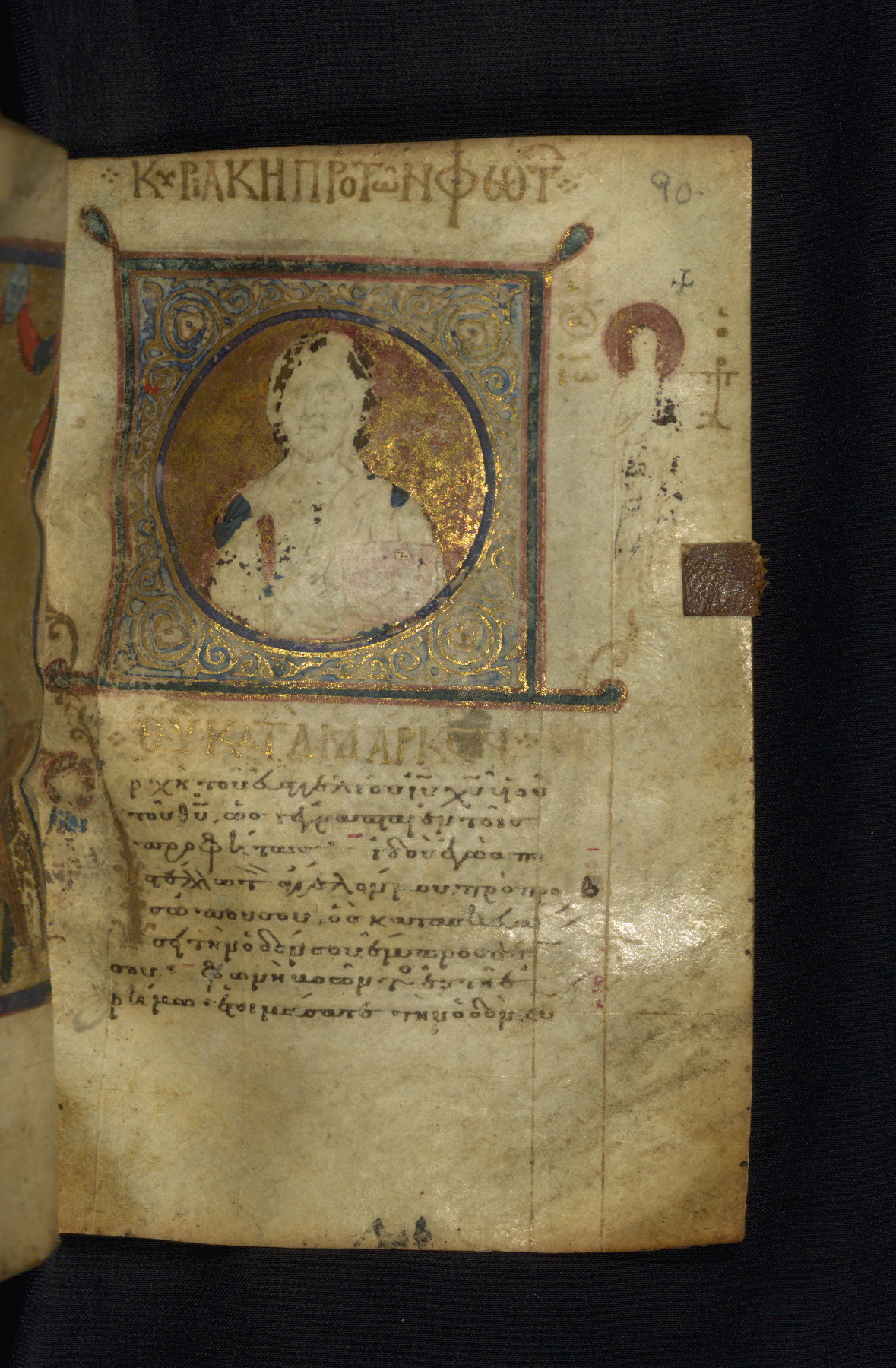
● ἐν Ἠσαίᾳ τῷ προφήτῃ is supported by Codex Bezae (D, 05, Greek-Latin), Codex Koridethi (Θ, 038), the core members of f1, 565, and 205 (from the mid-1400’s), plus 700, 1243, and 1071.  (Only these last three lack close affiliation with either the Western or Caesarean Text.)  A few other minuscules support ἐν Ἠσαίᾳ τῷ προφήτῃ but were not listed in the UBS apparatus; these include 22.  Minuscule 22 shares some readings with f1 and 205, and also shares a note about the ending of Mark; in 22 the note is shorter (failing to claim that the Eusebian Canons omit Mk. 16:9-20, very probably because where and where 22 was made, the Canons had been adjusted to include those verses) but it is recognizably the same note. (Minuscules 15, 22, 1110, 1192, and 1210 all have the note about Mark 16:9-20.)  Also included:  61 (Codex Montfortianus, on 55r; this manuscript is famous for its inclusion of the Comma Johanneum), 372 (assigned to the 1500’s, with some Latin notes in the margins), and 391 (produced in 1055).

● ἐν βίβλω λόγων Ἠσαΐου τοῦ προφήτου is read by 1273 (the George Grey Gospels) and 544 and a similar text is in the book in a full-page picture of Mark in Lectionary 1635.

            For a convenient summary of versional and patristic evidence, see the STEPBible Textual Apparatus and Wieland Willker’s Textual Commentary on the Greek Gospels – Volume 2, Mark, 2015 Edition.  Readers should be aware that 2427 (cited throughout Mark in the 27th edition of the Nestle-Aland Novum Testamentum Graece) has been proven to be a forgery, based on a printed text from the 1800’s, and that although f1 is cited for “in Isaiah the prophet,” this represents only a consensus of its core members.)
            The Armenian version was listed in UBS2 as support for ἐν τοῖς προφήταις, but in UBS4 the Armenian version was listed as support for ἐν Ἠσαίᾳ τῷ προφήτῃ.  The older Armenian manuscripts tend to not have “Son of God” in Mark 1:1, and to read “in Isaiah the prophet” in 1:2 – following the Caesarean form.  However, a competition of influences upon the Armenian tradition began very early in its history, in addition to later influence from the Vulgate. 

            Most of the Greek lectionaries, such as Lect 123 (an illustrated lectionary from the 900’s), Lect 379 (from the 800’s), Lect 1599 (from the 900’s), Lect 71 (from 1066), Lect 183 (from the 800’s or 900’s), and the illustrated Lect 120 (from the 1100’s) support ἐν τοῖς προφήταις, but there are some exceptions, such as Lect 562 (from A.D. 991), which supports ἐν Ἠσαίᾳ τῷ προφήτῃ.
           
● One more variant seems to be attested by the Old Latin Codex Usserianus Primus (VL 14); the Byzantine and Alexandrian readings are combined, so as to read, “in Isaiah and in the prophets.”  However the text is difficult to read due to damage to the parchment (See fol. 150r at the page-views at the Trinity College Dublin website .)

            In this essay, the reading “in the prophets” will be defended as original, and I will argue that its Alexandrian and Western rivals originated in the following way:
            In the 100’s, some copyists were mildly averse to non-specific references to Old Testament books, and added specific names in place of the original non-specific references.  Mark 1:2 is one of the passages affected by this tendency toward specificity.  Some copyists, understanding the paraphrastic opening phrase – which could be understood as a reference to Exodus 23:20 (in the Law, rather than the Prophets) – as merely an introduction to Isaiah’s words, adjusted the text so as to identify the prophet being cited. 
           
            This happened independently in Alexandrian and Western transmission-streams, which is why the Alexandrian witnesses consistently have τῷ before Ἠσαίᾳ, while the major Western and Caesarean witnesses do not.  When (and where) copyists and commentators were confident that Mark was using Malachi rather than Exodus, Christian scholars whose manuscripts read “in Isaiah the prophet” developed inventive explanations about how Mark could appear to identify Malachi’s words as if they had been written by Isaiah.  These explanations were sufficiently convincing to allow the reading to remain in the Alexandrian and Western transmission-lines. 

            The insertion of specific names, where the original text has no specific name, is a recurring scribal practice, and one which is observable in some of our very earliest New Testament manuscripts.  For example, in the early Alexandrian transmission-stream, in Luke 16:19, in the story about the rich man and Lazarus, the rich man was given a name:  he was named Nineveh.  This reading is found in Luke 16:19 in Sahidic copies, and in the manuscript known as Codex Sinaiticus Arabicus, or CSA, one of the documents discovered at St. Catherine’s Monastery in 1975.  (A collation of CSA by Hikmat Kachouh was released in 2008 in the journal Novum Testamentum.)  But there is much earlier evidence for that reading.  Papyrus 75 reads named Neuhs in the same passage (ονοματι νευης), and this is the same name, Nineveh, disfigured by a parableptic error in which the copyist skipped the first syllable.  (Two Greek manuscripts, minuscules 36 and 37, have margin-notes which also identify the rich man as Nineveh.)
            When a character in the Gospels plays a prominent role, but has no name, frequently a name is provided.  Bruce Metzger documented this phenomenon in his essay, Names for the Nameless in the New Testament, which serves as chapter 2 of New Testament Studies:  Philological, Versional, and Patristic
            The scribal tendency to provide names for unnamed individuals comes into play repeatedly in passages where the text refers to the fulfillment of prophecies.  The non-specific attribution “through the prophet” is often turned into a specific attribution.  Usually the attribution is correct, but sometimes it is incorrect.
            The Old Latin Codex Colbertinus (VL 6) displays this tendency.  Its text of Mark 15:27 provides names for the two robbers who were crucified with Jesus – Zoathan and Chammatha.  VL 6, like practically all Latin manuscripts of Mark, also reads “in Isaiah the prophet” in Mark 1:2.  In Matthew 1:22 – where Matthew quoted Isaiah without naming him (simply saying that “what was spoken by the Lord through the prophet” was fulfilled) –  Codex Colbertinus states specifically that the prophecy was given by Isaiah.
            This phenomenon is not limited to one medieval Old Latin copy.  Codex Bezae, which D. C. Parker has assigned to c. 400, also includes Isaiah’s name in the text of Matthew 1:22, both in its Latin text and in its corresponding Greek text.  Old Latin Codex Veronensis (VL 4, from the 400’s) also has Isaiah’s name in Matthew 1:22.  So do the Old Latin codices Brixianus (VL 10, from the 500’s) and Sangermanensis (VL 7, c. 810) and Vercellensis (VL 3, probably from the 370’s).  (Metzger expressed some uncertainty about Codex Vercellensis’ reading in his Textual Commentary, but “ESEIAM PROPHETAM” is shown clearly in Irici’s 1748 presentation of Codex Vercellensis.)  “Isaiah” is practically the normal Old Latin reading in Matthew 1:22. 
            The earliest evidence for the reading “in Isaiah the prophet” in Matthew 1:22, however, may be even earlier than the earliest Old Latin manuscript:  in the Latin text of Irenaeus’ Against Heresies 3:21:4 (composed in Greek c. 184), Irenaeus quotes Matthew 1:22:  “et quoniam Angelus in somnis dixit ad Joseph:  Hoc autem factum est, ut adimpleretur quod dictum est ab Esaia Propheta:  Ecce virgo it utero concipiet.”  It is possible that the form of this quotation was altered by the Latin translator of Irenaeus’ work, but that too would be early testimony.  
            In the Syriac tradition, the same scribal tendency is on display.  In Matthew 1:22, the inclusion of the name “Isaiah” is attested by the Sinaitic Syriac, the Curetonian Syriac, the Harklean Syriac, and the Palestinian Aramaic.
            Another Western witness that displays the tendency to fill the vacuum when a prophet’s statements are cited without specifying his name is the Middle Egyptian Glazier Codex of Acts (G67, from the 400’s).  Instead of “in the prophets” in Acts 13:30, G67 reads, “in Habakkuk the prophet.”
           
            The scribal tendency toward specificity is also displayed by the core members of family-1.  Although these manuscripts are medieval, they are generally thought to represent a text of the Gospels similar to a text used by Origen at Caesarea in the 200’s; this is indicated by their support for the reading “Jesus Barabbas” in Matthew 27:17; according to a Latin translation of Origen’s Commentary on Matthew, Origen stated that some of his copies had this reading.
            The text of f1 indicates that copyists of the manuscripts used by Origen were not exempt from the tendency toward specificity, and that occasionally the scribal attempt to make the text more specific was poorly executed.  In Matthew 13:35, where most manuscripts simply read “by the prophet,” without naming the prophet being quoted, the text in f1 includes a specific name:  Isaiah. 
            That is not a correct reference; Matthew’s quotation clearly comes from Psalm 78:2, which was composed by Asaph, not by Isaiah.  Yet an early copyist’s need for specificity was greater than his grasp of the contents of the Old Testament, and the name “Isaiah” was perpetuated in various manuscripts, including minuscules 1, 543, 788, 230, 983, and 1582 (and some others), and Codex Θ. 
            Eusebius of Caesarea, in his Commentary on the Psalms, mentioned that some copies read “in Isaiah the prophet” in Matthew 13:35, but not the accurate copies. 
            Jerome, in his Homily 11 on Psalm 77 (our Psalm 78), cited Matthew 13:35 and claimed that the reading “through the prophet Asaph” is supported by “all the ancient copies” – “in omnibus ueteribus codicibus” – but it was changed by ignorant individuals (see Amy Donaldson’s Explicit References to New Testament Variant Readings Among Greek and Latin Church Fathers, Vol. 2, pages 369-370).  In addition, Jerome wrote that Porphyry (an anti-Christian author who wrote c. 270) made an accusation against Matthew that can only be accounted for by Porphyry’s use of a copy of Matthew with the reading “in Isaiah the prophet” in Matthew 13:35:
            “Porphyry, that unbeliever . . . says, ‘Your evangelist, Matthew, was so ignorant that he said, “What is written in Isaiah the prophet:  I will open my mouth in parables, I will utter mysteries from of old.”’ . . .  Now, just as this was the scribes’ error, it was, likewise, their error to write ‘Isaiah’ instead of ‘Asaph.’” 
            Jerome proceeded to offer a theory that some early copyist, reading “Asaph the prophet” in his exemplar, did not recognize the name “Asaph,” and replaced it with “Isaiah.”  He offered the same line of reasoning in his Commentary on Matthew.  On the premise that Jerome was not being altogether deceptive, it would appear that the text of Matthew 13:35 in copies that he considered ancient had been expanded to include Asaph’s name.  (We shall take a closer look at Jerome’s testimony later.)
            The tendency to make non-specific quotations of Old Testament prophets more specific – via the insertion of a prophet’s proper name rather than “through the prophet” or “by the prophet” – was so strong that copyists in the Western and Caesarean transmission-streams inserted prophets’ names in various passages – and, in the case of Matthew 13:35 in the Caesarean transmission-stream, perpetuated a specific name even when it was the wrong name.   
            The scribal tendency toward specificity was so strong in the Old Latin transmission-line that in Old Latin Codex Vercellensis (VL 3) a copyist felt that it was necessary to identify the prophet being quoted in Matthew 2:5.  Four copies of the Harklean Syriac display the same tendency, but their copyists exercised restraint by only putting Micah’s name in the margin of this passage.  In VL 3 (probably produced in the 370’s), the copyist (or his exemplar’s copyist) embedded the prophet’s name directly into the text – and, making matters worse – the identification is incorrect:  VL3 reads there, “per Eseiam propheta,” that is, “through Isaiah the prophet.”

            What about Alexandrian witnesses?  Yes; although not as heavily as elsewhere, the tendency toward specificity impacted Alexandrian manuscripts too:  “Isaiah the prophet” is the reading of Codex ﬡ at Matthew 13:35.
            In the margin of Matthew 2:15 in Codex Sinaiticus, we see how precarious it would be to assume that copyists knew the Old Testament too well to attribute to Isaiah a passage from a different Old Testament book.  Matthew 2:15 contains a quotation of Hosea 11:1 – “that it might be fulfilled which was spoken by the Lord through the prophet, saying, ‘Out of Egypt I called My Son.’”  Someone did not recognize that the passage being quoted was Hosea 11:1 (because in the Septuagint, Hosea 11:1 reads differently, as “When Israel was a child then I loved him, and called his sons out of Egypt”) and thought instead that Matthew was referring to a passage in Numbers – maybe 15:41 or 20:16 – and for that reason, he wrote in the margin of Codex Sinaiticus, in small vertically stacked lettering, “In Numbers.” 
            However reasonable it might seem to assume that copyists knew the Old Testament so well that they would not have risked giving the impression that they attributed a passage to Isaiah that did not originate with Isaiah, there is evidence against such an assumption.  Not only does the text of VL3 attribute Micah 5:2 to Isaiah in Matthew 2:5, but in Matthew 21:4 (according to Metzger in Textual Commentary, page 54), a few Vulgate copies, Bohairic copies, and Ethiopic copies add Isaiah’s name, although the quotation is from Zechariah. 
            Not all copyists were familiar with the Old Testament text, and for most of those who did know the Old Testament well, the text they knew was the Septuagint. Consequently there was a risk that copyists would imagine that their exemplars contained an error when a Gospels-manuscript contained a form of an Old Testament passage that did not match up with the form in which it was found in the Septuagint. 
            Mark’s use of Malachi 3:1 is one such case.  His utilization of Malachi 3:1 closes with the phrase, “who shall prepare your way” (ὃς κατασκευάσει τὴν ὁδόν σου) in the Alexandrian text, or, in the Byzantine Text, “who shall prepare your way before you” (ὃς κατασκευάσει τὴν ὁδόν σου ἔμπροσθέν σου).  Neither is an exact match with the text of Malachi 3:1 in the Septuagint, which ends with the phrase “καὶ ἐπιβλέψεται ὁδόν πρὸ προσώπου μου” – “and he shall carefully look for a way before me.”  (See Maurice Robinson’s article Two Passages in Mark in Faith & Mission, 13/2 (Spring 1996), pp. 66-111.)  An additional factor to consider is that the Septuagint’s text of Exodus 23:20a reads Καὶ ἰδοὺ ἐγὼ ἀποστέλλω τὸν ἄγγελόν μου πρὸ προσώπου σου – “And behold, I send my messenger before your face” – which might have caused some copyists to wonder if the readers of their copies would suppose that Mark was using a passage in the Law, rather than in the Prophets.    
            So if anyone wonders, “If the reading ‘in Isaiah the prophet’ in Mark 1:2 is not original, where did it originate?”, let the copyists of ﬡ, D, Θ, the Old Latin copies, and the main manuscripts of f1 reply:  from the same place that their readings “in Isaiah the prophet” in Matthew 1:22, Matthew 2:5, and Matthew 13:35 originated:  from the propensity of some early scribes to make non-specific references more specific.
            A faint echo of the kind of scribal confusion that led to the insertion of Isaiah’s name in Mark 1:2 (or an independent repetition of it) may be seen in two medieval Bohairic manuscripts.  Boh-E1 (a Coptic-Arabic manuscript produced in 1208), has the Bohairic words for “Exodus” and for “Malachi” in the margin near Mark 1:2.  An Arabic note says, “A copy has, ‘the prophets.’”  Boh-O1 (a Coptic manuscript produced in the 1300’s) has an Arabic note that says, “Isaiah prophesied with the voice of one crying, and Moses and Malachi prophesied with the sending of the messenger.”  The notes in both copies show that to some copyists, Mark 1:2 was understood to refer not just to the Prophets, but to a passage in Exodus.


To be continued in Part Two:  Mark 1:2, Origen, and Jerome