Followers

Tuesday, October 10, 2017

Codex Laudianus, GA 45, GA 46, GA 57, and Friends

The Gatehouse at the
Bodleian Library.
            Sir Thomas Bodley (1535-1613) was the namesake of the second-largest library in Great Britain:  the Bodleian Library, on the campus of Oxford University.  This is the Hotel California of libraries; once a book enters the Bodleian Library, it can never leave.  The library currently contains over 12 million books, plus hundreds of pictures, sculptures, coins, and one stuffed crocodile. 
            It is also home to many Greek manuscripts – mostly ancient classical works – including some Greek New Testament manuscripts.

            Codex Laudianus (Ea, 08) is the most important Greek New Testament manuscript in the Bodleian Library.  It is a manuscript of the book of Acts, probably from the 500s, written in matching columns of Latin and Greek on each page.  This manuscript was donated by Archbishop William Laud.  It was used in Sardinia (where someone wrote a note on it, mentioning the location), and later, after being taken to England, it was used in the early 700s by the notable historian, theologian, and translator known as the Venerable Bede, who mentioned many of its unusual readings, including downright unique readings in Acts 4:10, 5:30, and 7:16. 
            Codex Laudianus is the earliest extant Greek manuscript that contains Acts 8:37, on fol. 70v, (although the verse was used in the 180’s by Irenaeus in Against Heresies 3:12:8, by Cyprian in the mid-200s in Testimonies 3:12:43, by Augustine in Sermon 49:11, and by some other patristic writers, and is found in the Coptic Glazier Codex (G67)).  Textual critic David C. Parker has commented on some corrections in this manuscript.

Two other Greek manuscripts housed at the Bodleian Library are online:
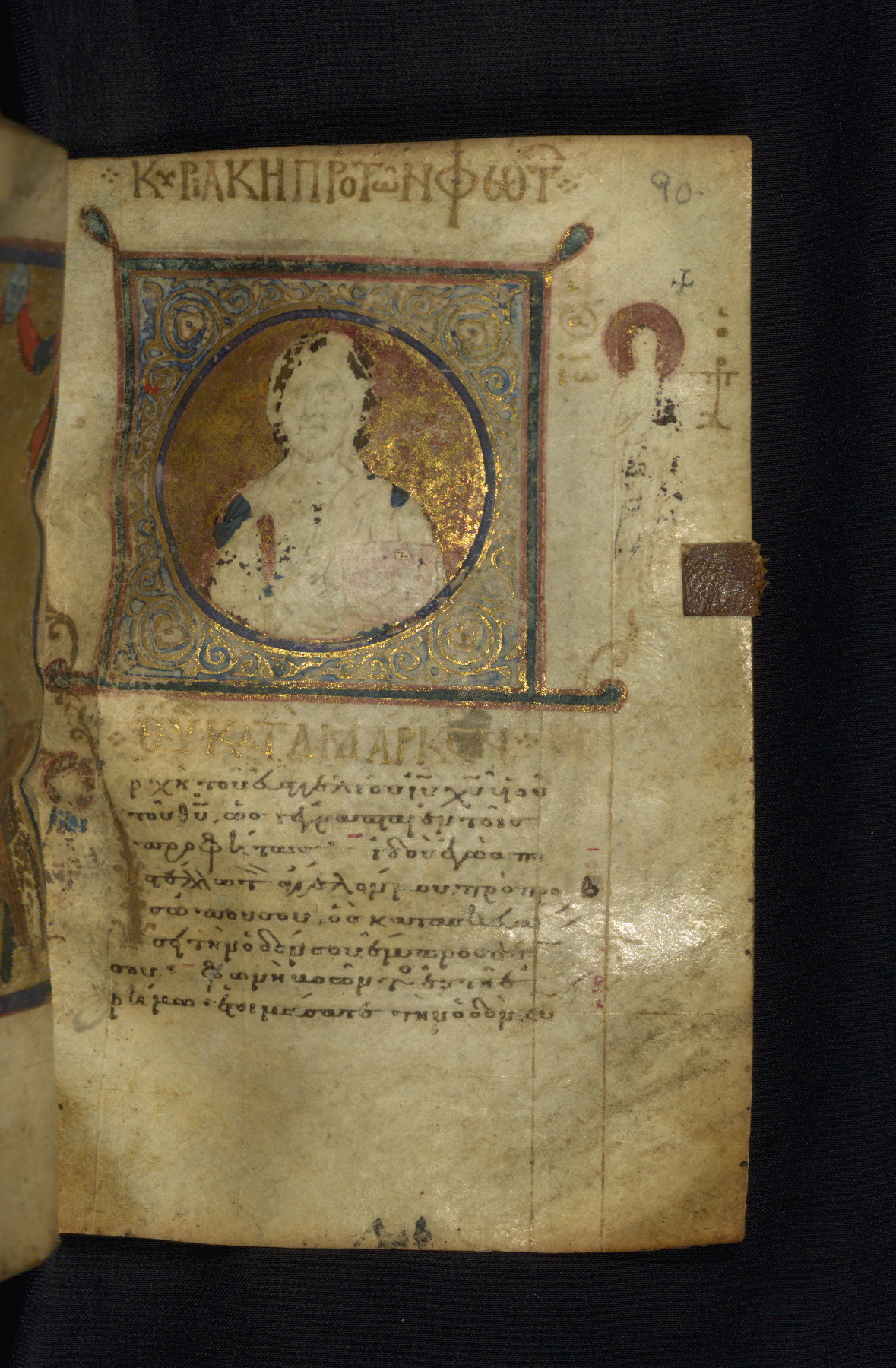
            MS Barocci 31 is GA 45, a fairly ornate manuscript of the Gospels (with portraits of the Evangelists) from the late 1200s.
            Matthew (Image 21, fol 7r)
            Mark (Image 245, fol. 119r)
            Luke (Image 389, fol. 191r)
            John (Image 635, fol. 314r)

            MS Barocci 29 is GA 46, which has been assigned to a wide variety of production-dates; the current guess is to the early 1300s. 
            Matthew (Image 63, fol. 31r)
            Mark (Image 239, fol. 118r)
            Luke (Image 359, fol. 177r)
            John (Image 563, fol. 277r)

            The Bodleian Library houses several New Testament uncials – including Codex Γ (036), known as Codex Tischendorfianus IV, and Codex Λ (039), known as Codex Tischendorfianus III, and 0134 (Selden Supra 2, fol. 177-178) (text from Mark 3 and 5) – and over thirty minuscules (including GA 47, 557, and 558).  A lectionary is also online at the Bodleian’s website:  MS Barocci 197, a palimpsest.

            Some important versional manuscripts are also kept at the Bodleian Library, including the MacRegol Gospels, also called the Book of Birr (A replica of this manuscript is in the library of Birr, Ireland).
           
             Nearby at Magdalen College, Magdalen College MS 9 is GA 57, a Greek manuscript from the late 1100s which contains every book of the New Testament except Revelation.  Here is a basic index of GA 57:   
            Matthew (Image 10, fol. 3r)
            Mark 1:11 (Image 74, fol. 35r)  (The first page of Mark is missing, but you can see traces of the imprint left by the initial “A” of Mark 1:1 in the margin on this page.  Ultraviolet light might reveal more.)
            Luke (Image 116, fol. 56r ) 
            John (Image 187, fol. 91v)
            Acts (Image 236, fol. 116r)
            James (Image 303, fol. 149v)
            First Peter (Image 310, fol. 153r)
            Second Peter (Image 317, fol. 156v)
            First John (Image 322, fol. 159r)
            Second John (Image 329, fol. 162v)
            Third John (Image 331, fol. 163v)
            Jude (Image 333, fol. 164v) 
            Romans (Image 335, fol. 165v)
            First Corinthians (Image 359, fol. 177v)
            Second Corinthians (Image 382, fol. 188r)
            Galatians (Image 398, fol. 196r)
            Ephesians (Image 406, fol. 200r)
            Philippians (Image 414, fol. 204r)
            Colossians (Image 420, fol. 207r)
            First Thessalonians (Image 426, fol. 210r)
            Second Thessalonians (Image 432, fol. 213r)
            First Timothy (Image 436, fol. 215r)
            Second Timothy (Image 442, fol. 218r)
            Titus (Image 447, fol. 220v)
            Philemon (Image 450, fol. 222r)
            Hebrews (Image 452, fol. 223r)
            Psalms (Image 470, fol. 232r)

            This manuscript received some attention from Orlando Dobbin in his 1854 book about Codex Montfortianus on page 29; Dobbin noted that it supports “Lord and God” in Acts 20:28, “God was manifested” in First Timothy 3:16, and the non-inclusion of the Comma Johanneum in First John 5:7.  Another presentation of GA 57 is online, with thumbnail-pageviews.
            Magdalen College is also home to Magdalen College MS Greek 7 (part of GA 1907) – a copy of Romans and First Corinthians.

            Perhaps the most famous New Testament manuscript on the premises of Magdalen College is Magdalen College MS Greek 17, better known as Papyrus 64, which consists of small fragments with text from Matthew 26.  The late Carsten Peter Thiede proposed that these fragments were extremely early – from the first century!  He also claimed that a few manuscript-fragments found among the Dead Sea Scrolls were the remains of New Testament texts.  The evidence for his position has been called into question by other researchers; nevertheless Papyrus 64 is unquestionably the earliest Greek manuscript of the text that it contains.  Stay tuned for a post focused on Papyrus 64, Papyrus 67, and Papyrus 4.

            Earlier this year, A Catalogue of Greek Manuscripts of Magdalen College, Oxford was released.  Readers who are curious about the diverse Greek manuscripts housed at Magdalen College may wish to obtain a copy.


Thursday, October 5, 2017

Mark 1:2 (Part 4) - Miscellaneous Evidence

            Today as we conclude this exploration of the evidence about Mark 1:2, let’s consider some miscellaneous questions.

How diverse is the evidence for “in the prophets”?

Codex Cyprius (K, 017),
from the 800s
.
            The agreement of Codex Washingtoniensis with Codex Alexandrinus and the Byzantine Text is sometimes treated casually, but it actually is rather significant, because although the text of Codex W is primarily Byzantine in Matthew and in Luke from 8:13 onward, its text of Mark is very different.  Larry Hurtado describes it in his introduction to the volume The Freer Biblical Manuscripts:  “In Mark 1-4 Codex W agrees more closely with Codex Bezae and other “Western” witnesses.  But at some point in Mark 5, the textual affiliation shifts markedly, and throughout the rest of Mark Codex W cannot be tied to any of the major text-types.  In this main part of Mark, however, W was later shown to exhibit a very interesting alignment with the Chester Beatty Gospels codex (P45).” 
            The agreement of Codex A and Codex W demonstrates a more widespread range of attestation than the agreement of ﬡ and B, which were very likely produced in the same scriptorium, or by copyists trained in the same place.  Augmenting the case that Codex A’s transmission-line is separate from that of Codex W is the observation that they read differently at the end of Mark 1:2 (A has εμπροσθεν σου; W does not) – not to mention the insertion in Codex W of several lines of Greek text from Isaiah 40:4-8 between Mark 1:3 and 1:4.
GA 1216.

            In addition, sub-groups of manuscripts within the Byzantine transmission-line consistently support “in the prophets” in Mark 1:2.  Besides those mentioned already, 72 (a copy with some Arabic notes), 117, 128, 304 (a manuscript of Matthew and Mark, in which the text is divided into segments interspersed with commentary), 444, 492, 780, 783, 809 (a deluxe manuscript from the 1000s, with some marginal commentary), 817 (a manuscript used by Erasmus; like other manuscripts in which the text of John is accompanied by Theophylact’s commentary, it does not contain John 7:53-8:11), 826 (considered a strong representative of the f13 cluster), 389 (a manuscript with unusual decorations in its Canon-tables), 1216, 1342, 2483, some Armenian copies, Ethiopic copies, and the Old Slav/Glagolitic version demonstrate that the reading “in the prophets” was read in multiple locales. 
           
Why don’t we see a scribal tendency toward specificity in Matthew 27:35b?

            The scribal tendency toward specificity manifested in versional evidence at Matthew 1:22, 2:5, 2:15, 21:4, but not in Matthew 27:35b.  The reason for this is that Matthew 27:35b did not circulate as widely as the rest of the text of Matthew; it is in the Textus Receptus but it is not included in the Robinson-Pierpont Byzantine Textform, or in the archetype of f35 compiled by Wilbur Pickering.
            The question about whether Matthew 27:35b is original or not may be set aside for the time being (though perhaps it should be mentioned that this verse-segment is strongly supported by Old Latin evidence, and that it ends with the same word (κλῆρον) as the verse-segment that precedes it, which would make it vulnerable to accidental loss).  The thing to see is that Matthew 27:35b escaped being the subject of the scribal tendency toward specificity by being absent from multiple transmission-lines.

What was the text of Mark 1:2 quoted by Victorinus of Pettau?    

            Victorinus of Pettau, in the late 200s, cited Mark 1:2 with “in Isaiah the prophet” in his Latin commentary on Revelation.  His text may reveal the kind of liberties that were taken by Western copyists.   Either Victorinus cited Mark 1:1-2 very loosely, or else his Latin text was radically altered; Victorinus quoted Mark 1:1-2 as follows“Mark, therefore, as an Evangelist, who begins, ‘The beginning of the Gospel of Jesus Christ, as it is written in Isaiah the prophet:  ‘The voice of one crying in the wilderness,’ has the likeness of a lion.” (Notice that Victorinus’ text not only omits the material from Malachi, but also lacks the phrase “the Son of God.”

How do patristic writers of the mid-late 300s – Serapion of Thmuis, Basil of Caesarea, and Epiphanius of Salamis – quote Mark 1:1-2?

            I do not possess critically edited editions of the works of Serapion of Thmuis, or of Titus of Bostra, or of Basil of Caesarea, or of Epiphanius (who have all been cited as support for “in Isaiah the prophet”) – and so I have resorted to the comments of John Burgon, in the form in which they were collected by Edward Miller for the book called The Causes of Corruption of the Traditional Text of the Holy Gospels, published in 1896.  I rephrased some wording and changed the syntax slightly in the following quasi-quotation from page 113: 
            “Serapion, Titus, and Basil merely borrow from Origen; and, with his argument, reproduce his corrupt text of St. Mark 1:2.  Basil, however, saves his reputation by leaving out the quotation from Malachi, passing directly from the mention of Isaiah to the actual words of that prophet.  Epiphanius (and Jerome, too, on one occasion) does the same thing.”            Those who wish to test Burgon’s claims, if they have the resources, may wish to consult Serapion of Thmuis’ Against the Manichees, 25, 37, and Basil of Caesarea’s Against Eunomius, 2:15, and Epiphanius’ Panarion 51:6:4, and see if their compositions run parallel to the contents of Origen’s comments in Book 2 of Contra Celsus, which run as follows:   

            “Even one of the Evangelists, Mark, says, ‘The beginning of the gospel of Jesus Christ, as it is written in the prophet Isaiah, Behold, I send my messenger before your face, who shall prepare your way before you.’  This shows that the beginning of the gospel is connected with the Jewish writings.  What, then, is the force in Celsus’ Jew’s objection [Celsus had pictured a Jew objecting that Christians were merely a sect of Judaism] seeing that if anyone was to predict to us that the Son of God would visit mankind, it would be one of our prophets, and the prophet of our God?  Or how is it a charge against Christianity to point out that John, who baptized Jesus, was a Jew?”
 
            Similarly, in Chromatius’ use of Mark 1:2 with “in Isaiah the prophet” in Prologues to Sermons on Matthew, Chromatius seems to have recycled the material that one sees in Irenaeus’ Against Heresies 3:11:9. 

Do Byzantine copyists elsewhere display willingness to remove a prophet’s name from the text if it appears problematic?

            Such willingness is assumed by many commentators, as exemplified by Bruce Terry in his online A Student’s Guide to Textual Variants:  “The quotation in verses 2 and 3 is from two scriptures:  the first part is from Malachi 3:1 and the second part is from Isaiah 40:3.  Thus it is likely that copyists changed the reference to make it more general.”
            Robert Waltz provides another example:  “The quotation is not from Isaiah alone, but from Malachi and Isaiah.  The attribution to Isaiah is an error, and scribes would obviously have been tempted to correct it.”
            The same assumption is expressed by Metzger in A Textual Commentary:  “The quotation in verses 2 and 3 is composite, the first part being from Mal 3.1 and the second part from Is 40.3.  It is easy to see, therefore, why copyists would have altered the words “in Isaiah the prophet” . . . . to the more comprehensive introductory formula, “in the prophets.””
            However reasonable that may sound, when we turn to Matthew 27:9 – where readers could understandably imagine that Matthew attributed to Jeremiah a paraphrase of Zechariah 11:12-13 – the Byzantine text adamantly reads “Jeremiah” nevertheless.
            Meanwhile, when we look at representatives of the transmission-lines where “in Isaiah the prophet” was read in Mark 1:2, it is precisely there that we see a willingness to mess with the text of Matthew 27:9.  A consultation of the first volume of Willker’s Textual Commentary on the Greek Gospels will show that Origen, Eusebius, and Jerome all expressed a suspicion that there was a scribal error in the manuscripts that read “Jeremiah” in Matthew 27:9.  Augustine (in The Harmony of the Gospels, Book 3, chapter 7, written in A.D. 400), shows that by his time, some Latin copyists had removed the name “Jeremiah” to relieve readers of the burden of investigating the text:
            “If anyone finds a difficulty in the circumstance that this passage is not found in the writings of the prophet Jeremiah, and thinks that this damages the credibility of the Evangelist, let him first take notice of the fact that the ascription of the passage to Jeremiah is not contained in all the codices of the Gospels, and that some of them state simply that it was spoken “by the prophet.” 
            Augustine, for his part, proceeded to reject the non-inclusion of Jeremiah’s name – because, he explained, most of the codices contain Jeremiah’s name, and because “those critics who have studied the Gospel with more than usual care in the Greek copies report that they have found that the more ancient Greek exemplars include it,” and so forth.  But not all copyists shared his insight – which is why, in minuscules 33 and 157 (33 being one of the few minuscules that read “in Isaiah the prophet” in Mark 1:2) – there is no proper name in Matthew 27:9, and, turning to versional evidence, there is likewise no proper name there in the Peshitta, nor in VL 3 (both of which support “in Isaiah the prophet” in Mark 1:2).  In minuscule 22 and in the margin of the Harklean Syriac version, Zechariah’s name is placed there, and in the Old Latin Codex Rehdigeranus (VL 11, from the first half of the 700s) not only is Jeremiah’s name absent, but Isaiah’s name has been put into the text.
            Codex D’s text also displays scribal willingness to simply delete a proper name that seemed problematic in Matthew 14:3; Philip’s name is missing.  And in Mark 6:3, Codex D does not include Jairus’ name, apparently merely to bring the Marcan text into closer conformity to the Matthean parallel.
            Codex ﬡ’s text similarly resolves a perceived difficulty in Matthew 23:35 via the removal of the words υἱοῦ Βαραχίου.
            Meanwhile, the Byzantine Text in these passages retains the proper names which were considered problematic – so problematic that they were removed or replaced – in various Western, Caesarean, and Alexandrian manuscripts.  This evidence ought to lead one to suspect that the witnesses which contain a text in which names were inserted or removed – Codex Bezae (D), Codex Sinaiticus (ﬡ), Codex Koridethi (Θ), the Old Latin witnesses (especially VL 3), the Peshita, 33, and f1 – should not be trusted very much where a variant involves the presence or absence of a name, such as in Mark 1:2.  To remove those witnesses from the picture would be to remove over half of the Greek manuscript-support cited in the UBS apparatus for “in Isaiah the prophet” in Mark 1:2.

Was Mark more likely to write “in Isaiah the prophet,” or “in the prophets”? 

            Two other New Testament authors – Matthew and Paul – occasionally blend together two citations from the Old Testament, using one as a sort of thematic cross-reference for the other.  Matthew appears to do this in 21:4-5, focusing on Zechariah 9:9 with a dash of Isaiah 62:11.  And in 27:9, Matthew appears to use verbiage from Zechariah to frame the scene in Jeremiah 32:6-9 – unless, as some suspect (as Origen and Jerome did), Matthew refers here to an entirely different and non-canonical composition by Jeremiah, consisting of Hebrew source-material used in The Prophecy of Jeremiah to Passhur.”  (See Willker, Vol. 1, TVU #377, for details.)  Likewise Paul, in Romans 3, does not meticulously separate his quotations which are united by a common theme. 
            Mark, however, was not like Matthew and Paul.  Matthew repeatedly quotes from the Old Testament, expecting his readers to know their Scriptures.  Paul, trained as a Pharisee, quoted from the Old Testament frequently.  Mark, in contrast, seems to have felt a stronger obligation to explain coinage-values (cf. 12:42) than to specify which Old Testament prophecies were fulfilled by Jesus.   
            Turning, then, to the other passages in Mark where material from Isaiah is used – 4:12 (Isaiah 6:9), 7:6-7 (Isaiah 29:13), 9:44, 9:46, 9:48 (Isaiah 66:24 – 9:44 and 9:46 are absent from the Nestle-Aland compilation), 11:17 (Isaiah 56:7), and, in the Byzantine text, 15:28 (Isaiah 53:12) – what stylistic pattern do we see?  Except for 7:6, it is one of non-specificity.     
                  
            The cumulative weight of these points favors “in the prophets” as the original reading of Mark 1:2.  The reading “in Isaiah the prophet” is likely to have arisen in both the early Alexandrian and Western transmission streams independently, due to a widespread scribal tendency to add specificity to the text. 


POSTSCRIPT

            I do not intend for this postscript to be considered an integral part of the case for “in the prophets,” but some readers may enjoy pondering it.  The Alexandrian Text of the Gospels (particularly the text of Codex Vaticanus) is well-aligned with the earliest stratum of the Sahidic version, and the Western Text of the Gospels is likewise well-aligned with the Old Latin version.  Could translators have introduced proper names into their local translations?  And, subsequently, could the Greek texts in the locales where these translations were in use have been adjusted to conform to the translation?
            We see a tendency toward specificity in some modern English paraphrases.  In Matthew 1:22, The Amplified Bible includes Isaiah’s name, bracketed, in the text; The Voice includes it in italics.  In Matthew 2:5, the Living Bible, the Voice translation, and Eugene Peterson’s The Message all include Micah’s name.  The Voice includes Zechariah’s name in Matthew 21:4.  The Message also inserts Amos’ name in Acts 7:42, and Isaiah’s name in Acts 7:48.
            The people who made these paraphrases did not consider what they did to be reckless and unnecessary tampering when they inserted proper names into these passages.  They regarded this step as a helpful amplification of the specific meaning of the text.  Some translators of early versions (particularly the Sahidic, Old Latin, and Syriac) – and some early copyists who prepared Greek manuscripts to be read to congregations – had the same intention.

●●●●●●●

Note:
All four posts in this series can be downloaded as a single file at my Academia.edu page, and also among the files on Facebook in the NT Textual Criticism group.

Wednesday, October 4, 2017

Mark 1:2 (Part 3) - Irenaeus and Tatian

[Continued from the previous post]
 
            Continuing our investigation about the text of Mark 1:2, let’s turn now to Irenaeus, the earliest evidence for Mark 1:2.  Irenaeus had grown up in Asia Minor (he states in Against Heresies 3:3:4 that he saw Polycarp at Smyrna), and served as bishop in the city of Lugdunum (now Lyons), in Gaul (now France).  He also visited Rome in 177, when Roman persecution targeted Lugdunum.  He wrote the third book of his most famous work, Against Heresies, in about 184, which means that his quotations of Mark are from a manuscript earlier than any known to exist.            
A Vulgate copy
from the 800s,
with "in Isaiah the prophet"
in Mark 1:2.
            Considerable sections of Against Heresies are extant only in Latin or Syriac, rather than in the Greek language in which Irenaeus wrote.  For this reason, some scholars have suspected that when we encounter quotations of Mark 1:2 with “in the prophets” in Against Heresies, we are seeing the hand of a Latin translator who replaced Irenaeus’ quotations with a text more familiar to the translator.  However, the Old Latin and Vulgate firmly support “in Isaiah the prophet” – so whoever suggests that the Latin translator made Irenaeus’ Greek quotation agree with some Latin text that read “in the prophets” in Mark 1:2 should identify what Latin text he has in mind.
            In Against Heresies 3:10:5, Irenaeus wrote, “Wherefore also Mark, the interpreter and follower of Peter, does thus commence his Gospel narrative:  ‘The beginning of the gospel of Jesus Christ, the Son of God, as it is written in the prophets, Behold, I send my messenger before your face, who shall prepare your way.  The voice of one crying in the wilderness, Prepare the way of the Lord; make the paths straight before our God.’  Plainly does the commencement of the Gospel quote the words of the holy prophets, and point out Him at once, whom they confessed as God and Lord, Him, the Father of our Lord Jesus Christ, who had also made promise to Him, that He would send His messenger before His face, who was John, crying in the wilderness, in the spirit and power of Elijah, ‘Prepare ye the way of the Lord; make straight paths before our God.’”
            (The combination of variants in this citation is interesting, and merits closer study:  “Son of God” is included in verse 1, and “in the prophets” is read in verse 2; yet “before you” is not read at the end of verse 2, and the close of the quotation seems to be conformed to the text of Isaiah 40:3.)
            Against the idea that Irenaeus’ text has been altered here by a copyist of his works, it should be noticed that Irenaeus, commenting on the passage, did not proceed to say that one prophet (i.e., Isaiah) thus testified, but that they (i.e., the prophets) confessed him as God and Lord, and he made this affirmation as he saw no need for further comment.
            However, in Against Heresies 3:11:8, which is preserved in Greek and Latin, Irenaeus quotes Mark 1:1-2 with “in Isaiah the prophet.”  In addition, his brief quotation does not include the phrase “the Son of God” – Ἀρχὴ τοῦ εὐαγγελίου Ἰησοῦ Χριστοῦ ὡς γέγραπται ἐν Ἡσαΐα τῷ προφήτη.  This form of Mark 1:1-2a, excluding “Son of God” and including “in Isaiah the prophet” without τῷ before Ἡσαΐα, is rare; it is attested only in Codex Θ and in the Armenian and Georgian versions, and a few respectably early patristic compositions, as far as I can tell.  While nothing precludes the idea that Irenaeus possessed the kind of text displayed in Codex Θ (and in Oxyrhynchus Papyri LXXVI 5073, a talisman probably made in the late 200s), there is another possibility:  that at this point Irenaeus was incorporating the contents of an earlier source into his own composition.        
            Let’s take a look at the context of the quotation in Against Heresies 3:11:8:  it arrives as Irenaeus is defending the idea that there are four, and only four, Gospels. Just as there are four cherubim around God’s heavenly throne; each angelic likeness is associated with one of the four Gospels.  Using Revelation 4:7, Irenaeus explains that the Gospel of John corresponds to the confident lion; the Gospel of Luke corresponds to the ox; the Gospel of Matthew corresponds to the man, and the Gospel of Mark corresponds to the eagle – this last association being based on the swiftness of an eagle’s flight and the swiftness with which Mark summarizes Jesus’ activities, providing a quick overview:  “Mark, on the other hand, commences with the prophetical spirit coming down from on high to men, saying, ‘The beginning of the gospel of Jesus Christ, as it is written in Isaiah the prophet,’ – pointing to the winged aspect of the gospel; and on this account he made a compendious and cursory narrative, for such is the prophetical character.”
            Further along in Against Heresies, in 3:16:3, Irenaeus again refers to Mark 1:2.  He specifically quotes from Mark:  “Wherefore Mark also says, ‘The beginning of the gospel of Jesus Christ, the Son of God, as it is written in the prophets.’  Knowing one and the same Son of God, Jesus Christ, who was announced by the prophets . . . .”
            In the two instances where Irenaeus quotes Mark 1:1-2a with “Son of God” and “in the prophets,” the adjacent comments from Irenaeus do not give any hint that his own text has been replaced with something else; his comments interlock with a text of Mark in which those two readings are in the text.  But at the same time, there is no sign of tampering in the quotation in which Irenaeus fails to use “Son of God” and in which he names Isaiah the prophet.
            None of these passages in Against Heresies shows any sign of tampering by the Latin translator of Against Heresies.  It looks like Irenaeus used two different forms of the text of Mark 1:2 – one which read, “in the prophets,” and one which read “in Isaiah the prophet,” in the Western form of the Greek text (ἐν Ἠσαίᾳ τῷ προφήτῃ).  The only conclusion this evidence points to is that two forms of Mark 1:2 – one reading “in Isaiah the prophet” and another reading “in the prophets” – were in circulation in the 180’s. 

            Now let’s turn to a comment made by a Syriac writer named Isho’dad of Merv, around A.D. 850.  Though later than Charlemagne, Isho’dad’s writings are valuable, inasmuch as he frequently relied upon older compositions.  Isho’dad acknowledged a difficulty in the Syriac text of Mark 1:2 (where the Peshitta reads “in Isaiah the prophet”) and he mentioned five proposals about how to resolve it, without expressing a preference for any of them: 
            “It is asked, ‘Why did Mark say, “As it is written in Isaiah the prophet, ‘Behold, I send My messenger before Thy face,’” etc., when it is written in Malachi? 
            “Some say that it was in Isaiah and was lost.  Other say that he put to the voice of one crying in the wilderness, ‘Prepare the way,’ etc., this sign as an answer.  Others say that because it was translated from Roman [i.e., Latin; this reflects a tradition that Mark originally wrote in Latin] to Greek, and from that to Syriac, the interpreters made a mistake, and put ‘Isaiah’ instead of ‘Malachi.’ 
            “Others say that he [i.e., Mark] is not concerned to be meticulously precise about the reference, as is the custom of the Scriptures. 
            “Others say that the Diatessaron-book, which was composed in Alexandria, instead of this ‘as it is written by Isaiah the prophet,’ says, ‘by the prophets.’”  (See Margaret Gibson’s The Commentaries of Isho’dad of Merv, 1911, Vol. 1, page 126). 
            Let’s zoom in on that last proposal.  Isho’dad, in his description of the Diatessaron as a text composed in Alexandria, has probably confused the Diatessaron of Ammonius of Alexandria – a Matthew-centered cross-reference system mentioned in the much-circulated Ad Carpian, but not known to be extant – with the Diatessaron produced by Tatian (in the early 170’s), in which the contents of the four Gospels were blended together into a single non-repeating narrative. 
            The text that Tatian produced – whether Greek or Syriac – is not extant, and its fullest echo, the Arabic Diatessaron, has been extensively (but not entirely) conformed to the Peshitta. (That is, the arrangement of the text was substantially retained, but because Tatian was suspected of heresy due to his asceticism, the text itself was adjusted to agree (mostly) with the Peshitta, and this Syriac text was subsequently translated into Arabic.)  Isho’dad’s statement here, then, may be the only extant indication that Tatian’s Diatessaron originally contained the reading “in the prophets” extracted from Mark 1:2. 
            J. Rendel Harris, in the preface to Gibson’s translation of Isho’dad’s Commentary (p. xxviii), mentioned that a later Syriac writer, Jacob Bar-Salibi (d. 1171), expanded Isho’dad’s remark:  “Others [say] that in the book Diatessaron which is preserved [or was composed] in Alexandria and was written by Tatianus the bishop, as also in the Greek Gospel and in the Harkalian, it is written ‘in the prophet,’ without explaining what prophet.”
            If indeed Tatian’s Diatessaron read “in the prophets,” then this would constitute another second-century witness for that reading.

Continued in Part Four:  Mark 1:2 and Some Other Evidence


Tuesday, October 3, 2017

Mark 1:2 (Part 2) - Origen, Jerome, and Eusebius

[Continuing from the previous post.]

            Once the reading “in Isaiah the prophet” was introduced in Mark 1:2, the puzzlement that it induced invited the erudition of scholars.  The first known commentator to address the problem was Origen, who seems to have regarded his manuscripts at Caesarea with a measure of suspicion where proper names were concerned.  In a comment on John 1:28 in Book 6, Part 24 of his Commentary on John, Origen wrote, “In the matter of proper names the Greek copies are often incorrect, and in the Gospels one might be misled by their authority.” 
            Earlier in his Commentary on the Gospel of John (Book 6, Part 14), Origen offered a theory about what Mark has done in 1:2:    
            “He has combined two prophecies spoken in different places by two prophets into one, ‘just as it is written in Isaiah the prophet, “Behold I am sending my messenger before your face, who will prepare  your way; a voice crying in the wilderness, Prepare the way of the Lord, make his paths straight.’  For the ‘voice crying in the wilderness’ is recorded after the narrative about Hezekiah.  But ‘Behold I am sending my messenger before your face’ is by Malachi.  And so, because he is abridging, the Evangelist placed two oracles side by side, attributing them both to Isaiah.”
            This statement from Origen formed part of the Catena in Marcum, a running commentary in the margin of some manuscripts, consisting mainly of extracts from patristic writings.  (See William R. S. Lamb’s The Catena in Marcum:  A Byzantine Anthology of Early Commentary on Mark, page 222, © 2012 Koninklijke Brill NV.) 
            Immediately prior to the extract from Origen, the Catena in Marcum (quite legible in minuscule 773) offers an entirely different approach, with a different solution:
            Τοῦτο προφητικὸν Μαλαχίου ἐστὶν, οὐχ Ἡσαΐου.  Γραφέως τοινύν ἐστι σφάλμα, ὥς φησιν Εὐσβιος ὁ Καισαρείας ἐν τῷ πρὸς Μαρίνον περὶ τῆς δοκούσης ἐν τοῖς Εὐαγγελίοις περὶ τῆς ἀναστάσεως διαφωνίας. – that is, “This prophetic saying is from Malachi, not Isaiah.  It appears to be an error by copyists, of the sort which Eusebius of Caesarea spoken in his composition to Marinus in which he clarified the discrepancies in the Gospels’ accounts about the resurrection.”
            The comment probably refers to part 8 of Eusebius’ response to the second question in Ad Marinum, which is about how to harmonize Matthew 28 and Mark 16 regarding the timing of the resurrection.  In this part of his explanation, Eusebius presents (but does not end up embracing) the idea that the perceived harmonization-difficulty can be resolved if one assumes that the name “Magdalene” was mistakenly added by a copyist to the name of one of the women named Mary who visited Jesus’ tomb, and that subsequent copyists perpetuated the error (σφάλμα).  Eusebius mentions in his comment to Marinus that when a name in the text causes confusion, it “often turns out to be actually due to a scribal error.”  (See Eusebius of Caesarea – Gospel Problems & Solutions, pages 110-111.) 

            Jerome, having adopted the reading “in Isaiah the prophet” into the Vulgate, was somewhat obligated to comment on it, and he did so repeatedly.  Very probably the work known as Homily 75, On the Beginning of the Gospel of Saint Mark, was written by Jerome, although it was preserved in a collection of the works of Chrysostom.  The researcher Dom G. Morin regarded it as the work of Jerome.  
            Working from the premise that Jerome wrote this homily, let’s take a look at its contents, relying on pages 121ff. of The Homilies of St. Jerome – Volume 2 (60-96) translated by Sister Marie Liguori Eward, I. H. M., in the Fathers of the Church series.  (I adjusted the following text slightly.)  The Latin text of Mark, drawn from Jerome’s own Vulgate, is digested a little at a time:

“The beginning of the Gospel of Jesus Christ, the Son of God” –
            And therefore, not the son of Joseph.  The beginning of the Gospel is the end of the Law; the Law is ended and the Gospel begins.
“As it is written in Isaiah the prophet, ‘Behold, I send my messenger before you, who shall prepare your way.” –
“As it is written in Isaiah.” 
            Now as far as I recall by going back in my mind and sifting carefully the Septuagint, as well as the Hebrew scrolls [how many people besides Jerome could say this?], I have never been able to locate in Isaiah the prophet the words, ‘Behold, I send My messenger before you.’  But I do find them written near the end of the prophecy of Malachi.  Inasmuch as this statement is written at the end of Malachi’s prophecy, on what basis does Mark the evangelist assert here, ‘As it is written in Isaiah the prophet’?
            This author Mark is not to be lightly esteemed.  In fact, the apostle Peter says in his letter, ‘The church chosen together with you, greets you, and so does my son Mark.’  O apostle Peter, Mark, your son – son not by the flesh but by the Spirit – though informed in spiritual matters, is uninformed here, and credits to one prophet of Holy Scripture what is written by another:  ‘As it is written in Isaiah the prophet, “Behold, I send My messenger before you.”’
            This is the very passage that the impious Porphyry, who has barfed out poison in his many writings against us, attacks in his fourteenth book.  ‘The Gospel-writers,” he claims, “were men so ignorant, not only in secular matters but even regarding divine writings, that they cited the testimony of one prophet and attributed it to another.”  That is what he hurls at us.  Now, what shall we say in answer to him?
            I think, inspired by your prayers, that this is the answer:
“As it is written in Isaiah” –
            What is written in Isaiah the prophet?  “The voice of one crying in the wilderness, ‘Make ready the way of the Lord; make His paths straight.’”  That is written in Isaiah, but there is a clearer explanation of this text in another prophet, and the Evangelist is really saying that this is John the Baptist, of whom Malachi has also said, ‘Behold, I send my messenger before you, who shall prepare your way.’  The phrase, ‘It is written’ refers only to the following verse, ‘The voice of one crying in the wilderness, “Prepare the way of the Lord; make His paths straight.”’  To prove, furthermore, that John the Baptist was the messenger who was sent, Mark did not choose to recommend his own word, but to offer proof from the word of a prophet.”
            Thus Jerome proposed that while Mark’s treatment of the text of Isaiah and Malachi had been so puzzling to Porphyry that he had concluded that Mark had a poor grasp of which prophet said what, what really happened is that Mark used an extract from Malachi as a sort of introductory cross-reference to the prophecy of Isaiah.
            Jerome also commented about Mark 1:2 in his Epistle 57 (To Pammachius), a fascinating letter in which Jerome put his cleverness and erudition on display in the course of defending his translation-work.  Jerome frankly asserted in this letter that as far as he could tell, Matthew misquoted Zechariah 13:7 in Matthew 26:31:  “In this instance,” he writes, “according to my judgment – and I have some careful critics with me – the evangelist is guilty of a fault in presuming to ascribe to God what are the words of the prophet.”
            Yet in the very next paragraph, he insists that when he says that he cannot see how the author has not made a mistake, this only shows the limits of Jerome’s own intellect; he declines to charge the inspired authors with error.  It is in the beginning of that same paragraph – the ninth – that he brings up the text of Mark 1:2:

            “I refer to these passages, not to convict the evangelists of falsification – a charge worthy only of impious men like Celsus, Porphyry, and Julian – but to bring home to my critics their own want of knowledge, and to gain from them such consideration that they may concede to me, in the case of a simple letter, what, whether they like it or not, they will have to concede to the apostles in the Holy Scriptures.  [The idea here is that Jerome cannot be charged with impropriety for using a loose translation-method in his rendering of a letter for a fellow-worker (Eusebius of Cremona), because the apostles also were content to convey merely the gist of things on occasion.]  Mark, the disciple of Peter, begins his gospel thus:  ‘The beginning of the gospel of Jesus Christ, as it is written in the prophet Isaiah:  Behold, I send my messenger before your face, which shall prepare your way before you.  The voice of one crying in the wilderness, “Prepare ye the way of the Lord; make his paths straight.”’
            “The quotation is made up from two prophets, that is to say, Malachi and Isaiah.  For the most part, ‘Behold, I send my messenger before your face, which shall prepare your way before you,’ occurs at the close of Malachi.  But the second part – ‘The voice of one crying,’ and so forth – we read in Isaiah.  On what grounds, then, has Mark in the very beginning of his book set the words, ‘As it is written in the prophet Isaiah, “Behold, I send my messenger,’ when, as we have said, it is not written in Isaiah at all, but in Malachi, the last of the twelve prophets?  Let ignorant presumption solve this nice question if it can, and I will ask pardon for being in the wrong.” 
            In this composition, Jerome was not interested in solving the problem presented by Mark’s presentation of Malachi’s words as if they were Isaiah’s; he wanted instead to make his critics aware of the problem, probably foreseeing that if they accepted the idea that Mark had made an inexact quotation, then they could not throw rocks at Jerome for inexact translation-work without hitting Mark.  It ought to be noted that throughout his comments on Mark 1:2, Jerome seemed unaware of the existence of the reading “in the prophets,” even though he wrote within a generation of the time when Codices A and W were made.   
            In his Commentary on Matthew (written in 398 in Bethlehem), Jerome was more forthcoming, in the course of a comment on Matthew 3:3:    
            “Porphyry compares this passage to the beginning of the Gospel of Mark, in which is written, ‘The beginning of the gospel of Jesus Christ, the Son of God, just as it is written in the prophet Isaiah:  Behold, I am sending my messenger before your face, who will prepare your way, a voice of one crying in the wilderness, Prepare the way of the Lord, make his paths straight.’  For since the testimony has been intertwined from Malachi and Isaiah, he asks how we can imagine that the citation has been taken from Isaiah only. 
            Men of the church have responded to him in great detail. My opinion is either that the name of Isaiah was added by a mistake of the copyists, which we can prove has also happened in other passages, or, as an alternative, one piece has been made out of diverse Scriptural testimonies.  Read the thirteenth Psalm and you shall discover this very thing.” (See page 68 of Thomas P. Scheck’s 2008 English translation, Saint Jerome – Commentary on Matthew, #177 in the Fathers of the Church series.)
            The detailed responses by “men of the church” probably included the lost 30-volume work Against Porphyry by Apollinaris of Laodicea, and another refutation by Methodius of Olympus, and another one by Eusebius of Caesarea. But rather than leave it at that, Jerome summarized two possibilities that could resolve the difficulty.  Jerome did not go into detail about what he hoped would be realized when one reads the thirteenth Psalm (which in our modern Bibles is Psalm 14).  Perhaps he hoped that readers would see that Psalm 14 and Psalm 53 convey the same message with some variation in the wording, or that Paul, when quoting from Psalm 14 in Romans 3:10-18, felt free to also quote from some thematically related passages without separate introductions. 
            The second option that Jerome gives in his Commentary on Matthew is essentially the same solution offered in Homily 75, On the Beginning of the Gospel of Saint Mark – that Mark expected his readers to treat the quotation from Malachi as a sort of cross-reference for the quotation from Isaiah.  Those who accepted this approach would no longer feel that there was a need to augment or adjust the text, and this may be why the reading “in Isaiah the prophet” is so prevalent in the Latin text of Mark 1:2:  to scribes armed with the explanations provided by Jerome and other “men of the church,” it was not a difficult reading.  To copyists familiar with the writings of Origen, Eusebius, and Jerome, the reading “in Isaiah the prophet” was capable of being resolved in two ways:  by assuming that the name “Isaiah” was a scribal intrusion, or that Mark had intertwined his references, with Malachi’s words preceding Isaiah’s words. 
The first page of the Canon Tables
in the Bury Gospels (Harley 76)
.
            One more patristic work should be mentioned here: the Eusebian Canon-tables, made by the author of the previously mentioned Ad Marinum.  Inspired by a Matthew-centered cross-reference system devised by Ammonius of Alexandria, Eusebius of Caesarea (d. 339) had divided the text of each Gospel into sections, assigning a number to each section, and at the beginning of the Gospels he drew up ten lists of section-numbers, showing where one could find parallel-passages shared by all four Gospels, and where one could find parallel-passages shared by different combinations of Gospels, and in the tenth (and last) list, where one could find passages distinct to a single Gospel.  The brief instruction-manual for these lists, presented as a letter from Eusebius to his friend Carpian, precedes the Canon-tables in many manuscripts.  The Eusebian Canons became very popular in the 300’s – and the section-numbers even appear in Codex Sinaiticus (in an incomplete and imprecise form) – and they are practically a normal feature of later manuscripts.
          
            As the Eusebian Canons gained popularity, there was an elevated risk of harmonizing Mark 1:2 (Section 2) with the parallels in Matthew 3:3 (Section 8), Luke 3:3-6 (Section 7), and John 1:23 (Section 10), for these four sections were aligned in the first column of Canon One of the Eusebian Canons; all four feature quotations of Isaiah 40:3, and Matthew, Luke, and John specifically mention Isaiah.  This factor did not originate the reading “in Isaiah the prophet” in Mark 1:2, but it would not be surprising if it encouraged some copyists to prefer that reading, as the more harmonious reading. 


Continued in Part Three:  Mark 1:2, Irenaeus, and Tatian

Sunday, October 1, 2017

Mark 1:2 - In Isaiah, or In the Prophets?


[Note:  Readers are encouraged to explore the embedded links in this four-part essay, many of which lead to digital images of Mark 1:2 in manuscripts.]

Part 1:  Reviewing the Greek Manuscript Evidence

            Did Mark 1:2 originally say “in the prophets” (ἐν τοῖς προφήταις) or “in Isaiah the prophet” (ἐν τῷ Ἠσαίᾳ τῷ προφήτῃ)?  As we embark on a multi-part exploration of this question, let’s thoroughly describe the external evidence, beginning with the manuscript-evidence for each rival variant: 

● ἐν τοῖς προφήταις, according to the UBS apparatus, is supported by Codex Alexandrinus (A, 02), Codex Washingtoniensis (W, 032), f13, 28, 180, 579, 597, 1006, 1010, 1292, 1342, 1424, 1505, and Byz.
            “Byz” represents not only hundreds of Greek Gospels-manuscripts that are less than 900 years old, but also the following manuscripts: 

            Codex Basiliensis (E, 07), Codex Boreelianus (F, 09), Codex Seidelianus II (H, 013), Codex Cyprius (K, 017), Codex Campianus (M, 021, which has “Isaiah” in the margin), Codex Guelferbytanus A (Pe, 024), Codex Vaticanus 354 (S, 028), Codex Nanianus (U, 030), Codex Mosquensis II (V, 031), Codex Monacensis (X, 033), Codex Macedonianus (Y, 034), Codex Petropolitanus (Π, 041), Codex Rossanensis (Σ, 042, from the 500’s), Codex Beratinus (Φ, 043), Codex Athous Dionysiou (Ω, 045), 047, 0133, and minuscules 24, 27, 29, 34, 67, 100, 106, 123, 134, 135, 144, 150, 161, 175, 259, 262, 274, 299, 300, 338, 344, 348, 364, 371, 376, 399, 405, 411, 420, 422, 478, 481, 564, 566 (paired with Λ, 039), 568, 652, 669, 771, 773, 785, 875, 942, 1055, 1073, 1076, 1077, 1078, 1079, 1080, 1110, 1120, 1172, 1187, 1203, 1223, 1225, 1266, 1281, 1346, 1347, 1357, 1379, 1392, 1422, 1426, 1444, 1458, 1507, 1662, 1663, 1701, 1816, 2142, 2172, 2193, 2290, 2324, 2368, 2369, 2370, 2373, 2414, 2474, 2509, 2545, 2722, 2790, 2800, 2811, 2812, 2854, 2907, and 2929.  


● ἐν τῷ Ἠσαίᾳ τῷ προφήτῃ is supported by Oxyrhynchus Papyri LXXVI 5073, Codex Sinaiticus (01, Aleph (À), Codex Vaticanus (B, 03), Codex Regius (L, 019, “Isaiah” is spelled Ϊσαϊα), Codex Sangellensis (Δ, 037, Greek-Latin), 33, 151, 892, 1241, about 10 other minuscules, and the D’Hendecourt Scroll (from the 1300’s).  (Minuscule 151’s retention of this reading may have something to do with the inclusion of Eusebius’ apologetical composition Ad Marinum in the same volume.)

● ἐν Ἠσαίᾳ τῷ προφήτῃ is supported by Codex Bezae (D, 05, Greek-Latin), Codex Koridethi (Θ, 038), the core members of f1, 565, and 205 (from the mid-1400’s), plus 700, 1243, and 1071.  (Only these last three lack close affiliation with either the Western or Caesarean Text.)  A few other minuscules support ἐν Ἠσαίᾳ τῷ προφήτῃ but were not listed in the UBS apparatus; these include 22.  Minuscule 22 shares some readings with f1 and 205, and also shares a note about the ending of Mark; in 22 the note is shorter (failing to claim that the Eusebian Canons omit Mk. 16:9-20, very probably because where and where 22 was made, the Canons had been adjusted to include those verses) but it is recognizably the same note. (Minuscules 15, 22, 1110, 1192, and 1210 all have the note about Mark 16:9-20.)  Also included:  61 (Codex Montfortianus, on 55r; this manuscript is famous for its inclusion of the Comma Johanneum), 372 (assigned to the 1500’s, with some Latin notes in the margins), and 391 (produced in 1055).

● ἐν βίβλω λόγων Ἠσαΐου τοῦ προφήτου is read by 1273 (the George Grey Gospels) and 544 and a similar text is in the book in a full-page picture of Mark in Lectionary 1635.

            For a convenient summary of versional and patristic evidence, see the STEPBible Textual Apparatus and Wieland Willker’s Textual Commentary on the Greek Gospels – Volume 2, Mark, 2015 Edition.  Readers should be aware that 2427 (cited throughout Mark in the 27th edition of the Nestle-Aland Novum Testamentum Graece) has been proven to be a forgery, based on a printed text from the 1800’s, and that although f1 is cited for “in Isaiah the prophet,” this represents only a consensus of its core members.)
            The Armenian version was listed in UBS2 as support for ἐν τοῖς προφήταις, but in UBS4 the Armenian version was listed as support for ἐν Ἠσαίᾳ τῷ προφήτῃ.  The older Armenian manuscripts tend to not have “Son of God” in Mark 1:1, and to read “in Isaiah the prophet” in 1:2 – following the Caesarean form.  However, a competition of influences upon the Armenian tradition began very early in its history, in addition to later influence from the Vulgate. 

            Most of the Greek lectionaries, such as Lect 123 (an illustrated lectionary from the 900’s), Lect 379 (from the 800’s), Lect 1599 (from the 900’s), Lect 71 (from 1066), Lect 183 (from the 800’s or 900’s), and the illustrated Lect 120 (from the 1100’s) support ἐν τοῖς προφήταις, but there are some exceptions, such as Lect 562 (from A.D. 991), which supports ἐν Ἠσαίᾳ τῷ προφήτῃ.
           
● One more variant seems to be attested by the Old Latin Codex Usserianus Primus (VL 14); the Byzantine and Alexandrian readings are combined, so as to read, “in Isaiah and in the prophets.”  However the text is difficult to read due to damage to the parchment (See fol. 150r at the page-views at the Trinity College Dublin website .)

            In this essay, the reading “in the prophets” will be defended as original, and I will argue that its Alexandrian and Western rivals originated in the following way:
            In the 100’s, some copyists were mildly averse to non-specific references to Old Testament books, and added specific names in place of the original non-specific references.  Mark 1:2 is one of the passages affected by this tendency toward specificity.  Some copyists, understanding the paraphrastic opening phrase – which could be understood as a reference to Exodus 23:20 (in the Law, rather than the Prophets) – as merely an introduction to Isaiah’s words, adjusted the text so as to identify the prophet being cited. 
           
            This happened independently in Alexandrian and Western transmission-streams, which is why the Alexandrian witnesses consistently have τῷ before Ἠσαίᾳ, while the major Western and Caesarean witnesses do not.  When (and where) copyists and commentators were confident that Mark was using Malachi rather than Exodus, Christian scholars whose manuscripts read “in Isaiah the prophet” developed inventive explanations about how Mark could appear to identify Malachi’s words as if they had been written by Isaiah.  These explanations were sufficiently convincing to allow the reading to remain in the Alexandrian and Western transmission-lines. 

            The insertion of specific names, where the original text has no specific name, is a recurring scribal practice, and one which is observable in some of our very earliest New Testament manuscripts.  For example, in the early Alexandrian transmission-stream, in Luke 16:19, in the story about the rich man and Lazarus, the rich man was given a name:  he was named Nineveh.  This reading is found in Luke 16:19 in Sahidic copies, and in the manuscript known as Codex Sinaiticus Arabicus, or CSA, one of the documents discovered at St. Catherine’s Monastery in 1975.  (A collation of CSA by Hikmat Kachouh was released in 2008 in the journal Novum Testamentum.)  But there is much earlier evidence for that reading.  Papyrus 75 reads named Neuhs in the same passage (ονοματι νευης), and this is the same name, Nineveh, disfigured by a parableptic error in which the copyist skipped the first syllable.  (Two Greek manuscripts, minuscules 36 and 37, have margin-notes which also identify the rich man as Nineveh.)
            When a character in the Gospels plays a prominent role, but has no name, frequently a name is provided.  Bruce Metzger documented this phenomenon in his essay, Names for the Nameless in the New Testament, which serves as chapter 2 of New Testament Studies:  Philological, Versional, and Patristic
            The scribal tendency to provide names for unnamed individuals comes into play repeatedly in passages where the text refers to the fulfillment of prophecies.  The non-specific attribution “through the prophet” is often turned into a specific attribution.  Usually the attribution is correct, but sometimes it is incorrect.
            The Old Latin Codex Colbertinus (VL 6) displays this tendency.  Its text of Mark 15:27 provides names for the two robbers who were crucified with Jesus – Zoathan and Chammatha.  VL 6, like practically all Latin manuscripts of Mark, also reads “in Isaiah the prophet” in Mark 1:2.  In Matthew 1:22 – where Matthew quoted Isaiah without naming him (simply saying that “what was spoken by the Lord through the prophet” was fulfilled) –  Codex Colbertinus states specifically that the prophecy was given by Isaiah.
            This phenomenon is not limited to one medieval Old Latin copy.  Codex Bezae, which D. C. Parker has assigned to c. 400, also includes Isaiah’s name in the text of Matthew 1:22, both in its Latin text and in its corresponding Greek text.  Old Latin Codex Veronensis (VL 4, from the 400’s) also has Isaiah’s name in Matthew 1:22.  So do the Old Latin codices Brixianus (VL 10, from the 500’s) and Sangermanensis (VL 7, c. 810) and Vercellensis (VL 3, probably from the 370’s).  (Metzger expressed some uncertainty about Codex Vercellensis’ reading in his Textual Commentary, but “ESEIAM PROPHETAM” is shown clearly in Irici’s 1748 presentation of Codex Vercellensis.)  “Isaiah” is practically the normal Old Latin reading in Matthew 1:22. 
            The earliest evidence for the reading “in Isaiah the prophet” in Matthew 1:22, however, may be even earlier than the earliest Old Latin manuscript:  in the Latin text of Irenaeus’ Against Heresies 3:21:4 (composed in Greek c. 184), Irenaeus quotes Matthew 1:22:  “et quoniam Angelus in somnis dixit ad Joseph:  Hoc autem factum est, ut adimpleretur quod dictum est ab Esaia Propheta:  Ecce virgo it utero concipiet.”  It is possible that the form of this quotation was altered by the Latin translator of Irenaeus’ work, but that too would be early testimony.  
            In the Syriac tradition, the same scribal tendency is on display.  In Matthew 1:22, the inclusion of the name “Isaiah” is attested by the Sinaitic Syriac, the Curetonian Syriac, the Harklean Syriac, and the Palestinian Aramaic.
            Another Western witness that displays the tendency to fill the vacuum when a prophet’s statements are cited without specifying his name is the Middle Egyptian Glazier Codex of Acts (G67, from the 400’s).  Instead of “in the prophets” in Acts 13:30, G67 reads, “in Habakkuk the prophet.”
           
            The scribal tendency toward specificity is also displayed by the core members of family-1.  Although these manuscripts are medieval, they are generally thought to represent a text of the Gospels similar to a text used by Origen at Caesarea in the 200’s; this is indicated by their support for the reading “Jesus Barabbas” in Matthew 27:17; according to a Latin translation of Origen’s Commentary on Matthew, Origen stated that some of his copies had this reading.
            The text of f1 indicates that copyists of the manuscripts used by Origen were not exempt from the tendency toward specificity, and that occasionally the scribal attempt to make the text more specific was poorly executed.  In Matthew 13:35, where most manuscripts simply read “by the prophet,” without naming the prophet being quoted, the text in f1 includes a specific name:  Isaiah. 
            That is not a correct reference; Matthew’s quotation clearly comes from Psalm 78:2, which was composed by Asaph, not by Isaiah.  Yet an early copyist’s need for specificity was greater than his grasp of the contents of the Old Testament, and the name “Isaiah” was perpetuated in various manuscripts, including minuscules 1, 543, 788, 230, 983, and 1582 (and some others), and Codex Θ. 
            Eusebius of Caesarea, in his Commentary on the Psalms, mentioned that some copies read “in Isaiah the prophet” in Matthew 13:35, but not the accurate copies. 
            Jerome, in his Homily 11 on Psalm 77 (our Psalm 78), cited Matthew 13:35 and claimed that the reading “through the prophet Asaph” is supported by “all the ancient copies” – “in omnibus ueteribus codicibus” – but it was changed by ignorant individuals (see Amy Donaldson’s Explicit References to New Testament Variant Readings Among Greek and Latin Church Fathers, Vol. 2, pages 369-370).  In addition, Jerome wrote that Porphyry (an anti-Christian author who wrote c. 270) made an accusation against Matthew that can only be accounted for by Porphyry’s use of a copy of Matthew with the reading “in Isaiah the prophet” in Matthew 13:35:
            “Porphyry, that unbeliever . . . says, ‘Your evangelist, Matthew, was so ignorant that he said, “What is written in Isaiah the prophet:  I will open my mouth in parables, I will utter mysteries from of old.”’ . . .  Now, just as this was the scribes’ error, it was, likewise, their error to write ‘Isaiah’ instead of ‘Asaph.’” 
            Jerome proceeded to offer a theory that some early copyist, reading “Asaph the prophet” in his exemplar, did not recognize the name “Asaph,” and replaced it with “Isaiah.”  He offered the same line of reasoning in his Commentary on Matthew.  On the premise that Jerome was not being altogether deceptive, it would appear that the text of Matthew 13:35 in copies that he considered ancient had been expanded to include Asaph’s name.  (We shall take a closer look at Jerome’s testimony later.)
            The tendency to make non-specific quotations of Old Testament prophets more specific – via the insertion of a prophet’s proper name rather than “through the prophet” or “by the prophet” – was so strong that copyists in the Western and Caesarean transmission-streams inserted prophets’ names in various passages – and, in the case of Matthew 13:35 in the Caesarean transmission-stream, perpetuated a specific name even when it was the wrong name.   
            The scribal tendency toward specificity was so strong in the Old Latin transmission-line that in Old Latin Codex Vercellensis (VL 3) a copyist felt that it was necessary to identify the prophet being quoted in Matthew 2:5.  Four copies of the Harklean Syriac display the same tendency, but their copyists exercised restraint by only putting Micah’s name in the margin of this passage.  In VL 3 (probably produced in the 370’s), the copyist (or his exemplar’s copyist) embedded the prophet’s name directly into the text – and, making matters worse – the identification is incorrect:  VL3 reads there, “per Eseiam propheta,” that is, “through Isaiah the prophet.”

            What about Alexandrian witnesses?  Yes; although not as heavily as elsewhere, the tendency toward specificity impacted Alexandrian manuscripts too:  “Isaiah the prophet” is the reading of Codex ﬡ at Matthew 13:35.
            In the margin of Matthew 2:15 in Codex Sinaiticus, we see how precarious it would be to assume that copyists knew the Old Testament too well to attribute to Isaiah a passage from a different Old Testament book.  Matthew 2:15 contains a quotation of Hosea 11:1 – “that it might be fulfilled which was spoken by the Lord through the prophet, saying, ‘Out of Egypt I called My Son.’”  Someone did not recognize that the passage being quoted was Hosea 11:1 (because in the Septuagint, Hosea 11:1 reads differently, as “When Israel was a child then I loved him, and called his sons out of Egypt”) and thought instead that Matthew was referring to a passage in Numbers – maybe 15:41 or 20:16 – and for that reason, he wrote in the margin of Codex Sinaiticus, in small vertically stacked lettering, “In Numbers.” 
            However reasonable it might seem to assume that copyists knew the Old Testament so well that they would not have risked giving the impression that they attributed a passage to Isaiah that did not originate with Isaiah, there is evidence against such an assumption.  Not only does the text of VL3 attribute Micah 5:2 to Isaiah in Matthew 2:5, but in Matthew 21:4 (according to Metzger in Textual Commentary, page 54), a few Vulgate copies, Bohairic copies, and Ethiopic copies add Isaiah’s name, although the quotation is from Zechariah. 
            Not all copyists were familiar with the Old Testament text, and for most of those who did know the Old Testament well, the text they knew was the Septuagint. Consequently there was a risk that copyists would imagine that their exemplars contained an error when a Gospels-manuscript contained a form of an Old Testament passage that did not match up with the form in which it was found in the Septuagint. 
            Mark’s use of Malachi 3:1 is one such case.  His utilization of Malachi 3:1 closes with the phrase, “who shall prepare your way” (ὃς κατασκευάσει τὴν ὁδόν σου) in the Alexandrian text, or, in the Byzantine Text, “who shall prepare your way before you” (ὃς κατασκευάσει τὴν ὁδόν σου ἔμπροσθέν σου).  Neither is an exact match with the text of Malachi 3:1 in the Septuagint, which ends with the phrase “καὶ ἐπιβλέψεται ὁδόν πρὸ προσώπου μου” – “and he shall carefully look for a way before me.”  (See Maurice Robinson’s article Two Passages in Mark in Faith & Mission, 13/2 (Spring 1996), pp. 66-111.)  An additional factor to consider is that the Septuagint’s text of Exodus 23:20a reads Καὶ ἰδοὺ ἐγὼ ἀποστέλλω τὸν ἄγγελόν μου πρὸ προσώπου σου – “And behold, I send my messenger before your face” – which might have caused some copyists to wonder if the readers of their copies would suppose that Mark was using a passage in the Law, rather than in the Prophets.    
            So if anyone wonders, “If the reading ‘in Isaiah the prophet’ in Mark 1:2 is not original, where did it originate?”, let the copyists of ﬡ, D, Θ, the Old Latin copies, and the main manuscripts of f1 reply:  from the same place that their readings “in Isaiah the prophet” in Matthew 1:22, Matthew 2:5, and Matthew 13:35 originated:  from the propensity of some early scribes to make non-specific references more specific.
            A faint echo of the kind of scribal confusion that led to the insertion of Isaiah’s name in Mark 1:2 (or an independent repetition of it) may be seen in two medieval Bohairic manuscripts.  Boh-E1 (a Coptic-Arabic manuscript produced in 1208), has the Bohairic words for “Exodus” and for “Malachi” in the margin near Mark 1:2.  An Arabic note says, “A copy has, ‘the prophets.’”  Boh-O1 (a Coptic manuscript produced in the 1300’s) has an Arabic note that says, “Isaiah prophesied with the voice of one crying, and Moses and Malachi prophesied with the sending of the messenger.”  The notes in both copies show that to some copyists, Mark 1:2 was understood to refer not just to the Prophets, but to a passage in Exodus.


To be continued in Part Two:  Mark 1:2, Origen, and Jerome