Followers

Showing posts with label Origen. Show all posts

Tuesday, July 25, 2023

Mark 13:14 - Who Said What?

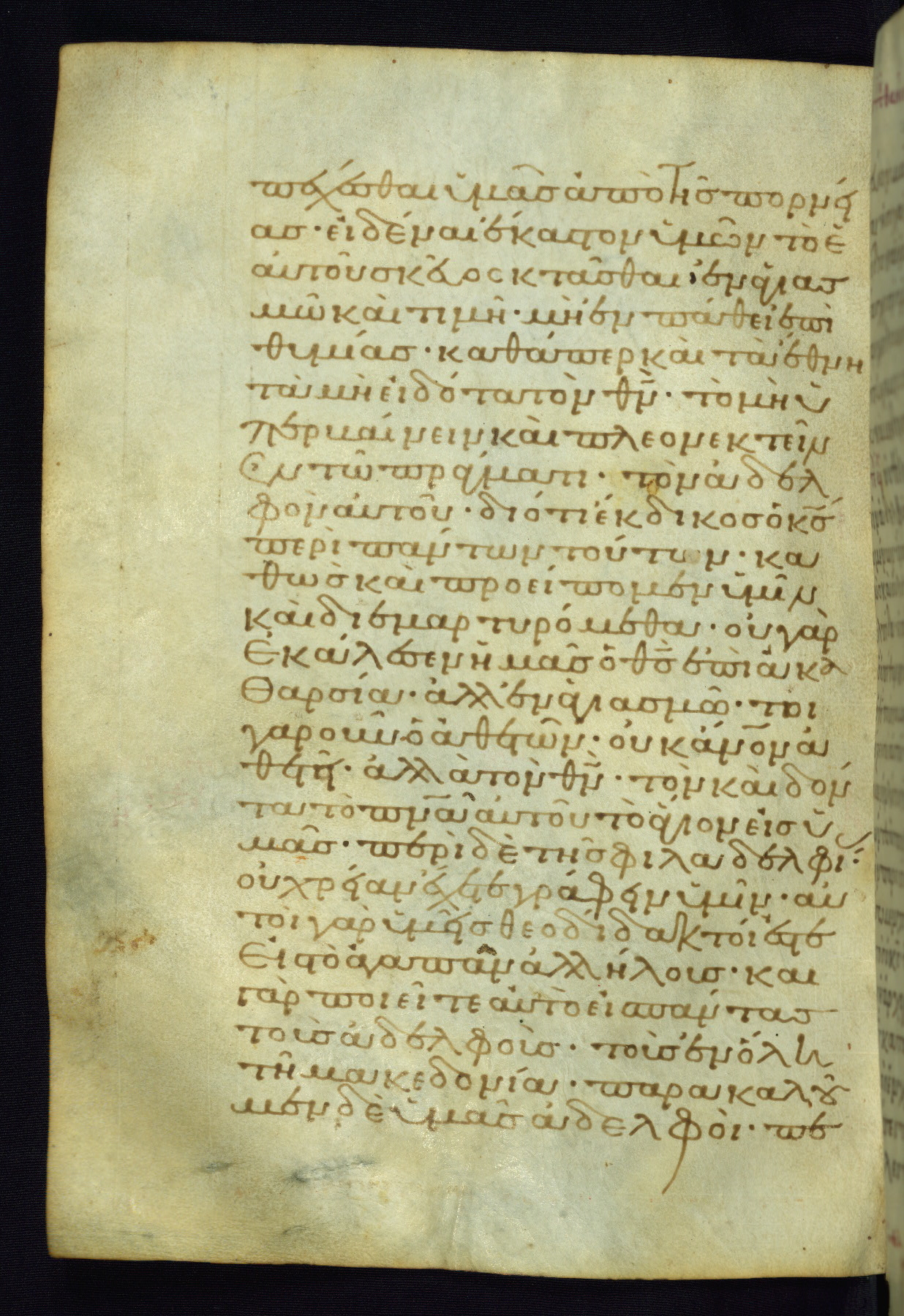
          "But when ye see the abomination of desolation standing where he ought not (let him that readeth understand), then let them that are in Judaea flee unto the mountains."  Thus read the words of Jesus in Mark 13:14 in the Revised Version (1881). But in the KJV, NKJV, EOB-NT, MEV, and WEB, the verse is a bit longer:  before the word "then" is the phrase, "spoken of by Daniel the prophet," based on the words τὸ ῥηθὲν ὑπὸ Δανιὴλ τοῦ προφήτου, which appears in the Textus Receptus and in the vast majority of Greek manuscripts (including A K M U Y Γ Δ Θ Π 157), as well as in the Peshitta, the Harklean Syriac, and six Old Latin copies (aur, c, e, k, l, q).   

          The basis for "spoken of by Daniel the prophet" is not supported by À (Sinaiticus) B D L W Ψ and  565 700 892.  Nor are the words found in the Old Latin copies d, ff2, i, n, and r1,  or the Vulgate (though the phrase is included in some copies of the Vulgate), or in the Sahidic version, the Armenian version, and the Old Georgian version (according to Wieland Willker, who covered this variant-unit in his Textual Commentary on the Gospels).

Codex Macedonianus (Y/034), shown here,
includes the words in Mark 13:14 that are
not included in the Alexandrian Text
    Neither the UBS Greek New Testament (4th edition) nor the Nestle-Aland Novum Testamentum Graece (27th edition) mention this six-word variant.  That's right:  a six-word Byzantine variant goes entirely uncovered in the GNT and NTG, as if it never existed.

          What has happened here in Mark 13:14?  The editors of the Greek New Testament apparently felt that the Byzantine reading is a harmonization to Matthew 24:15.  The phrase in Matthew is similar; Matthew 24:15 has διὰ instead of ὑπὸ.  Some members of f1 read διὰ, and so do 28 579 and 1424.  It seems to me the theory that a harmonizer added τὸ ῥηθὲν ὑπὸ Δανιὴλ τοῦ προφήτου is not very tenable, partly because a harmonizer would be unlikely to be so picky as to change διὰ into ὑπὸ.

          But how can the omission of τὸ ῥηθὲν ὑπὸ Δανιὴλ τοῦ προφήτου be explained, especially considering that it missing not only in the Alexandrian?  Therein lies a tale:

          In the 200s, the authorship of certain portion of Daniel and Susanna in the Septuagint (LXX) were debated; Origen and his colleague Julius Africanus exchanged letters about Susanna.  In addition, the third-century pagan author Porphyry argued (as many interpreters still argue today) that the entire book of Daniel was composed in intertestamental times, during the reign of the Syrian ruler Antiochus Epiphanes.  No Christians seem to have objected to Christ's reference to Daniel in Matthew 24:15 as the source of Daniel 9:27.  But in the first centuries of Christianity, when copies of the Gospels were being circulated individually, a thoughtful copyist of the Gospel of Mark, seeing a reference to the book of Daniel coming from the mouth of Jesus, may have thought that source of the words τὸ ῥηθὲν ὑπὸ Δανιὴλ τοῦ προφήτου was a marginal note that an earlier copyist, or an individual who supervised copyists, had inserted into the text ‒ and, satisfied with the thought that the phrase was not original, declined to include it in subsequent copies.  

          That this happened, and happened early enough to influence some Old Latin copies, the text of the Sinaitic Syriac, and the text of Sinaiticus and Vaticanus, is more probable than the idea that someone creating the Byzantine text, selecting readings from the Alexandrian and Western copies, threw τὸ ῥηθὲν ὑπὸ Δανιὴλ τοῦ προφήτου into Mark 13:14, especially considering that the words are not in Mark 13:14 in the earliest representatives of the Alexandrian or Western Greek text.

          This implies that the Alexandrian Text of the Gospel of Mark was not mechanically copied by scribes.  It implies that the Alexandrian Text of the Gospel of Mark was (slightly) edited by an editor who  removed features that appeared to him to run the risk of inviting objections from outsiders.  Lest this might seem to be a conspiracy theory, I leave you with the words of Bruce Metzger (from The Text of the New Testament, 4th edition, p. 312) that the Alexandrian Text is considered "on the whole the best ancient recension."


Sunday, March 19, 2023

The Phantom of Ammonius (Misinformation about Mark 16:9-20)

Who was Ammonius and what did he write about Mark 16:9-20?

 Ammonius Saccas of Alexandria (175-242) was a philosopher.  He might possibly have been (like, it’s remotely possibly conceivable) the Ammonius I am about to discuss. But Ammonius of Alexandria is probably not Ammonius Saccas.  Our Ammonius is an individual mentioned by Eusebius of Caesarea in his brief letter Ad Carpianus.

 So let’s ask another question:  What is Eusebius’ letter to Carpian about, and what does he say about Ammonius?

Ad Carpianus (or, To Carpian) is a brief instruction-manual about how to use the Eusebian Canons – Eusebius’ cross-reference system for the Gospels.  To Carpian is featured near the beginning of many Greek Gospels-manuscripts, and is still reproduced on pages  84*-85* of the Nestle-Aland Novum Testamentum Graecae (27th ed.).   Ammonius is mentioned at the outset.   

           Using Mark DelCogliano’s translation of Eusebius’ letter (which is in the public domain (thanks, Mark!)) as the basis for the following (with minimal adjustments) we may see the relevant portion in English: 

            “Eusebius to Carpianus his beloved brother in the Lord:  greetings.

Ammonius the Alexandrian, having exerted a great deal of energy and effort as was necessary, bequeaths to us a harmonized account of the four gospels.  Alongside the Gospel according to Matthew, he placed the corresponding sections of the other gospels.
          But this had the inevitable result of ruining the sequential order of the other three gospels, as far as a continuous reading of the text was concerned.  Keeping, however, both the body and sequence of the other gospels completely intact – in order that you may be able to know where each evangelist wrote passages in which they were led by love of truth to speak about the same things – I drew up a total of ten tables according to another system, acquiring the raw data from the work of the man mentioned above. These tables are set out for you below.”

           Eusebius proceeded to describe his own cross-reference system, in which Eusebius divided the text of the four Gospels into sections, and each section was assigned a number, and each number was arranged in ten lists.  But today we are not concerned with the testimony of Eusebius; I am looking at the testimony of Ammmonius.  (Those who wish to learn more about Eusebius’ Gospels-cross-reference system are welcome to watch my video about the Eusebian Canons which I made several years ago.)

          What Eusebius says about Ammonius’ attempt to harmonize the Gospels is enough to demonstrate that Ammonius’ material is not represented by Eusebius’ Section-divisions.  This was demonstrated by John Burgon in 1871 in his book The Last Twelve Verses of Mark Vindicated.  Burgon observed that Ammonius’ Matthew-centered cross-reference system would not be capable of featuring passages in Mark, Luke, and John for which there is no parallel section in Matthew.  Referring to those sections, Burgon wrote, “Those 225 Sections can have found no place in the work of Ammonius. And if (in some unexplained way) room was found for those parts of the Gospels, with what possible motive can Ammonius have sub-divided them into exactly 225 portions? It is nothing else but irrational to assume that he did so.”  (See pages 295 to 312 (Appendix G), especially page 302, of John Burgon’s 1871 book The Last Twelve Verses of the Gospel According to Saint Mark Vindicated Against Recent Critical Objectors.)        

Bruce Metzger, I try to take it easy on
you, since you're dead, but ...   
did you expect this to just slide by?
          Nevertheless, Bruce Metzger, in his highly influential handbook The Text of the New Testament, (in the third edition, 1992) on page 226, as he commented on this passage, Metzger wrote, “Clement of Alexandria, Origen, and Ammonius show no knowledge of these verses.” The same sentence appears in the fourth edition (2005), co-edited by Bart Ehrman, on p. 322.

          (This particular sentence constituted a departure from how Metzger had previously described the evidence in 1964; for details see the 1:50-mark in the three-minute video Mark 16:9-20 and The Parrot Problem.)

          Also, in his influential A Textual Commentary on the Greek New Testament, Metzger wrote, “The original form of the Eusebian sections (drawn up by Ammonius) makes no provision for numbering sections of the text after 16.8.”

          Metzger was writing as if he had access to something to which he had no access.  While it would be correct to state that the original form of the Eusebian sections did not make any provision for numbering sections of Mark 16:9-20, it is incorrect to say that the original form of the Eusebian sections were “drawn up by Ammonius.”

          The Eusebian Sections include, in Canons (i.e., Tables) Eight, Nine, and part of Ten, sections which are not paralleled in Matthew and thus would have had no place in Ammonius’ cross-reference system.

          Ammonius cannot be considered a valid witness for the inclusion or non-inclusion of Mark 16:9-20. We simply do not have any data from Ammonius one way or the other regarding this.  Ammonius is a phantom witness – contrary to the Bruce Metzger, and contrary to the textual apparatus of the first, second, and third editions of the UBS GNT.  If you own a commentary that spreads Metzger’s and Ehrman’s falsehood about Ammonius, I recommend that you add, in the margin, in ink, “This claim about Ammonius is false.”        


[Readers are encouraged to test the data in this post and are invited to explore the embedded links.]


Friday, July 29, 2022

First Corinthians 10:9 - "the Lord" or "Christ"?

             Leaving the Gospels momentarily, today we explore a textual variant in the Pauline Epistles:  in First Corinthians 10:9, did the text originally say “Nor let us tempt Christ” (Χριστόν) or “Nor let us tempt the Lord” (Κύριον) or “Nor let us tempt God” (Θεόν)?  All three readings are nomina sacra (sacred names, usually written in contracted form), and thus, with the nomina sacra in play, amount to the difference between ΧΝ, ΚΝ, and ΘΝ.

Erasmus' text of I Cor. 10:9 (1522)
            The treatment of this variant by editors, publishers and printers of the (mainly) Byzantine Text has been consistent:  Erasmus (all editions), Gerbel (1521), Stephanus (1550), Melchoir Sessa (Venice) 1538, John Fell (1675), Bengel (1734), and Scholz (1836) all have favored “Χριστόν”; Griesbach also had Χριστόν in the text.  Χριστόν is read in Hodges & Farstad’s Majority Text (1982), and in the Robinson-Pierpont Byzantine Textform (2005), and in the Solid Rock Greek New Testament. 

            English Bibles in use today with “Christ” in First Corinthians 10:9 include the KJV, NKJV, EOB (Eastern Orthodox Bible), WEB, EHV, and also the CSB, ESV, NET, NIV 2011, NLT, NCV (New Century Version), and NRSV.

I Cor. 10:9 (Nicolaus Gerbel, 1521)
            Κύριον was consistently adopted by most editors of the critical text, other than Griesbach, until about 1970:  “Lord” was the reading adopted by Lachmann (1831), Buttmann (1862), Tregelles (1869), Tischendorf (8th edition, 1872), Westcott & Hort (1881), Eberhard Nestle (1904), Alexander Souter (1920), and the Nestle-Aland compilation up to and including the 25th edition.  The first and second editions of the United Bible Society’s Greek New Testament also read Κύριον.      

I Cor. 10:9 (Fell, 1675)
            Consequently, “Lord” has appeared in First Corinthians 10:9 in several English Bibles of the past 150 years, including the Revised Version (1881), the American Standard Version (1901), the Revised Standard Version, the Living Bible, the New Life Version, the New American Standard Bible (1960 & 1995), the New International Version 1984, and the Tree of Life Version (2011).  Meanwhile, the Tyndale House GNT reads “κύριον” and the SBLGNT reads “Χριστόν.”

            Now let’s look at some text-critical data: 

Fell's footnote (1675)
             In 1982, in New Testament Textual Criticism:  Its Significance for Exegesis:  Essays in Honor of Bruce M. Metzger, a chapter by Carroll D. Osburn focused on this variant.  Osburn’s data is far more detailed than any other apparatus:  in support of Χριστόν, Osburn listed P46, D, E, F, G, K, L, Ψ 056 0142 0151 and 489 minuscules (including 1 6 18 35 69 88 131 205 209 323 330 424 440 451 489 517 547 614 618 629 630 796 910 945 999 1241 1242 1243 1245 1270 1315 1353 1424 1448 1505 1611 1646 1734 1738 1739 1827 1852 1854 1881 1891 1912 1982  1984 2125 2200 2400 2412 2492 2495), numerous Old Latin witnesses including itar, b, d, dem, e, f, g, o, x, z and the Vulgate, the Peshitta, the main text of the Harklean Syriac, the Sahidic version, and the Bohairic version.   

I Cor. 10:9 in Codex Sinaiticus     
           Κύριον, meanwhile, is supported by À B C P 0150 33 43 104 181 255vid 256 263 326 365 436 1175 2110 2127 2464 and 22 other minuscules, and the margin of the Harklean Syriac, the Armenian version and the Ethiopic version.

            Osburn’s thorough list extends to two other readings:

            Codex A, 2 81 1127 1595 and 14 other minuscules (and 2815 which Osburn did not list, but Swanson does) read Θεόν.

            Nothing appears between ἐκπειράζωμεν and καθως in 97 1729* 1985 and 2659.

             Settings aside Θεόν and the complete absence of any nomina sacra, Osburn focuses on the contest between Κύριον and Χριστόν.  Things get very interesting in the patristic evidence: 

            The earliest support for Χριστόν is Marcion (the arch-heretic from Pontus who worked for a while in Rome c. 140); Epiphanius, in the late 300s, claimed that Marcion changed the text from Κύριον to Χριστόν.  But, as Osburn argues, it is reasonable to understand Epiphanius’ claim as a presumption – i.e., that Epiphanius’ text read Κύριον and he assumed that Marcion had changed it – rather than as an observation.  Slightly later is Irenaeus (in Against Heresies, Book 4, ch. 27), and slightly later than Irenaeus are Clement of Alexandria, Origen (in a statement preserved in the margin of GA 1739), and Theotecnus (bishop of Caesarea-in-Palestine, and an associate of Origen), writing against Paul of Samosata for the Council of Antioch (268).  

            The bishops involved in the Council of Antioch in 268 also produced the Letter of Hymenaeus, of which Osburn provided a relevant extract, which implies that “neither Paul of Samosata nor his opponents were aware of a biblical text which read other than Χριστόν in v. 9.”  (Osburn mentioned in a footnote, however, that the text of the Letter of Hymenaeus printed by M.J. Routh in 1846, and by E.Schwartz in 1927, has Κύριον.) 

            Also in support of Χριστόν are Ambrosiaster, Ephraem Syrus, Pelagius, Augustine, Pseudo-Oecumenius, and Theophylact.  Chrysostom also cites I Cor. 10:9 with Χριστόν three times.

            Κύριον is supported by Epiphanius, Theodoret of Cyrrhus (in a substantial quotation in his commentary on the Pauline Epistles), Cassiodorus, John of Damascus, and Sedulius Scotus.  Chrysostom is cited as using κύριον once.  

           Now let’s analyze this evidence and reach a conclusion. 

I Cor. 10:9 in Tregelles' text.
            The case for κύριον is not lightweight:  agreements of À and B were considered practically decisive by Westcott & Hort, and their judgment held sway for over a century, though as early as 1899 Theodor Zahn, as Carroll noted, firmly opposed it.              

            Χριστόν has in its favor the support of very early and geographically diverse patristic witnesses.  The discovery of P46 with Χριστόν (written as ΧΡΝ - see BP II f.49 in the online Chester Beatty Papyrus Collection on the fourth line from the bottom) probably should have instantly elicited a change in the critical text here, inasmuch as with its discovery, Χριστόν scores high on multiple metrics:  it is the reading of the oldest manuscript; it is the reading of the most manuscripts (by far); it is the reading of the most diverse array of manuscripts; it is the reading favored by a strong combination of early patristic writers.  About the only counter-argument that favors Κύριον is the internal consideration that Paul would be unlikely to have written that the Hebrews in the wilderness tempted Christ – but as indicated in a note in the NET, Osburn built an effective cumulative argument that the case against Χριστόν driven by this internal evidence is weak.  I cannot think of any reason but haste, and perhaps over-reliance on the work of Tregelles (who had no access to P46) to elicit the Tyndale House GNT’s adoption of κύριον.  It was due to over-reliance upon À and B that κύριον was ever adopted in printed Greek New Testaments; hopefully the days of such over-reliance, repeatedly shown to be merely a disguised bias, are behind us. 

              Χριστόν merits confident inclusion in the text.                     


Friday, October 2, 2020

Video Lecture: Mark 16:9-20: External Evidence

 In Lecture 16 in the series Introduction to NT Textual Criticism, I describe some external evidence pertaining to the ending of Mark (16:9-20.  Subtitles provide a full outline of the lecture.  Here is a sample of part of this 41-minute lecture in which I begin to examine patristic evidence:
            Another part of the evidence has also experienced a high level of misrepresentation:  the patristic evidence.  Two statements from Bruce Metzger’s Textual Commentary on the Greek New Testament have been repeated by many other commentators:  first, “Clement of Alexandria and Origen show no knowledge of the existence of these verses.”

             Those who encounter this statement might conclude that these two writers’ non-use of Mark 16:9-20 implies that the passage was not in their copies of the Gospel of Mark.  But Clement barely made any clear quotations from the Gospel of Mark outside of chapter 10.  Similarly, Origen does not use a 54-verse segment of text in Mark 1:36-3:16, or a 28-verse segment in Mark 3:19 to 4:11, or a 41-verse segment of text in Mark 5:2 to 5:43. 

             If Origen did not quote from Mark 16:9-20, then those 12 verses are just one of many 12-verse segments of Mark from which Origen does not quote.  But, there is a passage in Origen’s composition Philocalia, chapter 5, that may be based on Mark 16:15-20.     

 EUSEBIUS AND JEROME

             Second, Metzger stated that “Eusebius and Jerome attest that the passage was absent from almost all Greek copies of Mark known to them.” 

   This statement needs major clarification, especially because it has been misrepresented by some commentators.  Ben Witherington III  erroneously stated, “Eusebius and Jerome both tell us these verses were absent from all Greek copies known to them.” 

   In real life, in the composition Ad Marinum, Eusebius responds to a question from Marinus about how Matthew 28:2 can be harmonized with Mark 16:9:  Matthew says that Christ arose “late on the Sabbath,” but Mark says “early in the morning on the first day of the week.”  Already, we see that Marinus’ text of Mark, just as old as Eusebius’ testimony, included Mark 16:9-20.

            Eusebius mentions two ways to resolve the apparent discrepancy:  First, a person could say that the relevant passage is not found in all copies of the Gospel according to Mark, and that the text in the accurate copies ends at the end of verse 8.  Almost all copies of the Gospel of Mark end there. 

            That is what one person might say, rejecting the passage and rendering the question superfluous.  But, Eusebius continued, another view is that both passages should be accepted; it is not the job of faithful readers to pick and choose between them. 

            Granting that this second perspective is correct, the proper thing to do is to interpret the meaning of the passage.  If we draw a distinction in the wording, we would not find it in conflict with the words in Matthew’s account.  We should read the words in Mark, “Rising early in the morning on the first day of the week,” with a pause after “Rising,” for that refers to Christ’s resurrection.   The rest, “early in the morning on the first day of the week,” pertains to the time of His appearance to Mary Magdalene. 

             Three things must be noticed whenever Eusebius’ testimony is mentioned:  First, he does not frame the statement about manuscripts as his own observation; he frames it as something that someone might say.  Second, instead of advising Marinus to reject the passage, Eusebius recommends that he should retain the passage, and he even tells him how to pronounce the passage so as to make it clear that it is harmony with the passage in Matthew 28.

            Third, Eusebius himself quotes Mark 16:9 further along in the same composition.  Once he states that “some copies” of Mark say that Jesus had cast seven demons out of Mary Magdalene, and once, he says that Jesus cast seven demons out of Mary Magdalene “according to Mark.”

            It should also be pointed out that nobody, in the decades after the Diocletian persecution, had the means to survey how many manuscripts existed throughout the Roman Empire to support particular readings.

            What about Jerome?  It should first be acknowledged that Jerome included Mark 16:9-20 in the Vulgate Gospels, which he specifically stated that he prepared on the basis of ancient Greek manuscripts.  Jerome himself was born in the mid-300s, so we may reckon that these Greek manuscripts were older than that.

            Again:  Metzger’s statement is, “Eusebius and Jerome attest that the passage was absent from almost all Greek copies of Mark known to them.”  Let’s test that. 

            The relevant statement from Jerome is found in his composition Ad Hedibiam, from about the year 407, in which, among other things, he responds to a broad question about harmonization-difficulties in the resurrection-accounts in the Gospels.  In the course of his response, he breaks down the question into a series of Questions and Answers, clearly patterned on Eusebius’ earlier work to Marinus.

             Jerome, like Eusebius, says that there are two ways to solve the question.  Jerome, like Eusebius, says that one way is to reject the passage in Mark, on the grounds that it is absent in nearly all of the Greek copies, and because it seems to narrate things that contradict the other accounts.  And Jerome goes on to say that Matthew and Mark have both told the truth, and that when the text is read with a pause after “Jesus arising,” before “on the first day of the week in the morning appeared to Mary Magdalene,” the difficulty goes away.

            Jerome is plainly instructing Hedibia to retain the verses.

            This is how D. C. Parker explained the situation in 1997:  Jerome’s letter to Hedibia “is simply a translation with some slight changes of what Eusebius had written.  It is thus worthless for our purposes.”  And Parker concluded:  “Jerome is no evidence for the Short Ending.”

            John Burgon had said basically the same thing, over a hundred years earlier:  Jerome was saving time and effort by condensing part of Eusebius’ earlier composition in his letter to Hedibia – just as he had acknowledged, in his Epistle 75, that he sometimes dictated to his secretary what he had borrowed from other writers.

             But this is not all:  in 417, in Against the Pelagians, Jerome pictured a champion of orthodoxy explaining where he had seen the interpolation that is now known as the Freer Logion:  he located this interpolation “In certain exemplars, and especially in Greek codices, near the end of the Gospel of Mark” – and then he quotes almost all of Mark 16:14, and then presents the interpolation. 

            How is it that Jerome says that he saw the Freer Logion after Mark 16:14 “especially in Greek codices,” and also say that almost all Greek codices lack Mark 16:9-20?  Because the first statement is drawn from his own experience, while the second one was extracted from Eusebius’ composition, in which it was framed as something that someone might say.

 . 

Wednesday, March 25, 2020

Clement's Byzantine Text of First Thessalonians


            Clement of Alexandria is one of the best-known writers of early Christianity; although we lack details of his birth and death, an estimate of 150-215 is probably not far off.  He was trained at Alexandria by Pantaenus, and after Pantaenus died, Clement began to lead the catechetical school at Alexandria, around A.D. 200.
            Clement of Alexandria left behind several compositions in which he quoted, referred to, or otherwise used many passages from the New Testament.  By putting together these Scripture-utilizations, we may get a picture of the New Testament text that Clement used.  By working through Clement’s Hortatory Address to the Greeks and Paidagogus and Stromateis and Hypotyposeis and What Rich Man Can Be Saved?, and other compositions, it is possible to isolate Clement’s Scripture-utilizations and tentatively reconstruct the text he used. 
            One might expect to find that Clement used a New Testament with strong Alexandrian affinities – after all, he was located in Alexandria.  But back in 2008, Carl Cosaert analyzed Clement’s Gospels-text and acknowledged that “Clement fails to meet the 65% rate of agreement necessary for classification as an Alexandrian witness in the Gospels.”
            In Matthew, Cosaert’s analysis indicated that although Clement’s text agrees with Sinaiticus more than with any other manuscript – at 73 out of 116 units of variation – Codex Π was a very close second, at 68 out of 109, and Codex Ω was a very close third, at 72 out of 118.  This is statistically a tie.  But it is not just a tie between these three witnesses.  Cosaert also compared Clement’s text of Matthew to the Textus Receptus – and it performed as well as Codex Vaticanus (B):  the Textus Receptus agreed with Clement’s text of Matthew 73 times out of 118 units of variation (61.9%); Codex B agreed with Clement’s text of Matthew 71 out of 117 units of variation (60.7%).
            In Mark, Cosaert’s analysis indicated that Clement’s text agrees more with the Textus Receptus – 29 times, out of 47 units of variation – than with À (21/42) or B (25/47).  The data from Clement’s utilizations from Mark is, however, rather sparse:  fewer than 50 units of variation, stretched over 16 chapters, are extant to consider. 
            In Luke, Cosaert’s analysis indicated that Clement’s text agrees more with Codex D than with any other Greek manuscript – 89 agreements out of 134 units of variation. In comparison, Codex Ω agreed with Clement’s text 77 out of 143 units of variation; P75 agreed with Clement’s text 62 out of 116 units of variation, and Codex Π agreed with Clement’s text at 74 out of 140 units of variation. 
            In John, Cosaert’s analysis indicated that Clement’s text agrees more with Codex L than with any other witness – 54 agreements out of 72 units of variation.  Manuscripts 33, B, and P75 (all between with a 70-75% agreement-rate) also agree with Clement’s text of John more than Π, Ω, and the Textus Receptus (which all hover around 60%).  Codex À does even worse, though, with an agreement-rate of only 54.3%.
            Cosaert’s data instructively illustrates two things.  First, it shows that it is precarious to draw conclusions based on sporadic sampling:  we cannot know the textual affinities of Clement’s text of Matthew by looking at his text of John, and we cannot know Clement’s text of Luke by looking at his text of Matthew.  Analyzing a patristic writer’s text is not always as simple as putting one knife into one jar one time and concluding that the whole jar contains peanut butter.   Clement’s Gospels-text is not comparable to a horserace in which one horse wins; it is more like four horse-races in which the outcome is different in every race:  In Mark, the Byzantine text seems to win; in Luke, the Western text comes out ahead; in John, the Alexandrian text wins, and in Matthew, the race is close and ends in a cloud of dust.
            Second, it shows that there is not much basis for the idea that the text of Clement’s compositions has been corrupted (toward a Byzantine standard).  Had this been the case, we would not see Western affinities in Clement’s text of Luke, or such strong Alexandrian affinities in Clement’s text of John.
            With all that in mind, let’s turn to another piece of research on the text used by Clement:  Maegan Gilliland’s 2016 doctoral thesis at the University of Edinburgh School of Divinity:  The Text of the Pauline Epistles and Hebrews in Clement of Alexandria.  (Use the link to download the thesis!)  This is a very detailed piece of research; Gilliland presents a book-by-book apparatus of Clement’s utilizations of each of Paul’s epistles, collated against representative witnesses of each text-type.  Although neither the Robinson-PierpontByzantine Textform nor the Hodges-Farstad Majority Text was included in the comparison, the Byzantine Text is well represented by minuscule 2423, a manuscript housed at Duke University.
            Although it would be worthwhile to take a leisurely tour of Gilliland’s thesis book-by-book, today I want to zero in on the data it contains about Clement’s text of First Thessalonians.  First Thessalonians is a rather small book, containing only five chapters; in these five chapters Gilliland has identified 32 variant-units utilized by Clement.   
            Before proceeding further, let’s briefly revisit  Cosaert’s data for the Gospel of John:  72 variation-units are stretched across 21 chapters.  The witness with the strongest agreement with Clement was Codex L (54/72) and after also observing that Clement’s text of John agrees with 33, B, and P75 about 70-75% of the time, Cosaert concluded, “Clement’s strong levels of agreement with the Alexandrian tradition clearly identify his text as Alexandrian.”   I want to make sure that it has registered that with one Alexandrian witness agreeing with Clement’s text 75% of the time over 21 chapters, and with three Alexandrian witnesses agreeing slightly less, Clement’s text of John was clearly identified as Alexandrian. 
            Now let’s look at Gilliland’s data about Clement’s text of First Thessalonians:  Gilliland compared Clement’s use of readings in 32 passages:  1:5, 2:4, 2:5, 2:6, 2:7, 2:12, 4:3, 4:4, 4:5, 4:6, 4:7, 4:8, 4:9, 4:17, 5:2, 5:4, 5:5, 5:6, 5:7, 5:8, 5:13, 5:14, 5:15, 5:17, 5:19, 5:20, 5:21, 5:22, 5:23, and 5:26.
            No utilizations were detected from chapter 3, and only one utilization – the use of a single word, δυνάμει in Str. 1.99.1 – was detected in 1:5 (and it seems to me that this could be a utilization of First Corinthians 4:20 instead).  If we set that aside, then Clement’s references to First Thessalonians cover only 2:4-12, 4:3-4:9, 4:17-5:8, and 5:13-5:26.  The existence of 30 utilizations concentrated in four segments, consisting of 11 verses, 7 verses, 10 verses, and 14 verses – a total of 42 verses – ought to be a plentiful basis on which to form an impression of the form of Clement’s text of First Thessalonians.  This is especially true when we remember that 72 utilizations, stretched over 879 or 866 verses (depending on which compilation one is using), were considered sufficient to tell us about Clement’s text of John.  (A rough-and-ready picture of the situation may be gained by considering that in these four segments of text from First Thessalonians, Clement gives us no data about 12 verses, in the Gospel of John Clement gives us no data about 794 verses (at least).

            Gilliland found that the medieval Byzantine minuscule 2423 agrees with Clement’s utilizations in First Thessalonians in 29 of the 32 variation-units – yielding an agreement-rate of 91%. 
            This justifies Gilliland’s statement (on p. 542 of her thesis) that “A glance at the individual manuscripts reveals a strong association between Clement’s text of 1 Thessalonians with the Byzantine manuscripts,” and (on p. 543), that Clement’s text of First Thessalonians “exhibits a text that is strongly aligned with the Byzantine tradition.”
            However, in the fifth chapter of Gilliland’s thesis, on p. 567, she states, “Perhaps the unusually high agreement with the Byzantine text is only a fluke resulting from a small data set.”  One page later, she states less tentatively, “There simply are not enough variation units for 1 Thessalonians to come to any conclusion about its textual nature,” and suddenly, “Clement’s text of I Thessalonians cannot be labeled as Byzantine.”
            The apparent reason for this sudden shift:  an “Inter-Group Profile” shows that Clement agrees with no Byzantine readings in First Thessalonians that are distinctly Byzantine; it also shows that Clement agrees with no Western readings that are distinctly Western, and it also shows that Clement agrees with one distinctly Alexandrian reading. 
             But let’s take a close look at the differences between the text of First Thessalonians in the Byzantine Text, in Clement’s text, and in Codex Vaticanus, to see if this reasoning is sound.  First, we should notice that in First Thessalonians 2:6, the Byzantine Text (Robinson-Pierpont) reads ἀπό rather than ἀπ’.  (The Textus Receptus there reads ἀπ’, agreeing with 2423 and Clement.)  Second, we should notice that in First Thessalonians 5:8, where 2423 appears to includes ὑιοι, the Byzantine Text does not.  Compared to 2423, the Byzantine Text thus loses one agreement in 2:6 and gains one agreement on 5:8; its net rate of agreement is thus the same as that of 2423:  out of 32 opportunities to agree with Clement, the Byzantine Text agrees 29 times.  The Textus Receptus agrees with Clement even more:  30 agreements out of 32 opportunities to agree. 
            Besides the Byzantine Text’s reading ἀπό instead of ἀπ’ in 2:6, the Byzantine Text also disagrees with Clement’s text at three points:
            ● 4:5 – Byz has θεόν where Clement has κυριον, but because all of the flagship-witnesses disagree with Clement, this variation-unit was set aside.
            ● 5:5 – Byz does not have γὰρ after πάντες
            ● 5:6 – Byz has καὶ before οἱ λοιποί
            ● 5:8 – Byz has σωτηρίας at the end of the verse, where Clement has σωτηριου, but because all of the flagship-witnesses disagree with Clement, this variation-unit was set aside.

            Codex Vaticanus, in comparison, disagrees with Clement’s text of First Thessalonians at
            ● 2:5 – B does not include ἐν before προφάσει
            ● 2:7 – B (and À) has ἀλλα instead of ἀλλ’
            ● 2:7 – B (and À* and P65 and C*) has νήπιοι instead of ἤπιοι
            ● 2:7 – B (and C and 1739) has ἐὰν instead of ἂν
            ● 4:5 – Byz has θεόν where Clement has κυριον, but because all of the flagship-witnesses disagree with Clement, this variation-unit was set aside.
            ● 4:6 – B (and À* and A and 33 and 1739) does not include ὁ before κύριος
            ● 4:7 – B has ἀλλα instead of ἀλλ’
            ● 4:8 – B (and A and 33 and 1739*) does not include καὶ
            ● 4:8 – B (and À*) reads διδόντα instead δόντα
            ● 5:7 – B has μεθυοντες where all other flagship-manuscripts have μεθυσκόμενοι,  However, Clement does not agree with Clement at this point:  in Paed. 2.80.1, Clement uses μεθυοντες, while in Strom. 4.140.3 μεθυσκόμενοι is used.
            ● 5:8 – Byz has σωτηρίας at the end of the verse, where Clement has σωτηριου, but because all of the flagship-witnesses disagree with Clement, this variation-unit was set aside.
            ● 5:19 – B has ζβέννυτε instead of σβέννυτε
           
            B has important Alexandrian support in six of these readings; in four cases B and À* agree.  It thus seems undeniable that no amount of spin can prevent the conclusion that Clement’s text of First Thessalonians really is much more Byzantine than Alexandrian.

Post-script:  
Two Translation-Impacting Variants in First Thessalonians

            First Thessalonians 2:7 contains a textual variant that has a potentially drastic effect on the meaning of the verse:  does Paul say “we were gentle (ἤπιοι) among you” (as in the KJV, NKJV, ESV and CSB), or does he say “we were like young children (νήπιοι) among you” (as in the NIV and NLT; the NLT does not have the word “young”)?
First Thessalonians 4:8-10
in GA 1022
            Bruce Metzger, from the first edition of his handbook The Text of the New Testament, used this textual variant-unit to illustrate a contrast of external and internal evidence to his students.  “Gentle” (ἤπιοι) has broad support from witnesses such as A K L P 33 the Peshitta, the Sahidic version, Clement, and Chrysostom; “infants” (νήπιοι) also has diverse support from P65, À* B C Old Latin, the Vulgate, the Bohairic and Ethiopic versions, and patristic writers such as Cyril and Augustine.
            Metzger explained that because the preceding word, ἐγενήθημεν (“we were”), ends with the letter ν, it would be easy for the letter ν to be added to ηπιοι, creating “νήπιοι” – and it would also be easy for the letter ν to be phonetically dropped from νήπιοι, creating ἤπιοι.  After presenting both sides of the issue, Metzger gave a verdict in favor of ἤπιοι, appealing to Daniel Mace’s axiom that no manuscript is as old as common sense – that is, considering that the transcriptional probabilities seem about equal, one should consider what the author is likely to have written, and this consideration favors ἤπιοι.  It is intrinsically unlikely that Paul would suddenly drop the idea, like lightning from a clear sky, that he and his associates had behaved like babies, and in the next breath say that they had been like a nursing mother cherishing her children.           
            Nevertheless, despite Metzger’s lucid argument – which he later restated in a protest-note in his Textual Commentary – he was outvoted by his colleagues.  Today, the reading in the Nestle-Aland/UBS compilation is (incorrectly) νήπιοι.   

            First Thessalonians 4:8 contains two overlapping textual variants:  (1)  the inclusion or non-inclusion of καὶ followed immediately by (2) a contest between διδόντα and δόντα.  The reading καὶ δόντα (supported by Clement and the Byzantine Text) may account for the rise of καὶ διδόντα and διδόντα:  an early copyist whose uncial-writing was less than ideal wrote KAIDONTA but the first A was mistaken for a Δ, as if he had written  KΔIDONTA.  Subsequently, the letter K was regarded either as a stray letter and removed (leaving what was then understood as διδόντα (found in Codex B), or else it was regarded as a kai-compendium, which was then expanded into καὶ before διδόντα (read by À*).
            One may see a progression from καὶ δόντα to διδόντα in sync with progression from Clement to Origen.  For reference:  Griesbach and Scholz had καὶ δόντα; Tregelles and Westcott-Hort and Nestle (1899) and Souter adopted διδόντα (without καὶ); Holmes’ SBL-GNT reads καὶ διδόντα; one wonders by what reasoning this longer reading was preferred.  The Tyndale House Greek New Testament correctly reads καὶ δόντα.


Readers are invited to double-check the data in this post.


Saturday, July 13, 2019

Hort's Lecture on Origen

Fenton John Anthony Hort

            In 1890, Fenton John Anthony Hort (half of the Westcott-Hort duo) delivered a series of six lectures on ante-Nicene fathers.  They were published in 1895, a few years after his death.  What follows here, with slight adjustments, is the sixth lecture in the series.

LECTURE VI:  ORIGEN

            In the last two lectures the Fathers who have come before us have all belonged to Africa. It will be the same today.  We return now from North Africa, and the two great Fathers whom at this early time it brought forth for Latin theology, to Egypt and to the most characteristically Greek theology.
            If the influence of Clement of Alexandria over the later times of early Christianity was less than we might have expected, the same cannot be said of his great pupil Origen.  Not only had he the veneration of devoted disciples for several generations, but the theologies built up in the succeeding centuries of the age of the Fathers would, as far as we can see, have been very different from what they actually were, had it not been for the foundations laid by him.  Above all, his influence as an interpreter of the Bible, direct and indirect, has been both wide and lasting.  In the ancient Church three men stand out above all others as having left a deep mark by their independent interpretation of Scripture.  The other two are Theodore of Mopsuestia (late in the fourth century), the highest representative of the School of Antioch, and (a generation later) Augustine the North African, the primary teacher of the Latin West.  Not the least interesting fact however in the history of the influence of Origen as an interpreter is the way in which his thoughts and often his words were appropriated and handed on by Latin Fathers, and especially the three greatest Latin Fathers of the fourth century, Hilary of Poitiers (theologically the greatest of them all), Ambrose and Jerome.
            In this manner, as well as by direct translations of some of Origen’s works, Origenian ideas, penetrating down through various channels, supplied a by no means insignificant element in the very miscellaneous body of traditional interpretation which prevailed till the fresh and open study of the meaning of Scripture was restored, chiefly by the Revivers of learning just before the Reformation and by some of the Reformers themselves.  The permanent value of his interpretation of Scripture is much lessened by the fact that, in common with most ancient interpreters outside the School of Antioch, he shows an excessive devotion to allegorical senses; yet along with this mere fancifulness we find in him evidence of a genuine and profound study of the words of Scripture.  For all his great and lasting influence, Origen’s name has been by no means surrounded with the halo of conventional glory which has traditionally adorned Fathers inferior to him in every way.  Some of his speculations were doubtless crude and unsatisfactory, but these are but trifles beside the vast services which he rendered to theology; and accordingly, every now and then, from Athanasius onwards, he has received cordial words of vindication from men who were able to recognize goodness and greatness, in spite of an unpopular name.
            Unlike the Fathers whom we have been lately considering, Clement of Alexandria, Tertullian, Cyprian, Origen had the blessing of Christian parentage, and received from his father Leonides a careful education both in the ordinary Greek culture of the day and in the study of Scripture, becoming the pupil of Clement.  He was not seventeen when that persecution of about the year 202 under Septimius Severus occurred which drove Clement from Alexandria, and Leonides was thrown into prison. Origen himself, being restrained by a device of his mother’s from rushing to join him in the anticipated martyrdom [she hid his clothes – JSJ], wrote to him entreating that no care for his family should be allowed to shake his constancy.  On his father’s martyrdom, with confiscation of goods, he provided for his own and his mother's and six brothers’ wants by teaching, except that he was lodged by a lady of wealth.
            Some heathens came to him for instruction, including Plutarchus, who was martyred, and Heraclas, who became Bishop of Alexandria; and thus he was led to take up, though in an informal way, the dropped work of the Catechetical School.  After a time he was placed formally at its head by the Bishop Demetrius.  For some twelve years he went on without other interruption than a short visit to Rome and another to Arabia, lecturing to large audiences as a layman, living a sternly rigorous and self-denying life.  To this time belongs the rash act of self-mutilation always associated with his name, suggested to him by a misunderstanding of the real drift of one of our Lord’s sayings.  Meanwhile he labored to fit himself for his work more and more.  On the one hand he studied Hebrew; on the other he attended the lectures of the most eminent heathen philosophers, that he might be ‘better able to understand the thoughts of those’ who came to him for help.  The work increased so much that he associated with himself his convert Heraclas.
            At length about the year 215 he was driven by tumults to leave Alexandria, as Clement had done, and took refuge for a considerable time at Caesarea, the Greek or Roman capital of Palestine.  Alexander, now Bishop of Jerusalem, of whom we heard a fortnight ago, and the Bishop of Caesarea joined in inviting him to preach (homilein) to the assembled congregation. On receiving a remonstrance from Demetrius at their permitting a layman to preach before bishops, they cited various precedents in defense of their action.  But Demetrius refused to give way, and fetched Origen back to Alexandria in a peremptory way.  After his return he was persuaded by Ambrosius, now a friend, formerly a convert of his from some Pseudo-Gnostic sect, to undertake commentaries in writing, for which purpose Ambrosius provided short-hand writers.
            But after Origen had taught at Alexandria for about a quarter of a century, his career there came to a painful end.  The Churches of Achaia, being much distracted by what were called heresies (of what kind, is not related), invited him to come to their help.  He started without obtaining license from Demetrius (but under what circumstances we do not know), and took his way through Palestine.  There he was ordained presbyter by the Bishop of Caesarea, with Alexander’s knowledge and approval.  He then completed his journey to Greece, making sojourns at Ephesus and Athens, and at length returned home.  His reception there is a sad one to read of.  Demetrius assembled “a synod of bishops and of certain presbyters,” by whom he was forbidden to teach or even reside in Alexandria.  They did not agree to reject his ordination, as apparently Demetrius wished, but this too he obtained from a subsequent smaller meeting of bishops alone.
            Our too fragmentary authorities do not tell us quite clearly the ground of condemnation. Apparently it was the ordination of one who was mutilated, though it is also possible that doctrinal differences and it may be even personal jealousies were unavowed motives of action. There is reason to believe that the Roman Church supported the action of Demetrius, but it was entirely ignored by the Bishops of Asia; those of Palestine, Arabia, Phoenicia (i.e. probably North Syria) and Achaia being specially mentioned.  Origen left Alexandria for ever, and though beloved disciples of his own succeeded Demetrius as bishop, apparently no attempt was made to undo the banishment.
            Gentlest, humblest, and most peace-loving of men, Origen would be the last to disturb the peace of the Church for his own sake.  Accordingly for the third time he betook himself to the friendly Caesarea, and there in the great seaport beside the Mediterranean he made his permanent home for the rest of his life, above twenty years.  Being welcomed and cherished by the two Palestinian Bishops of whom we heard before, he carried on his literary work as a Christian theologian with the help of Ambrosius, and at the same time resumed oral instruction, partly by expository sermons of a comparatively simple kind in Church, partly by more advanced lectures to students and philosophical enquirers, as at the Catechetical School of Alexandria.
            With this period are specially connected the names of two illustrious disciples, Firmilianus and Gregory of Neocaesarea.  Firmilianus was apparently already bishop of the Cappadocian Caesarea, the capital of the inland regions of Eastern Asia Minor, when this recorded intercourse with Origen took place, though it may well have begun at an earlier time. Sometimes he used to get Origen to come to visit him in Cappadocia to instruct his Churches; sometimes he used to make stays in Palestine to have the personal benefit of hearing Origen discourse.  A man of still greater eminence in the years after the middle of the third century was Gregory Bishop of Neocaesarea in Pontus.  According to his own narrative he had traveled to Palestine to educate himself as an advocate by study at Beirut, where there was a famous School of Roman Law; but before fixing himself there, he had traveled on to Caesarea with his sister, whose husband held an official post there.  Beirut however was soon given up.  He fell (with his brother) under the spell of Origen’s teaching and personal presence, and remained under his instruction for five years.
            On his departure he delivered an address in expression of his gratitude, and this address is still extant.  In it he describes how he first came under Origen, and how Origen dealt with him and with other pupils.  First came a training in the faculties of the mind, a pruning away of wild growths of opinion for opinion’s sake, an enforcement of clear thinking and exact speaking.  Then came the study of the visible order of nature, founded on the study of geometry.  Thirdly came Christian ethics as founded on godliness, which he called the beginning and the end of all the virtues. Having passed through these preliminary stages of mental discipline, Origen’s pupils were encouraged to read freely in the works of Greek poets and philosophers, and then, thus prepared, to enter on the study of Christian theology proper, more especially in its primary source, the Bible.
            Such was the method of Origen’s regular teaching at Caesarea.  But he did not refuse invitations to leave home for a while, and give help to other Churches.  Some time, we know, he spent at Athens.  Twice he was asked to come into Arabia to help in neutralizing false doctrines which had arisen there.  In each case, instead of using declamation and anathemas, he sought quiet conference with the men who had propounded these doctrines; and in each case succeeded in persuading them that they had been in error.  If later controversies had been dealt with in the same spirit, what a different Christendom and a different world would now be meeting our eyes!
            Our first glimpse of Origen was as a boy, encouraging his father to face martyrdom without hesitation, undistracted by any anxieties for his helpless family. A third of a century later a similar task fell to his lot.  The emperor Alexander Severus, who had been friendly to the Christians, and with whose mother Mamsea Origen had had some intercourse, had come to a violent end, and his murderer and successor Maximinus entered on a persecution of such Christians, it would seem, as had stood in special favor with Alexander.  Origen was apparently saved by a Christian Cappadocian lady, Juliana, who kept him out of harm’s way.  But Ambrosius and a presbyter of Caesarea were imprisoned, and to them Origen wrote an Exhortation which we still possess.
            But fifteen years later, or less, he had to suffer grievously in his own person.  In that persecution of Decius in which his old fellow-student and supporter Alexander died in prison, he too was cast into prison, and had to undergo a succession of tortures.  Decius’ reign was a short one; and on his death Origen was released from prison, shattered by the treatment which he had received, and two years later he died at Tyre, being not far from 70 years of age.  His tomb in the Cathedral of Tyre is several times in the early Middle Ages noticed as then still visible, and the inscription of it still later; and a tradition of his place of burial is still said to be current in the neighborhood.  Though he does not bear the conventional title of Saint, no saintlier man is to be found in the long line of ancient Fathers of the Church.
            One of the best known sentences of Butler’s Analogy, occurring in the Introduction, is to this effect:  “Hence, namely from analogical reasoning, Origen has with singular sagacity observed, that he who believes the Scripture to have proceeded from him who is the Author of Nature, may well expect to find the same sort of difficulties in it, as are found in the constitution of Nature.”  These few words are characteristic of the subjects of Origen’s writings.  He was deeply and reverently occupied in meditation on all things in heaven and earth of which the human mind can take any cognizance; but the Bible was the center of all his thoughts and of all his studies.  He wrote commentaries or preached homilies, taken down by rapid writers, on a large proportion of books of both Testaments.  What is lost was far more than what is preserved: but we still have much, large portions of the commentaries on St. Matthew and St. John, that on the Romans in a too free Latin condensed translation, some Homilies on Jeremiah, many Greek fragments on various books, and many Latin translations of Homilies, chiefly on the Old Testament.
            A biblical work of another kind was what is called Origen’s Hexapla, an arrangement of the books of the Old Testament in (for the most part) six parallel columns, each containing a distinct text, the Hebrew, the same in Greek letters, the Septuagint, and three other Greek translations.  Numerous detached readings copied from it have been preserved, but hardly more. By this combination of texts Origen hoped to throw light on the meaning of many passages in which a Greek reader would be either bewildered or misled if he had only the Septuagint before him.  Besides the Exhortation to Martyrdom mentioned before, we possess a very interesting little treatise of Origen’s on Prayer. Very little unhappily remains of his letters, of which a collection was made some time after his death. But we fortunately possess in one shape or other what were probably his two greatest works, the systematic doctrinal treatise on First Principles, written before his departure from Alexandria, preserved for the most part only in a too free Latin version; and the eight books against Celsus in the original Greek, written near the end of his life. In connection with Origen’s writings it is worth while to mention the Philocalia, a small collection of extracts from them chiefly bearing on the interpretation of Scripture, made late in the fourth century by Basil and Gregory of Nazianzus.  It was from this source that Butler made his quotation, and the little book deserves to be better known.
            As an easy specimen of the book on First Principles, which chiefly consists of somewhat difficult speculative meditations, we may take a passage on the thirst for Divine knowledge implanted in the heart of man, and, however little he may know in this life, intended to render him capable of even higher levels of knowledge in the stages of the future life.
            “Therefore, as in those crafts which are accomplished by hand, we can perceive by our understanding the reason which determines what a thing is to be, how it is to be made and for what purposes, while the actual work is accomplished by the service of the hands, so in the works of God which are wrought by His own hand, we must understand that the reason and designs of the things which we see made by Him, remain unseen.  And just as, when our eye has seen things made by the craftsman, the mind, on observing something made with especial skill, is forthwith anxious to enquire in what fashion or manner or for what purposes the thing has been made, so much more and in an incomparably higher degree the mind is anxious with an unspeakable longing to recognize the reason of the things which we behold made by God.  This longing, this ardent desire, has we believe without doubt been implanted in us by God, and, just as the eye naturally requires light and object of vision, and our body by nature demands food and drink, so our intellect is possessed with a fit and natural desire for knowing the truth of God and discovering the causes of things.  Now this desire we have received from God not in order that it should never be satisfied or be capable of satisfaction; otherwise vainly will the love of truth appear to have been implanted in our intellect by God the Creator, if it is made never capable of satisfying its longing.
            “Wherefore even in this life those who have laboriously given their attention to godly and religious meditations, even though they obtain but a small amount from the great and infinite treasures of the Divine wisdom, yet just because they keep their minds and attention turned towards these subjects and outstrip themselves in this desire, receive much profit from the very fact that they are directing their minds to the search and love of discovering truth and making them more ready to receive future instruction, just as, when a man wishes to paint a portrait, if a pencil sketch in bare outline first marks out the plan of the coming picture, and prepares marks on which the features may be laid, the rough outline doubtless is found more ready to receive the true colors, so may a mere sketch, a rough outline by the pencil of our Lord Jesus Christ, be traced on the tablets of our heart.  And perhaps it is for this reason that it is said, ‘For to everyone that hath shall it be given, and it shall be added to him.’  Whence it is certain that to those who possess in this life a sort of rough outline of truth and knowledge shall be added in the future the beauty of the perfect picture.  Such, I imagine, was the desire indicated by him who said, ‘But I am constrained in two ways, having a desire to depart and be with Christ, for it is far better,’ knowing that when he had returned to Christ, he would recognize more clearly the reasons of all things which are done on earth.” [From Origen, ii. IV. p. 236.       Redep. (ii. xi. 4, 5).]
            The Books against Celsus contain at once the best and the most comprehensive defense of the Christian faith which has come down to us from the days of the Fathers.  They defend it not against popular prejudice and malice only, as the early Apologists had done, but against the careful and powerful indictment laid by an earnest though scoffing heathen philosopher who was also apparently an accomplished Roman lawyer, writing in the name of the highest philosophy of the time, and passionately devoted to the welfare of the Roman Empire.  A long time had passed between the writing of Celsus’ “True Account,” as he called his literary onslaught on the Christians and their faith, and its coming into Origen’s hands.  He had no real knowledge about the author, but he evidently felt that if he could answer him successfully, he would practically have effectually upheld the cause of the Gospel at all points.  If he sometimes fails to understand on what this or that smart saying of Celsus’ really rested, he never shows the unfairness of the mere partisan.  The candor and patience of his treatise are among its brightest qualities.
            The whole treatise amply repays reading and re-reading; one passage however must now suffice.  It is the reply to Celsus’ scoff about the lateness of the Incarnation and its limitation to an obscure corner of the world, a scoff in form, but covering a serious question.  As regards the time, Celsus compared it to the comic poet’s representation of Zeus as waking out of sleep and suddenly sending Hermes to men. As regards the place, he asked why God did not breathe souls into many bodies and send them all over the earth. Here is the answer.
            “Observe here too Celsus’ want of reverence when he most unphilosophically brings in a comic poet, whose object is to raise a laugh, and compares our God the Creator of the Universe with the god in his play who on awaking dispatches Hermes. We have said above that, when God sent Jesus to the human race, it was not as though He had just awoken from a long sleep, but Jesus, though He has only now for worthy reasons fulfilled the divine plan of His incarnation, has at all times been doing good to the human race.  For no noble deed among men has ever been done without the Divine Word visiting the souls of those who even for a brief space were able to receive such operations of the Divine Word.  Nay, even the appearance of Jesus in one corner of the world (as it seems) has been brought about for a worthy reason, since it was necessary that He of whom the prophets spoke should appear among those who had learnt one God, who read His prophets and recognized Christ preached in them, and that He should appear at a time when the Word was about to be diffused from one corner to the whole world.
            “Wherefore also there was no need that many bodies should be made everywhere, and many spirits like to that of Jesus, in order that the whole world of men might be illumined by the Word of God.  For it sufficed that the one Word rising like the Sun of Righteousness from Judea should send forth His speedy rays into the soul of them that were willing to receive Him.  And if anyone does wish to see many bodies filled with a divine Spirit, ministering like Him the one Christ to the salvation of men in every place, let him take note of those who in all places do honestly and with an upright life teach the word of Jesus, who are themselves too called ‘Christs’ (‘anointed ones’) in the passage, ‘Touch not mine anointed ones and do my prophets no harm.’  For even as we have heard that antichrist comes and nevertheless have learnt that there are many antichrists in the world, even so, when we recognize that Christ has come, we observe that owing to Him many Christs have been born in the world, to wit, all those that like Him have loved righteousness and hated iniquity, and for this reason God, the God of Christ, anointed them too with the oil of gladness.  But He however, having loved righteousness and hated iniquity to a higher degree than those who are His partners, has also received the first-fruits of the anointing, and, if we may so term it, has received the entire unction of the oil of gladness, while they that were His partners partook also in His unction, each according to his capacity.
            “Wherefore, since Christ is the head of the Church, so that Christ and His Church are one body, the ointment has descended from the head to the beard (the symbol of the full-grown man Aaron), and this ointment in its descent reached to the skirts of his clothing. This is my answer to Celsus’ impious speech when he says that ‘God ought to have breathed His Spirit into many bodies in like manner and to have sent them forth throughout the world.’  So then while the comic poet to raise a laugh has represented Zeus as asleep and as waking up and sending Hermes to the Greeks, let the Word which knows that the nature of God is sleepless teach us that God with regard to seasons orders the affairs of the world as reason demands.  But it is not to be wondered at, if, seeing that the judgments of God are sublime and hard to interpret, uninstructed souls do err, and Celsus among them.
            “There is then nothing absurd in the fact that to the Jews, with whom were the prophets, the Son of God was sent, so that beginning with them in bodily form He might arise in power and spirit upon a world of souls desiring to be no longer bereft of God.” [Origen, adv. Celsum, vi. 78 foll.]
            At Origen’s death in the year 253 we are still nearly half a century from the end of the first three centuries, and nearly three-quarters of a century from the Council of Nicea.  If time permitted, it would not be difficult to give some account of Fathers belonging to this interval who are quite worthy of being known.  At the same time it is true that we have only fragments, sometimes hardly that, of the men who seem as if they had been best worth knowing.  Moreover, with the exception of the almost forgotten Lucianus of Antioch, they seem to have been less original and important Fathers than nearly all those who have come before us this term.  The most attractive group is formed by the disciples of Origen, not only the two already spoken of, but Heraclas, and Pierius, and Dionysius of Alexandria of whom we can obtain a tolerably vivid and very pleasant image from the fragments of his letters preserved by Eusebius, showing how a great bishop trained by Origen would deal with the difficult questions raised by persecution without and false doctrine within.  Then would come Pamphilus, the loving collector of memorials of Origen and zealous champion of his good name against the detractors who were beginning to assail it; himself a martyr in the terrible last persecution at the beginning of the fourth century.  And Pamphilus in turn leads to his younger friend Eusebius the historian, who lived and wrote in the fourth century, and yet might in some ways be called the last of the Ante-Nicene Fathers.
            But we must be content with this very hurried glance at that most important but most obscure time between the death of Origen and Cyprian and the Council of Nicea.  A better break than at the death of Origen we could hardly desire.  Not to speak of the men of later days, looking only at those other Fathers who have come before us this term, we cannot help recognizing that they had often work given them to do which he could not do, and that they were enabled to see some truths which he could not see.  But he is for us practically the last and most characteristic of the early Fathers, properly so called, the Fathers who lived while Christian thought could still be free, and while Christian faith still embraced the whole world.  From all these early Fathers taken together, you will, I trust, have gained the feeling, if you had it not already, that Christian pastors and teachers in this nineteenth century can ill afford to neglect the thoughts and aspirations of those earliest Christian ages, though, like the thoughts and aspirations of all intervening times, they must remain a dead letter to us till they are interpreted by the thoughts and aspirations of our own time as shone upon by the light of the Spirit who is the teacher of Christ’s disciples in every succeeding age.