Clement of Alexandria Alexandria
by Pantaenus, and after Pantaenus died, Clement began to lead the catechetical
school at Alexandria
Clement
of Alexandria
 One might expect to find that Clement
used a New Testament with strong Alexandrian affinities – after all, he was
located in
One might expect to find that Clement
used a New Testament with strong Alexandrian affinities – after all, he was
located in
In
Matthew, Cosaert’s analysis indicated that although Clement’s text agrees with
Sinaiticus more than with any other manuscript – at 73 out of 116 units of
variation – Codex Π was a very close second, at 68 out of 109, and Codex Ω was
a very close third, at 72 out of 118.
This is statistically a tie. But
it is not just a tie between these three witnesses. Cosaert also compared Clement’s text of
Matthew to the Textus Receptus – and
it performed as well as Codex Vaticanus (B):
the Textus Receptus agreed
with Clement’s text of Matthew 73 times out of 118 units of variation (61.9%);
Codex B agreed with Clement’s text of Matthew 71 out of 117 units of variation
(60.7%).
In Mark,
Cosaert’s analysis indicated that Clement’s text agrees more with the Textus Receptus – 29 times, out of 47
units of variation – than with À (21/42) or B (25/47).
The data from Clement’s utilizations from Mark is, however, rather
sparse: fewer than 50 units of variation, stretched over 16 chapters, are extant to consider.
In Luke,
Cosaert’s analysis indicated that Clement’s text agrees more with Codex D than
with any other Greek manuscript – 89 agreements out of 134 units of variation.
In comparison, Codex Ω agreed with Clement’s text 77 out of 143 units of
variation; P75 agreed with Clement’s text 62 out of 116 units of variation, and
Codex Π agreed with Clement’s text at 74 out of 140 units of variation.
In John,
Cosaert’s analysis indicated that Clement’s text agrees more with Codex L than
with any other witness – 54 agreements out of 72 units of variation. Manuscripts 33, B, and P75 (all between with
a 70-75% agreement-rate) also agree with Clement’s text of John more than Π, Ω,
and the Textus Receptus (which all
hover around 60%). Codex À does
even worse, though, with an agreement-rate of only 54.3%.
Cosaert’s
data instructively illustrates two things.
First, it shows that it is precarious to draw conclusions based on
sporadic sampling: we cannot know the
textual affinities of Clement’s text of Matthew by looking at his text of John,
and we cannot know Clement’s text of Luke by looking at his text of Matthew. Analyzing a patristic writer’s text is not
always as simple as putting one knife into one jar one time and concluding that
the whole jar contains peanut butter. Clement’s Gospels-text is not comparable to a
horserace in which one horse wins; it is more like four horse-races in which the
outcome is different in every race: In
Mark, the Byzantine text seems to win; in Luke, the Western text comes out
ahead; in John, the Alexandrian text wins, and in Matthew, the race is close
and ends in a cloud of dust.
Second, it
shows that there is not much basis for the idea that the text of Clement’s
compositions has been corrupted (toward a Byzantine standard). Had this been the case, we would not see
Western affinities in Clement’s text of Luke, or such strong Alexandrian affinities
in Clement’s text of John.
With all that in mind, let’s turn to
another piece of research on the text used by Clement: Maegan Gilliland’s 2016 doctoral thesis at
the University of Edinburgh School of Divinity:
The Text of the Pauline Epistles
and Hebrews in Clement of Alexandria.
(Use the link to download the thesis!)
This is a very detailed piece of research; Gilliland presents a
book-by-book apparatus of Clement’s utilizations of each of Paul’s epistles,
collated against representative witnesses of each text-type. Although neither the Robinson-PierpontByzantine Textform nor the Hodges-Farstad Majority Text was included in the
comparison, the Byzantine Text is well represented by minuscule 2423, a
manuscript housed at Duke
University
Although it
would be worthwhile to take a leisurely tour of Gilliland’s thesis
book-by-book, today I want to zero in on the data it contains about Clement’s
text of First Thessalonians. First
Thessalonians is a rather small book, containing only five chapters; in these
five chapters Gilliland has identified 32 variant-units utilized by
Clement.
Before
proceeding further, let’s briefly revisit Cosaert’s data for the Gospel of John: 72 variation-units are stretched across 21
chapters. The witness with the strongest
agreement with Clement was Codex L (54/72) and after also observing that
Clement’s text of John agrees with 33, B, and P75 about 70-75% of the time,
Cosaert concluded, “Clement’s strong levels of agreement with the Alexandrian
tradition clearly identify his text as Alexandrian.” I want to make sure that it has registered
that with one Alexandrian witness agreeing with Clement’s text 75% of the time
over 21 chapters, and with three Alexandrian witnesses agreeing slightly less,
Clement’s text of John was clearly identified as
Alexandrian.
Now let’s
look at Gilliland’s data about Clement’s text of First Thessalonians: Gilliland compared Clement’s use of readings
in 32 passages: 1:5, 2:4, 2:5, 2:6, 2:7,
2:12, 4:3, 4:4, 4:5, 4:6, 4:7, 4:8, 4:9, 4:17, 5:2, 5:4, 5:5, 5:6, 5:7, 5:8,
5:13, 5:14, 5:15, 5:17, 5:19, 5:20, 5:21, 5:22, 5:23, and 5:26.
No
utilizations were detected from chapter 3, and only one utilization – the use
of a single word, δυνάμει in Str. 1.99.1 – was detected in 1:5 (and it seems to me
that this could be a utilization of First Corinthians 4:20 instead). If we set that aside, then Clement’s
references to First Thessalonians cover only 2:4-12, 4:3-4:9, 4:17-5:8, and
5:13-5:26. The existence of 30
utilizations concentrated in four segments, consisting of 11 verses, 7 verses, 10
verses, and 14 verses – a total of 42 verses – ought to be a plentiful basis on
which to form an impression of the form of Clement’s text of First Thessalonians. This is especially true when we remember that 72
utilizations, stretched over 879 or 866 verses (depending on which compilation one is using), were considered sufficient to tell us
about Clement’s text of John. (A
rough-and-ready picture of the situation may be gained by considering that in
these four segments of text from First Thessalonians, Clement gives us no data
about 12 verses, in the Gospel of John Clement gives us no data about 794
verses (at least).
Gilliland found that the medieval Byzantine
minuscule 2423 agrees with Clement’s utilizations in First Thessalonians in 29
of the 32 variation-units – yielding an agreement-rate of 91%.
This
justifies Gilliland’s statement (on p. 542 of her thesis) that “A glance at
the individual manuscripts reveals a strong association between Clement’s text
of 1 Thessalonians with the Byzantine manuscripts,” and (on p. 543), that
Clement’s text of First Thessalonians “exhibits a text that is strongly aligned
with the Byzantine tradition.”
However, in the fifth chapter of
Gilliland’s thesis, on p. 567, she states, “Perhaps the unusually high
agreement with the Byzantine text is only a fluke resulting from a small data
set.” One page later, she states less
tentatively, “There simply are not enough variation units for 1 Thessalonians
to come to any conclusion about its textual nature,” and suddenly, “Clement’s
text of I Thessalonians cannot be labeled as Byzantine.”
The apparent reason for this sudden
shift: an “Inter-Group Profile” shows
that Clement agrees with no Byzantine readings in First Thessalonians that are distinctly Byzantine; it also shows that
Clement agrees with no Western readings that are distinctly Western, and it also shows that Clement agrees with one
distinctly Alexandrian reading.
But let’s take a close look at the differences
between the text of First Thessalonians in the Byzantine Text, in Clement’s
text, and in Codex Vaticanus, to see if this reasoning is sound. First, we should notice that in First
Thessalonians 2:6, the Byzantine Text (Robinson-Pierpont) reads ἀπό rather than
ἀπ’. (The Textus Receptus there reads ἀπ’, agreeing with 2423 and
Clement.) Second, we should notice that
in First Thessalonians 5:8, where 2423 appears to includes ὑιοι, the Byzantine
Text does not. Compared to 2423, the
Byzantine Text thus loses one agreement in 2:6 and gains one agreement on 5:8;
its net rate of agreement is thus the same as that of 2423: out of 32 opportunities to agree with
Clement, the Byzantine Text agrees 29 times.
The Textus Receptus agrees
with Clement even more: 30 agreements
out of 32 opportunities to agree.
Besides the Byzantine Text’s reading
ἀπό instead of ἀπ’ in 2:6, the Byzantine Text also disagrees with Clement’s
text at three points:
● 4:5 – Byz has θεόν where Clement
has κυριον, but because all of the flagship-witnesses disagree with Clement,
this variation-unit was set aside.
● 5:5 – Byz does not have γὰρ after
πάντες
● 5:6 – Byz has καὶ before οἱ λοιποί
● 5:8 – Byz has σωτηρίας at the end
of the verse, where Clement has σωτηριου, but because all of the
flagship-witnesses disagree with Clement, this variation-unit was set aside.
Codex Vaticanus, in comparison,
disagrees with Clement’s text of First Thessalonians at
● 2:5 – B does not include ἐν before
προφάσει
● 2:7 – B (and À) has
ἀλλα instead of ἀλλ’
● 2:7 – B (and À* and
P65 and C*) has νήπιοι instead of ἤπιοι
● 2:7 – B (and C and 1739) has ἐὰν
instead of ἂν
● 4:5 – Byz has θεόν where Clement
has κυριον, but because all of the flagship-witnesses disagree with Clement,
this variation-unit was set aside.
● 4:6 – B (and À* and
A and 33 and 1739) does not include ὁ before κύριος
● 4:7 – B has ἀλλα instead of ἀλλ’
● 4:8 – B (and A and 33 and 1739*)
does not include καὶ
● 4:8 – B (and À*)
reads διδόντα instead δόντα
● 5:7 – B has μεθυοντες where all
other flagship-manuscripts have μεθυσκόμενοι,
However, Clement does not agree with Clement at this point: in Paed. 2.80.1, Clement uses
μεθυοντες, while in Strom. 4.140.3 μεθυσκόμενοι is used.
● 5:8 – Byz has σωτηρίας at the end
of the verse, where Clement has σωτηριου, but because all of the flagship-witnesses
disagree with Clement, this variation-unit was set aside.
● 5:19 – B has ζβέννυτε instead of
σβέννυτε
B has important Alexandrian support
in six of these readings; in four cases B and À* agree. It thus seems undeniable that no amount of spin can prevent the conclusion that Clement’s text
of First Thessalonians really is much more Byzantine than Alexandrian.
Post-script:
Two Translation-Impacting Variants in First
Thessalonians
First Thessalonians 2:7 contains a
textual variant that has a potentially drastic effect on the meaning of the
verse: does Paul say “we were gentle
(ἤπιοι) among you” (as in the KJV, NKJV, ESV and CSB), or does he say “we were
like young children (νήπιοι) among you” (as in the NIV and NLT; the NLT does
not have the word “young”)?
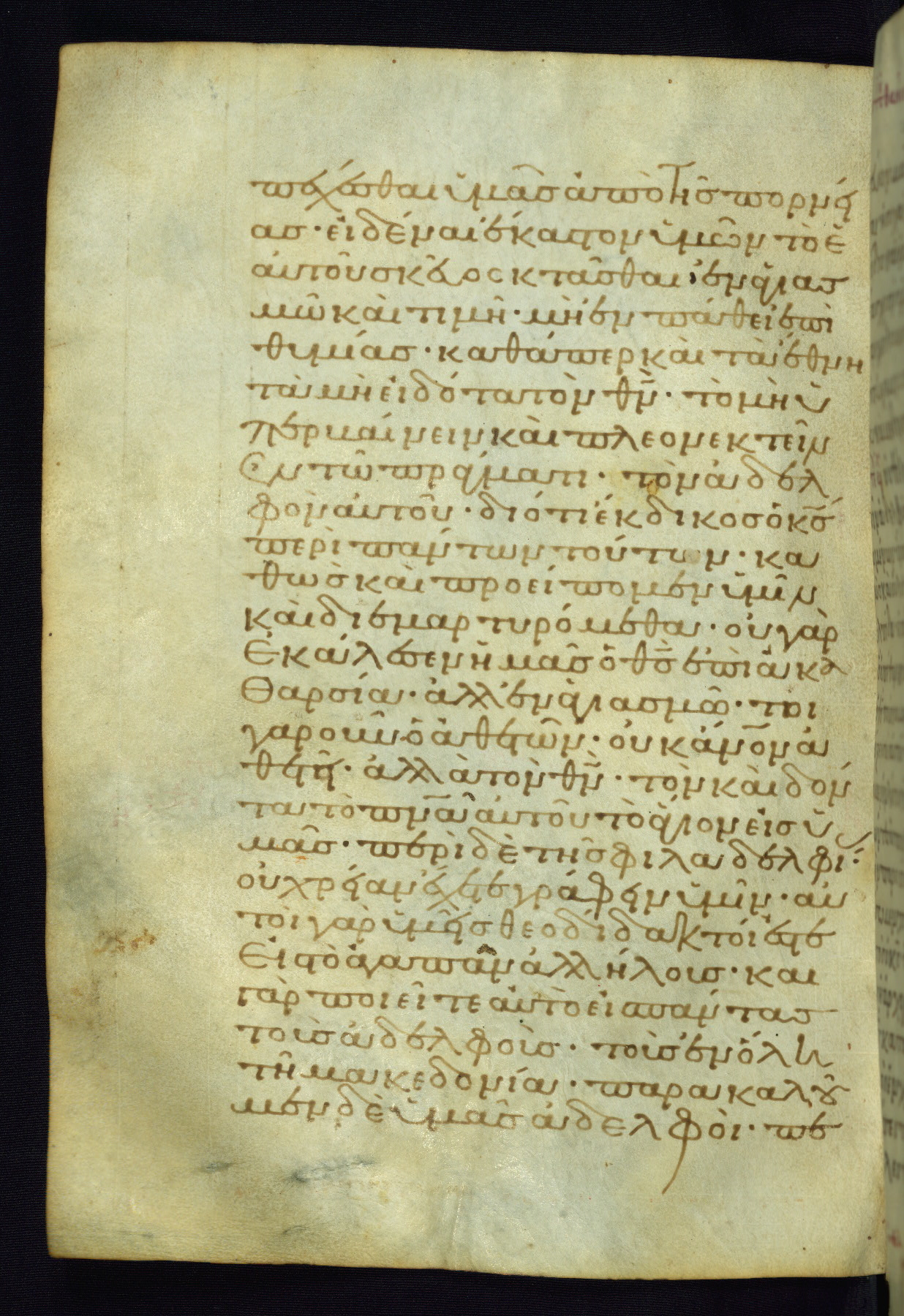
 |
| First Thessalonians 4:8-10 in GA 1022 |
Bruce Metzger, from the first
edition of his handbook The Text of the
New Testament, used this textual variant-unit to illustrate a contrast of
external and internal evidence to his students.
“Gentle” (ἤπιοι) has broad support from witnesses such as A K L P 33 the
Peshitta, the Sahidic version, Clement, and Chrysostom; “infants” (νήπιοι) also
has diverse support from P65, À* B C Old Latin, the Vulgate, the Bohairic and Ethiopic
versions, and patristic writers such as Cyril and Augustine.
Metzger explained that because the
preceding word, ἐγενήθημεν (“we were”), ends with the letter ν, it would be
easy for the letter ν to be added to ηπιοι, creating “νήπιοι” – and it would
also be easy for the letter ν to be phonetically dropped from νήπιοι, creating
ἤπιοι. After presenting both sides of
the issue, Metzger gave a verdict in favor of ἤπιοι, appealing to Daniel Mace’s
axiom that no manuscript is as old as common sense – that is, considering that
the transcriptional probabilities seem about equal, one should consider what
the author is likely to have written, and this consideration favors ἤπιοι. It is intrinsically unlikely that Paul would
suddenly drop the idea, like lightning from a clear sky, that he and his
associates had behaved like babies, and in the next breath say that they had
been like a nursing mother cherishing her children.
Nevertheless, despite Metzger’s
lucid argument – which he later restated in a protest-note in his Textual Commentary – he was outvoted by
his colleagues. Today, the reading in
the Nestle-Aland/UBS compilation is (incorrectly) νήπιοι.
First
Thessalonians 4:8 contains two overlapping textual variants: (1)
the inclusion or non-inclusion of καὶ followed immediately by (2) a
contest between διδόντα and δόντα. The
reading καὶ δόντα (supported by Clement and the Byzantine Text) may account for
the rise of καὶ διδόντα and διδόντα: an
early copyist whose uncial-writing was less than ideal wrote KAIDONTA but the first
A was mistaken for a Δ, as if he had written
KΔIDONTA. Subsequently, the
letter K was regarded either as a stray letter and removed (leaving what was
then understood as διδόντα (found in Codex B), or else it was regarded as a kai-compendium, which was then expanded
into καὶ before διδόντα (read by À*).
One may see a progression from καὶ
δόντα to διδόντα in sync with progression from Clement to Origen. For reference: Griesbach and Scholz had καὶ δόντα; Tregelles
and Westcott-Hort and Nestle (1899) and Souter adopted διδόντα (without καὶ); Holmes’
SBL-GNT reads καὶ διδόντα; one wonders by what reasoning this longer reading was
preferred. The Tyndale House Greek New Testament
correctly reads καὶ δόντα.
Readers are invited to double-check the data in this post.