Leaving the
Gospels momentarily, today we explore a textual variant in the Pauline
Epistles: in First Corinthians 10:9, did
the text originally say “Nor let us tempt Christ”
(Χριστόν) or “Nor let us tempt the Lord”
(Κύριον) or “Nor let us tempt God”
(Θεόν)? All three readings are nomina sacra (sacred names, usually written in contracted form), and thus, with the nomina sacra in play,
amount to the difference between ΧΝ, ΚΝ, and ΘΝ.
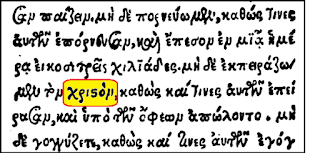 |
| Erasmus' text of I Cor. 10:9 (1522) |
The
treatment of this variant by editors, publishers and printers of the (mainly)
Byzantine Text has been consistent:
Erasmus (all editions), Gerbel (1521), Stephanus (1550), Melchoir Sessa
(Venice) 1538, John Fell (1675), Bengel (1734), and Scholz (1836) all have
favored “Χριστόν”; Griesbach also had Χριστόν in the text. Χριστόν is read in Hodges & Farstad’s
Majority Text (1982), and in the Robinson-Pierpont Byzantine Textform (2005),
and in the Solid Rock Greek New Testament.
English
Bibles in use today with “Christ” in First Corinthians 10:9 include the KJV, NKJV,
EOB (Eastern Orthodox Bible), WEB, EHV, and also the CSB, ESV, NET, NIV 2011,
NLT, NCV (New Century Version), and NRSV.
 |
| I Cor. 10:9 (Nicolaus Gerbel, 1521) |
Κύριον was
consistently adopted by most editors of the critical text, other than
Griesbach, until about 1970:
“Lord” was the reading adopted by Lachmann
(1831), Buttmann (1862), Tregelles (1869), Tischendorf (8
th edition,
1872), Westcott & Hort (1881), Eberhard Nestle (1904), Alexander Souter
(1920), and the Nestle-Aland compilation up to and including the 25
th
edition.
The first and second editions
of the United Bible Society’s
Greek New
Testament also read Κύριον.
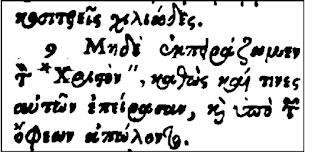 |
| I Cor. 10:9 (Fell, 1675) |
Consequently,
“Lord” has appeared in First Corinthians 10:9 in several English Bibles of the
past 150 years, including the Revised Version (1881), the American Standard
Version (1901), the Revised Standard Version, the Living Bible, the New Life
Version, the New American Standard Bible (1960 & 1995), the New
International Version 1984, and the Tree of Life Version (2011).
Meanwhile,
the Tyndale House GNT reads “κύριον” and the SBLGNT reads “Χριστόν.”
Now let’s look at some text-critical data:
 |
| Fell's footnote (1675) |
In 1982, in
New Testament Textual Criticism: Its Significance for Exegesis: Essays in Honor of Bruce M. Metzger, a
chapter by Carroll D. Osburn focused on this variant. Osburn’s data is far more detailed than any
other apparatus: in support of Χριστόν,
Osburn listed
P46, D,
E, F, G, K, L, Ψ 056 0142 0151 and 489 minuscules (including 1 6 18 35 69 88 131
205 209 323 330 424 440 451 489 517 547 614 618 629 630 796 910 945 999 1241 1242
1243 1245 1270 1315 1353 1424 1448 1505 1611 1646 1734 1738 1739 1827 1852 1854
1881 1891 1912 1982 1984 2125 2200 2400 2412
2492 2495), numerous Old Latin witnesses including it
ar,
b,
d,
dem,
e,
f,
g,
o,
x,
z and the Vulgate, the Peshitta, the main text of the
Harklean Syriac, the Sahidic version, and the Bohairic version.
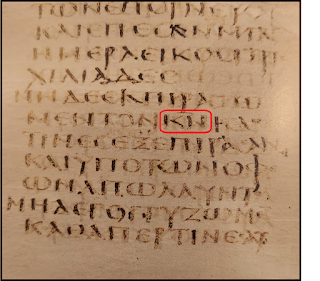 |
| I Cor. 10:9 in Codex Sinaiticus |
Κύριον,
meanwhile, is supported by
À B C P 0150 33 43 104 181 255
vid 256 263 326 365
436 1175 2110 2127 2464 and 22 other minuscules, and the margin of the Harklean
Syriac, the Armenian version and the Ethiopic version.
Osburn’s thorough list extends to two
other readings:
Codex A, 2
81 1127 1595 and 14 other minuscules (and 2815 which Osburn did not list, but
Swanson does) read Θεόν.
Nothing
appears between ἐκπειράζωμεν and καθως in 97 1729* 1985 and 2659.
Settings
aside Θεόν and the complete absence of any nomina
sacra, Osburn focuses on the contest between Κύριον and Χριστόν. Things get very interesting in the patristic
evidence:
The
earliest support for Χριστόν is Marcion (the arch-heretic from Pontus who worked for a while in Rome c. 140); Epiphanius,
in the late 300s, claimed that Marcion changed the text from Κύριον to
Χριστόν. But, as Osburn argues, it is
reasonable to understand Epiphanius’ claim as a presumption – i.e., that Epiphanius’ text read Κύριον
and he assumed that Marcion had changed it – rather than as an
observation. Slightly later is Irenaeus
(in Against Heresies, Book 4, ch. 27), and slightly later
than Irenaeus are Clement of Alexandria, Origen (in a statement preserved in
the margin of GA 1739), and Theotecnus (bishop of Caesarea-in-Palestine,
and an associate of Origen), writing against Paul of Samosata for the Council
of Antioch (268).
The bishops
involved in the Council of Antioch in 268 also produced the Letter of Hymenaeus, of which Osburn
provided a relevant extract, which implies that “neither Paul of Samosata nor
his opponents were aware of a biblical text which read other than Χριστόν in v.
9.” (Osburn mentioned in a footnote, however, that the text of
the Letter of Hymenaeus printed by
M.J. Routh in 1846, and by E.Schwartz in 1927, has Κύριον.)
Also in
support of Χριστόν are Ambrosiaster, Ephraem Syrus, Pelagius, Augustine,
Pseudo-Oecumenius, and Theophylact.
Chrysostom also cites I Cor. 10:9 with Χριστόν three times.
Κύριον is
supported by Epiphanius, Theodoret of Cyrrhus (in a substantial quotation in
his commentary on the Pauline Epistles), Cassiodorus, John of Damascus, and
Sedulius Scotus. Chrysostom is cited as
using κύριον once.
Now
let’s analyze this evidence and reach a conclusion.
 |
| I Cor. 10:9 in Tregelles' text. |
The case
for κύριον is not lightweight:
agreements of
À and B were considered practically decisive by Westcott
& Hort, and their judgment held sway for over a century, though as early
as 1899 Theodor Zahn, as Carroll noted, firmly opposed it.
Χριστόν has
in its favor the support of very early and geographically diverse patristic witnesses. The discovery of P46 with Χριστόν (written as
ΧΡΝ - see BP II f.49 in the online Chester Beatty Papyrus
Collection on the fourth line from the bottom) probably
should have instantly elicited a change in the critical text here, inasmuch as
with its discovery, Χριστόν scores high on multiple metrics: it is the reading of the oldest manuscript;
it is the reading of the most manuscripts (by far); it is the reading of the
most diverse array of manuscripts; it is the reading favored by a strong
combination of early patristic writers.
About the only counter-argument that favors Κύριον is the internal
consideration that Paul would be unlikely to have written that the Hebrews in
the wilderness tempted Christ – but as indicated in a note in the NET, Osburn
built an effective cumulative argument that the case
against Χριστόν driven by this internal evidence is weak. I cannot think
of any reason but haste, and perhaps over-reliance on the work of Tregelles
(who had no access to P46) to elicit the Tyndale House GNT’s adoption of κύριον. It was due to over-reliance upon À and B that κύριον was ever adopted in printed Greek New Testaments; hopefully the days of such over-reliance, repeatedly shown to be merely a disguised bias, are behind us.
Χριστόν
merits confident inclusion in the text.


