Followers

Showing posts with label Hand to Hand. Show all posts

Saturday, September 24, 2022

Hand to Hand Combat: GA 1691 vs. Sinaiticus in Matthew 7:26-8:5

          Earlier this month, we looked at a page in GA 1691 that contained most of Matthew 7:26-8:5.  GA 1691 is one of many manuscripts featured at the CSNTM website.  More than one reader of that post had a question:  is GA 1691 really more accurate than Codex Sinaiticus?  Today we shall investigate this question, as far as Matthew 7:26-8:5 is concerned, via a quick round of hand-to-hand combat – that is, a comparison of the text of both manuscripts.  The standard of comparison shall be the Nestle-Aland NTG (28th edition), although the Solid Rock Greek New Testament (third edition) will also be consulted.  The passage in which both manuscripts will be compared is Matthew 7:26-8:5, the same passage featured in the previous post (slightly expanded to include the entirety of the verses on the page of 1691).  

          As usual, the comparison is scored as follows:  every extra letter earns the manuscript a point, and every missing letter earns the manuscript a point.  Word-order differences that do not change the meaning and which do not result in any loss of text do not receive a score.  Contractions of nomina sacra (sacred names) and other contractions are not counted as variants.  The number of points = the total amount of corruptions, so the lower score wins.

GA 1691 compared to NA28:

26 – 1691 transposes to τὴν οἰκίαν αὐτοῦ instead of αὐτοῦ τὴν οἰκίαν

27 – no variants

28 – 1691 has συνετέλεσεν instead of ετέλεσεν (+3)

29 – 1691 does not have αυτων at the end of the verse (-5)

1 – 1691 has Καταβαντι δε αυτω instead of Καταβαντος δε αυτου (+2, -4)

2 – 1691 has ελθων instead of προσελθων (-4)

3 – 1691 has ο Ις after αυτου (+7, uncontracting the n.s.)

4 – 1691 has εκαθερισθη instead of εκαθαρισθη (+1, -1)

4 – 1691 has προσενεγκε instead of προσενεγκον (+1, -2)

5 – 1691 has Εισελθοντι instead of Εισελθοντος (+1, -2)

5 – 1691 has αυτω instead of αυτου (+1, -2)

5 – 1691 has Καπερναουμ instead of Καφαρναουμ (+2, -2)

Thus, using NA28 as the standard of comparison, GA 1691 has 17 non-original letters and is missing 20 original letters, for a total of 37 letters’ worth of corruption.

          Now let’s see how the scribe who copied the Gospels in Codex Sinaiticus did in Matthew 7:26-8:5, compared to NA28.

À compared to NA28:
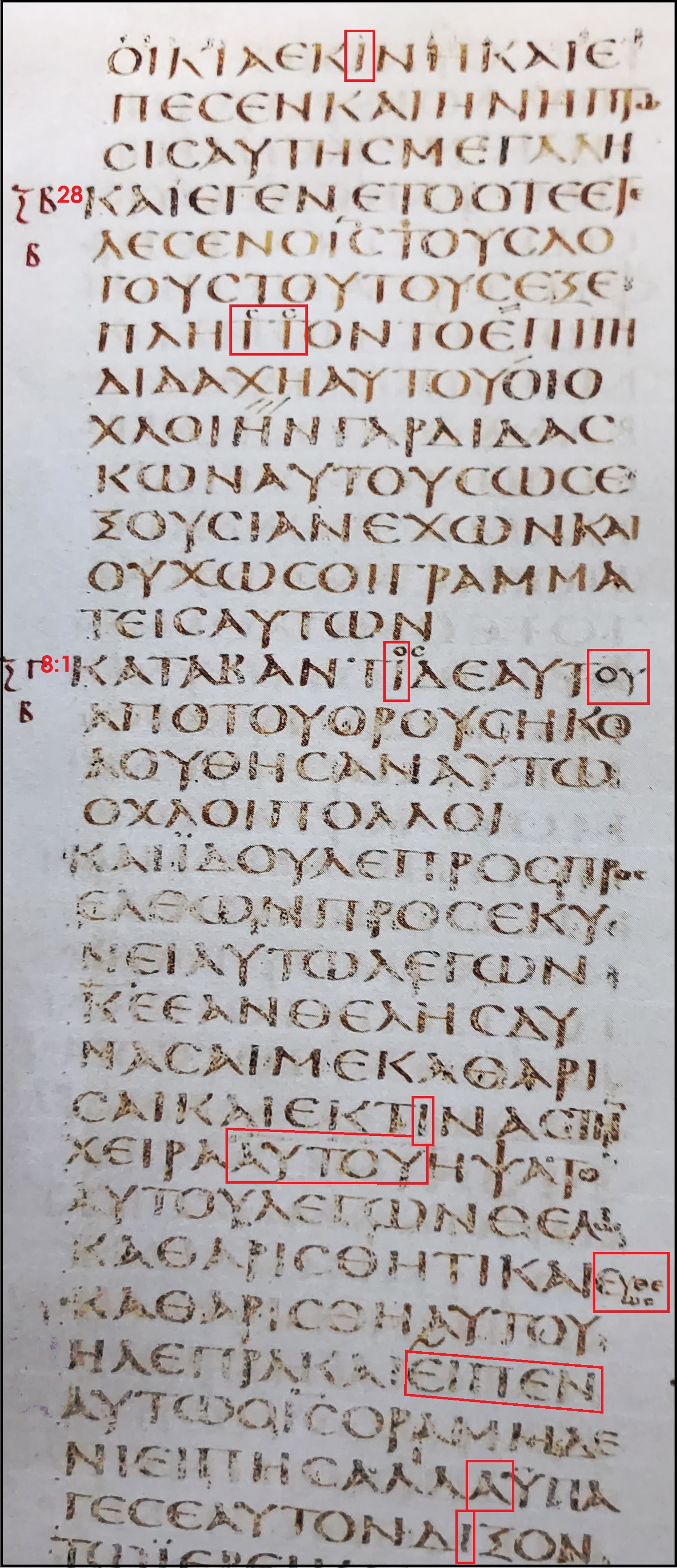
(from Codex Sinaiticus)

26 – no variants

27 – À has ελθαν instead of ελθον (+1, -1)

27 – À does not have καὶ ἔπνευσαν οἱ ἄνεμοι (-19)

27 – À has εκινη instead of εκεινη (-1)

28 – À has ἐξεπλήττοντο instead of ἐξεπλήσσοντο (+2, -2)

28 – À transposes to επι τη διδαχη αυτου οι οχλοι instead of οι οχλοι επι τη διδαχη αυτου

1 – À has Καταβαντι δε αυτω instead of Καταβαντος δε αυτου (+2, -4) (A corrector has erased the ω but it is noted in the trnscription)

2 – no variants

3 – À has εκτινες instead of εκτεινες (-1)

3 – À has αυτου after χειρα (+5)

3 – À does not have ευθεως (-6)

4 – À has ειπεν instead of λέγει (+5, -5)

4 – À has αλλα instead of αλλ՚ (+1)

4 – À has διξον instead of δειξον (-1)

4 – À has προσενεγκε instead of προσενεγκον (+1, -2)

5 – À has εκατοναρχης instead of εκατοναρχος (+1, -1)

            Thus, the text of Codex Sinaiticus, uncorrected, has 18 non-original letters and is missing 42 original letters, for a total of 60 letters’ worth of corruption in Matthew 7:26-8:5.  Even if we remove from the equation all the minor (and not-so-minor) orthographic variants in 7:27, 8:3, 8:4, and 8:5, that still leaves 44 letters’ worth of corruption. 

            Want to see how both manuscripts compare to the Solid Rock Greek New Testament?  Well, GA 1691 reads exactly like the Solid Rock Greek New Testament (third edition) throughout Matthew 7:26-8:5 except for two little orthographic variants in Matthew 8:4 (where 1691 has εκαθερισθη instead of εκαθαρισθη, and Μωϋσης instead of Μωσης).  There is no need, considering the variants in À noted above, to ask which manuscript agrees more with the Solid Rock GNT.   

            GA 1691 is the clear winner of this round of hand-to-hand combat.  

            Side-note:  an Alexandrian reading in NA28 in 8:1 (προσελθων instead of the Byzantine ελθων) is questionable.  ελθων is supported not only by the Byzantine text but also by C K L S U V W X  Γ Π 33.  Scholz and Griesbach and Knapp (1797)  read ελθων.  The προς in the immediately preceding λεπρος may have been accidentally repeated. 


Wednesday, February 9, 2022

Hand to Hand Combat: GA 1690 versus Codex Sinaiticus in John 3:22-36

          Today we present a thrilling skirmish in the arena of John 3:22-26:  Codex Sinaiticus (from the mid-300s) vs. minuscule 1690 (at the National Library of Greece, from the 1200s or 1300s).  Digital page-views of 1690 are at the CSNTM website, and Codex Sinaiticus can be viewed at Codex Sinaiticus.org .    The text of John 3:22-36 in UBS4 (which is the same in UBS5 and NA27 and NA28) shall serve as referee.  The usual rules apply:  nomina sacra contractions shall not be considered variants, and transcriptions shall be noted but not considered variants unless they involve some addition or loss of letters.


John 3:22-36 in GA 1690:

22 – has διέτριβε instead of διέτριβεν (-1)

23 – Ἰωάννης is written as ιω

23 – has σαλημ instead of σαλείμ (+1, -2)

23 – has παρεγένοντο instead of παρεγίνοντο (+1, -1)

24 – Ἰωάννης is written as ιω

25 – has Ἰωάννου written as ιω

26 – has Ἰωάννην written as ιω

26 – has ειπον instead of ειπαν (+1, -1)

26 – has μεμαρτύρεκας instead of μεμαρτύρηκας (+1, -1)

27 – has Ἰωάννης written as ιω

27 – has λαμβάνει instead of λαμβάνειν (-1)

27 – has ουδεν instead of ουδε εν (-1)

28 – does not have μοι (-3)

28 – does not have [οτι] (-3)

29 – has ἐιστηκως instead of ἐστηκως (+1)

30 – has ἐστι instead of ἐστιν (-1)

31 – has ἐστι instead of ἐστιν at the end of the verse (-1)

32 – begins the verse with και (+3)

32 – has ἑώρακε instead of ἑώρακεν (-1)

32 – has ηκουσε instead of ηκουσεν (-1)

33 – has αυτου transposed to follow μαρτυρίαν instead of after λαβων

33 – has ὁ θς after δίδωσιν (+5, expanding the nomen sacrum)

34 – no variants

35 – no variants

36 – has την before ζωήν (+3)

          The text of John 3:22-36 in 1690 is missing 18 original letters and includes 16 original letters, for a total of 34 letters’ worth of corruption.  Now let’s see how the text of À does.

John 3:22-36 in Sinaiticus:

22 – transposes και οι μαθηται αυτου to follow εις την Ιουδαιαν γην 

22 – has κακει instead of και εκει (-2)

23 – has ενγυς instead of εγγυς +1, -1)

23 – has παρεγεινοντο instead of παρεγίνοντο (+1, -1)

24 – does not have ὁ (added by a corrector) (-1)

24 – has δε συν- before ζήτησις (a corector has overdotted and written ουν above the line) (+5)

24 – has μετα ϊουδαιων instead of μετα ιουδαιου (changed by a corrector) (+2, -2)

25 – has ειπον instead of ειπαν (+1, -1)

26 – has ραββει instead of ραββι (+1)

26 – has βαπτιζι instead of βαπτιζει (-1)

27 – has λαβιν instead of λαμβάνειν (-4)

27 – has ουδεν instead of ουδε εν (-1)

28 – has υμις instead of υμεις (-1)

28 – has μαρτυριται instead of μαρτυρειτε (-2, +2)

28 – does not have [οτι] (-3)

29 – has αυτου after ἑστηκως (transposed)

30 – has αυξανιν instead of αυξανειν (-1)

31 – has ο δε ων instead of ὁ ων (+2)

31 – has επι instead of the first εκ (+2, -10

31 – does not have ἑπάνω πάντων ἐστιν (-16)

32 – begins the verse with ον (+2)

32 – has ἑώρακε instead of ἑώρακεν (ν is added above the line) (-1)

32 – has ηκουσε instead of ηκουσεν (ν is added above the line) (-1)

32 – has ουδις instead of ουδεις (-1)

33 – no variants

34 – has απεστιλεν instead of απεστειλεν (-1)

34 – has δίδωσι instead of δίδωσιν (-1)

35 – no variants

36 – does not have δε (-2)

36 – has απιθων instead of απειθων (-1)

36 – has εχει instead of ὄψεται (+4, -6)

36 – transposes μένει to the end of the verse

          The text of John 3:22-36 in  À is missing 61 original letters and includes 23 non-original letters, for a total of 94 letters’ worth of corruption. Wait; 1690 has just 34 letters’ worth of corruption here and À has 94?


         Let’s drop all those itacisms and final-νs and transpositions from consideration, boiling things down a bit, and see how things stand:

1690:

27 – has ουδεν instead of ουδε εν (-1)

28 – does not have μοι (-3)

28 – does not have [οτι] (-3)

32 – begins the verse with και (+3)

33 – has ὁ θς after δίδωσιν (+5, if the nomen sacrum is expanded)

36 – has την before ζωήν (+3)

          With trivialities set aside, the text of John 3:22-36 in 1690 is missing 7 original letters and includes 11 original letters, for a total of 18 letters’ worth of corruption.  Now let’s see how the text of À does:


Sinaiticus’ text of John 3:22-36:

23 – has ενγυς instead of εγγυς +1, -1)

24 – does not have ὁ (added by a corrector) (-1)

24 – has δε συν- before ζήτησις (a corector has overdotted and written ουν above the line) (+5)

24 – has μετα ϊουδαιων instead of μετα ιουδαιου (changed by a corrector) (+2, -2)

27 – has λαβιν instead of λαμβάνειν (-4)

27 – has ουδεν instead of ουδε εν (-1)

28 – does not have [οτι] (-3)

31 – has ο δε ων instead of ὁ ων (+2)

31 – has επι instead of the first εκ (+2, -1)

31 – does not have ἑπάνω πάντων ἐστιν (-16)

32 – begins the verse with ον (+2)

36 – does not have δε (-2)

36 – has εχει instead of ὄψεται (+4, -6)

          With trivialities set aside, the text of John 3:22-36 in À is missing 17 original letters and includes 37 non-original letters, for a total of 54 letters’ worth of corruption. (That's assuming, remember, that the editors of UBS4 got things right here.  That οτι in verse 28, and a couple of other points, look very suspect.)  

          Wait; even with trivial itacisms and final-νs and transpositions set aside, and even with UBS4 (brackets and all!) officiating, the text in 1690 (from the 1200s or 1300s) clobbers the text in À, from the 300s, by a score of 18 letters’ worth of corruption to 54 letters’ worth of corruption?  Yes. 

           1690 appears to be a member of Family Π (“Ka”).  1690 was observed by Michael Bruce Morrill (in A Complete Collation and Analysis of All Greek Manuscripts of John 18) to be in agreement with the Majority Text 96.5% of the time in John 18.  Its text of John 18 is very close to the text of 1627, 1699, 2404, and 2902.  Its text’s resilience in this passage is almost as interesting as its use of ιω as a sacred name within the text.   


[Readers are welcome to check the accuracy of this post.]


Monday, January 13, 2020

Hand to Hand Combat: Sinaiticus vs. 490 in Luke 15:1-10

            It’s time for a round of hand-to-hand combat!  Today’s arena:  Luke 15:1-10, a famous passage in which Jesus delivers the Parables of the Lost Sheep and the Lost Coin.  The combatants:  Codex Sinaiticus (from c. 350) and minuscule 490 (from the 1000s).  Codex Sinaiticus (À) comes to the fight with a considerable advantage:  copyists had only about 300 years to introduce corruptions into its text, while at least 940 years separate GA 490 from the autograph (positing a composition-date for the Gospel of Luke in the early 60s).  One might naturally expect À to have the more accurate text.  Let’s see if the evidence confirms this.
            As in other rounds of hand-to-hand combat, I will make a close assessment of all deviations from the stand-in for the original text; the Tyndale House Greek New Testament serves as our proxy.  Sacred-name contractions and other contractions and abbreviations are not counted as variants; transpositions are mentioned but not treated as losses or gains of materials unless an actual loss or gain occurs.  The recorded text of each MS in the comparison is the text of the MS prior to later, post-production corrections.  After the initial raw data is collected, it will be filtered so as to set aside itacisms and some other untranslatable variants.

Luke 15:1-10 in Sinaiticus:
1 – no differences
2 – À does not have ουτος (-5)
2 – À has προσδεχετε instead of προσδεχεται (+1, -2)
3 – no differences
4 – À has καταλιπει instead of καταλειπει (-1)
4 – À has ου after εως (+2)
5 – no differences
6 – À has συνκαλει instead of συγκαλει (+1, -1)
6 – À has συνχάρητέ instead of συγχάρητέ (+1, -1)
7 – À has εστε instead of εσται (+1, -2)
7 – À has χριαν instead of χρειαν (-1)
7 – À has εχουσι instead of εχουσιν (-1)
8 – À has ζητι instead of ζητει (-1)
9 – À has συνκαλει instead of συγκαλει (+1, -1)
9 – À has συνχάρητέ instead of συγχάρητέ (+1, -1)
10 – no differences

            Thus, in these 10 verses, Sinaiticus’ text has lost 16 original letters and gained 8 non-original letters, for a total of 24 letters’ worth of corruption.  When we filter out trivial variants, there are only two variants of substance here:  the absence of ουτος in verse 2 and the presence of ου in verse 4, yielding a total of seven letters’ worth of corruption. Can GA 490 do better than that?  Let’s see:


Luke 15:1-10 in GA 490:         
1 – transposition:  εγγίζοντες αυτω
2 – 490 does not have τε (-2)
3 – 490 has ειπε instead of ειπεν (-1)
3 – no differences
4 – transposition:  εν εξ αυτων
4 – 490 has ου after εως (+2)
5 – 490 has εαυτου instead of αυτου (+1)
6 – no differences
7 – transposition:  εσται εν τω ουνω
7 – 490 has εχουσι instead of εχουσιν (-1)
8 – 490 has οτου instead of ου (+2)
9 – 490 has τας before γείτονας (+3)
10 – transposition:  χαρα γινεται ενώπιον
10 – 490 has γινεται instead of γεινεται (-1) [NA reads γινεται]

            Thus, in these 10 verses, GA 490’s text has lost 5 original letters and has gained 7 non-original letters, for a total of 12 letters’ worth of corruption.  490’s text also contains four transpositions.  When we filter out trivial variants, there are five variants remaining:  (1) the absence of τε in verse 2, (2) the presence of ου in verse 4, (3) εαυτου instead of αυτου in verse 5, (4) οτου instead of ου in verse 8, and (5) τας in verse 9 – yielding a total of 10 letters’ worth of corruption. 
            So, in terms of strict formal accuracy, 490’s text retains more of the original text, and loses less than À does, by a score of 24 to 12.  But if we set aside matters of spelling, À wins, barely, by a score of 7 to 10.  (One could arguably reduce 490’s score to 9 if one sets aside as trivial the difference between εαυτου and αυτου in verse 5.)

I note in passing that there could be a case for adopting ου after εως in Luke 15:4.  This reading is supported by À A Δ Y M N f1 f13 579 et al.