Followers

Tuesday, June 7, 2022

Sinaiticus' Cancel-Sheets: What Did They Replace?

           Usually, when a textual critic encounters a manuscript, it’s taken for granted that its text was written down by a single copyist.  But this is not always the case, especially with large manuscripts.  In Codex Sinaiticus, for example, “Scribe A” is the moniker given to the scribe who copied the New Testament – but the diorthōtēs (proof-reader/supervisor) who oversaw the production of the manuscript, and who was probably responsible for selecting the exemplars upon which it was based, also contributed three cancel-sheets, forming a total of 12 pages of the manuscript.  (The diorthōtēs also wrote the opening verses of Revelation.)  Each cancel-sheet consists of a double-sided parchment page connected to another double-sided parchment page.  Scribe D’s cancel-sheets contain

          (1) Matthew 16:9-18:12 (front and back),

          (2) Matthew 24:36-26:6 (front and back),

          (3) Mark 14:54-16:8 and Luke 1:1-56 (front and back and front and back),

          (4) First Thessalonians 2:14-First Thessalonians 5:28, (front and back) and

          (5) Hebrews 4:16-8:1 (front and back).

         The intrusion of a different scribe upon the work of another scribe at these points, replacing the main scribe’s work, is not indicated in the textual apparatus of the Nestle-Aland and UBS compilations.

             What elicited the introduction of these cancel-sheets?  Did the main copyist make a bad haplographic error, skipping a passage so big that the page he copied could not be salvaged?  Had he made a huge dittographic mistake, writing a large portion of text twice?

          Dr. Peter Head, in his 2008 article The Gospel of Mark in Codex Sinaiticus: Textual and Reception-Historical Considerations at TC-Journal, wrote, “We cannot know what was wrong with the original work of Scribe A at these points.”  Let’s test that claim.  We may not be able to know with certainty what elicited the removal of Sinaiticus’ initial pages, to the same extent that we know that diamonds are hard, but we can make some relevant deductions by looking in the cancel-sheets for evidence that Scribe D was supplying text that had been skipped by the first scribe, or that Scribe D was removing text that had been written twice by the first scribe.   Probably nothing was drastically wrong on at least half of the replaced pages – but each folio had to be accepted as a unit. 

          The first step toward gaining some idea as to what elicited Sinaiticus’ cancel-sheets is to simply count the letters on each page, upon each of which the text is arranged in four columns.  Then we can compare the amounts of letters on these pages to the amounts of letters typical of Scribe D (who also wrote the text in Codex Sinaiticus in Genesis, Tobit, the first part of Psalms, etc.).

          An often-overlooked resource is particularly helpful here.  In 1961, T.B. Smith completed the publication of Contributions to the Statistical Study of Codex Sinaiticus, which contained the research of his father-in-law Christian Tisdall (1878-1951).  Tisdall’s work included an appendix in which he listed the letter-counts of each column in the New Testament portion of the manuscript.  Using Tisdall’s data, here are the letter-counts for the replacement-pages.  I have identified the cancel-pages by numbers (1,2,3,3,5,6), and by letters (r,v, representing recto and verse) for each individual page:

          1r (Mt. 16:9-17:10) =  Q75-f.2r):  2,432 letters
          1v (Mt. 17:10-18:12) = Q75-f.2v):  2,531 letters      

           2r (Mt. 24:36-25:21) = Q75-f.7r):  2,537 letters

          2v (Mt. 25:21-26:6) = Q75-f.7v):  2,624 letters

           3r (Mk. 14:54-15:16) = Q77-f.4r):   2,614 letters

          3v (Mk. 15:16-16:1) = Q77-f.4v):   2,617 letters

           4r (Mk. 16:2-Lk. 1:18) = Q77-f.5r):  1,960 letters

          4v (Lk. 1:18-Lk. 1:56) = Q77-f.5v):  2,792 letters

           5r (I Thess. 2:14-4:13) = Q85-f.3r):  2,645 letters

          5v (I Thess. 4:13-5:28) = Q85-f.3v):   1,940 letters

           6r (Hebrews 4:16-6:18) = Q85-f.6r): 92]  2,551 letters

          6v (Hebrews 6:18-8:1) = Q85-f.6v): 93]  2,482 letters

Mt. 25:44 in Sinaiticus
           On the first three pages of the first cancel-sheet, there in nothing suggestive of either haplography or dittography on the main scribe’s pages.  On the fourth page, though, there are four consecutive lines of text at the top of the fourth column (in Matthew 25:44) that are nowhere close to filling the line.  Conceivably, the diorthōtēs didn’t fill these four lines so as to convey a rhythmic cadence for this passage.  But probably, the main scribe make a bad error at or near this point, and that is what led to the removal of the pages he had produced.  Perhaps his line of sight had drifted from Τότε at the beginning of v. 44 to the Τότε at the beginning of v. 45.

          The second cancel-sheet has several consecutive columns of the text of Luke with a number of letters greatly exceeding the usual rate:  the text in columns 11-16 of the cancel-sheet is written at an average rate of 691 letters per column.  The main scribe had probably skipped a large segment of text; either consisting of 311 letters (by jumping from Επεν δ Μαριμ at the beginning of v. 34 to Επεν δ Μαριμ at the beginning of v. 38) or consisting of 319 letters (by jumping from γένετο at the beginning of v. 5 to the γένετο at the beginning of v. 8).  The diorthōtēs had to compress his lettering quite thoroughly to fit the passage that had been skipped by the main scribe.

          On the third cancel-sheet, the rate of letters-per-page on the second set of pages looks ordinary.  The rate of letters-per-page is only slightly higher on the first page (containing I Thess. 2:14-4:13).  The rate of letters-per-page is significantly lower on the second page (containing I Thess. 4:13-5:28):  it hold just 1,940 letters.  This is due mainly to the end of I Thessalonians in the fourth column, followed by the closing title, after which the rest of the column is blank.  A blunder of the main scribe probably affected the portion of text on this page, but its nature cannot be determined.


Saturday, June 4, 2022

Pen, Print, & Pixels: Peter Gurry: Textual Notes in Early English Bibles

Daniel Buck reports on another session of the Pen, Print, & PIxels Conference:

Peter Gurry

          Peter Gurry gave a brief history of printed English Bibles up to the King James, focusing on their text-critical marginal notes.  The first of these editions was Tyndale’s of 1525, printed in Cologne as far as the 22nd chapter of Matthew before the printing was stopped by the local authorities.  This edition had extensive printed notes in the margins.

          Tyndale’s second edition, the first complete NT, was printed in Worms in 1526, a press run of six thousand of which only three copies remain, none of them quite complete:  the British Museum’s copy is missing the title page.  In that copy, the first owner not only colorized the illustrations but added his own marginal notes [in Latin]!  This edition was reprinted by a Bible printing firm in Antwerp several times before 1534, when George Joye undertook to anonymously edit the text for them, putting some of his own theology into the revision.  This provoked Tyndale enough to issue his own revision in which he criticized Joye by name in the introduction.

          This 1534 edition, Tyndale’s third, contained substantial marginal notes (but none of a textual nature), very interpretative and marked with stars.  For example, the word “sandals” which had been introduced to the English Bible by Wycliffe, was retained, but with a note at Mark 6:9 explaining what they were.  Like the second edition, this 1534 NT has chapters subdivided into paragraphs, and lacks the line in John 8 about the adulterous woman’s detractors being accused of their own conscience.

          We now move on to the Whittingham NT of 1557, printed in Geneva.  It was the first English NT to be printed in Roman type, the first to be subdivided into verses, and the first to use italics for implied words.  Conrad Badius printed it, brother in law of Stephanus. There was a real brain trust then in Geneva.  According to the introductory pages, this translation was “Compared with the Greke, and best approued translations.”  It was based on Erasmus, Stephanus, and Beza’s Latin-only 1556 NT.    Whittingham mentions “divergent readings in diverse Greek copies,” using a symbol for a word-length variant and || for a sentence-length variant. (Peter Gurry had searched in vain for any examples of these in the margins, finally finding a series of the latter in Acts!) All but one of the nine are a full verse long. 

A conjectural emendation offered in the 
margin of the 1611 KJV
.
         Textual margin notes are always italic and in a bigger font. Of Beza’s 350 textual variants noted in Acts, only 9 were included, kind of clustered on a few pages. In the Geneva NT, which came out three years later, variants were marked by double bars. There are only 21 such in NT, all 9 carried over from Whittingham in Acts, and the rest mostly in the Gospels from Beza’s text.

          Finally: the KJV.  Up until now, title pages of English Bibles have been keen to point out the inclusion of notes to help the reader, but not so the King James, even though it contained 6000 marginal notes in the OT and 300 in the NT.  Instead, the editors actually felt a need to apologize in the preface for providing the notes. In doing so, they took a slight swipe at Sixtus VI, who disallowed any variety of readings in the margin of his Vulgate. 

          The variant notes read much as do those in modern editions:  “As some read” or “many copies wanting.”  Most variant notes are indistinguishable from translation notes, usually starting with “Or.”  About three-fourths of the NT notes are just alternate renderings.  Acts 13:18 has a conjecture, proposing ἐτροφοφόρησεν for ἐτροποφόρησεν.  [This is, as far as Peter could see in a quick run through the margins, the only note in the entire KJV with Greek in it – but Daniel Buck has observed that there’s another one on the same page: τα οσια at verse 34].

          I John 2:23 is the only place the KJV uses typefont to indicate a textual variant, instead of a marginal note. That variant was found either in the text or margin in their Greek sources. The KJV editors included many more variants than the Geneva, but not as many as were in Beza’s GNT, making their own judgment on which of Beza’s to include.

          And now some conclusions. 

          ● It is striking how many editions made their notes a selling point, for which Geneva is so famous.  But they go along with other features now common:  book summaries, chapter summaries, cross references, readers’ introductions.

          ● Those who produced these English Bibles knew that many of their readers would be reading the Word of God in their own language for the first time. So they also included extensive book prefaces. Tyndale’s preface to Romans is the longest in the whole NT, longer than Romans itself – and almost entirely directly translated from Luther.  

          ● Early English Bible translators made only a vague distinction between translation differences and textual differences. They didn’t see them as distinctly as we do.

          ● Finally, I’m not sure we’ve improved much on the KJV notes.


Friday, June 3, 2022

Pen, Print, & Pixels - Kathleen Maxwell's Session

Daniel Buck reports on Kathleen Maxwell’s presentation, “Decorative Systems in Byzantine Manuscripts,” given at the Pen, Print, & Pixels conference in May.  Just imagine yourself listening to the following from Dr. Maxwell: 


Dr. Kathleen Maxwell

          Decorative systems are an important element in the paratext.  During the latter Byzantine period, scribes also had to include illustrations, or at least leave space for them.  To be a scribe was to be a book producer and graphic artist as well as a copyist.  A beautifully illustrated MS allows us to make significant conclusions about its patron.  By the end of the sixth century a system of illustrations in Greek gospel books had emerged, but we wait until the middle of the ninth century for initials and headpieces.

          Art historians have ignored the pandects as art, focusing only on their column layout. There is a dramatic evolution in ornament across Codices Sinaiticus (À, 01), Alexandrinus (A, 02), Vaticanus (B, 03), with focus on the endings of books rather than the beginnings.  The pandects have a coronis at the end of every book; in 01 it is what we call a half eta form.  The horizontal axis separates the end of the text from the subscription.

          The entire post-text inkwork is called the tailpiece, including a vignette or colophon.  Sometime it takes the form of a Xi-rho, such as above the end title of Isaiah, but the next column just says IEREIMIAC, with almost a dotted line frame around it, slightly indented in the column.

          At the end of Mark in 01 and 02 there are distinctive tailpieces.  Many coronides in 03 are simple, but the one at the end of Numbers is heavy, suggesting a candlestick. The end of John is the most elaborate of all. In 02, there is more fanfare for the initials of each book—the first 203 lines are rubricated. The ending coronis is a full right angle frame across the column. The ending of OT books feature a rectangle- or triangle-shaped series of forked paragraphos or diples.  In 02, there are some vases in the endpiece similar to vases in the Greek classical period, and four-sided decorative frames such as to end John.  Apocalypse ending has a headband, like those frequently found in later MSS.

          Thus the late antiquity. Sixth century illustrated manuscripts consist of:  three purples (the Rossano Gospels), and the Gold London Canon tables.  That’s it for Greek MSS!  But a HUGE jump from the fifth century. Little evidence of decoration in the text though. Canon table lost.  Seated Mark is the only full-page portrait left from pre-726, when iconoclasts took over, but now those have been added later.

          Two fragmentary canon tables are 6/7th cent, just 2 leaves, with more round-framed busts of the apostles. Rabbula gospels are AD 586 in Syriac, and Abu Garimas in Ge’ez dated to the 6th or 7th century by Carbon 14. Still no headpieces or decorated initials at this period.  To Carpianus in the Rabbula Gospels is illustrated with the same circled busts, but way more, and smaller.  The Garima Gospels also have lavishly illustrated canon tables. Both are thought to be copied from Greek Gospel books. The Ethiopic Garima Gospels has paragraphos, diples, asterisks, and rubrics.  There seems to be a hard line between the artist and the scribe here.

          Iconoclastism:  726-787.  Interlude: 878-815. [843: triumph of orthodoxy]  Second: 845-843, and the creative explosion that brought it down and led to the flourishing of Byzantine art.

          Uspenski Gospels, earliest dated MS (from 835).  GA 461, written by a reformer of Byzantine monasticism.  Still more attention on the end of books than the beginning.  Not a whole lot more at front end than 01!

          The earliest MS of Ptolemy’s Almagest shows typical ninth-century tailpieces. Same whether religious or secular MSS, and often made by the same scribes.

          Finally invented the headpiece in 861, GA 844 Sinai Gr 210 Lectionary.

          Paris Grec 510, circa 880 of Greg Nazianus. Full color endpieces. “Earliest elaborated & painted headpieces of any Byz MSS.” But with the subscriptions that are very subdued. Now a three-sided endframe has emerged.

          GA 07 takes it a step further. Kephalaia are now present with lavish two color red and green designs. Red and green titles also.


Q: Is the cross at the kephalaia supposed to be a front-piece for Matthew?

A: Matthew also ends in red & green, but with a frame, so more decorated than at the beginning.  No systematic approach to decoration had yet emerged, so that pushes its date back to the eighth century.


          Two minuscule purples are from this period, late ninth century, and probably from the same scribe. John is the only Gospel-title written in gold, and the John portrait uniquely has a purple parchment codex pictured on John’s lectern.  GA 1143 Berat and GA 565 Grec 53 St. Petersburg.  Simple motifs at end of Mark.

          By GA 420 we have quadrolobe starting the gospel books. Matthew only extant portrait. In GA 030, from the early 900s, the Tholos temple is pictured, much like an illustration in the Garima Gospels.  Once we get into the 900s we have a wealth of riches, even manipulation of the text. Princeton Garrett 1 opens Mark in cruciform uncial, and features a hugely lavish tailpiece.

          The Leo Bible is a very archaizing MS dated to c. 940 (the first volume is extant).  Vat Reg Gr 1 looks like a knockoff of 02.  

          In the Rabbula Gospels there are peacocks adorning the canon tables.  Paris Grec 70 also has peacocks in the canon tables.  Matthew’s portrait was replaced by just a framed headpiece.  It has a Bluutenleitspiel, flower-petal style, in the headpiece.

          GA 1110 is held up as the standard for elaborate Byzantine art on the canon tables, topped by birds as usual.  Canon table design really comes into its own in the 11-12th century.  Gospel portraits are very elaborate with Roman imperial backgrounds. Finally in the tenth century, the full decorative system takes over, complementing the text without overwhelming it, with endings more minimized from now on.


Dan Wallace asked:  two of them had the evangelist facing away from the biblical text. Any change or standardization?

A:  That was the “pensive John” often shown this way, contemplating rather than writing.


Daniel Buck asked:  What was the system for the text in the codex pictured within the evangelists’ portraits?

A: Usually if legible, the opening words of their own gospel.  You can learn so much more about how a MS was produced when you find one unfinished. Sometimes drawn in but not painted, sometimes just blank.

Additional information about the Pen, Print, & Pixels conference is available at the blog of CSNTM.


Wednesday, June 1, 2022

Pen, Print, and Pixels - Day 2

Daniel Buck


Daniel Buck reports on two of the sessions he attended on Day Two of the conference:

(1)  Holger Strutwolf:  The ECM of Mark

             This latest fascicle of the Editio Critica Maior is being produced in two forms simultaneously:  the online edition on the website, and the printed edition in three volumes. [Daniel Buck:  I took a look at them, and they seem to all be German/English diglots, with the English either in alternate paragraphs or alternate columns, marked either way with a solid line along the left margin.]  The process began with Text und Textwert, compiled by Aland.  1,754 MSS were known and available for Mark:  the majority are stable and uniform, so most of them were left out of consideration as redundant.  In TuT of Mark, there were 196 test passages for which all MSS on the list were photographed and compared.      

            These 196 were all cases where the reading of the majority differed from the NA text. 1,566 of the 1,754 MSS agreed with each other 90% or more.  Scholars determined which MSS were the most reliable representatives of the majority text and used them, about 100 total. Then they transcribed in full all 188 of the remaining MSS of Mark and 15 papyri, so 219 MSS altogether formed the database for the apparatus.

            All 219 selected MSS are compared to each other by percentage of shared reading in the 196 (or less, in case of damaged MSS) test passages.  Holger threw up a bunch of percentage-comparisons.[Daniel Buck:  I noticed that 2427, the long-discredited “Ancient Mark,” was only 79.3% same as Vaticanus.]  All this data is available on the Münster website, generated by computer manipulation of the entered transcriptions. There are also links to patristic citations, in the original language, in context! That alone represents a big accomplishment. You can also click through to the lexical definition of any word cited in the apparatus, and bring up line-by-line transcriptions. There is even hope in the near future to make ECM interactive.

            Holger then talked about CBGM.  He talked about pre-genealogical coherence, genealogical coherence, and stemmatic coherence (regarding which see Wasserman & Gurry’s “A New Approach to Textual Criticism: An Introduction to the CBGM”).  It seems that stemmatic coherence is rarely used, and never as the primary step.

            Textual flow diagrams connect every MS with its potential ancestors at every variant unit. For example, he showed flow from the texts found in 35 to 18 to 042. Visualization of variations hints at locations where changes took place.     


Holger Strutwolf
            Then came a very interesting section where he explained how the use of CBGM overturned the WH/SBL omission (and NA bracketing) of υἱοῦ τοῦ θεοῦ in Mark 1:1.  In NA27, the majority text was not really considered to be a candidate for the original text, it was dismissed as an anti-adoptistic corruption.  But in view of Σὺ εἶ ὁ υἱός μου ὁ ἀγαπητός already being in v. 11, there seemed no reason to add it to v. 1.  Also in favor of the shorter reading, it has been observed that jumps of the eye at the beginning of a MS are very improbable. And it’s been claimed that because it’s a nomina sacrum, homoeoteleuton would be unlikely.  

            Setting the CBGM’s Connectivity Level at 5 will show up to 5 ancestors.  If less than 5, it goes to other lines, with most likely at the top. CBGM showed the shorter reading, f, to have arisen five times independently in all the witnesses for it!  Because all five are way under 90% alike, all must have independently lost the a reading, υἱοῦ τοῦ θεοῦ.       

            CBGM is thus able to falsify the arguments of Bart Ehrman regarding this variant-unit.  So, now it turns out that the jump of the eye even can happen in nomina sacra (as attested by it happening in very late MSS – a good reason to study them!).  In the stemma of 1:1, it was assumed that all five other ECM variants stemmed directly from the a reading, either by addition or omission.  But there is a problem. The flow diagram doesn’t show that 03 and 019 both had descent from 01.  Here, apparently, is where stemmatic coherence was brought in to show the individual steps.

            Another such case is at Matthew 3:11, units 18-26.  Here the majority reading is very classical Greek. A 03 has a koine form; it was common to use neuter plural as real plural.  This exemplifies a movement to standardize the majority text, but it entered in a chaotic network of ways. The Atticistic reading won out, but the copyists were used to koine Greek and kept changing it back.  So the flow diagram actually goes from A to Byz and back!  Text diagrams are not to be misused:  inconsistencies may show movement back to the original reading, not from it directly!  It is a tool that must be subject to methodological, historical, and even theological considerations!


Q:  Given that so many MSS were lost, would the results change, with more coherence, could they be added?

Strutwolf:  Yes, especially in the case of old MSS, of which we have very few.  But we have many newer MSS with texts.  We could fill out the coherence between the old MSS much better if the missing links were available.  Thus in many MSS there is a mixture of old and young readings with no surviving ancestors to show the sources of this co-mingling.

Next:  Kathleen Maxwell presents Decorative Systems in Byzantine Manuscripts.


Monday, May 23, 2022

Pen, Print, & Pixels 2022 - Report on Day One

The Plano Marriott at Legacy Town Center
           This past week, on May 19-20, specialists in New Testament from around the world – Britain, Germany, Australia, Amsterdam, Arizona – gathered at the Dallas/Plano Marriott at Legacy Town Center for the Pen, Print, & Pixels Text and Manuscript conference, hosted by the Center for the Study of New Testament Manuscripts.

          Daniel Buck was there, and was able to attend about half of the sessions.  He had these takeaways from the first day of the conference:

          The speakers were generally in agreement that there is still much new ground to be turned in the field of New Testament textual criticism.

          l Hugh Houghton foresees much more to discover in palimpsests through Multi-Spectral Imaging, and much to be gained from the study of family relationships in catena manuscripts.

          l Timothy Mitchell envisions learning more about how published work made it into circulation, and especially how they were guarded against tampering once they passed out of the authors’ direct control, by studying numerous references to that process in Greco-Roman classical works.

          l Peter Montoro has only just started us off in tracking down more examples of back-eddies in the transmission stream where continuous text manuscripts textually feed off of patristic homilies, such as a singular reading in GA 104 at Romans 2:26 from Chrysostom's homilies (Jan Krans, a bit later in the day, cited John 1:28 in Origen as such a case).

          l Dirk Jongkind thinks that it’s time to turn a corner in our approach to singular readings (proposing that they should be weighed both before and after counting them), and may even be ready to remove the old but not-quite-yet-ancient landmark of the Gregory-Aland numbering scheme.

          l Ryan Griffin wants us to further change the modern critical text to align more closely with the “Western” readings of p46 at three places in Philippians.

          l Edgar Ebojo sees a lot of work to be done in using distinctive line endings, especially in reconstructing inextant text and in distinguishing the scribes by their idiosyncratic ways of writing them.

          l Jan Krans is not at all ready to declare the “folly and duty” of proposing new textual emendations to be complete.

          And that was all just from some of the first day’s sessions.

Zooming in on some specific details:

          Hugh Houghton explained how looking beyond the continuous text in the dozens of catena manuscripts allows us to classify them into families, and even to identify family readings which are a direct result of chopping the text into lemmas.  Frequently the beginning or ending content of a lemma is completely excised in the process, and for no other reason than ease in production; only that content worthy of commentary was thought essential for inclusion.

          Now we can directly identify the source of omission for which, in such cases, could be accounted for by no previously identified scribal habit. Houghton urges the special identification of catena manuscripts, suggesting that prefixes or superscripts to GA numbers could be used for this process. He foresees that a lot more about family relationships between manuscripts will emerge as we do this.

Dirk Jongkind
          Dirk Jongkind asked the question, “Is the use of singular readings on the way out?” He certainly hopes so, at least when it comes to studying scribal habits—because more recent research (such as the research conducted by himself and Elijah Hixson) shows that focusing on just singular readings overlooks a lot of the data – especially in MSS like 01 and 0319.  However, he’s not about to throw out the whole idea.  He finds singular readings to still be useful for studying individual MSS and scribes:  all scribes make similar errors, but they don’t make them all in the same way.  But when it comes to focusing on singular readings to cast light on the canons of criticism, he points out that the same data, once in the hands of different scholars, has led to opposite conclusions.  

          Jongkind pointed out that there are two categories of evidence:  singular readings, and changes made by a particular scribe as he copied his exemplar.  In an ideal world the first would be a subcategory of the second, maybe even completely overlapping, but this is far from the case in the five manuscripts for which it can reasonably assumed that we have both the exemplar and the copy.  Instead we have three possible categories:  

          (1) singular readings that are not scribal errors because they were actually copied from a lost exemplar,

          (2) singular readings that are scribal errors because they were committed first-hand, and

          (3) “undetected” scribal errors that are not singular readings, because they were easy mistakes to make and thus several unrelated manuscripts share them (thus causing the most common scribal errors to be excluded from being counted under such a scheme).

          He mentioned five manuscripts for which the figures for both of the latter categories have been tabulated (three of these actually being the purple codices for which Elijah Hixson argued that he had been able to reasonably reconstruct their common exemplar, wherever two of the three agreed).  These five vary considerably as to which proportion of their scribal errors are also singular readings, showing that the approach that only looks at singular readings is flawed, in that it excludes much of the available data from consideration.

          Jan Krans gave a thorough history of conjectural emendations going back to 1453  showing that emendation of the New Testament text did not become a major practice until Erasmus and Beza, before tapering off quite a bit since the end of the 19th century (perhaps due in part to the lack of a classical education by today’s scholars).  He even did some textual criticism of the emendations, showing how confusing ellipsis marks for ditto signs in one listing of known emendations had a similar effect on subsequent lists.

Wednesday, May 18, 2022

Souter's GNT Preface

            In 1910, Scottish scholar Alexander Souter (1873-1949) released his Novum Testamentum Graece.  This was just 21 years after Westcott and Hort replaced the Textus Receptus with their own very heavily pro-Alexandrian compilation, and only nine years after Eberhard Nestle released the first edition of his Novum Testamentum Graece in 1898.  Souter’s Greek New Testament presented what he understood to have been the base-text of the 1881 Revised Version.  Souter’s GNT is not the text of Westcott and Hort, but of Westcott and Hort after it had been filtered through the minds of their fellow creators of the 1881 Revised Version.

            In 1912 Souter wrote The Text and Canon of the New Testament (revised in 1935).  He also produced a Pocket Lexicon of the Greek New Testament, which (unlike the UBS Greek-English Dictionary) includes some terms that are used in the text of Codex Bezae but which are not found in most other manuscripts.  Souter also edited The Earliest Latin Commentaries on the Epistles of St. Paul (1927).  His last major work was Glossary of Later Latin to 600 A.D.

            Souter’s GNT (copies of which can still be found at online markets such as eBay, etc.) has been superseded in the marketplace by the UBS and Nestle-Aland editions.  Those who seek it out will, however, find a tidy edition of the Greek New Testament very similar to what is in print today.  

            How did Souter introduce his work?  With two very short prefaces, written in Latin.  Since Latin is treated as a relic in many schools in America today, I thought it might be helpful to present here an English rendering of the Prefaces with which Souter introduced his GNT.   But beware:  my own skill at translating Latin is minimal; I hope that other will improve upon the translation given here.  Stay tuned for corrections/revisions:

1910 PREFACE:

The purpose of this edition of the Greek New Testament is to present the text which was the basis for the Revised Version in English published in 1881, which was produced by scholars at Oxford whose research into the text is necessary to gain an overview of its history. 

Regarding the selection of readings that I have noted in the apparatus:  although I devoted much time to this, I am unable to placate everyone, and it can scarcely be doubted that readers will reproach me for having omitted a particular variant somewhere.  But if I am going to please no one in this regard, at least it may be said that many of the apparatus-notes here are more complete and more accurate than can be found in any other edition.

I have consulted versions as they are represented in the most recent editions, which were not covered in Tischendorf’s Greek compilations:  Latin (Old Latin and Vulgate), Syriac (the Old Syriac, the Peshitta, the Philoxenian, the Palestinian), Coptic (Bohairic, Sahidic [from Horner]), and, in the Apocalypse, Armenian (as represented in both the ancient text and in ordinary editions).  I have also consulted the patristic evidence; I cannot say how many thousands of passages in the fathers’ works I have re-examined.  And finally, I have consulted the writings of the primarily Latin interpreters, such as Ambrosiaster, Tyconius, Pelagius, Pseudo-Jerome, Cassiodorus, and Bede, using in some cases editions which I have prepared and which, I am confident, will not be significantly altered in the future either by our scholars or by foreigners.  It should be noted that the elegant work of William Sanday was always on hand to guide me.  May that tireless patron of New Testament studies be given his due honor and commemoration, and may the same be done for the printers, who have exercised extraordinary diligence.

 Sent from Oxford, in the year of our salvation 1910. 

 PREFACE OF THE UPDATED EDITION

 After 33 years, within which a large number of copies of the previous edition were sold, I was fortunate to be approached by a very respectable publishing-house which insisted upon another edition.  As far as the text itself is concerned, the discoveries of the past few years are not of the sort, in my view, that would make it wise to make a fresh compilation of the text. 

For now it is clear that there are many more textual variations than previous generations imagined, and it is also clear that it is better to rely on the many minuscule copies than has been done previously.  See, for example, the research by Kirsopp and Silva Lake, and by Hermann C. Hoskier – the former chiefly in the Gospels, the latter in the Apocalypse.  Adolph Jülicher’s laborious collection of versions of the Gospels has been a valuable contribution to the study of the Latin Gospels, and has had an effect upon almost the entire New Testament. 

            In the following pages, I have taken precisely this approach, and shared some readings from recently-discovered papyri, like those in the Chester Beatty collection, and from Codex Washingtoniensis (W) and Codex Koridethi (Θ) and also from some small fragmentary sources.  I reviewed the versional data in accordance with the current editions, citing readings from the best editions of the fathers which I have on hand, such as the Venerable Bede in Acts of the Apostles by M.L.W. Laistner, and in the General Epistles by British Library curator C.H. Milne, which is not yet published. 

            Readers, both known and unknown, have corrected a few mistakes of the first edition, for which I am grateful.  This edition was prepared with proof-reading by Frederick Fyvie Bruce, A.M. (a former student of mine), who is now a lecturer at Leeds University.  His learning and diligence made important contributions, to the great advantage of my readers. 

 Sent from Oxford, in September, in the year of our salvation 1944.

Here is Souter’s Latin text, for those who would like to correct my no-doubt flawed renderings:

PRAEFATIO

Huius editionis Novi Testamenti Graecu lex haec constituta eat, ut is textus, qui Anglae recensioni anno 1881 editae subesse uidetur quique Oxoniensium manibus teritur, denuo actum agere uideamur, breuem ad paratum criticum addidimus, quo adiutus multa inuenias quae sine ad uerum textum enucieandum siue ad historiam eius inlustrandam neglegi non possint.   In elegendis uero lectionibus quas adnotarem etsi multam operam impendi, omnibus scilicet satis facere nequeo et uix dubium est quin praetermissum hoc additum illud exprobraturi sint mihi lectores.

Quod si in illa re nemini sum placiturus, fortasse non siaplicebunt adnotatiunculae ipsae, quas diligentius interdumque plenius quam in ulla alia editione conscriptas reperias,   nammpraeter quam in ulla alia editiones codicum Graecorum Tischendorfio ignotorum quoas fieri poterat adhibui, uersiones laudaui secundum editiones criticas recentissimas : Latinas (et antiquioris et uulgatam), Suras (ueterem, uulgatam, Philoxenianam. Palaestinensem), Aegyptiacas (Bohairicam, Sahidicam), in Apocalypsi Aemeniacas (ueterem et uulgatam),  idem quoque de testimonio sanctorum patrum feci, nec possum dicere quot milia locorum denuo inspexerim.   Quod denique in libellostudiosis nostris maxima ex parte destinato ἐξηγητὰς Latinos, in quibus iam diu lucubro, Ambrosiastrum, Tyconium, Pelagium, Pseudo-Hieronymum, Cassiodorum, Bedam, secundum codicun conlationes a me ipso factas citaui, id doctis et nostris et alienigenis haudingratum fore confido.

Concinnanti opus numquam deerat mihi consilium sagacissimum Guilelmi Sanday S.T.P.  studiorum talium patroni indefessi, neque taceda est typographorum eximia diligentia.

Dabam Oxonii mense Septembri

Anno Salutis MCMX.

EDITIONIS ALTERIUS PRAEFATIO

Feliciter mihi contigit ut post XXXIII annos, intra quos permulta exemplaria editionis prioris sunt diuendita, bibliopola honestissimus alteram poposcerit.  Quantum quidem ad textum ipsum pertinet, recentuirum annorum reperta eius generis sunt ut praesenti tempore imprudentis me iudice esset textus editionem nouam refingere.  Nunc enim luce clarius est antiquissimis temporibus multo plures fuisse uarias letiones quam maiores nostri putarant et codices uetustos non necessario semper omnium optimos quia sint uetusti, neque recentiores minoris momenti esse quod antiquitate scriptionis non gaudeant.   Codices quoque multos qui ‘minusculi’ dicuntur, melius e diligentius quam adhuc factum est innitescere oportet, exemplo Kirsopp et Siluae Lake, Hermanni C. Hoskier, illorum praecipue in Euangelio, huius in Apocalypsi.   Uersionum quidem quas uocant Sahidicae editio a G. W. Horner curata totum fere Nouum Testamentum inlustrauit, Adolphi Jülicher collectio laboriosa adiumentum pretiosissimum ad studium Latinarum euangeliorum uersionum antiquarum contulit, nec praetermittendae sunt editiones aliarum uersionum qualis Roberti P. Blake Georgicae.   In paginis sequentibus id solum egi ut communicem papyraceorum recns repertorum aliquot lectiones, uelut Chester Beatty, pergamenorum uelut Washingtoniensis (W), Koridethi (Θ), minusculorum denique quorundam ; uersoinum indicia ad normam hodiernam recenseam ; patrum lectiones ad optimas quas ad manum habeo editiones citem, ut Bedae Venerabilis in Actus Apostolorum a M. L. W. Laistner, in Epistulas Canonicas a C. H. Milne curatam, quae nondum sub prelo est.

Editionis prioris pauca errata correxerunt lectores noti ignotique, quibus maximam habeo gratiam.  Fridericus Fyuiee Bruce, A.M., olim discipulus meus, Universitatis Leodiensis nunc praelector, plagulas huius editionis, qua est summa doctrina diligentiaque, perlegit, magno emolumento meo et lectorum.

Dabam Oxonii mense Septembri

Anno Salutis MCMXXXXIIII.


Saturday, May 14, 2022

Lessons in Ligatures from GA 260

Minuscule 260 is a Greek manuscript of the Gospels produced in the 1200s.  Though not particularly old, it displays the oldest form of the Byzantine text (Kx), very accurately written. The copyist of 260 had very clear handwriting which allows aspiring Greek manuscript-readers to get a good idea of how some medieval copyists blended together letters (and contracted and stacked them).  Let’s tour some features in GA 260 which collective give some lessons in ligatures.


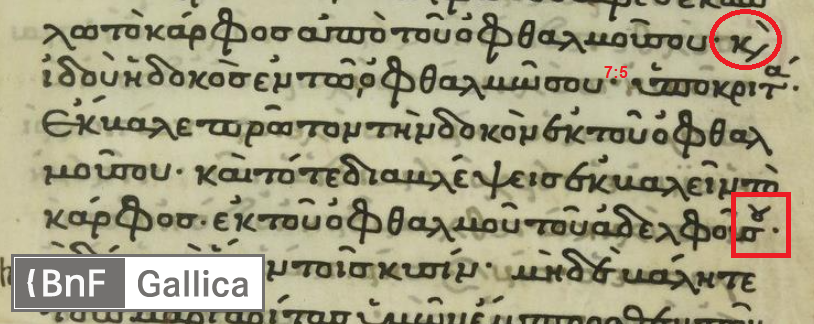
Mt 4:22-24 – Notice here the initial in the left margin in verse 23.  The initials in 260 before Mt. 7:11 are written rather sloppily in black; after this the initials are neatly written in red.  The Eusebian section-numbers are also missing until #54 (ΝΔ) at Mt. 7:12.  Also notice the nu at the end of therapeuon in v. 23 and the stacked upsilon at the end of autou in verse 24.


Mt. 6:18 – Here is another stacked upsilon.  One can also see a stacked omega at the end of kruptō in v. 19.  This is not a textual variant; it was simply the copyist's way of conserving space at the end of a line (the same word, without letter-stacking, appears one line later.


Mt 7:1-2 – Here (underlined in yellow) we see the true text, not the Textus Receptusαντιμετρηθησεται.  Also notice how the copyist used a minimum of strokes to write -ete and -et-


Mt 7:4-5 – Here we see the word kai ("and") contracted as a kai-compendium.  We also see the word sou written in stacked letters.


Mt. 10:8b-10 – Besides the lack of any mention about raising the dead, notice how mh is written with the eta forming a downward swoosh.  Also notice how eta is only implied (by a diacritical mark) in the  word τροφῆς


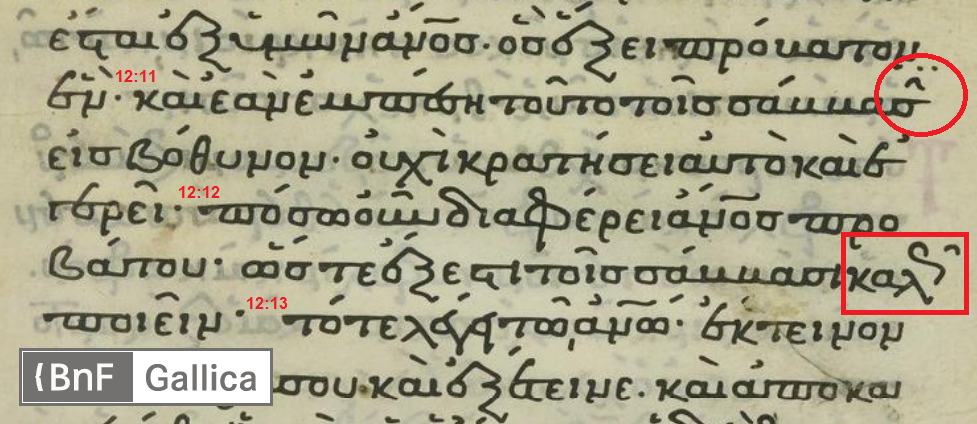
Mt 12:11-12 – Notice how the copyist has written the final syllables of sabbasin and kalos.


Mt 12:24-25 – Notice the outos followed by ouk (with stacked ou) in v. 24.


Mt 13:3 – Notice how idou is written.


Mt 13:37-38 – The copyist of 260 did not contract huios ("son") into a sacred name very often.  Also notice the stacked letters at the end of ponerou.


Mt 19:19 – Besides noticing that there is no sou after the contracted patera, notice the variant involving haplography in the last word on the page (os eauton rather than os seauton) and how its final syllable has been written.


Mt 28:19-20  Even in the triune baptismal formula, huiou is not contracted.  Also notice how the letters in v. 20 are written in a centered vortex.  And notice how the nu is written in Amen at the very end of verse 20.


Mark 2:18  Here we see one of the copyist's rare parableptic mistakes.  A secondary hand has supplied the missing words in the margin.  Also notable:  how the copyist has written dunantai in v. 19.


Lk 6:48 – Notice the stacked letters of tē and the lettering of the final syllable of petran


Lk 8:6 Kai is written in a different compendium-form here.  Also notice that the copyist has written around a small hole, which must have been in the parchment before the copyist wrote.


Lk 9:49  Notice the stacked letter at the end of epistata, and the appearance of ἡμῶν at the end of the last line.


Lk 12:42-43  Although the copyist often wrote kurios as a contracted sacred name (as seen here twice, he also wrote kurios uncontracted in a context in which the referred-to lord is not necessarily the Lord.  Also notice the stacked omega in kairo.


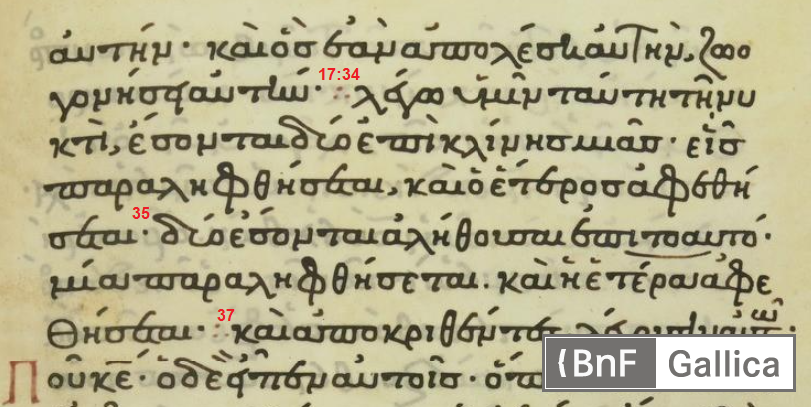
Luke 17:35-37 – GA 260, like the  Robinson-Pierpont Byzantine Textform and like manuscripts mentioned in a footnote in the 1611 KJV, does not have verse 36. 


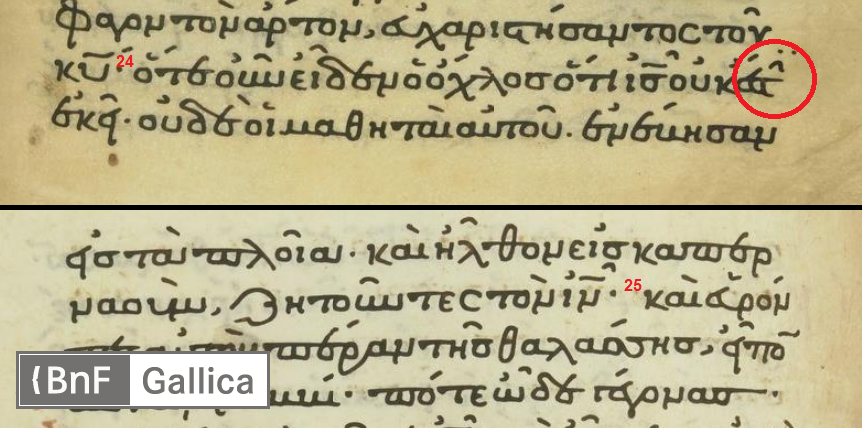
Jn 6:24 – Notice how estin is written.  Also, the word autoi, which one would expect to find between the last word of the first page  and the first word of the second page, is absent.  GA 260 is not the only manuscript in which this autoi is missing; it's also missing in Codex Sinaiticus (though a later corrector has added autoi above the line) and Codex S (028).  


Jn 19:37 – Notice how the copyist has written meta at the beginning of v. 38.  Also notice the lectionary-rubric in the lower margin, added by another hand, informing the lector that he has reached the end of the reading for the ninth hour at Eastertime.


          All in all, GA 260 is a very good Byzantine Gospels-manuscript, and its copyist's script is a good example of medieval handwriting.   There are many examples of handwriting in GA 260 worth looking at that are not covered here.  Full-color digital page-views of the entire manuscript can be downloaded from Gallica (as BNF Cat. MS Grec 51), and the entire manuscript is indexed (allowing viewers to search by chapter-and-verse) at CSNTM, which has black-and-white as well as full-color page views of GA 260.