Followers

Sunday, December 17, 2023

Christmas Gifts and Stocking Stuffers for Textual Critics (and their kids)

 It's almost Christmas 2023 - 

the only such Christmas there will ever be - 

So why not give your seminary friend

a book he/she can read and lend?

     I have three volumes available on Amazon, for the Kindle e-reader (or Kindle app) and also available in paperback: (click the link to go to Amazon for more information)

Authentic:  The Case for Mark 16:9-20 (Fourth Edition)

The Epistle of James - English Translation, Commentary, and Greek Text

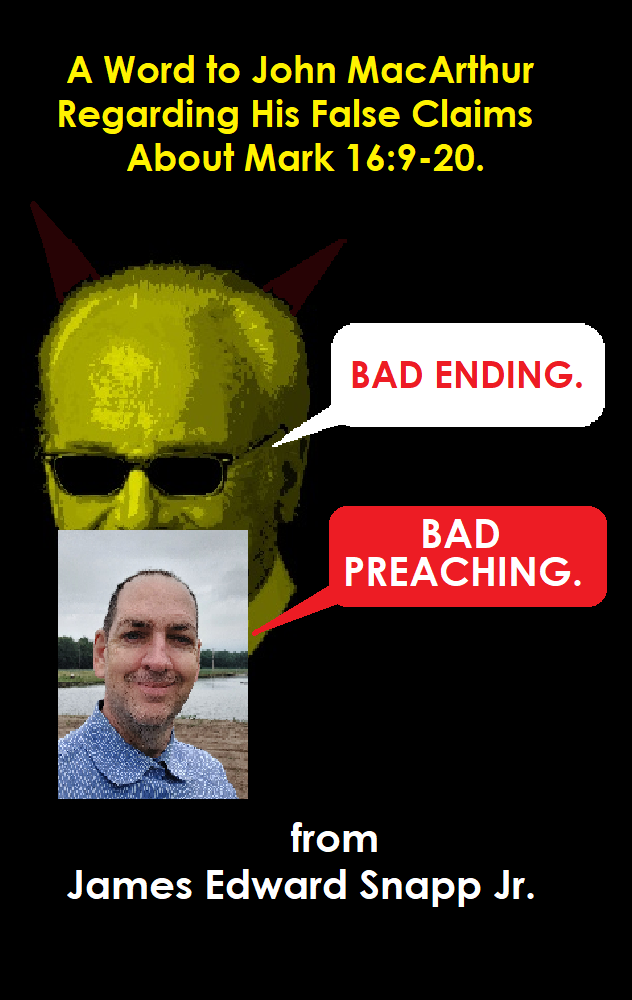
A Word to John MacArthur Regarding His False Claims About Mark 16:9-20. (Large Print)

And don't forget:  I am available to speak about the reliability of the New Testament text at any church, anywhere (okay, not in North Korea yet, but almost anywhere) that can pay for my travel expenses and room and board.  (Yes, this includes Apologia Church.)

Have a joyous Advent season and a happy new year 2024 (and please buy my books)!

Coming soon:  A Word to James R. White About His False Claims About the Text of the Gospels.

And if you want something for the youngsters, I have also published (with very little direct application to New Testament textual criticism) these two little gems:

Saint Brigid and the Fairy Gates (Youth Edition)

The Enormous Dragon (co-authored with my elder son Peregrine Kirk Snapp) - a book about an orphan, for orphans and other earthling children.


As of December 14, 2023, Authentic:  The Case for Mark 16:9-20 (Fourth Edition) is ranked 1,752 in the Christian Reference section.  


Thursday, November 9, 2023

Improvement: BAR's Updated Article on Codex Sinaiticus

          At the Biblical Archaelogy website, an article titled “What’s Missing from Codex Sinaiticus, the Oldest New Testament?” originally published by “Biblical Archaeology Society staff” on August 12, 2015, contained several false statements. 

          A heading in the article still refers to “Mark 16:1-14.”  That is false.  (In real life, Mark 16 continues to verse 20, as the verse-numbers in BAS’ article further down the page plainly show.)

           In general however the article has been greatly improved.    

          Those who want to get some idea of the differences between Codex Sinaiticus and the text of most manuscripts of the Gospels may explore the comparisons I have made in Matthew, Mark, Luke, and John.

        Thank you, BAS staff, for improving this article.

Friday, October 13, 2023

The Interpolation in Matthew 27:49: Why?

             “Two suppositions alone are compatible with the whole evidence.   First, the words ἄλλος δὲ κ. τ. λ. may belong to the genuine text of the extant form of Mt, and have been early omitted (originally by the Western text) on account of the obvioous difficulty.  Or, secondly, they may be a very early interpolation, absent in the first instance from the Western text only, and thus resembling the Non-Western interpolations in Luke xxii xxiv except in its failure to to obtain admission into the prevalent texts of the third and fourth centuries. 

            “The prima facie difficulty of the second supposition is lightened by the absence of the words from all the earlier versions, though the defectiveness of African Latin, Old Syriac, and Thebaic evidence somewhat weakens the force of this consideration.  We have thought it on the whole right to give expression to this view by including the words in double brackets, though we did not feel justified in removing them from the text, and are not prepared to reject altogether the alternative supposition.”

            (Hort, Notes on Select Readings, p. 22)

             What was F.J.A. Hort talking about?  Most Americans who are acquainted with the NIV, ESV, CSB, and NASB have no clue, because these versions have no footnote at Matthew 27:49.  The Tyndale House Greek New Testament does not have an apparatus-listing at Matthew 27:49.  (Dr. Dirk Jongkind, Tyndale House GNT editor, discussed it in February 2018 at the Evangelical Textual Criticism blog).  

            The CSB is particularly strange in this regard, because it features a textual footnote pointing out trivial textual variants nearby, but not for this one which involves a drastic change in meaning and in doctrine.

            Let us take a closer today.


From Westcott & Hort's 1881 Greek text
ἄλλος δὲ λαβὼν λόγχην ἔνυξεν αὐτοῦ τὴν πλευρὰν καὶ ἐξῆλθεν ὕδωρ καὶ αἷμα is supported by Sinaiticus, Vaticanus, C L U Γ and by about 35 minuscules MSS (specifically, 5 26 48 67 115 127 160 175 364 782 871 1010 1011 1057 1300 1392 1416 1448 1555 1566 1701 1780 2117 2126 2139 2283 2585 2586 2622 2680 2766 2787).  The first hand of minuscule 2437 (previously examined here in 2018) should be included in this list, despite having had the words erased by a corrector.

            Also supporting the inclusion of these words (in some cases with ὕδωρ and αἷμα transposed) are Palestinian Aramaic copies, the Ethiopic version, Middle Egyptian, quite a few Irish Vulgate and Old Latin copies (the list includes the Book of Mulling and the Book of Kells and the Book of Dimma).
            I will not review the details of what Hort, in 1881, and more recently, Willker has written regarding Macedonius and Chrysostom and Severus and the ancient (alleged) autograph of the Gospel of Matthew found on Cyprus in the late 400s.
            The Revision Committee in 1881 heeded Hort’s advice somewhat, and as a result the 1881 RV featured a margin-note linked to Matthew 27:49 which stated, “Many ancient authorities add And another took a spear and pierced his side, and there came out water and blood.   See John xix. 34.
                   If the men who translated and edited the 1984 NIV had done what they did 99% of the time – i.e., follow the Nestle-Aland compilation – then the NIV, too, would say “And someone else, taking a spear, pierced his side and there came out water and blood” in Matthew 27:49.  The same can be said regarding the creators of the NASB, ESV, NNIV (that’s how I refer to the 2011 NIV, which varies drastically from the 1984 NIV), and CSB.   I cannot of course judge their motives but they seem awfully fickle at this particular point.

            Perhaps their fickleness is due to reluctance to admit into the text, even in double brackets or in a footnote, a textual variant which would destroy the doctrine of inerrrancy (which I have already discussed here).  Philip Comfort acknowledgd  in Encountering the Manuscripts (2005) that the inclusion of ἄλλος δὲ λαβὼν λόγχην ἔνυξεν αὐτοῦ τὴν πλευρὰν καὶ ἐξῆλθεν ὕδωρ καὶ αἷμα would appear to create “a jarring contradiction.”

            (Notice, by the way, that there is no distigmai in Vaticanus here – because Sepulveda would not have pointed out to Erasmus such an erroneous reading in his (Sepulveda’s) prized ancient codex.)

            Operating on the premise that editors of the NIV, ESV, CSB, etc., have held (that it is an interpolation), what would motivate an early scribe to create and into the text these words?

            A desire to show that some Romans, or some Jews, were merciful to Jesus as he was dying on the cross.  Crucifixion is a painful experience.  It can last for days.  A person who ended Jesus’ torture would be understood by his contemporaries to be acting mercifully.

            There is a slight anti-Judaic tendency in the Western text of Acts.  I propose that there was a slight pro-Jewish tendency at work in the Alexandrian Greek transmission-line, which carried over into the Old Latin transmission-line that is represented in some Irish Old Latin copies of the Gospel of Matthew.  

            Before the four Gospels were collected together, our interpolator could point to his interpolation and say “Look!  Not all of the Jews on the scene were bad.  Sure, God destroyed Jerusalem forty years later, but there was a remnant there on Calvary; there was at least one noble Jew who defied the Romans and showed mercy to Jesus on the cross – not giving him a drink to prolong his suffering, but spearing him, in defiance of the Roman soldiers, in order to end his suffering.”

            Or, the interpolation might have been made by an early pro-Roman scribe, who wished to convey that the Romans who crucified Jesus were just following orders, and had no personal vendetta against Jesus (something most first-century readers of Matthew would naturally assume), and that one of them, in an act of insubordination, speared Jesus, causing his immediate death and an end to his sufferings.


Picture from the Rabbula Gospels

         The traditions about Saint Longinus may thus become more relevant – was he Roman, or Jewish?  Or both?

             The earliest traditions about Longinus consistently portray him as a Roman centurion, as far as I can tell.  On that premise, the interpolation in the Alexandrian text of Matthew 27:49 was created in order to excuse the Romans.  The Romans could argue that as legitimate agents of the Roman Empire, they should be forgiven for crucifying Jesus – and, with this interpolation, offer an extra consideration:  they didn’t even allow Jesus to suffer on the cross longer than what was required to carry out the orders of Pontius Pilate – barely enough time to crucify Jesus, and enough time to allow all the bystanders to read the inscription Pilate ordered them to post on the cross, and enough time to finish gambling.

             (As it turned out, it only took Jesus six hours to suffer and die for the sins of the whole world, but the Roman soldiers couldn’t have known that.)

             I consider it very likely that John, when he wrote the fourth Gospel in Ephesus, was aware of this interpolation and either read it, or heard about it.

             Notice the explicit words of John 19:35  - “The one who saw it [i.e., John] has testified , and his testimony is true.  He knows that he is telling the truth, so that you also may believe.”  What could be the motivation for such explicitness, except to respond to an interpolation that John detected in his own copy of the Gospel of Matthew, or a copy that someone had told him about?

              So:  after walking through the external and internal evidence carefully and slowly, I conclude that the words ἄλλος δὲ λαβὼν λόγχην ἔνυξεν αὐτοῦ τὴν πλευρὰν καὶ ἐξῆλθεν ὕδωρ καὶ αἷμα in the Alexandrian text (and whatever other texts) are an interpolation, and may confidently be treated as the interpolation they are.  That is, they are an interesting display of an early scribe’s concern, but as a representation of the autograph of the Greek text of the Gospel of Matthew, they should be entirely ignored.


Wednesday, October 4, 2023

John 5:3b-4: Original or Not?

            Metzger’s observation that 5:3b contains two “non-Johannine” words is lightweight, considering that John had few other occasions to use either ἐκδέχεσθαι or κίνησις.

            (I commend to readers both the article written by Zane Hodges in 1979 in Bibliotheca Sacra 136, pp. 25-39, and the article by Gordon Fee which appeared in Evangelical Quarterly 54 (pp. 207-218.)              

            Before reaching a conclusion about John 5:3b, let’s investigate 5:4.  Dr. Bill Mounce addressed this variant briefly, but his treatment is extremely oversimplified.  More is required.  First, we must get an idea of how much textual variation there is within this verse.  In A K L Y Δ Π, κυρίου (ΚΥ) appears after αγγελος γαρ (or, in L, αγγελος δε).  And instead of κατέβεινεν, A K Π Ψ 579 have ἐλούετο.  And A (supported by some Bohairic manuscripts) has ουν between δήποτ’ and κατείχετο.  Instead of δήποτε, K and Π have δ’ αν.  In Cc H M U Y Δ Λ Π 078 and at least 17 lectionaries, instead of ἐτάρασσεν, the text reads ἐταράσσετο.  The Ethiopic version also supports ἐταράσσετο.   Swanson erroneously lists Δ as if it reads ἐταράσσετο and ἐτάρασσεν; a check of the manuscript show that it supports ἐταράσσε το (the το being the το before ὕδωρ).  

            Plus, in S Λ Π 047, and 72 minuscules, the passage is marked with asterisks.  The Harklean Syriac also features the verse marked with asterisks.

             The external evidence mostly aligns with the external evidence for 5:3b – but not quite. D Wsupp 33, 2718, and the Armenian and Georgian versions, which include 4:3b, do not imclude 5:4.  5:4 is supported by Tatian’s Diatessaron (as demonstrated by a comment by Ephrem in his commentary ), by Ambrose, by Tertullian, by Chrysostom (who was listed in UBS1 as a witness for both inclusion and non-inclusion), and Cyril.  

            Tertullian, in De Baptismo 5, near the end of the chapter, wrote, “If it seems an unheard-of thing that an angel should interfere with water, there was a precedent for that which was to be. The pool of Bethsaida ‘was stirred’ by the intervention of ‘an angel.’  Those who complained of their health used to watch for him. For anyone who had first descended there ceased to complain after a bath. This picture of bodily cure was prophetic of spiritual cure, according to the practice by which things carnal always precede, being a picture of things spiritual. As, therefore, the grace of God spread among men, greater power was added to the waters and the angel.”

            Tertullian goes on to say, “Those who healed bodily defects now heal the spirit.  Those who worked temporal salvation now restore for us everlasting salvation.  Those who freed one once a year, [this indicates how Tertullian understood κατά καιρόν] now daily save communities, death being destroyed by the washing away of sins.”  Tertullian clearly had no problem reading this verse and applying it to the life of the church.

            Chrysostom commented on 5:3b-4 in detail in his commentary on John, perceiving in the paralytic’s healing a thematic template of baptism and salvation. 

            Tertullian, in Latin, and Chrysostom, in Greek, demonstrate the antiquity of the passage in the text, as early as two papyri from c. 200 and c. 400 would.  Chrysostom also shows that John 5:4 was read in the text of the church in Byzantium during his bishopric.  Amphilochius of Iconium (340-403; bishop after 374) – cousin of Gregory of Nazianzus – does not include 5:4 in the text he used.  Both the non-inclusion and inclusion of 5:4 are very early readings.

            What phenomenon, occurring sometime between 90 (when the Gospel of John was written – unless John Robinson’s redating to pre-70 – in light of (among other things) 5:2 – is adopted) and 200, could elicit one transmission-stream to include John 5:4 (in the case of Tertullian’s text of John), and another transmission-stream to not include John 5:4 (in the case of P75, À, and B)? 

            I am willing to posit that an anomaly in the autograph of the Gospel of John itself elicited different treatments of John 5:3b-4.  Picture John reading chapter 5 to his listeners from the autograph for the very first time – without 5:3b-4.  Inevitably, someone would ask, “John, why were these sick, blind, lame, and paralyzed people waiting near the pool instead of swimming in its water?”  And I can imagine that John added an explanatory note in the margin, “waiting for the moving of the waters.”

            And then someone asked, “What agitated the pool’s water?”.  And John, realizing that his listeners in Ephesus were oblivious to the background of the pool at Bethesda, added another note – and thus verse 4 came into existence as a second marginal note.  When John died, the autograph was entrusted to the Christian community at Ephesus – and they treated the annotations in three different ways in the next generation:

            In the ancestor of Byzantine manuscripts, the notes were either blended into the main text (as John 21 has been), or else copies just the way they appeared in the autograph, in the margin with symbols to connect them to John 5:3-5.  In the ancestor of Alexandrian manuscripts, receiving the text of the autograph slightly later (being in Egypt, not Ephesus), the notes were assumed to have originated with someone other than John, and were therefore not considered worthy to be included in either the main text or in the margin. 

            Another consideration might have been in play in the mind of the early Alexandrian scribe who decided not to include verse 4:  a desire to protect John from the charge of promoting superstition.  A scribe who thought he knew that water in the pool of Bethesda was agitated by entirely natural forces could easily persuade himself that the marginal note in his exemplar, stating that an angel of the Lord bathed in the pool of Bethesda, could not have been written by an inspired author; in addition, he did not wish to appear to commend Asklepieions.

            The testimony of P and its relatives which have John 5:4 with asterisks commends family P as an excellent representative of the autograph of the text of the Gospels.  The form of verse 4 that appears in Codex P is the form which should be adopted, instead of the readings found in the majority of manuscripts.

            An addition question is sure to be asked:  what should English Bible editors do with John 5:3-4?  I have no objection to the inclusion of 5:3-4 in the main text, or in the margin, with a note stating that the passage appears in the margin, or not at all, in a few early manuscripts.  But to omit it entirely would guarantee that English readers would perpetually ask, as John’s first listeners did, “Why weren’t they all swimming?” or, “Who or what stirred up the waters?”

            Another question may be on the minds of some readers:  Would an inspired author expand on his own narrative in this way, adding marginalia?  I see no reason why not.  Many a Spirit-led preacher reading from a manuscript he wrote has spontaneously clarified himself mid-sermon.  Even Saint Paul, in First Corinthians 1:16, clarified that he had baptized the household of Stephanas (who, according to tradition, was the jailor in Acts 16), right after saying, “I baptized none of you except Crispus and Gaius.”  I Cor. 1:16 may have originally been a note in the margin added by Paul as he proof-read the letter; no one at Corinth, however, would have doubted its veracity.


Wednesday, August 9, 2023

Looking into the Alexandrian Text at John 12:12

            War – what is it good for?  “Absolutely nothing,” many have answered.

            And when the question is asked, “What is the Alexandrian text good for?”, quite a few people have responded with the same answer.  Independent Fundamentalist Baptists tend to insistently subscribe to the Textus Receptus, and some KJV-Onlyists even make it a formal condition of church fellowship to use the KJV or versions in languages other than English that conform to the meaning of the KJV New Testament.

            Simultaneously you might think, listening to other folks, that the Alexandrian text is the greatest invention since sliced bread.  The text of the New Testament portion of the ESV, NIV, CSB, and NRSV are all based primarily on the Alexandrian Text – the “critical text” that is published in the Nestle-Aland Novum Testamentum Graece and the UBS Greek New Testament.  (And why is this compilation referred to as the critical text?  Weren’t all compilations critical, i.e., thoughtfully compiled?  Are we supposed to be given the impression that other compilations are not critical, and merely reproduce the text found in a particular manuscript??) 

            I reckon that 99% of American preachers who promote English versions based on the NA/UBS compilation(s) still get their justification for using it, at any given point of variation, from Bruce Metzger’s Textual Commentary of the Greek New Testament – apparently never realizing that Metzger’s Textual Commentary was made with the intention of promoting the UBS compilation.  (So if you’re looking for an objective textual commentary, Metzger-readers, or for one written by an author who wasn’t writing under the influence of the Lucianic recension delusion, you’re digging in the wrong place.)

            Meanwhile, advocates of the Byzantine Text tend to reject the Alexandrian text as a matter of course; if they didn’t, they wouldn’t be majority-text advocates. 

            I would argue, though, that the Alexandrian text excels in at least one area:  the preservation of the original grammar.  For example:  there’s a little variation-unit in John 12:12 that doesn’t get attention often, because its effect on translation is so slight:  between τη επαύριον and ἐλθὼν, did John write ὄχλος πολὺς ὁ or ὁ ὄχλος πολὺς or simply ὄχλος πολὺς?  The Byzantine text has ὄχλος πολὺς ὁ, and its allies include Codex Alexandrinus, D K W X Π Ψ f1 579 700 1424 (etc.) plus the Peshitta, the Sahidic version, and the Gothic version.  Even Origen is cited in the UBS GNT as support for ὄχλος πολὺς ὁ – apparently the only patristic reference the editors considered worth mentioning.  Papyrus 2vid, assigned to the 500s, also supports ὄχλος πολὺς ὁ.

            Codex Sinaiticus initially read ὄχλος πολὺς but a corrector has conformed its text to the  Byzantine/Western/Caesarean reading.  D 565 892 and 1195 agree with À’s initial reading.  But that’s not the true Alexandrian reading.   The Alexandrian reading here is what Vaticanus has:  ὁ ὄχλος πολὺς ὁ.  And Codex B is allied with P75 P66vid B L 1241, the Sinaitic Syriac, and the Bohairic version.  (The UBS apparatus listed f13 as if it supports ὁ ὄχλος πολὺς ὁ; Swanson lists f13 as support for ὄχλος πολὺς ὁ).

            Bruce Metzger, a few verses earlier, treated support from multiple transmission-streams as a strong indicator of a reading’s genuineness (“the overwhelming manuscript support for the verse seemed to a majority of the Committee to justify retaining it in the text,” wrote Metzger).  That’s a general principle with which I enthusiastically agree.  But in this case, despite the shallowness of the external evidence in favor of the minority reading, there’s a valid reason for favoring it:  the internal evidence.  It’s the reading more likely to have been written by John, and it’s the reading more likely to have been altered by scribes.    

            Metzger’s colleagues seem to have had some misgivings about the Alexandrian reading here, giving their decision a “C” rating.  Metzger wrote, “The expression ὁ ὄχλος πολὺς serving as the subject of a verb [in verse 9] is such unusual Greek (with πολὺς in the predicate position) that serious doubts arise whether the evangelist could have written it thus.”  The counter-argument should be obvious:  are later scribes likely to have changed the text from ὄχλος πολὺς ὁ to ὁ ὄχλος πολὺς ὁ?

            Granting that some Alexandrian scribes were not particularly attentive in the vicinity of this variant-unit (P75’s scribe skipped the second part of verse 8), I am content to accept the Alexandrian reading, not on the grounds that its external support is stronger, but on the grounds than internal considerations are in its favor.  There are many other examples that could be selected to show the Alexandrian tendency to preserve original grammatical quirks – not errors; just grammatical quirks, like when a baseball umpire correctly says, “That ain’t a strike” – but this one may suffice for today.


Tuesday, July 25, 2023

Mark 13:14 - Who Said What?

          "But when ye see the abomination of desolation standing where he ought not (let him that readeth understand), then let them that are in Judaea flee unto the mountains."  Thus read the words of Jesus in Mark 13:14 in the Revised Version (1881). But in the KJV, NKJV, EOB-NT, MEV, and WEB, the verse is a bit longer:  before the word "then" is the phrase, "spoken of by Daniel the prophet," based on the words τὸ ῥηθὲν ὑπὸ Δανιὴλ τοῦ προφήτου, which appears in the Textus Receptus and in the vast majority of Greek manuscripts (including A K M U Y Γ Δ Θ Π 157), as well as in the Peshitta, the Harklean Syriac, and six Old Latin copies (aur, c, e, k, l, q).   

          The basis for "spoken of by Daniel the prophet" is not supported by À (Sinaiticus) B D L W Ψ and  565 700 892.  Nor are the words found in the Old Latin copies d, ff2, i, n, and r1,  or the Vulgate (though the phrase is included in some copies of the Vulgate), or in the Sahidic version, the Armenian version, and the Old Georgian version (according to Wieland Willker, who covered this variant-unit in his Textual Commentary on the Gospels).

Codex Macedonianus (Y/034), shown here,
includes the words in Mark 13:14 that are
not included in the Alexandrian Text
    Neither the UBS Greek New Testament (4th edition) nor the Nestle-Aland Novum Testamentum Graece (27th edition) mention this six-word variant.  That's right:  a six-word Byzantine variant goes entirely uncovered in the GNT and NTG, as if it never existed.

          What has happened here in Mark 13:14?  The editors of the Greek New Testament apparently felt that the Byzantine reading is a harmonization to Matthew 24:15.  The phrase in Matthew is similar; Matthew 24:15 has διὰ instead of ὑπὸ.  Some members of f1 read διὰ, and so do 28 579 and 1424.  It seems to me the theory that a harmonizer added τὸ ῥηθὲν ὑπὸ Δανιὴλ τοῦ προφήτου is not very tenable, partly because a harmonizer would be unlikely to be so picky as to change διὰ into ὑπὸ.

          But how can the omission of τὸ ῥηθὲν ὑπὸ Δανιὴλ τοῦ προφήτου be explained, especially considering that it missing not only in the Alexandrian?  Therein lies a tale:

          In the 200s, the authorship of certain portion of Daniel and Susanna in the Septuagint (LXX) were debated; Origen and his colleague Julius Africanus exchanged letters about Susanna.  In addition, the third-century pagan author Porphyry argued (as many interpreters still argue today) that the entire book of Daniel was composed in intertestamental times, during the reign of the Syrian ruler Antiochus Epiphanes.  No Christians seem to have objected to Christ's reference to Daniel in Matthew 24:15 as the source of Daniel 9:27.  But in the first centuries of Christianity, when copies of the Gospels were being circulated individually, a thoughtful copyist of the Gospel of Mark, seeing a reference to the book of Daniel coming from the mouth of Jesus, may have thought that source of the words τὸ ῥηθὲν ὑπὸ Δανιὴλ τοῦ προφήτου was a marginal note that an earlier copyist, or an individual who supervised copyists, had inserted into the text ‒ and, satisfied with the thought that the phrase was not original, declined to include it in subsequent copies.  

          That this happened, and happened early enough to influence some Old Latin copies, the text of the Sinaitic Syriac, and the text of Sinaiticus and Vaticanus, is more probable than the idea that someone creating the Byzantine text, selecting readings from the Alexandrian and Western copies, threw τὸ ῥηθὲν ὑπὸ Δανιὴλ τοῦ προφήτου into Mark 13:14, especially considering that the words are not in Mark 13:14 in the earliest representatives of the Alexandrian or Western Greek text.

          This implies that the Alexandrian Text of the Gospel of Mark was not mechanically copied by scribes.  It implies that the Alexandrian Text of the Gospel of Mark was (slightly) edited by an editor who  removed features that appeared to him to run the risk of inviting objections from outsiders.  Lest this might seem to be a conspiracy theory, I leave you with the words of Bruce Metzger (from The Text of the New Testament, 4th edition, p. 312) that the Alexandrian Text is considered "on the whole the best ancient recension."


Sunday, June 25, 2023

Matthew 26:28: My Blood of the New Covenant

            In Matthew 26:28, did Jesus say, "This is my blood of the new covenant"?  Or did he say, "This is my blood of the covenant'?  The contest, in Greek, is between τὸ τῆς καινῆς and τῆς.  The external evidence - as presented in the apparatus of Wayne Mitchell's The Greek New Testament, 4th edition - shows that representatives of multiple text-types support τὸ τῆς καινῆς or τῆς καινῆς:  the Byzantine text finds allies in A, C, D (without the τὸ), E, F, G. H. K, M, S, U, W, Γ, Δ, Π Ω 074vid f1  f13 28 205 565 579 597 700 892 1006 1071 1241 1243 1342 1505 1582 Lect  the Old Latin and Vulgate, the Peshitta, Palestinian Aramaic, Sahidic and Bohairic versions (except for one Bohairic copy, and Schenke's Middle Egyptian), Armenian, Ethiopic, and part of the Old Georgian version. The Byzantine reading also has support from Irenaeus (in Latin), Origen (in Latin), Theophilus of Alexandria, Theodoret, Jerome, and Augustine.

           P45 (damaged, but with space-considerations taken into account) and P37 agree with Vaticanus and Sinaiticus (and 019 035 038 33) on the shorter reading.  Irenaeus (as preserved in Armenian) agrees with the shorter reading, and so do Cyprian and Cyril.
           Both readings are clearly ancient.
           Looking at the parallel in Mark 14:24, the longer reading is paralleled word for word in the Byzantine Text.  Meanwhile, the passage without "new" is supported by Vaticanus, Sinaiticus, and L D P W Z Θ Ψ and Old Latin Codex Bobbiensis.  

          Metzger proposed that the longer reading in Mt. 26:28 originated via a harmonization to Luke 22:20.  I propose, however, that something else has affected the text of Matthew 26:28. And it wasn't Marcionism.  It could be imagined that Marcion or a Marcionite created the shorter reading because to Marcion, Jesus Christ did not introduce a new covenant; to Marcion, the one true God had nothing to do with the covenant of the Law. 
           Metzger asserted that if καινῆς had been present in the original text of Matthew 26:28, "there is no good reason why anyone would have deleted it."  Some might insist that a Marcionite's theology would be, to him, a reason to delete it.  But can a Marcionite's influence upon the Alexandrian text of Matthew have been so strong?  Marcion himself only accepted his own edited text of the Gospel of Luke.  So the idea that Marcionism was a factor seems unlikely. 
           But the flimsiness of an arrow thrown at the shorter reading does not really prove the strength of the shorter reading.  If the shorter reading is regarded as original, then the text of Matthew 26:28 must have been harmonized to Luke 22:20 in multiple transmission-streams (affecting the Byzantine Text, the Old Latin and Vulgate, the Sahidic, the Sinaitic Syriac, Armenian, Ethiopic, and Slavic versions).  Neither Lachman nor Tregelles seems to have thought that was a plausible option.

            A less sinister mechanism than Marcionism seems to have been at work in the Alexandrian text of Matthew 26:28:  simple parablepsis.  A scribe beginning with τῆς καινῆς before διαθήκης could skip καινῆς by accidentally jumping from the -ῆς in τῆς to the -ῆς at the end of καινῆς.  Perhaps slightly facilitating the omission of καινῆς was the influence of scribes' recollection of Exodus 24:8 as written in the Septuagint, where Moses "took the blood, sprinkled it on the people, and said, 'This is the blood of the covenant which the LORD has made with you according to all these words.'"  There is no καινῆς in Exodus 24:8, the passage that Christ's words in Matthew 26 reflect.  Contrary to Metzger's assertion that "there is no good reason" for a deletion in Matthew 26:28, it is easy to see that a mechanism of deliberate harmonization (to Exodus 24:8) and a mechanism of accidental omission could both contribute to the creation of the shorter reading.  (Whenever an accidental omission occurs,  aren't observations about the lack of motive superfluous?)

          A wild card should not be overlooked:  the word τὸ before τῆς καινῆς in the Byzantine Text.  Non-Greek scribes might not have bothered with this; Greek scribes may have naturally added τὸ, regarding the resultant reading to be a slight stylistic improvement not affecting the meaning of the text.  (Conversely, Alexandrian scribes might have considered it unnecessary.)  This detail need not be resolved to maintain the conclusion that καινῆς was part of the original text of Matthew 26:28.