Followers

Showing posts with label Peshitta. Show all posts

Friday, June 13, 2025

John 7:46 - Neither Shortest Nor Longest

In his obsolete Textual Commentary of the Greek New Testament, regarding the end of John 7:46 Bruce Metzger briefly stated, "The crisp brevity of the reading supported by p66c, 75 B L T W coptbo al was expanded for the sake of greater explicitness in various ways, none of which, if original, would account for the rise of the others."  

Let's test that.

Following νθρωπος, we see the following variety: 

ὡς οὗτος ὁ νθρωπος - Byz K M N U Γ Δ Θ Λ Π Ψ  f1 f13 2 28 33 69 124 157 565 579 1071 1424 1505

ὡς οὗτος λαλει ὁ ἄνθρωπος  - P66* 01* (There is an itacism in 01 and P66*, and 01 has a singular reading at the beginning of the verse, pictured.)

ὡς οὗτος λαλει (after ἄνθρωπος ἐλάλησεν) - 05

That's not a lot of variety.   03 P66c 019 T and 032 appear to be the only manuscripts which support the reading adopted in UBS4.

Meanwhile, support for a longer reading comes not only from all other Greek manuscripts (with GA 13 dissenting due to a scribal error, initially failing to include ἐλάλησεν earlier in the verse, and with a transposition - ἐλάλησεν οὗτως - in N Ψ 33 1071 1241) but also from the Sahidic, Armenian, Ethiopic, Georgian, and Syriac (Sinaitic, Curetonian, Peshitta, and Harklean) versions, as well as the Palestinian Aramaic and the Vulgate.  A very impressive array.

While some commentators point out that the Byzantine text displays a tendency to clarify via embellishment, one should also be aware of the opposite tendency in the Alexandrian text to economize via abbreviation - i.e., to attempt to express the same idea using fewer words.  

If one were to treat the reading supported by the vast majority of manuscripts and versions as original here, the reading of 03 and allies is readily explained as either the result of a parableptic leap from the first ἄνθρωπος to the second ἄνθρωπος., or as an intentional attempt to eliminate superfluity.  

An early scribe could conceivably consider the Alexandrian reading in need of embellishment, and add "like this" or "like this man."  On the other hand, the addition of "like this" and "like this man" adds nothing that anyone could not figure out in a moment.  If John wrote ὡς οὗτος ὁ νθρωπος, his reason for doing so would be obvious:  that is what he overheard the soldiers say.  In addition, the reading in P66* and 01 is accounted for as a conflation of the Byzantine reading and the reading in 05.

Instead of defending the Alexandrian reading by assigning to scribes a desire to make a frivolous embellishment, it is better in this case to regard the reading of 03 and allies as an accidental or intentional truncation of what John wrote.

One medieval scribe - the copyist of 2483(2866) - illustrated that a scribe in the Middle Ages could commit dittography while copying John 7:46-47.  And where dittography is possible, parablepsis tends to be possible too.

For those who may be interesting in how English versions treat this variant:  KJV NKJV MEV RSV Message NASB95 NET NIV EHV EOB all support the longer reading, demolishing any  assumption that those who reject Metzger’s premise here must harbor a pro-Byzantine prejudice.    

(Thanks to Ben Crawford for sharing this photo of GA 2483 from the Benjamin Crawford Collection, Alabama.)


0    

Thursday, November 28, 2024

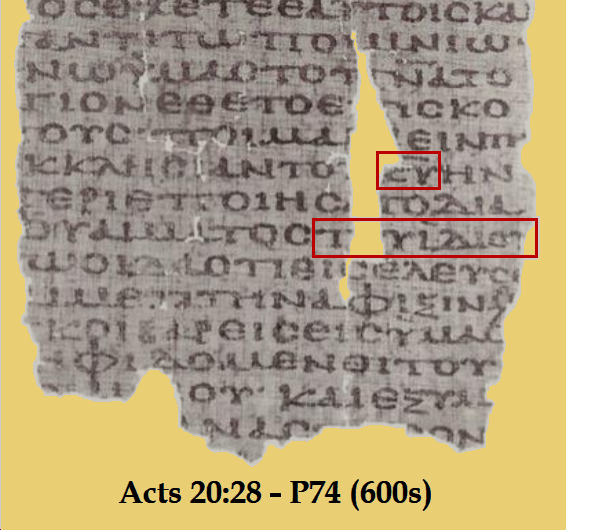
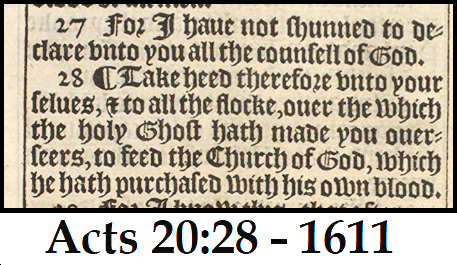
Acts 20:28 – Smuggling in an Emendation?

          Two textual issues in Acts 20:28 have impacted translations of the verse:  First:   did Luke refer to the church as the “church of God,” the “church of the Lord,” or the “church of the Lord and God”?  Second, at the end of the verse, did Luke write that the church was obtained through his blood, or through the blood of his Son?

          Let’s review the external evidence:
          Greek Support for ἐκκλησίαν τοῦ θεοῦ includes ﬡ B 056 614 1175 1611 104 2147 1505 Byz, Lectionary 60, l592, l598, l603, l1021, and l1439.  Versional support is provided by the Vulgate, the Peshitta, the Harklean Syriac, the Georgian version, and itar, c, dem, ph, ro, w and a Bohairic copy.  Patristic support for ἐκκλησίαν τοῦ θεοῦ is supplied by Athanasius, Basil, Epiphanius, Chrysostom, Cyril, and Ambrose.    

          Greek support for ἐκκλησίαν τοῦ κυρίου includes P74 A C* D E Ψ 33 181 307 453 547 610 945 945 1678 1739 1891 2344 2464 and l599.  Versional support for ἐκκλησίαν τοῦ κυρίου is supplied by itd, e, gig, p the margin of the Harklean Syriac, Sahidic, Bohairic, and Armenian versions.  Patristic support for ἐκκλησίαν τοῦ κυρίου comes from Irenaeus (in Latin), Didymus (in Latin), Theodoret, Ambrosiaster, Jerome, and Pelagius.      

          Greek support for ἐκκλησίαν τοῦ κυρίου καί θεοῦ includes H L P C3 049 1 69 88 226 323 330 440 618 927 1241 1245 1270 1828 1854 2492 and most lectionaries.  Versional support is limited to a Slavic lectionary copy.

          (In addition, Swanson recorded GA 1837’s ἐκκλησίαν τοῦ κυ ιυ καί θῦ.)

          The KJV, reflecting the Textus Receptus, reads “Take heed therefore unto yourselves, and to all the flock, over the which the Holy Ghost hath made you overseers, to feed the church of God, which he hath purchased with his own blood.” [emphasis added here, and in the following quotations]

           Similarly, the Christian Standard Bible reads “shepherd the church of God, which he purchased with his own blood.”  The Evangelical Heritage Version reads “shepherd the church of God, which he purchased with his own blood.”  The ESV reads “care for the church of God, which he obtained with his own blood.”  The NIV reads “shepherds of the church of God, which he bought with his own blood.” 

          The World English Bible, following the Byzantine Text, reads, “Take heed, therefore, to yourselves, and to all the flock, in which the Holy Spirit has made you overseers, to shepherd the assembly of the Lord and God which he purchased with his own blood.”

          Modern versions render Acts 20:28 in quite diverse ways:  usually the base-text τοῦ θεοῦ is followed, not only in the English Standard Version, NIV, EHV and CSB but also in the NET, RSV, NRSV, CEB, and CEV.

          The New World Translation (a translation produced for the cult known as “Jehovah’s Witnesses,” also known as the Watchtower Society) reads “Pay attention to yourselves and to all the flock, among which the holy spirit has appointed you overseers, to shepherd the congregation of God, which he purchased with the blood of his own Son.”           Inasmuch as no manuscript of Acts reads “of his own Son,” it appears that the modern Arian cult has added to the words of God.  But the Jehovah’s Witnesses Bible butchers are not alone in this respect.  The NET also renders Acts 20:28 with an appeal “to shepherd the church of God that he obtained with the blood of his own Son.”

          Likewise  the NRSV (including the compromised Updated Edition) have Paul tell the Ephesian elders to “shepherd the church of God that he obtained with the blood of his own Son” – echoing the RSV, which reads, “care for the church of God which he obtained with the blood of his own Son.”  The relatively recent Common English Bible reads “shepherd God’s church, which he obtained with the death of his own Son.”  The CEV (Contemporary English Version) reads, “Be like shepherds to God’s church. It is the flock he bought with the blood of his own Son.”  

          The Lexham English Bible likewise reads, “shepherd the church of God which he obtained through the blood of his own Son.  The Complete Jewish Bible reads “shepherd God’s Messianic community, which he won for himself at the cost of his own Son’s blood.”  The Good News Translation reads “shepherds of the church of God, which he made his own through the blood of his Son.”  The New Century Version says “You must be like shepherds to the church of God, which he bought with the death of his own son.”  The Mounce Reverse Interlinear New Testament reads, “shepherd the church of God, which he purchased with the blood of his own Son.”  The Voice says “Shepherd the church of God, this precious church which He made His own through the blood of His own Son.” 

          English versions which end Acts 20:28 with a clear reference to the blood of God’s Son – even though the Greek equivalent of the word “son” is not in the base-text – include the NWT, NET, RSV, NRSV, CEV, Lexham, GNT, Mounce, The Voice, and CEB.

          In 1881 Hort wrote over three columns of his Notes on Select Readings about Acts 20:28 and concluded that “It is by no means impossible that ΥΙΟΥ dropped out after ΤΟΥΙΔΙΟΥ at some very early transcription affecting all existing documents.  Its insertion leaves the whole passage free from difficulty of any kind.”  Metzger mentioned that Hort’s proposal is not necessary – but no less than nine modern English versions appear to be conformed to Hort’s proposed emendation!

Metzger dismissed the majority reading as “obviously conflate.”  The  Byzantine reading τοῦ κυρίου καί θεοῦ may account for both of the longer readings, however, if early scribes committed parablepsis, skipping from the –ou of κυρίου to the –ου of θεοῦ (producing ἐκκλησίαν τοῦ κυρίου), and some subsequently substituting θεοῦ in place of κυρίου, resisting the idea of God having blood.   

          The Tyndale House Greek New Testament reads “ἐκκλησίαν τοῦ κυρίου” and concludes with “αἵματος τοῦ ἰδίου.”  Holmes’ SBL-GNT reads “ἐκκλησίαν τοῦ θεοῦ” and concludes the verse with “αἵματος τοῦ ἰδίου.” 


          It may be worthwhile to consider the thoughts of some who have approached the textual issue from a pastoral perspective – for example Bob Luginbill, Sam Shamoun, and the La Vista Church of Christ (near Omaha Nebraska).

          Considering that the longer reading’s earliest appearance is relatively late, and that ἐκκλησίαν τοῦ θεοῦ is supported by the Peshitta, the Vulgate, Chrysostom and Athanasius, ἐκκλησίαν τοῦ θεοῦ should be adopted, being early, geographically widely supported, and attested in multiple transmission-lines.  GA 1739’s text may be adopted for the entire verse.   

          English readers should be aware that at least eight modern versions essentially echo a conjectural emendation in this verse.


Saturday, January 15, 2022

John 1:51 - "Hereafter, You Shall See"

             In John 1:51, there’s a small variant that doesn’t get much attention.  The NASB, NIV, NLT, CSB, NRSV, EHV, and NET don’t include it in their base-text, nor do they mention it in a footnote (though it is in the Textus Receptus and the Byzantine Text, and thus it is also reflected in the text of the KJV, NKJV, WEB, MEV, and EOB-NT).  The little phrase ἀπ ἄρτι (usually rendered in English as henceforth or hereafter) is not in the early Alexandrian Text; it is not in P66, P75, B, À, L, or W (which has secondary pages in this part of John) and a few later manuscripts (Willker lists 0141, 397, 579, 821, 1819, and 2129). 

          We cannot discern what the reading was in John 1:51 in D or the Sinaitic Syriac or the Curetonian Syriac; they are not extant at this point in the text. 

          UBS4 offers no data at all about this variant, but Willker lists A, X, Δ, Θ, Ψ, f1, f13, 33, 565, 1071, 1241 and the Majority (i.e., Byzantine) Text as support for including ἀπ ἄρτι, in addition to the Old Latin copies e (VL 2, Palatinus – 400s), q (VL 13, Monacensis – 500s or 600s), and r1 (VL 14, Usserianus primus – c. 600 [BL 40107]), and the Peshitta.   Swanson adds K M L P U Y 2 69 700 1424 in support of ἀπ ἄρτι.  Versions (except the most literal and wooden) generally should not be leaned upon where redundant or superfluous words and phrases are involved, and “In the future you shall see” is somewhat redundant (for what other time could there be?).

          The words ἀπ ἄρτι are Johannine; they occur again in John 13:19 and 14:7 (and in Matthew at 23:39, 26:29, 26:64, but not in Mark or Luke). 

John 1:51 in Codex Macedonianus.

          Metzger asserts in the UBS Textual Commentary that “the gloss was apparently derived from Mt 26.64.”  However, in John 1:51, Jesus addresses Nathanael and promises that Nathanael (and at least one other person on the scene) will see Jesus as the embodiment of what was signified in Jacob’s vision (in Genesis 28), whereas in Matthew 26:64, Jesus addresses the high priest, and says that he would see the Son of Man “sitting at the right hand of God, and coming in the clouds of heaven” – which is hardly a parallel to what is said in John 1:51.

           Let’s compare the possibilities:  that (a) very early in the transmission of the Gospel of John in Egypt, a scribe excised ἀπ ἄρτι, regarding it as redundant, or (b) somewhere in the transmission-line shared by A, X, Δ, Θ, Ψ, f1, f13, 33, 565, 1071, 1241, the Peshitta, and three relatively early Old Latin copies (VL 2, 13, and 14), a scribe thought that John 1:51 just doesn’t say enough without ἀπ ἄρτι, and inserted it.  It seems to me that researchers have been over-impressed by the early date of P75, B, P66, and À.  A scribe influencing the same transmission-line that saw the excision of ἐν in John 1:4 (in P66), the excision of ὁ in John 1:15 (the initial reading of P66), the excision of ὁ in John 1:35 (in B and P75), the excision of ἐγὼ in John 1:27 (the initial reading in P66), and the excision of ὁ in John 1:47 (in B) would be capable of excising ἀπ ἄρτι in John 1:51.  Meanwhile, adequate consideration has not been given of the age required by an ancestor shared by A, P, D, f1, VL 2, 33, 700, the Peshitta, and the Harklean Syriac.  Ἀπ ἄρτι should be retained in John 1:51.


Thursday, July 1, 2021

Scrivener: Principles of Comparative Criticism: Part 4

[continued from Part 3]

     How is this divergency of the Peshito version from the text of Codex B explained by Tregelles?  He feels of course the pressure of the argument against him, and meets it, if not successfully, with even more than his wonted boldness. The translation degenerates in his hands into “the version commonly printed as the Peshito” (p. 170).  Now let us mark the precise nature of the demand here made on our faith by Dr. Tregelles.  He would persuade us that the whole Eastern Church, distracted as it has been and split into hostile sections for the space of 1400 years, Orthodox and Jacobite, Nestorian and Maronite alike, those that could agree about nothing else, have laid aside their bitter jealousies in order to substitute in their monastic libraries and liturgical services another and a spurious version in the room of the Peshito, that sole surviving monument of the first ages of the Gospel in Syria!  Nay more, that this wretched forgery has deceived Orientalists profound as Michaelis and Lowth, has passed without suspicion through the ordeal of searching criticism, to which every branch of sacred literature has been subjected during the last half-century!  We will require solid reasons indeed before we surrender ourselves to an hypothesis as novel as it appears violently improbable.

And what is the foundation on which our opponent rests his startling conjecture?  The reader is aware that besides the Peshito, several other Syriac versions, some grounded upon it, and therefore implying its previous existence and popularity (e.g. the Philoxenian, executed A.D. 508, and Cardinal Wiseman’s Karkaphensian), others seemingly independent of it (e.g. Adler’s Jerusalem Syriac, and a palimpsest fragment lately discovered by Tischendorf) have been more or less applied to the criticism of the New Testament.  About the year 1847 Canon Cureton, in his most fruitful researches among the MSS purchased for the British Museum from the Nitrian monasteries, met with extensive fragments of the Gospels, which Tregelles has collated, and found to contain “altogether ancient readings,” and thus to be “an important witness to the ancient text” (p. 161).  As this MS, assigned to the fifth century, is still unpublished, we can only say at present that it affords us “AN HITHERTO UNKNOWN VERSION;” certainly not “the version commonly printed as the Peshito” with mere various readings.1  [1 – As this sheet is going to press (July 1858) Dr. Cureton’s “ Remains of a Very Antient Recension of the Four Gospels in Syriac, Hitherto Unknown in Europe,” has at length appeared. The Syriac text had been printed in 1848, but was doubtless withheld by the learned editor in the hope of finding leisure to write Prolegomena more full, and possibly containing more definite conclusions, than those with which he has favored us.  It would ill become me to express a hasty judgment respecting theories on which so eminent a scholar has bestowed thought and time and much labor. He will naturally expect Biblical critics to hesitate before they implicitly admit, for instance, the persuasion which he hardly likes to embody in words, that we have in these precious Syriac fragments, at least to a great extent (Preface, p. xciii), the very Hebrew original of St. Matthew’s Gospel, so long supposed to have been lost, that even its existence has been questioned.  But topics like this are sure to be warmly debated by abler pens than mine; I will confine myself to those points that concern my argument, the relation these fragments bear to the Peshito.  And here I would say in all humble deference (for my knowledge of Syriac, though of long standing, is not extensive) that my own hurried comparison of the Curetonian and Peshito texts would have led me to take them so far for quite separate versions.  Even Dr. Tregelles, who, through the editor’s kindness, has been enabled to use the text for years, and whose bias is very strong, can only venture to say “the differences are great; and yet it happens not infrequently that such coincidences of words and renderings are found (and that too, at times, through a great part of a passage) as to show that they can hardly be wholly independent” (Tregelles, Horne’s Introd. p. 268).  To the same effect also Dr. Cureton speaks:  “It seems to be scarcely possible that the Syriac text published by Widmanstad, which, throughout these pages, I have called the Peshito, could be altogether a different version from this.  It would take up too much space to institute here a comparison of passages to establish this fact, which, indeed, any one may easily do for himself” (Preface, p. lxx).  I heartily wish that Dr. Cureton had fully investigated the subject; he might have removed the difficulties at least of those who love truth, and are ready to embrace it wherever they shall find it.  As it is, we can but say with Tregelles, “Such a point as this can only be properly investigated after the publication of this version shall have given sufficient time to scholars to pursue a thorough investigation” (Tregelles, ubi supra).  In the meanwhile neither he nor I are at liberty to assume the truth of that hypothesis which may happen to harmonize best with our preconceived opinions.]

     To this version has been given the appellation of the Curetonian Syriac, and long may it bear that honored name: but for regarding it as the true Peshito, in the room of that commonly so known, I perceive at present no cause whatever except the strong exigency of Dr. Tregelles’ case.

     Yet has not the Peshito Syriac been suspected by previous writers of exhibiting a corrupt or modernized text?  Undoubtedly the reconciliation of the Maronites with the see of Rome, and the channels through which its earlier editions were conveyed to us, induced certain critics to hazard a conjecture that this version, like the Armenian, had been tampered with, in order to bring it into closer conformity with the Latin Vulgate.  This, however, is a change in precisely the opposite direction to that which Tregelles’ hypothesis demands:  his complaint against the Peshito is not its accordance with the Latin, but its consent with Codex A and the junior MSS against it.

I vouch not for the correctness of this surmise as regards the Armenian; its injustice towards the Peshito is demonstrated by the evidence of that old MS Rich 7157 in the British Museum, of the eighth century, a period long anterior to that when a “fœdus cum Syris” was possible on the part of the admirers of the Vulgate.  This precious document has been collated throughout by Tregelles; together with several others of high antiquity in the Museum, it has been carefully examined by Dr. Cureton, by Mr. Ellis, and two German scholars (Bloomfield, Preface to N. T., ninth edition, p. viii, note).  The reports of all concur to the same effect: these venerable MSS exhibit a text, singularly resembling that of the printed editions; which last were consequently drawn from purer and more ancient sources than, reasoning from the analogy of the Greek text, the warmest advocates of the Peshito had been led to anticipate.


(6). We have little to say about citations from the Fathers.  That the Latin ecclesiastical writers should accord with the Latin versions is nothing strange; perhaps some of them could not read, none of them used familiarly the Greek original.  As witnesses for the readings of the Italic or Vulgate they are of course valuable: unless in the very rare instances where they expressly appeal to the Greek, their influence upon it is but indirect and precarious.  As regards the Greek Fathers I am bound to state, that no branch of Biblical criticism has been so utterly neglected as the application of their citations to the discussion of various readings; indeed I know almost nothing that has been seriously attempted with respect to it, except Griesbach’s examination of the quotations of Origen in his Symbolae Criticae.  The whole question, however, is so replete with difficulties, that Bishop Fell (N. T. Oxon. 1675) thought the bare allusion to them sufficient to absolve him from entering upon it at all.  The ancient Fathers were better theologians than critics; they often quoted loosely, often from memory; what they actually wrote has been found peculiarly liable to change on the part of copyists.  Their testimony therefore can be implicitly trusted, even as to the MSS which lay before them, only in the comparatively few places where the course of their argument, or the current of their exposition, renders it manifest what reading they support. At present we have many intimations in our critical editions that this or that ecclesiastical author countenances a variation from the Textus Receptus, but few cases, very few indeed, are recorded in which they agree with it: the latter point being confessedly no less essential to our accurate acquaintance with the state of the evidence than the former.

     Any enlarged discussion on this head of our argument must at any rate be postponed till we possess more reliable information on the facts it involves.  Most thankful should I be to any student who has leisure and disposition to enter upon this wide yet almost unoccupied field. Meantime I am constrained to admit that many examples have been established by Griesbach and his successors, wherein Origen agrees with Codices BL against Codex A and the received text, one or both.  I will not dissemble, I strive not to evade, the force of such early testimony where it is unambiguous and express: let such readings be received with “peculiar attention,” let them never be rejected without grave and sufficient reason. Yet the support given to B or L by Origen is very far from being uniform or “habitual.”  While I can well understand the importance of his confirmation where he countenances the readings they exhibit, I fail altogether in apprehending what service he can do them, where he is either silent or positively hostile.1


[1 – e.g. Origen sides with the received text or with A against B, Matthew 21:29 cited by Tregelles (p. 107), and in the course of the next few chapters in 25:17; 25:19; 26:48; 26:53; 27:3; 27:11; 27:54 bis; 28:15; 28:18.  I could multiply references lectoris ad fastidium.  It may tend to show the precariousness of patristic testimony if I add that in five of the above-named passages Origen’s authority may be cited on both sides.]


Monday, June 28, 2021

Scrivener: Principles of Comparative Criticism - Part 3


F. H. A Scrivener
F. H. A. Scrivener

I am unfeignedly anxious to present to the reader a clear and even forcible statement of the principles of textual criticism maintained in Dr. Tregelles’ “Account of the Printed Text of the Greek Testament.”  I assure him I do not criticize his book unread,1 or reject his theory without patient examination.  [1 – “Let me request anyone who may wish to understand the principles of textual criticism which I believe to be true, to read what I have stated,” etc. (Tregelles, Addenda, p. 2). A moderate request certainly, but I should hope it was hardly needed.]

 I presume he would wish it to be enunciated in such terms as the following:

The genuine text of the Greek New Testament must be sought exclusively from the most ancient authorities, especially from the earliest uncial copies of the Greek.  The paramount weight and importance of the last arises not from the accidental circumstance of their age, but from their agreement with the other independent and most ancient authorities still extant, viz. the oldest versions and citations by the fathers of the first four centuries.


To which proposition must be appended this corollary as a direct and necessary consequence:

“The mass of recent documents [i.e. those written in cursive characters from the tenth century downwards] possess no determining voice, in a question as to what we should receive as genuine readings. We are able to take the few documents whose evidence is proved to be trustworthy, and safely discard from present consideration the eighty-nine ninetieths, or whatever else the numerical proportion may be” (Tregelles, p. 138).

In the ordinary concerns of social life, one would form no favorable estimate of the impartiality of a judge (and such surely is the real position of a critical editor) who deemed it safe to discard unheard eighty-nine witnesses out of ninety that are tendered to him, unless indeed it were perfectly certain that the eighty-nine had no means of information, except what they derived from the ninetieth.  On that supposition, but on that supposition alone, could the judge’s reputation for wisdom or fairness be upheld.  That mere numbers should decide a question of sacred criticism never ought to have been asserted by any one; never has been asserted by a respectable scholar.  Tischendorf himself (Proleg. p. xii) cannot condemn such a dogma more emphatically than the upholders of the general integrity of the Elzevir text.  

But I must say that the counter-proposition, that numbers have “no determining voice,” is to my mind just as unreasonable, and rather more startling.  I agree with Dr. Davidson (p. 333) in holding it to be “an obvious and natural rule” that the reading of the majority is so far preferable. Not that a bare majority shall always prevail, but that numerical preponderance, especially where it is marked and constant, is an important element in the investigation of the genuine readings of Holy Scripture.  For on what grounds shall we justify ourselves in putting this consideration wholly aside?  Is the judge convinced to a moral certainty that the evidence of the eighty-nine is drawn exclusively from that of the ninetieth?  It has never I think been affirmed by any one (Dr. Tregelles would not be sorry to affirm it, if he could with truth) that the mass of cursive documents are corrupt copies of the uncials still extant: the fact has scarcely been suspected in a single instance, and certainly never proved.  I will again avail myself of Davidson’s words, not only because they admirably express my meaning, but because his general bias is not quite in favor of the views I am advocating.  Ceteris paribus," he observes, “the reading of an ancient copy is more likely to be authentic than that of a modern one.  But the reading of a more modern copy may be more ancient than the reading of an ancient one.  A modern copy itself may have been derived not from an extant one more ancient, but from one still more ancient no longer in existence.  And this was probably the case in not a few instances” (p. 101).  

No one can carefully examine the readings of cursive documents, as represented in any tolerable collation, without perceiving the high probability that Davidson’s account of them is true.  But it is not essential to our argument that the fact of their being derived from ancient sources now lost should be established, though internal evidence points strongly to their being so derived: it is enough that such an origin is possible, to make it at once unreasonable and unjust to shut them out from a “determining voice” (of course jointly with others) on questions of doubtful reading.  I confess that Tregelles is only following his premises to their legitimate conclusion in manfully declaring his purpose in this respect; but we are bound to scrutinize with the utmost jealousy and distrust a principle which involves consequences so extensive, and he must forgive me if I add, so “perilous.”

It is agreed then on all hands that the antiquity of a document is only a presumption, a primâ facie ground for expectation, that it will prove of great critical importance.  “The oldest MSS,” writes Dr. Davidson again, “bear traces of revision by arbitrary and injudicious critics.  Good readings make good manuscripts” (p. 101).  “It ought to be needless for me to have to repeat again and again,” insists Dr. Tregelles, whose reviewers I suppose were δυσμαθέστεροι, “that the testimony of very ancient MSS is proved to be good on grounds of evidence (not mere assertion); and that the distinction is not between the ancient MSS on the one hand, and all other witnesses on the other – but between the united evidence of the most ancient documents – MSS, versions, and early citations – together with that of the few more recent copies that accord with them, on the one hand, and the mass of modern MSS on the other” (Tregelles, Addenda, p. 2).

Very well:  this immeasurable superiority claimed for the early uncials over all later authorities (so that the former shall be everything in criticism, the latter absolutely nothing) rests not on an axiom intuitively true; it has to be proved by an induction of scattered facts; and we are bound to watch the process of proof with the greater care, from our previous knowledge that when once established it will inevitably lead us to conclusions which seem hardly consistent with even dealing towards a whole legion of honest and reputable witnesses.

Now Dr. Tregelles produces no less than SEVENTY-TWO passages from various parts of the New Testament (pp. 133-147), as a kind of sample of some two or three thousand which he reckons to exist there, wherein “the more valuable ancient versions (or some of them) agree in a particular reading, or in which such a reading has distinct patristic testimony, and the mass of MSS stand in opposition to such a lection, [while] there are certain copies which habitually uphold the older reading” (Tregelles, p. 148).  Of course I cannot follow him step by step through this long and labored catalogue; an adequate specimen taken without unfair selection will amply suffice to show my opponent’s drift and purpose.  I will therefore transcribe all the places he cites from the Gospel of St. Mark (they amount to seven), making choice of that Gospel partly for its shortness, partly because I wish, in justice to Dr. Tregelles, to discuss in preference those texts which remain unmutilated in the four uncial codices of the first class (see above, vide supra, p. vi.); in the following list they all are complete, except C in Mark 13:14 alone.  As Tregelles “for the sake of brevity” has laid before us these passages “without any attempt to state the balance of evidence” (p. 148), l have ventured to supply within brackets an omission which I cannot help considering a little unfortunate.


(l).  Mark 3:29.  Common text, αἰωνίου κρίσεως.  Vulg. has, however, ‘reus erit æterni delicti;’ so too the Old Latin [a. b. c. e. ff2. g1. l. Tregelles N. T., 1857], the Memphitic, Gothic, Armenian; and this is the reading of Cyprian [bis, Treg. N. T.], Augustine, and Athanasius. Corresponding with this BLΔ, 33 (and one other MS [28; add 2pe]), read αἰωνίου ἀμαρτήματος, and C* (ut videtur), D, 69 (and two others [13. 346]), have αἰωνίου ἀμαρτίας, a perfectly cognate reading.” (p. 141).

[But κρίσεως is found in AC** (whose primitive reading seems quite doubtful) EFGHKMSUVΓ1 being all the other uncials that contain the passage.  Of the cursive copies, all go with the received text, except the six named above, and three which have κολάσεως.  The Peshito Syriac reads [Syriac word] judicii; thus also the Harclean Syriac of the 7th century, the Ethiopic (“in condemnatione”), the Codex Brixianus f of the Italic (or Old Latin), the Codex Toletanus of the Vulgate, and any Fathers not named by Tregelles, many of whom must have cited this remarkable passage.]


[1 – Of the uncials cited for these texts B (Tregelles’ favorite) is least accurately known.  ACDLΔ have been edited in full; EFGHKMSUVΓ have been so repeatedly collated (recently by Tischendorf or Tregelles or both) that when they are not cited as supporting variations so marked as those under discussion, their testimony even sub silentio in behalf of the received text may be fully relied upon.  In these seven texts, however, they are expressly cited by Tischendorf’s seventh edition for the readings here ascribed to them.]


(2).  “Mark 4:12.  τὰ ἁμαρτήματα of the common text is omitted by Origen twice; by one MS of the Old Latin [two b. i. in Treg. N. T.], the Memphitic, and Armenian, with BCL, 1 (and some other MSS)” [i.e. “22. 118. 209. 251. 340* al.”   Scholz:  τὰ ἁμαρτήματα Theophyl. and eight MSS].

[τὰ ἁμαρτήματα is read in ADEFGHKMSUVΔ (hiat. Γ), all cursives not named above, Syriac both Peshito and Harclean, Ethiopic, Gothic, Vulgate, all Italic MSS except two].


(3).  “Mark 4:24. τοῖς ἀκούουσιν omitted by the Old Latin, Vulgate, Memphitic, Eth, with BCDLΔ, and some other copies.” [credentibus f Gothic, Treg. N. T.].

[Tischendorf, even in his seventh edition, adds G (Harl. 5684), but on reference to the MS, I find he is wrong.  Griesbach adds “item 13. 69 semel,” yet 69 in this verse reads τοῖς ἀκούουσιν, as do AEFGHKMSUV (hiat. Γ), all other cursive MSS, both Syrr.].


(4).  “Mark 10:21.  ἄρας τὸν σταυρὸν omitted by the Old Latin in most copies [b. c. f. ff2. g1,2 k. l. Treg. N. T.], Vulgate, Memphitic [by Schwartze], (so too Clem. Alex. and Hil.), with BCDΔ.” [L is here defective, and so for the first time deserts its allies: add to the list Scholz’s 406].

[ἄρας τὸν σταυρὸν is read in AEFHKMSUVXΓ, the whole mass of cursive copies, the Harclean Syriac, Wilkins’ Memphitic and the Gothic.  The words are placed before δευρο in G 1. 13. 69. 118. 124 and four other cursives; in Peshito Syr., Eth., Armenian, the Vercelli MS. a. of the Old Latin, and Irenaeus].


(5).  “Mark 12:4.  λιθοβολήσαντες omitted by Old Latin, Vulgate, Memphitic, [Theb., Treg. N. T.], Armenian, with BDLΔ, 1, 33 and four other copies.” [i.e. 28. 91. 118. 299.]

[But λιθοβολήσαντες is found in ACEFGHKMSUVXΓ, all other cursive copies, both Syrr,, Gothic, Eth.].


(6).  “Mark 12:23.  ὅταν ἀναστῶσιν om. some copies of Old Latin [b (ut vid.). (c). (k) Treg. N. T.], Memphitic, Syr, [i.e. Peshito; Treg. N. T. adds Theb. Eth.] with BCDLΔ, 33.

[ὅταν ἀναστῶσιν is read in AEFGHKMSUVXΓ, all cursives but one (13. 69. 346 alio ordine), Vulgate, a. ff. g2. i. of Old Latin, Harclean Syriac, Gothic, Armenian].


(7).  “Mark 13:14.  τὸ ῥηθὲν ὑπὸ Δανιὴλ τοῦ προφὴτου om. most copies of Old Latin [a. ff. g1. only in Treg. N. T., where he adds Theb.], Vulgate, Memphitic, Armenian, also Augustine expressly, with BDL.” [Scholz adds “nec attingunt Victor et Theophylact.”]

[The words are read in AEFGHKMSUVXΓΔ, all cursives (with some variation in my y and eight others), both Syriac, Eth, c. k. of Old Latin].


I do not think the reader will desire more than these specimens, transcribed as they are consecutively from Dr. Tregelles’ list without the possibility of undue selection.  I fully believe him that they may be increased twenty-fold.  It is time to offer a few remarks on the facts that have been alleged by each of us.  Meanwhile I must beg that the design of my learned opponent in producing his examples be carefully borne in mind.  He does not so much aim at showing that the readings of Codex B and its adherents are preferable to those of the received text (though this he implies throughout), as at demonstrating that the united testimonies of early uncials, primitive versions, and ecclesiastical authors of the first four centuries form together such a mass of evidence as will overhear the voice of the vast majority of witnesses of all ages and countries.

 We may grant that his favorite documents are entitled to great weight in the process of critical investigation, and this I admit fully and without reserve: we might even prefer many of their readings to those of the received text, which on the whole I am not quite disposed to do: and yet we must demur as firmly as ever to the claim of paramount and exclusive authority he sets up for them.  With these preliminary observations I pass on to an analysis of the state of evidence in the passages Dr. Tregelles has brought to our notice.


(1). First then it is obvious that the uncial documents, even the earliest of them, are much divided in every place he has cited. I hardly know why the Alexandrine MS. (A) has come to be considered a little younger than the Codex Vaticanus (B); we have free access to and minute knowledge of the one; through the jealousy of the Papal librarians our acquaintance with the other is still very imperfect1[1 – Since writing the above I have examined Cardinal Mai’s long-expected edition of the Vaticanus (5 Tom. Roman 1857) – the text of which was ten years passing through the press (1828-38), and was then kept back from publication till within the last few months.  I regret that I cannot even now modify my statement of the precariousness of our knowledge of this great document.  I must needs add my voice to the loud chorus of disappointment this work has called forth throughout Europe.  It is impossible to study Vercellono’s letter to the reader, prefixed to the first volume, without seeing the strange incompetency both of Mai and of himself, for the task they had undertaken.  In fact, Vercellone’s frank admission of the great Cardinal’s inaccuracy would be amusing if it were not most vexatious.  Finding his sheets full of errors and misrepresentations of the Codex Vaticanus (some of them inserted from printed books!), Mai tries to get rid of them as well as he can, sometimes by canceling a few leaves, sometimes by manual corrections made in each copy; while he reserves the mass for a table of errata, to be placed at the end of each volume.  In this unpromising state was the work found by Vercellone after Mai’s death in 1854, when, anxious to celebrate the Cardinal’s memory “novâ usque gloriâ atque splendidiore coronâ” (Tom. I. p. iii), he drew up the tables of errata projected by his predecessor, and at length submitted this deplorable performance to the judgment of Biblical scholars.  His lists of errata are obviously most imperfect; as regards orthography he only professes to give us “selectiora,” for Mai, it seems, did not care much about such points; at any rate it was not worth while to delay publication on their account: and so “reliqua quae supererunt eruditis castiganda permittimus; immo ut summâ ακριβεια castigentur optamus” (ib. p. xiii).  Add to all this that the lacunae throughout the MS are supplied from later sources; that even accidental omissions and errors of the pen are corrected in the text, though noted in the margin; that the breathings, accents, and ι subscriptum are accommodated to the modern fashion, and that a slight Preface of a few pages by Mai supplies the place of the full Prolegomena once promised and so urgently required.] 


  much doubt hangs over many of its readings; it seems barely certain whether its accents and breathings are prima or secunda manu.2  [2 – On this point however Vercellone’s testimony should be heard. After correcting Birch’s statement that the breathings and accents are prima manu, he adds, “etenim amanuensis ille, qui cunctas totius codicis litteras, vetustate pallescentes, atramento satis venuste, servata vetere forma, renovavit, idem accentus etiam spiritusque imposuit, qui nulli fuerant a prima manu; ut illae codicis particulae ostendunt, quas certis de causis (id est vel quia repetitas in codice vel ab eo improbatas) non attigit.  Rei hujus veritatem codicis spectatores ipsi per se deprehendent.” (Cod. Vatican. Tom. V. p. 499.)  I presume it is for this reason that while the facsimile of one column, Mark 1:1-9, prefixed to Tom. V. of Mai’s edition, contains no breathings or accents, they are represented in the splendid plate of the three columns of the first surviving page (commencing Gen. 46:28 πολιν) prefixed to Tom. I.]

We will adopt however the usual opinion about them: no competent critic places A later than the fifth, or B earlier than the fourth century.3 [3 – I find no traces in Mai’s Codex Vaticanus of the absurd opinion once imputed to him, that this MS dates as far back as the second century; Vercellone acquiesces in the date usually assigned to it, that of the fourth or early in the fifth century, but refers to Hug for the proof.]

  Now in each of these seven places A sides with the Elzevir text against B.  Is it an argument in favor of B that its readings are ancient?  The same plea might be entered for those of A.  And their divergencies, it will be noted, are not merely accidental exceptions to a general coincidence, but perpetual, almost systematic.  While I confess freely the great importance of B, I see not why its testimony ought, in the nature of things, to be received in preference to that of A.  I cannot frame a reason why the one should be listened to more deferentially than the other.

 (2).  In the next rank, yet decidedly below A or B, stand the palimpsest fragment C (Codex Ephraemi) and the Codex Beza or D. This latter is generally considered much the least weighty of the four great MSS of the Gospels (see for instance Alford, N.T. Proleg. on D.): and that not so much on account of its later date (perhaps about the middle of the sixth century), as from the violent corrections and strange interpolations wherewith it abounds.

“Its singularly corrupt text,” observes Davidson, “in connection with its great antiquity, is a curious problem, which cannot easily be solved.” (p. 288)4  [4 – Dr. Tregelles, indeed, in partial reference to Codex D, is good enough to say, “Some people rest much on some one incorrect reading of a MS, and then express a great deal of wonder that such a MS could be highly valued by critics. The exposure of such excessive ignorance as this might be well dealt with by one who knows Greek MSS as well as Mr. Scrivener” (p. 137 note). Thus appealed to, I will reply, that, putting aside the case of mere errors of the scribe, I do think that the admitted corruptions and deliberate interpolations which we all recognize in the Codex Bezae have a natural tendency to detract from the credibility of its testimony in more doubtful cases.]

Now in the seven passages under consideration, C accords with B in four cases, with A once; once its reading is doubtful, once its text has perished. Codex D agrees with B five times, much resembles it once, and once sides with A.  Thus these documents of the second class favor B rather than A, C however less decidedly than D.

 (3).  When we descend to uncials of the third rank, from the eighth century downwards, the case is entirely reversed. One of them indeed (L of the eighth or ninth century) edited by Tischendorf (Monumenta Sacr. Ined. pp. 57-399) is here and elsewhere constantly with B: Δ also (Codex Sangallensis of the ninth century) supports B five times, A only twice1[1 – Observe, however, that “The text of St. Mark’s selection of the passages in St Mark’s Gospel is that which especially gives this MS a claim to be distinguished from the mass of the later uncial copies.”  (Introductory Notice to Tregelles’ N. T. , 1857, p. iv);  which intimates that our selection of the passages in St. Mark’s Gospel is peculiarly favorable to Dr. Tregelles, so far as Δ is concerned.] while all the rest extant (EFGHKMSU and X where it is unmutilated) unanimously support A.  Some of these are as ancient as L, several quite as valuable as Δ.

(4). On coming down from uncial to cursive MSS the preponderance is enormous. Dr. Tregelles does not object to the rough estimate of ninety to one; and those few copies which often maintain the readings of BL are by no means steadfast in their allegiance.  Yet even here the resemblance to A or B or to each other is but general. The materials accumulated in the present volume and elsewhere show isolated readings of the most recent codices, even of those which approach nearest to the Elzevir edition, for which no ancient authority can be produced except the Codex Vaticanus.  No one who has at all studied the cursive MSS can fail to be struck with the individual character impressed on almost every one of them.  It is rare that we can find grounds for saying of one manuscript that it is a transcript of some other now remaining.  The fancy which was once taken up, that there existed a standard Constantinopolitan text, to which all copies written within the limits of that Patriarchate were conformed, has been “swept away at once and for ever” (Tregelles, p. 180) by a closer examination of the copies themselves.  Surely then it ill becomes us absolutely to reject as unworthy of serious discussion, the evidence of witnesses (whose mutual variations vouch for their independence and integrity) because their tendency on the whole is to uphold the authority of one out of the two most ancient documents against the other.


(5).  One of the arguments on which Dr. Tregelles lays most stress is the accordance of the oldest versions with Codex B rather than with A.  So far as the Latin versions are concerned the passages he has alleged must be admitted to prove the correctness of his assertion.  The Vulgate agrees with A but twice, with B five times. The Old Latin translations (for the term Italic, it seems, is obsolete), though in six instances some of them countenance A, give a clear majority for B.  I do not like to speak of the Coptic or Armenian translations, as I am totally ignorant of the languages wherein they are written: Tregelles, I perceive, labors under the same disadvantage (p. 171), and will be as reluctant as I am to dogmatize about matters on which we are both disqualified from pronouncing a trustworthy opinion.  Certainly these versions incline powerfully to the Latin, if we may rely on the common representation of them, and one of the editors of the Armenian (Zohrab) denies the correctness of the suspicion revived by Tischendorf, “Ætate multo seriori [than its origin in the fourth or fifth century] armenos codices passim ad latinam versionem correctos esse, virorum doctorum opinio fert” (Proleg. p. lxxviii).


It is time to turn to the Queen of the primitive versions, the graceful and perspicuous Peshito Syriac.  Here, at any rate, there is no ambiguity as to the preference bestowed on Codex A: it is supported by the Syriac in six cases out of the seven.  Nor is this the result of mere accident in the Gospel of St. Mark; no one who has studied its readings will question that a like proportion is steadily maintained throughout the New Testament.  Here then is a venerable translation, assigned by eminent scholars to the first century of our era [Now, in 2021, usually assigned to the late 300s – JSJ], undoubtedly not later than the second, which habitually upholds the readings of one of the two oldest uncial copies, of the later uncials, and of the vast majority in cursive characters.  Our conclusion shall now be drawn, mutatis mutandis, in the words of Tregelles, when he sums up the results of his induction of the seventy-two passages I have so often alluded to.  “Here then is a sample of very many passages, in which, by the testimony of the most ancient version, that such a reading was current in very early times, the fact is proved indubitably; so that even if no existing MS supported such readings, they would possess a strong claim on our attention; and such facts might have made us doubt, whether the old translators were not in possession of better copies than those that have been transmitted to us.  Such facts so proved might lead to the inquiry, whether there are not some MSS which accord with these ancient readings; and when examination shows that such copies actually exist (nay that they are the many in contrast to the few), it may be regarded as a demonstrated point that such MSS deserve peculiar attention” (Tregelles, p. 147) . . . . But here I pause; it is enough that I claim for Codex A and its numerous companions “peculiar attention” by reason of their striking conformity with the Peshito Syriac.  I ask not, I have no right to ask, that Codex B and its scanty roll of allies, strengthened as they are by the Latin, perhaps by other versions, should be overlooked in forming an estimate of the merits of conflicting readings. I am content to lay myself open to the poet's humorous reproof,

Νήπιοι, οὐδὲ ἴσσασιν ὅσῳ πλέον ἥμισυ παντός.