Followers

Showing posts with label Orthodox. Show all posts

Friday, February 18, 2022

The EOB New Testament: Best English Translation Ever

             I am pleased to present and review a relatively new English New Testament:  the Eastern/Greek Orthodox New Testament, also known as the New Testament portion of the Eastern Orthodox Bible (abbreviated from here on as “EOB-NT”), which was initially published in 2013.

Laurent
Cleenewerck

         “The EOB New Testament,” says its online presentation at Amazon, “is a new translation of the official Greek Orthodox text called the Patriarchal Text of 1904.”  It goes on to say that the EOB-NT is “a fresh and accessible translation created within the Orthodox community.”   Its editor is identified as Laurent Cleenewerck.  Presbyter Cleenewerck currently serves as the rector of Saint Innocent Orthodox Christian Church in Eureka, CA.

            New English translations are not uncommon nowadays:  the past 50 years have seen the premiere of the NIV 1984 (now discontinued), NASB (updated in 1995), ESV (updated in 2016), HCSB, CSB (2017), CEB, CEV, NLT, TNIV (now discontinued), NIV 2011, NRSVue, and so forth.  Meanwhile, many advocates of the KJV have resisted these translations, arguing (among other things) that they either omit a significant number of verses and phrases, or relegate them to the footnotes.

            The EOB New Testament poses a challenge to such objections.  In its extensive introduction (p. viii),  one finds a statement that the purpose of its Greek base-text “is not to offer an always speculative reconstruction of the original autographs but to provide a uniform ecclesiastical text which is a reliable and accurate witness to the truth of the Christian faith.”

            Because it is based on the 1904 Patriarchal Text, the EOB-NT includes all these verses and phrases (with footnotes mentioning the reading of the CT – Critical Text – in each case):  Matthew 6:13b, Matthew 12:47, Matthew 13:14 “spoken of by Daniel the prophet,” Matthew 16:2b-3, Matthew 17:21, Matthew 18:11, Matthew 20:16b, Matthew 23:14 (as 23:13), Mark 6:11b, Mark 7:16, Mark 9:29 “and fasting,” Mark 9:44, Mark 9:46, Mark 11:26, Mark 14:24 “new,” Mark 15:28, Mark 16:9-20, Luke 4:8, Luke 9:55-56, Luke 11:2b, Luke 11:4b, Luke 17:36, Luke 22:43-44, Luke 23:17, Luke 23:34a, Luke 24:12, Luke 24:40, Luke 24:42b, Luke 24:51b, John 3:13, “who is in heaven,” John 5:3-4, John 7:53-8:11, Acts 8:37, Acts 9:5-6, Acts 13:42, Acts 15:34, Acts 23:9b, Acts 24:6-8, Acts 28:29, Romans 1:16, “of Christ,” Romans 16:24, and First John 5:7-8.

            Although the EOB-NT contains the Johannine Comma in First John, its footnote states explicitly that this reading is supported by “a few recent Greek manuscripts,” and that “This passage is undoubtedly an interpolation or later theological comment seemingly of Spanish-Latin origin.”

            Unlike the NKJV and MEV, the EOB-NT rejects many of the readings in the Textus Receptus (and KJV) which are not supported by the Byzantine Text.  It is similar to the World English Bible (which makes sense considering that, as its introduction says, the EOB-NT “began as a revision of the WEB”).  Here are some examples of readings in the Gospel of Matthew in the EOB-NT that are different from the KJV due to different readings in their base-texts:

            3:8 – “fruit” (notfruits”)

            5:47 – “friends (not “brethren)

            7:2 – does not have “again”

            8:15 – “him” (not “them”)

            9:36 – “weary” (notfainted”)

            12:35 – does not have “of the heart”

            18:19 – “Again, amen” (not just “Again”)

            18:29 – does not have “all”

            20:22 – “or” (not “and”)

            20:26 – “shall be (not “let him be”)

            21:1 – “Bethsphage” (not “Bethphage”)

            26:26 – gave thanks for it” (not “blessed it”)

            27:35 – does not have “that it might be fulfilled which was spoken by the prophet, They parted my garments among them, and upon my vesture did they cast lots”

            27:41 – includes “and the Pharisees”


            The influence of a better and broader array of evidence manifests itself in many other passages.  Some samples: 

          ● Luke 7:31 does not begin with “And the Lord said,”

          ● John 1:28 refers to Bethany (not Bethabara),

          ● Acts 9:5 does not include “It is hard for thee to kick against the pricks,”

          ● Acts 9:6 does not include “And he trembling and astonished said, ‘Lord, what wilt thou have me to do?’ And the Lord said unto him,”

          ● Ephesians 3:9 reads “dispensation,”

          ● Philippians 4:3 begins with “Yes” (not “And”)

          ● Colossians 1:6 includes “and growing,”

          ● Colossians 1:14 does not include “through his blood,”

          ● James 4:12 includes “and judge,”

          ● First Peter 2:2 includes “in salvation.”

          ● Jude verse 4 refers to “our only Master and Lord Jesus Christ,”

          ● Revelation 6:12 refers to the “whole moon,”

          ● Revelation 8:13 refers to “an eagle,” and

          ● Revelation 22:20 refers to the “tree of life” (not “book of life” as in the KJV).

            At all these points (and many more) the EOB-NT’s base-text has preserved the original text better than the Textus Receptus.

            To illustrate the EOB-NT's translation-technique, here are three sample extracts from the EOB-NT:

            JOHN 1:12:  “But as many as received him, to them he gave the ability to become God’s children, to those who believe in his Name.”

            FIRST TIMOTHY 3:2:  “The overseer must be irreproachable, a husband of one wife, self-controlled, sensible, modest, hospitable and a good teacher.”

            TITUS 3:4-5:  “But when the kindness of God our Savior and his love toward mankind appeared (not by works of righteousness which we did ourselves, but according to his mercy), he saved us through the washing of regeneration and renewing of the Holy Spirit.”

            The translation-technique of the EOB-NT comes very close to Bruce Metzger’s ideal of “as literal as possible, as free as necessary.”  Monetary terms and ancient measurement-units are not converted into their modern equivalents; instead, footnotes explain the ancient terms via modern counterparts.  The most unusual rendering is perhaps found in Philippians 4:3, where the Greek word that is often rendered “yokefellow” or “fellow-worker” is rendered in the EOB-NT as a proper name, Syzygus – with a footnote conveying that this rendering is not airtight.    

            Extensive quotations from the Old Testament are italicized.

            Instead of resorting to headings that interrupt the text, all of the EOB-NT’s headings are in the side-margin, in italicized red print.

            The myriad footnotes in the EOB-NT mention very many textual variants in the Textus Receptus, the Majority Text, and the Critical Text – far more than the footnotes in the ESV and NIV and CSB – almost enough to give 100% validation to the introduction’s claim that “All significant variants between PT/MT/TR and CT have been studied and footnoted to provide variant readings.”  Even some of Codex Bezae’s very unusual readings have found a home in the EOB-NT’s footnotes, such as at Matthew 20:28, Luke 22:19, 24:3, etc. – but not in the book of Acts.

            Many footnotes point out passages where a New Testament author’s citation of an Old Testament passage agrees with the Septuagint.   Most of the footnotes are brief, but some come close to commentary-summarizations; for instance, the footnotes for John 1:1-2, John 8:58, and Second Thessalonians 2:7 seem too prolix.

            Footnote-readers will encounter occasional Greek words.  And, unlike the writers of the footnotes in other English New Testaments, the EOB-NT’s footnote-writer was not afraid to mention patristic writers such as Irenaeus, Clement, Hippolytus, Origen, Epiphanius, Jerome, Basil, Hilary, Gregory of Nyssa, Cyril of Alexandria, and Theodoret.  It is highly recommended that readers carefully absorb the Introduction to the EOB-NT and the prefatory Abbreviations and Codes (which identifies, among other things, the abbreviations for several English translations and 21 witnesses (mainly Greek manuscripts).  However, that will not help the typical American reader to whom patristic authors are, sadly, a complete mystery.  Such readers will just have to learn!                   

        I suspect that the EOB-NT embodies the kind of revision of the traditional New Testament text that John Burgon wished for in the late 1800s – avoiding the Egypt-centric compilation that is currently presented as the text of “reasonable eclecticism” (in real life, it is 99% Alexandrian), and which is the basis of the New Testament in the ESV, NIV, CSB, NASB, NRSV, and NLT.  The EOB-NT stands apart from these versions and is superior to them all.

            This is not to say that the EOB-NT is flawless.  Some of the readings in its base-text are not original.  For instance, Matthew 25:13 in the EOB-NT concludes with “that the Son of Man is coming,” which surely originated in the Byzantine Text for the purpose of wrapping up a lection.  But as far as I can tell, these accretions are, one and all, quite benign, and they tend to clarify the meaning of the passage in which they occur, just as the NIV routinely inserts a proper name where there is no proper name in its base-text.
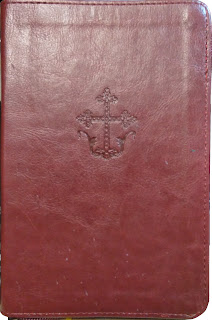
         I have only physically met the EOB-NT in the form of its Portable Edition, which was published by New Rome Press in 2019 (and can be purchased for $40 at their website).  The features of the EOB-NT Portable Edition are notable: 

            Its burgundy leather cover has two ribbons, yellow and red.  A zipper protects the pages (but also prevents them from laying flat).  The print is small; some readers may need a magnifying-glass.  There are two columns of text on each page.

            The text is formatted into logical paragraphs.

            An unfortunate formatting-error has survived in Matthew 27:31:  the words “Simon of Cyrene–The way to Golgotha– The crucifixion of the Lord” were intended to be in the margin in red print, but somehow they have been presented as if they are part of the text.  (Hopefully this will be remedied in future editions.)

            As one handles the EOB-NT Portable Edition, one may feel as if a New Testament manuscript is being held.  Each Gospel is preceded by a full-page illustration, and illustrations – more like icons – also appear before First Corinthians, and after Revelation.   Each book of the New Testament, large or small, is introduced with an artistic, uncomplicated red headpiece, and the book-title in artistic red lettering. Chapter-numbers and superscripted verse-numbers are red.  Footnote-numbers, in black, are also superscripted.

            The text is supplemented by useful colorful maps that deserve special mention.  They depict the Roman Empire, Jesus’ Ministry in Galilee, Jesus’ Journeys to Jerusalem, The Jewish Diaspora at Pentecost, Paul’s Early Travels, Paul’s Third Missionary Journey, Paul’s Trip to Rome, The Ministry of Peter and Philip, the Spread of Christianity During the 1st and 2nd Centuries A.D., and Early Christian Communities, followed by an icon of the Harrowing of Hell with Romans 8:31-34.  

            More information about the EOB-NT Portable Edition can be found in the video-reviews by Orthodox Review and R. Grant Jones and Biblical Studies and Reviews.


Friday, December 22, 2017

The Text of Phoebadius

            Today’s subject requires some historical background.
            Following the Council of Nicea in 325, Arius – who promoted the view that there was a time when the Word did not exist, and was the first created thing – was declared a heretic and was sent into exile.  But in the years that followed, Athanasius – Arius’ most vocal opponent, who promoted the orthodox view that the Word is uncreated and worthy of worship – was also sent into exile, and then was restored to his office, and then was exiled again; this happened repeatedly.  If emperor Constantine’s purpose for organizing the Council of Nicea had been to reduce disharmony in the Christian churches, he did not succeed.  Eventually, just before dying, Constantine was baptized (or sprinkled) by Eusebius of Nicomedia (not to be confused with Eusebius of Caesarea) – a bishop who was in the minority that favored Arianism. 
            The bishops at the Council of Nicea had established the divinity of Christ and issued the Nicene Creed – but some other important subjects were not addressed (particularly, the subject of which books were to be considered authoritative was not covered, contrary to widespread claims that may be traced to the fictitious Da Vinci Code) and in the decades that followed the leaders of the Arians managed to stretch the vocabulary of the creed in such a way that it seemed to the emperors that their theology could fit through it.
Julian the Apostate
(Emperor, 361-363)
            Constantius II (co-emperor from 337 to 350, and sole emperor from 350 to 361) favored Arian theology, and just before he died, he was baptized (or sprinkled) by Euzoius, the Arian bishop of Caesarea.  His successor Julian (reigned 361-363) was neither orthodox nor Arian; he attempted to revive paganism and for this reason is known as Julian the Apostate.
            In the middle of this chaotic stage entered Phoebadius of Agen in what is now southwestern France.  He was a bishop from sometime before 357 to sometime after 392 (when Jerome, in his Lives of Illustrious Men, mentioned that Phoebadius was still living).  In the mid-300’s, when the Arian bishops of Caesarea were busy transferring texts from papyrus onto parchment to remedy the destructive natural effects of humidity, Phoebadius boldly and busily defended orthodox theology, participating in councils and writing letters against the slippery word-games used by his Arian contemporaries. 
            Phoebadius wrote in Latin, and thus the Scripture-quotations in his sole extant composition – Against the Arians – provide a glimpse at the Old Latin text that he used.  R. P. C. Hanson has observed that Phoebadius was well-acquainted with at least some of the writings of Tertullian, and that Phoebadius “certainly had Hebrews in his canon.”  Phoebadius also quoted from the book of Tobit.  His work was influential in the theological disputes of the mid-300’s.  Against the Arians was translated into English by Keith C. Wessel in 2008 and this English translation can be downloaded for free.  Using that resource, let’s take a look at some of Phoebadius’ citations and utilizations of the New Testament in the first 12 chapters of his composition Against the Arians, remembering that this was composed in 357 and thus represents a witness as old as Codex Sinaiticus.  I list them in the order in which they appear.

●  John 20:17b
●  Philippians 2:9
●  John 17:3
●  Matthew 19:17 or Mark 10:19 or Luke 18:19 – “Why do you say that I am good?  No one is good except God alone.”
●  John 5:44 – “Why do you not seek honor that comes from the one and only God?”
●  Matthew 24:36 – “Concerning that day and hour no one knows except the Father alone.”  (Notice that Phoebadius’ text does not include the phrase “nor the Son.”)
●  John 11:35 – Phoebadius does not quote this verse but mentions that Jesus wept at the grave of Lazarus.
●  Luke 19:41 – Phoebadius does not quote this verse but mentions that Jesus wept over Jerusalem.
●  John 3:6
●  Matthew 26:41 or Mark 14:38 – “The flesh is weak, but the spirit is willing.”  (Notice the transposition.)
●  First John 3:7 (a snippet) – “The one who has the substance of the world”
●  Luke 19:8 (a snippet) – “Look, I am giving half of my substance.”
●  Colossians 1:27
●  First Corinthians 1:24 – “Christ is the power (virtus) of God”
●  Romans 11:34 (snippet)
●  First Corinthians 2:16 (snippet)
●  First Corinthians 2:11 (snippet, twice) – “from him and with him and in him”
●  John 9:29
●  John 16:28 – “I have come forth from the Father and from the bosom of the Father”
●  (20) Matthew 11:27
●  John 16:13
●  First Corinthians 2:10-11
●  Matthew 7:7 or Luke 11:9 (notice the transposition)
●  Matthew 11:25
●  Matthew 13:11 or Mark 4:11 (Byz) or Luke 8:10
●  Ephesians 3:5
●  Colossians 1:27 (an allusion)
●  John 8:14-15
●  John 4:24 (snippet)
●  (30) First Corinthians 15:28 (allusion)
●  Revelation 13:11 (adaptation) – “having horns like lambs but speaking as dragons” 
●  John 14:28 (snippet)
●  John 5:23 (snippet)
●  John 1:18 – Phoebadius specifies that he is citing from John, and quotes, “No one has ever seen God except the only begotten Son who is in the bosom of the Father.”  We see here a defender of Christ’s divinity using the reading “only begotten Son.” 
●  John 17:10
●  John 5:19
●  John 6:38
●  John 8:29 (snippet)
●  John 14:10
●  Second Corinthians 1:20

We thus see that in these 12 chapters, 40 verses are used, mostly from the Gospels.  Let’s continue, covering the remainder of Phoebadius’ composition.

●  Matthew 16:27 – Phoebadius specifically quotes from Matthew:  “The Son is going to come in the glory of his own Father.”
●  Luke 9:26 – Phoebadius specifically quotes from Luke:  “When the Son of Man comes with his own glory and that of his Father.” 
●  Colossians 2:9
●  John 16:15 (snippet)  
●  First John 5:11 – “We proclaim to you eternal life, life that was with the Father, and he adds, and in the Son.” 
●  John 14:10
●  John 5:19
●  John 1:3
●  John 10:30
●  John 7:28-29 – “You neither know me or where I am from, nor that I have not come on my own.  But the one who sent me is true, the one you do not know.  But I know him because I am with him, and he has sent me.”  (Notice the rendering of the first part)
●  John 8:16b 
●  John 10:15a
●  John 3:35b
●  (15) John 5:43a
●  Revelation 1:8 or parallels – “He who is and who was and who is to come, the Almighty.”  (Notice the transposition.)
●  First John 1:1-2
●  John 16:27 (snippet)
●  John 10:30
●  John 14:9-10 (snippets)
●  John 8:29a
●  Romans 11:36 (snippet)
●  John 5:37 (allusion)
●  John 8:19
●  John 4:24a
●  Second Corinthians 13:4 
●  Matthew 26:41 or Mark 14:38 – “The flesh is weak, but the spirit is willing.”  (Notice the transposition, which also occurred the first time Phoebadius quoted the sentence.)
●  First Corinthians 1:18 (snippet)
●  First Corinthians 15:3 (snippet)
●  (30) John 10:30
●  John 14:10
●  John 10:30
●  John 14:9
●  John 4:24a
●  First Corinthians 2:11
●  Romans 11:34
●  John 1:3
●  Philippians 2:6-7
●  Romans 11:33
●  Romans 11:36
●  John 14:16
●  Galatians 1:8

            Taking all 28 chapters of Phoebadius’ Against the Arians into consideration, we see that in this composition he used material from the New Testament 82 times.  He used a few passages – particularly Matthew 26:41 (or Mark 14:38), John 4:24a, and John 10:30 – more than once.  All in all, no less than 70 passages from the New Testament are utilized in this composition.  If it had never been discovered until today, we would announce a rather significant discovery, equivalent to the discovery of 70 little manuscript-fragments as old as Codex Sinaiticus.    
            Yet Phoebadius is hardly known, and lately it seems that the entire category of patristic evidence is being unfairly and unscientifically minimized.  No patristic evidence of any kind appears in the apparatus of the recently published Tyndale House edition of the Greek New Testament.  And in the “textual flow diagrams” in Tommy Wasserman and Peter Gurry’s A New Approach to Textual Criticism, intended as an introduction to the Coherence-Based Genealogical Method, I did not see any patristic writers at all. 
            Recently apologist James White claimed that “The citations of Scriptural material from patristic sources are notoriously vague,” but I welcome him to go through the list presented here and see where, aside from the parallel-passages and the three instances specifically described as allusions, there are any grounds for not affirming that Phoebadius used the passage that is listed.  He also said, “I do not believe that patristic citations can overcome the actual manuscript evidence.”  But where the patristic citations are clear and there is no reason to question the contents of the patristic text itself, they should have the same weight as the owners’ manuscripts.  What does Dr. White think the patristic writers were citing?

            Even relatively little-known patristic compositions can provide significant text-critical data.  Those who would minimize or dismiss patristic testimony run a high risk of investing a lot of effort in a method that is doomed to produce inaccurate results, like a recipe in which the cooks have chosen to omit important ingredients.
            In other news:  Merry Christmas, everyone!