Followers

Monday, November 18, 2024

Hand to Hand Combat: 03 versus 017 in John 9:1-9

 John 9:1-9 is a memorable episode in the ministry of Christ, beginning John's account of the healing of the man born blind.  Let’s compare how two important majuscules – Codex Vaticanus (B/03) and Codex Cyprius (K/017) – present this segment of John’s Gospel.  First we will use NA27 as the basis of comparison.

Codex Vaticanus (B) compared to NA27

1 – no variants

2 – has οι after οι (+2)

2 – Ῥαββεί inistead of Ῥαββί (+1)

3 – no variants

4 – εργάζεσθε instead of εργάζεσθαι (+2, -1)

5 – no variants

6 – επέθηκεν instead of επέχρισεν (+3, - 4)

7 – does not include ουν και ενίψατο και ηλθεν (-22)

8 – no variants

9 – αλλ instead of αλλα (-1)

 Compared to NA27, Vaticanus has 8 non-original letters and is missing 28 original letters, for a total of 36 letters’ worth of corruption.

Codex Cyprius (K/017) compared to NA27

1 – παραγον instead of παραγων (+1, -1)

1 – γεννητης instead of γενητης (+1)

2 – no variants

3 – no variants

4 – εμε instead of ημας (+2, -3)

5 – no variants

6 – does not have αυτου (-5)

6 – has του τυφλου after οφθαλμους (+9)

7 – no variants

8 – no variants

9 – does not have ελεγον ουχι αλλα (-14)

Compared to NA27, Cyprius has 13 non-original letters and is missing 23 original letters, for a total of 36 letters’ worth of corruption.

Now let’s compare using the Byzantine Textform as the standard of comparison.

Codex Vaticanus (B) compared to RP-Byz

1 – no variants

2 – has οι after οι (+2)

2 – Ῥαββεί inistead of Ῥαββί (-1)

3 – no variants

4 – ημας instead of εμε (+3, -2)

4 – εργάζεσθε instead of εργάζεσθαι (+2, -1)

5 – no variants

6 – επέθηκεν instead of επέχρισεν (+3, - 4)

6 – has αυτου (+5)

6 – does not have του τυφλου after οφθαλμους (-9)

7 – ερμηνεύετε instead of ερμηνεύεται (+1, -2)

7 – does not include ουν και ενίψατο και ηλθεν (-22). A parableptic error.

8 – προσαίτης instead of τυφλος (+8 , -5 )

9 – does not have δε οτι (-5)

9 – ελεγον ουχι αλλ after αλλοι (+13)

Compared to Byz, 03 has 37 non-original letters, and is missing 51 original letters, for a total of 88 letters’ worth of corruption.

Codex Cyprius compared to RP Byz

1 – παραγον instead of παραγων (+1, -1)

2 – no variants

3 – no variants

4 – no variants

5 – no variants

6 – no variants

7 – no variants

8 – προσαίτης instead of τυφλος after οτι (+8, -5)

8 – προσαίτης instead of τυφλος after οτι (+8, -5)

9 – δε after εκεινος (+2)

Compared to Byz, 017 has 19 non-original letters and is missing 11 original letters, for a total of 30 letters of corruption.

In 9:4, ημας δει and πέμψαντός με both received D ratings from the UBS Committee; πέμψαντός ημας is supported by P66 P75 ﬡ* L W.

Whatever yardstick one employs, 017 is at least as accurate as 03 in this particular passage.  Rather than being dismissed as irrelevant, it should be given much more weight than it was given by those who compiled the NA/UBS compilation.


Friday, November 15, 2024

Luke 9:55-56 - What a Knot!

           Having seen that a scribal note at the end of Luke 9:54 became extremely popular and eventually dominated over 99.5% of extant manuscripts, let’s move along to the fascinating cluster of variants in verses 55-56 – one of the most difficult variant-units in the New Testament.   Metzger’s six-line dismissal of the longer readings has been augmented in online studies by several researchers including Robert Clifton Robinson and the NET’s annotator.  Zooming in on verse 55 first, we see that the Textus Receptus, the Byzantine Textform, and the Majority Text and quite a few MSS read (after αὐτοἷς) καὶ εἶπεν οὐκ οἴδατε οίου πνεύματός ἐστε ὑμεις” and verse 56 begins with ὁ γὰρ υἱὸς τοῦ ἀνθρώπου οὐκ ῆλθεν ψυχὰς ἀνθρώπων ἀπολέσαι άλλὰ σῶσαι. – that is (in the EOB New Testament) “You do not know of what kind of spirit you are.  The Son of Man did not come to destroy people’s  lives but to save them.

          Weighing in for non-inclusion are P45 P75 À A B C E G H L S V W D X Y Ω and about 430 minuscules including 28 33 157 565 892 1424 etc.   The Sinaitic Syriac and the Sahidic version do not include the material.  Cyprian supports the inclusion of "the Son of Man is not come to destroy men's lives, but to save them" (in Letter 58:2 - thanks to Demian Moscofian for this reference).  Chrysostom supports the inclusion of εἶπεν οὐκ οἴδατε οίου πνεύματός ἐστε ὑμεις and non-inclusion of ὁ γὰρ υἱὸς τοῦ ἀνθρώπου οὐκ ῆλθεν ψυχὰς ἀνθρώπων ἀπολέσαι άλλὰ σῶσαι.  Epiphanius supports inclusion.  Basil weighs in for non-inclusion.

Majuscules that support inclusion (with minor variations) include D (although D does not include ὑμεις at the end of v. 55 and 56a) Y M K U Γ Θ Λ Π,  and the 1,300 minuscules that include the longer reading include f1 f13 124 180 205 597 700 1006 1243 1292 1505.  Willker noticed that 240 minuscules read ποίου instead of οίου (agreeing with D), and that 33 minuscules have the first segment of verse 56 before the last segment of verse 55.  Latin support for non-inclusion includes a, aur, b, c, e, f, q, r1 and the Clementine and Wordsworth’s edition of the Vulgate. Nestle’s Novum Testamentum Latine reads “Et conversus increpavit illos, dicens :  Nescitis euius spiritus estis.  Filius hominis non venit animas perdere, sed salvare.”   I have not verified the claim that Codex Fuldensis supports non-inclusion.  The Curetonian Syriac, the Peshitta, and Harklean Syriac support inclusion and so do the Armenian and Gothic versions.  Ambrose and Ambrosiaster both support the longer reading.

            (GA 579 has a unique expansion which I will ignore here.)

            Early readers might have wondered know what Jesus said when he rebuked James and John.  But would they be willing to invent a response from Jesus and present it as if it originated with Jesus?  Is it likely that a scribe would add this sentence knowing that it was not originally part of Luke’s Gospel?

            On the other hand, if Luke wrote καὶ εἶπεν οὐκ οἴδατε οίου πνεύματός ἐστε ὑμεις  ὁ γὰρ υἱὸς τοῦ ἀνθρώπου οὐκ ῆλθεν ψυχὰς ἀνθρώπων ἀπολέσαι άλλὰ σῶσαι, what possible motive would any scribe have to remove these words?  Luke preserved Jesus’ saying (in 19:10) that the Son of Man came to seek and to save the lost – so why add a similar statement here?

            A very bad case of parablepsis could account for the loss of καὶ εἶπεν οὐκ οἴδατε οίου πνεύματός ἐστε ὑμεις  ὁ γὰρ υἱὸς τοῦ ἀνθρώπου οὐκ ῆλθεν ψυχὰς ἀνθρώπων ἀπολέσαι άλλὰ σῶσαι if a scribe’s line of sight drifted from the καὶ after αὐτοῖς to the καὶ before ἐπορεύθησαν.  However this seems unlikely for several reasons.  First, due to the large amount of lost material.  Second, because a proof-reader would almost certainly correct the omission.  Third, because the attestation for non-inclusion are from Alexandrian (P75 À B Sahidic), Western (Old Latin a b c r1 ), and Byzantine (A S Ω 1424) transmission-lines.  

            Let’s take a closer look at a few of Chrysostom’s utilizations of Luke 9:55-56.   Near the end of Homily on Matthew 29 he cited 9:55b plainly.  Ini his 51st Homily on John he utilized 9:55b again.  And he did so again in Homily on First Corinthians 33 when commenting on I Cor. 13:5, writing, “Wherefore also when the disciples besought that fire might come down, even as in the case of Elijah, ‘You know not,’ says Christ, ‘what manner of spirit you are of.’” 

            We are looking at two variants here, not just one:  (1) the addition of καὶ εἶπεν οὐκ οἴδατε οίου πνεύματός ἐστε ὑμεις and (2) the inclusion of ὁ γὰρ υἱὸς τοῦ ἀνθρώπου οὐκ ῆλθεν ψυχὰς ἀνθρώπων ἀπολέσαι άλλὰ σῶσαι.  We are also looking at several strata in the transmission of the text.

           I suspect we are dealing with a phenomenon involving marginalia in the autograph.  Whether the marginalia was added by Luke, or by a later scribe, is very difficult to determine.  Imagine the main text of verses 55-56 looking like it does in Codex S (028).  Then picture καὶ εἶπεν οὐκ οἴδατε οίου πνεύματός ἐστε ὑμεις in the margin to the left, and ὁ γὰρ υἱὸς τοῦ ἀνθρώπου οὐκ ῆλθεν ψυχὰς ἀνθρώπων ἀπολέσαι άλλὰ σῶσαι in the margin to the right.  Scribes coming to this could interpret it in different ways.  To encapusulate the hypothetical history of the text at this point, I will name alphabetically the scribes who treated it differently:

          Alex and Bill perpetuate only the main text, thinking that the marginalia is all secondary and non-Lukan.
          Cecil perpetuates the main text and includes all the marginalia as the text in the copy he produces.

           Dexter perpetuates the main text and includes 55b in the main text of the copy he produces.

          Later, using exemplar based on the ones made by Bill and Cecil, Edward made a copy resembling most Byzantine MSS, with 55b and 56a indiscernible from the rest of the text.

          Fred similarly made a copy including 55b and 56a, but in a different order.

           How should modern English versions handle this?  I would be content with what we see in the New American Standard Bible (1995), but with brackets only around 56b:  But He turned and rebuked them, and said, “You do not know what kind of spirit you are of [for the Son of Man did not come to destroy men’s lives, but to save them.”] And they went on to another village.”  Let’s see an array of different treatments:

            Modern English versions have handled this variants in a variety of ways:

          NIV:  But Jesus turned and rebuked them. Then he and his disciples went to another village. (no footnote)

          NLT:  But Jesus turned and rebuked them.a  The footnote reads:  “Some manuscripts add an expanded conclusion to verse 55 and an additional sentence in verse 56: And he said, “You don’t realize what your hearts are like. 56 For the Son of Man has not come to destroy people’s lives, but to save them.”
          ESV:  But he turned and rebuked them.a  The footnote reads:  Luke 9:55 Some manuscripts add And he said, “You do not know what manner of spirit you are of; 56for the Son of Man came not to destroy people's lives but to save them.”

          WEB:  But he turned and rebuked them, “You don’t know of what kind of spirit you are.  For the Son of Man didn’t come to destroy men’s lives, but to save them.”

          EHV:  But he turned and rebuked them. “You don’t know what kind of spirit is influencing you.  For the Son of Man did not come to destroy people’s souls, but to save them.”a  Then they went to another village.  The footnote reads “Luke 9:56 Some witnesses to the text omit this quotation.”

          The Message hyper-paraphrase:  Jesus turned on them: “Of course not!” And they traveled on to another village.”

          Christian Standard Bible:  and they went to another village.(Footnote:  Other mss add and said, “You don’t know what kind of spirit you belong to. 56 For the Son of Man did not come to destroy people’s lives but to save them,”)


In conclusion, with the present state of evidence, the best option is to include καὶ εἶπεν οὐκ οἴδατε οίου πνεύματός ἐστε ὑμεις in the text and ὁ γὰρ υἱὸς τοῦ ἀνθρώπου οὐκ ῆλθεν ψυχὰς ἀνθρώπων ἀπολέσαι άλλὰ σῶσαι in a footnote.

Friday, November 8, 2024

Luke 9:54 - What Happened?

Internal evidence is seldom more weighty than it is in Luke 9:54-56, where a cluster of textual variants pop up.  Today let’s zoom in on Luke 9:54.  At the end of Luke 9:54, ὡς καὶ Ὴλίας ἐποίησεν follows ἀυτούς in the Textus Receptus, the Byzantine text, A C D K Π W X Δ Θ Ψ 0211 f1, f13 33 565 892 1424 1505.  Versional support is found in several Old Latin witnesses (a, b, c [sort of], d, f, q, r1) Gothic Peshitta Harklean Syriac Some Bohairic copies and some Vulgate copies.

Greek witnesses without ὡς καὶ Ὴλίας ἐποίησεν include P45, P75, À B L X 157 579 700 1241 1342.  Versional support for the shorter reading is supplies by Old Latin aur e l, the Vulgate, the Sinaitic Syriac and Curetonian Syriac, the Sahidic version, Armenian version, and an early strata of the Georgian version.  Patristic support for non-inclusion comes from Tatian’s Diatessaron, Jerome, and Cyril of Alexandria.      

Tertullian, in Against Marcion IV:23, focused on Luke 9:54-56 when he wrote, “The Creator, at Elijah’s demand, brings down a plague of fire upon that false prophet.  I take note of a judge’s sternness: and on the contrary of Christ’s gentleness when reproving the disciples as they call for the same punishment upon that village of the Samaritans. Let the heretic also take note that this gentleness of Christ is promised by that same stern Judge:  He shall not strive, it says, nor shall his voice be heard in the street: a bruised reed shall he not break, and smoking flax shall he not quench.  Such a one was even less likely to burn men up.  For even in reference to Elijah in his day, it says, The Lord was not in the fire but in a gentle spirit. 

It is not easy to discern from this what Tertullian’s copy of Luke read at the end of 9:54.   He clearly drew a contrast between what Jesus wanted his disciples to do and what had happened in the case of Elijah in Second Kings 1, but this is something that could be easily done without the words ὡς καὶ Ὴλίας ἐποίησεν or their Latin equivalent.  Tertullian is thus a non-witness. 

The internal evidence is decisive in this case:  there is no evident reason to remove the words if they were original.  There is a natural and simple reason to add ὡς καὶ Ὴλίας ἐποίησεν, to pinpoint the alluded-to incident.  The words were not written by Luke.   


Tuesday, November 5, 2024

Four More Witnesses Affirming Mark 16:9-20

 The indefatiguible Jil De La Tourette has recently confirmed the following:

· An Anonymous Author in the 400s writing Consultationes Zacchei Christiani et Appolonii Philosophi (Questions of a Pagan to a Christian) - in Book II, XII:18 utilized Mark 16:19.  (Thanks to Rahel Schar for working on this source.)

· Quodvultdeus of Carthage (mid-400s) quoted from Mark 16:19 several times in Liber Promissionum et Praedicatorum Dei  (Book of the Promises and Predictions of God), Book III, XXX:31-32 (16:14 twice) and Book III, XXX. 32 (16:19).

· The Venerable Bede in
De Tabernaculo
 cited 16:15-16 in Book II, 63, 16:19 in  Book II, 98 16:17-18 in Book III, 34, and 16:19 in Book III, 116.

· John Scotus Erigena (800s) utilized material from 16:9-20 in Periphyseon (On the Division of Nature) in Book IV, 760A & 774B and Book V, 912A.

This information supplements the data about early manuscripts,  earlier patristic sources, early versions, lectionaries, and talismans supportive of the last twelve verses of the second Gospel compiled in my book Authentic:  The Case for Mark 16:9-20 (4th ed.), now available on Amazon.


Tuesday, October 29, 2024

Mark Ward and His Ridiculous Claim about the KJV


Dr. Mark Ward
 If you know me at all you know that I am not, never have been, and never will be an advocate of KJV-Onlyism.  The more I study the position the more I am tempted to completely dismiss dogmatic KJV-Onlyism as a schismatic and somewhat cultic position that is not so much a position as a condition.  Dogmatic KJV-Onlyists such as Will Kinney (with whom I had a lengthy debate earlier this year) seem to confuse their simple ability to be stubborn as if it is a point in favor of their position.


            But this past week I witnessed a position from the opposite camp 
 from a user of multiple modern versions based on the Nestle-Aland/UBS compilations of the New Testament  that is in its own way no less extreme.  Dr. Mark Ward, an editor at Crossway known for his blog, his editorial work at Crossway, and his book Authorized: The Use and Misuse of the King James Bible, in the course of a debate with Dr. Dan Haifley, stated, if I understand him correctly, that it is a sin to give a child a King James Bible.  The footage is here (click the embedded link), following the 1:18:00 mark of the debate.   

   
            Mark Ward stated "The King James should be revised or replaced in institutional settings like this pulpit, like Scripture memory curriculums, like Bible colleges, like revivals, even the signage outside your church."

           So far so good.  Then Dr. Ward went on to say (following the 1:21:00 mark of the debate) "There comes a point at which it's so close to this ditch that actually it is a sin for a given Bible translation to be handed to children.  I'm saying we've reached the point where there's a sufficient number of readability difficulties that it's time to turn away from the King James in institutional  contexts.  Would I say it's a sin to hand to your child?  Here's what I'd say, quoting the King James:  to him that knoweth to do good and doeth it not to him it is sin."  

            He kept going, telling his audience, "Don't hand unintelligible words to your children," and "It's between you and God whether it's a sin or not, but don't do it."

            To which I say:  Ridiculous.

            Most New Testaments include the book of Revelation.  Give 100 twelve-year-olds copies of the book of the Apocalypse of Sant John and ask them to interpret chapter thirteen, (using the Contemporary English Version or the English Standard Version), without assistance from ecclesiastical authorities, all on their own, and I predict that you will get 100 different interpretations (I haven't tested this suspicion; readers are invited to test my theory) and lots of questions about the intelligibility of this piece of apocalyptic literature.  

            Mark Ward seems to have missed a fundamental point about the intelligibility of Scripture.  No Scripture was ever written with the understanding that its readers would be in a literary and educational vacuum.  Christians are instructed to worship together.  Christians should consider the Scriptures together - a practice known in modern times as group Bible Study.  The same person who affirmed that some things in the Pauline epistles are hard to understand (even for adults) also commanded his readers (in II Peter 3:18) to "Grow in grace, and in the knowledge of our Lord and Savior Jesus Christ."  

            We are expected to mature.  With maturity comes new understanding of what was once unintelligible.  We are expected to fellowship together.  We are expected to learn.  We should progress beyond a childhood understanding of a melodious tortoise when reading Song of Solomon 2:12b ("the voice of the turtle is heard in our land").  The fact that children can read as children and misunderstand things does not render the King James Version full of shortcomings.  The shortcoming is in the individual's level of comprehension - which is constantly changing.   

            Dr. Ward seems to think that the Bible should be translated so plainly that it is incapable of being misunderstood.  Unfortunately such a translation has never existed and never will exist on earth.      

            Ask an American twelve-year-old to interpret Isaiah 10:9 (KJV:  "Is not Calno as Carchemish? is not Hamath as Arpad? is not Samaria as Damascus?"   ESV:  "Is not Calno like Carchemish? Is not Hamath like Arpad? Is not Samaria like Damascus?") without resorting to a commentary.  For that matter, ask a twenty-year-old American or Canadian to interpret the verse.  I predict that 99 out of 100 will say "I do not understand this."  Does such a lack of understanding reflect a flaw in the translation, or a lack of maturity in the individual interpreter?  Surely the latter.  And a lack of maturity, or the characteristic of being underinformed, is the real problem in what Mark Ward tries to frame as reasons not to use the KJV over and over and over.            

           In the real world people who are determined to understand the Bible will seek out resources like BibleRef and the Blue Letter Bible (with its collection of commentaries) and LEARN.  Even in a fantasy realm in which children are incapable of becoming smarter and more literate and learning new things, it would not be remotely sinful to give a child a KJV, because it is better to have some truth than none of it.  

            I encourage Mark Ward:  come out of your fantasyland in which children never grow up and are incapable of learning new things.  Thomas Nelson Publishers disagrees with you.  They publish a children's version of the KJV.  Lo and behold Hendrickson Publishers also publish a Childrens KJV New TestamentLifeway and Holman Bible Publishers also publishes a Kids KJV.  There are even KJV Bibles marketed to be given to illiterate babies.  The KJV Armor of God Bible is marketed with the claim that it is "perfect for ages 6-10."  Is it sinful to give such Bibles?  No.  Dr. Ward, stop observing ignorance in action and concluding that ignorance must be accommodated.  Say instead that ignorance must be reduced via learning.

            For my part, although I prefer the New Testament in the EOB New Testament and the Evangelical Heritage Version and the New King James Bible and the World English Bible over the KJV New Testament, I would happily give the King James Bible to a child if the only other option was to give no Bible at all – which is a real scenario in some places.  Exceptionally rare is the occasion when a Bible is given and the giver can perfectly foresee how accurately it will be interpreted.  

            The act of sharing a Bible in any English translation is an act of faith that God will use it to convey his message as the reader will continue to study and learn.  Some sinful perversions masquerading as translations (such as the "Clear Word" and "The Passion Translation" and the Jehovah's Witnesses' "New World Translation") are to be avoided by the flock of God, or else used only as examples of what translators should not do.   The King James Version does not fall into that category.  Dr. Ward, if James 3:10 implies that giving a KJV to a child is sinful because of a risk of misinterpretation, then giving a Bible – KJV, ESV, NIV, NRSV – to any immature person is sinful, because the element of risk remains.  Stop being silly.

           Paul told Timothy (in Second Timothy 4:15) that "from infancy you have known the Holy Scriptures" (EHV).  He seems to have regarded this as a good thing - not because he ever imagined that an infant's level of comprehension never changes, but because he trusted the Holy Spirit to work through the Scriptures to make Timothy wise unto salvation.


Monday, October 21, 2024

GA 560 - Another Gospels-manuscript with Distigmai

GA 560 is a thousand-year-old copy of the four Gospels, containing an esentially Byzantine text.  It resides at the University of Glasgow as Manuscript Hunter 475.  Its Gospels text is preceded by 17 pages of material – instructions for a wedding service, and priestly vows.  Then comes Ad Carpianus and a simple well-executed Canon Tables before the Gospel of Matthew begins.  Each evangelist has a full-page icon.    Colorful headpieces are full size.


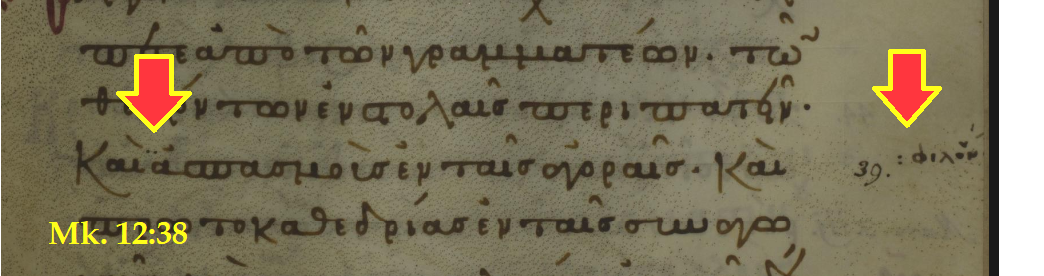
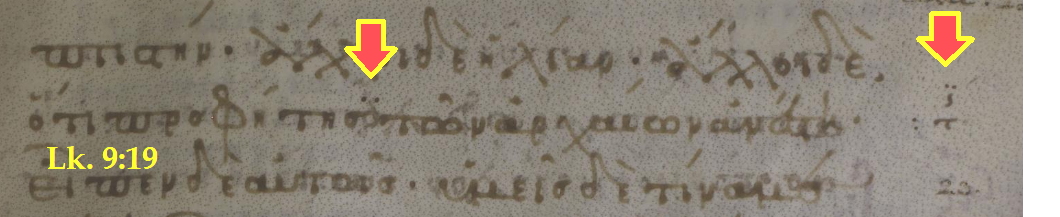
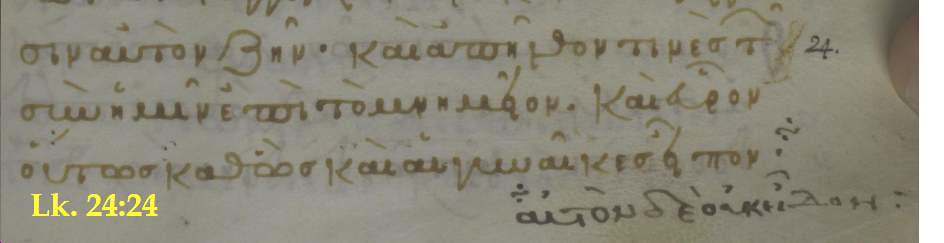
There is a minimal series of marginal notes constituting variant readings.  Making GA 560 somewhat unusual, these are denoted with distigmai (umlauts) in the text, linked to umlauts or colons in the margin. 


In Mark 4:17 the words και διωγμου δια τον λογον ευθεως are missing in the main text; a colon appears above the line.  They are supplied in the side margin alongside a colon.


In Mk 7:2 after αρτους the word εμεμψατο or εμεμψαντο is not in the main text.  It is supplied in the side margin; over-trimming has resulted in the loss of the final syllable.


In Mark 8:34 the text reads ακολουθειν, the majority reading, but the reading in the margin is ελθειν, supported by À A Β Κ L Π et al.  Distigmai link the two readings.


In Mark 10:17 there is nothing between εις οιδον and προσδραμων.  The words ιδου τις πλούσιος (read by A Κ Π Θ 700) are in the side margin, linked to the spot in the text via distigmai.


In Mark 10:30 there is no occurrence of και πατέρα.  A kai-compendium and πρα appear in the margin beside a colon; a distigmai appears above the line.  Nearby in the margin is what appears to be a reference to Origen. 


In Mark 12:38, φιλον- appears in the margin beside a colon; a distigmai appears in the text over the line between και and ασπασμους.


In Mark 13:3, between επηρώτα and καθ’ ιδιαν there is nothing in the main text, but a distigmai is above the line.  In the eside margin the word αυτον appears beside a distigmai.


In Mark 14:43 a distigmai appears above the line between ιούδας and εις.  In the side margin ὁ ισκαριώτης appears beside a distigmai.


In Mark 15:12 between αποκριθεις and παλιν a distigmai is above the line.  In the side margin a distigmai accompanies πάλιν, which appears before αποκριθεις in À Β C Θ Ψ et al, and after αποκριθεις in A Δ K M Π and the usual Byzantine text.


In Luke 1:8 a distigmai appears above the line after αὐτον.  In the margin a distigmai accompanies ησαν.


At the end of Luke 1:21 a distigmai appears above the between αυτόν and εξελθών.  In the side margin a distigmai accompanies ἐν τῶ ναῶ.  As far as I know 560 and 700 uniquely omit these three words, which precede αυτόν in B L W Ψ 565 579.

In Luke 3:33, Ἀραμ is followed by τοῦ Ἰωράμ.  Then before τοῦ Ἑσρών a distigmai appears above the line.   In the side margin another distigmai accompanies τοῦ Ἀρνὶ.


At the end of Luke 4:10 a distigmai is above the line after σε.  In the side margin a colon accompanies ἐν πάσεις ταις οδοις σου, a f1 reading.


In Luke 7:26 after ουτός a distigmai appears above the line.  In the side margin another distigmai accompanies γαρ, which is read by f1 and U Θ Ψ 33 and 1424.


A distigmai appears above the line at the end of Luke 8:21.  In the margin another distigmai accompanies αὐτον, the usual Byzantine reading (not supported by W Π 700 or f1).

In Luke 9:19 a distigmai is above the line between προφήτης and τῶν.  A colon and a distigmai accompany τ[ις] in the margin.

At the end of Luke 11:28 a distigmai appears.  In the margin a colon accompanies αὐτον.


At the end of Luke 12:7 a distigmai appears.   In the margin a colon accompanies υμ[εις], which is attested by D F G Y K M Θ Π 33.


In Luke 23:8 a distigmai appears before ιδειν.  In the margin a dot accompanies χρόνου (also supported by N W Π 157 f1).


In Luke 24:24 the words αὐτον δε οὺκ ειδον are missing in the main text, and added in the nearby margin.  As far as I know 560 and 565 uniquely share this omission.


In John 4:31 after μαθηται a distigmai appears above the line; αυτοῦ is supplied in the margin beside another distigmai.


In John 5:4 a ٧ appears after αγγελος.  In the margin, κυ (κυρίου), which is also supported by A K L Y Π Δ.


In John 6:52 after σάρκα an umlaut is above the line.  In the margin αυτοῦ appears beside a colon.   Αυτοῦ is supported by B P66 and 1424. 


At the end of John 8:6 after γῆν a distigmai appears.  In the margin beside a colon is προσποιούμενος.  The word μὴ is absent. 


In John 8:10 after εισιν the words οί κατήγοροί σου are not in the text; they appear in the margin.


At the beginning of John 19:3 the words καὶ ηρχοντο προς αυτον are absent from the main text; they are supplied in the margin (agreeing with B P66 À L N W  Θ Λ Π).  


An intriguing collection of marginalia as well as proof of the use of distigmai by a (late) medieval scribe!   It may seem like this was a lot of work for the sake of some very small details  but even very small details mattered to the scribe who did the work.


The indexing of GA 560 was made at the request of Craig Harmon in memory of his beloved wife Becky J. Harmon. 


Wednesday, October 9, 2024

Scribes & Scripture - A Nice Addition to a New Testament Textual Critic's Bookshelf

Scribes & Scripture (full title Scribes and Scripture - The Amazing Story of How We Got the Bible), by Peter J. Gurry and John D. Meade, is a 2022 release from Crossway.  It has three parts – (1) text, (2) canon, and (3) translation.  Competently written, this book is what John Barton’s A History of the Bible should have been.  There is not much new data in Scribes & Scripture – much of the same ground was plowed in books focused on one of the three parts, such as Paul Wegner’s The Journey from Texts to Translation.  

          Focusing on elements in the book that pertain to New Testament textual criticism, most of the authors’ review of the history of the text of the New Testament is unobjectionable, accurate, and tidy.  There are a few inaccuracies, such as the claim that “the majuscules stop around the end of the ninth century” (p. 85)   I was a bit disappointed reading pages 94-100, where four textual variants are examined (Mark 1:2, Luke 23:34, Mark 16:9-20, and John 7:53-8:11).   The authors arrive at incorrect conclusions in three out of four cases and their discussion of the remaining variation-unit (Lk. 23:34) is inconclusive.  Rather than echoing Metzger’s preference for the “in Isaiah the prophet” in Mark 1:2, the less specific reading (“in the prophets”) should be adopted. 

          Regarding Mark 16:9-20 the author says (p. 97) “Whether or not we should treat it as Scripture is a difficult question.”  Considering that Mark 16:9-20 is treated as Scripture by the Roman Catholic Church, the Eastern Orthodox Church, and the Lutheran Church, and was included in the Vulgate, the Peshitta, the King James Version and all Reformation era Bibles, I have to wonder who the “we” is in that sentence.   

          In the discussion about John 7:53-8:11 the authors wrote that “Almost 270 continuous-text Greek manuscripts out of about1,500 do not have it” (p. 97).  It would have been better to say that 270 continuous-text Greek manuscripts do not have the passage while 1,500 do.

          The third section contains no mention of the translation work of Giannozzo Manetti; although Annet den Haan has drawn attention to this Renaissance scholar’s Latin translation of a Greek text of the New Testament apparently her work hasn’t yet trickled down to American evangelical scholars.   

          Scribes and Scripture does what its authors set out to do:  to explain how American evangelicals got their Bible.  With minor reservations, I recommend it.