Followers

Showing posts with label Novum Testamentum. Show all posts

Wednesday, May 18, 2022

Souter's GNT Preface

            In 1910, Scottish scholar Alexander Souter (1873-1949) released his Novum Testamentum Graece.  This was just 21 years after Westcott and Hort replaced the Textus Receptus with their own very heavily pro-Alexandrian compilation, and only nine years after Eberhard Nestle released the first edition of his Novum Testamentum Graece in 1898.  Souter’s Greek New Testament presented what he understood to have been the base-text of the 1881 Revised Version.  Souter’s GNT is not the text of Westcott and Hort, but of Westcott and Hort after it had been filtered through the minds of their fellow creators of the 1881 Revised Version.

            In 1912 Souter wrote The Text and Canon of the New Testament (revised in 1935).  He also produced a Pocket Lexicon of the Greek New Testament, which (unlike the UBS Greek-English Dictionary) includes some terms that are used in the text of Codex Bezae but which are not found in most other manuscripts.  Souter also edited The Earliest Latin Commentaries on the Epistles of St. Paul (1927).  His last major work was Glossary of Later Latin to 600 A.D.

            Souter’s GNT (copies of which can still be found at online markets such as eBay, etc.) has been superseded in the marketplace by the UBS and Nestle-Aland editions.  Those who seek it out will, however, find a tidy edition of the Greek New Testament very similar to what is in print today.  

            How did Souter introduce his work?  With two very short prefaces, written in Latin.  Since Latin is treated as a relic in many schools in America today, I thought it might be helpful to present here an English rendering of the Prefaces with which Souter introduced his GNT.   But beware:  my own skill at translating Latin is minimal; I hope that other will improve upon the translation given here.  Stay tuned for corrections/revisions:

1910 PREFACE:

The purpose of this edition of the Greek New Testament is to present the text which was the basis for the Revised Version in English published in 1881, which was produced by scholars at Oxford whose research into the text is necessary to gain an overview of its history. 

Regarding the selection of readings that I have noted in the apparatus:  although I devoted much time to this, I am unable to placate everyone, and it can scarcely be doubted that readers will reproach me for having omitted a particular variant somewhere.  But if I am going to please no one in this regard, at least it may be said that many of the apparatus-notes here are more complete and more accurate than can be found in any other edition.

I have consulted versions as they are represented in the most recent editions, which were not covered in Tischendorf’s Greek compilations:  Latin (Old Latin and Vulgate), Syriac (the Old Syriac, the Peshitta, the Philoxenian, the Palestinian), Coptic (Bohairic, Sahidic [from Horner]), and, in the Apocalypse, Armenian (as represented in both the ancient text and in ordinary editions).  I have also consulted the patristic evidence; I cannot say how many thousands of passages in the fathers’ works I have re-examined.  And finally, I have consulted the writings of the primarily Latin interpreters, such as Ambrosiaster, Tyconius, Pelagius, Pseudo-Jerome, Cassiodorus, and Bede, using in some cases editions which I have prepared and which, I am confident, will not be significantly altered in the future either by our scholars or by foreigners.  It should be noted that the elegant work of William Sanday was always on hand to guide me.  May that tireless patron of New Testament studies be given his due honor and commemoration, and may the same be done for the printers, who have exercised extraordinary diligence.

 Sent from Oxford, in the year of our salvation 1910. 

 PREFACE OF THE UPDATED EDITION

 After 33 years, within which a large number of copies of the previous edition were sold, I was fortunate to be approached by a very respectable publishing-house which insisted upon another edition.  As far as the text itself is concerned, the discoveries of the past few years are not of the sort, in my view, that would make it wise to make a fresh compilation of the text. 

For now it is clear that there are many more textual variations than previous generations imagined, and it is also clear that it is better to rely on the many minuscule copies than has been done previously.  See, for example, the research by Kirsopp and Silva Lake, and by Hermann C. Hoskier – the former chiefly in the Gospels, the latter in the Apocalypse.  Adolph Jülicher’s laborious collection of versions of the Gospels has been a valuable contribution to the study of the Latin Gospels, and has had an effect upon almost the entire New Testament. 

            In the following pages, I have taken precisely this approach, and shared some readings from recently-discovered papyri, like those in the Chester Beatty collection, and from Codex Washingtoniensis (W) and Codex Koridethi (Θ) and also from some small fragmentary sources.  I reviewed the versional data in accordance with the current editions, citing readings from the best editions of the fathers which I have on hand, such as the Venerable Bede in Acts of the Apostles by M.L.W. Laistner, and in the General Epistles by British Library curator C.H. Milne, which is not yet published. 

            Readers, both known and unknown, have corrected a few mistakes of the first edition, for which I am grateful.  This edition was prepared with proof-reading by Frederick Fyvie Bruce, A.M. (a former student of mine), who is now a lecturer at Leeds University.  His learning and diligence made important contributions, to the great advantage of my readers. 

 Sent from Oxford, in September, in the year of our salvation 1944.

Here is Souter’s Latin text, for those who would like to correct my no-doubt flawed renderings:

PRAEFATIO

Huius editionis Novi Testamenti Graecu lex haec constituta eat, ut is textus, qui Anglae recensioni anno 1881 editae subesse uidetur quique Oxoniensium manibus teritur, denuo actum agere uideamur, breuem ad paratum criticum addidimus, quo adiutus multa inuenias quae sine ad uerum textum enucieandum siue ad historiam eius inlustrandam neglegi non possint.   In elegendis uero lectionibus quas adnotarem etsi multam operam impendi, omnibus scilicet satis facere nequeo et uix dubium est quin praetermissum hoc additum illud exprobraturi sint mihi lectores.

Quod si in illa re nemini sum placiturus, fortasse non siaplicebunt adnotatiunculae ipsae, quas diligentius interdumque plenius quam in ulla alia editione conscriptas reperias,   nammpraeter quam in ulla alia editiones codicum Graecorum Tischendorfio ignotorum quoas fieri poterat adhibui, uersiones laudaui secundum editiones criticas recentissimas : Latinas (et antiquioris et uulgatam), Suras (ueterem, uulgatam, Philoxenianam. Palaestinensem), Aegyptiacas (Bohairicam, Sahidicam), in Apocalypsi Aemeniacas (ueterem et uulgatam),  idem quoque de testimonio sanctorum patrum feci, nec possum dicere quot milia locorum denuo inspexerim.   Quod denique in libellostudiosis nostris maxima ex parte destinato ἐξηγητὰς Latinos, in quibus iam diu lucubro, Ambrosiastrum, Tyconium, Pelagium, Pseudo-Hieronymum, Cassiodorum, Bedam, secundum codicun conlationes a me ipso factas citaui, id doctis et nostris et alienigenis haudingratum fore confido.

Concinnanti opus numquam deerat mihi consilium sagacissimum Guilelmi Sanday S.T.P.  studiorum talium patroni indefessi, neque taceda est typographorum eximia diligentia.

Dabam Oxonii mense Septembri

Anno Salutis MCMX.

EDITIONIS ALTERIUS PRAEFATIO

Feliciter mihi contigit ut post XXXIII annos, intra quos permulta exemplaria editionis prioris sunt diuendita, bibliopola honestissimus alteram poposcerit.  Quantum quidem ad textum ipsum pertinet, recentuirum annorum reperta eius generis sunt ut praesenti tempore imprudentis me iudice esset textus editionem nouam refingere.  Nunc enim luce clarius est antiquissimis temporibus multo plures fuisse uarias letiones quam maiores nostri putarant et codices uetustos non necessario semper omnium optimos quia sint uetusti, neque recentiores minoris momenti esse quod antiquitate scriptionis non gaudeant.   Codices quoque multos qui ‘minusculi’ dicuntur, melius e diligentius quam adhuc factum est innitescere oportet, exemplo Kirsopp et Siluae Lake, Hermanni C. Hoskier, illorum praecipue in Euangelio, huius in Apocalypsi.   Uersionum quidem quas uocant Sahidicae editio a G. W. Horner curata totum fere Nouum Testamentum inlustrauit, Adolphi Jülicher collectio laboriosa adiumentum pretiosissimum ad studium Latinarum euangeliorum uersionum antiquarum contulit, nec praetermittendae sunt editiones aliarum uersionum qualis Roberti P. Blake Georgicae.   In paginis sequentibus id solum egi ut communicem papyraceorum recns repertorum aliquot lectiones, uelut Chester Beatty, pergamenorum uelut Washingtoniensis (W), Koridethi (Θ), minusculorum denique quorundam ; uersoinum indicia ad normam hodiernam recenseam ; patrum lectiones ad optimas quas ad manum habeo editiones citem, ut Bedae Venerabilis in Actus Apostolorum a M. L. W. Laistner, in Epistulas Canonicas a C. H. Milne curatam, quae nondum sub prelo est.

Editionis prioris pauca errata correxerunt lectores noti ignotique, quibus maximam habeo gratiam.  Fridericus Fyuiee Bruce, A.M., olim discipulus meus, Universitatis Leodiensis nunc praelector, plagulas huius editionis, qua est summa doctrina diligentiaque, perlegit, magno emolumento meo et lectorum.

Dabam Oxonii mense Septembri

Anno Salutis MCMXXXXIIII.


Tuesday, May 15, 2018

N-A in 2018 and W-H in 1881: How Similar?

Eldon Jay Epp

Eldon Jay Epp, in his 1974 essay, The Twentieth Century Interlude in New Testament Textual Criticism (published in the Journal of Biblical Literature), mentioned the result of a comparison made by Kurt Aland between the compilation of the Greek New Testament that was produced by Westcott and Hort in 1881, and the compilation in the 25th edition of the Nestle-Aland Novum Testamentum Graece published in 1963:  Aland detected that the difference between the 1881 text and the 1963 text amounted to 558 variants.  Epp concluded from this that “None of the currently popular hand-editions of the Greek NT takes us beyond Westcott-Hort in any substantive way as far as textual character is concerned.”
Epp observed the differences between the materials used by Westcott and Hort and the materials that subsequently became available.  Westcott and Hort did not use any papyri when making their compilation; they utilized no more than 45 uncial manuscripts; they used only about 150 minuscules; they cited only a small number of lectionaries.  In comparison, the modern textual critic in 1974 had the ability to consult over 80 papyri and 270 uncials.  Almost 2,800 minuscules were catalogued, along with 2,100 lectionaries.  (These quantities have grown significantly since 1974.)  Versional evidence and patristic research has “advanced significantly” – particularly where Syriac, Old Latin, and Armenian studies are concerned.
Yet in 1980, Epp acknowledged – in a sort of sequel-article, A Continuing Interlude in New Testament Textual Criticism? (in Harvard Theological Review) – that the multitude of discoveries made after 1881 have not had much impact on the text, even though they have not vindicated the model of the text’s transmission-history that was assumed by Hort:  “What have our vastly increased manuscript discoveries and analysis done for us?” Epp asked.  “Do they confirm the methods and theories that produced the text of a hundred years ago?  All of us would quickly answer ‘Certainly not!’”
The thing to see is that the text of 100 years ago (i.e., in 1980, the text of 1881, Hort’s compilation) is barely different from the text being published as the 28th edition of Novum Testamentum Graece.  To offer up-to-date evidence of this point, I have made a fresh comparison of the 1881 compilation and the current edition of the Nestle-Aland compilation, in the following way:  first, I noted the 34 changes that were introduced between the 27th and 28th editions in the General Epistles.  (These have already been individually listed and described.)  I then proceeded to sift through Wieland Willker’s online presentation of the Greek New Testament in which he denotes differences between the Nestle-Aland NTG and Hort’s 1881 text.  Throughout the comparison, I noted all disagreements, but also assigned a special category to points in the text where one compilation or the other compilation has bracketed readings – that is, points where the difference between the two compilations is either (a) a matter of adding or subtracting brackets around variants, or (b) a matter of adding a bracketed word or words.
Here are the results, book by book: 


[Book: Disagreements / Disagreements that involve brackets]
Matthew: 188 / 95.  Full disagreements = 93.
Mark: 145 / 86.  Full disagreements = 59.
Luke: 156 / 84.  Full disagreements = 72.
John: 202 / 115.  Full disagreements = 87.
Subtotal:  Gospels: 691 / 380. Full disagreements = 311.
Acts: 204 / 89. Full disagreements = 115.
Romans: 65 / 36. Full disagreements = 29.
First Corinthians: 62 / 33. Full disagreements = 29.
Second Corinthians: 34 / 16. Full disagreements = 18.
Galatians: 23 / 10. Full disagreements = 13.
Ephesians: 16 / 11. Full disagreements = 5.
Philippians: 14 / 6. Full disagreements = 8.
Colossians: 14 / 10. Full disagreements = 4.
First Thessalonians: 17 / 11. Full disagreements = 6.
Second Thessalonians: 7 / 4. Full disagreements = 3.
First Timothy: 6 / 5. Full disagreements = 1.
Second Timothy: 8 / 3. Full disagreements = 5.
Titus: 6 / 2. Full disagreements = 4.
Philemon: 3 / 2. Full disagreements = 1.
Hebrews: 34 / 18. Full disagreements = 16.

Subtotal: Pauline Epistles: 309 / 167. Full disagreements = 142.
Papyri?  Who needs 'em?
James: 20 / 4. Full disagreements: 16.
First Peter: 26 / 13. Full disagreements: 13.
Second Peter: 12 / 5. Full disagreements: 7.
First John: 18 / 11. Full disagreements: 7.
Second John: 2 / 0. Full disagreements: 2.
Third John: 1 / 0. Full disagreements: 1.
Jude: 8 / 4. Full disagreements: 4.

Subtotal:  General Epistles: 87 / 37. Full disagreements = 50.
Revelation: 81 / 38. Full disagreements = 43.
Total Disagreements:  1,372
Total Full Disagreements:  661.
            Adding to this the 34 new readings in NA28, the total number of full disagreements in the 28th edition of Novum Testamentum Graece against WH1881 is 695.
            This is particularly interesting when one turns to the Editionum Differentiae (Appendix III) in the 27th edition of NTG, which lists (among other things) the differences between NA27 and NA25.  (The text was essentially unchanged in the intervening 26th edition, which had essentially the same text as the third edition of the UBS Greek New Testament.)  There one can observe that between NA25 and NA27, there were 397 changes in the Gospels, 119 in Acts, 149 in the Pauline Epistles, 46 in the General Epistles, and 29 in Revelation, for a total of 740.  
            Thus, setting aside cases of bracketed words, it seems that if one were to start with WH1881 and change it until it matched up with NA28, one would need to make 695 changes, whereas using the same approach, if one were to start with the 1963 NA25, and change it until it matched up with NA28, one would need to make 774 changes.  It seems that the compilers of NA28 must think that the WH1881 compilation – made without the benefit of papyri, and based on a transmission-model which no serious textual critics still advocate (at least, none known to Dr. Peter Gurry, as he mentioned in a recent post at the Evangelical Textual Criticism blog) – was closer to the original text than the 1963 compilation was. 


(Readers are invited to double-check the statistics in this post.)

Thursday, October 26, 2017

Equitable Eclecticism - Part 1

            In 2010, I wrote an essay called Equitable Eclecticism:  The Future of New Testament Textual Criticism, and included it in the Kindle e-book Assorted Essays on New Testament Textual Criticism.  Since then, I have frequently been asked about how my text-critical approach differs from the Byzantine Priority approach and Reasoned Eclecticism.  So, as a convenient reference, here is the essay on Equitable Eclecticism, presented in two parts (with some improvements).

Equitable Eclecticism: 
The Future of New Testament Textual Criticism

Textual Criticism:  Its Goals and Risks 

The textual criticism of the Gospels is a scientific task which has two goals.  The primary goal is the reconstruction of the text of each Gospel in its original form, that is, the form in which it was initially received by the church.  The secondary goal is the reconstruction of the transmission-history of the text.  This involves both the evaluation of rival readings in specific variant-units, and the evaluation of the documents in which the readings are found.  Hort, in his 1881 Introduction, argued that if superior readings are consistently found in a particular document or set of documents, in cases that seem easy to decide, then the character of the documents should be a factor when considering harder cases. 
            Hort expressed this principle as an axiom:  “Knowledge of documents should precede final judgment upon readings.”  The consideration of individual variant-units should never be completely detached from the question of the relative quality of the witnesses, or from the question of how groups of variants became characteristic readings of text-types.  Accurate text-critical judgments will assist in the estimation of the relative values of witnesses, and in the reconstruction of the text’s transmission-history; simultaneously, accurate assignments of relative value to the witnesses, combined with accurate reconstructions of the text’s transmission-history, will assist specific text-critical decisions.     
The textual critic who engages this method should vigilantly avoid circularity; the adoption of a reading because “the best manuscripts support it ought to be a last resort.  After observing, on analytical grounds, that certain witnesses seem to consistently contain the best readings, a textual critic might then be tempted to abandon the initial approach which led to that premise, and proceed to use the premise itself to justify a tendency to adopt the readings of those witnesses.  Similarly, a textual critic who notices that a group of witnesses tends to contain the worst readings might be tempted to reject the remainder of the testimony of that group of witnesses.  If a textual critic proceeds to build on both such premises, the premises will virtually determine the results of the rest of the analysis. The “best manuscripts” will seemingly get better and better.  

Competing Models of Transmission-History

The model of transmission-history adopted by a textual critic has a strong effect upon the values which a textual critic assigns to the testimony of groups of witnesses, and therefore also upon the final evaluation of variants.  In this respect, the approach which I advocate – Equitable Eclecticism – resembles the approach used by Hort.  However, Equitable Eclecticism yields an archetype which is significantly different from the Revised Text produced by Westcott & Hort, and from the modern descendants of the Revised Text (such as the 28th edition of the Nestle-Aland Novum Testamentum Graece).  This is because research and discoveries subsequent to Westcott & Hort have required the adoption of a transmission-model significantly different from the one used by Hort. 
Hort, building on premises developed by previous investigators, reasoned that the Byzantine Text was essentially the result of a recension that consisted of readings drawn from manuscripts with Alexandrian or Western readings; Byzantine variants were derived from the Alexandrian Text, or the Western Text, or both, or, in some cases, came into being during the recension.  Hort therefore rejected all distinctive Byzantine variants.  After dismissing the Western Text as the result of scribal creativity, embellishment, and a general lack of discipline (with the exception of a smattering of readings), Hort declared the Alexandrian Text (which he called the “Neutral” text) the only text-type which could possibly be regarded as the depository of the original text of the Gospels. 
Hort’s endorsement of the Alexandrian Text was not absolute, but it was so strong that he openly stated that variants shared by the Alexandrian Text’s two flagship codices (B and À) “should be accepted as the true readings until strong internal evidence is found to the contrary,” and “No readings of ÀB can safely be rejected absolutely,” while “All distinctively Syrian” – that is, Byzantine – “readings must be at once rejected.”
Thus, in the approach used by Hort, the degree of favor that was given to the Alexandrian Text was matched only by the degree of disregard that was given to the Byzantine Text.  The categorical rejection of Byzantine readings was a natural implications of Hort’s model of transmission-history in which the Western Text was derived from the Alexandrian Text, and the Byzantine Text was derived from both the Alexandrian Text and the Western Text. 
However, Hort acknowledged that such a clear-cut genealogical model would be out of place if a transmission-model persistently involved readings which all had some clearly ancient attestation.  [See Hort’s Introduction, page 286, § 373.]
This very thing, or something very close to it, was subsequently proposed by textual critics in the 1900s.  Eminent scholars such as E. C. Colwell, G. D. Kilpatrick, and Kurt and Barbara Aland maintained, respectively, that “The overwhelming majority of readings,” “almost all variants,” and “practically all the substantive variants in the text of the New Testament” existed before the year 200.  Nevertheless the Hortian text has not been overthrown.  Only slightly changed, it has become entrenched in NA-28 and UBS-5 as the primary, and nearly exclusive, Greek New Testament used in seminaries. 
With the discovery and publication of Egyptian New Testament papyri in the 1900s – beginning with Grenfell and Hunt’s work at Oxyrhynchus – Hort’s  claim that the Alexandrian readings have a demonstrably greater antiquity than their rivals has eroded.  Harry A. Sturz collected and categorized dozens of distinctive Byzantine variants which were supported by at least one early papyrus.  Sturz’s data does not vindicate the entire Byzantine Text (and we should not expect it to do so).  What it does do is demonstrate that Hort’s main reason for rejecting distinctive Byzantine readings was unsound.  According to Hort’s transmission-model, none of the early distinctive Byzantine readings listed by Sturz should exist.  The fact that they obviously did exist, even in papyri found in Egypt, demonstrates that the Byzantine Text may, at any given point, attest to an ancient distinctive reading.  Hort’s theory of the origin of distinct Byzantine readings was wrong.
In addition, discoveries about the texts in the papyri, in early versions, and in early parchment codices have contributed to the erosion of one of the building-blocks of Hort’s approach:  the proposal that conflations in the Byzantine Text demonstrate that it is later than the Alexandrian Text and the Western Text.  As Edward Miller objected in 1897, eight conflations cannot justify the rejection of the entire Byzantine Text.  They may be comparable to recently minted coins dropped in an ancient well. 
Dr. Wilbur Pickering, in Appendix D of his book The Identity of the New Testament Text, showed that an apparent conflation exists in Codex Sinaiticus at John 13:24 (where the Alexandrian Text has και λεγει αυτω ειπε τις εστιν, the Byzantine Text has πυθεσθαι τις αν ειη, and Sinaiticus reads πυθεσθαι τις αν ειη περι ου ελεγεν, και λεγει αυτω ειπε τις εστιν).  A conflation appears to occur in B at Ephesians 2:5 and at Colossians 1:12 (where the Western Text has καλεσαντι, the Byzantine Text has ικανωσαντι, and B has καλεσαντι και ικανωσαντι).  In D, a conflation appears to occur at Acts 10:48 and John 5:37 (where the Alexandrian Text – supported by P75 – has εκεινος μεμαρτυρηκεν, the Byzantine Text – supported by P66 - has αυτος μεμαρτυρηκεν, and D has εκεινος αυτος μεμαρτυρηκεν).                
In the world according to Hort,
this should not happen.
The papyri have supplied direct evidence against Hort’s belief that apparent conflations imply that the text in which they are found must be late.  In P53, the text of Matthew 26:36 seems to read ου αν, where the Byzantine text has ου and the Alexandrian Text and Western Text have αν.  Papyrus 66 reads σχισμα ουν παλιν at John 10:19 (agreeing with the Byzantine Text), where the Alexandrian Text has σχισμα παλιν and the Western Text has σχισμα ουν.  Similarly, P66 reads εβαστασαν ουν παλιν at John 10:31 (again agreeing with the Byzantine Text), where the Alexandrian Text has εβαστασαν παλιν and the Western Text has εβαστασαν ουν.  
The appearance of such readings in very early manuscripts forces the concession that they do not imply that the text in which they appear is late.  Instead, they prove that an early text can appear to include conflations.  Nevertheless some modern-day textual critics still appeal to Hort’s list of eight Byzantine conflations as if it demonstrated that the entire Byzantine Text was secondary. [See for example Dan Wallace’s treatment of the data in his online essay The Conspiracy Behind the New Bible Translations.]    
Ironically, as the papyri-discoveries took away the pedestal upon which Hort’s transmission-model had stood, they also tended to exonerate Hort’s favored text of the Gospels, the Alexandrian Text, by demonstrating the high antiquity of the Alexandrian text of Luke and John.  Papyrus 75, in particular, possesses a remarkably high rate of agreement with B.  This shows that the Alexandrian Text of Luke and John was carefully preserved in the 200s, and this has tended to alleviate the suspicions of some earlier scholars that the Alexandrian Text was the result of editorial activity in the 200s.
The correspondence between Papyrus 75 and Codex B was interpreted by some textual critics as a demonstration of the antiquity and superiority of the entire Alexandrian Text.  Kurt Aland compared the situation to sampling a jar of jelly or jam:  a mere spoonful is enough to show what is in the rest of the jar.  However, although the agreement between P75 and B proves that the Alexandrian Text of Luke and John is not the result of scribal editing conducted in the 200s, it did not prove that Alexandrian readings are not results of earlier scribal editing.  
Theoretically, if the Western Text could develop in the period prior to the production of P75, so could the Alexandrian Text.  Papyrus 75 proved that the Alexandrian Text of Luke and John is very early; it did not prove that Alexandrian readings are not the result of very early editorial activity.  (As late as 1992, Bruce Metzger maintained that most scholars “are still inclined to regard the Alexandrian text as on the whole the best ancient recension,” on page 216 of The Text of the New Testament, third edition (1992), emphasis added.)
  
Nor did Papyrus 75 prove that the Byzantine Text is less ancient than the Alexandrian Text.  It shows what kind of Gospels-text (or at least, major parts of the Gospels-text) was in use in Upper Egypt in the early 200s.  It does not constitute evidence about what form of text was used, or was not used, in other places.  
The most significant evidence for the absence of the Byzantine Text prior to the 300s is the lack of patristic testimony for its use, but this is largely an argument from silence.  The natural destructive effects of humidity upon papyrus-material, allied with Roman persecutors who sought to destroy Christian literature, silenced a large proportion of the Christian communities of the first three centuries of Christendom.  According to Hort’s theories, when these communities adopted the Byzantine Text in the 300s and 400s, they embraced a new, imported text of the Gospels, setting aside whatever they had used previously.  A more plausible alternative is that they simply continued to use their own local texts which consisted primarily of Byzantine readings.  (For additional thoughts on this subject see my post Byzantine Manuscripts:  Where Were They Before the 300s?.)         
The discovery of the papyri led some textual critics to advocate an undue emphasis upon the ages of witnesses, resulting in a lack of equity toward variants with no support in Egypt.  Because the Egyptian climate allowed the preservation of papyrus, the oldest copies will almost always be copies from Egypt.  To favor the variant with the oldest attestation is to tilt the playing-field, so to speak, in favor of whatever readings are found in whatever manuscripts were stored in the gentlest climate.  But this is no more reasonable than favoring the variants of a manuscript because it was found closer to the equator than other manuscripts.  Certainly when two rival variants are evaluated, and the first is uniformly attested in early witnesses, while the second is found exclusively in very late witnesses, the case for the first one is enhanced.  But to assign values to witnesses according to their ages without considering factors such as climate is to introduce a lack of equity into one’s analysis.  
The papyri-discoveries elicited another interesting development.  Before Hort, pioneering scholars such as Griesbach had organized witnesses into three main groups – Western, Byzantine, and Alexandrian.  Each group, characterized by consistent patterns of readings, was considered a text-type, and manuscripts sharing those special patterns of readings were viewed as relatives of one another.  Hort then divided the Alexandrian group into two text-types, calling its earlier stratum the “Neutral” text, supported by Sinaiticus and Vaticanus.  Then, following analysis by Kirsopp Lake, the Caesarean text of the Gospels was added.  But the evidence from the papyri indicates that even in a single locale (Egypt), the text existed in forms other than those four. 
Consider Papyrus 45, a fragmentary copy of the Gospels and Acts from the early 200s (or slightly earlier).  In Mark 7:25-37, when P45 disagrees with either B or the Byzantine Text or both, P45 agrees with B 22% of the time, it agrees with the Byzantine Text 30% of the time, and 48% of the time it disagrees with them both.  Such departures from the usual profiles of text-types has led some textual critics to reconsider the existence of early text-types, arguing instead that the text in the 100s and 200s was in a state of fluctuation.  A plausible alternative is that some of the papyri attest to the existence of localized text-forms which became extinct, without implying that the Western, Byzantine, and Caesarean forms did not exist prior to the 300s.

Competing Greek New Testaments

In the late 1800s, Westcott & Hort’s Greek text of the New Testament faced several obstacles.  First was the popularity of the Textus Receptus, which, as the base-text of the King James Version, had the status of an ancient landmark in English-speaking countries, regardless of how carefully attempts were made to demonstrate that its Reformation-era compilers, or some stealthy editors in ancient times, were the real landmark-movers.   
In 1898, the Würrtemburg Bible Society published the first edition of Novum Testamentum Graece, an inexpensive Greek New Testament which closely resembled the Westcott-Hort compilation, and which was designed to compete with the edition of the Textus Receptus which was being widely disseminated by the British and Foreign Bible Society.  (The leaders of BFBS apparently had not found Hort’s 1881 case for his compilation irresistible.)  
Eberhard Nestle wrote an enthusiastic recommendation of this handy Greek New Testament; his brief review appeared in the Expository Times in June of 1898.  He pointed out how “disgraceful” it would be to continue to circulate Erasmus’ errors in Rev. 17:8 and Rev. 22:19-21.  He invited the British and Foreign Bible Society to begin to circulate Novum Testamentum Graece instead of the Textus Receptus.  In 1904 the British and Foreign Bible Society began circulating the fourth edition of Novum Testamentum Graece.  Its editor:  Eberhard Nestle. 
While that was happening, a scholar named Hermann von Soden was in the process of compiling an edition of the Greek New Testament which textual scholars expected to become definitive, superseding all previous editions.  But when von Soden’s Greek New Testament was released in 1902-1911, it was found to be extremely cumbersome, and it was flawed in various ways.  Nestle’s Novum Testamentum Graece was on hand to meet the need of seminarians and other textual researchers, and it has done so ever since – and it eventually was adopted, in later editions, as the primary base-text for new translations.
But should that be the case?  According to Kurt and Barbara Aland, the 27th edition of NTG differs from the text compiled by Eberhard Nestle “in merely 700 passages.”  Considering the high number of variant-units involved, this implies that the text of the Gospels in NA-27 and UBS-4 is essentially the same text that was published by Eberhard Nestle in the early 1900s.  (See page 20 of The Text of the New Testament:  “In its 657 printed pages the early Nestle differs from the new text in merely seven hundred passages.”  Consider that in the Gospels alone, the 25th and 27th editions of NTG disagree at over 400 places.)
It is as if the papyri (and the research into early versions, and the revisions of patristic writings, and other significant discoveries and research undertaken in the 1900s) have scarcely had an impact, whereas in reality they cracked the transmission-model that was a large part of the foundation of the Westcott-Hort compilation.

The marketplace for Greek New Testaments in the early 1900s rapidly became crowded:  Bernard Weiss, Alexander Souter, and J. M. S. Baljon made compilations which rivaled Nestle’s.  F. H. A. Scrivener’s editions of the Textus Receptus remained in circulation. Thomas Newberry’s 1870 Englishman’s Greek New Testament – an interlinear edition of the Textus Receptus which featured a presentation of variants adopted by textual critics prior to Westcott & Hort (Griesbach, Lachmann, Tregelles, Tischendorf, Alford, and Wordsworth) – also remained in print.  The public generally had to choose between either a Greek text similar to the 1881 revision of Westcott & Hort, or the Textus Receptus.  
That changed in 1982, when Zane Hodges and Arthur Farstad published a compilation called The Greek New Testament According to the Majority Text.  As its name implies, this text was intended to consist of the readings shared by the majority of Greek manuscripts.  Hodges and Farstad proposed that the Alexandrian Text is a heavily edited, pruned form of the text, and that the Majority Text is much better, inasmuch as “In any tradition where there are not major disruptions in the transmissional history, the individual reading which has the earliest beginning is the one most likely to survive in a majority of documents.”  The work of Hodges and Farstad was the basis for many text-critical footnotes in the New Testament in the New King James Version, which was published around the same time under Dr. Farstad’s supervision. 
A similar work was released in 1991 by Maurice Robinson and William Pierpont, called The New Testament in the Original Greek According to the Byzantine/Majority Textform.  A second edition was published in 2005.  Rejecting any notion of defending the Textus Receptus (which differs from the Byzantine Text at over 1,800 points, about 1,000 of which are translatable), Robinson and Pierpont regarded the Byzantine Text as virtually congruent to the original text.  The Byzantine Textform consists of a series of majority readings, wherever majority readings clearly exist.  Outside the pericope adulterae (John 7:53-8:11) and the book of Revelation, almost no analytical attempts to reconstruct the relationships of variants within the Byzantine tradition seems evident, since the question is usually settled by a numerical count (or, by a consultation of representative manuscripts, using data from von Soden’s work).
In some respects, Hodges & Farstad and Robinson & Pierpont have paved a trail that was blazed in the 1800s by John Burgon, who opposed the theories of Westcott & Hort.  Burgon’s aggressive writing-style sometimes overshadowed his argumentation; nevertheless some of his views have been vindicated by subsequent research.  
For example, Hort asserted that “even among the numerous unquestionably spurious readings of the New Testament there are no signs of deliberate falsification of the text for dogmatic purposes,” but Burgon insisted that the opposite was true.  Burgon’s posthumously published Causes of Corruption (1896) even included a sub-chapter titled “Corruption by the Orthodox.”  Almost a century later in 1993, a variation on Burgon’s theme was upheld by Bart Ehrman in the similarly titled book The Orthodox Corruption of Scripture.  As a result, although Ehrman exaggerated his case in many respects, no textual critics now consider Hort’s assertion to be correct. 
Many scholars and interested bystanders, noticing that the weaknesses of several of Hort’s key premises and assertions have been exposed, have been willing to consider the model of transmission-history proposed by the supporters of the Byzantine Textform.  Others have irresponsibly attempted to associate it with the fundamentalist doctrine of King James Onlyism.  
Others have rejected it because, despite detailed lists of principles of internal and external evidence in Dr. Robinson’s essay The Case for Byzantine Priority, the factor that usually determines the adoption of a variant in the approach advocated by Robinson is its attestation in over 80% of the Greek manuscripts.  Patristic evidence and the testimony of early versions are not included in the equation of what constitutes the majority reading.  Distinctive Alexandrian variants, Western variants, Caesarean variants, and even minority readings attested by the oldest Byzantine witnesses (such as parts of Codices A and W) have no chance of being adopted; generally, if a variant is supported by over 80% of the Greek manuscripts, it is adopted.  

The validity of such an approach depends upon the validity of the premise that the transmission of the text of the Gospels was free from “major disruptions.”  However, major disruptions have had enormous impacts upon the transmission of the text.  Roman persecutions – followed by Roman sponsorship  wartime and peacetime, dark ages and golden ages – all these things, plus innovations and inventions related to the copying of manuscripts, drastically changed the circumstances in which the text was transmitted, and while all text-types were affected by them, they were not all affected to the same extent.  It is no more scientifically valid to adopt a reading because it was favored in Byzantine scriptoriums than it is to adopt a reading because the manuscripts that support it were kept in an area with low humidity (namely Egypt) and thus lasted longer than the manuscripts in other places.        

[Continued in Part 2]

Friday, August 4, 2017

Nestle-Aland, Edition 28: Cracks in the Text

          The Nestle-Aland Novum Testamentum Graece is the base-text of most major modern English versions of the New Testament.  The editors of the 28th edition of NTG introduced 34 changes to the text, all in the General Epistles (James-Jude).  Since the text of the 27th edition of NTG was the same as the text in the 26th edition (published in 1979), this means that all of the discoveries and research of the past 38 years might as well not exist as far as the standard critical text of the other 20 books of the New Testament are concerned.  
          But changes are coming.  If the changes introduced in NA28 are indicators of the kinds of changes yet to be seen in the rest of the New Testament, two things are clear: 
          (1) Whereas NA27 disagreed with the Byzantine Text in James-Jude 279 times, NA28 disagrees with the Byzantine Text in those seven books 272 times.  There is thus a very slight increase in the value assigned to Byzantine readings.
          (2) One of the changes introduced in NA28 was a conjectural emendation.  In Second Peter 3:10, where previous editions read εὑρεθήσεται (“shall be found”), NA28 adds a word, with the result that the sentence conveys precisely the opposite meaning – οὐχ εὑρεθήσεται (“shall not be found”). Although Second Peter 3:10 also ends with “shall not be found” in the Sahidic version and in a manuscript of the Harklean Syriac version (or of the Philoxenian Syriac; I have seen this evidence cited in more than one way), there is no Greek support for the inclusion of the word οὐχ.  Thus there is a slight increase in the value assigned to conjectural emendations of the Greek text.  (One could say that Greek support is non-existent for 3% of the readings (1 out of 34) introduced into the text of NA28.)

 
Second Peter 3:9b-12a in Sahidic.
        It may seem at first that these two tendencies represent two opposite approaches, as if one group of editors valued the reading found in the vast majority of Greek manuscripts, and another group of editors was willing to adopt readings that are not found in any Greek manuscripts.  However, they are both effects of the rise of the same approach:  thoroughgoing eclecticism, in which the textual editors adopt whatever reading they consider to best account for its rivals, even when its Greek support is weak or non-existent.        
          What might future editions of the critical text look like if the editors apply thoroughgoing eclecticism to the text from Matthew to Revelation?  Here is a list of some cracks in the text – places where changes to the Nestle-Aland compilation are most likely to occur in the future, mainly due to the editors’ openness to adopt readings with minimal or non-existent Greek support, and sometimes due to a higher value assigned to Byzantine readings with widespread support.      

● Matthew 1:16 – Instead of the usual text that means that Joseph was betrothed to Mary, and that Jesus, who is called the Christ, was born of Mary, the Sinaitic Syriac manuscript says that Joseph, to whom the virgin Mary was betrothed, begat Jesus, who is called the Christ.”  This was all it took, in Hermann von Soden’s compilation of the Greek New Testament (published in a series of volumes in 1902-1910), to rationalize altering the Greek text of Matthew 1:16b so as to read Ἰωσὴφ δε. ᾧ ἐμνηστεύθη παρθένος Μαριάμ, ἐγέννησεν Ἰησοῦν τὸν λεγόμενον Χριστόν, as if the original text meant the same thing as the Syriac text in the Sinaitic Syriac manuscript. 
            When J. R .Moffatt made his 1917 version of the New Testament, he used von Soden’s compilation as his base-base text; consequently, Moffatt rendered Matthew 1:18 as “Jacob the father of Joseph, and Joseph (to whom the virgin Mary was betrothed) the father of Jesus, who is called ‘Christ.’”  (The Sinaitic Syriac also adds the clause “to you” in Matthew 1:21, and omits the phrase “and he knew her not” in Matthew 1:25, and then states that “She bore to him a son.”)  One might suppose that Christian academia would consider this scandalous or heretical, but as it turned out, Moffatt was later chosen to serve on the translation-committee for the Revised Standard Version.  Von Soden’s treatment of Matthew 1:16, though, has been abandoned . . . so far.      

● Matthew 21:44 – Although this verse is only missing in a few Greek manuscripts and assorted versional and patristic witnesses (mainly Old Latin copies and the Sinaitic Syriac manuscript), and it could be argued that simple scribal careless is the reason (inasmuch as Καὶ begins this verse and the next one), its non-inclusion is noted in footnotes in the ESV, CSB, and NRSV, and it is feasible that future editors may relegate it to a footnote.   

● Matthew 28:19 – The reference to the baptismal formula “in the name of the Father, and of the Son, and of the Holy Spirit” is in all Greek manuscripts of the passage.  In a quotation of the passage by Eusebius of Caesarea (who lived in the late 200’s and early 300’s), the passage is cited as if Jesus said, “Go and make disciples of all nations in My name.”  In his Oration in Praise of Constantine (16:8), Eusebius likewise utilizes Matthew 28:19 as if Jesus said, “Go and make disciples of all nations in My name.”  In 1902, researcher F. C. Conybeare argued in an article in The Hibbert Journal that the triune formula was an early interpolation, and that although Eusebius also quoted the passage with the entire formula included, the shorter reading is the original one.  (Responses to Conybeare’s case were hammered out almost as soon as his article was released.) 
 
The textual apparatus for the final
verses of Matthew 28 in the 16th
edition of the Nestle compilation.
           The reading εν τω ονοματι μου (“in my name”) used to be in the apparatus of the Nestle compilation – see for example the 16th edition, from 1935 – but was later expunged.  It is possible that it might reappear in the apparatus in future editions, which would probably delight some Unitarians and Oneness Pentecostals.       

● Mark 1:1 – The phrase “Son of God” is missing from a smattering of manuscripts, and this has led some textual critics (including Michael Holmes, editor of the SBLGNT) to regard the words as an addition by copyists.  It is possible that future editors of the Nestle-Aland compilation may agree.

● Mark 1:41 – Although only one Greek manuscript – Codex Bezae – reads ὀργισθεὶς (the Greek equivalent of “angry”), the 2011 edition of the NIV used that as its base-text, instead of σπλαγχνισθεὶς (“filled with compassion”) which was adopted (without a footnote) in the 1984 NIV.  Σπλαγχνισθεὶς is read by the Byzantine Text, by Codex Vaticanus, by Codex Sinaiticus, and by pretty much all other Greek manuscripts of any significance.  (A few medieval copies don’t have either term, harmonizing the passage with the text of the parallel-account in Matthew 8.)  I have explained that the reading in Codex Bezae is intrinsically improbable, and is likely the result of an attempt to retro-translate the Greek text to correspond to the Latin text (Codex Bezae is a Greek-Latin manuscript, in which the text is written in Greek, and then the same, or approximately same, passage is written on the opposite page).  Nevertheless it is possible that future editors, favoring the shallow arguments that have been offered by Bart Ehrman in favor of ὀργισθεὶς, may introduce it into the text.

● Mark 5:22 – Whose daughter did Jesus raise from the dead?  Mark and Luke tell us his name.  Why did Matthew leave out this little detail?  Researcher J. K. Elliott has suggested that one possible explanation is that Matthew left it out because it was not in his copy of the Gospel of Mark – and that although the non-inclusion of the words ὀνόματι Ἰάϊρος (“named Jairus”) is attested only by Codex Bezae and a few Old Latin copies, internal evidence tips the scales toward non-inclusion of these words, the idea being that there seems to be no obvious reason why they would be removed if they were originally present. 

● Mark 15:25 – Various commentators on the Gospels have perceived an apparent discrepancy between Mark’s statement that Jesus was crucified at the third hour, and the statement in John 19:14 that Jesus was being sentenced by Pilate at the sixth hour.  Rather than imagine that different methods of hour-reckoning are involved, some individuals, ancient and modern, have proposed that either the text of Mark 15:25 or the text of John 19:14 contains an ancient error, and that the Greek numeral ϝ (the obsolete letter digamma, which stands for “6” when written as a numeral, and which was written in a few different forms, one of which looks like the English letter F) was misread as if it was Γ (the letter gamma, which stands for “3” when written as a numeral).  Some copyists apparently thought that this idea must be correct, and wrote the Greek equivalent of “sixth” in Mark 15:25; a few others (including the copyists of the important uncials L and Δ) wrote the equivalent of “third” in John 19:14.  Future editors might consider either reading original, arguing that John was aware of the Gospel of Mark and would not starkly contradict Mark.   

● Luke 1:46 – Although all Greek manuscripts of this passage state that Mary is the person who spoke the Magnificat, a few early Old Latin witnesses attribute the song to Elizabeth instead.  Jeffrey Kloha, who was recently recruited by the Museum of the Bible to be its director of Collections Operations, has offered an interesting case for this reading.

● Luke 4:44 – Two of the most important textual critics of the 1800’s – Samuel Tregelles and Constantine von Tischendorf – adopted the Byzantine reading Γαλιλαίας (of Galilee) rather than the Alexandrian reading Ἴουδαίας (of Judea).  The reason is clear:  before verse 44, Luke describes Jesus’ ministry in Galilee, and after verse 44, Luke is still describing Jesus’ ministry in Galilee.  There seems to be no impetus for the sudden mention of Judea.  The NASB resorts to guiding its readers to a resolution of this problem, not by adopting or even mentioning the reading found in the vast majority of manuscripts, but by explaining in a footnote that Luke intended to refer to “the country of the Jews (including Galilee).”  This seems rather facile – but how else can one accept the text of Luke 4:44 in the Nestle-Aland compilation without conceding that Luke inexplicably confused Judea and Galilee
            Of course the scholars in charge of the Nestle-Aland compilation harbor no reluctance to attribute errors to Luke; their greater difficulty here is to explain how Luke – whose grasp of the geography in his narratives seems well-grounded – managed to make such an incredible mistake.  Future editors may conclude that such a mistake is less likely to have originated with Luke and more likely originated with a very early copyist (earlier than Papyrus 75, which supports Ἴουδαίας), not unlike the reading in Codex Sinaiticus in Luke 1:26, which says that Nazareth was a city in Judea
               
● Luke 6:1 – It is possible that instead of σαββάτω, future editors might prefer the very widely attested, but difficult to understand, Byzantine reading, σαββάτω δευτερωπρώτω.  All manner of hypotheses have been offered to explain the Byzantine reading and its tenacious ability to survive being copied by scribes who are supposed to have been allergic to difficulties.  The theory proposed by the late Bruce Metzger (in his Textual Commentary on the Greek New Testament) seems rather dubious.  Future editors might surrender to the force of the internal evidence, and admit that in this case it was Alexandrian copyists, rather than Byzantine ones, who excised a difficult feature in their exemplars.

● John 1:13 – All Greek manuscripts of this passage display a text which refers collectively to those “who were born, not of natural descent, or of the will of the flesh, or of the will of man, but of God,” as the CSB renders the passage.  However, some early writers – including Irenaeus and Tertullian – cite the verse as if it refers specifically to Christ, via a singular reference, rather than a plural one.  Tertullian (who wrote in Latin in North Africa) shows that he is also aware of the plural reading, but he insists that the singular reading is correct, and in chapter 19 of his composition On the Flesh of Christ, Tertullian boldly proposes that the plural reading is an effect of tampering.  This might be enough to provoke a footnote here in some English translations in the future.     
           
● John 1:18 – Although “only-begotten God” (misrendered “the only God” in the ESV) has achieved wide acceptance, especially after it was found in Papyrus 66, there may be something to the suspicion that the adoption of this reading was a sort of theological trade-off in the shift from the Textus Receptus to the text of Westcott & Hort, and then to the Nestle-Aland compilation(s):  theologians who were reluctant to say good-bye to proof-texts such as the Comma Johanneum and First Timothy 3:16 could say hello to new affirmations of Christ’s deity via the acceptance of the Granville Sharp rule in Second Peter 1:1 (as long as the text of Codex Sinaiticus was avoided) and Titus 2:13 – and via the acceptaince of the reading Θεός in John 1:18. 
            However, not only is μονογενὴς Θεός an entirely non-Johannine term (unless one accepts it as genuine, of course), but some translators of major English versions that are based on the Nestle-Aland compilation seem reluctant to translate it accurately.  The CSB, for example, renders John 1:18 as follows:  “No one has ever seen God.  The one and only Son, who is himself God and is at the Father’s side – he has revealed him.”  Just what is the CSB’s textual justification for including both the word “Son” and the phrase “who is himself God” in this verse??? 
            The NIV is equally bad:  “No one has ever seen God, but the one and only Son, who is himself God and is in closest relationship with the Father, has made him known.”  The reading ὁ μονογενὴς Θεός, which is supported by Papyrus 75,  demands a rendering like what is in the NASB:  “the only begotten God.”  But what if the article (ὁ) disappears, as it does in P66, Sinaiticus, Vaticanus, and the Nestle-Aland compilation?  The annotator of the NET has argued for the article-free reading, on the grounds that “θεός without the article is a much harder reading.”  The NET also states that “Although υἱός fits the immediate context more readily, θεός is much more difficult.”  That is true, no doubt, but is it likely that John would produce such a difficult term, and never mention it again?  The NET resorts to an inventive rendering to circumvent what would otherwise seem to be a reference to a god:  “The only one, himself God.”
            A purely theological case against the reading μονογενὴς Θεός might be proposed in light of the various ways in which several of the translations have mangled its meaning and thus confused their readers, on the grounds that God is not the author of confusion.  A more scientific case against μονογενὴς Θεός might be put together via (a) careful consideration of the immense span of the patristic support for ὁ μονογενὴς υἱός, and (b) the observation that the case for Θεός, with or without ὁ, involves the admission that Byzantine scribes declined to adopt a reading which, according to some apologists for the Alexandrian Text, would have been theologically enormously helpful.
            It is not impossible that a third reading, ὁ μονογενὴς, despite being poorly attested – it is supported by Ephrem Syrus (citing the Diatessaron), by the Palestinian Syriac version, by two Vulgate manuscripts, and by Pseudo-Vigilius – might be considered by some future editors to be the variant which best explains its rivals.  Charles Burney also offered a conjecture:  μονογενὴς θεοῦ (“only-begotten of God”).
            In any event, it would not be surprising if future editors and translators alter their treatment of this passage, perhaps by returning to the very widespread reading ὁ μονογενὴς υἱός (the only-begotten Son) in John 1:18 on the basis of the theory that the introduction of Θεός – rather than being the effect of Valentinian tampering, as some have suspected – was due to the early accidental confusion of one sacred-name contraction for another, and that the loss of the article was just one of many such losses typical of the Alexandrian Text.

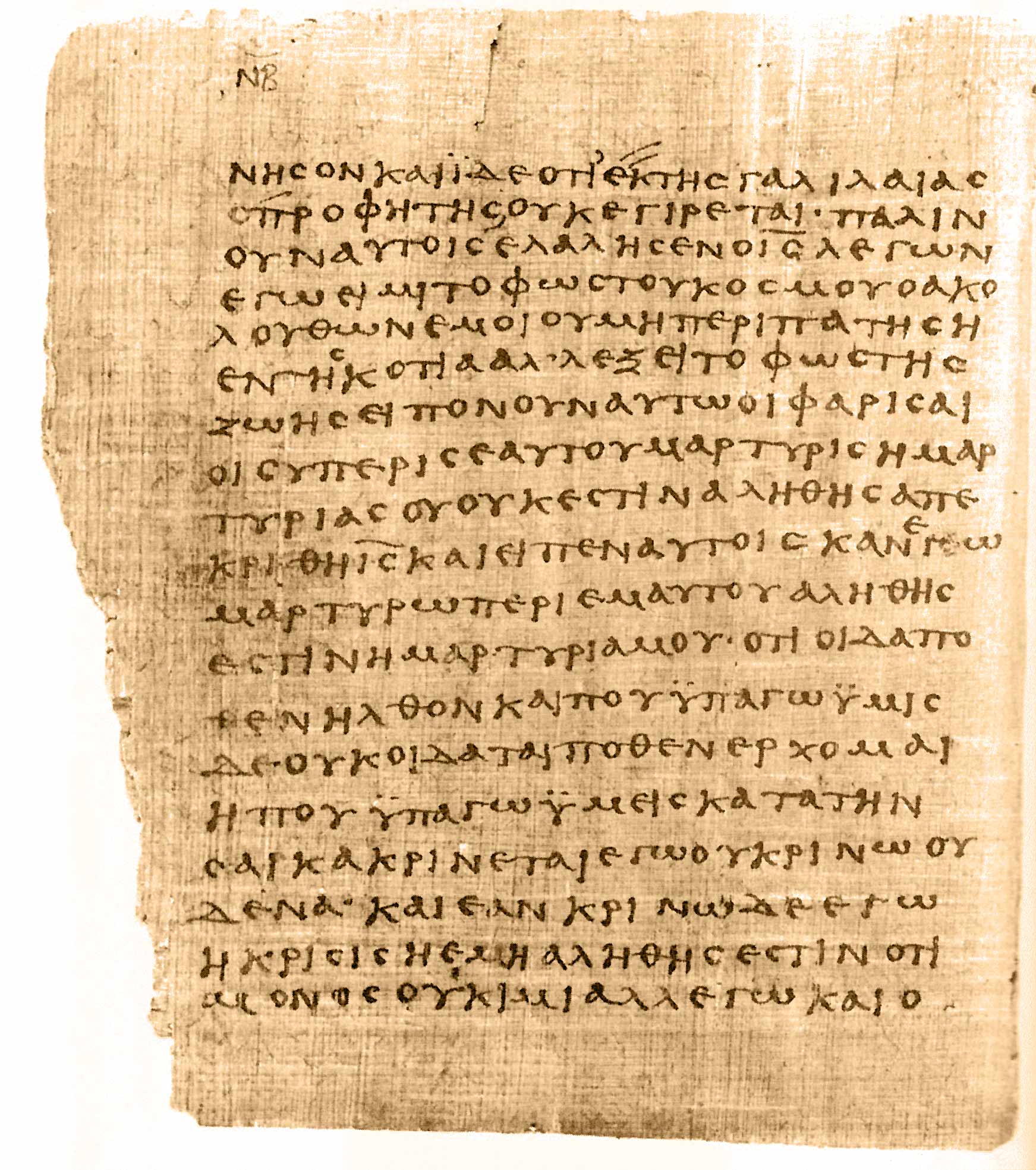
● John 7:52 – It is sometimes said that the excellence of the preservation of the New Testament text in the extant manuscripts is demonstrated by the observation that despite all of the discoveries of papyrus manuscripts in the late 1800’s and 1900’s, no reading that is supported exclusively by the papyri has been adopted in place of readings that were already extant.  However, a reading of Papyrus 66 might come closer to doing so than any other variant in the papyri. 
  
John 7:52 in Papyrus 66.
          William Bowyer
’s 1782 book Critical Conjectures and Observations on the New Testament included a theory expressed by Dr. Henry Owen about John 7:52:   “The Greek text, I apprehend, is not perfectly right:  and our English Version has carried it still farther from the true meaning.  Is it possible the Jews could say, “that out of Galilee hath arisen no prophet;” when several (no less perhaps than six) of their own prophets were natives of that country?  When they tell Nicodemus to search the Scriptures (see Cambr. MS. and Vulgate Version), they plainly meant, for the birth-place of the prophet that was to come, i.e., the Messiah; which he would find to be, not any town of Galilee, but Bethlehem in the land of Judea.  Hence then I conclude, that what they really said, and what the reading ought to be, was – ὅτι Ὁ ΠΡΟΦΗΤΗΣ ἐκ τῆς Γαλιλαίας οὐκ ΕΓΕΙΡΕΤΑΙ:  That the prophet is not to arise out of Galilee:  from whence they supposed Jesus to have sprung.”   
            The second part of Owen’s proposal was adopted by textual critics in the 1800’s, for ἐγείρεται is supported by a variety of important manuscripts (including א B D N W Δ).  The first part, though, was not vindicated until the discovery of Papyrus 66, which has the Greek equivalent of “the” before the word “prophet” – exactly what Owen, in the 1780’s, thought was the original reading. 
            (It is sometimes claimed that Papyrus 75 also supports this reading; however, the digital online image of the passage in Papyrus 75 shows that Papyrus 75 has no testimony about this one way or the other, due to thorough damage to the papyrus after the Γαλιλα of the second occurrence of Γαλιλαίας.) 
            It is possible that future editors, impressed by the cogency of Owen’s argument as well as by the early date of the manuscript with which it interlocks, may move the article into the text.        

            The Gospels are not the only part of the New Testament in which non-extant readings, and variants with very slight external support, may be embraced in the future.  God willing, in my next post, I will examine ten other passages, outside the Gospels, which have invited conjectural emendation in the past, and which may do so in the future.


_______________


Quotations from the ESV have been taken from The Holy Bible, English Standard Version. ESV® Permanent Text Edition® (2016). Copyright © 2001 by Crossway Bibles, a publishing ministry of Good News Publishers.

Quotations from the NIV have been taken from the Holy Bible, New International Version®, NIV® Copyright ©1973, 1978, 1984, 2011 by Biblica, Inc.®  Used by permission. All rights reserved worldwide.

Scripture quotations marked CSB have been taken from the Christian Standard Bible®, Copyright © 2017 by Holman Bible Publishers.  Used by permission.  Christian Standard Bible® and CSB® are federally registered trademarks of Holman Bible Publishers.

Scripture quotations marked NASB taken from the New American Standard Bible®, Copyright © 1960, 1962, 1963, 1968, 1971, 1972, 1973, 1975, 1977, 1995 by The Lockman Foundation.  Used by permission.